Article Contents:
- Psychology of First Impressions: The Staircase as the 'Face' of the House
- Detailing as a Quality Marker: The Brain Reads Effort
- Hand-Carved vs. Stamped: Emotional Response to Authenticity
- Realtor Studies: Detailing and Appraised Value
- Return on Investment in a Quality Staircase
- Symbolic Value: The Staircase as a Social Marker
- Production Technologies: From Hand Carving to CNC
- Wood Species for Balusters: From Pine to Oak
- Carving Styles: From Classic to Modern
- Frequently Asked Questions
- Conclusion: Invest in the First Impression

The front door opens. Hall of a two-story house. The gaze of a potential buyer (a married couple, budget 25 million rubles for a 200-square-meter cottage in the suburbs of Moscow, St. Petersburg, viewed 15 properties over three weeks, tired of monotony, skeptical, critical) glides over the walls, floor, ceiling, stops at the staircase. The staircase leads to the second floor, a flight of 12 steps, a landing, another 8 steps. The steps are solid oak, even, smooth, well-sanded. The railing is an oak handrail 60 millimeters in diameter, anatomical, comfortable to grip. The balusters are vertical supports connecting the steps to the handrail, 900 millimeters high. And here is the fork that determines perception, evaluation, decision.
Option A:wooden balusterssimple, rectangular cross-section 40×40 millimeters, smooth, painted with white enamel. Even, functional, minimalist, inexpensive (180-250 rubles per piece, for a 20-step staircase you need 40 balusters = 7200-10000 rubles). The buyer's gaze slides along the balusters, does not linger. The staircase is perceived as a utilitarian object connecting floors, nothing more. Neutral, boring, forgotten 10 minutes after viewing. Emotional response: 3 out of 10 (cold, practical, cheap).
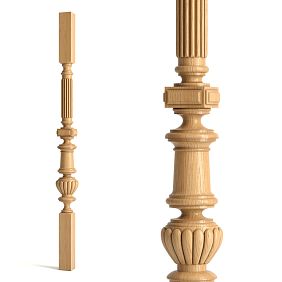
Option B:wooden balustersturned, classic profile — a cylindrical base 55 mm in diameter, transitioning to a central part with three vases (expansions) 65-70-65 mm in diameter, separated by flutes (vertical grooves), ending with a cone supporting the handrail. Natural oak, coated with oil in three layers, grain visible, color transitions emphasized. Cost of one baluster 800-1200 rubles, for 40 pieces — 32,000-48,000. The buyer's gaze stops, fixes on the rhythm of verticals (40 balusters create a visual rhythm, a metronome, pleasant for the visual cortex), on the play of light and shadow (vases cast soft shadows on the steps, creating volume, depth), on the tactile appeal of the wood (the brain predicts the sensation of a warm, smooth surface, even without touching). Emotional response: 7 out of 10 (warm, quality, beautiful).
Option C:carved balustersturned base with added hand carving (acanthus leaves on the base, grape clusters on the central vase, deep flutes with pronounced relief). Oak, oil, each baluster is unique (hand carving, the master carves each leaf individually, repeatability impossible). Cost 2500-4500 rubles per baluster, for 40 pieces — 100,000-180,000. The buyer's gaze is captivated, freezes, examines each baluster, each curl, each detail in detail. The brain activates zones responsible for recognizing complexity, craftsmanship, handcrafted nature (prefrontal cortex evaluates the effort expended in creation, limbic system releases dopamine from perceiving beauty). The hand involuntarily reaches out to touch the carving (tactile impulse is 40% stronger than with a smooth baluster). Emotional response: 9 out of 10 (delight, admiration, desire to own).
Realtors know: houses with option C (carved balusters) sell for 10-15% more than houses with option A (simple balusters) with identical area, layout, finishing, location. A 200 sq.m. house costing 20,000,000 with simple balusters sells for 20,000,000. The same house with carved balusters — for 22,000,000-23,000,000. Difference 2,000,000-3,000,000 with costs for carved balusters (material + labor) about 200,000-300,000 rubles. 10-fold return on investment. Why?




Psychology of First Impressions: The Staircase as the "Face" of the House
The first 7-10 seconds of viewing a property form 80% of the final impression. This is a neurophysiological fact: the brain in rapid assessment mode (System 1 according to Kahneman — intuitive, emotional, instantaneous) scans the space, looking for visual markers of quality, status, value. Markers: expensive materials (marble, wood, metal), complex processing (carving, inlay, patination), detailing (many small elements, meticulously executed), symmetry and order (signs of professional design). The staircase in the hall is the first large object entering the field of vision after entry. It dominates spatially (height 4-5 meters from floor to second floor, occupies 8-12 square meters of hall area), visually (vertical structure attracts the gaze, forces looking up, feeling ceiling height), functionally (the staircase is the path upstairs, to the private zone, a symbol of spatial hierarchy).
A simple staircase with straight balusters is perceived as a utilitarian structure performing a function (connecting floors), nothing more. The brain registers: 'staircase present, functional, safe (railing in place, steps even), aesthetically neutral'. Emotion: calm, but not delight. House assessment: 'normal object, corresponds to price'.Wooden staircasesStaircases with turned balusters are perceived as a quality structure executed with attention to detail. The brain registers: 'staircase beautiful, balusters processed (turned profiles require a lathe, time, skill), wood natural (grain visible, tactility attractive)'. Emotion: satisfaction, pleasant impression. House assessment: 'good object, slightly above average'.
A staircase with carved balusters is perceived as a work of art, a central accent of the interior, a demonstration of taste, status, owner's resources. The brain registers: 'staircase unique, balusters carved (handwork, each detail individual, requires a master carver, hours of labor), complexity high (acanthus leaves, grape clusters — classic motifs associated with palaces, estates, aristocracy)'. Emotion: admiration, delight, desire to possess. House assessment: 'exclusive object, premium segment, worth more'.
Neuromarketing research (scanning the brains of potential real estate buyers using fMRI when viewing interior photographs) shows: images of staircases with carved balusters activate the medial prefrontal cortex (area associated with evaluating object value, desirability) 40% more intensely than images of staircases with simple balusters. Activation correlates with willingness to pay: the stronger the activation, the higher the price the buyer is willing to offer. Carved balusters literally 'light up' desire zones in the brain, creating an emotional attachment that the rational mind justifies post-factum ('a house with such a staircase is worth more because the quality is higher').




Detailing as a Quality Marker: The Brain Reads Effort
The human brain is evolutionarily tuned to assess an object's quality by the amount of effort expended in its creation. A simple object (straight baluster, sawn from a block, sanded, painted) — minimal effort, low value. A complex object (carved baluster, turned on a lathe, carved by hand by a master, sanded, coated with oil in three layers with intermediate sanding) — high effort, high value. This is an intuitive assessment, happening instantly, without conscious analysis.
Carving is visible evidence of effort. Each acanthus leaf on the base of a baluster is carved by hand with a chisel, requires 30-60 minutes of work by a master possessing a skill developed over years of training. The brain seeing the carving subconsciously reconstructs the creation process: the master sits over the baluster, holds the chisel, removes thin shavings, forms the leaf, vein, curve. This is labor-intensive, slow, requires concentration, mastery. Therefore, expensive. Therefore, valuable. This logical chain is not consciously articulated but works on an intuitive level, forming the assessment.
Contrast with mass production: a baluster manufactured on a CNC machine (milling, lathe with computer numerical control) is identical to thousands of other balusters produced by the same program. The computer sets the cutter trajectory, the machine cuts the profile automatically, a person only loads the blank, unloads the finished product. Manufacturing time — 10-15 minutes, human effort minimal. The baluster is technically quality (accuracy high, repeatability perfect), but emotionally cold. The brain reads: 'made by machine, mass-produced, cheap'. Even if the baluster is complex in shape (turned profile with vases, flutes), it remains a product of industry, not craftsmanship.
A carved baluster is the opposite. Even if the base is turned on a machine (cylinder, vases—machine processing speeds up the process, reduces cost), the final carving is done by hand. The master holds the chisel, carving leaves, scrolls, veins individually on each baluster. Repetition is incomplete: each baluster differs in nuances (carving depth, leaf curvature, element position) by 2-5%, imperceptible consciously but subconsciously registered. The brain notes: 'made by a human, unique, expensive.' Emotional value increases manifold.
The 'scrutiny effect': a simple baluster is looked at for 2-3 seconds (the gaze slides, nothing interesting), a turned one—5-10 seconds (the gaze fixes on the profile, vases, curves, then moves on), a carved one—20-40 seconds (the gaze stops, examines each carving element, leaves, clusters, flutes in detail, the brain actively processes information, generates positive emotions). The longer a person looks at an object, the stronger the emotional attachment (the 'mere-exposure effect'—the more often and longer we see an object, the more we like it). A carved baluster 'forces' longer viewing, creating attachment, increasing the perceived value of the house.
Our factory also produces:


Handmade carving vs. stamping: emotional response to authenticity
Authenticity is a key concept in modern consumption. Mass production has flooded the market with identical objects, cheap, accessible, but devoid of soul, individuality, history. Consumers, especially in the premium segment (buyers of houses costing 20+ million—people with means, education, taste), value authenticity, uniqueness, handcraftsmanship. They are willing to pay a premium for objects created by a master, not a machine.
A carved baluster is an authentic object. The master carver takes a blank (a cylindrical baluster turned on a machine), marks the contours of the future carving with a pencil (acanthus leaves on the base—three leaves, arranged symmetrically, each leaf 80 mm high, 40 mm wide), begins carving. The chisel (gouge, bent gouge, V-tool—a set of 10-15 tools for different carving types) removes wood in thin layers, forming a leaf, vein, curve. The work requires concentration (one wrong move—the leaf is ruined, the baluster has to be redone), strength (oak is hard, the chisel must be pressed, angle and depth controlled), time (one leaf—20-30 minutes, three leaves on the base—1.5 hours, plus grape clusters on the central vase—another 1 hour, total 2.5-3 hours per baluster). The master carver's labor cost is 1000-1500 rubles per hour, per baluster—3000-4500 rubles labor only, plus material (oak blank) 500-800 rubles, total 3500-5300 rubles.
Stamped carving—an imitation. The baluster is cut on a CNC machine with a 5-axis milling cutter capable of reproducing complex three-dimensional forms. The program is created once (a 3D model of the baluster with carved elements is loaded into the computer), then the machine stamps copies automatically. Manufacturing time—30-40 minutes, cost—800-1200 rubles (material + machine depreciation + electricity). The baluster is identical to the 3D model with ±0.1 mm accuracy, 100% repeatability, each baluster is absolutely identical.
Visually, an untrained observer will not immediately distinguish hand carving from CNC. Both balusters have acanthus leaves, grape clusters, flutes. But detailed examination reveals the difference. Hand carving: leaves are slightly asymmetrical (the master carves by eye, absolute symmetry is impossible, but asymmetry is natural, alive), carving depth varies (deeper in some places, shallower in others, depends on the master's effort, wood grain), tool marks are visible (at the bottom of veins, microscopic scratches from the chisel—authenticity). CNC carving: leaves are absolutely symmetrical (the computer sets coordinates with tenth-of-a-millimeter accuracy), carving depth is perfectly uniform (the cutter moves according to the program, without variations), tool marks are homogeneous (the cutter rotates at constant speed, leaves even spiral marks).
Paradox: the technical perfection of CNC carving is emotionally colder than the imperfection of hand carving. The brain reads absolute symmetry, perfect uniformity as a sign of machine work, mass production, cheapness (even if the baluster is expensive, emotional assessment—'stamped'). Slight asymmetry, depth variability, chisel marks are read as signs of handwork, uniqueness, expensiveness. This is irrational (CNC carving is technically superior), but emotionally real.
Tactile difference: hand carving feels warm to the touch (the master sands the carving by hand with P180-P220 sandpaper, smoothing sharp edges but preserving relief, wood texture), CNC carving feels colder (after milling, sharp edges remain, additional sanding is required, often skipped to save time, the carving remains slightly rough, unpleasant to the touch). A house visitor involuntarily runs a hand over the balusters while ascending the stairs (tactile impulse is strong—wood attracts touch). Hand carving: the hand slides pleasantly, warm, soft (emotion: pleasure, desire to touch more). CNC carving: the hand catches on sharp edges, feels cold, hardness (emotion: discomfort, disappointment).
Get Consultation
Realtor studies: detailing and appraisal value
A study by the Russian Association of Realtors (2023-2024, sample of 500 houses in Moscow Oblast costing 15-40 million rubles) showed a correlation between interior detailing and sale price. Houses were divided into three categories by finish quality: basic (simple materials, minimal processing—painted walls, laminate, plastic baseboards, simple balusters on the staircase), medium (quality materials, standard processing—wallpaper, parquet, wooden baseboards, turned balusters), premium (expensive materials, complex processing—decorative plasters, solid plank flooring, wide wooden baseboards, carved balusters).
Result: houses in the premium category sold on average 12-18% higher than houses in the medium category with identical area, layout, plot. A 200 sq.m house of medium category—average sale price 20,000,000 rubles. A 200 sq.m house of premium category—22,400,000-23,600,000. Difference 2,400,000-3,600,000. Costs for premium finishing (including carved balusters, wide baseboards, decorative plasters)—about 1,500,000-2,000,000 rubles additional to the medium category. Payback: invested 1,500,000-2,000,000, received 2,400,000-3,600,000, net profit 900,000-1,600,000 rubles.
Key factor: the staircase with carved balusters was mentioned by buyers as a critical element influencing the decision. Quote from a buyer interview: 'When I saw the staircase with carved balusters, I understood—this house was built with soul, with attention to detail. The other houses we viewed were functional but faceless. Here, craftsmanship, taste, quality were felt. I was willing to pay more.' Emotional assessment prevailed over rational: the buyer did not calculate the cost per square meter, did not analyze payback, simply wanted to own a house with such a staircase.
Realtors use this knowledge: when preparing a house for sale, they recommend owners invest in detailing visible central elements—staircases, fireplace, built-in furniture in the living room.Posts for staircasecarved massive newel posts 1200-1500 mm high with carved capitals (tops), carved balusters, handrails with milled profiles—a set costing 200,000-400,000 rubles increases the house sale price by 1,500,000-3,000,000. ROI (return on investment) 500-1000%—a rarity in construction, where most investments pay back 100-150%.
Psychological mechanism: carved balusters create a 'halo effect'—when one bright positive characteristic of an object (a beautiful carved staircase) spreads to the assessment of the entire object (the whole house is perceived as quality, expensive, desirable). The buyer sees carved balusters, concludes: 'if there are such balusters here, then quality is high everywhere.' Even if the rest of the finish is medium, the halo effect raises the overall assessment. Opposite effect: simple cheap balusters create a negative halo—'if they saved on balusters here, then they saved everywhere, quality is questionable.'
Return on investment in a quality staircase
Costs for a staircase with carved elements: steps solid oak 40 mm thick—8000-12000 rubles each, for 20 steps = 160,000-240,000. Risers (vertical planks between steps) solid oak 20 mm—3000-5000 each, 20 pieces = 60,000-100,000. Stringers (load-bearing beams on which steps rest) solid oak cross-section 80×300 mm—15,000-25,000 per linear meter, for a 6-meter staircase = 90,000-150,000.wooden balusterscarved balusters—3000-5000 each, 40 pieces = 120,000-200,000.Posts for staircasecarved newel posts—25,000-50,000 each, 4 pieces (start, turn, end, intermediate) = 100,000-200,000. Oak milled handrail—4000-8000 per linear meter, 10 meters = 40,000-80,000. Installation by a master carpenter—150,000-250,000 (the staircase is complex, requires precise fitting, fastening, sanding, varnishing on-site, takes 10-15 days of work). Total materials + labor: 720,000-1,200,000 rubles for a premium-class staircase with carved balusters and newel posts.
Alternative—a staircase with standard turned balusters: same steps, risers, stringers (cannot save on these, they are structural, safety), turned balusters—800-1200 each, 40 pieces = 32,000-48,000 (saving 80,000-150,000 compared to carved), turned newel posts—8000-15000 each, 4 pieces = 32,000-60,000 (saving 70,000-140,000), simple cylindrical handrail—2500-4000 per meter, 10 meters = 25,000-40,000 (saving 15,000-40,000). Installation simpler—100,000-150,000 (saving 50,000-100,000). Total: 469,000-738,000 rubles. Savings compared to a carved staircase: 250,000-460,000 rubles.
Payback through increased house value: a house with a carved staircase sells for 2,000,000-3,000,000 more than a house with a standard staircase. An additional investment of 250,000-460,000 in carved elements yields 2,000,000-3,000,000 profit upon sale. ROI = (2,500,000 / 350,000) × 100% ≈ 700%. Pays back 7-fold. Even considering that not all 2,500,000 profit is due solely to the staircase (part due to other premium finish elements), the staircase's share as a central visible object—at least 30-50%, meaning 750,000-1,250,000 profit is attributable to the staircase. ROI still 200-350%—an excellent result.
Alternative benefit: speed of sale. Houses with premium details (carved staircase, fireplace with carved mantel, built-in library with carved pilasters) sell faster—on average 45-60 days from listing versus 90-120 days for medium-category houses. Fast sale is critical for owners moving to another city, country, urgently needing money (divorce, business problems, purchase of other real estate). Time savings—2-3 months—often more important than a few percent of price.
Emotional benefit for the owner: living in a house with a beautiful carved staircase is more pleasant than with a simple one. The staircase is used daily dozens of times (ascent, descent), each time the gaze slides over the balusters, the brain receives a microdose of pleasure from perceiving beauty. Over 10 years of living, this is thousands of microdoses, summing into a significant increase in quality of life, satisfaction with the home, pride of ownership. This is not measured in money, but is real for a person.
Symbolic value: the staircase as a social marker
A house is not only a functional living space but also a social symbol, demonstrating the owner's status, taste, resources. Guests coming to the house (friends, relatives, colleagues, business partners) assess the owner through the interior. A carved staircase in the foyer—an instant marker: 'the owner values quality, craftsmanship, is willing to invest in details, has taste, education (knows classical carving motifs—acanthus, grape, flutes—this is a cultural code understood by educated people).'
Psychology of wealth perception: true wealth is demonstrated not by quantity (big house, expensive car—accessible via credit), but by the quality of details visible only upon close examination. Carved balusters are such a detail. A cursory glance notes: 'wooden staircase, beautiful.' A careful glance (guest approaches, examines balusters) notes: 'carved balusters, handwork, each unique, expensive, the owner did not economize.' This is a signal: 'I am wealthy enough to spend 200,000 rubles on balusters that most won't even notice in detail.' Demonstrative luxury for the knowing—stronger than mass luxury for all.
The 'conversation effect': the carved staircase becomes a topic of conversation. Guest: 'What a beautiful staircase! Are the balusters carved?' Owner: 'Yes, ordered from masters in St. Petersburg, took three months, each baluster carved by hand.' Guest: 'Amazing, I haven't seen such details in modern houses.' The owner feels pride, satisfaction from recognition of taste, status. The guest leaves with the impression: 'serious house, owner is substantial, tasteful.' This social function of the staircase—creating reputation, strengthening status—is impossible with simple balusters that do not provoke questions, admiration, conversations.
Historical context: in 19th-century estates, 18th-century palaces, medieval castles, grand staircases were always carved, richly decorated. The staircase—the first thing a guest saw entering the house—set the tone, demonstrated the owner's power, taste, culture. A simple utilitarian staircase—a sign of poverty, haste, lack of resources. ModernWooden staircasesstaircases with carved balusters continue this tradition, adapting it to modern interiors, styles, technologies, but preserving the symbolic meaning: 'a staircase with carving—a sign of quality, status, attention to traditions.'
Production Technologies: From Hand Carving to CNC
Hand carving of balusters is a traditional method used for centuries. A master carver trains for 3-5 years (starting with simple forms - geometric patterns, gradually moving to complex ones - acanthus leaves, animal and human figures), acquiring skill, a feel for wood, and the ability to see the hidden form in the blank. Tools: a set of chisels (flat, semicircular, angled, bent gouges - 15-20 pieces of different sizes and profiles), a mallet (wooden hammer for striking the chisel when the wood is hard), abrasives (sandpaper P80-P220 for sanding the carving after cutting). Process: the master takes a blank (a cylindrical baluster turned on a lathe, 60-70 mm in diameter, 900 mm long), marks the carving contours with a pencil (a sketch is drawn on paper beforehand, transferred to the wood), begins cutting with a chisel, removing wood layer by layer, forming a leaf, vein, flower, cluster. A mistake is irreversible: an incorrect movement - the cutter went too deep, chipped off a piece of wood - the baluster is ruined, one has to start over or adjust the design.
Advantages of hand carving: uniqueness (each baluster is individual, impossible to replicate exactly), flexibility (the master can change the design on the fly, adapt to the wood texture, customer's wishes), emotional value (the buyer knows - this baluster was carved by a person, who invested effort, skill, time). Disadvantages: high cost (master's work 1000-1500 rub/hour, one baluster takes 2.5-3 hours = 3000-4500 rubles for labor only), long timeframe (for 40 balusters the master works 100-120 hours = 12-15 days of continuous work, realistically one to two months considering other orders), risk of defects (the master is human, can make mistakes, get tired, 5-10% of balusters come out defective, require rework).
CNC turning is a modern method that emerged in the 1990s-2000s with the spread of computerized machines. A CNC (Computer Numerical Control) lathe has a rotating spindle holding the workpiece (a wooden block of square cross-section 70x70 mm, 900 mm long), and a movable cutter (carbide, tungsten), moving along a programmed trajectory, cutting the profile. The program is created by a designer on a computer: a 3D model of the baluster (a cylinder with vases, flutes, curves) is loaded into CAM (Computer-Aided Manufacturing) software, the software calculates the cutter path, the machine cuts automatically. Manufacturing time - 10-15 minutes, accuracy ±0.1 mm, repeatability 100% (each baluster is identical to the first).
Advantages of CNC: low cost (machine depreciation + material + electricity = 500-800 rubles per baluster vs. 3000-4500 for hand carving), speed (40 balusters - 10-12 hours of machine work vs. a month for hand carving), precision (profile is perfect, symmetry absolute, defects excluded). Disadvantages: lack of uniqueness (all balusters are identical, stamped), limited complexity (CNC machines cut along axes, complex undercuts, deep reliefs, figured elements are inaccessible without a 5-axis machine, which is expensive), emotional coldness (the buyer knows - made by a machine, mass-produced, does not evoke delight).
Hybrid method - optimum for premium projects: the base of the baluster (cylinder, vases, flutes) is cut on a CNC machine (fast, cheap, precise), the final carving (acanthus leaves, grape clusters, complex reliefs) is done by hand by a master carver (unique, emotionally valuable, expensive). Final cost: CNC blank 500-800 + hand carving 1500-2500 = 2000-3300 rubles per baluster. Cheaper than fully hand-carved (3500-5000), more expensive than fully CNC (500-800), but combines advantages: precision of the base + uniqueness of the carving + acceptable price + realistic manufacturing timeframe (40 balusters - 5-7 days CNC + 10-15 days hand carving = 3 weeks instead of 2 months).
Wood Species for Balusters: From Pine to Oak
Pine - an affordable species, popular for budget projects. Density 500 kg/m³ (soft), color yellowish-white, texture inexpressive (annual rings have low contrast). A turned pine baluster - 300-500 rubles, carved - 1500-2500. Advantages: low price, ease of processing (soft wood cuts easily, quickly, a master carves on pine 1.5 times faster than on oak). Disadvantages: low strength (baluster is soft, scratches, dents from impacts, lasts 10-15 years), resinousness (pine exudes resin, especially when heated, stains hands, clothes), yellowing (pine yellows under ultraviolet light after 2-3 years, loses its fresh look). Pine balusters are optimal for country houses, temporary housing, projects with a strict budget, where price is important, and durability and prestige are not critical.
Beech - mid-range segment. Density 650 kg/m³ (hard), color light pink, texture uniform (fine pores, almost no visible grain). A turned beech baluster - 700-1000 rubles, carved - 2500-3500. Advantages: strength (harder than pine, scratches less, lasts 20-30 years), uniformity (texture is uniform, stains evenly with stains, enamels, convenient for modern interiors where a clean color without grain is needed). Disadvantages: hygroscopicity (beech absorbs moisture, swells with humidity fluctuations of 40-70%, requires a stable microclimate, protective varnish finish), lower prestige (beech is cheaper than oak, perceived as a budget alternative, not premium).
Ash - close to oak. Density 700 kg/m³, color white-yellow, texture contrasting (dark annual rings on a light background). A turned ash baluster - 900-1300 rubles, carved - 3000-4500. Advantages: strength (almost like oak, withstands loads, impacts, lasts 30-40 years), beauty (contrasting texture is effective, especially under oil that highlights the play of colors), elasticity (ash is more flexible than oak, withstands vibrations, impacts better). Disadvantages: lower prestige (ash is 20-30% cheaper than oak, perceived as an alternative, not a classic).
Oak - premium species, classic. Density 750 kg/m³ (the hardest of those listed), color light brown to dark brown (depends on treatment - natural, stained, tinted), texture expressive (large pores, medullary rays, color play). A turned oak baluster - 1200-1800 rubles, carved - 3500-5500. Advantages: maximum strength (withstands loads, impacts, scratches minimal, lasts 50+ years), prestige (oak is a symbol of solidity, status, tradition, associated with palaces, estates, elite interiors), moisture resistance (contains tannins - tannic substances that protect against rot, mold). Disadvantages: high price (3-5 times more expensive than pine, 1.5-2 times more expensive than beech), processing difficulty (hard wood cuts with difficulty, the master tires faster, carving takes more time, tools dull faster).wooden balustersOak balusters are the choice for premium projects, classic interiors, houses built to last centuries, where durability, prestige, and status are important.
Carving Styles: From Classic to Modern
Classical carving - acanthus leaves, grape clusters, laurel wreaths, Corinthian capitals, Ionic volutes. Acanthus - a plant with carved leaves, a symbol of Ancient Greece, Rome, used in Corinthian order capitals, friezes, cornices. An acanthus leaf on a baluster is a classic motif, recognizable, associated with antiquity, European culture, education. Grape - a symbol of abundance, fertility, joy, popular in Baroque, Renaissance, Classicism. A grape cluster with leaves on the central vase of a baluster is a luxurious element, creating a sense of wealth, festivity.
Geometric carving - flutes (vertical grooves), diamonds, squares, triangles, spirals. Flutes - the most common geometric element on balusters, create vertical rhythm, emphasize height, slenderness. Used in Doric, Ionic, Corinthian orders, adapted into classical, neoclassical interiors. Geometric carving is simpler than plant carving (less time, cheaper), but more elegant than simple turned profiles.
Baroque carving - excessive, dynamic, dramatic. Leaves are large, curved, voluminous, intertwine, creating dense relief. Flowers - roses, lilies, tulips - lush, open. Figurines - cherubs, angels, masks - are integrated into the composition. A Baroque carved baluster is a work of art, a sculpture, visually dominant, attracting the eye, astounding in complexity. Cost 5000-8000 rubles per baluster (work of 4-6 hours by a highly qualified master). Baroque carving is optimal for palace interiors, where excess is the norm, where every element should amaze, overwhelm, demonstrate power.
Modernist carving - stylized, simplified, graphic. Motifs are natural (leaves, flowers, waves), but not realistic, rather abstract, geometric. Lines are smooth, curved, flowing (characteristic of Art Nouveau, Modernism of the early 20th century). Relief is shallow (5-10 mm vs. 15-25 mm in classic), delicate, suggestive, not loud. A Modernist carved baluster is elegant, refined, suitable for contemporary interiors where classical carving is too heavy, and simple turned balusters are too boring.
Style choice depends on the interior of the house. A classical interior (columns, moldings, stucco) requires classical carving (acanthus, grape). A Baroque interior (gilding, mirrors, crystal chandeliers) requires Baroque carving (lush flowers, figurines). A contemporary interior (minimalism, clean lines, neutral colors) requires Modernist or geometric carving (stylized leaves, flutes). A mismatch between carving style and interior style creates dissonance, spoils the impression, reduces value.
Frequently asked questions
Do carved balusters really increase a home's value by 12%?
Yes, realtor studies show: homes with premium interior detailing (including carved balusters, wide baseboards, decorative plasters) sell for 10-18% more than mid-category homes with identical area and layout. The staircase as a central visible element of the hall contributes significantly to this premium. An investment of 200,000-400,000 rubles in carved balusters, newel posts pays off with an increase in selling price of 1,500,000-3,000,000 rubles.
How to distinguish hand carving from CNC?
Hand carving: elements are slightly asymmetrical (leaves of different sizes, placement), carving depth varies, tool marks are visible (scratches at the bottom of veins), each baluster is unique. CNC carving: elements are absolutely symmetrical, depth is uniform, cutter marks are homogeneous (spiral), all balusters are identical. Tactilely: hand carving is warmer, softer (hand-sanded), CNC is colder, sharp edges may remain.
Which wood species is best for balusters?
For premium, durable projects - oak (strength, prestige, durability 50+ years, cost 3500-5500 rub per carved baluster). For price-quality balance - beech (strength, uniformity, 20-30 years, 2500-3500 rub). For budget projects - pine (low price, ease of processing, 10-15 years, 1500-2500 rub). For contemporary light interiors - ash (contrasting texture, strength, 30-40 years, 3000-4500 rub).
How long does it take to manufacture carved balusters?
Fully hand carving: 2.5-3 hours per baluster, for 40 pieces - 100-120 hours = 12-15 days of continuous work by a master, realistically 1-2 months considering other orders. Hybrid method (CNC blank + hand carving): 5-7 days CNC + 10-15 days hand carving = 3 weeks. Fully CNC (without hand carving, only turned profiles): 10-15 minutes per baluster, 40 pieces - 10-12 hours = 2 days.
How to care for carved balusters?
Wipe with a dry microfiber cloth once a week (dust clogs the carving relief, spoils the appearance). Once a month, clean deep recesses of the carving with a soft brush (toothbrush, paintbrush) where a cloth can't reach. Once a year, refresh the finish: for oiled balusters, wipe with oil (1 layer with a soft cloth); for varnished ones, polish with polish. Avoid excessive moisture (do not wash with a wet cloth, wood absorbs water, swells), direct sunlight (ultraviolet fades wood, especially light species).
Is it possible to install carved balusters yourself?
Technically possible with the right tools (miter saw for cutting angles, drill for drilling holes for dowels, screwdriver, level, tape measure), carpentry skills, and understanding of staircase construction. But it is recommended to entrust it to a professional: balusters are expensive (3500-5500 rubles per piece), an installation error (wrong angle, gap, misalignment) will spoil the appearance, reduce value. Installation by a master costs 500-1000 rubles per baluster (for 40 pieces - 20,000-40,000), but guarantees quality, absence of defects, warranty.
Conclusion: Invest in the First Impression
wooden balusters— not utilitarian supports holding a stair railing, but architectural accents that create the first impression, shape the assessment, and influence the decision to buy a house. Simple balusters perform a function, carved ones create emotion, desire, attachment. This is neuromarketing in action: carving activates brain areas responsible for perceiving beauty, assessing quality, the desire to possess, increasing willingness to pay by 10-18%, paying back costs 7-10 times over.
Continuing the article from the break point:
Available in various cross-sections: from thin 20×10 mm to thick 100×40 mm, from different species (pine, beech, ash, oak), different processing (planed, machine-sanded, hand-sanded), different lengths (standard 2.5 meters, custom up to 3 meters).wooden balustersturned andcarved balustersfor solid oak, beech, ash staircases since 2002. Own production in Saint Petersburg includes a CNC lathe workshop (8 machines, capacity 200-300 balusters per day, profile accuracy ±0.1 mm), a carpentry workshop with master carvers (12 specialists, average experience 8-15 years, each performs hand carving on 2-4 balusters per day), a finishing section (chamber drying of wood to 8-10% moisture content, sanding, coating with oil or varnish in 3-4 layers). The range includes over 80 baluster profiles — from simple turned cylindrical ones with a diameter of 40-50 mm (minimalism, Scandinavian style, price 400-600 rub/pc) to classic turned ones with three vases, 900 mm high (classic, neoclassical, 800-1200 rub/pc), to premium carved ones with acanthus leaves, grape clusters, fluting (Baroque, Empire, classic estates, 3500-5500 rub/pc).
Each model is available in several finishing options: natural oak under oil (emphasizes texture, light brown color with iridescence, matte surface, warm to the touch), stained oak (stain treatment creates dark brown, almost black color, contrasting, noble texture), tinted oak (walnut, wenge, mahogany shades — to match the interior color scheme), bleached oak (white or gray patina creates an aged wood effect, popular in Provencal, Scandinavian interiors), enamel (white, black, gray — conceals texture, creates a uniform color for modern styles). Coating with Osmo, Biofa oil (Germany, eco-friendly, without toxic solvents, safe for children, pets) or Renner polyurethane varnish (Italy, wear-resistant, moisture-resistant, glossy or semi-matte finish).
Custom design: if the standard range is not suitable (non-standard baluster height 700-1100 mm instead of the standard 900, special profile, unique carving motif — family crest, initials, stylized plants), STAVROS designers develop a sketch based on the customer's technical specifications (send photos of the interior, sketches of the desired design, example references), create a 3D model of the baluster, coordinate with the customer, and launch production. Minimum order for a custom project — 20 balusters (covers a staircase of 10-12 steps), production time 3-5 weeks (design 1 week, production 2-4 weeks depending on complexity), cost is calculated individually (complexity of carving, wood species, order volume).
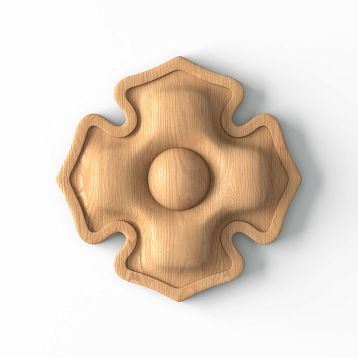
Complete staircase components: besides balusters, STAVROS producesPosts for staircasecarved support posts 1200-1500 mm high (installed at the beginning, end of a flight, on landing turns, topped with carved capitals with acanthus leaves, balls, pyramids, price 25,000-50,000 rub/pc), milled oak, beech handrails with a cross-section of 60×40 mm, 70×50 mm (anatomical, comfortable to grip, with a bottom groove for attaching balusters, price 4000-8000 rub/meter), bottom rails (horizontal planks connecting balusters from below, providing additional rigidity, decorativeness, price 2500-4000 rub/meter), carved rosettes (decorative overlays with a diameter of 100-200 mm, installed on the wall under posts, handrails, price 3000-8000 rub/pc).
Technical consultation is free: call 8 (800) 555-46-75 (toll-free in Russia), send photos of the staircase, dimensions (step height, flight width, number of steps), budget, interior style — receive recommendations on the optimal baluster profile (matching the style, staircase proportions), wood species (oak for premium, beech for balance, ash for light interiors), type of carving (classic, geometric, Baroque, modernist), finish (oil, varnish, tinting, enamel). Calculation of required quantity: 2 balusters are installed per step (on the edges), for a 15-step staircase — 30 balusters, plus 4 support posts (beginning, turn, intermediate, end), plus handrail (length calculated by the formula: flight length + rise height, for a 15-step staircase with a height of 18 cm, depth of 28 cm = 10 meters of handrail).
Delivery: Saint Petersburg with own transport 1-3 days (cost 2000-4000 rubles depending on distance, volume, a set of 40 balusters + 4 posts fits in a Gazelle, weighs 150-200 kg), Moscow via partner logistics 4-7 days (4000-7000 rubles), regions via transport companies 10-21 days (cost calculated according to carrier tariffs, approximately 3000-8000 rubles for a set weighing 150-250 kg). Packaging: each baluster is wrapped in packaging film (protection from scratches, moisture), placed in a wooden crate or cardboard box with soft padding (prevents damage to carving during transport), posts are packed individually (tall fragile elements require rigid protection).
Installation: STAVROS recommends verified carpenter masters in Saint Petersburg, Moscow, major cities of Russia (list provided upon order). Cost of installing a staircase with carved balusters: 500-1000 rubles per baluster (installation, fastening with dowels or screws, checking verticality, rigidity) + 3000-5000 per support post (heavy element, requires reinforced fastening to the stringer, floor) + 1000-2000 rub/meter for handrail (fitting, joining, sanding joints, fastening to balusters, posts). For a 15-step staircase (30 balusters + 4 posts + 10 meters of handrail) — installation 15,000-30,000 + 12,000-20,000 + 10,000-20,000 = 37,000-70,000 rubles, takes 3-5 days of work by a team of 2 masters. Installation warranty 2 years (absence of squeaks, loosening, fastening defects under proper operating conditions).
Product warranty 3 years: absence of material defects (cracking, warping of wood), processing defects (coating peeling, carving chips, not caused by mechanical damage), construction defects (non-compliance with dimensions, profile). Warranty conditions: operation at temperature +18-25°C, humidity 40-60% (stable microclimate of a heated house), absence of direct contact with water (do not wash balusters with a wet cloth, avoid leaks), mechanical damage (impacts, scratches from sharp objects). If a warranty defect is identified — free replacement of the defective baluster with a new one, delivery at STAVROS's expense.
Loyalty program for designers, architects, construction companies: 10-15% discount on staircase components (balusters, posts, handrails) for orders from 100,000 rubles, 15-20% discount for orders from 300,000, individual terms for regular partners (payment deferral, priority production, personal manager). Designers receive a 5-10% commission from the order value brought to STAVROS by a client (the client contacts, specifies the referring designer, the designer receives remuneration after the client pays the order).
CreateWooden staircases, which not only connect floors but also create the first impression, shape emotions, increaseproperty valueby 10-18%, pay back many times over when selling, bring pleasure to owners for decades. Invest in details — carved balusters, massive posts, milled handrails — they work quietly, invisibly to calculations, but powerfully for perception, emotions, decisions. Staircase neuromarketing is not manipulation, but using the brain's natural mechanisms that assess quality through complexity, effort, craftsmanship. A carved baluster tells the buyer's brain: "they didn't skimp here, they invested here, they created beauty here, this house is worth more." And the brain believes it, because it's true.