Article Contents:
- Why baseboard height depends on door casing
- Baseboard profile: how it affects alignment with door casing
- Miter cuts: internal and external, miter saw and panel saw
- Joints without gaps: technology of precise end-matching
- Baseboard alignment with door casing: three methods
- Baseboard finishing: before or after installation, what to paint, how to avoid runs
- Baseboard mounting: self-tapping screws, glue, nails, finishing screws
- Common mistakes when installing baseboard
- Baseboard selection by interior style
- FAQ: answers to popular questions about wooden baseboard
- Conclusion: STAVROS company — baseboard that fits seamlessly without gaps

Baseboard seems like a detail that is thought about last. Walls are painted, floor is laid, doors are installed — and then people remember about baseboard. They go to the store, choose by color, buy, install. And suddenly it turns out: baseboard is wider than casing, sticks out, looks messy. Or vice versa — casing overhangs the baseboard, creating a step where dust accumulates. Corners are mitered incorrectly, joints diverge, gaps appear between boards. Painting is uneven, tone transitions are visible. All this is the result of choosing and installing baseboard without understanding how it aligns with door casings, how to properly make miter cuts, how to achieve joints without gaps.and paint it to the desired shade — standard practice in modern design. It is important to use special wood finishes that allow the material to breathe.It's not just about aesthetics, but about a system where each parameter — height, thickness, profile — is linked to other interior elements.

Why baseboard height depends on door casing
Door casing is a vertical strip framing the door opening, closing the gap between the frame and the wall. Baseboard is a horizontal strip framing the wall perimeter, closing the gap between the floor and the wall. These two elements meet at the point where the door touches the floor. At this point, they must align beautifully, logically, without visual conflict. If baseboard height is random, if it doesn't correspond to casing width, imbalance occurs, which is visually jarring.
The classic rule: baseboard height should be approximately equal to casing width, plus or minus 10-15%. If casing is 70 mm wide, baseboard should be 60-80 mm high. If casing is 90 mm wide, baseboard should be 80-100 mm. This creates visual harmony when horizontal and vertical lines are balanced, not competing for attention. A narrow baseboard under a wide casing looks short, insufficient. A tall baseboard under a narrow casing looks crude, disproportionate.
But height is only one variable. Baseboard thickness relative to casing thickness is critically important for alignment. Standard casing has thickness 10-12 mm (budget doors) or 16-18 mm (quality doors). Baseboard is usually 16-20 mm thick. If baseboard is thicker than casing, it will protrude, creating a step. If baseboard is thinner than casing, casing will overhang it. Both options are functionally incorrect — dust accumulates on protrusions, visually it looks like poor installation.
Ideal alignment is flush, when the front surface of the baseboard and the front surface of the casing lie in the same plane. This is possible if baseboard thickness equals casing thickness. For example, 16 mm casing and 16 mm baseboard. Then they meet level, without step, without gap, forming a clean 90-degree angle. Such alignment looks professional, neat, finished.with a classic profile creates a sense of solidity, reliability.Available in different thicknesses, and selection must be made knowing the thickness of already installed casings.
If thicknesses don't match (which often happens), there are two options. First: baseboard is slightly thinner than casing (e.g., 16 mm casing, 12 mm baseboard). Casing overhangs baseboard by 4 mm, creating a small step. This is acceptable if casing is thicker — it visually 'dominates', baseboard submits to it. Second option: baseboard is thicker than casing, but the end of the baseboard that meets the casing is beveled at an angle, creating a smooth transition. This technique is more complex, requires precise work, but yields a beautiful result.buy wooden skirting boardMust be ordered with extra length to allow for such adjustments.




Baseboard profile: how it affects alignment with door casing
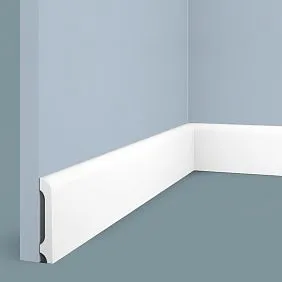
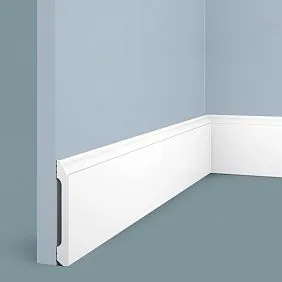
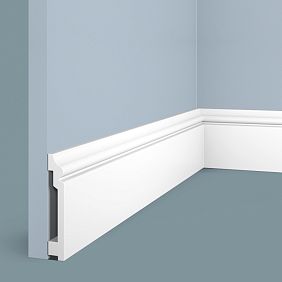
Baseboard is not just a rectangular strip. It has a profile — the cross-sectional shape that determines how it meets the wall, floor, and casing. Different profiles create different effects, and profile selection must consider not only aesthetics but also functional alignment.
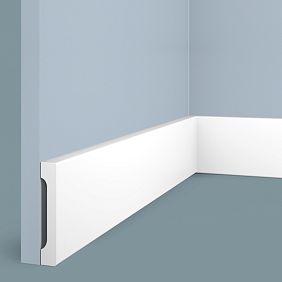
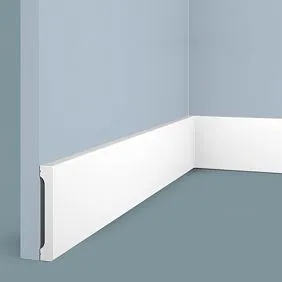
Simple rectangular profile — a flat strip of constant width from floor to top edge. Such baseboard easily aligns with casing if their thicknesses match. Baseboard end is straight, casing end is straight, they meet at a right angle, forming a clear line. This is the simplest option for installation, requiring no complex miter cuts. But visually, it may appear too rigid, geometric, especially in classic interiors where decorative elements are valued.
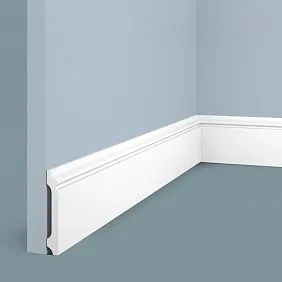
Profiled baseboard — a strip whose front surface is not flat but has relief: protrusions, recesses, rounded edges. Profile can be simple (one rounded top edge) or complex (multiple steps, grooves, protrusions). Such baseboard looks more beautiful, richer, but is more difficult to install. When profiled baseboard meets casing, the question arises: how to align the baseboard's relief with the casing's flat surface? Often, the baseboard's profile simply ends, resting against the casing. This is acceptable if the profile is not too complex. If the profile is deep with pronounced steps, the abrupt end looks unattractive, unfinished.
Solution — use casings with profiles that match the baseboard's profile. If baseboard has a rounded top edge, casing should also have a rounded edge. If baseboard has a groove, casing may have the same groove. This creates visual continuity, making the alignment logical.Wooden skirting board purchaseCan be purchased as part of the same collection as the baseboard, where profiles are already designed by the designer and match each other.
Beveled baseboard — a strip whose lower part is wider than the upper part, front surface slopes at an angle. Such profile visually appears lighter than rectangular, baseboard seems less bulky. Alignment with beveled baseboard requires that casing also be beveled or that the baseboard's end be mitered to align with casing without gaps. This is more complex than with rectangular profile, but the result looks more elegant.
Baseboard with cable channel — this is a plastic or MDF baseboard with an internal cavity where wires are hidden. Such baseboards usually have a simple rectangular profile and easily connect with door casings. But wooden baseboards are rarely made with a cable channel — wood is valued for its naturalness and solidity, and the cavity inside weakens the structure. If you need to hide wires, it's better to use special channels behind the baseboard, between the baseboard and the wall.wooden baseboards for floorHeavy and dense, wires cannot be run through them, but they can be laid in the gap between the baseboard and the wall if the wall is uneven.
Our factory also produces:


Cutting angles: internal and external, miter and circular saw
Corners — the most difficult place in baseboard installation. If the corner is cut incorrectly, the boards won't align, leaving a gap between them, and the joint will look crooked. If the corner is cut correctly, the two boards meet perfectly, forming a straight line without a gap. The difference between amateur and professional installation is clearly visible in the corners.
Internal corner — this is the angle between two walls directed inward (most corners in a room are internal). To install baseboard in an internal corner, each board is cut at a 45-degree angle, but mirrored. The left board is cut so that the cut goes from left to right, from the front to the back side. The right board is cut so that the cut goes from right to left. When the two boards meet, their ends form a 90-degree right angle.
External corner — this is the angle between two walls that protrudes into the room (e.g., a column projection, bay window). For an external corner, the cut is reversed: the ends of the boards are cut so that the sharp edges face outward, and the blunt edges face the wall. The left board is cut from left to right, but from the back to the front side. The right board is cut from right to left, from the back to the front. When the boards meet, they form a neat external corner without a gap.
Miter box — this is a simple tool for cutting baseboards at standard angles (45 and 90 degrees). It's a groove with slots into which the baseboard is placed, and the saw blade is inserted into the slot at the required angle, resulting in a clean cut. Miter boxes are cheap and accessible, but have a drawback: they work only with exactly 90-degree angles. If the wall angle is not straight (a common situation in real apartments — angles of 88 or 92 degrees), cutting in a miter box will leave a gap. The baseboards won't fit perfectly, requiring manual adjustment, sanding the ends, and filling gaps.
Circular saw — this is an electric tool that cuts precisely at a specified angle, from 0 to 90 degrees with 1-degree increments or less. Using a protractor, you measure the actual wall angle, set the saw to half of that angle (if the wall angle is 88 degrees, set the saw to 44 degrees), make cuts on both boards, and they will fit perfectly. Circular saws are more expensive than miter boxes, but for wooden baseboards, they are essential — wood cuts cleanly without chips, and the end is smooth, requiring no additional finishing.wooden skirting board purchaseBuy with a margin, because some material will be lost during cutting angles.
Cutting at 45 degrees — this is a basic technique, but it requires precision. The baseboard is placed in the miter box or on the circular saw with the front side up and the back side pressed against the fence. The saw blade or disc cuts through the baseboard at a 45-degree angle. It's important that the baseboard doesn't shift during cutting — any movement will result in a crooked cut. After cutting, the end is checked: it should be flat, without chips or wood marks. If there are defects, the end is sanded with fine sandpaper until it becomes smooth.
Checking angles before cutting — mandatory. Using a protractor, measure the angle between the walls. If the angle is close to 90 degrees (89–91 degrees), you can cut standard 45-degree angles. If the angle differs significantly (85 or 95 degrees), you need to adjust: divide the angle in half and cut at the resulting value. For example, an 88-degree angle — cut at 44 degrees. This will give a precise fit without gaps.wooden planks on the wallCan be used as a template for practicing cuts before cutting expensive baseboard.
Get Consultation
Joint without gaps: technology of precise end fitting
Even with correctly cut angles, gaps may appear — due to uneven walls, slight wood shrinkage or swelling, or microscopic cutting deviations. A gap between baseboard boards is a defect that is immediately noticeable and spoils the overall interior impression. The goal is to achieve joints without gaps, where the ends of the boards meet so tightly that a knife blade cannot be inserted.
First rule — cut with a margin. It's better to cut slightly short than too long. If you cut too short, the board won't reach the corner, and you'll have to discard it and cut a new one. If you cut with a margin (1–2 mm longer than needed), you can sand the end, remove the excess, and achieve the exact length. Sanding the end is done with medium-grit sandpaper (120–150), moving along the cut to avoid damaging the front surface of the baseboard.
Second rule — fit before fastening. Place each board in position, check how it fits with adjacent boards, door casings, and corners. If there is a gap, check where exactly: on one side or both, at the top or bottom. If the gap is on one side, adjust the angle cut — resaw the end at a slightly different angle. If the gap is uniform along the entire joint, the board is either too short or too long — adjust the length accordingly.
Third rule — account for wall irregularities. Walls are rarely perfectly flat. Some areas bulge, others sink. A baseboard pressed against an uneven wall won't lie flat along its entire length. Either the middle of the baseboard will be away from the wall, or the edges. This affects joints: if the wall is curved, the baseboard will also curve, and the ends will shift, creating a gap even with correct cuts. The solution — find the most bulging point on the wall, press the baseboard against it, fix it, and the rest of the baseboard will follow the wall's profile.
Fourth rule — use glue at joints. Even with perfect cuts, it's better to apply wood glue to the ends before joining. Glue will fill microscopic gaps that are invisible to the eye but may appear over time as the wood dries. Glue is applied in a thin layer to both ends, the boards are joined, and excess glue is wiped off immediately with a damp cloth. After 10–15 minutes, the glue sets, and the joint becomes monolithic.
Fifth rule — final fitting after installation. Even if everything is done correctly, after all boards are secured, minor imperfections may be discovered: microscopic gaps, slight misalignments. These are corrected with wood putty. Putty is selected to match the baseboard color (if the baseboard is not painted) or the future paint color. Putty is applied with a putty knife into the gap, smoothed, and after drying, sanded. If the baseboard will be painted, the putty will be completely covered by paint. If the baseboard is varnished or oiled, the putty must be as close in tone as possible, otherwise the joint will be noticeable.
Baseboard connection with door casing: three methods
The point where the baseboard meets the door casing is a critical spot visible immediately upon entering the room. If the connection is done carelessly, it spoils the overall interior impression. If the connection is done neatly, it is a sign of professionalism and attention to detail. There are three main methods to connect the baseboard with the casing, each with its own advantages and limitations.
Method one: the baseboard rests against the casing at a right angle. This is the simplest method. The baseboard runs along the wall, reaches the casing, is cut perpendicular to it (end at 90 degrees to the length of the baseboard), and rests against the casing. The end of the baseboard remains visible. This method works if the baseboard thickness equals or is less than the casing thickness. If the baseboard is thinner than the casing, the baseboard end is completely hidden behind the casing and not visible. If the thicknesses are equal, the baseboard end and the casing edge lie in the same plane, forming a clean vertical line.
Method two: the baseboard is cut at 45 degrees in the vertical plane, creating a smooth transition to the casing. Instead of resting against the casing perpendicularly, the baseboard ends with a beveled end that slopes upward from the floor. This creates a more elegant, finished connection, especially if the baseboard is profiled with relief. The beveled end looks like a decorative element rather than a broken board end. This method requires precise cutting with a circular saw: the baseboard is set vertically, the saw is set to 45 degrees, and the cut is made. The beveled end must be smooth, without chips, as it remains visible.
Method three: the baseboard and casing meet at 45 degrees, forming a diagonal seam. This is the most complex but most beautiful method. The baseboard end is cut at 45 degrees in the horizontal plane (as in corner cutting), and the bottom edge of the casing is also cut at 45 degrees. The two boards meet at an angle, forming a diagonal line from the floor to the casing edge. This connection looks like furniture molding, professional and neat. However, it requires that the casing and baseboard be made of the same material, color, and thickness. Otherwise, the diagonal seam will look like an attempt to mask a mismatch rather than a decorative technique.
The choice of method depends on the thickness ratio, interior style, and installer's skill level. In budget renovations, the first method is used — simple and fast. In quality renovations, the second or third method is preferred — more beautiful and neat.Moldings made of polyurethaneCan be used instead of wooden baseboard if a complex profile shape is needed, which is difficult to cut from wood, but polyurethane does not provide the nobility, warmth, or longevity that wood offers.
If the casing is much thicker than the baseboard (casing 20 mm, baseboard 12 mm), the casing will protrude 8 mm above the baseboard — this is significant and creates a visible step. In this case, it's better to use the second method: cut the baseboard at 45 degrees vertically to create a smooth, not abrupt, transition. Or select a baseboard with thickness close to the casing thickness.wide wooden baseboardMay have variable thickness — thick at the base, thin at the top edge, which facilitates connection with casings of different thicknesses.
Baseboard painting: before or after installation, what to paint, how to avoid runs
Wooden baseboards are rarely used in their natural color — wood requires protection from moisture, dirt, and mechanical damage. Painting or varnishing is not only aesthetic but also functional: protective coatings extend the baseboard's service life and simplify maintenance. However, painting baseboards is a separate task with its own rules and subtleties.
Should you paint before or after installation? This is the key question. Painting before installation gives a better finish: the board lies horizontally, paint applies evenly without drips, all sides including ends are easily paintable. After painting, boards dry and are then installed. However, during installation, damage to the finish is inevitable: scratches from tools, chipped ends from cutting angles, marks from fasteners. These damages will need to be touched up on-site, which may result in visual tone inconsistencies.
Painting after installation gives a uniform finish without seams, but is technically more difficult: the skirting board is already attached to the wall, painting must be done vertically, increasing the risk of drips. Hard-to-reach areas (corners, joints with window casings) are painted unevenly and may leave unpainted spots. However, you don’t need to touch up installation damage, the finish is continuous and uniform in tone. This method is preferable if the skirting board is installed with adhesive, without visible fasteners, if walls are perfectly flat, and if the installer is careful.
Compromise option: the first coat (primer and base color) is applied before installation, the second coat (finish color) after installation. This provides a quality base finish, protects the wood during installation, and the finish coat hides all damage, creating a uniform tone. Primer is applied with a brush or roller, dries, boards are lightly sanded with fine-grit sandpaper (raised wood fibers), the first coat of paint or stain is applied, dries. Then boards are installed. After installation, the finish coat of paint or varnish is applied, which is not sanded but simply allowed to dry.
What to paint wooden skirting board with? It depends on the desired result. Varnish (clear or tinted) preserves wood texture, emphasizes naturalness, but does not hide wood defects — knots, resin pockets, tone differences remain visible. Oil (linseed, tung) penetrates into the wood, protects from within, creates a matte or semi-matte surface, pleasant to the touch. Wax gives a soft sheen, but is less resistant to abrasion, requires periodic renewal.
Paint (alkyd, acrylic, oil) completely hides wood texture, creates an even color, can be matte, semi-matte, or glossy. Paint hides wood defects, allows any color to be created, is easy to clean. But paint "kills" the naturalness of wood, turning the skirting board into a uniform surface. If the wood is high quality with beautiful texture, use a transparent finish. If the wood is budget and has defects, paint is better.Wooden baseboardPine is usually painted, as pine has an uneven texture. Skirting boards made of oak or ash are usually finished with varnish or oil to show off the beauty of the wood.
How to avoid runs and drips? Paint is applied in thin layers, better two or three thin layers than one thick one. The brush should not be overloaded with paint — excess paint is squeezed out at the edge of the can. Brush strokes along the skirting board, without stopping, with even pressure. If the finish is applied after installation, painter’s tape or cardboard is placed under the skirting board to avoid staining the wall and floor. Corners and joints are painted with a fine brush, with extra care. After applying a layer, allow drying time (as indicated on the paint can), then light sanding with fine-grit sandpaper, dust removal, and application of the next layer.
Skirting board mounting: self-tapping screws, adhesive, nails, finishing pins
The method of mounting the skirting board affects its appearance and durability. Incorrect mounting causes the skirting board to detach from the wall, squeak under pressure, crack. Proper mounting makes the skirting board monolithic with the wall, it does not move, does not deform, and lasts for decades.
Self-tapping screws — the most reliable mounting method. Screws are screwed into the wall (if the wall is wooden or has a wooden frame) or into wall plugs (if the wall is concrete or brick). Before screwing, a hole is drilled in the skirting board slightly smaller than the screw diameter, then a larger drill bit is used to create a recess under the head (countersinking) so that the head sits below the skirting board surface. The screw is screwed in, the head is in the recess, then the recess is filled with putty, sanded, and painted. The screw becomes invisible.
Distance between screws — 40-60 cm. More often is not needed, as it weakens the skirting board; more holes mean greater risk of splitting the wood. Less often is also not advisable — the skirting board will detach from the wall between screws, especially if the wall is uneven. Screws are screwed in at the center height of the skirting board, perpendicular to the wall. If the skirting board is tall (more than 100 mm), two rows of screws can be screwed in — upper and lower, at 1/4 and 3/4 of the skirting board height.
Adhesive — a mounting method that leaves no visible traces. Adhesive is applied to the back of the skirting board (the side that contacts the wall), the skirting board is pressed against the wall, held for several minutes until the adhesive sets. Construction adhesive (liquid nails), PVA wood glue (if the wall is wooden), polyurethane adhesive are used. Adhesive holds the skirting board securely if the wall is flat and the skirting board fits tightly along its entire length. If the wall is uneven, adhesive won’t work — the skirting board will detach in areas with depressions.
Advantage of adhesive — no visible fasteners, the skirting board looks like one whole unit with the wall. Disadvantage — difficult to remove if removal is needed (during renovation, replacing flooring). Adhesive can be combined with screws: apply adhesive to the back, press the skirting board against the wall, temporarily fix with screws (2-3 per board) until the adhesive dries. After the adhesive dries, screws can be unscrewed, holes filled with putty, or left in place for additional security.
Finishing pins — thin nails without heads or with microscopic heads, driven in with an air gun. The mark left by the pin is almost invisible, no putty required. Pins hold the skirting board securely if the wall is wooden or if wooden blocking strips are installed. For concrete and brick walls, pins are not suitable — they do not penetrate hard material. Finishing pins — a professional mounting method, used by carpenters, requires special equipment (air gun).
The choice of mounting method depends on the wall material, skirting board type, and aesthetic requirements. For wooden skirting board on concrete wall — screws in wall plugs or adhesive. For wooden skirting board on wooden wall — screws directly or finishing pins. For profiled skirting board, where aesthetics matter — adhesive, to avoid visible fasteners.
The choice of mounting method depends on the wall material, type of skirting board, and aesthetic requirements. For wooden skirting on a concrete wall — screws into anchors or adhesive. For wooden skirting on a wooden wall — screws directly or finish nails. For profiled skirting, where aesthetics are important — adhesive, to avoid visible fasteners.wooden corniceThe cornice is mounted similarly — on screws or adhesive, considering that the cornice is under the ceiling and the load on it is minimal.
Common mistakes when installing skirting board
First mistake — incorrect length measurement. The skirting board is cut randomly, without precise measurements, resulting in a board that is either too short or too long. A short board doesn’t reach the corner, requiring a patch piece that looks like a patch. A long board hits the corner, bends, and doesn’t fit the wall. Rule: measure twice, cut once. Measure the distance from corner to corner (or from corner to window casing) with a tape measure, add 1-2 mm for possible inaccuracies, mark the skirting board, and cut. It’s better to cut with a small allowance and fit it, than to cut too short and discard it.
Second mistake — cutting angles without considering the actual wall angle. Standard cuts are made at 45 degrees, but the wall angle is 88 or 92 degrees, resulting in boards that don’t meet, leaving a gap. Rule: before cutting, measure the wall angle with a protractor, divide it by two, cut at the resulting angle. Or use the "on-site" method: press the board against the wall at the corner, draw a line along the board on the floor with a pencil, do the same on the other side of the corner, the two lines will intersect, forming the actual angle. Cut at this angle.
Third mistake — mounting the skirting board before painting, when painting after installation is planned, but the installer does not protect the wall and floor. Paint gets on the wall and floor, requiring cleaning, leaving marks. Rule: before painting the installed skirting board, apply painter’s tape to the wall above the skirting board and along the floor next to the skirting board. After painting, while the paint is still wet, carefully remove the tape. If the tape is removed after the paint dries, the paint may peel off with the tape, leaving a ragged edge.
Fourth mistake — using screws that are too long, which pass completely through the skirting board, through the wall, exit on the other side or hit reinforcement, wiring. Rule: screw length should be such that it enters the wall by 30-40 mm, but no more. For a 16 mm thick skirting board and 20 mm thick plaster, a 60 mm screw is needed (16+20+30=66, rounded to 60). A longer screw may hit wiring, pipes, or reinforcement, which is dangerous.
Fifth mistake — ignoring thermal expansion gaps. Wood expands and contracts with changes in temperature and humidity. If the skirting board is installed tightly between two window casings, without a gap, it may jam when expanding, crack, or bow. Rule: leave a 1-2 mm gap between the end of the skirting board and the window casing. This gap is imperceptible but gives wood space to move. The gap can be filled with color-matched sealant that remains elastic and does not crack during wood movement.
Choosing skirting board to match interior style
Skirting board is not a neutral element. Its shape, height, color, profile affect the perception of the interior, supporting or destroying its style. The skirting board must be chosen according to the overall style to look natural, not like a random detail.
Classic interior requires a tall skirting board (80-120 mm) with profile — rounded edges, grooves, steps. Skirting board is painted white or wall color, rarely — wood color under varnish. Classic skirting board is often complemented bymoldings on wallscreating a unified decorative system. The skirting board thickness should match the thickness of door casings, usually 16-18 mm.Buy decorative elementscan be installed on skirting boards in corners or in the center of the wall, creating additional decoration.
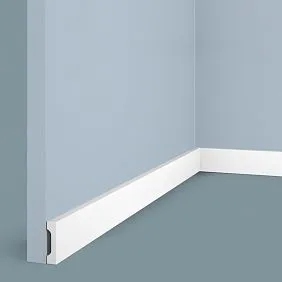
Modern minimalist interior requires a simple skirting board — low (40-60 mm), with a simple rectangular profile or even without a profile (flat). Skirting board is painted wall color to visually blend with walls, not drawing attention. Or in contrasting color (black skirting board on white walls), creating a graphic line. The thickness of a minimalist skirting board can be less — 10-12 mm, making it visually light, almost invisible.
Scandinavian interior prefers a medium-height white skirting board (60-80 mm) with a simple profile. Made of pine or spruce, painted with white matte paint. Standard thickness — 16 mm. Scandinavian skirting board is functional, not overloaded with decoration, yet neat and well-made.wooden baseboards for flooringLight-colored woods are suitable for Scandinavian style, especially if the wood grain is left visible under a thin layer of white paint or oil.
Loft uses skirting board minimally or omits it entirely. If present, it is metallic or made of dark wood, low (40-50 mm), with a rough, unplaned surface. Sometimes, instead of skirting board, a simple metal angle bracket screwed to the wall and floor is used. In loft, industrial aesthetics are important, so wooden skirting board should look utilitarian, not decorative.Wooden beamCan be used as decoration on walls or ceiling in loft, but not as skirting board.
Provence and country styles require skirting board made of natural wood, painted in light tones (white, cream, blue, olive) with a worn, patina effect. Medium height (60-80 mm), simple profile but not severe — gentle rounded edges, no complex steps. It is important that the skirting board looks handmade, slightly imperfect, with a lively surface. Factory-made flawless skirting board is unsuitable for Provence, as it is too smooth and mechanical.
FAQ: Answers to popular questions about wooden skirting board
What is the optimal skirting board height for a standard apartment with 2.7-meter ceilings?
For standard ceilings, the optimal skirting board height is 60-80 mm. This creates visual balance — the skirting board is noticeable but does not dominate. If door casings are 70 mm wide, the skirting board should be 70 mm or close to that. If ceilings are lower (2.5 m), 50-60 mm is better. If ceilings are higher (3 m and above), 80-100 mm is acceptable.
Should the skirting board match the floor or the walls?
It depends on the desired effect. Skirting board matching the floor visually extends the floor onto the wall, making the room feel more grounded and cozy. Skirting board matching the walls visually blends with the wall, making the room appear taller and lighter. Contrasting skirting board (black against white walls and light floor) creates graphic clarity and defined lines. In classic interiors, skirting board is often white, like door casings, regardless of floor or wall color.
Can wooden skirting board be installed in a bathroom?
Not recommended. Wood is sensitive to humidity; in the bathroom, it may swell, deform, and develop mold. If a wooden skirting board is absolutely necessary in the bathroom, choose moisture-resistant species (teak, larch), treat with special moisture-resistant compounds, and ensure good ventilation. However, it is better to use moisture-resistant materials — polyurethane, plastic, or ceramic.
How often should wooden skirting board be replaced?
A quality wooden skirting board, properly installed and painted, lasts 20-30 years or more. Oak, ash, and larch can last up to 50 years. Replace the skirting board only if it is damaged (cracks, chips), if the interior is radically changed (different style, proportions), or if it rots due to moisture. Periodically (every 5-10 years), renew the finish — repaint or reapply varnish.
What to do if walls are very uneven and the skirting board does not fit properly?
There are three solutions. First: level the walls with plaster or drywall before installing the skirting board (ideal but expensive). Second: use flexible skirting board (polyurethane or plastic), which follows the profile of uneven walls. Third: install wooden skirting board on the most protruding points of the wall, fix it there, and fill gaps between the skirting board and wall with sealant or putty, then paint. Sealant will hide unevenness, and the skirting board will appear to fit tightly against the wall.
Can skirting board be used without paint, in natural wood color?
Yes, but wood must be protected. Unpainted, unprotected wood quickly gets dirty, darkens, and loses its appearance. Minimum protection — apply varnish or oil, which preserves the natural color while protecting against moisture and dirt. Varnish creates a film on the surface (matte, satin, or glossy), while oil absorbs into the wood, preserving its texture more naturally. Wax provides a soft sheen but requires periodic renewal.
How to connect skirting board on a long wall if one board is not enough?
Skirting board is joined butt-to-butt with 45-degree beveled ends. Both ends are beveled at the same angle (both 45 degrees in one direction), joined to form a diagonal seam. This seam is less noticeable than a straight seam, especially if the skirting board has a profile. The joint should not be in the middle of the wall but in an inconspicuous place — behind furniture, in a corner, in shadow. Ends are glued, joined, and secured with screws from both sides of the joint.
Should there be a gap between skirting board and floor?
No, skirting board should fit tightly against the floor, without gaps. A gap between skirting board and floor looks like a defect, collects dust and debris. If the floor is uneven (with bumps and dips), the skirting board may not fit along its entire length. In this case, either level the floor, use flexible skirting board, or trim the bottom edge of the skirting board to match the floor profile (difficult and requires skill).
How to calculate the amount of skirting board needed for a room?
Measure the room’s perimeter (length of all walls where skirting board will be installed), subtract the width of door openings (where skirting board is not needed), add 10% for cuts and reserve. Skirting board is sold in standard-length planks (usually 2-2.5 meters). Divide the required length by the length of one plank and round up — this gives the number of planks. For example, room perimeter 20 meters, minus two door openings of 0.8 meters each (1.6 meters), total 18.4 meters. Add 10% reserve — 20.2 meters. Plank length 2.5 meters, need 20.2 / 2.5 = 8.08, round up to 9 planks.
Where to buy quality wooden skirting board with options for height and profile selection?
Contact manufacturers with their own production, offering a wide range of profiles, wood species, and finishes. Check wood quality (no knots, cracks, resin pockets for quality skirting board), profile milling accuracy, and presence of certificates.and paint it to the desired shade — standard practice in modern design. It is important to use special wood finishes that allow the material to breathe.Available as ready-made (for self-painting) or with factory paint.
Conclusion: STAVROS — skirting board that fits without gaps
Skirting board is not a minor detail chosen at the last minute. It is an element that completes the interior, connects the floor with walls, creates neatness, order, and spatial logic. Correct height under door casings, precise joints without steps, beveled corners without gaps, flush end joints without gaps, quality paint without runs — all this requires knowledge, experience, and attention to detail. Cheap skirting board installed carelessly spoils even an expensive renovation. Quality skirting board installed professionally enhances even a budget space.
STAVROS offers a wide range of wooden skirting boards, manufactured in-house from solid pine, oak, ash, and beech. Heights from 40 to 120 mm, thicknesses from 12 to 20 mm, various profiles — from simple rectangular to classic multi-step relief. Skirting board is supplied unfinished (for self-painting) or with high-quality factory sanding.Door casings are an essential part of the trim system. Their profile must match the profiles of cornices and moldings. The width of the casing is usually 1.5–2 times wider than the wall molding. The wood species and color are identical to all other elements., Moldings, Crown Molding, balusters, decorative elements, Polyurethane ItemsAlso available — everything for comprehensive interior styling in one style. Specialist consultations will help select skirting board of the required height and thickness for your door casings, calculate the quantity, choose mounting and painting methods. Delivery available in Moscow, St. Petersburg, and throughout Russia. STAVROS — skirting board that does not require filing with a file, because it is made precisely.