Article Contents:
- What Are Door Casings for Interior Doors and Why Are They Needed
- Practical Function of Door Casings
- Decorative Function of Door Casings
- Why Door Casings Are Especially Important for Interior Doors
- Types of Door Casings for Interior Doors
- By material
- By shape
- By style
- Wooden Door Casings for Interior Doors: Advantages and Features
- Why Wood Is Valued More Highly
- Which interiors wooden architraves suit
- When to Choose a Smooth Profile and When to Choose a Decorative One
- How to choose door trims for interior doors
- By material
- By door style
- By size
- By finish
- Door trims for interior doors in interior design: how to match with baseboards, cornices, and moldings
- Door trims and baseboards
- Skirting boards and moldings
- Architraves and cornices
- Door trims and decorative elements
- Which door trims are better for interior doors: wood, MDF, or decorative alternatives
- Decorative door trims for interior doors in a classic interior
- When a standard door trim is not enough
- How to design a door opening as a portal
- Door trims, pilasters, capitals, and cornices in the same style
- Where to buy door trims for interior doors and what to look for when ordering
- What's important to clarify before purchase
- Why it's convenient to buy door trims and matching decor in one place
- When it's better to order a door opening finishing kit right away
- Door trims for interior doors by STAVROS: how to choose a solution to match your interior
- Frequently Asked Questions
- Which architraves are best for interior doors?
- What's better: wooden architraves or MDF?
- How to choose the width of a door trim for an interior door?
- Can wooden architraves be painted?
- Which door trims are suitable for a classic interior?
- How do decorative door trims differ from regular ones?
- Are architraves needed if there are door extensions?
- How to match door trims with baseboards?
- Can wooden door trims be combined with MDF baseboards?

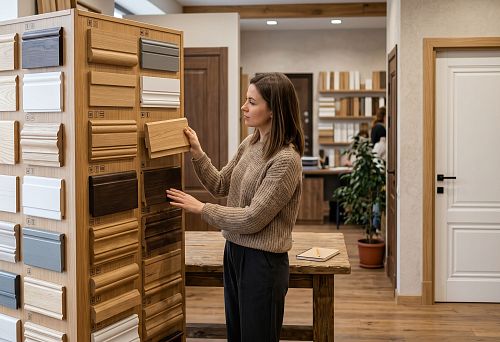
An interior door is not just a passage between rooms. It is one of the most noticeable elements of any room: you pass by it dozens of times a day, it is constantly in your field of vision. And that is precisely why how it is finished—the door leaf, frame, and, of course, the trim—determines the overall impression of the interior.
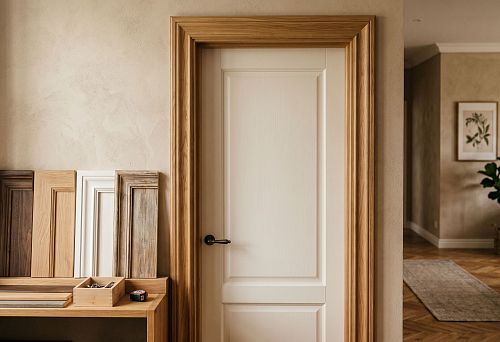
Door trims for interior doorsThey solve several problems at once: they cover the mounting gap between the frame and the wall, create a visually finished look for the doorway, and—in the hands of a skilled designer—become part of a full-fledged interior ensemble. When the casing, baseboard, cornice, and moldings are selected with a unified logic, the room acquires that very sense of completeness which is impossible to describe in words but is instantly felt upon entering.
This article is a commercial guide, not an encyclopedia entry. Here you will find everything you need to make the right choice: which material to take, which profile will suit your door, how to assemble a cohesive doorway design, and where to buy. Andwood trim items—moldings, cornices, baseboards, and decorative elements in a unified style—are available in the STAVROS catalog.


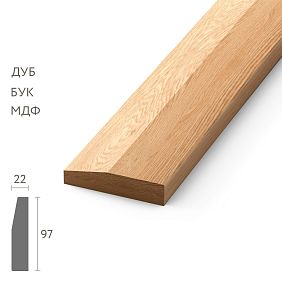
What are casings for interior doors and why are they needed
Before choosing—it's worth clearly understanding what exactly you are buying and what function this element performs. A casing is not just a strip. It is a detail that works on two levels simultaneously: practical and decorative.




The practical function of casings
When installing any interior door, a gap remains between the door frame and the wall—it is filled with mounting foam or another sealant. This joint is unsightly, vulnerable to mechanical damage, and in an untreated state looks like unfinished work.
The casing fits snugly against the frame on one side and overlaps the gap, resting on the wall surface on the other. This covers the mounting seam, protects it from dust and accidental impacts, and prevents its deterioration during use. In wooden and country houses, where walls may experience slight settling, a properly selected solid wood casing compensates for these movements without cracks or deformations.
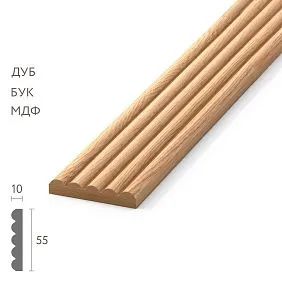
Standard widthof casings for interior doorsvaries from 50 to 100 mm — depending on the size of the opening, the design of the frame, and the interior style requirements. The length is from 190 to 235 cm, which covers standard door openings with a height of 2–2.1 meters.
Our factory also produces:


Decorative function of architraves
This is the second and, perhaps, more important function from the perspective of interior perception. A properly selected architrave creates a complete image of the door — it transforms the opening from a technical hole in the wall into an architectural element of the room.
The profile, width, and material of the architrave define the character of the entire door framing. A wide, shaped architrave with relief gives the door monumentality — it begins to look like a portal. A smooth, straight profile, on the contrary, blends into a modern minimalist interior without drawing attention to itself. A carved architrave becomes an accent that speaks to the aesthetic preferences of the homeowner.
Moreover, the decorative role of the architrave is manifested in its ability to connect the door with other finishing elements: withwith wooden cornices, moldings, and baseboards. When all these elements are made in a unified profile and color — the interior acquires an internal rhythm that is perceived as harmony.
Get Consultation
Why architraves are especially important for interior doors
An interior door is not a facade element that can be viewed from a distance. It is always in front of your eyes. Every time you move from room to room, you see the architrave and how well it harmonizes with the rest of the finish.
A poor or inappropriate architrave can visually cheapen even the highest quality door. A budget plastic strip on a solid wood door is a contradiction that is felt immediately. Conversely, a properly selectedinterior door architraveIt elevates the perception of the entire door, adding weight and character.
That is why choosing architraves is not a secondary task during renovation. It is part of the design solution that determines the quality of the final result.
What types of architraves are there for interior doors
The market offers a wide choice — by material, profile, and style. It's not difficult to navigate this variety if you understand the logic of each classification.
By material
Solid wood is the leader in all significant parameters: durability, aesthetics, repairability. Oak or beech architraves have a dense structure, a pronounced natural grain, and high strength. They can be painted an unlimited number of times: sanding, priming, a new coating — and the product looks like new. This is the choice for interiors designed to last for decades.
MDF is a material made from pressed wood fibers with binders. It holds its profile well, is easy to paint, and is cheaper than solid wood. However, if mechanically damaged, it is practically irreparable — the damaged fragment is replaced entirely. In high humidity, it swells. For budget solutions with neutral durability requirements, it is an acceptable option. Products made from this material are available in the sectionMDF Skirting Board and Architrave.
Veneered architraves — a base of MDF or inexpensive wood, faced with a thin sheet of valuable wood. The appearance is close to solid wood, the price is lower. But if damaged, the veneer peels off, and restoring the product is difficult. This is a compromise option for mid-price segment projects.
Decorative solutions combined with architectural decor — when a simple architrave is not enough. Wide profile frames, complemented bypilastersandcapitalscreate a full-fledged door portal in a classic or neoclassical style.
By shape
-
Straight — rectangular cross-section, minimal relief or its complete absence. Geometry, precision, modernity.
-
Figurative — with S-shaped, stepped, or wavy transitions in the profile. A classic solution for doors with a pronounced character.
-
Classical — a multi-step profile that widens toward the center. Creates a sense of architectural framing, recognizable in the European tradition.
-
Carved — ornament or relief directly on the surface. For classic, neoclassical, and historical styles.
-
Wide — from 80 to 120 mm. Create the effect of a monumental portal, especially suitable for tall doors.
By style
Modern — smooth, straight, without ornament. Work in minimalism, loft, and Scandinavian interiors.
Classical — a figured profile with symmetrical transitions. Suitable for classic apartments and country houses.
Neoclassical — stricter than classical. Geometry is clear, details are fewer, but they are precise and significant.
Decorative portal-style — maximum width, complex profile, additional elements. For formal rooms and decorative openings.
Wooden architraves for interior doors: advantages and features
Wood is a material with history. Wooden architraves were installed on doors in an era when the concept of 'renovation' meant work for decades. And this tradition is not accidental: solid wood offers what no modern substitute provides.
Why wood is valued higher
First and foremost — the living texture. A wooden architrave looks different under various lighting: in sunlight, the natural grain pattern emerges; in shadow, the depth of the material is revealed. This is the very quality that distinguishes natural material from any imitation.
Wooden architraves for interior doorspossess a number of practical advantages:
-
Durability — with proper finishing, a service life of 30–50 years or more
-
Repairability — any scratch or wear can be removed by sanding and applying a new coating
-
Repaintability — unlimited number of times, in any color, to match any new interior concept
-
Noble texture — the natural wood grain is not reproduced by MDF or polyurethane
-
Eco-friendliness — natural material without chemical volatile compounds
-
Status — a wooden architrave is associated with quality and long-term thinking
About all the diversitywooden trim— what to choose, how to combine, how not to make a mistake — in detail in our thematic guide.
For Which Interiors Are Wooden Casings Suitable
Classic interior — here wood is the main and irreplaceable material. Figurative oak architraves under white enamel or tinting are the standard for classic bedrooms, living rooms, and studies.
Neoclassicism and modern classicism — more restrained in ornament, but no less demanding of material quality. Here wood works in tandem with clear profiles and strict geometry.
Country house and cottage — natural wood is absolutely organic here. It echoes the material of the floor, ceiling beams, and furniture.
Interiors with natural materials — when a room has wood, stone, textiles — a wooden architrave fits into this system as a natural participant.
Scandinavian style — light oak or beech under matte varnish or enamel create a clean, fresh image characteristic of the northern tradition.
When is it better to choose a smooth profile, and when a decorative one
A question that is asked most often. The answer depends on the style of the interior and the effect you want to achieve.
A smooth profile is appropriate when the interior is built on lines, not on details. When the furniture is geometric, the finish is neutral, and an extra detail would only disrupt the balance. A smooth wooden architrave here is precise and inconspicuous.
Figurative and carved profile — when the door should become an accent. When the interior is rich in details: stucco, moldings, cornice with relief. Here the casing is part of the overall decorative text, and its character should be proportionate to the surroundings.
How to choose casings for interior doors
This is a practical block. We will analyze each parameter sequentially — so that after reading, you have a clear answer to the question "what to buy".
By material
Wood (solid wood) — if the planning horizon is 10 years or more. If aesthetics, the possibility of repainting, and repairability are important. For classic and status interiors — only solid wood.
MDF — if the budget is limited, the interior is neutral, and durability requirements are moderate. The flat, even surface takes enamel well, but if damaged, it requires replacement.
Decorative profiles — for complex portals and architectural framings where specific shapes or moisture resistance are needed.
By door style
Smooth door without relief — straight or moderately figured casing 60–70 mm wide. Laconic, modern, not overloaded.
Classic panel door — wide figured casing, 80–100 mm. The profile should support the character of the door leaf, not contrast with it.
Door with milling or decorative overlays — the casing should be in the same stylistic register. Carved decor on the door is a reason to consider a figured or ornamental casing.
Decorative portals — maximum width, pilasters on the sides, an over-portal element or cornice on top. This is no longer a casing in the usual sense, but a full-fledged architectural statement. Aboutdoor decorMore details in the STAVROS ready-made solutions catalog.
By size
Casing width is the main parameter. For standard interior doors 600–900 mm wide, 60–80 mm strips are optimal. For tall and massive doors — 80–100 mm. For decorative portals — 100–120 mm and wider.
Thickness — usually 12–18 mm. Thin casing looks flimsy, too thick — heavy and bulky. For standard solutions, 12–15 mm is optimal.
Proportion to the opening — the casing should visually 'hold' the door, not get lost next to it. The taller and wider the door — the wider and more massive the framing can be.
For tall doors (2.1–2.4 m) — the vertical lines of the casing visually elongate the opening and make it more solemn. Here you can choose a wider and richer profile.
By finish
-
For painting — sanded solid wood or MDF, smooth surface. Priming before painting is mandatory.
-
For enamel — wood with a uniform texture (beech is preferable to oak). White casings for interior doors are one of the most popular options in modern and classic interiors.
-
Natural wood — clear varnish, matte or glossy. Shows the natural grain of the wood.
-
Tinting gives wood the desired shade while preserving its texture. Popular tones include oak, walnut, and wenge.
-
Dark shades — for interiors with dark furniture, oak parquet, rich textiles.
Door Casings for Interior Doors in Interior Design: How to Coordinate with Baseboards, Cornices, and Moldings
This is perhaps the most important section for those thinking not only about the casing but also about the interior as a whole. This is precisely where the difference between 'the renovation is done' and 'the interior is created' emerges.
Door Casings and Baseboards
Wooden baseboard— a horizontal element along the perimeter of the floor. A door casing — a vertical element along the perimeter of the door. Their connection should be visible to the naked eye: a unified profile, the same wood species, the same finish.
If the casing is shaped with rounded transitions — the baseboard should be from the same 'family': with similar transitions, comparable width. If the casing is straight and laconic — the baseboard is chosen in the same geometric key.
Color is especially important: if the casings are for white enamel —with a classic profile creates a sense of solidity, reliability.should also be in a white tone. A mismatch in shades of white is a common mistake that is immediately noticeable.
The lower end of the casing should meet the floor — with a gap for the baseboard. The baseboard is mounted over this joint, covering it. This is the correct installation technique that gives a neat and even result.
Baseboards and moldings
Wooden moldingcreates a horizontal rhythm on the walls: divides the surface into zones, forms a frame-like border, creates a frieze. When the walls are structured with moldings — the door opening with a casing fits organically into this system.
Coordination principle: the profile of the molding and the profile of the casing should be from the same stylistic vocabulary. This does not mean identity — but it means belonging to the same family of forms. Shaped molding with rounded transitions + shaped casing with similar plasticity = harmony. Smooth molding + smooth casing = purity and order.
It is also important to consider horizontal lines: wall moldings should not 'cut' the architrave at awkward heights. Ideally, the top molding aligns with the level above the window or door.
View specific samplesof wooden moldings in the STAVROS catalog.
Casings and Cornices
wooden cornice— a horizontal finishing element at the junction of the wall and ceiling. In a classic interior, the cornice and architrave perform complementary functions: the cornice 'finishes' the wall from above, the architrave frames the opening. Together they create a rectangular architectural frame for the room.
In a full-fledged classical ensemble, the cornice often repeats the same profile as the element above the door in the door framing. This is no coincidence—it is an architectural system where every detail is consciously connected to another. For more on how to select trim in a unified style, see the article onwooden cornice, baseboard, and moldings.
Architraves and Decorative Elements
For classical and neoclassical openings, an architrave alone is often insufficient. Here, additional decorative elements come into play:
-
Corner rosettes — overlay elements at the junction points of the top and side architraves. They create an accent and conceal the corner joint.Carved wooden decorationis available in the STAVROS catalog.
-
to buy, which will allow you to transform your furniture using carved wooden elements. You can use the C-003-3 decor set to decorate furniture, walls, doors, or any other surface. The C-003-3 decor set is made of oak or beech, known for their strength, durability, and beauty. You can buy the C-003-3 decor set at the Stavros decor store, which specializes in producing and selling decorative elements and hardware for furniture and interiors. At the Stavros decor store, you will find a wide selection of decor sets of various shapes, sizes, and styles. You can chooseand doors — overlay ornamental elements, creating an additional decorative layer.
-
Wooden pilaster— a vertical architectural element that transforms an architrave into a full-fledged door portal.
-
wooden capital— crowns the pilaster, creating an architectural transition to the supraportal element.
Which architraves are best for interior doors: wood, MDF, or decorative alternatives
An honest comparative analysis without exaggeration. Three materials — three different answers to one question.
| Criterion | Solid wood | MDF | Decorative polyurethane |
|---|---|---|---|
| Appearance | Living natural texture | Smooth, neutral | Imitates stucco |
| Durability | 30–50 years | 10–15 years | 15–20 years |
| Repairability | High | Low | Low |
| Moisture resistance | Medium (with coating) | Low | High |
| Repainting | Unlimited | 1–2 times | Limited |
| Prestige | Maximum | budget | Medium |
| Compatibility with decor | Ideal | Satisfactory | In some cases |
| Price | Higher | Below | Medium |
The conclusion is straightforward: if the goal is to create a durable, beautiful, and status-worthy interior, woodenDoor casings for interior doorsThey win in terms of overall parameters. MDF is suitable for budget solutions with a short horizon. Polyurethane is for special cases when moisture resistance or a complex shape is needed at a limited cost.
Key point: if you choose wooden door casings — buy together with themSolid Wood Itemsin a unified style: baseboard, cornice, moldings. This ensures consistency in color, profile, and character — everything that makes the interior complete, not a set of random details.
Decorative door casings for interior doors in a classic interior
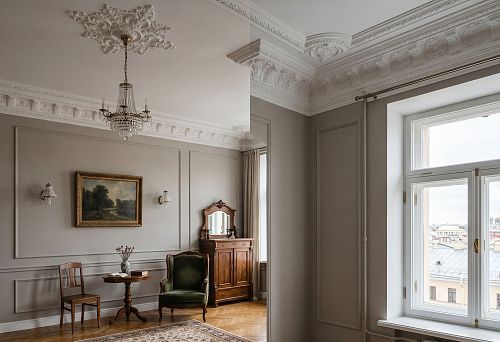
A classic interior is an environment where every detail carries meaning. There are no random elements here: cornice, molding, baseboard, door framing — everything follows a single architectural logic. And it is here that the door casing ceases to be just a strip and becomes part of the system.
When a regular door casing is not enough
A standard door casing — even a beautiful one — cannot convey the monumentality of a classic opening. For this, more is needed: a wide profile door casing, reinforced with additional elements. When ceilings are high, doors are massive, and the interior is built according to architectural laws — the door opening must be framed accordingly.
Door Decoratingin a classic style begins precisely with the door casing, which sets the scale of the entire framing. Next — adding elements: pilasters, capital, over-door cornice.
How to frame a door opening as a portal
A door portal is an architectural frame around an opening that turns an entrance into a room into a spatial accent. The classic portal is constructed according to the following scheme:
-
A wide, shaped casing around the perimeter is the foundation of the framing.
-
Pilasteron the sides — creates the feeling of architectural supports.
-
buy a capital— crowns the pilaster, creating an architectural transition.
-
A cornice or pediment above the opening — the horizontal completion of the entire composition.
-
Corner rosettes at the junction points — decorative accents.
Such a solution is appropriate in formal living rooms, studies, halls. It creates the feeling of an interior into which thought and craftsmanship have been invested.
Casings, pilasters, capitals, and cornices in the same style.
When all elements of the door ensemble — the casing, pilaster, capital, cornice — are made from the same wood species, in the same style, and with the same finish, the result is unmistakable for a set of randomly purchased parts. This is precisely the level aspired to in classic projects.
Interior door casingsin combination withdoor decor— this is a full-fledged architectural statement. It is in this form that the design of an interior door rises to the level of a design project.
For more details on capitals and applied decorative elements, see the article aboutcapitals and architectural decor made of wood and polyurethane.
Where to buy architraves for interior doors and what to look for when ordering
Choosing the material and profile is half the task. The second half is to place the order correctly to avoid disappointment upon delivery and installation.
What is important to clarify before purchasing
Material and wood species. 'Wood' without specifying the species is not information. It is important to know: oak or beech, kiln-dried, moisture control. For solid wood architraves, the optimal wood moisture content is 12–14%. Higher moisture will lead to deformation after installation.
Dimensions. The height of the door opening determines the required length of the architrave. For standard doors 2000–2100 mm + allowance for trimming. If the opening is non-standard — clarify the possibility of custom sizing.
Profile. Be sure to look at the drawing or working sample — not just at the promotional photo. The architrave profile looks different under different lighting, and studio presentation does not always give an accurate impression.
Finish. What is recommended for coating? Beech takes white enamel well. Oak looks better with tinting or natural varnish. Clarify the manufacturer's recommendations.
Door compatibility. Does the supplier's range include skirting boards, cornices, and moldings in the same profile? This is critical for a unified result.
Why it's convenient to buy architraves and related decor in one place
One batch of wood — more uniform color. One profile system — guaranteed compatibility in proportions. One manufacturer — unified quality control.
Whendoor architraves for interior doors, wooden skirting board purchaseandbuy wooden cornice— all of this in one order, from one catalog — eliminates the risk of inconsistencies during installation. This is especially important for large-scale renovations where there are multiple doors and rooms on one site.
When it's better to order a door opening finishing kit right away
A comprehensive order is always justified. But especially — if you are planning a classic or decorative interior with portals, pilasters, and cornices. In this case, all elements should be from the same collection: otherwise, discrepancies in profile and shade are inevitable and will be noticeable after installation.
Also important: architraves are installed before skirting boards. The lower end of the architrave should meet the floor, after which the skirting board covers this joint. If you order everything at different times — there is a high risk of size mismatches. A simultaneous order eliminates this problem.
Architraves for interior doors from STAVROS: how to choose a solution for your interior
STAVROS is a manufacturer of wooden moldings and architectural decor. The STAVROS catalog contains everything needed for the complete finishing of interior doors — from architrave to capital.
What's available:
-
Door casings for interior doors— smooth and shaped, made of solid oak and beech, for painting and natural tones, in standard and wide sizes
-
Trimming Items— baseboards, cornices, moldings, friezes — all in a unified profile system
-
Buy wooden molding— for wall panels, horizontal belts, decorative framing
-
wooden cornice— for ceiling finishing and over-portal elements
-
Decorative InsertsandCarved Decor— for corner elements and ornamental accents
All STAVROS products are made from solid wood with humidity control. Chamber drying, manual surface sanding, precise adherence to dimensions. Delivery across all of Russia, retail and wholesale work, special conditions for architects and design studios.
SelectInterior door casingsand a complete set for door opening decoration — in the catalogof solid wood products from STAVROS.
Frequently asked questions
What are the best architraves for interior doors?
The best choice is solid oak or beech wooden architraves. They are durable (30–50 years with proper finishing), repairable, easy to paint in any color, and create a natural, warm look. MDF is suitable for a limited budget but is inferior to solid wood in all key parameters.
What is better: wooden architraves or MDF?
Wood wins in terms of durability, repairability, surface quality, and visual 'luxury'. MDF is cheaper, but if damaged, it requires complete replacement of the section, handles moisture poorly, and has limited repainting options. If the project is designed for years, solid wood justifies the investment.
How to choose the width of an architrave for an interior door?
For a standard door 60–90 cm wide, architraves 60–80 mm are optimal. For wider or taller doors — 80–100 mm. For decorative portals — from 100 mm. The skirting board should be of comparable width to the architrave to maintain proportions.
Can wooden architraves be painted?
Yes. This is one of the main advantages of solid wood. A wooden architrave can be painted any color: white enamel, tinting, varnish with pigment. If necessary, it can be sanded and repainted. The number of repaints is practically unlimited.
Which architraves are suitable for a classic interior?
Wide, shaped architraves (80–120 mm) with a multi-step or S-shaped profile made of solid oak. For full classic styling — combined with pilasters, capitals, and a cornice in a unified style. White enamel or natural oak tone — both options are appropriate.
How do decorative architraves differ from regular ones?
Regular architraves are smooth or with a minimal profile. Decorative ones have pronounced relief, carving, ornamentation, and possibly corner overlay elements. Decorative architraves turn a door opening into an architectural accent and require a corresponding level of overall finishing.
Are architraves needed if there are door jamb extensions?
Yes. Extensions are expanders for the door frame to match the wall thickness. An architrave is an overlay strip that covers the joint between the extension (or frame) and the wall. These are different functional elements: they complement, not replace, each other.
How to match door casings with baseboards?
Unified style: if the casing is profiled — the baseboard should also be profiled, from the same profile 'family'. Unified wood species and finish: one color, one tone. Unified purchase: preferably from the same catalog and batch. The bottom end of the casing meets the floor, the baseboard covers this joint on top.
Can wooden door casings be combined with MDF baseboards?
Technically — yes. But from a design perspective — not advisable. Different materials inevitably lead to discrepancies in color and texture, especially with the same white enamel. For a cohesive result, a uniform material throughout the room is recommended.
Full rangedoor casings for interior doors, moldings, cornices, baseboards, and decorative elements — in the STAVROS catalog:Solid Wood Items. Decorative solutions for doors — in the sectionDoor Decoration. Delivery across Russia