








































Article Contents:
- What Are Door Frame Casings and Why Are They Needed
- Door unit as a system
- When one casing is enough, and when extensions are needed
- What is an extension and when is it mandatory
- Types of Door Frame Casings
- Flat architraves
- Profiled architraves
- Figurative and classic casings
- Carved architraves
- Modern minimalist profiles
- Materials: solid wood or MDF
- Solid Wood Casings
- MDF door casings
- Where solid wood is more appropriate, where MDF is more practical
- How to choose trim width
- Joint overlap rule
- Standard width ranges
- Narrow doors and compact spaces
- Wide openings and classic interiors
- How to match trim to door style
- Smooth panels
- Classic paneled doors
- Neoclassical doors
- Doors with decorative molding
- Color, coating and combination with the box
- Door color
- Box color
- Contrasting architrave
- Painted and natural coatings
- Combination with baseboards and moldings
- Trims for interior door frame: application specifics
- Apartment
- Country house
- Commercial interiors
- How to choose a set without visual overload
- Typical mistakes when choosing trims
- What to buy with the trim: complete linear set
- Extensions for door frame
- Door Trim
- Moldings
- Baseboards
- Decorative elements for a cohesive interior
- Where to buy door casings for door frames
- Ready-made solutions
- Made to order
- By drawings
- When a custom profile is needed
- How to design a doorway: step-by-step selection logic
- Installation nuances: what to know before installation
- Current trends: what a modern doorway looks like
- Design combinations: how to pair trim with other interior details
- Door trims for different interior styles
- Scandinavian Style
- Classic and neoclassic
- Modern style
- Loft
- Russian Classicism and Empire
- Quantity calculation: how many meters of trim are needed
- Frequently asked questions when choosing trims
- FAQ: Answers to Popular Questions
- STAVROS: trim you can trust

Imagine: an expensive door leaf, a high-quality frame, fresh renovation — and suddenly your eye catches a rough joint between the frame and the wall. Where there should be a clean line, there is an unsightly gap filled with mounting foam or unevenly puttied. A familiar picture? This is exactly where the role of the trim begins — a small but incredibly important element without which any, even the most expensive doorway looks unfinished.
Door frame trimsare not just decor. They are the final touch that brings the entire door unit together, hides technical installation flaws, and sets the character of the entire interior space around the passage. In this article, we will break down everything: which profile to choose, when you cannot do without an extension, how solid wood differs from MDF, how not to make a mistake with width and color, and where to buy a set that will last for decades.


What are door frame architraves and why are they needed
Strictly speaking, a trim is a profiled strip installed over the junction of the door frame and the wall. Its main task is simple and clear: to cover the installation gap that inevitably remains after the frame is installed. This gap is filled with mounting foam, sometimes covered with putty — but still, without a trim, the connection point looks technical, raw, and unfinished.
However, the functions ofdoorway trimsare not limited to this. First, the trim forms a visual frame for the opening — it is what the eye perceives as the boundary between the wall and the door. Second, a properly selected profile enhances the stylistic solution of the door: a classic shaped trim emphasizes the baroque character of the leaf, a laconic flat strip fits into minimalism. Third, the trim participates in forming a complete door unit — together with the frame, extension, baseboard, and moldings, it creates a finished architectural detail, not a set of disparate elements.
There is another aspect rarely mentioned: the trim protects the wall from abrasion and dirt around the perimeter of the opening. In high-traffic areas — hallways, corridors, office corridors — this noticeably extends the lifespan of the finish.




The door unit as a system
Professionals view a doorway as a system: the door leaf, hinges, lock, frame, extension (if needed), casing, and baseboard. Remove any element, and the system works worse.Door moldingThis is the set of all trim elements that frame the opening: casings, extensions, moldings, baseboards. It is the consistency of all details that gives the result when the door looks like a piece of joinery art, rather than a set of materials bought from different places.
Our factory also produces:


When one casing is enough, and when extensions are needed
This question stumps many—especially those who are renovating for the first time or changing doors on their own. Let's break down the logic.
The door frame has a specific width—as a rule, it is selected to match the wall thickness. If the frame width exactly matches the wall thickness, the casing simply covers the joint on both sides, and that is enough. This situation is ideal, but in practice it occurs less often than we would like.
More often it is different: the wall is thicker than the frame allows. This is especially relevant when installing doors in brick houses, when constructing partitions from non-standard thickness aerated concrete, or with multi-layer insulation systems. Then an open space remains between the end of the frame and the wall plane—the so-called "protrusion" or "overhang." It is this that the extension covers.
Get Consultation
What is a door extension and when is it mandatory
door casings and extensionsThese are interconnected elements of one system. An extension is a flat or profiled strip that "extends" the frame to the wall thickness. After installing the extension, the casing is mounted over the extension, covering the joint between the extension and the wall.
It is simple to understand if an extension is needed: measure the wall thickness in the opening and compare it with the width of the door frame. If the wall is wider, an extension is needed. If the frame is wider than the wall or matches it, an extension is not needed.
The telescopic kit deserves special attention. This is a solution where the casing and extension are structurally connected: the casing fits into the groove of the extension and is fixed without glue or nails. Telescopic systems are convenient for DIY installation, practically do not create gaps when the house settles, and allow adjusting the position of the casing within small limits.
What is a door extension— this question is often asked in search, and the answer to it is important even before going to the store: an extension is not an option, but a necessary element of the system when the dimensions of the frame and the wall do not match.
What types of architraves are there for a door frame
The market offers a huge variety of profiles. But all this diversity can be organized into several clear categories — and then the choice no longer seems chaotic.
Flat casings
The most minimalist solution. A flat strip of rectangular cross-section, sometimes with a chamfer or slight rounding along the edge. Ideal for modern interiors: Scandinavian style, loft, minimalism, hi-tech. Such a trim does not claim a decorative role — it simply neatly covers the joint without distracting the eye from the door.
Profiled casings
A strip with one or several relief transitions: steps, fillets, shelves. This is the most popular type — universal, suitable for both classic and moderately modern interiors. A profiled trim adds volume and visual significance to the opening without excessive pretentiousness.
Shaped and classic trims
A complex profile with alternating convex and concave elements — ogee, oval, quarter-round, cyma. Such trims are characteristic of neoclassicism, Empire style, Baroque, colonial style. They require combination with corresponding door decor and the overall interior — otherwise they look alien.
Carved casings
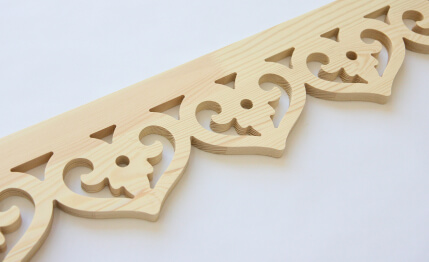
A separate story iscarved door casings, made by hand or on a CNC machine. This is no longer just millwork, but architectural decor with character. A carved trim is appropriate in homes with a distinct style: Russian terem, hunting lodge, historical interior, estate aesthetics. In a city apartment, a carved trim looks like an accent element — a bold design solution for those who are not afraid to stand out.
Modern laconic profiles
Special mention deserves profiles with straight geometric lines, sometimes asymmetrical — with one shelf or a thin groove. They work well in interiors with a contrasting color scheme and an accent door.
New wooden trimsregularly appear in the STAVROS catalog — those looking for a non-standard profile or wanting to decorate an interior according to current trends should keep an eye on assortment updates.
Materials: solid wood or MDF
This is perhaps the most pressing question when choosing a platband. And the answer depends not only on the budget, but also on operating conditions, interior style, and planned service life.
Solid wood architraves
Wooden casingsmade from solid wood — this is a choice in favor of naturalness, durability, and the aesthetics of a living material. Wood breathes, has a natural pattern, is easy to process and paint, and with proper care lasts for decades.
Oak, beech, pine, ash, and linden are most often used for making platbands. Oak and beech are hardwoods, they scratch less and retain their shape longer. Pine is cheaper but softer — in heavily used rooms it can get dents. Ash gives a beautiful, pronounced fiber pattern that looks good under clear varnish.
Solid wood door architravesare appropriate where naturalness is important: a country house, an apartment with expensive renovations, a study, a living room. They pair well with wooden door leaves made from the same or similar material.
One nuance: wood reacts to humidity. In rooms with high humidity — bathroom, kitchen — solid wood platbands need to be carefully treated with protective compounds or choose an alternative.
MDF door platbands
MDF platbandsare a modern and practical choice. MDF (medium-density fiberboard under high pressure) is characterized by stability: it does not warp with temperature and humidity changes, does not crack, and does not change geometry over time. The surface of MDF is perfectly smooth, which is critical for painting: paint lays down without pores or knots, resulting in a perfectly smooth plane.
MDF architraves are the optimal choice for interior doors in apartments with central heating, where the air is very dry in winter. Solid wood in such conditions can develop cracks and gaps, MDF does not.
In terms of price, MDF is generally more affordable than solid wood with a comparable profile. This makes it the preferred choice when finishing a large number of openings — for example, during a full apartment renovation or when furnishing a commercial space.
Where solid wood is more appropriate, where MDF is more practical
| Criterion | Solid wood | MDF |
|---|---|---|
| Naturalness | Yes, a natural wood grain | No, imitation or painting |
| Stability | Depends on wood species and humidity | High, does not warp |
| Processing | Requires regular maintenance | Minimal maintenance |
| Price | Higher | More affordable |
| Painting | Good, with primer | Excellent, perfectly smooth |
| Durability | Very High | High |
| For wet areas | Only with protective treatment | Preferable |
How to choose architraves by width
The width of the trim is not a matter of taste, it's a matter of geometry. An incorrectly chosen width leads to two problems: either the trim does not cover the joint (and the edge of the installation area remains visible), or it is too wide and visually "eats up" the wall next to the opening.
Rule for covering the joint
The minimum width of the trim must cover the installation gap with a margin of at least 10–15 mm on each side. The standard installation gap between the frame and the wall is about 20–30 mm. This means the minimum working width of the trim is approximately 40–50 mm. That is why trims narrower than 40 mm are rare and used only in special design solutions.
Standard width ranges
In practice, the following values are most common:
-
40–55 mm — narrow, laconic trim for a modern interior;
-
60–70 mm — universal size, suitable for most doors and rooms;
-
80–100 mm — wide trim, characteristic of classic and neoclassical styles;
-
over 100 mm — architectural profiles, portals, pilasters.
Narrow doors and compact rooms
In small spaces — hallway, combined bathroom, pantry — a too-wide casing creates a feeling of clutter. Here, profiles of 40–60 mm are optimal: they handle the task without visually narrowing the already small space.
Wide openings and classic interiors
A large opening — for example, a double door or arched entrance — requires appropriate framing. A narrow casing will look random and disproportionate. For wide openings in a classic interior, choose profiles from 80 mm, often supplementing them with corner blocks or decorative rosettes in the corners.
How to choose casings for a doorway without mistakes — this issue is primarily resolved through measurement: measure the actual gap, rather than relying on the 'standard' from the brochure.
How to match the casing to the door style
The casing and the door should speak the same language. This is not a metaphor — it is a design principle called visual consistency. If the door speaks the language of minimalism, and the casing responds in the language of baroque, the doorway will look like a poorly translated phrase.
Smooth panels
Doors without decoration — with a smooth surface, possibly with a matte or glossy finish — pair well with flat or minimally profiled casings. A good choice: a strip with one shelf or a small radius transition. The simpler the door, the cleaner the casing should be.
Classic doors with panels
A door with vertical or horizontal panels is already a declaration of a classic style. The casing should support it: a profile with a scotia, a heel, and several steps. It is this type of casing that creates a unified stylistic frame in which the door panels and the casing profile echo each other.
Doors in neoclassical style
Neoclassicism is a modern interpretation of classical forms. Here, more restrained profiles are acceptable than in historical classicism, but a completely flat casing will look insufficient. The optimal choice is a profiled casing of medium width (65–80 mm) with one or two relief transitions.
Doors with decorative trim
If the door leaf is equipped with decorative moldings, overlays, or carved decor, the casing should either repeat the character of this decor or deliberately contrast with it. Mixing profiles of different characters within a single opening is a common mistake that destroys stylistic integrity.
Door trim and classic furniture — this is a topic worth studying separately: properly selected trim can connect furniture and the door into a single ensemble.
Color, finish, and combination with the frame
Choosing the color of the casing is a more subtle task than it seems at first glance. There is no single correct solution, but there are several working strategies.
Matching the door color
The classic and safest strategy: the casing is painted or tinted the same color as the door leaf. This creates a unified door ensemble where all details blend into one whole. This approach works especially well when the door is an accent element of the interior.
In the color of the frame
Often the frame and casing are made from the same material and have the same finish. This is logical: they are part of one structural unit. If the door leaf is a different color, an interesting two-tone effect arises: the door itself is accent, while its framing is neutral.
Contrasting casing
A bold solution: the casing intentionally contrasts with the door or wall. For example, a white door in a dark wall with a black or graphite casing. Or vice versa: a dark door with a white casing on a white wall. This is a modern trend that works well in interiors with a pronounced concept.
Painted and natural finishes
The choice between painted and transparent (lacquered or oiled) finish is primarily determined by the material.wooden casingOak or ash with a beautiful fiber pattern is a sin to paint: varnish or oil will reveal the natural texture. MDF casing for painting allows you to get any RAL color without restrictions.
Combination with baseboard and moldings
The doorway does not exist in a vacuum — next to it on the walls and floor are baseboards, possibly moldings or wall panels. The profile and color of the casing should be coordinated with the baseboard: the same material, the same finish, similar profile thickness.How to assemble a complete door unit— a question that is answered in detail by professional STAVROS articles, and it is worth studying before starting the purchase.
Casings for interior door frames: specifics of application
Interior doors are the most common scenario for using architraves. But even in this standard case, there are nuances that determine the result.
Apartment
In a city apartment, it is important to maintain a balance between style and practicality. Most often, all doors in the apartment are identical or similar — and the architraves should be from the same series, with the same profile and color. A mismatch in details instantly makes the interior look cheaper, even if the doors themselves cost a significant amount.
For apartments with a small area, it is recommended not to overload the openings with wide architraves. A profile of 55–65 mm is a universal solution that does not narrow the corridors and does not put pressure on the walk-through rooms.
Country house
Here the scale is different: high ceilings, wide openings, often open wooden structures. A solid wood architrave is an organic choice for a wooden house, timber, or log.Solid wood door solutions — this is a complete system in which architraves, baseboards, moldings, and linear elements are united by a single material and profile.
In a country house, wider architraves are appropriate — 70–90 mm, often with a classic figured profile. Carved architraves here are perceived as a continuation of the architectural character of the building.
Commercial interiors
Office, hotel, restaurant, retail space — in commercial premises, architraves primarily perform a functional role, not a decorative one. Here, material stability, resistance to mechanical impact, ease of installation and replacement are important. MDF architraves are a practical and economically justified choice for commercial interiors.
How to choose a set without visual overload
Three rules that always work:
-
One profile — for all doors in the space;
-
One coating — color or tone should not "vary" from door to door;
-
One width — or a deliberate contrast (e.g., a wide casing for the entrance area and a narrow one for interior doors).
Typical mistakes when choosing casings
Experience shows that most mistakes are made before purchase — at the selection stage. Let's break down the most common ones.
Too narrow casing. It would seem that a smaller casing is more modest and elegant. In practice, a narrow casing that barely covers the installation gap looks random and cheap. If the gap is slightly larger than normal (which is common with crooked walls), the casing may not cover the problem area at all.
Mismatch with the door frame in style. An ultra-modern frame door with a milled groove and a casing with a classic heel profile is like two people speaking different languages. Such a combination does not create style; it destroys it.
Different tone of the extension and casing. This is a very common mistake when buying from different places or at different times. The shade of white from one manufacturer's extension and another's casing can differ significantly. The eye sees this instantly — especially in daylight.
Mixing cheap and premium profiles in one unit. An expensive door with a casing made of laminated MDF from the lower price category is money thrown away. The casing always "pulls" the overall perception of the door down or up.
Ignoring the baseboard. The casing is chosen, but the baseboard is thought about separately and later. As a result, a profile conflict arises at the junction of the casing and baseboard: different thicknesses, different angles, different colors. The casing and baseboard should be bought in one trip, from the same series.
What to buy with the casing: a complete set of trim
A competent approach to designing a doorway is to purchase all system elements at once. This saves time, eliminates mismatches in colors and profiles, and allows for perfect consistency of details.
Door frame extensions
If the wall is wider than the frame, extensions are indispensable.Door frame extensionsmust be made of the same material and have the same finish as the frame. Telescopic extensions simplify installation and compensate for minor deviations in wall thickness.
Door molding
Door trim refers to the set of all profiled products that complete the design of the opening and adjacent surfaces.Door molding— these are casings, extensions, moldings, baseboards, transition profiles. It is better to buy trim from the same series and from the same manufacturer.
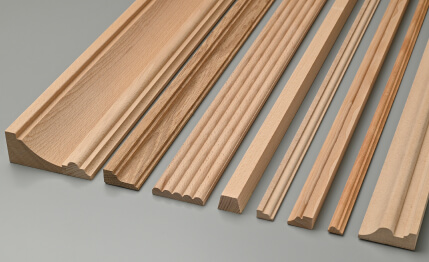
Moldings are linear profiles used to create framed compositions, zone walls, and frame openings. They come in various widths (from 20 to 150 mm) and relief complexity — from smooth to richly decorated.
Moldings are used to decorate walls around a doorway: creating frames, accent panels, and borders. They enhance the architectural character of the opening and connect the door to the room's interior. The molding can match the casing profile or intentionally differ, depending on the design intent.
Baseboards
The baseboard is the lower horizontal line of the interior. Its profile and color should be coordinated with the casing: same thickness, related profile, same finish.Materials for finishing and millwork— here you can view the full product catalog and select a coordinated set.
Decorative elements for a cohesive interior
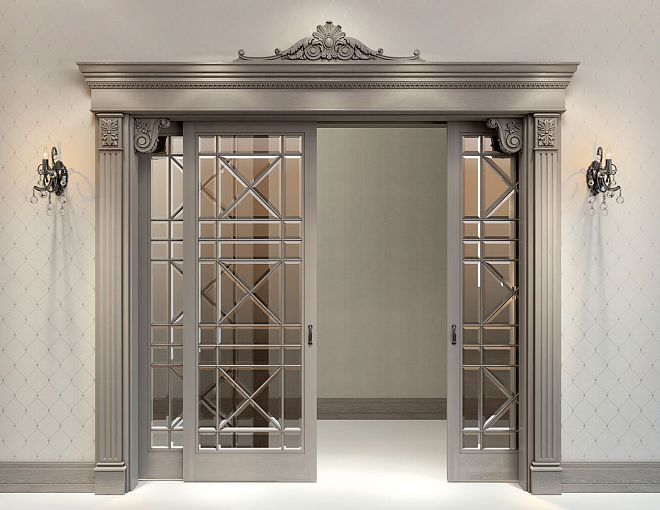
In classical and neoclassical interiors, a horizontal element — the so-called "cap" or sandric — is often installed above the doorway. Pilasters are sometimes added along the side jambs. Corner blocks and rosettes at the junctions of vertical and horizontal parts of the casing are another way to enhance the architectural character of the opening.
Where to buy door frame casings
The market offers several purchase formats — and the right choice depends on your tasks, deadlines, and budget.
Ready-made solutions
The fastest way: visit a store or website, select the desired profile from the available range, and buy. Ready-made solutions are good when the project is standard: standard wall thicknesses, standard ceiling heights, popular profiles.Wooden casingsin the STAVROS catalog — this is exactly that format: a wide selection of profiles in stock.
Custom order
If the required profile or material is not available in the standard range, production is ordered. Lead times usually range from a few days to several weeks, depending on the complexity of the profile and production load. Non-standard lengths and finishes are also made to order.
By drawings
Architectural and design projects often involve unique profiles that are not available in the ready-made range. In this case, the customer or designer provides the profile cross-section, and the manufacturer produces the casings strictly according to the drawing.Oak and beech trims and strips — here you can choose a breed for a custom profile.
When you need an individual profile
Restoration of a historical interior, an original design project, replacement of damaged architraves in a house with a non-standard profile — in these cases, a custom order is inevitable. A good manufacturer can replicate any profile from a sample or drawing.where to buy wooden items — this material describes in detail the ordering formats at STAVROS.
How to design a doorway: step-by-step selection logic
To avoid getting lost among the abundance of options, it is convenient to follow a simple sequence:
-
Measure the wall thickness and compare it with the width of the frame — you will understand if an extension is needed.
-
Determine the interior style — this will immediately narrow down the profile selection to 3–5 options.
-
Choose the material — solid wood or MDF, based on operating conditions and budget.
-
Select the width — taking into account the actual installation gap and the scale of the room.
-
Match the color — with the door, frame, baseboard.
-
Purchase the entire trim set at once — casings, extensions (if needed), baseboards, moldings.
-
Ensure profile consistency — same series, same manufacturer.
How to choose casings and extensions for doors— this question becomes much simpler when there is a clear algorithm.
Installation nuances: what to know before installation
Installing a casing is not a difficult task, but it requires precision. A few things to consider in advance.
Cutting at 45 degrees. At corners, casings are joined with a miter — at a 45° angle. The quality of this cut determines whether the corner will be beautiful or have an unsightly gap. For precise cutting, use a miter saw or a miter box.
Gap from the wall. The casing should fit tightly against the wall along its entire length. If the wall is uneven, gaps may remain under the casing. They should be filled with acrylic sealant of the desired color, not left empty.
Fastening. The casing is fixed with liquid nails, finishing nails, or brads. On smooth surfaces, liquid nails work well; on uneven ones, it is better to combine with nails for reliable fixation.
Installation order. First, install the side vertical parts, then the horizontal top part. The correct sequence and precise cutting of corners are the key to a neat result.
Current trends: what a modern doorway looks like
In 2024–2026, several clear trends in doorway design are emerging.
Monochrome solutions. The door, frame, casing, wall — all in one color. The graphic rhythm of the openings, marked by a thin casing, creates architectural expressiveness without clutter.
Contrasting frames. A dark casing on a light wall is a bold move that makes each opening an accent element. It looks especially impressive with natural veneer or painted MDF in deep tones.
Wide profiles in classic interiors. Neoclassicism is gaining strength: openings with casings 80–100 mm, corner blocks, horizontal "caps" above the door. This is not nostalgia, but a conscious architectural choice.
Natural solid wood without painting. Oil, wax, clear varnish — coatings that reveal the natural pattern of the wood. Oak, ash, walnut — the three most popular options.
Minimalist slats in japandi style. A thin, almost invisible casing — only 40–45 mm wide, smooth, with a minimal profile. The space breathes, the door almost dissolves into the wall.
Designer combinations: how to combine casing with other interior details
The casing never exists on its own. It is part of the visual system of the interior, which includes walls, floors, furniture, and lighting. A few working combinations.
White door + white casing + wooden baseboard. A light, airy solution with a warm accent at the bottom. Works well in Scandinavian style.
Oak door + oak casing + oak baseboard. A monolithic solution where wood takes the lead role. Suitable for a country house and an apartment with a warm color palette.
Dark anthracite door + dark casing + light wall. The opening as a graphic element, an architectural accent. Modern, confident, clear.
Classic white door with shaped casing + molded baseboard. A historically accurate solution for classic interiors. Requires consistency of all details and high quality execution.
How to design a doorway with casings and extensions — this is a topic that cannot be covered in a few words, but understanding the basic principles of combination already gives a huge advantage when choosing.
Door casings in different interior styles
Scandinavian style
Light walls, natural wood, minimal decor. Casing — narrow, flat, white or natural wood. No complex profiles, no carved elements. Clean lines are the main principle.
Classicism and neoclassicism
Profiled casing 70–100 mm wide with a heel, fillet, shelves. Corner blocks at the junctions of vertical and horizontal parts. Color — white, cream, or light wood tones.
Modern style
Geometrically clear flat or minimally profiled casing. Width — 50–70 mm. Color — matching the door or contrasting. Material — MDF for painting or solid wood without texture.
Loft
Industrial interior with brickwork, exposed pipes, and metal details. The casing here is often deliberately simplified or absent altogether — the joint is covered with a metal corner or left decoratively "raw." If a casing is needed, a simple rectangular dark-colored batten is chosen.
Russian classicism and Empire style
Wide casing (90–120 mm) with a rich profile, horizontal sandrik above the door, corner rosettes. Material — solid wood or polyurethane (for rooms with unstable humidity). Finish — white or gold.
Quantity calculation: how many meters of casing are needed
The question is practical but important. Calculating the required amount of casing for one door is simple:
-
Standard door opening height is 2000–2100 mm. Two vertical side casings: 2 × 2100 = 4200 mm.
-
Horizontal casing at the top: opening width (usually 700–900 mm) + 2 × casing width (allowance for trimming).
-
Total for one door on both sides: approximately 10–12 linear meters.
Always add 10–15% allowance to the calculated quantity for trimming and possible defects.
Questions most frequently asked when choosing casings
Practice shows: despite the abundance of information, buyers keep returning to the same questions. We will answer them directly and honestly.
Can you combine different profiles in one apartment?
You can — but only intentionally. For example, a wide classic casing is chosen for the living room, a narrow modern one for the bedroom. But a random mix, where each room has its own profile without design logic, gives an impression of incompleteness.
Is it necessary to paint the casing the same color as the door?
No. This is one strategy, not the only one. Casing in the color of the wall, contrasting casing, casing in the color of the frame — all options work when applied correctly.
What is more important: material or profile?
Both parameters are important, but in different scenarios. For long-term use in challenging conditions, material is more important. For creating a specific style image, profile is more important.
Can you replace casings without replacing the door frame?
Yes, the casing is a removable element. When replacing casings, the frame does not need to be touched. This is one of the most affordable ways to update the appearance of a doorway without major renovation.
FAQ: Answers to popular questions
What width of casing should I choose for a door frame?
Minimum — 50 mm to reliably cover the installation gap. Standard for most rooms — 60–70 mm. For classic interiors and wide openings — 80–100 mm and wider.
Is an extension needed for the architrave?
Needed if the wall thickness is greater than the door frame width. Measure the wall in the opening — and it will immediately become clear. The extension and casing must be from the same series and same material.
What's better: solid wood or MDF?
Depends on conditions. Solid wood — for country houses, luxury interiors, rooms with natural wood. MDF — for city apartments, rooms with central heating, commercial spaces. MDF is more stable under humidity fluctuations.
Can I choose a casing that exactly matches the door color?
Yes, if you order it made from the same material and with the same finish. When painting, you can use the same tint. If the door is veneered — choose veneer from the same species.
Can I order a non-standard size or profile?
Yes. A good manufacturer will make casings according to any drawing or sample. Lead times depend on the complexity of the profile and order volume.Door trim and classic furniture — this material describes product customization options.
How to choose a casing to match the baseboard?
Choose from the same series: same material, same finish, similar thickness and profile character. Different profiles are acceptable — it's important that they are related in spirit, not conflicting.
Can I install trim myself?
Yes, if you have a miter saw or miter box. The difficulty lies in precise 45° cuts at corners. For telescopic systems, installation is even easier: no corner cutting needed.
Do I need to prime MDF trim before painting?
Absolutely — if the trim comes without a finish coating. Primer seals pores, ensures even paint application, and improves adhesion. Trim intended for painting from a good manufacturer often comes pre-primed.
Which trim should I choose for white interior doors?
White doors pair well with white or light trim of any profile. Profile choice depends on interior style. For modern interiors — flat or minimally profiled. For classic — shaped. A contrasting dark trim on a white door is a bold and trendy solution.
STAVROS: trim you can trust
When it comes to high-qualitywooden casingsand complete door trim, STAVROS is a name that sounds like a guarantee. The company specializes in manufacturing products from solid wood and MDF: trim, extensions, moldings, baseboards, cornices, carved elements — everything needed to create a cohesive, beautiful, and durable door opening.
STAVROS produces trim products for any task — from simple apartment finishing to complex custom projects. The range includes both ready-made series in stock and custom manufacturing based on individual drawings and samples. Materials — proven oak, beech, ash, pine, as well as high-quality MDF for stability in any conditions.
Full catalogmolding productsSTAVROS allows you to select a coordinated set: trim, extension, baseboard, molding — from the same material, same profile, same manufacturer. This eliminates color and profile mismatches and guarantees results that last for decades.
Choose STAVROS — and every doorway in your home will become not a technical node, but an architectural accent backed by craftsmanship, material, and attention to detail.