










































































Article Contents:
- Where to Buy Window Casing and What to Check Before Ordering
- What window casings can be bought
- By material
- By Type of Design
- By style
- Wooden Window Casing: Why It's the Most Popular Option
- How to Choose Window Casing
- By House Style
- By Shape and Profile
- By Width and Proportions
- Carved Window Casing to Buy: When It's Justified
- What to Pair Window Casings With
- How Much Does Window Casing Cost
- How to Order Window Casing
- Selection by style and house type: cheat sheet
- Frequently asked questions about choosing and buying architraves
- How to choose the right architrave for a window?
- Which window architrave is better to buy: smooth or carved?
- What are the best window trims for a wooden house?
- How to choose an architrave based on window width?
- How to coat a wooden architrave for outdoor use?
- Can I buy an architrave for a non-standard window size?
- How many casings are needed for one window?
- Where is the best place to view a catalog of wooden architraves?
- Additional solutions for window opening decoration
- Installation: what is important to consider before mounting
- Window Casings: A Look into History and the Future
- Conclusion
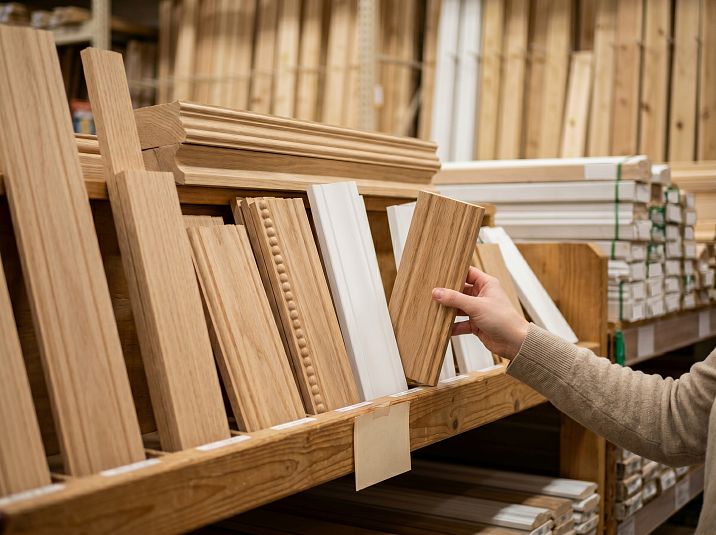
A window without framing is an unfinished thought. An architectural detail left unsaid, not brought to completion. It is preciselyCasing for a windowthat puts the final touch on the facade's appearance, turning a bare opening into a well-thought-out design element. If you want to buy a window casing and not make a mistake in your choice — this article is written specifically for you. Not a reference guide with definitions, but a practical commercial guide: what type to choose, how to match it to the house, what to combine it with, and where to look for ready-made solutions.
The modern buyer is not just looking for a standard linear product off the shelf. They are looking for a ready-made solution for the facade: so that the casing fits organically into the style of the house, does not clash with the cornice, and supports the overall character of the building — be it a strict cottage, a cozy country house, or a wooden house in the Russian tradition. This means that the choice of a wooden window casing begins long before measurements — with an understanding of what the facade should be like as a whole.


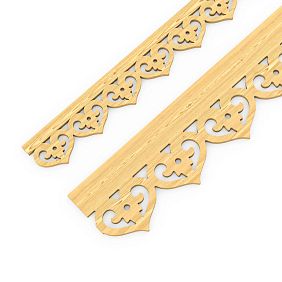
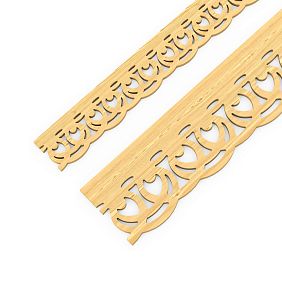


Where to Buy a Window Casing and What to Check Before Ordering
Before clicking the 'add to cart' button, it's worth pausing and going through several key parameters. The market offers a wide choice: from cheap linear products made of raw pine to handmade solid oak items. To buy window casings and not regret it — check several points.
Material. A facade casing works outdoors. It withstands rain, frost, and hot sun. Therefore, coniferous species (pine, spruce) are suitable for budget solutions provided there is high-quality impregnation, while larch is a more durable choice for a facade without constant maintenance. Oak — if maximum density and visual weight are needed.
Width and profile. The casing must completely cover the mounting gap and not look out of place. For standard windows, a width of 70–100 mm is suitable; for tall facade openings — 120–150 mm. The profile can be flat (2D), volumetric, classic with a chamfer, or shaped.
Smooth or carved. This is the main fork in the road. A smooth casing is a universal choice for a modern and minimalist facade.carved window casingis for those who want an artistic accent, Russian style, a festive wooden house with history.
Purpose: facade or interior. Exterior trim should be made of moisture-resistant material, without hollow interiors, and paintable with facade compounds. Interior trim can be thinner and made from softer wood.
Availability of complementary elements. A good supplier will offer not just thewooden window trim, but also cornices, connecting rosettes, corner overlays, and decorative brackets. This is important: a set always looks better than a collection of disparate parts.
Ordering conditions. Standard product length is 2000 mm. Clarify: whether custom manufacturing to non-standard sizes is possible, how quickly stock items are shipped, and what the delivery cost is.




What window architraves can you buy
The wooden trim market is structured by several criteria—material, design type, and style. We'll examine each block in detail so you can choose window trim consciously.
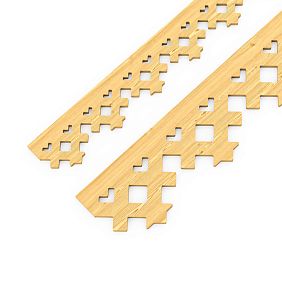
Our factory also produces:




By material
Wooden trims are the most in-demand category. Wood is a living material with natural texture, warm tones, and visual depth that cannot be replicated. Buying wooden window trims means choosing durability with proper care and unique aesthetics that neither plastic nor MDF can provide.
Solid wood trims are a segment above average. They contain no glued hollows, do not delaminate, and do not deform from humidity fluctuations. Buying solid wood window trim means making a long-term investment. Pine solid wood is a budget-friendly and common option. Oak or larch is for those who prioritize resistance to atmospheric loads.
Glued laminated panels deserve special mention—the material used by STAVROS for their products. Cross-laminated pine panels with knots and resin pockets removed are not a compromise but a technologically sound solution: resin does not seep out in sunlight, the product does not crack, and maintains its shape throughout its service life.
Options for painting and tinting. Most wooden trims are supplied without a finish—this is a plus, as the buyer chooses the finish to match their facade. Buying window trim for painting means getting a clean surface for any color: from classic white to deep walnut, dark green, or anthracite. Tinting allows you to highlight the wood grain and give the facade a noble appearance.
Get Consultation
By type of finish
Smooth trims — laconic, with an even surface. Suitable for modern homes, Scandinavian style, minimalism. They do not overload the facade and pair well with large windows.
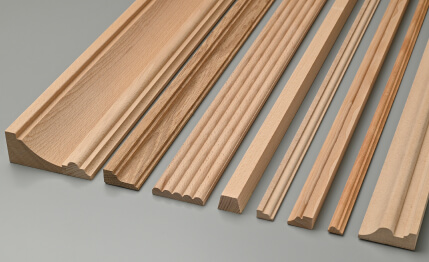
Decorative trims — with light relief, bevel, chamfered edge, or shaped profile. An intermediate option between smooth and carved — there is plasticity, but no complex carving.
Shaped trims — with pronounced geometry: stepped, arched tops, variable profile. A good choice for a cottage in classic or retro style.
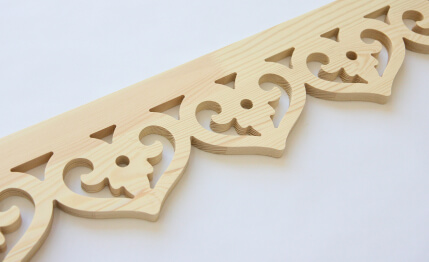
Carved trims — an artistic element with ornamentation. Flat (2D) patterns allow for building depth in the composition through layering, where narrow details are overlaid on a wide base. Buying a carved window trim means turning the window opening into an accent point on the facade. For more details on specific models, see the section House Carving.
By style
Classic trims — symmetrical profile, restrained ornament, neutral geometry. Compatible with most architectural styles. Buying a classic wooden window trim is a fail-safe solution for a house in European style.
Modern trims — straight lines, minimal relief, wide profile. For homes in Scandinavian spirit, modern wooden architecture, chalets.
Trims in Russian style — with ornaments of plant and geometric motifs characteristic of folk wooden architecture. Buying a window trim in Russian style means reconnecting with tradition, giving the house a lively folk character.
Trims for decorative facade — when the window framing is part of a larger facade composition with cornices, brackets, and overlays. Such solutions are best viewed in the section Facade Decoration.
Wooden window trim: why it is the most in-demand option
If we ask ourselves why wood wins in this niche, the answer turns out to be multi-faceted. It's not just tradition—it's a combination of properties that are difficult to replicate in synthetic materials.
Natural texture and warmth. Wood has visual depth: each board has its own pattern, its own shades, its own story. Two casings from the same species will never be completely identical—this is not a defect, it's a value. The natural texture of wood lives and changes under sunlight, giving the facade volume and warmth.
Visually expensive look. A wooden window casing signals the quality of the entire house. Even a modest cottage with a correctly chosen window frame looks well-kept and stylish. It's a detail that guests notice and that the owner sees every time they approach the house.
Appropriateness for wooden houses and cottages. A wooden house requires wooden decor—this is not a rule, it's material logic. Plastic on a log house looks inorganic. Wood does not: it continues the architecture without interrupting it. Buying wooden window casings for a house made of timber or logs means preserving the integrity of the appearance.
Compatibility with cornices and house carvings. Wood pairs well with wood. A casing,wooden corniceand carved elements from the same or a similar species create a unified facade system. This is important: disparate materials weaken the overall appearance of the facade, while unity of species and finish unifies it.
The practical aspect is no less important: wooden casings can be restored. The old layer of paint is removed, the surface is sanded, and the product looks like new again. Neither plastic nor metal offer this possibility.
How to choose a window casing
This is the most applied section of the article. There are no general words here—only specific criteria for specific tasks.
By house style
Wooden house. Here, the choice of casing is dictated by the building itself. For a log house—a pattern with folk motifs, plant ornamentation. For a house made of profiled timber—a more strict figured or smooth profile.Buy window trim for a wooden house— means accurately guessing the scale: the trim should not be smaller or weaker in character than the house itself.
Dacha. A country house allows for more freedom. Here you can play with color, choose a light pattern that doesn't aim for solemnity. Buying window trim for a dacha — most often this is a choice in favor of a practical smooth or simple decorative option made of pine for painting.
Bathhouse. Resistance to moisture is especially important for a bathhouse. Larch or high-quality pine trim with impregnation is the optimal choice. Buying window trim for a bathhouse — means choosing a material that doesn't swell from steam or darken from moisture in the shortest time.
Cottage. A cottage in a classic execution requires aristocratic framing. Wide profile, possibly — a shaped top or a decorative keystone above the opening. Buying window trim for a cottage — often this is a choice towards a set: the trim itself plus a cornice, plus decorative elements around the perimeter of the facade.
Facade with decorative elements. When the house already has brackets, pilasters, overlays — the trim should be their continuation, not a competitor. To selectwooden window framein this case, it's better based on the existing elements.
By shape and profile
Narrow trim (up to 80 mm) — for small windows, laconic facades, windows with frequent spacing. Doesn't overload the plane, preserves a sense of lightness.
Wide trim (from 100 mm) — visually enlarges the window, makes it the central element of the facade. Used where an accent is needed.
Calm profile — straight edges, minimal relief. Suitable for modern houses and where you don't want to complicate things.
Accent profile — with a bevel, steps, and a pronounced line break. Adds plasticity and shadow to the facade.
Casing with ornament — a carved version with a flat pattern. Buying a window casing with an ornament means immediately specifying the complexity of the pattern: fine openwork or a large geometric pattern. This affects both the price and the feel of the facade.
By width and proportions
Proportions are the key to harmony. The casing should match the scale of the opening: not overwhelm the window and not get lost next to it.
For small windows (up to 900 mm in width) — casing width 60–80 mm. A narrow profile will support the proportion without adding weight.
For tall openings — the casing length is selected with a margin, and the width can be slightly larger than standard so that the side planks look substantial.
For a striking facade accent — a wide casing with an ornament paired with a carved cornice and corner overlays. Such a combination turns an ordinary window into an architectural portal.
How to choose a casing based on window width: follow a simple rule — the casing width should be 8–12% of the window opening width. So, for a 1200 mm window, the optimal casing is 100–120 mm in width.
Buying a carved window casing: when is it justified
Carving is not just decoration. It is an architectural language. And it has its own grammar: a carved casing is appropriate where it finds support in the overall character of the building, rather than hanging as a lonely note on an unprepared facade.
If you need an accent on the facade. When the house wall is laconic, but you want to give the facade individuality — a carved window frame becomes a focal point. It is the window opening that is the main 'frame' for perceiving the facade, and a carved onewindow casingtransforms this frame into a work of art.
If the house is in Russian style. Carving and the Russian wooden house are historically inseparable. Folk craftsmen never left a window "bare": every opening was framed with ornamentation, every pattern carried meaning. Buying a carved window casing in Russian style means continuing this tradition with modern manufacturing quality.
If house carving is already used. If the facade features carved cornices, pediment boards, or friezes — the casings must match this language. A style mismatch between the cornice and the casing disrupts the integrity of the image. See howHouse Carvingpairs with window casings in the catalog of ready-made solutions.
If an artistic composition around the window is needed. A carved casing is part of a broader system: it can be complemented by an upper pediment insert, openwork side brackets, and connecting rosettes in the corners. All together, this creates a complete facade composition around the opening.
Important nuance:carving for casingsallows the use of the layering technique — when a narrow carved element is attached over a wide, smooth base. This provides volume and artistic depth without the need to order a solid, complex ornament.
What to pair window casings with
A well-designed facade is a system, not a collection of separate parts. The casing works as part of an ensemble, and knowing its surroundings influences the choice no less than the profile itself.
Cornices. A wooden cornice along the roof overhang is the first visual companion to the window trim. They should match in character: a concise cornice with concise trim, carved with carved. It's convenient to selectWooden cornicesto match already chosen window trims in one catalog — both style and material will align.
House carving. Bargeboards, soffits, overlay panels — all this forms the facade context. If the house hasHouse Carving, window trims are chosen so as not to stand out from its ornamental vocabulary.
Overlays and connecting elements. In corners where the side strips of the window trim meet the top one, wooden rosettes or corner overlays are used. They cover the joint and give the frame a finished look. This is a detail that defines the class of the entire solution.
Decorative elements. Brackets, central inserts, openwork corner pieces —decorative elementsallow adding artistic richness without transitioning to full carving. A good way to create a facade with 'level' on a moderate budget.
Molding products. Baseboards, moldings, cornice profiles — the entireTrimshould be maintained in a unified logic. It doesn't necessarily have to be the same ornament, but definitely the same wood species and the same finishing system.
Facade decor. If the house is conceived as a full-fledged architectural statement — the window trim becomes part of a larger facade program. See inspiring exampleswindow trimand overall facade solutions is better before placing an order: it's easier to understand what the final appearance will be.
How much does window trim cost?
Price is one of the key factors when purchasing. The range is wide: from several hundred rubles per linear meter for simple pine trim to several thousand for a carved piece of artistic class. Let's break down what determines the cost.
Material. Pine is the budget category. Larch is about 30–50% more expensive but significantly more resistant to external influences. Oak is the premium segment, but the visual result is also different.Buy solid wood window trimmade of oak is an investment that pays off with its long service life.
Type of finish: smooth vs. carved. Smooth trim is the most affordable. Adding a profile (bevel, step) slightly increases the price. Carved trim is more expensive because it requires CNC milling and subsequent manual sanding.
Size. Standard length is 2000 mm. Non-standard lengths and widths are custom-made, which incurs additional costs. Wide trim is always more expensive than narrow trim of the same length.
Complexity of the ornament. A simple geometric pattern is one price point. A complex floral ornament with fine details is another. The price of carved trim is largely determined by machine time and the complexity of post-processing.
Ready-made product or custom manufacturing. Stock item — fast shipping and fixed price. Manufacturing to individual sizes or non-standard ornamentation — more expensive, but provides full project compliance. Ordering a window casing to size — the right approach for non-standard openings or complex facade solutions.
Approximate price guide (based on STAVROS catalog data):
-
Smooth wooden casing (molding) — from 2050 rubles per item
-
Carved casing (house carving) — from 2550 to 7310 rubles per item depending on the model
-
Carved connecting elements — from 380 to 1510 rubles
Buying window casings at a reasonable price means choosing a stock item and selecting cornices and decorative elements to match it, without going into a custom order. This is the optimal path for most private houses.
How to order a window casing
The ordering process seems simple — but only at first glance. In practice, there are several steps that need to be followed sequentially for the result to meet expectations.
Step one: determine dimensions. Measure the window openings — the width and height of each window where casing installation is planned. Account for joint allowance and cut. For a standard 1200 × 1400 mm window, three planks will be needed: two side planks about 1500 mm long and one top plank — about 1300 mm. The bottom plank is often not installed during facade mounting.
Step two: choose a style. Start from the house's architecture. A wooden log house — look towards trims in the catalog and simultaneously in the section house carving. Cottage in a classic style — look for a shaped profile with appropriate ornamentation. Modern house — smooth or decorative trim with clear lines.
Step three: choose the finish. Decide whether you will paint or stain. For painting — pine with good surface preparation is suitable. For staining — oak or larch is better, where the wood grain itself is a decoration. A wooden window trim for staining acquires a warm, lively appearance that lasts for years with proper care.
Step four: assemble the decorative set around the window. Trim is the starting point, not the final one. After it — connecting rosettes, cornice, possibly — brackets on the sides. Look at Facade Decorationanddecorative elements as a possible addition to the main order.
Step five: clarify deadlines and availability. Stock items are shipped quickly. Custom-made products take time. Clarify production timelines before placing an order — especially if there are specific installation dates.
Selection by style and house type: cheat sheet
Below is a brief table for guidance when choosing:
| Object type | Recommended casing type | Material | Addition |
|---|---|---|---|
| Wooden log house | Carved or decorative | Pine / larch | House carving, cornice |
| Dacha / country house | Smooth or lightly decorative | Spruce | Cornice, overlays |
| Bathhouse | Smooth, moisture-resistant | Larch | Without complex decor |
| Cottage Classic | Figurative / wide profile | Pine / oak | Cornices, brackets |
| Modern house | Smooth / strict profile | Pine / oak | Minimum decor |
| House in Russian Style | Carved with ornament | Pine (glued panel) | House carving, frieze boards |
Frequently asked questions about choosing and purchasing platbands
Below are answers to common questions that arise before purchase.
How to choose the right window trim?
Start with three parameters: house style, opening size, material. Style determines the type of finish (smooth or carved), size determines the width and length of the strips, material determines the wood species and type of finish. The rest are details that are adjusted during the selection of the kit.
Which window trim is better to buy: smooth or carved?
Smooth is universal, economical, suitable for any facade. Carved is an artistic choice with a higher price. If the house already has elements of house carving, a carved trim is mandatory for the integrity of the image. If the facade is laconic, a smooth or light decorative option will be more appropriate.
Which trims are best for a wooden house?
For a wooden house, trims made of the same or similar material are best suited - pine, spruce, larch. For log houses and houses with pronounced folk architecture - carved trims in a traditional pattern. For modern wooden architecture - a strict profile without unnecessary decor.
How to choose trim based on window width?
Focus on a ratio of 8–12% of the opening width. For a 900 mm window - trim width of 70–90 mm. For a 1200 mm window - 100–120 mm. For wide facade windows from 1500 mm - 120–150 mm. Don't overdo it: too wide trim 'eats up' the window.
How to coat a wooden trim for outdoor use?
For facade application - facade paint or opaque impregnation. For tinting - stain followed by water-based varnish or oil-based composition. Before applying the finish - mandatory antiseptic impregnation, especially of the ends and joint areas. Without treatment, the trim outdoors will last no more than 1–2 seasons.
Can I buy trim for a non-standard window size?
Yes. Most manufacturers offer custom production for non-standard lengths and widths. The standard length is 2000 mm, which is cut to the specific size. For non-standard width (narrower or wider than standard) — you need to check production capabilities.
How many trims are needed for one window?
A standard window is framed with three strips: two side strips and one top strip (U-shaped installation). Sometimes a bottom strip is added for full framing. Corners are covered with connecting rosettes or mitered at 45°.
Where is the best place to view the catalog of wooden architraves?
In the STAVROS catalog — see the section for window and door architravesfor smooth and decorative options, and the section house carvingfor carved artistic solutions.
Additional solutions for window opening decoration
Buying an architrave is just the beginning. A professional perspective on window decorationalways includes several related categories.
Window cornices. A small protruding cornice above the casing protects the upper part of the frame from direct moisture ingress and simultaneously serves as an elegant architectural gesture.Window cornicesare available in several profiles in the STAVROS range — from simple straight to shaped with brackets.
Connecting elements. At casing joints — especially in corners — carved rosettes, openwork inserts, or geometric overlays are used. These are details that do not take up much space but significantly elevate the visual level of the entire frame.
Decor for moldings and trim. If you are working with an advanced facade decor system — pay attention todecorative elements: overlay rosettes, corner inserts, openwork brackets. They function as links between large facade elements.
Exploring ready-made facade solutions. Before placing an order, it makes sense to review ready-made examples of facade compositions — this will allow you to see how casing, cornice, and house carving work together in a real project. Such examples are available in the sectionfacade decoration.
Installation: what is important to consider before installation
Purchase is half the job. Installing the casing is the second half, which determines the final result. Several practical notes.
Surface preparation. The wall around the window opening must be level, dry, and free of flaking coating. If the wall is wooden, ensure that the timber or log does not have significant shrinkage in the window area.
Cutting at an angle. The connection of the side strips to the top is made either butt-jointed (the lower end of the side strip abuts the end of the top strip) or at a 45° angle with a mandatory rosette in the corner. Cutting at 45° requires precision—an uneven cut is immediately noticeable.
Fastening. On a wooden wall—with nails or screws followed by puttying the heads. On a plastered or brick wall—with dowels or liquid nails.
Post-installation treatment. All ends and joints after installation must be additionally coated with an antiseptic and a finishing compound. Especially the lower end of the side strips, which is exposed to moisture from rain.
Profile slope. For external installation, the casing profile should have a slight forward tilt so that water does not stagnate on the top surface. This is a technical detail often overlooked when ordering—clarify with the manufacturer when choosing the profile.
Window Casings: A Look into History and the Future
A wooden casing is not an invention of a modern decorator. It is a centuries-old tradition that has survived architectural epochs and retained its function. In Russian folk architecture, the casing carried not only a protective but also a sacred role: the ornament on it told about the owners, protected the house. Each element—a rooster, a solar disk, a plant curl—was not just decoration, but a symbol.
Today, this tradition lives on in a new form. Modern carved casings are manufactured using CNC machines, ensuring precision unattainable with hand carving. But the principle remains the same: framing the window defines the character of the house. Buying wooden window casings means choosing in favor of a living material and the centuries-old culture of wooden architecture.
At the same time, the modern buyer is not forced to choose between tradition and modernity. The assortment allows finding both a strict minimalist profile for a house in the European spirit and an ornate carved casing for a log house in the Russian style. The main thing is to choose consciously, based on the architecture of the house, not just personal taste detached from context.
More details on how towooden window trimFits into the overall facade design system, read in a separate article. Specific scenarios are analyzed there: from a modest dacha to a representative cottage with full facade decor.
Conclusion
A window casing is a detail with character. It doesn't just cover the mounting gap — it shapes the face of the house, sets the tone for the entire facade. Buying a window casing correctly means going from understanding your home's architecture to choosing a specific profile, material, and components.
If you're reading this article, you most likely already know that you want quality and results, not just 'to close the opening.' This means your path is to the catalog of wooden casings, to the section of carved solutions for the facade, and to selecting a kit for a specific house.
Take the next step right now:
-
Go to the casings catalog— wooden casings for windows and doors in several profiles and formats
-
View carved solutions— artistic casings with ornamentation for wooden houses, cottages, and dachas
-
Select a kit for the facade— casings, cornices, house carving, and decorative elements in a unified system
STAVROS Company is a Russian manufacturer of wooden decor for facades and interiors. Products are made from glued pine furniture board with knots and resin pockets removed — this guarantees shape stability and long service life. All casings are processed on CNC machines and hand-finished. Standard length — 2000 mm, thickness — 18 mm. Supplied without finish coating: you choose the finish for your house yourself. Orders — throughout Russia with delivery. STAVROS is not just a wooden casing. It's a facade solution that lasts for decades.