Article Contents:
- Where to buy window casing and why the profile choice determines the entire window appearance
- What Are Window Casings and Why Are They Needed
- What window casings can be bought
- Wooden window casings
- MDF trims
- Decorative window casings
- How to choose window casing before purchase
- By material
- By width
- By style
- By color and finish
- Wooden window casings: what are the advantages
- Aesthetics that imitation cannot reproduce
- Durability
- Repairability
- Ability to accept any covering
- Integrity of interior solution
- Window casings for interior and exterior: what to choose
- Window casings for interior
- Window casings for exterior
- Window casing dimensions
- Standard Sizes
- How to choose casing width for a specific window
- When wide door trims are needed
- How to account for slopes and opening features
- How casing affects window perception
- Beautiful window trims: how to choose based on house or interior style
- For classic interiors
- For modern windows
- For a wooden house
- For light interiors
- For accent window decoration
- How much does it cost to buy a window trim
- What affects the cost
- Where is the 'expensive' boundary
- What to combine window trims with
- Skirting boards and moldings
- Architraves and cornices
- Trims and wooden moldings
- Architraves and baseboards
- Trims and decorative molding
- Installation of trims on windows
- Surface Preparation
- Mounting methods
- Angle cutting
- Common Installation Mistakes
- Why it's important to buy quality molding
- STAVROS: wooden window casings and full interior molding
- Frequently Asked Questions
- Which window casing is best to buy?
- Which window casings to choose for a wooden house?
- Can you buy window casings for painting?
- Which casings are suitable for white windows?
- Which casings to choose for interior?
- How many casings are needed for one window?
- How to choose the width of an architrave for a window?
- Where to buy beautiful window casings?

A window without a casing is like a painting without a frame. Technically the function is performed: light passes through, the glass is held, the slopes are finished. But something is clearly wrong. The eye catches the incompleteness, the joint between the wall and the frame is not hidden, the opening looks bare and faceless. It would seem a small detail — but the impression of the entire room is different.
A window casing solves exactly this problem: it completes the window's design, conceals the installation seam, adds architectural expressiveness to the opening, and becomes part of the room's interior logic. It functions simultaneously as a technical element and a design tool. And that is precisely why choosing a window casing deserves a thoughtful approach—with an understanding of the material, profile, width, and compatibility with the rest of the finish.
If you have already decided to buy a window casing—this article will provide a complete foundation for making the right choice. If you are still unsure—read to the end. The question will become much clearer.
Looking for where to buy window casings together with moldings, cornices, and all wooden millwork in one catalog? Check out STAVROS's offer—wooden profiles, natural materials, unified collections for a cohesive interior result.


Where to buy a window casing and why the entire look of the window depends on the profile choice
Before moving on to selecting specific items, it's worth understanding one key principle: a window casing is not an isolated element. It exists in a context. Next to it are the reveals, wall, windowsill, curtains, cornices, and moldings. And each of these elements either supports the chosen profile or conflicts with it.
That's why an experienced designer never chooses window trim separately from the rest of the finish. They look at the whole picture: what style the room is, what the ceiling height is, how wide the openings are, what baseboards have already been chosen or are planned, and whether there are wall moldings.
When purchasing window trim, five parameters are fundamentally important:
-
Material — solid wood, MDF, or veneered option
-
Profile — smooth, shaped, classic, carved
-
Width — from 40 to 120 mm, depending on the scale of the opening
-
Finish — for painting, for enamel, with varnish or tinting
-
Style compatibility — the ability to combine with moldings, cornices, and baseboards from the same collection
To buy window trim correctly means to choose not just a beautiful strip, but an element that integrates into the system. It is this approach that yields a result you want to show off, not correct.




What are window architraves and why are they needed
To give a precise definition: a window trim is a profiled decorative strip that is mounted around the perimeter of a window opening and covers the joint between the frame (or slope) and the wall surface.
But that's only the technical side. In practice, trim serves at least four functions.
The first is to hide what shouldn't be visible. The mounting seam, foam, gaps, traces of slope leveling — the architrave covers all of this cleanly, neatly, and definitively. Without it, every renovation looks unfinished.
The second is to frame the window. The architrave frames the opening like a mat frames a photograph: it creates a visual border, highlights the window from the wall, and gives it a finished look. This is especially important for classic interiors, where every opening is an architectural element.
The third is to reinforce the stylistic logic of the space. A wooden architrave in a room with wooden parquet and natural moldings is not a detail; it's part of the interior language. It says: everything here is thought out, everything here is made of natural material, there is a unified system.
The fourth is protection. The architrave covers the joint from moisture, dust, and mechanical impacts. Especially relevant for facade solutions, but it also works partially in the interior.
By asking the question 'why,' it's easy to arrive at the answer 'you can't do without it.' And that's exactly right.
Our factory also produces:


What window architraves can you buy
The market offers several categories, and each addresses its own task. Let's examine them in detail.
Get Consultation
Wooden window architraves
Buy wooden window architrave— means betting on naturalness, durability, and an aesthetic that no synthetic material can replicate.
Wooden window casings are made from solid hardwoods and softwoods:
-
Oak is a dense, hard wood with a pronounced grain pattern. It is resistant to mechanical impact, takes stains, varnish, and paint exceptionally well. The preferred choice for classic and neoclassical interiors.
-
Beech has a smooth, fine-pored structure, ideal for white enamel. Its uniform surface without large pores provides a perfect coating—without drips or stains.
-
Ash features an aristocratic grain with clear parallel stripes. Suitable for light interiors, Scandinavian style, and modern classics.
-
Pine is an affordable wood, easy to work with, suitable for simple profiles. With proper drying and impregnation, it can be used both indoors and outdoors.
Advantages of wooden window casings:
-
Natural material with a unique grain pattern—each piece is one-of-a-kind
-
Multiple repaints without loss of surface quality
-
Repairability: scratches can be sanded and painted over
-
Perfect compatibility with other wooden finishing elements
-
Durability with proper coating — 30 or more years of service
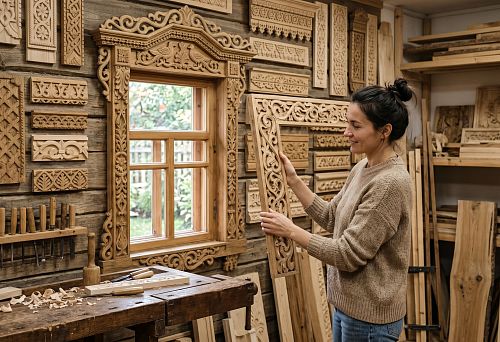
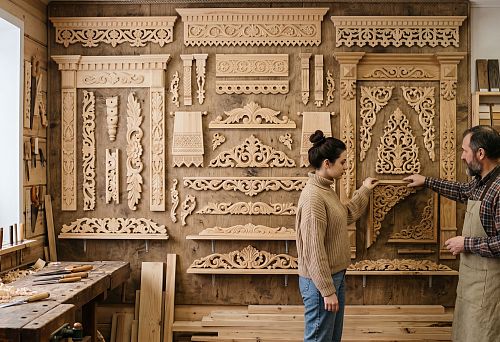
Samplesof carved wooden moldings— for those who want to see the variety of profiles before making a decision.
MDF Architraves
MDF (Medium Density Fiberboard) is a board made of pressed wood fibers with high density. The surface is smooth and uniform, and takes enamel paint well. Geometry is stable: with proper storage, it does not warp.
For which situations MDF is suitable:
-
Budget renovation without high durability requirements
-
Rental housing, where appearance is more important than longevity
-
Neutral interiors, where the architrave should simply be present without dominating
Key limitations: moisture sensitivity (swells with prolonged contact), irreparability of mechanical damage, limited number of repaints. Full range of MDF products — in the section MDF Skirting Board, where you can select matching trim in the same material.
Decorative window casings
This is a broad category that combines products with expressive character and high decorative load.
Smooth — minimalist rectangular or slightly beveled cross-section. For modern interiors, Scandinavian style, minimalism. The profile works for precision and clean lines.
Figural — multiple transitions in the profile, pronounced relief. Weight, character, classicism.Buy decorative window casings with a figural profile — the right choice for classic and neoclassical styles.
Classical — symmetrical multi-step profile, widening towards the center. Traditional European framing that looks equally good on wooden windows and plastic with proper painting.
Wide — from 80 to 120 mm. For high ceilings, large window openings, accent designs.Buy wide window casings— means turning a window into an architectural element, not just covering a seam.
Narrow — up to 55 mm. For small rooms and windows where the casing should be present discreetly, without overloading the space. The optimal choice for kitchens, hallways, bathrooms with small windows.
How to choose a window casing before buying
The goal of this section is to provide a clear, practical algorithm. Not theory, but concrete steps.
By material
Solid wood. Priority for all projects with a 10+ year horizon. Hardwoods (oak, beech, ash) withstand intensive use, maintain geometry, and allow for multiple coating renewals. With proper drying and finishing — a material for decades.
MDF. For budget projects and temporary solutions. Good geometry, smooth surface for painting — but with limited lifespan and zero repairability. If damaged — replace the entire section.
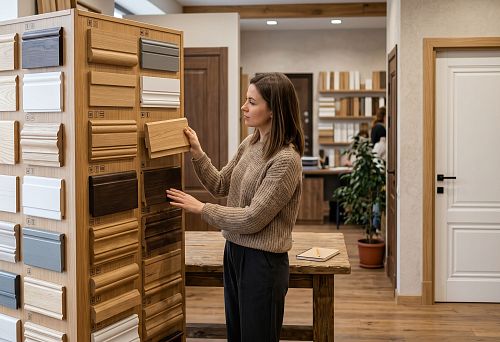
Veneered casings. An intermediate solution: MDF base, faced with thin natural veneer. Visually close to solid wood, costs less. The vulnerable spot — the veneer peels off upon impact or moisture exposure, and restoration is practically impossible.
Detailed characteristics of each type — in our guide towooden trim.
By width
The width of the casing is selected according to the scale of the opening and the height of the ceilings:
| Width | For which windows | Character |
|---|---|---|
| 40–55 mm | Small windows, narrow openings | Lightweight, inconspicuous |
| 60–75 mm | Standard windows 900–1200 mm | Neutral, universal |
| 80–95 mm | Large windows, high ceilings | Expressive, classic |
| 100–120 mm | Panoramic, accent | Monumental, architectural |
Important principle: the width of the window casing should be proportionate to the door casings in the same room. If the door has 70 mm, then on the window it is logical to have 70–75 mm — or slightly wider if the window is significantly larger than the door.
By style
Classic and neoclassical. Figurative multi-stage profile, width 80–110 mm, solid oak or beech, white enamel or natural tint. Complementwith decorative wooden moldingson the walls and a cornice near the ceiling — and the window becomes an architectural element.
Modern interior. Smooth or laconic profile, 60–70 mm, coating to match the wall or door. No unnecessary relief. Solid wood under matte varnish — a combination of minimalism with the naturalness of the material.
Wooden house. Here, wood is the only logical choice. No MDF can convey the organic nature of a wooden space. Pine or oak architraves, natural finish, possibly carved ornament — this is the language of a wooden house.Buy wooden window architravesfor a wooden house — a solution that looks as if it couldn't be any other way.
Country house. Naturalness, warmth, organic quality. A wooden window architrave rhymes with a wooden floor, ceiling beams, solid wood furniture. The interior gains integrity.
Apartment. Priorities — geometric precision, ease of installation, compatibility with standard slopes. Standard sizes, solid wood or MDF depending on budget.
By color and finish
White architraves. A classic that always works — with white windows, with light interiors, in Scandinavian style. Important detail: coordinate the white shade with the window manufacturer. RAL 9003, 9010, and 9016 read completely differently in daylight.
To match the wall color. The casing 'dissolves' into the wall, allowing the window to be perceived independently. Used as a design technique in minimalist interiors.
To match natural wood. Varnish or oil, the natural grain pattern is visible. A warm result, creating an organic connection with other wooden elements.
To match the window color. The casing and window frame are a single element. The boundary between them is blurred, and the opening is perceived as a whole.
In contrast. A dark casing on a light wall, or vice versa — an accent technique that requires confidence in the final result and, as a rule, consultation with a designer.
Wooden window casings: what are the advantages
This is not a marketing section. This is an honest conversation about why wood, despite its higher price, remains the preferred choice for window casings.
Aesthetics that imitation cannot reproduce
Natural wood is a living material. The grain pattern, pores, texture transitions — all of this is the result of decades of tree growth. In daylight, an oak casing reveals the depth and direction of the annual rings. In the evening — it highlights the volume and relief of the surface. No printed pattern on laminate or PVC provides the same effect upon close inspection.
Durability
A high-quality wooden casing made from a hardwood species, with proper coating, lasts 30–50 years. MDF begins to show signs of wear after 8–10 years: chips on the ends, swelling in the corners, wear on the coating.
Repairability
Scratched a wooden casing? Take fine sandpaper, sand the scratch, apply primer and a thin layer of paint. 20 minutes of work — the result is indistinguishable from new. MDF in the same situation is replaced entirely.
Ability to accept any finish
Want white trim now, and wood-look in 5 years? No problem. The wooden surface can be repainted any RAL color an unlimited number of times. MDF will withstand 1–2 repaints, after which the surface begins to lose its appearance.
Integrity of the interior solution
Buy window trimsmade of wood means laying the foundation for an interior with a unified material language. Wooden window trims are organically complemented bywooden corniceat the ceiling,Wooden baseboardat the floor, wall moldings. One wood species, one tint — and the room acquires an architectural logic that is felt by everyone who enters it.
Window trims for interior and exterior: what to choose
This is a fundamental question because the requirements for interior and exterior trim differ drastically.
Window trims for interior use
Interior window trim operates in stable conditions: without direct exposure to rain, wind, or ultraviolet light. This allows more freedom in material and finish selection.
The main task is to complete the finishing of the reveals and create a decorative window frame. At the same time, the trim must fit into the room's context: coordinate with baseboards, door casings, and moldings.
For interiors, the following are optimal:
-
Solid oak, beech, or ash with any finish coating
-
MDF for painting in budget solutions
-
Veneered options as a compromise between price and appearance
When creating an interior finishing system—where baseboards, moldings, and cornices must be from a single collection—it is convenient to select everything from one catalog.Buy window trimtogether with moldings and cornices at STAVROS—this guarantees a uniform profile and a uniform shade.
Exterior window trim
Facade casing is a fundamentally different context. Here, the tasks expand:
Decorative – framing the window opening from the outside, giving the facade completeness and character.
Protective – the casing covers the gap between the frame and the reveal from rain, wind, and mechanical impact.
Architectural – with the right selection, the casing shapes the stylistic appearance of the entire facade. This is especially relevant for wooden houses and houses in a classical style.
Requirements for facade casing:
-
Moisture resistance (impregnations, moisture-resistant varnishes, paints for exterior work)
-
UV resistance
-
Stable geometry with temperature fluctuations from -30 to +40°C
-
Reliable fastening considering wind loads
For wooden facade casings, it is critical: wood moisture content before installation not higher than 14–16%, high-quality end-grain impregnation, use of paints for exterior work. If these conditions are met, a wooden facade casing lasts 15–25 years.
Carved decorative window trims for wooden houses are a distinct artistic tradition.Carved casings STAVROSare made using traditional techniques, with modern tools and quality pine — for those who want to preserve the aesthetics of wooden architecture.
Window trim dimensions
Practical block without lyricism.
Standard Sizes
Standard length — 2100–2500 mm. This covers most window openings with a margin for trimming. For panoramic and non-standard tall windows — custom manufacturing.
Width: 40–120 mm. The most popular sizes are 60, 70, 80 mm.
Thickness: 12–18 mm for solid wood, 8–12 mm for MDF. The optimal thickness for a wooden window trim is 14–16 mm: sufficient for strength and not too heavy for fastening.
How to choose the width of a trim for a specific window
-
Window 600 × 1200 mm — trim 55–65 mm
-
Window 900 × 1400 mm — 65–75 mm
-
Window 1200 × 1500 mm — 75–90 mm
-
Window 1400 mm and wider — 90–120 mm
For high ceilings (2.7 m and above), the width can be increased by one size — this gives a more proportionate look.
When wide door casings are needed
Buy wide window casingsis worth considering in several situations:
-
Large window opening (from 1200 mm wide)
-
High ceilings from 2.7 m
-
Classical or neoclassical interior, where the window is an architectural accent
-
Uneven slopes with noticeable defects — a wide plank better covers problem areas
How to account for slopes and opening features
A jamb is the inner plane of an opening between the frame and the wall. If the jambs are finished with plaster or drywall, the casing is mounted over them, covering the joint between the jamb and the wall. If the jambs are unfinished, the casing partially conceals their edge.
For uneven jambs and noticeable surface variations, the optimal solution is: wide casing + acrylic sealant around the perimeter to fill gaps.
How casing affects the perception of a window
Wide casing visually enlarges the window, making it more substantial and monumental. Narrow casing keeps the window 'light' and inconspicuous. This can be used as a design tool: in small spaces, wide casing creates the illusion of a larger opening.
Beautiful window casings: how to choose according to the style of the house or interior
Beauty is not an abstract concept. In the context of window casing, it is the specific match of the profile, width, and material to the style of the space.
For a classic interior
Wide molded profile made of oak or beech, 80–110 mm. White enamel or tinting to resemble natural wood. Corner rosettes at joints are optional but add formality. Nearby —Buy wooden molding— for walls,wooden cornice— near the ceiling. The result is an interior with an architectural image, where every detail is in its place.
For modern windows
Smooth profile, 60–70 mm, matching the wall or door color. Matte varnish or matte enamel. No ornamentation. Here —buy beautiful window trims— means choosing clear geometry without unnecessary relief.
For a wooden house
A trim made from the same wood species as other wooden elements of the house. Natural oil or varnish with a slight tint. Carved ornament — if the house is in Russian or Scandinavian style. A wooden house requires a wooden trim — this is not a rule, it's the logic of the material.
For light interiors
White trim under enamel — a universal choice. Works in Scandinavian style, Provence, modern classic. Important condition: white baseboard, white doors, and white trims must be from the same batch or at least with a coordinated shade according to RAL.
For accent window decoration
Dark trim — wenge, dark oak, anthracite — on a light wall creates a strong accent. This is a technique for designer interiors with intentional contrast. Requires confidence in the concept, but when executed correctly — impressive and memorable.
How much does it cost to buy a window trim
A direct answer is impossible without context, but explaining the pricing logic is useful.
What affects the cost
Wood species. Oak and beech — more expensive than pine. The difference can be twofold or more. Hardwoods are more difficult to process, more expensive to procure.
Width. Every 10 mm addition to the width — a direct increase in material consumption and, accordingly, price. A wide oak trim of 100 mm is noticeably more expensive than a standard 70-millimeter one.
Profile complexity. Smooth profile — minimal milling, minimal surcharge. Figurative — multiple working passes along the profile, more complex machine setup. Carved ornament — manual work or special cutters, maximum labor intensity.
Coating. Sanded for painting — base cost. Finished coating (enamel, varnish, tinting, oil) — adds cost depending on the complexity of color matching.
Length. Standard lengths — available in assortment without markup. Non-standard — custom manufacturing with corresponding lead times and surcharge.
Level of decorativeness. Casing with carved ornament, applied elements, corner rosettes — this is not just a profile, it's a decorative product. The cost is higher, but the visual effect is incomparable.
Where is the boundary of 'expensive'
Competent approach: calculate the cost not per linear meter, but for the entire project. One house with five windows is approximately 25–30 linear meters of casing. With a difference of 500 rubles per meter between MDF and oak, the total difference will be 12,500–15,000 rubles. This is not an amount worth sacrificing 30 years of durability and aesthetics for.
What to combine window casings with
Window casing works within a system. Here's how this system is built.
Baseboards and moldings
Decorative wooden moldingscreate a horizontal rhythm on the walls: divide the plane into zones, form framed fields, set the scale of the space. When a wall is structured with moldings — the window opening with casing integrates organically into this grid.
Principle of profile coordination: stylistic proximity, not identity. A figurative molding next to a smooth casing — incompatibility. Figurative with figurative in the same plasticity — a system.Buy wooden moldingin the same catalog as the architraves — a simple solution to compatibility issues.
Casings and cornices
wooden cornicecompletes the system from above. In a classic interior, it completes the vertical: baseboard at the floor — architrave at the window — cornice at the ceiling. Three horizontal lines create an architectural framework, giving the room its proportions.
With high ceilings (from 2.7 m), a cornice is especially important: without it, the space feels unfinished. With low ceilings (up to 2.5 m), you can limit yourself to architraves and baseboards, avoiding cluttering the ceiling.
Models of wooden cornices — in the sectionwooden window cornices.
Architraves and wooden millwork
wooden trim items— is a complete interior system: friezes, layouts, corners, handrails, additional profiles. When all of this is executed in a unified collection from the same wood species with the same tinting — the interior gains an internal architectural logic that everyone in it can feel.
Learn more aboutfinishing with millwork products— in our extended materials guide.
Casings and baseboards
When decorating a window, a skirting board underneath it is a common element. An architrave on the sides and above the window + a window sill board + a skirting board under the sill — this is a complete window frame. A uniform material and profile on all four sides creates a finished look that is hard to take your eyes off.
Architraves and decorative moulding
buy wooden molding— a way to complement the window framing with a small decorative element: an overlay strip, a corner rosette, or a frame moulding around the architrave. In classic interiors, this technique gives the window the appearance of an architectural portal.
Installing architraves on windows
Installation is a topic that is easy to underestimate. An incorrectly installed architrave made of expensive material can look worse than a budget one installed wisely.
Surface preparation
Before installation, the reveals must be level, dry, and dust-free. If the reveals have only been plastered, it is important to wait for them to dry completely — at least 28 days for cement plaster, 7–10 days for gypsum plaster. Installing on a damp surface will lead to deformation of the architrave and peeling of the finish.
Methods of mounting
Finish nails — a classic, reliable method for wooden architraves. Thin nails (diameter 1.2–1.6 mm) with a small head. The heads are countersunk, filled with wood putty, sanded, and painted over. When done correctly — invisible.
Construction adhesive — convenient for smooth surfaces where fastener marks are undesirable. Applied in a zigzag pattern on the inner surface, the architrave is pressed and held for 5–10 minutes until it sets.
Combined method — adhesive around the perimeter + finish nails for fixation until the adhesive sets. Optimal: tight adhesion along the entire length and a reliable mechanical bond with the base.
Cutting Angles
The top horizontal casing meets the vertical side casings at a 45° angle. Tools: miter saw or miter box with precise adjustment. An error of 1–2 degrees creates a noticeable gap at the joint.
Alternative: decorative corner rosettes. Installed in corners, they cover joints and add decorative appeal. Especially suitable for classic interiors where complex profiles are difficult to miter precisely.
Typical installation mistakes
-
Installation on a wet surface guarantees deformation and detachment.
-
Inaccurate miter cut — a gap in the corner that cannot be masked.
-
Different material batches — color mismatch noticeable under any lighting.
-
Disproportionate width — a narrow casing on a large window looks unconfident.
-
No priming before painting — uneven coverage.
Why it's important to buy quality molding
Installation skill matters a lot — but it doesn't compensate for defects in poor material. A twisted casing will create gaps during installation. An unstable profile — an uneven joint in the corner. Product quality is the foundation on which everything depends.
STAVROS: wooden window casings and full interior millwork.
STAVROS is a Russian manufacturer of solid wood products with a full production cycle. Chamber drying, humidity control, precise profile milling, manual surface preparation. All products are released within unified collections — this means that architraves, skirting boards, moldings, and cornices from the same catalog will have identical profiles, textures, and finish shades.
In the STAVROS catalog you will find:
-
buy window casings— smooth and shaped profiles made of oak, beech, and ash
-
wooden trim items— skirting boards, moldings, cornices, friezes
-
decorative moldings— for walls, ceiling transitions, decorative framing
-
Wooden cornices— for ceiling finishing and area decoration
-
Carved Mouldings— for wooden houses and facade decor
-
Solid wood skirting boards— with the same profile as architraves
Retail and wholesale orders. Special conditions for designers, architects, and construction companies. Delivery across all of Russia.
Frequently asked questions
Which window architrave is best to buy?
For long-term results — solid hardwood (oak, beech, ash). Durable, repairable, can be repainted multiple times. MDF is suitable for budget and temporary solutions.
What window trims to choose for a wooden house?
Wooden ones from the same species or close to other house elements. Natural varnish coating or oil. For houses in traditional style — carved ornament. For a modern wooden house — smooth or laconic profile.
Can you buy window trims for painting?
Yes. Sanded wooden trim for painting is a popular category. Choose the profile and size, paint it yourself in any RAL color. Advantage: complete freedom in selecting the shade.
What trims are suitable for white windows?
White enameled ones are a classic that always works. It's important to match the shade of white with the window manufacturer. Also a working option is a trim in the color of the wall for the effect of 'dissolving' the frame.
What trims to choose for the interior?
Depends on the style. For classic — shaped profile, width 80–100 mm, oak or beech. For modern — smooth, 60–70 mm, matching the wall tone. For minimalism — extremely narrow and laconic. For Scandinavian style — white, simple profile.
How many trims are needed for one window?
For one window with two-sided finishing: 4 vertical strips (2 on each side) + 2 horizontal ones (one on top on each side). Total 6 pieces. For one-sided installation (only inside) — 3 pieces. Add 10–15% reserve for cutting.
How to choose the width of a window casing?
Base your choice on the window opening width: up to 900 mm — 55–65 mm trim, 900–1200 mm — 65–80 mm, over 1200 mm — 80–100 mm or more. Consider ceiling height: for ceilings from 2.7 m, increase the width by one step.
Where to buy beautiful window trims?
From a manufacturer with a full range — so that window trims, door trims, baseboards, and moldings can be sourced from a single collection.Buy wooden window architravesAt STAVROS — with the ability to select a complete set of millwork for your project.