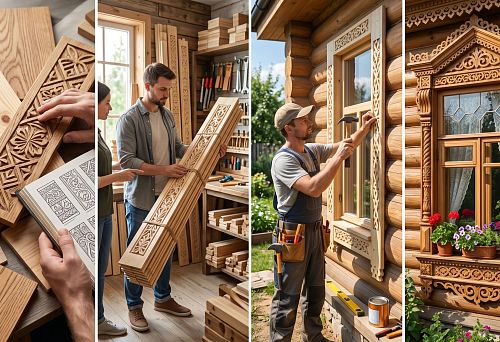
Article Contents:
- What is a window trim for a wooden house and why is it needed
- Practical Function
- Decorative function
- Which window trims are suitable for a wooden house
- Smooth window trims
- Profiled architraves
- Carved architraves
- Window trims with decorative patterns
- Solid Wood Casings
- Why wooden window trims are the best solution for a wooden house
- How to choose window trims for a wooden house
- By house type: timber, log, frame
- By facade style
- By window width and proportions
- By decor type: smooth, classic, carved
- By material and finish
- Carved window trims for a wooden house: when they are especially appropriate
- How to complement window trims so that a wooden house looks cohesive and expensive
- Window trims for houses made of timber, logs, and country wooden houses
- For a timber house
- For a log house
- For a country wooden house
- For a cottage in classic style
- Mistakes when choosing window trims for a wooden house
- Where to buy window trims for a wooden house
- What to look at first
- Ready-made window trims vs custom-made
- Why STAVROS is suitable for decorating a wooden house
- Conclusion
- Frequently Asked Questions (FAQ)
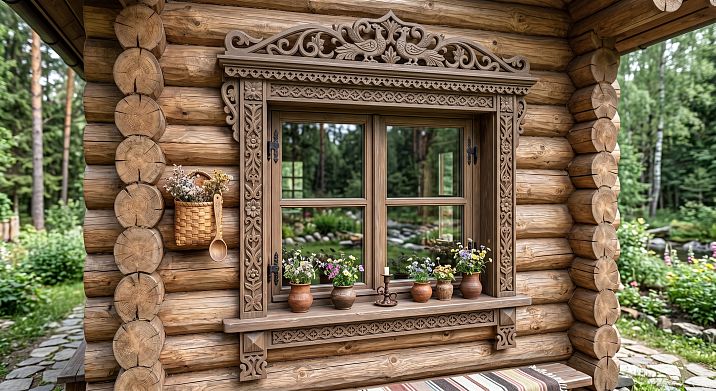
A wooden house speaks to the world in its own language—the language of texture, warmth, and imagery. And in this conversation, there are no trifles: every board, every corner, every element of the facade either enhances the impression or ruins it. Window trim for a wooden house is one of those elements that is instantly read by the eye and shapes the overall picture. A neat carved window frame or an elegant solid wood profile gives the house character. Bare openings without framing signal incompleteness.
If you're looking for window trim for a wooden house — whether it's a log cabin, modern timber, or a country cottage — this article is for you. No general talk about renovation, no digressions into interior doors. Only what matters specifically in the context of a wooden house: selection, style, material, systematic window and facade design. And — concrete answers to the question of where to buy window trim for a wooden house so that the result is cohesive and durable.


What is window trim for a wooden house and why is it needed
To be honest — the question 'why?' in relation to a wooden house is almost rhetorical. Here, the trim performs two absolutely equal functions simultaneously, and it would be a mistake to prioritize one over the other.




Practical function
Window trim for a wooden house covers the installation gap between the window frame and the wall opening. In a timber or log house, this gap is particularly significant: wood lives, breathes, settles — and gaps are inevitable over time. The trim keeps this joint closed, protecting it from drafts, driving rain, insects, and birds. This is not a decorative whim, but a structural necessity.
Furthermore, window trim in a wooden house absorbs indirect loads from the log house's settlement, covering expansion joints and maintaining a neat appearance of the opening even after years of active wood 'movement'.
Our factory also produces:


Decorative function
This is where the real thing begins. Decorating windows in a wooden house with trim is not just about closing a joint. It's an architectural statement. A carved trim with a traditional pattern turns an ordinary window opening into a focal point around which the entire facade composition is built. A wide classic profile with a shaped top gives the house monumentality. A concise, smooth oak trim gives it modern restraint.
Look at old Russian wooden houses: their 'face' is the windows. It was through the window framing that the house's status, the owner's taste, and belonging to tradition were read. This logic hasn't aged — it works today just as it did two hundred years ago.
Get Consultation
What kind of trim is suitable for a wooden house
The trim market is wide and diverse. Let's break down the typology — not formally, but with a focus on the real tasks of a wooden house owner.
Smooth trim
Minimalism is also a choice. A smooth rectangular solid wood profile without relief or with a slight chamfer looks good on houses in Scandinavian, modern country, or loft-wood styles. If the facade itself is expressive—through log texture, stain color, or a complex roof shape—a smooth casing does not 'compete' with this background but calmly frames it.
A smooth profile is also convenient for painting: it takes enamel, stain, and glaze perfectly. If you want to highlight the casing with a contrasting color against the wall, the smooth option provides a clean, graphic result.
Profiled casings
Between smooth and carved lies a wide range of profiled casings with shaped cross-sections. Beads, rolls, chamfers, stepped offsets—all of this creates a play of light and shadow, making the casing three-dimensional and expressive even without complex ornamentation. Classic casings for wooden houses fall into this category: they are appropriate in almost any stylistic context—from traditional Russian to modern neoclassical.
The width of profiled casings for wooden houses is generally wider than for interior ones—from 60 to 120 mm or more. This is important: on a house facade, a narrow casing gets lost, especially if the walls are dark or have a pronounced texture.
Carved casings
This is the highest level.carved platings for a wooden house—products with ornamentation, milled or hand-carved into the board surface. Floral patterns, geometric designs, solar symbols, wooden lace—all of this turns a window into a piece of applied art.
A carved casing is not only beautiful. It is also a historically justified choice: in traditional Russian wooden architecture, carving on casings was the main decoration of the house.Wooden patterns on windowscarried symbolic meaning—they protected the home, warded off evil spirits, and brought prosperity. Today, this meaning is more cultural than mystical, but the tradition lives on.
Casings with decorative patterns
A separate variety is a base casing plusDecorative Wooden Patternsas overlay elements. Milled or carved overlays—a flower, a curl, a geometric pattern—are attached to a straight board. This is a hybrid solution: you can combine a smooth base with different patterns, creating a unique composition for a specific house.
Buy Wooden Patternssold separately—a sensible approach for those who want to add decoration to already installed architraves or assemble a non-standard combination.
Solid wood architraves
By material—a separate category.Solid wood architraves for a wooden house—this is solid or glued wood without synthetic bases. For the facade, this is fundamental: MDF doesn't work outdoors, PVC loses its shape with temperature fluctuations, and polystyrene foam crumbles from moisture and frost.
Oak architraves for a house—maximum hardness, pronounced texture, resistance to moisture and mechanical impact. Oak on the facade will last 30–50 years with proper treatment. Beech architraves for a house—slightly lighter, perfect geometry, holds its shape and coating well. For outdoor use, beech needs reliable varnishing or oil impregnation. Pine and spruce—an affordable option with good resin content, which itself protects against rot; excellent for country houses and cottages in the mid-price segment.
Why wooden architraves are the best solution for a wooden house
Ask yourself: would it be strange to put a polystyrene foam architrave, made 'to look like wood,' on a wooden house? Strange—and how. Because an imitation next to a real material always loses. Visually, tactilely, in terms of durability.
Wooden architraves for a house—this is not nostalgia or conservatism. It's a pragmatic choice justified by several arguments at once.
Visual integrity with the facade. Wood to wood—this is natural harmony. Walls made of logs or timber and architraves made of the same or a related material create a unified facade canvas. The question 'where did this come from?' doesn't arise—everything looks organic, as if the house grew that way from nature.
Climate resistance. Properly treated wood for facade application is one of the most durable materials. Larch, oak, or pine with quality impregnation can withstand several decades without serious maintenance. Wooden products for home decoration do not 'warp' from summer heat or crack from winter frost—unlike synthetic alternatives.
Repairability. A crack, chip, or darkening—all can be resolved with local sanding and coating renewal. No complete replacement needed. Wood is restoration-friendly.
Tinting for any design. Wooden architraves for painting are the perfect base for realizing any color concept. Want contrasting white architraves on a dark timber facade? No problem. A delicate gray stain on pine? Elegant. Dark walnut to match the roof color? Convincing.
Compatibility with the decorative ecosystem.wooden corniceabove the window,Wooden trimaround the perimeter of the opening, carved overlays, and ornamental inserts—all are made from the same wood species and in the same style, forming a unified facade system.
That is why buying wooden architraves for the house is an investment in the facade, which pays off not only with a long service life but also with consistently high visual results.
How to choose architraves for a wooden house
The question of choice is the most frequent and multi-layered. Let's break it down by each significant parameter.
By house type: timber, log, frame
What kind of trim is suitable for a timber house? A timber house has even walls with horizontal seams. Both smooth and profiled trim of medium width (70–100 mm) are appropriate here. Carving will look organic if the house is decorated in a traditional or classic style.
What kind of trim is suitable for a log house? A log cabin has maximum texture. Here, the trim must have character: a narrow smooth profile gets lost against the background of logs. The best choice is a wide profiled trim or carved trim with a pronounced pattern. Width from 80 to 120 mm or more.
A frame wooden house is more neutral architecture. Here, both a modern smooth profile and a classic one, and moderately decorative are possible. The main thing is to choose a style and stick to it.
By facade style
This is a key question that is most often ignored when purchasing. How to choose trim according to the style of the house:
-
Traditional Russian style is a wide carved trim with a plant or geometric ornament, necessarily with a 'loban' (top horizontal board) and a 'ochelie'.patterns on wooden house mouldingshere is the basis of the image;
-
Classic country house is a profiled trim with several relief steps, a light carved ornament on the end is possible;
-
Scandinavian style, modern country is a clean profile, minimal decor, often for painting in a contrasting color;
-
Neo-Russian, ethnic is rich carving, traditional symbols, wide frames with finials;
-
Modern eclecticism is a smooth oak profile with an open texture under oil or varnish.
By width and window proportions
Proportion is the law. How to choose window trims for a wooden house considering size: the higher and wider the window, the wider the trim should be. A small window in a sauna or attic — 50–70 mm trim width. A tall window in a two-story cottage living room — from 100 mm and more. For non-standard openings with a shaped top — custom profile.
Trim thickness on the facade: at least 20–25 mm. A thin board outdoors warps faster, holds fasteners worse, and looks unreliable.
By type of decoration: smooth, classic, carved
Three levels of complexity:
-
Smooth — easier to install, lower in price, universal;
-
Profiled classic — medium price, expressive result, suitable for most wooden houses;
-
Carved — highest decorative value, requires precise alignment with the house style, maximum visual effect.
By material and coating
For exterior use — only solid wood of hard or resinous species: oak, larch, pine. Before installation — antiseptic impregnation is mandatory. After installation — finish coating: oil, varnish, enamel, or stain. Without this, even the highest-quality trim will last significantly less.
Carved window trims for wooden houses: when they are especially appropriate
Let's talk about carved window trims separately — they deserve it.
Carving on a window trim is not just a pattern. It is a language with which the house speaks to the one looking at it.Wooden patterns on mouldingstraditionally contained encoded images: a solar wheel, a grapevine, a water wave, a bird, a flowering branch. Each region of Russia had its own characteristic design. Volga houses — lace of floral ornament. Northern ones — strict geometry with volumetric openwork. Ural ones — massive, 'fleshy' carving with deep relief.
Today, this cultural heritage is not a museum artifact, but a living resource for decorating a wooden house.can decorate cornices, window sills and other interior elements, emphasizing their decorative value.are relevant in modern wooden house projects just as Baltic simplicity is in Scandinavian ones.
It is especially worth buying carved window trims for a wooden house when:
-
The house is built in a traditional or Neo-Russian architectural concept;
-
The facade already has other elements of house carving —wooden cornicewith ornament, bargeboards, trims above the porch;
-
I want to emphasize the individuality of the house, to make it stand out among the neighbors;
-
The house is being built 'in the old style' — log architecture, dark logs, forged details;
-
Wooden decor is also planned in the interior — carved doors, beams, stair posts.
An important nuance: how to choose the pattern of the window surrounds in accordance with the scale of the house. A fine lace ornament gets lost on a large facade — it is not visible from a distance of ten meters. For a large house, carving with a large, readable pattern is needed: wide blades, pronounced loops, voluminous curls. For a small country house, on the contrary, a more delicate openwork pattern is suitable.
How to combine window surrounds with cornices and house carving — the main principle: the ornament of the window surround and the ornament of the cornice should be from the same 'family'. Not necessarily identical, but related in pattern and scale. If the cornice carries a plant motif, a window surround with geometric patterns will create dissonance. If the cornice is strict and profiled — a carved window surround looks appropriate as a contrasting accent.
What to add to window surrounds so that a wooden house looks cohesive and expensive
One window surround on a window is better than nothing. But a system of several coordinated decorative elements — that's already architecture. It is here that a wooden house transforms from a structure into an image.
Cornices.wooden window cornices— the upper horizontal plank above the window opening. In traditional architecture, this is a separate, often the most decorative element: it is the cornice that carries the main carving, it is the first thing seen when looking at the facade.wooden cornicein the same style as the window surrounds creates a complete window 'frame', which is perceived as a single element.buy wooden cornicefrom the manufacturer — means guaranteeing the unity of material and finish with the other elements.
House carving.Decorative elements for the facade of a house— pricheliny, wind boards, podzory, lobani — elements that in traditional architecture form a full decorative ensemble. In this system, the window surround is one of the 'voices' in the choir, but not the soloist. When the entire facade is designed in a unified style, the house acquires that very integrity which cannot be conveyed in words but is instantly felt when looking at it.
Wooden patterns and ornaments.wooden ornamentin the form of applied decorative elements — rosettes, medallions, frieze inserts — place on the facade planes, around windows, under the cornice. This is the very detail that turns a 'just wooden house' into a 'beautiful wooden house'.wooden ornamenton the facade — is an author's statement, visible from afar.
Molding.wood trim itemscover joints, frame transitions between elements, create smooth horizontal or vertical lines on the facade. Glazing beads, friezes, battens — all of this works in the 'sheathing' between large decorative elements and gives the facade completeness.Wooden Picture Framearound the window opening — is one of the simplest and most effective techniques.
Facade decorative elements.facade decorative elements— corner overlays, pilasters, pediment decorations — complete the picture. There is not a single classic wooden house with rich trim where window surrounds exist in isolation from other decor.
Window surrounds for houses made of timber, logs, and country wooden houses
Wooden houses are different. The approach to choosing window surrounds should also be different.
For a timber house
A timber-framed house is architecturally more restrained than a log house. Smooth facades, clear geometric lines. Here, window trims can be chosen widely: both smooth profile for painting, and profiled classic, and moderately carved. Window trims for a timber house with a width of 80–100 mm look proportional on most windows.
If a timber house is built in a modern Scandinavian style — a smooth white or gray pine trim is ideal. If in a traditional Russian style — profiled with an ornament or carved with a plant motif.
For a log house
A log house is maximum texture and maximum tradition. Window trims for a log house must have their own volume and character, otherwise they simply 'drown' in the wall texture. Minimum width — 80 mm, recommended — 100–120 mm and more. Carving here is not only appropriate but also historically justified: it was log houses that traditionally carried the richest decoration.
Wooden patterns on housesIn log architecture — it's a dialogue with tradition. Even one quality carved trim on each window already creates an atmosphere.
For a country wooden house
A dacha is simplicity and warmth. No lush carving is needed here, no monumental profile. Window trims for a country wooden house — a modest but expressive smooth or light profiled option. Pine for staining, white paint, or just varnish. It is important that they are made of solid wood — for a dacha, this is a matter of durability: synthetics do not survive outdoors in a variable climate.
For a cottage in a classic style
A wooden cottage with classical architecture — a gable roof, symmetrical facades, columns or pilasters — requires an appropriate window trim. Window trims for a wooden cottage in a classical style: profiled with several relief steps, made of oak or beech, with varnish or oil finish. A cornice plank above the opening is mandatory.Carved wooden ornament – this is an art that preserves traditions of the past and finds its place in modern interiors. It can decorate any space, adding style, elegance, and individuality. Use wooden ornaments to create expressive accents, decorate facades, furniture, and walls, and you will transform your space, making it unique and irreplaceable!On corner overlays will complement the classical image.
Mistakes when choosing window trims for a wooden house
These mistakes occur regularly — and each of them reduces the result. Remember so as not to repeat.
Too simple a profile for an expressive facade. A smooth rectangular casing on large log walls looks as if it was taken from another house. It doesn't hear the context. The rule: the more complex and textured the facade, the more expressive the casing should be.
Too fine a pattern. The thinnest lace carving, visible only up close, is not decoration for a facade. It will be lost at a distance of five meters. FacadeCarved wooden decorationmust be legible from the street — large, clear, and in relief.
Lack of combination with cornices and decor. Casing as a separate element is half the job. If the cornice above the window is profiled and the casing is smooth — a visual break occurs. How to combine casings with cornices and house carving: everything should speak the same language. The best way is to order casings, cornices, andTrimming Itemsfrom a single source.
Choosing casings without considering the scale of the house. A small casing on a large two-story cottage is a joke. Look at the proportions: the height of the facade, the size of the window, the distance from the ground to the window. The larger the house — the more substantial the trim should be.
Mixing styles.can decorate cornices, window sills and other interior elements, emphasizing their decorative value.and Scandinavian straight lines on one facade is a challenge that only experienced architects handle. If you're not sure — stick to one stylistic direction.
Saving on material. MDF, PVC, polystyrene on the facade of a wooden house is a compromise you pay for within 3–5 years. Peeling, cracks, color change, deformation from moisture and frost. Only solid wood for exterior use. Only antiseptic and quality finishing coating.
Where to buy casings for a wooden house
When the question of 'how to choose' is settled, a practical one arises: where exactly to buy trim for a wooden house and what to look for when choosing a supplier?
What to look for first
Material. The supplier must transparently indicate the wood species and moisture content. For exterior use — only kiln-dried wood (moisture content 8–12%), only antiseptic-treated blanks. Ask — a conscientious manufacturer will answer without difficulty.
Assortment in a unified style. The best scenario for ordering trim for a wooden house is where there are simultaneously cornices, moldings,decorative wooden ornaments, facade elements. This is the only way to assemble a facade without 'mismatch'.
Quality of processing. Sanding should be final — without milling marks, without burrs, without angular roughness. Carving — clear, with smooth edges. Glued solid wood joints — invisible.
Possibility of kit assembly. A good supplier will offer not just a linear meter of trim, but a complete kit for a window: side planks, top lintel, corner elements or rosettes. This is convenient and eliminates on-site fitting.
Trim for a wooden house price — is an important parameter, but not the only one. Cheap trim made from undried pine will warp and crack within a year. The average price for window trim for a wooden house made from quality pine is from 500–900 rubles per linear meter; oak and beech profiles — from 1500 to 4000 rubles. Carved trim — from 3000 rubles per element and up, depending on the complexity of the ornament.
Buying wooden window trim from the manufacturer is always more advantageous than from a retail construction store: direct prices, the ability to choose the wood species, profile, finish, sometimes — custom manufacturing to individual sizes.
Ready-made trim vs custom manufacturing
Buy ready-made wooden architraves — quickly, conveniently, if the standard size fits. Standard for most houses: width 60–100 mm, thickness 20–25 mm, length 2–3 meters. If your windows are non-standard or you want a special profile — custom order. Lead time — usually 2–4 weeks depending on complexity.
Why STAVROS is suitable for decorating a wooden house
STAVROS — a manufacturer of solid wood products with its own production and a wide catalog covering all main tasks of wooden house decoration: fromthe wooden skirting boardto systemic facade decor.
House carving — a priority. In the STAVROS catalog, house carving is not a random section, but an independent direction. Here you can selectwindow architraves for a wooden housewith different types of ornament — from traditional Russian to modern geometric.Patterns wooden window casingsare manufactured on professional milling and CNC equipment and hand-sanded — the result confirms this.
Unified decor system for the facade. STAVROS — not a single-SKU store. Here you simultaneously havewooden cornice, wood trim items, decorative elements, Carved wooden items occupy a special place in this regard. Wood carving not only emphasizes the aesthetics of a room but also gives it warmth, lively energy, and uniqueness. In modern interiors, carved elements are widely used due to their unique properties and adaptability to any style—from classic to minimalism.for facade and interior. Everything — from solid wood, everything — in coordinated profiles and styles. This is precisely what allows assembling a cohesive facade, not a collection of random parts.
Selection of wood species and finishes. Oak, beech, pine, larch — depending on the task and budget. For painting, for tinting, for oil or varnish — options are available.
Consultation and expertise.Solid Wood Items— is the company's core profile, not a side business. STAVROS specialists will help select architraves for a specific house type, facade style, wood species, and window size.
Conclusion
Architraves for a wooden house are not a finishing touch that can be added later. They are a structural element of the facade that determines whether the house will look complete and cohesive or remain 'under construction'.
The best result is always systematic. Wooden house architraves paired withwooden window cornices, facade decorative elementsandwooden moldingcreate that unity of the facade for which wooden houses are essentially built. Not just shelter from the rain, but a place with character and history.
Choose only solid wood for exterior use. Think of the facade as a system. Consider the scale of the house, the architectural style, and how the architrave will work in conjunction with cornices, patterns, and other decorative elements. With this approach, a wooden house becomes what it should be — alive, warm, and unique.
STAVROS offers a complete arsenal to solve this task:window architraves for a wooden housemade from solid wood — from smooth profiles to complex carved ornaments;Buy Wooden Patternsfor applied decoration;buy wooden ornamentfor corners and frieze;buy wooden moldings in Moscowand regions with delivery. Everything is in the catalog, everything is made of wood, everything is part of a unified decoration system for a wooden house.
Frequently Asked Questions (FAQ)
How do window trims for a wooden house differ from regular window trims?
Window trims for a wooden house are typically designed for exterior use: they are made from denser wood species, have greater thickness (from 20 mm), and must undergo antiseptic treatment. Interior trims are thinner and softer in material.
Which wood species are best suited for exterior window trims?
For exterior use, the best options are larch (most resistant to moisture), oak (hard, durable, prestigious), pine (affordable, resinous, holds impregnation well). Beech for facades requires particularly thorough protection from moisture.
How much do window trims for a wooden house cost?
The price depends on the wood species and profile. Smooth pine trims start from 400–700 rubles/linear meter. Profiled oak trims start from 1500–3500 rubles/linear meter. Carved trims start from 3000 rubles per element. A ready-made set for one window (4 planks plus corner rosettes) ranges from 2500 to 15,000 rubles and above.
Do casings need to be treated before installation?
Absolutely. At minimum, antiseptic impregnation. For outdoor use, additionally a fire retardant (fire protection). After installation, a finish coating: oil, varnish, or enamel. Without protection, even oak on the facade will degrade in 5–7 years.
Can casings be purchased individually, not by the meter?
Yes. Most manufacturers sell casings both by the linear meter and as window kits. Carved decorative casings are often sold individually or as kits — side pieces, top lintel, corner elements.
How to choose a casing pattern for a wooden house?
Focus on the house style and window size. For a traditional Russian house — plant or solar ornament. For classic — geometric or order-based. The pattern should be legible from a distance of 5–10 meters, so for large houses — large relief patterns, for smaller ones — more delicate ones.
Do casings need to be replaced during the settling of a new wooden house?
Installing casings in a new log house is best done after the main settling (1–2 years after construction) or provide for sliding fasteners. If casings were installed before settling — after it, they will most likely need to be reinstalled or replaced.
Can carved casings be used for a modern wooden house?
Yes, and it's advisable — provided the ornament style is chosen correctly. For a modern house, geometric or abstract patterns in flat milling technique are suitable. They look contemporary while maintaining a connection to the wooden tradition.