Article Contents:
- What Are Moldings and Why Are They the Foundation of Classic Interior Design
- Definition: From Ancient Orders to Modern Interiors
- Functions of Moldings: From Technical to Aesthetic
- Types of Moldings: Classification by Application
- Furniture Overlays: From Utility to Art
- What Is a Furniture Overlay: Definition and History
- Types of Overlays: Classification by Form and Function
- Materials and Manufacturing Technologies for Overlays
- Technique for Creating Visual Rhymes: From Theory to Practice
- First Principle: Unity of Profile
- Second Principle: Repetition of Ornament
- Third Principle: Scale Coordination
- Fourth Principle: Rhythm and Repetition
- Fifth Principle: Color Unity
- Where to Apply Moldings: Practical Scenarios
- Wall Framing: Panel Systems
- Door Framing: Architraves as Architectural Frames
- Mirror Framing: Frames as an Extension of Architecture
- Picture and Panel Framing: Gallery Hanging with Moldings
- Profile Repetition Technique: From Walls to Furniture
- Choosing a Base Profile: Where to Start
- Profile Scaling: Creating a Family
- Coordinating Overlays with Molding Profiles
- Examples of Visual Rhymes in Real Interiors
- First Example: Classic Living Room with Paneled Walls
- Second Example: Neoclassical Bedroom with Minimal Decor
- Third Example: Provencal Dining Room with Patina
- Frequently asked questions: practical answers
- First Question: How Much Does It Cost to Create a System of Visual Rhymes in an Apartment?
- Question two: is it possible to create visual rhymes in a modern interior?
- Question three: is it necessary to use solid wood or will MDF work?
- Question four: how to coordinate visual rhymes with different furniture in different rooms?
- Question five: can visual rhymes be added to an already finished interior?
- Question six: how to care for moldings and overlays?
- Conclusion: the visual poetry of interior by STAVROS

Why do some interiors look like a cohesive work of art, while others resemble a random collection of items, even if the furniture is expensive and the walls are beautifully painted? The secret is not in the amount of money, not in the square footage, not in the quantity of decor. The secret lies in visual rhymes, in the repetition of forms that connect the architecture of the walls with the architecture of the furniture, the ceiling with the floor, the doors with the mirrors.Wooden moldingson the walls echo the profiles of door casings, and those, in turn, rhyme with framesoverlays on furniture— and now the interior transforms from chaos into a symphony, where every detail responds to another, where the eye moves along a meaningful route, where space gains internal logic.
What is a visual rhyme in design? It is the repetition of a certain motif — a profile, an ornament, a proportion — in different elements of the interior. Similar to how rhyme in poetry creates musicality by linking lines, a visual rhyme connects objects, creating unity in composition. The same cove on a wall molding and on a door casing. The same acanthus ornament on a carved overlay of a chest of drawers and on a decorative rosette above a door. The same profile width, repeated in the baseboard, cornice, mirror frame. This is not primitive copying, but a subtle system of echoes that the subconscious notices, creating a sense of completeness, harmony, and professionalism of design.
Why exactlywooden wall moldingsandfurniture appliquésbecome the main tools for creating visual rhymes? Because they are decorative but not self-sufficient — they frame, emphasize, structure. A molding by itself is just a strip, but forming a frame on the wall, it creates a panel, an architectural division. An overlay by itself is just a carved element, but glued onto a cabinet front, it transforms a smooth door into a piece of joinery art. And when the profile of the molding is repeated in the frame of the overlay, the two elements begin to converse with each other across the space of the room.



What are moldings and why are they the foundation of a classic interior
Before talking about rhymes, it is important to understand the nature of the tool itself — what moldings are, where they came from, what functions they perform.




Definition: from ancient orders to modern interiors
A molding is a profiled strip made of wood, plaster, polyurethane, or MDF with a shaped cross-section, intended for framing, dividing, structuring surfaces in an interior. Unlike a simple strip with a rectangular cross-section, a molding has a complex profile — coves, rounds, beads, fillets — creating a play of light and shadow, visual interest, and architectural quality.
The history of moldings dates back to ancient architecture. Ancient Greek temples had a complex system of profiled elements — column capitals with volutes, cornices with dentils, bases with tori and scotias. Each element of the order system — Doric, Ionic, Corinthian order — was a set of specific profiles, repeated with mathematical precision. The Romans developed the system, adding opulence and monumentality. The Renaissance revived ancient principles, applying them to palace interiors — walls received panels framed by profiled strips, ceilings — coffers with moldings, doors — casings with classical profiles.
The Baroque of the 17th-18th centuries brought the use of moldings to its peak — every surface was divided, framed, decorated.Decorative wooden moldingscovered walls from floor to ceiling, forming complex panel systems, frames, and surrounds. Carving, gilding, and polychromy turned moldings into works of art.
Classicism of the 18th-19th centuries simplified the Baroque excess, returning to ancient strictness. Moldings became more restrained, profiles cleaner, repetitions more regular. It was Classicism that created the system of moldings we know today — baseboards, cornices, casings, wall moldings with specific profiles, repeated throughout the house.
Modernism of the 20th century rejected moldings, proclaiming 'ornament is a crime'. Walls became smooth, without divisions. But by the end of the 20th century, a return began — postmodernism, neoclassicism, contemporary classicism once again turned to moldings, but now consciously, using them as a tool to create structure, not just decoration.
Our factory also produces:


Functions of moldings: from technical to aesthetic
The technical function of moldings is to cover joints, transitions, and gaps. A baseboard covers the joint between the wall and floor, hiding the expansion gap of the flooring. A ceiling cornice covers the uneven joint between the wall and ceiling, masking deviations in geometry. A door casing covers the gap between the door frame and the wall, hiding the mounting foam.
Architectural function — dividing surfaces, creating structure. A smooth wall 3 meters high and 4 meters wide is visually monotonous, unstructured.wooden wall moldingsdivide it into panels — three rectangles vertically, each framed by moldings — and the wall gains rhythm, scale, readability. The eye has something to latch onto, the space becomes comprehensible.
Decorative function — creating visual interest, style, character. A simple molding profile — a rounded quarter-round — creates softness, suitable for neoclassicism, Provence. A complex multi-step profile with beads, flutes — creates opulence, characteristic of Baroque, Empire. A geometric profile with right angles — minimalism, Art Deco.
Function of unifying heterogeneous elements — key to creating visual rhymes. When the same molding profile is repeated on walls, doors, furniture, mirrors — disparate items are united into a family, the interior gains integrity.
Get Consultation
Types of moldings: classification by application
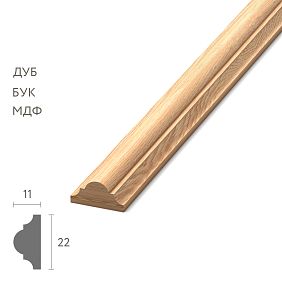
Wall moldings — strips 30-120 millimeters wide, mounted on walls to create panels, frames, surrounds. The profile varies from simple (one cove) to complex (combination of beads, fillets, flutes). Material — solid oak, beech, ash for painting or clear finish, MDF for enamel. Supplied length 2000-2400 millimeters, cut to required sizes.
Wall moldings are used to create panel systems — a wall is divided into rectangular panels by horizontal and vertical moldings. For framing wallpaper — a molding forms a frame around a wallpaper insert on a painted wall. For zoning — a horizontal molding at a height of 900-1000 millimeters divides the wall into a base and the main part.
Ceiling cornices are moldings 40-200 millimeters wide, installed at the junction of the wall and ceiling. The profile is usually asymmetrical — one side adjoins the wall, the other to the ceiling, with the central part protruding forward, creating a visor. Cornices visually complete the walls, creating an architectural frame for the room.
Door and window casings are moldings 60-100 millimeters wide, framing openings. The profile can be symmetrical or asymmetrical. Casings serve a dual function — technical (closing the gap) and decorative (framing, creating architectural character for the door).
Baseboards are moldings 60-150 millimeters high, installed at the junction of the wall and floor. The profile usually has a top rounding, the lower part is straight. Baseboards complete the bottom of the walls, creating visual support for vertical lines.
Furniture moldings are thin strips 15-40 millimeters wide, used for framing furniture fronts, creating frame structures, and decorating edges. The profile is delicate, corresponding to the scale of the furniture.
Furniture appliqués: from utility to art
If moldings are architectural elements that structure space, thenfurniture appliqués— are jewelry-like details, turning objects into works of joinery art.
What is a furniture appliqué: definition and history
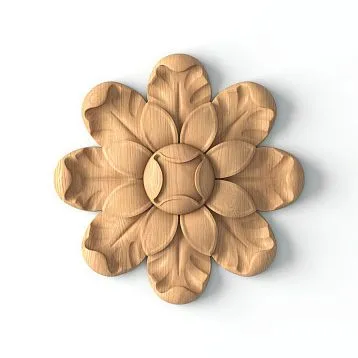
An appliqué is a three-dimensional decorative element made of solid wood, composite materials, or polymers, mounted on the surface of furniture fronts, doors, and drawers to create relief, ornamentation, and visual interest. Unlike carving done directly on the front, an appliqué is produced separately and glued onto the base, which provides flexibility — decoration can be added to finished furniture, replaced, or changed without damaging the carcass.
The history of furniture appliqués begins in the Renaissance era, when Italian masters began decorating chests, cassoni, with carved panels that were attached to smooth surfaces. This was simpler and cheaper than carving the entire front — a carver could make an appliqué on a workbench, then a joiner would glue it in place.
The Baroque of the 17th-18th centuries perfected the technique. French and Italian masters created appliqués of incredible complexity — putti, garlands, acanthus leaves, heraldic compositions — which were gilded, patinated, polychromed.Classic Furniturefurniture of that time was covered with carved appliqués from edge to edge.
Classicism simplified the decor, but appliqués remained — restrained, geometric, with clear contours. The Empire style of the early 19th century again increased opulence — appliqués with eagles, laurels, military trophies adorned furniture of the Napoleonic era.
Art Nouveau of the late 19th — early 20th century created its own language of appliqués — flowing plant forms, stylized flowers, asymmetrical compositions. Art Deco of the 1920s-1930s — geometric appliqués, zigzags, stepped forms.
Today, appliqués are experiencing a renaissance. ModernClassic Furnitureuses appliqués to create a connection with tradition, to add detailing, to transform simple case furniture into individual works.
Types of appliqués: classification by shape and function
Central appliqués — symmetrical elements placed in the center of the front. Shape: round, oval, diamond-shaped, rectangular. Size from 80×80 millimeters for small doors to 400×600 millimeters for large cabinets. Ornament — rosettes with petals, cartouches with acanthus, medallions with figurative compositions, geometric palmettes.
A central appliqué serves as the focal point of the front, attracts the eye, creates symmetry. On a chest of drawers with three drawers, each drawer receives a central appliqué — three identical elements form a vertical rhythm.
Corner appliqués — asymmetrical elements for the corners of fronts. Shape: quarter-rosette, corner scroll, stylized leaf. Size usually from 40×40 to 100×100 millimeters. Sold in sets of four — for the four corners of a rectangular front.
Corner appliqués create a framed composition, frame the panel, and enhance structure. The combination of a central and four corner appliqués is a classic scheme for decorating a cabinet door or buffet front.
Linear appliqués — elongated elements with repeating ornament. Width 20-50 millimeters, length cut to the required size from strips of 1000-2000 millimeters. Ornament — beads, egg-and-dart, meander, guilloche, plant border.
Linear appliqués frame the edges of fronts, form frames, and divide zones. A rectangle made of linear appliqués on a front creates a visual frame, inside which there can be a smooth surface, veneer of a valuable wood species, or a central appliqué.
Figurative appliqués — complex compositions of irregular shape. Acanthus scrolls, garlands of flowers, grape clusters, figures of putti, animals, musical instruments. Size varies, shape determined by the ornament. These are one-off elements for accent places — the center of a buffet pediment, the top of a mirror, the corners of a bed headboard.
Materials and manufacturing technologies for appliqués
Solid wood — the traditional and most valuable material. Oak, beech, ash, walnut, linden are used depending on the task. Hardwoods — oak, beech — for appliqués with clear geometric ornamentation, where edge strength is important. Softwoods — linden, aspen — for complex, detailed carving with thin elements, easily amenable to manual processing.
Carving technology varies. Hand carving — the traditional method, where a carver works with chisels, creating a unique element. Slow, expensive, but each appliqué is individual, possesses a liveliness unreproducible by machine.
CNC machine carving — a modern method, where a program controls a milling cutter, cutting the appliqué from a blank according to a 3D model. Fast, precise, reproducible. High-quality CNC centers create detailing close to handwork. Cost is several times lower than hand carving.
Combined technology — rough processing on CNC, finishing by hand. The machine creates the main relief, the carver adds details, cleans up, creates nuances. The optimal balance of speed, quality, and price.
MDF — a composite material, milled on CNC. MDF appliqués are 2-3 times cheaper than wooden ones, more stable — they do not warp with changes in humidity. Painted with enamel, creating a smooth surface of any color. But they lack the natural texture of wood, which is critical if the appliqué is under a clear varnish.
Polyurethane is a synthetic material molded in silicone forms. Polyurethane overlays are lightweight, moisture-resistant, and inexpensive. They are suitable for auxiliary areas like bathrooms, where wooden overlays deteriorate quickly. But forclassic furnitureIn living rooms and bedrooms, wood is preferable — for its tactility, nobility, and material persuasiveness.
Technique for creating visual rhymes: from theory to practice
With moldings and overlays, how to create a system of visual echoes that turns the interior into a composition?
First principle: unity of profile
Profile is the cross-section of a molding, determining its shape, light and shadow, and character. The same profile, repeated in different elements, creates a visual connection.
Imagine a molding profile—a quarter-circle with a small shelf on top. This profile is used in wall moldings forming panels on living room walls. The same profile repeats in door casings—doors are framed with moldings of the same cross-section. The baseboard also has a quarter-circle profile with a shelf, though its height is greater. The ceiling cornice is a variation of the same profile but adapted for horizontal placement.
Now look at the furniture. The dresser has fronts framed by furniture moldings — and the profile of these moldings repeats the profile of the wall moldings on a smaller scale. A quarter-round curve, a small shelf on top — recognizable. A visual rhyme is established — the dresser and the walls speak the same language of forms.
The mirror above the dresser is framed with a molding whose profile is also a quarter-circle with a shelf. The buffet doors in the dining room—the same molding profile. The bed headboard in the bedroom—moldings form a frame around the upholstered panel, the profile is familiar.
The entire house is unified by one profile, varying in scale but maintaining recognizability. This is not primitive repetition—it is a musical theme running through different parts of a symphony, in different orchestrations, yet recognizable.
Second principle: repetition of ornament
Ornament is a carved or milled motif on the surface of a molding or overlay. Repeating an ornament creates an even stronger visual rhyme than profile.
Imagine the 'bead' ornament (astragal)—a row of alternating oval beads and discs, an ancient motif used for millennia.Decorative wooden moldingsThe wall moldings in the living room have this ornament—a 60-millimeter-wide horizontal strip with a row of beads in the center frames the top of the panels.
The dining room door casing is also decorated with the bead ornament—a thin strip of beads runs along the outer edge of the casing, creating a refined frame.
Nowfurniture appliquésthe dresser. The central overlay on the dresser—an oval medallion with acanthus leaves, framed by... a row of beads. The visual rhyme with wall moldings and casings is obvious. The linear overlays on the buffet front form a rectangular frame—and the ornament of this frame is also beads.
The mirror frame—a wide wooden frame with a bead ornament on the inner edge, framing the mirror. The picture frame in the dining room—the same ornament. Even the dining table legs have a band of bead ornament on the upper part, under the tabletop.
The repetition is not monotonous—the ornament is used in measured doses, in key places, creating an echo. The eye notices the rhyme, subconsciously registers the connection, and the interior is perceived as a whole.
Third principle: consistency of scale
Scale is the size of an element relative to the object it is on. An 80-millimeter-wide molding is adequate for a 3000-millimeter-high wall but grotesquely large for a 900-millimeter-high dresser front. A 300-millimeter-diameter overlay is appropriate on a cabinet but overwhelming on a small door.
Consistency of scale means that the size of elements is proportional to the size of objects, with the proportion maintained. If a wall molding occupies 1/40 of the wall height (3000 mm wall, 75 mm molding), then a furniture molding on a 900-millimeter-high dresser should be approximately 900/40 = 22-25 millimeters.
Practically, this means creating a family of moldings of different sizes but the same profile. Wall molding 80×40 millimeters. Door casing 70×25 millimeters—the same profile, but thinner. Furniture molding 25×12 millimeters—again the same profile, even smaller. Baseboard 120×20 millimeters—the profile is adapted for vertical placement, but recognizable.
Wooden moldingsMoldings from quality manufacturers are released in families—one profile in several sizes, allowing for a scale hierarchy while preserving visual unity.
Overlays are also coordinated in scale. A large central overlay 300×400 millimeters on the buffet pediment. A medium overlay 150×200 millimeters on the door of the same buffet. A small overlay 80×100 millimeters on a dresser drawer. The ornament is the same—acanthus leaves—but the scale of the carving is adapted. On the large overlay, the leaves are detailed, with veins and curls. On the medium one—simplified. On the small one—stylized. The visual connection is maintained while respecting scale.
Fourth principle: rhythm and repetition
Rhythm is the alternation of elements with a certain periodicity. In an interior, rhythm creates dynamics, structure, and predictability, which calms the eye.
The simplest rhythm is the repetition of identical elements. A wall with three panels formed by moldings—three rectangles of the same size, a vertical rhythm. A dresser with three drawers, each with a central overlay—three overlays, a vertical rhythm. The rhythms of the wall and dresser coincide—the rhyme is reinforced.
Complex rhythm is the alternation of different elements. Large panel—small—large—small. Large overlay—two small—large. Rhythms are coordinated, creating visual music.
Horizontal rhythm of moldings on room walls. Molding at 300 millimeters from the floor (top of the plinth). Molding at 1000 millimeters (divider between plinth and main wall section). Molding at 2700 millimeters (ceiling cornice). Rhythm: 300—700—1700—proportion approximately 1:2:5.
The furniture repeats the rhythm. A 900-millimeter-high chest of drawers is divided into three parts by horizontal moldings. The lower part (plinth) is 150 millimeters. The middle part (two drawers) is 450 millimeters. The upper part (countertop with framing) is 300 millimeters. The proportion 150:450:300 = 1:3:2 is close to the proportions of the wall, creating a visual resonance.
Principle five: color unity
Even if the profiles, ornaments, and scales are coordinated, but the colors are heterogeneous, the visual rhymes weaken. Color unites or separates.
Allwooden wall moldings, architraves, baseboards, and cornices are painted white, creating an architectural foundation unified in color.furniture appliqués, furniture moldings are also painted white, visually harmonizing the furniture with the architecture.
Or conversely, natural wood. Oak moldings coated with oil that preserves the grain. Overlays made from the same oak, with the same finish. Color, texture, and material are unified, strengthening the rhymes through material kinship.
Patination, painting with an aging effect, can become a unifying factor. A base layer of white or cream, with dark patina (gray, brown, black) applied in the recesses of carvings and on the edges of profiles. All elements—moldings, overlays, architraves, baseboards—are patinated identically. The treatment technique is the same, visual unity is absolute.
Where to apply moldings: practical scenarios
The theory is clear, let's look at specific applicationswooden decorative moldingsand how they rhyme with furniture.
Wall framing: panel systems
A classic interior is unthinkable without wall panels formed by moldings. The wall is divided into rectangular sections—each section is framed by moldings, with a painted surface, wallpaper, fabric, or veneer inside.
The height of the panels is coordinated with the height of the furniture. If there is a 900-millimeter-high chest of drawers in the room, the wall panels are made 900-1000 millimeters high for visual coordination. The chest stands against the wall, its top aligning with the top of the lower panels—the rhyme is obvious.
The width of the panels is also coordinated. A chest of drawers 1200 millimeters wide—the panel on the wall behind it is 1200-1300 millimeters wide, slightly wider, creating a framing effect.
The profile of the panel moldings is repeated in the profile of the furniture moldings on the chest's facades. If the panels are formed by a molding with a 'gooseneck' profile (S-shaped curve), the chest's facades are framed by a molding with the same profile on a smaller scale.
Color is coordinated. The panels are painted light gray inside, the moldings are white. The chest is painted light gray, the furniture moldings are white. A mirror repetition of the color scheme.
Door framing: architraves as architectural frames
A door is a vertical rectangle requiring framing, just as a painting requires a frame. Architraves—moldings framing the door opening—fulfill this function.
The profile of the architrave is coordinated with the profile of the wall moldings. If the wall panels are formed by a molding with a bead and a cavetto, the architraves have the same profile. The door is perceived as part of the wall system.
The width of the architrave is coordinated with the width of the wall moldings. Wall moldings are 80 millimeters, architraves are 70-80 millimeters—commensurate, not contrasting.
Architraves rhyme with furniture throughfurniture appliqués. A decorative overlay is placed above the door—a horizontal element with a floral ornament, integrated into the upper part of the architrave. A similar overlay is placed on the pediment of a buffet standing in the same room. The ornament is identical—acanthus leaves forming a horizontal garland. A visual door-furniture rhyme is established.
The corners of the architraves can be decorated with corner overlays—rosettes at the junctions of the vertical and horizontal architrave strips. The same corner overlays are used on the corners of furniture facades. Repeating the element creates a connection.
Mirror framing: frames as an extension of architecture
A mirror above a chest, above a fireplace, in an entryway—not just a functional object, but part of a decorative system. The mirror frame is an opportunity to create a visual rhyme with the wall and furniture moldings.
The frame is made from molding of the same profile used on the walls.Wooden moldings100 millimeters wide form a rectangular frame, with the mirror inside. The frame profile—a quarter-round with a fillet—is the same as that of the wall panel moldings. The mirror is perceived as a panel on the wall, but with a reflective surface instead of a painted one.
The corners of the frame are decorated with corner overlays—carved rosettes, acanthus scrolls. The same overlays are used on the corners of the chest facades beneath the mirror. The mirror-furniture rhyme is obvious.
The color of the frame is coordinated with the color of the moldings and furniture. If the moldings are white, the furniture is white with gray facades—the frame is white, the inner edge with a gray patina echoing the gray of the furniture.
A mirror can be integrated into the wall panel system—the wall is divided into panels by moldings, one of the panels contains a mirror instead of a painted surface. The mirror's framing moldings are part of the wall's overall molding grid. The mirror is integrated into the architecture.
Framing of paintings and panels: gallery hanging with moldings
Paintings on the wall are accents, but without proper framing and placement they can look chaotic. Moldings help organize gallery hanging, create visual frames, and connect paintings with the architecture.
First option: each painting in its own molding frame on the wall. A frame made of molding—a rectangle slightly larger than the painting's frame itself—is mounted around the painting on the wall. The molding on the wall and the painting's frame create a double framing. The profile of the wall molding is coordinated with the wall moldings of the panels in the room. Visually, the painting is integrated into the architecture.
Second option: a group of paintings inside one large molding panel. A large panel measuring 2000×1500 millimeters is formed on the wall using moldings. Inside this panel, three to four paintings of different sizes are placed, hung asymmetrically, but all within a common frame. The molding panel organizes the group, creating visual order.
The profile of the molding picture panels is repeated in the profile of the furniture moldings. The buffet in the same room has facades framed with moldings of the same profile. Paintings and furniture visually rhyme through a common element.
Technique of repeating profiles: from walls to furniture
How to technically create a system of repeating profiles? Where to order a family of moldings and overlays with coordinated shapes?
Choosing a base profile: where to start
It begins with choosing a base profile—a shape that will become the leitmotif of the interior. The profile is determined by the style.
Classicism—a profile with a torus and a scotia. The torus (convex semicircular part) creates a light stripe under top lighting. The scotia (concave part) creates a shadow stripe. The combination of light and shadow gives plasticity. Proportions are strict and symmetrical.
Baroque—a complex multi-stage profile with several tori, scotias, and shelves. The play of light and shadow is dramatic, the relief is deep. Proportions are lush, ornamentation is active.
Neoclassicism—a simplified classical profile. One torus, one scotia, minimal details. Elegance, restraint, modernity while preserving classical principles.
Provence—a soft rounded profile (quarter-round) without sharp transitions. Creates coziness, softness, suitable for painted interiors with patina.
Minimalism—a straight profile with a chamfer (beveled corner). Geometricity, conciseness, absence of ornament.
Having chosen the style, the base profile is selected. This profile will be repeated in all elements—wall moldings, door casings, baseboards, cornices, furniture moldings.
Scaling the profile: creating a family
The base profile is scaled for different applications. Wall molding—full size of the profile, for example, width 80 millimeters. Door casing—the same profile, but width 70 millimeters, proportions preserved. Furniture molding—the profile is reduced to a width of 25 millimeters, but the shape is recognizable.
Quality manufacturers, such as STAVROS, offer ready-made families of moldings—one profile in several sizes. This saves time and guarantees consistency. The designer chooses the profile, orders all necessary sizes, and receives a system.
Alternative—custom production. STAVROS manufactures moldings according to individual drawings. The designer develops the profile, provides a cross-section drawing, and specifies the necessary sizes. Production programs milling machines, manufactures knives, and produces moldings of all sizes with an identical profile. Lead time 2-4 weeks, cost higher than standard moldings, but uniqueness is guaranteed.
Coordinating overlays with molding profiles
furniture appliquésOverlays should be coordinated with moldings through ornament, scale, style.
If the moldings have a bead ornament, overlays are chosen with beaded framing. The central overlay—a medallion with acanthus, framed by beads. Linear overlays—a strip of beads to form frames on facades.
If the moldings are smooth, profiled without ornament, geometric overlays are chosen—rosettes with radial petals without plant details, rectangular panels with flutes (vertical grooves).
The scale of the carving on the overlays is coordinated with the scale of the moldings. Deep relief moldings (15-20 millimeters) require overlays with deep carving (20-30 millimeters). Shallow relief moldings (5-10 millimeters) require overlays with delicate carving (10-15 millimeters).
STAVROS offers collections where moldings and overlays are already coordinated. The 'Classic' collection includes moldings with a torus-scotia profile, overlays with acanthus and beads. The 'Empire' collection—moldings with flutes, overlays with laurels, eagles, military trophies. The 'Provence' collection—soft rounded moldings, overlays with flowers, garlands. Purchasing a collection guarantees visual unity.
Examples of visual rhymes in real interiors
Theory and technique have been outlined, let's consider specific examples of interiors whereWooden moldingsandfurniture appliquéscreate visual rhymes.
First example: classic living room with paneled walls
Room 40 square meters, ceiling 3200 millimeters. Walls painted light beige.wooden wall moldingsThey form panels 1000 millimeters high in the lower part of the walls, with rectangular 1200×800 millimeter panels above. The molding profile is a classic bead-and-cove, 80 millimeters wide, painted white.
Door casings — the same bead-and-cove profile, 75 millimeters wide, white. Above the door is a horizontal overlay with a floral ornament — acanthus leaves forming a symmetrical composition, framed by a row of beads. White with light gilding on the relief.
Baseboard — a bead-and-cove profile adapted for vertical placement, 120 millimeters high, white.
Furniture: a solid oak chest of drawers, 950 millimeters high, 1400 millimeters wide. The carcass is painted light beige (to match the walls), the fronts of the three drawers are painted white. On each front — a frame made of furniture moldings, bead-and-cove profile, 25 millimeters wide, white. Inside the frame on the central drawer — an oval overlay with acanthus leaves, framed by beads, white with gilding — identical to the overlay above the door.
Buffet, 2100 millimeters high. The lower part — a carcass with doors framed by bead-and-cove moldings. The upper part — glazed cabinets with moldings of the same profile. The buffet's pediment is decorated with a large overlay — a horizontal composition with acanthus and beads, white with gilding.
Mirror above the chest of drawers — a frame made of bead-and-cove moldings, 100 millimeters wide, white. The corners of the frame — corner overlay-rosettes with acanthus scrolls, white with gilding.
Visual rhymes: the bead-and-cove profile repeats in wall moldings, casings, baseboard, furniture moldings, mirror frame. The acanthus and bead ornament repeats in the overlay above the door, on the chest of drawers, on the buffet, on the mirror. The color white with gilding unites all elements. The scale is coordinated — large elements on the walls and buffet, medium on the chest of drawers and mirror, small on the doors.
Second example: a neoclassical bedroom with minimal decor
Room area 20 square meters, ceiling 2800 millimeters. Walls painted gray-blue.Decorative wooden moldingsThey form three vertical panels on the wall behind the bed, panel height 2000 millimeters, width 600 millimeters each. The molding profile is a simplified quarter-round, 50 millimeters wide, painted white.
Door and window casings — the same quarter-round profile, 60 millimeters wide, white. Baseboard — quarter-round profile, 80 millimeters high, white.
Furniture: a bed with an upholstered headboard, framed by a wooden molding frame of quarter-round profile, 30 millimeters wide, white. The corners of the frame — simple corner overlay-rosettes with radial petals, white.
Bedside tables — carcass gray-blue, drawer fronts white, framed by quarter-round profile moldings, 20 millimeters wide. The center of each front — a small round overlay-rosette with petals, white.
Chest of drawers against the opposite wall — carcass gray-blue, fronts white, quarter-round moldings, central overlay-rosettes.
Mirror above the chest of drawers — a thin frame made of quarter-round profile molding, white.
Visual rhymes: the quarter-round profile repeats everywhere — walls, doors, baseboard, furniture, mirror. Rosettes with petals repeat on the bed, bedside tables, chest of drawers. The color white for all moldings and decor, gray-blue for the background — a two-color scheme, strictly adhered to. Minimalism of decor creates restraint, but the rhymes ensure integrity.
Third example: a Provencal dining room with patina
Room area 25 square meters, ceiling 2700 millimeters. Walls painted cream. Moldings form panels 900 millimeters high at the bottom, with vertical panels above. Profile — a soft rounded (ovolo), 70 millimeters wide, painted white with gray patina in the recesses.
Casings — ovolo profile, 70 millimeters wide, white with patina. Baseboard — ovolo, 90 millimeters high, white with patina.
Furniture: a solid oak dining table, tabletop natural with oil finish, base — legs and aprons painted white with blue patina. The legs have a band of ornament — a linear overlay with a floral border, white with patina.
Buffet — carcass cream, fronts white with lavender patina. The fronts are framed by ovolo profile moldings, 30 millimeters wide. Central overlays on the doors — bouquets of lavender and roses, carved, white with lavender and blue patina.
Chairs — frame white with patina, backs with carved overlays of floral ornament, white with patina.
Mirror — a frame made of ovolo molding, white with patina, corners with floral overlays.
Visual rhymes: the ovolo profile everywhere. Floral ornament — lavender, roses, leaves — repeats on the table, buffet, chairs, mirror. Patination — white with blue, gray, lavender patina — unites all elements, creating an aged effect characteristic of Provence. Floral overlays rhyme with each other, creating a garden theme.
Frequently Asked Questions: Practical Answers
First question: how much does it cost to create a system of visual rhymes in an apartment?
The cost depends on area, complexity, materials. For an 80 square meter apartment with two rooms, an entrance hall, a kitchen, a basic system of visual rhymes costs approximately as follows:
wooden wall moldingsSolid oak for panels — 150-200 linear meters with an average width of 60-80 millimeters, cost 800-1500 rubles per meter = 120,000-300,000 rubles. Door casings (6-8 doors) — 80-100 linear meters, 60,000-150,000 rubles. Baseboards — 60-80 meters, 50,000-120,000 rubles. Ceiling cornices — 60 meters, 40,000-80,000 rubles.
furniture appliquésSolid oak overlays — central overlays 15-20 pieces at 2000-8000 rubles each = 30,000-160,000 rubles. Linear overlays for frames — 20-30 meters at 1500-3000 rubles per meter = 30,000-90,000 rubles. Corner overlays — 40-60 pieces at 500-1500 rubles each = 20,000-90,000 rubles.
Painting or oil finishing — if performed by manufacturer STAVROS — 30-50% of material cost = 150,000-300,000 rubles. Installation of moldings and overlays — 100,000-200,000 rubles for a professional crew.
Total: 560,000-1,490,000 rubles depending on the choice of profiles, wood species, complexity of carving. Budget option with MDF moldings and simple overlays — 250,000-400,000 rubles. Premium option with hand-carved work — 2,000,000-3,000,000 rubles.
Second question: is it possible to create visual rhymes in a modern interior?
Absolutely. Visual rhymes are not exclusive to classic styles. Modern interiors useDecorative wooden moldingswith laconic profiles — straight, with bevels, with minimal rounding. Overlays are geometric — squares, rectangles, circles without plant ornaments.
The profile repeats just as in classic styles. Wall moldings with a straight profile form panels on an accent wall. Furniture moldings of the same profile frame the fronts of cabinets and dressers. A mirror in a straight wooden frame of the same profile. Doors with straight-profile casings.
Color unifies — all moldings are painted white or black matte, or natural wood like whitewashed oak. Rhymes are created through geometry, proportions, color, not through ornament.
Third question: is solid wood mandatory or will MDF work?
Functionally, MDF is suitable — stable, mills and paints well.Wooden moldingsMDF is 40-60% cheaper than solid wood, which is significant for large volumes.
But forclassic furniturein solid oak or walnut, moldings andfurniture appliquésfrom the same solid wood are preferable — material unity enhances visual rhymes. The wood grain, visible through a transparent finish, unifies elements more deeply than just form.
A compromise — architectural elements (cornices, moldings on high walls) from MDF for painting, furniture elements and baseboards from solid wood. Painted elements are visually identical, but furniture and tactile zones retain the nobility of wood.
Fourth question: how to coordinate visual rhymes with different furniture in different rooms?
A living room withclassic furniturea living room in oak, a bedroom with light Scandinavian furniture, a kitchen with a modern set — how to create unity?
The solution — the base profile of the moldings is the same in all rooms, but the overlays are adapted to the furniture style. In the living roomwooden wall moldingsclassic profile ogee, overlays with acanthus. In the bedroom, the same moldings on the walls, but overlays on the furniture are simple geometric rosettes without plant elements. In the kitchen, the same moldings frame the backsplash, but no overlays — a modern set without decoration.
Visual rhymes are created through the molding profile, which runs through the entire house, unifying different rooms. Overlays are local accents, adapted to each zone.
An alternative — color unity. All moldings, overlays, baseboards, casings are painted white in all rooms. The furniture is different, but white decor unifies the space.
Fifth question: can visual rhymes be added to an already finished interior?
Yes, and this is one of the advantages of moldings and overlays — they are mounted on finished surfaces. An apartment renovated five years ago, walls painted, furniture purchased. The interior is functional but visually disjointed.
are added to the walls — forming panels around existing furniture. Moldings are glued directly onto painted walls, then painted to match the wall color or a contrasting one.Decorative wooden moldingsare glued onto the fronts of dressers, cabinets, and doors. The profile of the moldings and the ornament of the overlays are coordinated — visual rhymes are created.furniture appliquésMirrors are reframed — old frames are replaced with new ones made from moldings of the same profile as on the walls. Doors receive new casings. Baseboards are changed to profiled ones from the same family.
Work duration is 1-2 weeks for an 80-square-meter apartment. Cost is 200,000-500,000 rubles depending on the volume. The result — the interior gains integrity, visual coherence, and a professional look.
Work duration 1-2 weeks for an 80 square meter apartment. Cost 200,000-500,000 rubles depending on scope. Result — the interior gains integrity, visual coherence, and a professional appearance.
Sixth question: how to care for moldings and overlays?
Wooden moldingsandfurniture appliquésPainted surfaces — wipe with a dry or slightly damp soft cloth once a week to remove dust. Avoid excess water — painted wood is durable, but prolonged wetness is harmful.
Moldings and overlays with lacquer or oil finish — wipe with special wood care products once a month. Oil requires renewal every 1-2 years — the surface is lightly sanded with fine sandpaper, and a new layer of oil is applied. Lacquer is more durable, requiring renewal every 5-7 years.
Carved overlays with deep relief — dust accumulates in the recesses. Remove with a soft brush, then wipe with a cloth. A vacuum with a soft brush attachment is also effective.
Damage — scratches, chips — on painted elements are retouched with paint of the same color. On elements with lacquer finish — sanded and locally coated with lacquer. Solid wood is repairable, which is an advantage over polyurethane.
Conclusion: The Visual Poetry of Interior by STAVROS
An interior without visual rhymes is prose, a collection of facts, functional items that perform tasks but lack emotional coherence. An interior with visual rhymes is poetry, where each element responds to another, whereWooden moldingson the walls echo the framing of furniture, wherefurniture appliquésrepeat the pattern of door ornaments, where the baseboard profile rhymes with the cornice profile, where color unites the disparate, where rhythm creates predictability that soothes the eye. This is not coincidence, but the result of thoughtful design, where every detail is chosen consciously, where a system of repetitions creates integrity, turning a collection of rooms and objects into a unified work where living is comfortable, pleasant, and aesthetically rich.
STAVROS is a leading Russian manufacturer ofwooden decorative moldings, overlays on furniture, classic furniture— offers a complete system for creating visual rhymes in the interior. Over 200 molding models — from simple straight to complex multi-step with carving, from 20 millimeters to 200 millimeters wide, made of solid oak, ash, beech, MDF. Over 300 overlay models — central, corner, linear, shaped — with patterns from classical acanthus to modern geometries.
The key advantage of STAVROS is the systematic approach. Moldings and overlays are organized into collections where profiles and patterns are already coordinated. The 'Classic Premium' collection — moldings with bead-and-flute profile in five sizes from wall to furniture, overlays with acanthus and beads in three scales. By ordering a collection, the client receives a ready-made system of visual rhymes where everything is coordinated.
The 'Neoclassical Light' collection — simplified profiles, restrained decor, light tones, patination. The 'Provence Floral' collection — soft curves, floral patterns, pastel coloring with patina. The 'Modern Graphic' collection — straight profiles, geometric overlays, black-and-white palette. Each collection is a ready-made solution for a specific style.
Custom design — STAVROS's specialization for clients with unique requirements. The designer develops molding profiles, overlay patterns, and project-specific elements. STAVROS manufactures the complete set — wall moldings, trims, baseboards, cornices, overlays — with perfect coordination. Development and production time 3-6 weeks. Custom project cost is 30-50% higher than standard collections, but uniqueness is guaranteed.
STAVROS production is equipped with the latest generation CNC milling centers, ensuring profile accuracy up to 0.1 millimeters. Carvers with years of experience perform manual finishing of complex overlays, adding details unattainable by machine. Wood — selected solid wood, kiln-dried to 8-10% moisture content, eliminating deformation after installation.
Painting and finishing — full cycle at STAVROS production. Moldings and overlays are painted in any RAL color, hand-patinated — dark patina is applied to carving recesses, creating a century-old effect. Staining — from light whitewashed oak to dark wenge. Coating with oil, lacquer — matte, semi-matte, glossy. The client receives ready-made elements requiring no additional processing.
3D visualization service — STAVROS creates a three-dimensional model of the interior with selected moldings and overlays. The client sees the result before production begins, can adjust and approve. Visualization shows visual rhymes — how profiles repeat, how patterns echo, how color unites. Eliminates selection errors, guarantees satisfaction with the result.
Delivery across Russia and CIS.wooden wall moldingsandfurniture appliquésare packed in protective film, cardboard, foam, placed in wooden crates for transport protection. Moscow, St. Petersburg — delivery in 1-3 days. Regions — 5-14 days. International delivery to Kazakhstan, Belarus, European countries.
STAVROS showrooms in Moscow and St. Petersburg demonstrate interior installations — rooms with installed moldings, furniture with overlays, framed mirrors. Visit, see visual rhymes in person, touch the carving, assess the quality of solid wood, consult with a designer. Free consultation on collection selection, calculation of required materials, cost estimate preparation.
Educational materials on the STAVROS website — articles on creating visual rhymes, videos on installing moldings and overlays, photo galleries of completed projects. Get inspired, learn, design your own interiors.
Choosing STAVROS, you choose system over chaos, professional design over randomness, solid wood quality over imitation, carver craftsmanship over mass production, individual approach over templates. Create interiors whereWooden moldingsrhyme withfurniture overlays, where profiles echo from walls to doors, where patterns repeat from furniture to mirrors, where color unites the disparate, where scale is coordinated, where rhythm creates the music of space, whereDecorative wooden moldingsand carved decor turn rooms into works of art, where every detail is meaningful, where visual rhymes create a poetry of forms, sounding in harmony from floor to ceiling, from hallway to bedroom, where living is not just comfortable but aesthetically rich, where home becomes a reflection of taste, culture, and an understanding of beauty.
Start creating visual rhymes today. Visit the STAVROS website, explore the collectionswall moldings woodandoverlays on furniture, choose a base profile, define a style, order samples. A designer consultation will help compose a system of rhymes for your home. 3D visualization will show the result. Production will create the elements. Installation will set them up. And in a month, your interior will transform, gaining a wholeness that all visitors notice, asking: 'Who is your designer?' — and you will proudly answer: 'Visual rhymes by STAVROS and my understanding of harmony.'