












































































Article Contents:
- Modern style: what it means for wooden decor
- Geometry as the language of space
- Color and material: restraint versus garishness
- Function as the basis of form
- Material selection: wood species and their character
- Oak: texture as a statement
- Beech: neutrality and versatility
- Ash: the golden mean
- Surface treatment: from texture to smoothness
- Round trim: soft geometry in hard lines
- Cylinder ergonomics
- Visual lightness
- Application of round trim
- Profile typology: from simple slats to complex compositions
- Rectangular slats: the basis of composition
- Flat moldings with bevel: delicate detailing
- Profiled moldings: hidden complexity
- Round slats: cylindrical alternative
- Interior application: from walls to ceilings
- Accent Walls: Focal Point
- Ceiling solutions: hidden geometry
- Panel systems: architecture on walls
- Space division: partitions and screens
- Color solutions: from monochrome to contrast
- Monochromatic solutions: immersion in a single tone
- Natural wood: texture as an accent
- Contrast solutions: black and white
- Combination with other materials: wood in context
- Wood and concrete: warmth versus cold
- Wood and metal: nature versus technology
- Wood and glass: transparency versus density
- Installation and Technical Aspects: How It Works
- Hidden Fastening: Invisible Mechanics
- Adhesive Installation: For Thin Profiles
- Installation of Round Molding: Brackets and End Fasteners
- Joint and corner processing
- Stylistic Adaptation: From Minimalism to Loft
- Strict Minimalism: Absolute Geometry
- Scandinavian Minimalism: The Warmth of Natural Wood
- Industrial loft: contrast of materials
- Japanese Minimalism: Emptiness as Value
- Care and Operation: Preserving Pristine Condition
- Regular Cleaning
- Recoating
- Climate Control
- Economic Solution: Investment in Quality
- Comparison with alternatives
- Long-term perspective
- Emotional value
- Answers to popular questions
- Can Wooden Moldings Be Used in Wet Areas?
- What Spacing Between Slats Is Optimal for an Accent Wall?
- Is Lathing Needed for Installing Slats on a Flat Wall?
- How to Choose Between Rectangular and Round Molding?
- Can Wooden Moldings Be Installed Independently?
- How Long Do Wooden Moldings Last?
- Conclusion: When Architecture Becomes Art

What happens when classical architectural elements meet the language of minimalism? A new aesthetic is born, wheremodern moldings round moldingthey cease to be mere decoration and become the structure of space. They create rhythm, divide planes into zones, guide the gaze—and yet remain almost invisible, dissolving into the architecture or, conversely, accentuating its graphic quality. A modern interior demands restraint, but not emptiness. Lines must be clear, forms—concise, details—functional. This is exactly what wooden moldings and round molding become when freed from decorative excess and left with only the essence—geometry, material, light.
The time when molding was exclusively associated with stucco, curls, and gilding is gone. TodayWooden moldingsthey are reinterpreted through the lens of modern architecture. Rectangular slats, minimalist profiles, strict lines—this is the new vocabulary with which space speaks. And whenwooden round balusters—cylindrical elements, handrails, rods, decorative slats—are added to them, a balance emerges between the rigidity of right angles and the softness of rounded forms. This is a dialogue of two geometries, creating a space that is both strict and humane.



Modern Style: What It Means for Wooden Decor
Modernity in interior design is a fluid concept. It is not tied to a specific era or movement, but rather defined by principles: functionality over decorativeness, honesty of materials, purity of lines, intentionality of every detail. When we talk aboutMolding modern stylewe are referring precisely to these principles embodied in wooden elements.




Geometry as the Language of Space
In modern interiors, geometry is the primary tool for organizing space. Vertical wooden slats define height, horizontal ones—width, diagonals create dynamism. But unlike classical moldings, where geometry is complicated by ornaments and carvings, modern profiles are extremely concise. Rectangle, square, cylinder—basic forms that do not distract but guide perception.
Imagine a wall with vertically mounted wooden slats of 20 by 40 millimeters cross-section, spaced 50 centimeters apart. This is not decoration—it is a structure that visually elongates the room, creates a sense of height, makes the ceiling appear more distant. The same slats, arranged horizontally, produce the opposite effect: the space expands, becomes more calm and static. Geometry works on a physiological level—it influences how we feel in a space.
Our factory also produces:


Color and Material: Restraint vs. Gaudiness
Modern moldings rarely serve as color accents. More often, they are painted to match the walls, creating a play of relief and shadow rather than color contrasts. White slats on a white wall, gray on a gray background—this is pure architecture, where form matters, not decorativeness. With side lighting, such relief is maximally revealed; with frontal lighting—it almost disappears, creating a dynamic picture that changes throughout the day.
But there is also the opposite approach: contrasting solutions where moldings stand out sharply. Black wooden slats on a white wall, dark oak on a light gray background—such compositions add graphic quality, turning the wall into an architectural drawing where every line is intentional. It's important that the contrast is justified: in minimalism, it works as the sole accent; in Scandinavian style, as a connection to nature through wood texture; in loft style, as a continuation of industrial aesthetics.
Get Consultation
Function as the Basis of Form
Any element in a modern interior must have a functional justification.Decorative wooden trimIt doesn't just decorate the wall—it conceals material joints, hides wiring, serves as a base for hidden lighting, and acts as a guide for sliding panels. Vertical slats can hide sound-absorbing materials or technical elements behind them—sockets, switches, cable channels. A horizontal molding at a height of 90 centimeters becomes a boundary between two types of finishes—paint and wallpaper, wood and concrete, plaster and tile.
Round molding in the form of horizontal rods can simultaneously serve as decor, a functional hanger, and a handrail. Multifunctionality is a key principle of the modern approach, where every element must justify its presence not only visually but also practically.
Material Choice: Wood Species and Their Character
Not all wood species fit equally well into modern aesthetics. The choice depends on the role the material's texture will play: whether it will become an accent or remain a neutral background.
Oak: Texture as a Statement
Oak has a large-pored structure with pronounced annual rings and radial rays. Its texture is discernible even on small elements, creating visual interest. When you need toBuy wooden moldingsand use it as an accent that draws attention to the naturalness of the material, oak is the best choice. Light oak with slight bleaching works in Scandinavian interiors, creating an atmosphere of northern restraint. Dark stained oak fits into urban and industrial spaces where graphic quality and contrast are needed.
Oak slats in their natural color on a white background create a rhythmic pattern where the wood texture becomes an ornament. This is a connection to nature that stays within the bounds of minimalism—the material is present but doesn't shout for attention.
Beech: Neutrality and Versatility
Beech, on the other hand, has a fine-pored, homogeneous structure, almost devoid of visible grain. This makes it ideal for painting—paint applies evenly, without spots or transitions. Beech moldings coated with matte enamel in white, gray, or anthracite look modern and neutral. They don't draw attention to themselves but work as architectural elements that organize space.
Beech is also good because it bends easily after steaming, allowing for the creation of radius elements. For interiors with complex geometry, curved walls, and arched openings, beech molding opens up possibilities unavailable to other species.
Ash: The Golden Mean
Ash occupies a middle ground: its texture is expressive but not as contrasting as oak's. Light ash shades with a slight waviness in the grain pair well with the aesthetic of natural simplicity characteristic of eco-style and organic modern. Ash slats retain the naturalness of wood without visually dominating.
Surface Treatment: From Texture to Smoothness
Modern aesthetics prefer matte and semi-matte finishes. Glossy varnishes create a sense of artificiality, disrupting the material's natural essence. Matte oils and waxes emphasize wood texture, preserve tactility, and allow the material to visually 'breathe.' For painted moldings, matte or semi-matte paint is important—it creates a velvety surface, prevents glare under artificial lighting, and softly diffuses light.
Brushing—removing soft fibers with a brush to create relief—can be appropriate but in a restrained form. Light brushing of oak slats adds tactility, makes the surface more interesting to the touch, but doesn't create an artificial antique effect.
Round Molding: Soft Geometry in Hard Lines
If rectangular moldings set strict geometry, thenRound wooden balustersintroduces softness and plasticity. Cylindrical elements with diameters from 20 to 50 millimeters create a different visual and tactile experience.
Cylinder Ergonomics
A round cross-section is comfortable for the hand—there are no sharp edges that dig into the palm. This makes a round profile ideal for handrails, railings, and rods that need to be held or leaned on. A diameter of 40–50 millimeters is optimal for an adult hand to grip; 30–35 millimeters is suitable for children's handrails or decorative rods; 20–25 millimeters is used for thin slat compositions.
Visual lightness
A round cross-section is perceived visually as lighter compared to a square one of the same mass. Light smoothly wraps around the cylindrical surface, creating soft gradient shadows without sharp boundaries. This property makes round molding a good choice for interiors where visual airiness is required.
Vertical round slats with a diameter of 30 millimeters, mounted at 10-centimeter intervals, create a semi-transparent wall that divides space but doesn't isolate it. Behind such a wall, you can place a sleeping area in a studio or a workspace in a living room—they will be visually separated but not cut off from the rest of the space.
Application of Round Molding
Round handrails on stairs and ramps combine functionality with minimalist aesthetics. Horizontal rods on an entryway wall serve as clothing hangers—a simple, honest, functional solution. Round slats can be used as curtain rods, as elements of slatted partitions, or as decorative accents in panel compositions.
Whenmodern moldings round moldingwork together, a balance arises between the rigidity of rectangular profiles and the softness of cylindrical ones. Straight lines set the structure, rounded ones soften it, making it more human.
Profile Typology: From Simple Slats to Complex Compositions
What specific profiles are used in contemporary interiors? Let's examine the main types and their applications.
Rectangular battens: the foundation of composition
The most versatile option is a rectangular batten with a cross-section ranging from 10 by 30 millimeters to 30 by 80 millimeters. It can be used vertically to create slatted panels, horizontally to divide walls into zones, or combined into geometric compositions. These battens are easy to cut, mount with adhesive or concealed fasteners, and can be painted in any color.
The advantage of a rectangular profile is its neutrality. It doesn't dominate or draw excessive attention, functioning as a structural element. Yet, from simple battens, complex patterns can be created: alternating vertical and horizontal lines, varying distances, and crafting relief panels.
Flat moldings with bevels: delicate detailing
A flat molding with a slight bevel along the edges represents the next level of detail. The bevel creates subtle light play on the edges, adding volume without decorative excess. Such moldings are excellent for framing panels, creating framed compositions on walls, and highlighting architectural elements.
The width of such moldings typically ranges from 40 to 100 millimeters, with a thickness of 10–18 millimeters. They are substantial enough to read as an architectural element but not so heavy as to overwhelm the space. Painted to match the wall color, they create subtle relief; painted in contrast, they form crisp, graphic frames.
Profiled moldings: hidden complexity
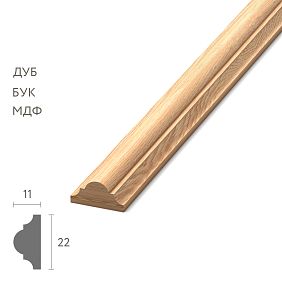
Even in contemporary interiors, there is a place for profiled moldings—but only restrained ones, without baroque curls. A molding with a simple ogee or gentle rounding creates soft shadows and is suitable for framing niches, shelves, and built-in cabinets.
Such profiles add softness without compromising contemporary aesthetics. They are used locally—only in areas requiring delicate visual emphasis. For example, a TV niche framed with a molding featuring a soft profile looks finished but not contrived.
Round battens: a cylindrical alternative
Round battens with a diameter of 15–40 millimeters offer an alternative to rectangular ones. They create a more organic, less industrial effect. Round battens work well in interiors where modernity blends with naturalness—eco-style, Scandinavian minimalism, Japanese design.
A diameter of 15–20 millimeters is suitable for thin graphic compositions, 25–30 millimeters for noticeable slatted panels, and 40–50 millimeters for functional elements like handrails and rods.
Application in interiors: from walls to ceilings
Where exactly areWooden moldingsand round millwork used in contemporary spaces?
Accent walls: focal points
An accent wall is one of the main tools in contemporary design. Instead of patterned wallpaper or decorative plaster, wooden battens are used to create a three-dimensional texture. Vertical battens with a cross-section of 20 by 40 millimeters, spaced 5–7 centimeters apart, form a semi-transparent plane behind which LED lighting can be concealed. Light filtering through the gaps between the battens creates a dramatic effect, especially in the evening.
Horizontal battens create a different effect: they visually widen the wall, making the room appear more expansive. This technique is good for narrow rooms, corridors, and elongated spaces. Combining vertical and horizontal battens within a single wall creates a geometric pattern reminiscent of Japanese screens.
Using round millwork for an accent wall adds softness. Vertical cylinders with a diameter of 30 millimeters, mounted 10 centimeters apart, create a rhythmic composition with gentle shadows. Such a wall is tactilely pleasing—you want to touch it, run your hand along the smooth surfaces.
Ceiling solutions: hidden geometry
The ceiling is often a forgotten plane that can play an active role. Wooden battens on the ceiling create direction, guide the eye, and visually lengthen or widen a room. Battens along the long axis of a room enhance the sense of length; across it, they make the space feel more compact.
LED strips can be integrated between the battens, creating uniform diffused lighting without visible light sources. This is a characteristic technique of contemporary lighting design: light comes from nowhere, it simply exists, creating a comfortable atmosphere without visual noise.
Panel systems: architecture on walls
Creating wall panels from moldings is a classic technique adapted to contemporary aesthetics. Unlike traditional boiserie with complex profiles, contemporary panels are laconic: rectangular frames made of thin moldings, painted to match the wall color or in contrast.
Panels can be large—one or two rectangles covering an entire wall—or small, creating a rhythmic grid. It's important to maintain proportions: overly small panels create visual noise, while overly large ones appear unfinished.
Inside the panels, other materials or textures can be used: wallpaper, paint in a different shade, decorative plaster, even fabric. In this case, the molding acts as a frame, organizing disparate materials and creating compositional unity.
Space division: partitions and screens
Open floor plans require zoning tools that divide space without isolating it. Slatted partitions made of wooden millwork are an ideal solution. Vertical battens with gaps allow light and air to pass through the structure, preserving a sense of spaciousness while visually marking zone boundaries.
Such a partition between the living room and kitchen marks a transition without creating a solid wall. Between a bedroom and a walk-in closet, it provides privacy without blocking natural light. A slatted screen on casters can serve as a mobile zoning element that moves as needed.
Round millwork with a diameter of 30–40 millimeters is particularly good for such partitions: it is less visually massive, creates soft shadows, and is pleasant to the touch. A structure made of round battens spaced 10–15 centimeters apart is transparent enough not to consume space yet dense enough to serve as a visual barrier.
Color solutions: from monochrome to contrast
The color of wooden moldings and round trim is an important issue requiring careful consideration.
Monochromatic solutions: immersion in a single tone
Painting moldings to match the wall color is a popular technique that creates a three-dimensional relief effect without color contrast. White moldings on a white wall, gray on a gray background—this is a play solely on light and shadow. With side lighting, the relief is maximally revealed; with frontal lighting, it almost disappears, creating a dynamic picture that changes throughout the day.
Monochrome works to create integrity and monolithic space. The interior looks calm, balanced, and architectural. This approach is characteristic of strict minimalism, where any color accent is perceived as a violation of the purity of the concept.
Monochromatic shades can vary from snow-white to deep anthracite. In Scandinavian interiors, light tones predominate—white, light gray, cream. In industrial and urban spaces—dark ones: graphite, black, dark brown. It is important that the shade of the moldings exactly matches the shade of the walls; otherwise, the relief effect is lost.
Natural wood: texture as an accent
Preserving the natural color and texture of wood is the opposite approach, where the material becomes visible and significant. Light oak, ash, beech in natural shades create a warm atmosphere and connect the interior with nature. This is important for eco-style, Scandinavian direction, Japanese minimalism, where the naturalness of materials is a fundamental position.
Natural wood pairs well with white or light gray walls. Wooden slats against a white wall create a graphic composition where the wood texture reads as a pattern. At the same time, the warmth of the wood softens the coldness of white, making the space more livable and human.
Dark wood—toned oak, wenge, thermally treated ash—creates a more dramatic effect. Dark wooden moldings on a light background look graphic and modern, almost like black ink on white paper. This is a technique characteristic of contemporary and urban interiors.
Contrast solutions: black and white
Maximum contrast—black moldings on white walls or white moldings on dark surfaces—creates a dramatic, expressive interior. This is a bold solution requiring confidence and precision in proportions. Contrast enhances geometry, makes lines sharper, and architecture more readable.
Black slats on a white background are a classic of modern design, referencing the works of Dutch architects from the early twentieth century, Japanese traditions, and Scandinavian graphic style. This is a universal solution that works in different contexts, from a city apartment to a country house.
Contrast can be softened by using not pure black and white but close shades—dark gray and light gray, anthracite and cream. This creates a more delicate, less sharp effect, suitable for spaces where calmness and balance are required.
Combination with other materials: wood in context
Modern interiors are rarely built on a single material. Wood combines with concrete, metal, glass, stone, creating a rich material palette.
Wood and concrete: warmth versus cold
Concrete is an industrial, cold, monolithic material. Wood is warm, textured, natural. Their combination creates a balance between urban severity and humanity. Wooden slats on a concrete wall soften its rigidity, add tactility, and make the space more habitable.
This is a characteristic technique of loft interiors, where exposed concrete surfaces are complemented by wooden elements. Vertical wooden slats can zone a concrete wall, creating rhythm and structure. Round wooden trim—handrails, rods—adds functionality without disrupting the industrial aesthetic.
Wood and metal: nature versus technology
Metal is a technogenic, precise, cold material. In combination with wood, it emphasizes the contrast between the natural and the man-made. Wooden moldings on metal fasteners, round trim in metal brackets—this is an honest, open combination where the construction is not hidden but displayed.
Black metal pairs well with light wood, creating contrast. Brass and copper—with dark wood, adding warmth and nobility. Stainless steel—with any shades, creating a modern, technological image.
Wood and glass: transparency versus density
Glass is a transparent, weightless material that transmits light. Wood is dense, opaque, textured. Their combination creates a play on the contrast of physical properties. Wooden slats in front of a glass wall work as a light filter, creating a rhythmic pattern of shadows.
A slatted partition made of round or rectangular trim in front of a window serves the function of a Japanese shoji—a semi-transparent screen that diffuses light, provides privacy, but does not block it completely. This is a subtle, delicate solution characteristic of spaces where a light and airy environment is valued.
Installation and technical aspects: how it works
The beauty of a modern interior largely depends on the quality of execution. How are wooden moldings and round trim installed to achieve a flawless result?
Hidden fasteners: invisible mechanics
Modern aesthetics require clean lines and the absence of visible fasteners. Wooden slats are mounted on hidden clips that attach to the wall battens. The slats themselves look as if they are floating in the air or glued in a weightless way.
For mounting vertical slats, a horizontal batten made of 30 by 40 millimeter bars is first installed with a spacing of 50–60 centimeters. Clips—metal clamps that fit into a groove on the back of the slat—are attached to this batten. The slat simply snaps into the clip, and there is no visible fastener on the outside.
For horizontal slats, the batten is made vertical; the logic is the same. It is important that the batten is set strictly level—any deviation will cause the slats to wave or skew.
Adhesive installation: for thin profiles
Thin moldings and light battens can be installed with adhesive without mechanical fasteners. Polyurethane adhesives are used for this, providing a strong bond to any substrate — concrete, brick, drywall, plaster.
Adhesive is applied to the back of the molding in a thin layer or in dots, the molding is pressed against the wall and secured with painter's tape or clamps during the curing time. After 12–24 hours, the adhesive polymerizes, and the fastening becomes permanent.
The advantage of adhesive installation is the absence of any fastener marks. The disadvantage is the inability to remove the element without damaging it and the wall surface.
Installation of round trim: brackets and end fasteners
Round trim — handrails, rods, horizontal battens — is installed either on brackets or on end fasteners. Brackets can be concealed or decorative. Concealed brackets are metal sleeves recessed into the end of the round element, which are fastened to the wall with screws. Decorative brackets are metal rings or paws that wrap around the round profile from the outside and are fastened to the wall in a visible manner.
The choice between concealed and decorative fasteners depends on the interior concept. In minimalist spaces, concealed fasteners are preferred; in industrial and loft interiors, decorative metal ones are used, emphasizing the structural nature.
For long horizontal elements of round trim, it is important to provide intermediate supports every 80–100 centimeters to prevent sagging.
Joint and corner processing
Joints of rectangular moldings in corners are made at a 45-degree angle using the miter method. A miter saw with precise angle adjustment is used for this. A deviation of even half a degree will lead to a visible gap, which is unacceptable in a modern interior where precision of execution is valued.
Round trim in corners is either cut at a right angle with decorative end caps installed, or bent (if the wood species and diameter allow). For bent elements, pre-steamed beech or special bent-glued blanks are used.
All joints after installation are sanded with fine sandpaper to remove any steps and unevenness. Then the elements are primed and painted or coated with oil — depending on the chosen finish.
Stylistic adaptation: from minimalism to loft
HowMolding modern styleHow does it adapt to specific design directions?
Strict minimalism: absolute geometry
In strict minimalism, moldings are painted the same color as the walls, creating relief without color accents. The number of lines is minimal — one or two vertical or horizontal axes defining the structure. Profiles are extremely simple — a rectangle without chamfers or rounding. Round trim is rarely used, only if function requires it — handrails on stairs.
The main thing in the minimalist approach is precision of execution. Any gap, unevenness, deviation from geometry will be conspicuous and undermine the concept.
Scandinavian minimalism: the warmth of natural wood
The Scandinavian approach is softer. Here, the natural texture of wood is welcome — light oak, ash, beech without tinting or with light bleaching. Battens can be painted white, but with the visible texture preserved through the paint. The number of lines is greater than in strict minimalism, creating rhythmic compositions.
Round trim is actively used — this is a connection to nature through the organic form of a cylinder. Vertical round battens with a diameter of 25–30 millimeters, placed at uniform intervals, create the graphic lightness characteristic of Scandinavian style.
Industrial Loft: Contrast of Materials
In loft interiors, wooden moldings and trim contrast with rough industrial surfaces — concrete, brick, metal. Wood softens the aggressiveness of these materials, adding humanity and warmth.
Wooden elements here are often left in their natural color or tinted in dark shades. Fasteners are displayed openly — metal brackets, bolts, rivets become part of the aesthetic. The combination of rough wood with an aged texture and industrial metal creates the loft's characteristic image of honest materials and exposed structures.
Japanese minimalism: emptiness as a value
The Japanese approach is built on the principle of ma — significant emptiness. Here, there are few moldings, but each has deep meaning. Wooden battens work as screens, filtering light and creating semi-transparent boundaries.
Preference is given to natural wood in light tones — hinoki, cypress, light oak. Surfaces are treated with oil, preserving the tactility and smell of wood. Round trim is used to create batten screens and partitions, reminiscent of traditional Japanese shoji and sudare.
Care and maintenance: preserving the pristine condition
How to maintain the impeccable appearance of wooden moldings and round trim for many years?
Regular cleaning
Wooden surfaces require delicate care. Dust is removed with a dry soft cloth or a vacuum cleaner with a soft brush. Wet cleaning is allowed, but with a well-wrung cloth, without excessive wetting. Water should not linger on the wood surface — this can lead to darkening, swelling, and coating delamination.
For painted surfaces, neutral cleaning agents can be used; for surfaces with an oil finish, special oil soaps that simultaneously clean and nourish the wood.
Recoating
Oil and wax finishes require periodic renewal — once a year or two, depending on the intensity of use and room conditions. Oil is applied in a thin layer, rubbed with a soft cloth, and residues are removed after 15–20 minutes. This procedure restores the protective properties of the coating and refreshes the appearance of the wood.
Varnished surfaces are more durable and do not require regular renewal. But if scratches or wear appear, they need to be sanded locally and recoated.
Climate control
Wood responds to changes in air humidity by expanding and contracting. To ensure the stability of wooden elements, it is important to maintain relative indoor humidity in the range of 40–60 percent. At lower humidity, wood dries out and cracks may appear. At higher humidity, it swells and elements may deform.
Using humidifiers in winter and dehumidifiers in summer helps maintain a stable climate favorable for wooden interior elements.
Economic rationale: investing in quality
How much does it cost to implement a project usingBuy wooden moldingsand round molding? How to assess the feasibility of such an investment?
Comparison with alternatives
Wooden moldings are more expensive than polyurethane or MDF alternatives. But they have advantages that justify the price difference: natural material, pleasant tactile feel, restorability, durability, eco-friendliness.
Polyurethane moldings are easier to install, moisture-resistant, and cost less. But they are artificial, cold to the touch, and require complete replacement if damaged. Wooden moldings can be repaired locally—sanded, repainted, refinished.
MDF moldings occupy a middle ground: cheaper than solid wood but more natural than polyurethane. They are good for painted solutions where wood grain is not important. But for interiors that value naturalness, solid wood is unbeatable.
Long-term perspective
Quality wooden moldings and round molding last for decades. With proper care, they retain their original appearance for 20–30 years or more. This is an investment that pays off in durability.
Moreover, natural wood in interiors increases property value. When selling an apartment or house, the presence of quality wood finishing becomes an argument for a higher price. Buyers value natural materials and are willing to pay for them.
Emotional value
Beyond financial calculations, there is an emotional component. Living in a space with natural wood is more pleasant. Wood breathes, changes over time, acquires a noble patina. It creates an atmosphere of warmth and coziness that artificial materials cannot provide.
Touching a wooden handrail with your hand, running your palm along a smooth oak slat, smelling the oil and wood—this is an experience that makes an interior not just beautiful but alive.
Answers to Popular Questions
Can wooden moldings be used in damp rooms?
Yes, but with caveats. For bathrooms and toilets, choose species with increased moisture resistance—oak, larch, thermally treated ash. The finish must be moisture-resistant—oils with water-repellent properties, waterproof varnishes. Good ventilation is important to prevent stagnant humid air.
In areas of direct contact with water—near sinks, bathtubs, showers—it is better not to use wood or protect it with additional barriers.
What spacing between slats is optimal for an accent wall?
Depends on the slat cross-section and desired effect. For thin slats 10–15 millimeters wide, optimal spacing is 5–8 centimeters—this creates a frequent rhythm, almost a continuous surface with narrow gaps. For more massive slats 20–30 millimeters wide, spacing can be increased to 10–15 centimeters, creating a more open structure.
General rule: the gap width should be approximately equal to or slightly greater than the slat width. This creates a harmonious rhythm where material and void balance each other.
Is a mounting frame needed for installing slats on a flat wall?
If the wall is perfectly flat, with plaster or drywall in good condition, lightweight slats can be glued directly to the wall. But for more secure fastening and the ability to adjust the plane, it is better to use a mounting frame. It allows compensating for wall irregularities, creating a ventilation gap behind the slats, and running utilities or insulation behind them.
For round molding, a mounting frame is mandatory, as adhesive mounting of cylindrical elements is unreliable.
How to choose between rectangular and round molding?
Rectangular profile is more defined, graphic, modern. It is good for minimalist interiors where geometry and line precision are important. Round profile is softer, more organic, more tactile. It suits interiors needing a connection with nature, where ergonomics and pleasant feel are valued.
Often it makes sense to combine both types: rectangular slats for wall panels, round molding for functional elements—handrails, rods, partitions.
Can wooden moldings be installed independently?
Yes, if you have basic woodworking and tool skills. For simple solutions—vertical or horizontal slats with uniform spacing—installation is not difficult. You need a miter saw for precise cutting, a level for geometry control, a screwdriver or adhesive for fastening.
For complex solutions—panel compositions with numerous joints, curved elements, integration with lighting—it is better to involve professionals. Errors in geometry, imprecise cuts, crooked lines will ruin the entire effect.
How long do wooden moldings last?
With proper installation, quality finish, and adequate care, wooden moldings last for decades. Oak elements can retain functionality and appearance for 50 years or more. Beech and ash—30–40 years. The service life of painted elements depends on paint quality—good formulations last 10–15 years without needing renewal.
Wooden moldings can be restored—sanded, repainted, refinished—which extends their life virtually indefinitely.
Conclusion: when architecture becomes art
The line between functionality and aesthetics in modern interiors is almost erased.modern moldings round molding— these are not just decorative elements, but tools for organizing space. They set the rhythm, create structure, guide the eye and movement, divide planes into zones, conceal technical elements, and serve as a foundation for lighting. When these elements are made from natural wood, they bring warmth, tactility, and a connection with nature into the space—something so often lacking in urban environments.
The choice between oak, beech, ash, between natural texture and coloring, between rectangular and round profiles—is a choice of the language in which the interior will speak. Light wood against a white background creates Scandinavian lightness. Dark wood against gray creates urban graphic quality. Monochromatic solutions create architectural rigor. Contrasting ones create dramatic expressiveness.
The company STAVROS owns the full production cycle of wooden moldings—from raw material selection to finishing. Here you can find both simple rectangular slats and complex-profile moldings, and round moldings of any diameter. Production is based on a combination of traditional joinery techniques and modern equipment, allowing for high geometric precision while preserving the naturalness of the material.
When wooden elements from STAVROS are integrated into a modern interior, they do not shout for attention or dominate, but work for the overall concept. They create that very subtle level of quality that distinguishes professional design from amateurish work. Lines are precise, joints are flawless, surfaces are perfectly smooth or textured exactly as intended. This is that very 'silence in the details' always valued by professionals.
And when you enter a space where every line is thought out, every material is honest, every detail is both functional and beautiful at the same time, you understand: architecture has become art. And this art is created not least by the hands of STAVROS masters, for whom wood is not just a material, but the language in which space speaks.


