












































































Article Contents:
- Philosophy of rejecting decorative excess
- From ornament to line
- Space as the main character
- Quality over quantity
- Thin skirting boards: delicate boundary between floor and wall
- Why skirting boards are needed in minimalism
- Proportions and materials
- Profiles and finishing
- Finishing and Fitting
- Smooth panels: wall as an architectural object
- Panels instead of wallpaper and paint
- Vertical and Horizontal Divisions
- Color and Texture
- Practical advantages
- Architraves and moldings: minimum profile, maximum precision
- Architrave as a thin frame
- Moldings: define but don't overload
- Hidden profiles and shadow joints
- Materials and technologies: how to make minimalism durable
- Solid wood vs MDF: what to choose
- Finish: matte as a principle
- Color solutions: palette of restraint
- Light and shadow: how minimalism works with lighting
- Natural light as the main actor
- Artificial lighting: hidden sources
- Play of shadows on smooth surfaces
- Practical scenarios: where minimalism works best
- Scandinavian interiors
- Japanese Minimalism
- Modern city apartments
- Offices and commercial spaces
- Why it's not boring: minimalism as complex art
- Simplicity requires mastery
- Details that matter
- Durability and relevance
- Frequently asked questions about minimalist finishing (FAQ)
- Won't minimalism look too cold and empty?
- What skirting board height is optimal for minimalism?
- Can thin skirting boards be used in a child's room?
- How much does it cost to finish a room in a minimalist style?
- Do walls need to be leveled before installing panels?
- Can minimalism be combined with other styles?
- How to care for smooth panels and thin skirting boards?
- Where to buy quality thin skirting boards and smooth panels?
- Professionals' choice: why STAVROS

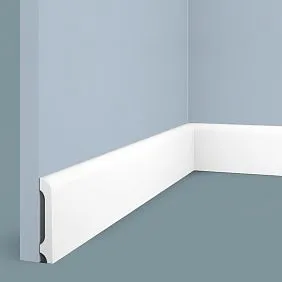
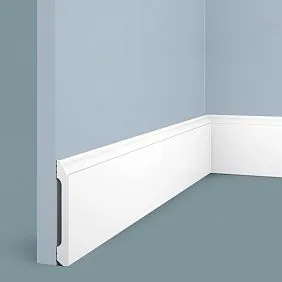
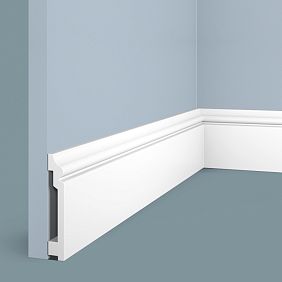
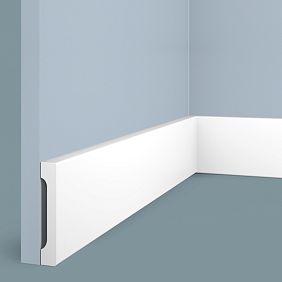
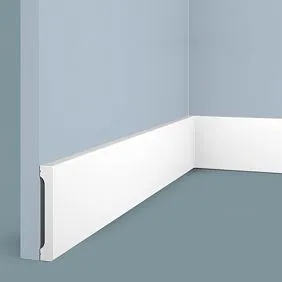
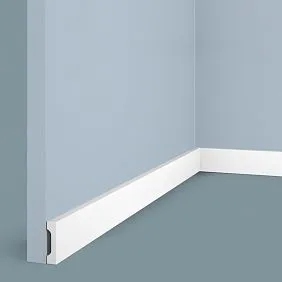
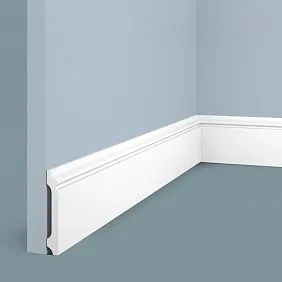
Classical stucco — luxurious rosettes, lush cornices with dentils, carved pilasters, multi-tiered moldings — remained a symbol of status and artistic taste for centuries. But times change, and with them, the language of interior design changes. Modern housing demands a different aesthetic: not decorative excess, but meaningful restraint, where every element serves the architecture of the space, rather than obscuring it with excessive details. Minimalism with relief — this is a new philosophy of finishing, wherethin skirting boardsandsmooth wall panelscreate an architectural framework without the rhetoric of Baroque or the bulkiness of traditional stucco.
What is 'minimalism with relief'? It is not a rejection of volume and line, but a reinterpretation of them. Instead of overloading the wall with ornaments, the designer uses simple geometry: laconic frames made of thin profiles, vertical divisions with smooth panels, barely noticeable cornices that do not shout about their presence but delicately emphasize the boundary between wall and ceiling. Relief exists, but it works as architectural punctuation: it places accents, builds rhythm, marks the boundaries of functional zones. At the same time, the material remains noble and tactile — solid oak or beech, high-class MDF, finished with matte enamels or natural varnish, which highlight the wood texture without covering it with gilding or patina.
Why is this approach gaining popularity? Because modern people are tired of visual noise. Life is filled with information flows, screens, advertising, and numerous irritants. The home becomes a refuge where one desires silence — including visual silence.thin skirting boardswith a height of 50–70 mm, simple architraves 60–80 mm wide, smooth panels without carvings or ornaments — all of this creates a space where it's easy to breathe. The eye rests, the mind is not distracted by deciphering complex decorative codes. And at the same time, it is not emptiness, not a cold 'nothing' — wood, its texture, matte surface, neat geometry of the profiles provide exactly the amount of visual information needed for comfort.

Philosophy of rejecting decorative excesses




From ornament to line
The 20th century brought a radical revision of the attitude towards decor. Adolf Loos wrote in 1908: 'Ornament is a crime.' Of course, this was a provocation, but behind it lay a serious thought: why spend resources, time, and the labor of craftsmen on creating decorations that serve no functional purpose? Modernism proclaimed: beauty lies in the honesty of construction, in correct proportions, in the quality of material and precision of execution, not in hanging plaster curls on walls.
Minimalism of the second half of the 20th century developed this idea further. The Japanese aesthetic of 'ma' — emptiness as a significant element of composition — influenced Western architecture and design. The space between objects became as important as the objects themselves. The wall ceased to be a canvas for decorative painting made of stucco and turned into an independent architectural element valued for the purity of its plane, for the play of light and shadow on a smooth surface, for the thin line that divides or unites volumes.
Today we live in an era of post-minimalism, where the strict asceticism of the 1970s–1990s has softened, admitting the warmth of natural materials, wood texture, and the softness of fabrics. But the principle remains: fewer elements, but each one is deliberate, high-quality, and meaningful.Thin skirting boards and smooth panels made of solid woodprecisely implement this philosophy: they exist, they function, they create architecture, but they do not shout about themselves.
Our factory also produces:


Space as the main character
In a minimalist interior, the main thing is not the furniture, not the decor, but the space itself. Air, light, the proportions of the room. The task of the finish is to emphasize these qualities, not to obscure them. Therefore, complex stucco that 'eats up' volume, breaks the wall into many small elements, and draws attention to itself is inappropriate here.
Imagine a room 4×5 meters with ceilings 2.7 m high. If you run a wide carved cornice 150 mm high around the perimeter, hang pilasters on the walls, and break up the plane with multi-tiered moldings, visually the room will 'shrink,' become fragmented, somewhat cramped. Now imagine the same room where the walls are smooth, painted in a light neutral color, with a thin 60 mm skirting board at the bottom and a barely noticeable 45 mm cornice under the ceiling. The space 'exhales,' becomes more spacious, brighter, calmer. This is the essence of minimalism with relief: to allow the space to be itself, only delicately marking its boundaries and proportions.
Get Consultation
Quality over quantity
Minimalism is demanding. When there is nothing superfluous on the wall, any mistake — a crooked joint, an uneven line, poor material quality — immediately catches the eye. Therefore, minimalist finishing is not cheaper than classical finishing, but often more expensive: every element must be flawless.
Wooden skirting boards and profilesmade of solid oak or beech, manufactured on high-precision equipment, with factory finishing — this is exactly the case where quality becomes the only possible option. It is not enough to simply buy a smooth plank — it must be perfectly straight (tolerance no more than ±1 mm per 2 meters), corners must join without gaps, the finish coating must be even, matte or semi-matte, without drips or orange peel. Factory production guarantees this, unlike artisanal products or cheap imports.
Thin Skirting Boards: A Delicate Boundary Between Floor and Wall
Why Skirting Boards Are Needed in Minimalism
Is it possible to do without skirting boards altogether? Theoretically, yes: there are solutions where the floor and wall meet flush, and the seam is filled with sealant. But in practice, this approach creates problems. The joint between the floor and wall is a risk zone: during cleaning, water seeps into the gap, causing parquet or laminate to swell and walls to get dirty. Flooring requires a perimeter expansion gap, and this gap needs to be covered. Finally, psychologically, people need a visual boundary: without it, a room seems unfinished, 'raw'.
A minimalist interior solves this problem with a thin skirting board—a profile with a height of 50–70 mm and a thickness of 12–16 mm. It is barely noticeable, doesn't create visual heaviness, yet performs all necessary functions: it covers the joint, protects the wall from damage during cleaning, and creates a neat boundary between the floor and the vertical plane. At the same time, a thin skirting board doesn't 'cut' the wall height, doesn't break it into tiers—it simply marks the bottom of the room and disappears from consciousness, remaining a background element.
Proportions and Materials
Thin solid wood skirting boardsrequire special attention to proportions. While a height of 50–60 mm is optimal for small rooms with ceilings of 2.4–2.7 m, for spacious rooms with heights of 3.0 m and above, profiles of 70–80 mm can be used. The thickness should be proportional to the height: a too-thin skirting board looks flimsy, a too-thick one looks crude. The standard 14–16 mm is the golden mean for most interiors.
Material is a fundamentally important issue. Plastic and polyurethane skirting boards are cheap, but in a minimalist interior, they look alien: artificial shine, hollow structure, lack of tactile nobility. Wood is a completely different matter. Solid oak or beech, even painted white or grey, retains its natural texture, matte finish, and warmth. Touching a wooden skirting board is pleasant; it doesn't chill the palm like plastic. This tactility is important because minimalism is not only a visual but also a sensory aesthetic.
High-density MDF is a good alternative to solid wood, especially if the budget is limited or particularly stable geometry is required for long straight sections. MDF is not afraid of temperature fluctuations, doesn't warp with changes in humidity, and can be easily painted any color with a flawlessly smooth surface. But here too, it's important to choose quality European MDF with a density of 750–850 kg/m³, not loose Chinese equivalents.
Profiles and Finishes
The shape of a thin skirting board should be as simple as possible. No carved details, complex coves, or decorative overlays. The ideal profile is a rectangular cross-section with a slight rounding of the top edge (radius 2–3 mm) so it doesn't look sharp. A minimal recess at the base for tight fitting to the floor is possible if the wall isn't perfectly even.
The finish is what 'makes' the skirting board. In minimalist interiors, three options are popular:
Matte white enamel—a classic of Scandinavian and contemporary style. A white skirting board visually 'extends' the wall downward, doesn't create contrast, making the room seem taller and brighter. It's important that the enamel is specifically matte, with a gloss level of no more than 5–10 units. Glossy white looks plasticky and cheap.
Natural wood under varnish or oil—for interiors where natural texture is valued. Light oak, bleached or tinted grey, works excellently in Scandinavian spaces. Dark walnut or wenge—for more solid, status interiors with contrasting combinations.
Enamel in the wall color—a technique that completely 'dissolves' the skirting board. If the walls are grey, the skirting board is painted the same grey. If beige—beige. The skirting board ceases to be a separate element, becomes an extension of the wall, and the boundary between floor and vertical plane blurs. This is the most radical minimalism but requires perfect execution: any installation flaw will be noticeable.
Installation Without Compromise
Installing thin skirting boards requires surgical precision. The slightest misalignment, a gap in the corner, a crack by the wall—and the entire effect of refined restraint is ruined. Therefore, you cannot skimp on installation.
The base must be perfectly even. If the wall is 'wavy,' the skirting board will pull away, forming gaps. There are two solutions: either level the wall (plaster, drywall) or use flexible polyurethane skirting boards, but in minimalism, this is a compromise because polyurethane doesn't offer the nobility of wood.
Corners are cut on a miter saw at 45° with accuracy to tenths of a degree. Even a half-degree deviation will create a noticeable gap or 'overlap.' After cutting, the ends are tinted or touched up so the wood core doesn't show through.
Attachment—with adhesive and finish nails (headless pins), which are driven in with a pneumatic pin nailer. The holes from the pins are filled with putty matching the skirting board color, sanded, and become invisible. If the skirting board is white, acrylic sealant can be used to fill micro-gaps by the wall and floor—it remains elastic and doesn't crack.
Smooth Panels: The Wall as an Architectural Object
Panels Instead of Wallpaper and Paint
A wall in a minimalist interior is not a background for furniture and decor but an independent architectural element. Patterned wallpaper is inappropriate here: it breaks up the plane, distracts attention. A smooth painted wall is better, but paint gets dirty over time, scratches, and requires regular renewal, especially in high-traffic areas (entryway, hallway, children's room).
Smooth wall panels made of solid wood or MDFsolve both problems: they create a perfectly smooth, noble surface and ensure durability. A panel can be painted any color, coated with matte varnish, or left with the natural wood texture. At the same time, it is stronger than paint, easy to clean, doesn't scratch from accidental contact, and doesn't require renewal for decades.
A smooth panel is not necessarily a solid sheet from floor to ceiling. More often, it's a system of modules of standard width (300–600 mm) and height (up to 2700 mm), mounted on battens and joined together. The joints can be invisible (tongue-and-groove with fitting and seam putty) or intentionally visible (shadow gap—a 2–3 mm gap that creates a vertical rhythm on the wall).
Vertical and horizontal divisions
A completely smooth wall without divisions is the ultimate minimalism, but sometimes it looks too 'empty,' especially in large spaces. To add structure without overloading the space, divisions are used:
Vertical—panels are installed vertically with a small gap between them. This creates rhythm, visually raises the ceiling, and adds dynamism. This technique is popular in modern living rooms, offices, and public spaces. The spacing between panels can be 300–500 mm, the gap—3–5 mm. Panels are attached with hidden clips, the gap remains clean or is filled with a dark backing to enhance contrast.
Horizontal—classic 'wainscoting' or boiserie. The wall is divided horizontally into two or three zones. The lower one (dado)—90–120 cm high—is clad with smooth panels, the upper one remains painted. The boundary is marked by a thin molding or simply the joint of two surfaces. This solution protects the lower part of the wall from damage, creates a visual anchor, and makes the space cozier. At the same time, minimalist aesthetics are preserved: no carved elements, everything is laconic and strict.
Combined—vertical and horizontal lines form a grid, a modular system. This is already more complex architecture but still within minimalism if the profiles are thin (20–40 mm) and the panels are smooth, without decoration.
Color and Texture
Minimalism does not mean the absence of color. Simply, the color palette is restrained, well-considered.Smooth panelscan be painted in any shade:
White — the most popular color in Scandinavian minimalism. White panels reflect light, making the room more spacious and brighter. It's important to choose the right shade of white: not a cold sterile one, but a warm milky or ivory.
Gray — from light gray (almost white) to dark graphite. Gray is universal, elegant, creates a calm, slightly urban background. Medium gray shades (taupe, greige) work great in modern interiors, adding depth without drama.
Beige and sand — warm neutral tones for creating a cozy atmosphere. Beige panels pair well with natural wood furniture, textiles, creating a sense of natural harmony.
Dark colors — black, dark blue, khaki, terracotta — are used as accents, on one wall or in the lower panel zone. They add drama, depth, make the interior more expressive, but require good lighting and a large room area.
Natural wood — light oak, ash, bleached beech for Scandinavian interiors; dark walnut, stained oak for more prestigious spaces. The wood texture adds tactility, warmth, connects the interior with nature. At the same time, the panels remain smooth, without carving — the texture of the material itself becomes the only decoration.
Practical Advantages
In addition to aesthetics, smooth panels offer a number of practical advantages:
Durability — a wooden or MDF panel withstands impacts, doesn't scratch from accidental furniture contact, doesn't get punctured by a suitcase corner (relevant for hallways).
Easy maintenance — the smooth surface is easy to wipe, dust doesn't accumulate on it like on relief moldings. Wet cleaning won't damage the factory coating.
Longevity — panels last for decades without losing their appearance. If after 15–20 years you want to update the color, light sanding and new painting are sufficient. Painted walls require renewal every 5–7 years.
Hiding utilities — a gap remains between the panel and the wall where electrical wires, network cables are routed. No need to chase walls, everything is done cleanly and quickly.
Sound insulation — wooden panels with an air gap slightly improve sound insulation, especially if a layer of mineral wool is added behind them.
Casing and moldings: minimum profile, maximum precision
Casing as a thin frame
A door or window opening in a minimalist interior doesn't require wide casing. Traditional 100–120 mm here is excessive.A thin casing 60–80 mm widedelicately frames the opening, covers the joint between the frame and the wall, but doesn't create a massive frame.
The casing profile should be as simple as possible: rectangular cross-section or with one small bevel. No carved elements, stepped profiles, decorative overlays. Color — matching the door leaf or matching the wall. If the doors are white, the casings are white. If the doors are wooden (oak, walnut), the casings are made of the same wood. Contrast combinations are possible but require refined taste: for example, white doors with light oak casings create an elegant but unobtrusive accent.
Installing thin casings — the same story as with baseboards: precision above all. 45° angles, joints without gaps, fastening with finish nails or glue, filling micro-gaps with sealant. If the casing is installed in a 'herringbone' pattern (one vertical plank and two at an angle on top), the joints must be perfectly fitted, otherwise the entire aesthetic falls apart.
Moldings: define, but don't overload
In a minimalist interiorMoldingsare used very sparingly. Their task is not to decorate, but to structure. For example:
A horizontal molding at a height of 90–100 cm separates the panel base from the upper painted part of the wall. The profile is thin, 20–40 mm, smooth or with a minimal bevel. It doesn't shout about itself but performs an important function — visually divides the wall into proportions, makes the room cohesive.
Vertical moldings are used to create a modular grid on the wall. For example, in the living room behind the TV, you can define a zone with thin vertical planks that 'embed' the TV panel into the wall, making it part of the architecture. Or in the bedroom behind the headboard, create a frame of thin moldings that defines the rest area.
Ceiling cornice in minimalism — a profile 30–50 mm high, often with hidden installation, behind which LED lighting can be built in. The cornice doesn't hang down, doesn't weigh on the space, but only marks the boundary between the wall and ceiling, creates a soft light line around the perimeter of the room.
All moldings should be of the same thickness, same color, same profile. Mixing different profiles and widths creates visual chaos, which contradicts the idea of minimalism.
Hidden profiles and shadow gaps
Modern minimalism often uses the technique of 'hidden profiles' — when elements are joined without visible casings and moldings, and the boundary is marked by a shadow gap — a 3–5 mm gap. For example, a door frame is installed flush with the wall, without a protruding casing, and a thin gap remains around it. Visually, the door is 'cut out' of the wall, looks like part of the architecture.
This approach requires perfect execution: walls must be level, the frame — precisely set, the gap — uniform around the entire perimeter. The slightest misalignment is noticeable. Therefore, hidden profiles are a premium finishing level, where experienced craftsmen with professional tools work.
Materials and Technologies: How to Make Minimalism Durable
Solid Wood vs MDF: What to Choose
Both materials are suitable for minimalist interiors, but each has its own characteristics.
Solid oak or beech is prestige, tactile nobility, durability. Wood is warm to the touch, has a natural texture that is pleasant to look at. Even painted white or gray, wood retains its 'soul,' a barely noticeable grain pattern that enlivens the smooth surface. Solid wood can be restored multiple times: sanded, repainted, refreshed. After 50 years, it will look as good as on the day of installation, if properly cared for.
But solid wood requires a stable climate. Humidity fluctuations of more than ±10% can cause slight deformations and cracking. In dry climates with central heating, it is important to maintain humidity at 45–55% using humidifiers. In regions with high humidity (coastal cities), good ventilation is needed.
High-density MDF is a more stable material. It does not react to humidity, does not warp, does not crack. Ideal for long panels and profiles where geometric stability is important. MDF is easily painted with a perfectly smooth, texture-free surface. This is a plus for those who want an absolutely flat matte plane without a hint of wood grain.
Disadvantages of MDF: it is heavier than wood, less 'noble' to the touch (though this is subjective), contains formaldehyde resins (E1 class is safe, but it is still synthetic). If damaged, MDF is harder to restore: you cannot simply sand it like wood.
For a minimalist interior, you can combine: baseboards and trims made of solid wood (they are visible, touched), panels made of MDF (large areas where stability and flatness are important).
Finishing: Matte as a Principle
Gloss is inappropriate in minimalism. Shiny surfaces reflect light, create glare, visual noise. Minimalism requires matte surfaces—surfaces that absorb light, create calm.
Matte enamel—gloss level of 5–10 units (practically no shine). Modern water-based enamels provide excellent coverage, are eco-friendly, and do not yellow over time. It is important to apply them in several thin layers with intermediate sanding for perfect smoothness.
Matte varnish—for cases where you want to preserve the wood texture. The varnish does not give shine but protects the wood from moisture, scratches, and dirt. Polyurethane matte varnishes are very durable and withstand intensive use.
Oil-wax—a natural coating that soaks into the wood, emphasizes the texture, and gives a silky-matte surface. Oil requires regular maintenance (renewal every 1–2 years) but creates a unique tactile effect. Suitable for panels where natural aesthetics are important.
Color Solutions: A Palette of Restraint
A minimalist palette is built on neutral colors with possible accents:
Achromatics—white, gray, black. White visually expands, gray creates balance, black adds drama. They can be combined: white walls + gray panels + black trims = classic monochrome.
Pastel tones—light beige, powder, light blue, mint. Add softness, warmth, without violating minimalist restraint.
Natural wood shades—light oak, ash, bleached wood for Scandinavian interiors; medium walnut for warmer spaces.
Accent colors—used pointwise, on one wall or in details. Terracotta, emerald, dark blue, graphite. But the main background remains neutral.
Light and Shadow: How Minimalism Works with Lighting
Natural Light as the Main Actor
A minimalist interior lives by light. Large windows, absence of heavy curtains, light walls and panels—all this works to let in maximum daylight. Smooth surfaces reflect light softly, without glare (thanks to matte finish), creating uniform illumination.
Thin baseboards and trims do not 'eat up' light, do not create deep shadows like carved cornices and pilasters. The space remains airy, bright even on a cloudy day.
Artificial Lighting: Hidden Sources
In minimalism, light sources are often hidden. Instead of chandeliers—recessed lights, linear profiles with LED strips, hidden lighting behind cornices and panels.
Hidden lighting behind a ceiling cornice creates a soft light line around the perimeter of the room, visually raises the ceiling, makes the space lighter.
Lighting behind panels—if panels are installed with a gap from the wall, an LED strip can be laid behind them. The panel glows from within, creating a floating, volumetric effect.
Spotlights are recessed into the ceiling or walls flush, do not protrude, do not attract attention. Light—is present, source—almost invisible.
Play of Shadows on Smooth Surfaces
A smooth wall in minimalism is not flat monotony, but a living surface that changes throughout the day depending on the lighting. Morning light reveals the subtle texture of wood, evening light creates soft shadows at panel joints. This is a subtle, unobtrusive dynamism that enlivens the space without decorative excess.
If the wall has vertical or horizontal divisions (shadow joints between panels), side lighting emphasizes them, creating a play of light and shadow. This is the 'relief' of minimalism—not carving or ornament, but the interplay of planes and lines in the light stream.
Practical scenarios: where minimalism works best
Scandinavian interiors
Scandinavian style is the quintessence of minimalism with relief. White walls, light wooden floors,thin white baseboards50–60 mm, simple casings, smooth panels of light oak or painted white. No moldings, no carved details—only clean lines, natural materials, an abundance of light.
Wall panels in Scandinavian interiorsare often used in the bedroom—behind the headboard, creating a warm, cozy 'backrest'. Or in the living room—one accent wall of vertical slats or smooth panels under natural varnish, contrasting with white painted walls.
Japanese minimalism
Japanese wabi-sabi aesthetics values simplicity, imperfection, and the natural beauty of materials.Smooth panels of natural woodwithout painting, preserving the texture, knots, and natural shades—this is very Japanese. Thin profiles, shadow joints instead of casings, absence of decor.
Color palette—natural wood tones, gray, black, white. Minimal furniture, low horizontal lines, emptiness as a significant element. Baseboards and casings may be completely absent or as thin as possible, almost unnoticeable.
Modern urban apartments
In urban apartments, especially small ones, minimalism with relief is a way to visually enlarge the space, make it brighter and more spacious. Light smooth panels, thin baseboards, absence of heavy cornices—all this works to create a sense of openness.
thin skirting boardspainted the same color as the walls visually raise the ceiling. Smooth panels instead of wallpaper create a calm, noble background without overloading a small space. Simple casings and hidden doors make the interior cohesive, without fragmentation into small elements.
Offices and commercial spaces
Minimalism in the office is not cold sterility, but professionalism, focus, attention to detail.Smooth panelsof dark wood or painted gray create a prestigious backdrop for meeting rooms and executive offices. Thin profiles, clear lines, quality materials—all this works for the company's image.
In public spaces—restaurants, cafes, galleries—minimalism creates a calm, elegant atmosphere where attention is directed not at the finish, but at people, art, food, conversation.
Why it's not boring: minimalism as a complex art
Simplicity requires mastery
A common misconception: minimalism is easy to execute because there are few elements. In fact, the opposite is true. When a carved cornice with dentils hangs on the wall, minor installation flaws get lost in the details. When the wall is smooth and the baseboard is thin, any mistake—a crooked joint, a gap, an uneven line—immediately catches the eye.
Minimalism is the highest level of skill. It requires perfect execution at all stages: from design to finishing. And this is precisely its beauty: perfection of proportions, precision of lines, nobility of materials. It is not a poverty of means, but a wealth of craftsmanship.
Details that matter
In a minimalist interior, every detail is worth its weight in gold. If in classic style you can 'clutter' a wall with decor and the eye gets lost in abundance, then in minimalism every line matters. Therefore,Thin skirting boards and smooth panels made of solid woodmust be impeccable in quality. This is not a case where you can save money and buy cheap MDF or plastic. Quality wood, factory finish, precise installation—that's what makes minimalism convincing.
Durability and relevance
Minimalist interiors do not become outdated. Fashion for Baroque, Empire, and Provencal comes and goes, but minimalism remains relevant for decades. Because it is based not on decorative trends, but on fundamental principles: proportion, light, material, space. These categories are eternal.
In 20 years, an interior withthin baseboards, smooth panels, and simple lines will look just as modern as today. And classical moldings may seem outdated, 'museum-like,' especially if the style of execution does not match current tastes.
Frequently Asked Questions about Minimalist Finishes (FAQ)
Won't minimalism look too cold and empty?
No, if materials and colors are chosen correctly. Wood, even painted white, retains warmth. Matte surfaces, soft lighting, and textiles (rugs, pillows, curtains) add coziness. Minimalism is not emptiness, but space for living, free from visual clutter.
What is the optimal baseboard height for minimalism?
For standard apartments with 2.7 m ceilings — 60 mm. For small rooms with 2.4–2.5 m ceilings — 50 mm. For spacious rooms with ceilings of 3.0 m and above — 70–80 mm. More important than absolute height are proportions: the baseboard should not 'cut' the wall, it should be barely noticeable.
Can thin baseboards be used in a child's room?
Yes, but it should be considered that thin baseboards are less durable than tall ones. If the child is young and active, it's better to choose a solid oak baseboard — it will withstand toy impacts. MDF or plastic may crack.
How much does it cost to finish a room in a minimalist style?
Depends on area and materials. Thin solid oak baseboards cost from 800 rub./linear meter, smooth panels — from 3000 rub./sq.m. A 20 sq.m. room with panels on one wall and baseboards around the perimeter will cost 80,000–120,000 rub. (materials + installation). This is comparable to good plastering and painting, but the result is more durable.
Do walls need to be leveled before installing panels?
Depends on the installation method. If panels are glued directly to the wall, the base must be level. If mounted on a frame, irregularities up to 30–40 mm can be compensated. For minimalism, a perfectly level finish surface is important, so a frame is often preferable.
Can minimalism be combined with other styles?
Yes, minimalism pairs well with loft (brick + smooth panels), eco-style (wood + natural materials), and Japanese style. The main thing is to maintain restraint and not overload the space with decor.
How to care for smooth panels and thin baseboards?
Dry cleaning with a soft cloth or vacuum with a brush once a week. Damp wiping with a well-wrung cloth without abrasives. Panels with a lacquered finish can be wiped with special wood care products 2–3 times a year. Oil finishes require renewal every 1–2 years.
Where to buy quality thin baseboards and smooth panels?
From manufacturers with their own production who control quality. STAVROS is one of the leaders in the Russian market for wooden interior products.
Professionals' Choice: Why STAVROS
When it comes to minimalist finishes, material quality and precision of execution are critical. The company STAVROS has been producing premium solid wood products for interiors of any complexity and style since 2002.Thin baseboards, smooth panels, simple architraves and moldingsfrom STAVROS combine European quality, Russian production, and reasonable prices.
STAVROS production expertise includes:
-
Chamber drying of wood to a moisture content of 8–12%, which prevents deformation and cracking of products during use.
-
Processing on high-precision equipment — four-sided planing machines with a tolerance of ±0.1 mm per linear meter, which is critical for the thin profiles of minimalist design.
-
Multi-stage finishing — sanding, priming, application of matte enamels or varnishes under controlled conditions for a perfect surface.
-
A wide range of profiles and finishes — from standard solutions to custom manufacturing based on individual drawings.
STAVROS offers:
-
thin skirting boardsmade of solid oak, beech, MDF, 50–80 mm high with simple profiles, painted in any color or with a natural varnish finish.
-
smooth wall panelsfor creating modern minimalist interiors — from Scandinavian white to dark accent walls.
-
Architraves and moldingsThin profiles for framing openings and creating architectural divisions without decorative excess.
-
Custom manufacturing of non-standard sizes and profiles for specific projects.
By choosing STAVROS, you get:
-
Guaranteed quality — 5-year warranty against manufacturing defects.
-
Timely delivery — streamlined logistics, extensive stock program, prompt shipping.
-
Professional support — assistance in material selection, quantity calculation, installation recommendations.
-
Durability — solid wood products last 30–50 years, maintaining their original appearance with minimal care.
Minimalism with relief is not a rejection of beauty, but its reinterpretation.Thin skirting boards and smooth panels by STAVROScreate interiors where every line matters, every surface is impeccable, and the space breathes with the calm and nobility of natural materials.


