Article Contents:
- Tactile Revolution: Why Wood Beats Metal and Plastic
- Geometry in Your Hands: Shapes, Sizes, Styling
- Round Handles: Timeless Classics
- Triangular Handles: Asymmetry and Modernity
- Oval Handles: Smoothness and Ergonomics
- U-Shaped Pull Handles: Functionality and Grip
- Button Handles: Compactness for Delicate Fronts
- Oak and Beech: Two Woods, Two Characters
- Beech: Light Elegance and Uniformity
- Oak: Expressive Texture and Age-Old Strength
- How to Choose the Wood Type?
- Color Palette: From Clear Oil to Deep Black
- Clear Coating: Natural Beauty in Full Glory
- White Handles: Scandinavian Freshness
- Black Handles: Contrast and Expressiveness
- Brown Handles: Warm Classic
- Where and How to Use: From Kitchen to Wardrobe
- Kitchen Units: Combining Practicality and Aesthetics
- Dressers and Cabinets: Accent Details for the Bedroom
- Wardrobes: Functionality for Large Furniture
- Children's Furniture: Safety and Brightness
- Installation and Replacement: Easier Than It Seems
- Marking: Precision is the Key to Symmetry
- Drilling: Caution with Thin Fronts
- Fastening: Don't Overtighten
- Replacing Old Handles: Updating Without Replacing Furniture
- Combining with Other Hardware and Decor
- Metal and Wood: Contrast of Materials
- Wooden Decor: Unity of Material
- Cornices and Baseboards: Finishing the Look
- Care and Preservation of Beauty for Decades
- Regular Cleaning: Gently and Delicately
- Coating Restoration: Oil Returns the Shine
- Damage Prevention: Prophylaxis
- Why Wooden Handles Are the Trend of 2026
- Eco-Consciousness: A Material That Does No Harm
- Craft Movement: Respect for Craftsmanship
- Durability: Against the Throwaway Culture
- Individuality: Rejecting Typification
- Where to Buy Quality Wooden Handles
- Supplier selection criteria
- Online Purchase: Convenience and Accessibility
- Frequently Asked Questions About Wooden Furniture Handles
- How Are Wooden Handles Better Than Metal Ones?
- Are Wooden Handles Suitable for the Kitchen?
- What Size Handle Should I Choose?
- Can I Paint Wooden Handles Myself?
- How long do wooden handles last?
- Which Wood Species Is Better — Oak or Beech?
- How to care for wooden handles?
- Can I Replace Handles on Old Furniture?
- How to Match Handles to the Interior Style?
- Is It Worth Buying Wooden Handles?
- Conclusion: The Final Touch for Your Furniture

Open a cabinet door. Pull a dresser drawer. Look at a kitchen set. What touches your fingers first? The handle. A tiny detail we don't notice but interact with dozens of times daily. And it is this detail that can either ruin the impression of expensive furniture or elevate an ordinary dresser to the level of a designer object.
Furniture HandlesWooden handles are not just hardware. They are the final touch that defines the character of furniture. They are a tactile pleasure that turns the routine act of opening a drawer into a pleasant ritual. They are a visual accent that either blends with the facade or contrasts with it, creating the desired effect.
Wood as a material for handles is returning to the peak of popularity in 2026. Eco-trends, a return to natural materials, respect for craftsmanship — all this makesWooden handleswooden handles in demand among those who choose quality and thoughtfulness in interior details.


Tactile Revolution: Why Wood Defeats Metal and Plastic
Touch a metal handle on a frosty morning. Cold, unpleasant, off-putting. Now imagine a wooden one — warm, alive, inviting to touch. The difference is colossal.
Wood has a unique ability to maintain room temperature and instantly warm up from the touch of a hand. Metal draws away heat, plastic feels cheap and lifeless.Wooden handleWooden handles create pleasant tactile sensations that subconsciously form a positive attitude toward the furniture.
Wood texture is another important aspect. The smooth polished surface of beech, the expressive pores of oak, the natural pattern of growth rings—all of this creates a visual and tactile depth unattainable by artificial materials. EachWooden Handleis unique thanks to the natural wood grain.
Sustainability is an increasingly significant argument. Wood is a renewable natural resource. The production of wooden handles does not require the chemical processes typical of plastic and does not create the toxic emissions characteristic of metallurgy.Wooden handles—the choice of those who consciously approach shaping their home environment.
The durability of solid beech or oak wooden handles is measured in decades. High-quality wood, properly dried and treated, does not warp, crack, or lose its original appearance throughout the furniture's lifespan. Unlike plastic handles that yellow and become brittle, or cheap metal ones that oxidize and develop an unsightly patina.




Geometry in your hands: shapes, sizes, styles
The variety of wooden handle shapes is astounding. From minimalist geometric figures to complex ergonomic designs—there is a suitable solution for every interior style and type of furniture.
Our factory also produces:



Round handles: a classic tested by centuries
Round knob handles are the most traditional form. The diameter varies from compact 30 millimeters for small dresser drawers to impressive 80-100 millimeters for large cabinet doors.
Small round handles 30-40 millimeters are ideal for furniture in children's rooms, compact dressers, and jewelry boxes. They are easy to grasp with two fingers, do not protrude significantly, do not get in the way, and do not snag clothing.
Medium handles 50-60 millimeters are a universal size for most types of furniture. Dressers, cabinets, kitchen drawers, bedside tables—such handles look organic everywhere.
Large handles 70-100 millimeters are an expressive accent for massive furniture. Wardrobes, buffets, wine cabinets, dressers in classic style benefit from substantial round handles that emphasize the item's weight and significance.
The shape can be strictly cylindrical, hemispherical, slightly flattened, with a beveled edge, or with a decorative indentation in the center. These nuances determine stylistic affiliation—from strict minimalism to decorative classicism.
Get Consultation
Triangular handles: asymmetry and modernity
Triangular handles are a bold design solution for modern interiors. Sharp angles, clear geometry, and unconventional shapes attract attention and create dynamism.
Such handles are especially appropriate in minimalist interiors, where every detail matters and form prevails over ornament. Furniture in Scandinavian style, loft interiors, modern kitchens with smooth fronts—triangular wooden handles add character without disrupting the overall restraint.
The sizes of triangular handles are usually in the range of 40-70 millimeters along the base. A thickness of 20-30 millimeters ensures a comfortable grip and visual weight.
Oval handles: smoothness and ergonomics
Oval and teardrop shapes combine ergonomics and aesthetics. Smooth lines are pleasing to the eye, and the absence of sharp angles makes the handles safe for children's rooms.
Elongated ovals sized 60×30 millimeters fit comfortably in the palm, providing a reliable grip when opening heavy doors. Rounded ovals closer to a circle are suitable for small drawers.
Such handles are stylistically universal. Classic interiors, Provence, country, modern eclecticism—oval wooden handles fit organically into diverse contexts.
U-shaped handles (pulls): functionality and grip
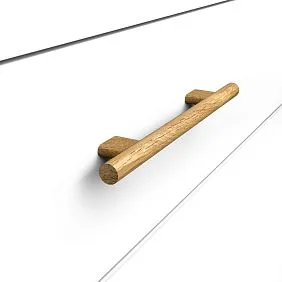
U-shaped handles (pulls) are the most functional form for large drawers and doors. You can fit your entire hand under such a handle, which is critically important when opening heavy pull-out drawers filled with clothing or dishes.
The length of U-shaped handles varies from compact 64 millimeters (distance between the centers of mounting holes) to impressive 200-300 millimeters for spacious kitchen drawers.
The projection height (distance from the front surface to the inner side of the handle) is usually 25-40 millimeters. This is sufficient for a comfortable grip but not so much that the handle gets in the way or snags.
The profile of a U-shaped handle can be round, square, or rectangular. A round profile with a diameter of 18-22 millimeters is the most comfortable for gripping. A square 20×20 millimeter profile creates a more modern, geometric look.
Knob handles: compactness for delicate fronts
Knob handles are minimalist elements of small size, barely protruding above the front surface. Diameter 25-35 millimeters, projection height 15-25 millimeters.
Such handles are ideal for furniture with paneled fronts, where a large handle would disrupt the proportions. Jewelry boxes, small nightstands, light dresser drawers—these are the areas of application for compact knobs.
The advantage is delicacy. The handle does not dominate, does not attract excessive attention, and allows the front to remain the main visual element.decorative inlays for furniturecombined with compact wooden buttons create a harmonious classic ensemble.
Oak and beech: two species, two characters
Choosing the wood species for handles is not only an aesthetic but also a practical question. Oak and beech are the two main species used for producing high-quality furniture handles, each possessing unique properties.
Beech: light elegance and uniformity
Beech is a light-colored species with a fine, uniform texture. Its color ranges from creamy pink to light brown. The pores are small, and the annual rings are faintly visible, creating a homogeneous, calm surface.
Beech has a hardness of about 3.8 on the Brinell scale, making it durable enough for daily use. A density of 650-680 kg/m³ gives the handle a substantial feel and a pleasant sense of quality in hand.
Beech is easy to work with, mill, and sand. This allows for creating handles with complex shapes featuring sharp edges and smooth transitions.Wooden handlesBeech handles are the choice for modern interiors where purity of form and color restraint are important.
A drawback of beech is its sensitivity to humidity. In environments with unstable climates, beech products may warp slightly. Therefore, for kitchens, especially those near sinks or stoves, it's better to choose oak or oil-treated beech.
Oak: expressive texture and age-old durability
Oak is a classic in furniture production. Its color palette ranges from light sandy to rich brown. The texture is expressive—large pores, clearly visible annual rings, and a natural grain that makes each handle unique.
Oak has a hardness of about 3.7-3.9 on the Brinell scale and a density of 690-720 kg/m³. Oak is stronger than beech, more resistant to humidity, and less prone to warping. Oak handles are the choice for kitchens, bathrooms, and rooms with variable microclimates.
Tannins present in oak wood provide natural protection against fungi and bacteria. This is especially important for kitchen furniture, where hygiene is critical.
Aesthetically, oak is associated with solidity, tradition, and quality.Furniture HandlesOak handles are perfectly suited for classic interiors, country-style furniture, English libraries, and studies.
How to choose the species?
For modern minimalist interiors where clean lines and light tones are important—beech. For classic, traditional interiors with an emphasis on texture and naturalness—oak. For kitchens and humid rooms—definitely oak. For furniture in children's rooms, where safety and eco-friendliness are important—both species are equally suitable; choose based on color and texture.
Color palette: from transparent oil to deep black
Natural wood is beautiful on its own, but a finish coating can enhance its natural beauty, adapt the color to a specific interior, and protect the wood from wear.
Transparent coating: natural beauty in all its glory
handles without coatingHandles with transparent oil/varnish showcase the natural beauty of the wood. The texture, color, and grain of the wood remain visible, creating a sense of naturalness.
Oil coating penetrates the wood structure, highlights the texture, and imparts a subtle matte sheen. The wood remains tactilely pleasant, warm, and alive. Oil provides protection against moisture and dirt while maintaining the wood's breathability.
Varnish coating creates a thin protective film on the surface. Varnish can be matte, semi-matte, or glossy. Matte varnish preserves the natural look of the wood, while glossy varnish creates a pronounced shine, emphasizing luxury.
Natural finishes are the choice for interiors in eco, Scandinavian minimalism, Japanese wabi-sabi, and modern organic design styles—anywhere a connection with nature and material authenticity is valued.
White handles: Scandinavian freshness
White wooden handles are the quintessence of Scandinavian style. Light, clean, creating a sense of air and space. White color visually expands a room, making furniture lighter and more airy.
White coating can be opaque, completely hiding the wood grain, or semi-transparent, allowing the natural pattern to show through. The latter creates an interesting effect—the handle is white but retains the character of the wood.
White handles are ideal for light-colored furniture—white, beige, or gray fronts. They create a unified monochrome composition where the handle is barely noticeable, not disrupting the purity of lines.
Black handles: contrast and expressiveness
Black wooden handles are a dramatic accent on light-colored fronts. Black on white, black on gray, black on light wood—the contrast draws attention, making the handle a significant design element.
Black finishes can be matte or glossy. A matte black surface creates understated elegance and is associated with modern design. Glossy black is more formal, luxurious, and suitable for classic interiors.
Black handles visually weigh down furniture, making it more substantial and serious. This can be an advantage for massive cabinets, dressers, and buffets where solidity is important. And a disadvantage for light, airy furniture, which black handles can visually overload.
Brown handles: warm classic
Brown shades—from light walnut to dark wenge—create a warm, cozy atmosphere. These are natural, organic colors associated with wood, stability, and tradition.
Brown handles perfectly complement furniture made of natural wood, MDF with wood-grain foil, and tinted fronts. They can match the front, creating a monochrome composition, or contrast—dark handles on light furniture, light handles on dark.
Wood tinting allows for any brown shade while preserving the visibility of the grain. This distinguishes painted wood from plastic imitating wood—the natural pattern remains, creating a sense of authenticity.
Where and how to apply: from kitchen to wardrobe
Furniture HandlesWooden handles are universal, but for each type of furniture, there are optimal solutions.
Kitchen sets: a combination of practicality and aesthetics
The kitchen is a space with high demands on hardware. Handles are touched dozens of times a day, often with wet or greasy hands. Therefore, strength, moisture resistance, and ease of cleaning are critical for the kitchen.
Oak handles with oil or varnish coating are the optimal choice. Oak is resistant to humidity, and the coating protects against stains. U-shaped bracket handles 96-128 mm long are convenient for pull-out drawers with pots and dishes. Round or oval handles 50-60 mm are suitable for wall cabinets.
The color of the handles is determined by the kitchen's style. Classickitchens with carved decorharmonize with handles in natural oak color or tinted to resemble walnut. Modern minimalist kitchens benefit from white or black handles of strict geometric shapes.
An important point is the combination of handles with other hardware. If the kitchen uses chrome hinges, faucets, and rails, wooden handles create an interesting contrast of cold metal and warm wood. If the hardware is copper or brass, choose handles in warm brown shades for a harmonious combination.
Dressers and cabinets: accent details for the bedroom
In the bedroom and living room, dresser and cabinet handles become significant decorative elements. There are no strict requirements for moisture resistance here, so you can choose the wood species and finish based solely on aesthetic criteria.
Medium-sized round handles 50-70 mm are a classic solution for dressers. Placed in the center of each drawer, they create a visual rhythm and structure the front.
For wide dresser drawers, you can use two handles placed symmetrically. Two small round handles 40 mm in diameter, spaced 200-300 mm apart, create a balanced composition.
The color of the handles can contrast with the front or blend with it. A white dresser with black handles is a graphic, expressive solution. A dresser made of natural oak with matching handles is monochrome elegance.
Cabinets: functionality for large furniture
Wardrobes, buffets, and display cabinets require large handles proportionate to massive doors. Round handles 70-100 mm or U-shaped brackets 160-200 mm long provide a comfortable grip and visually match the furniture's dimensions.
Vertical cabinet doors can be equipped with vertically oriented long brackets 300-400 mm, running almost the full height of the door. This solution creates a modern, dynamic look and is especially effective on tall, narrow fronts.
For cabinets in a classic style with panels and carved decor, choose handles in natural wood color or tinted to match the main wood.Carved overlays on frontscombined with wooden handles create a cohesive, harmonious image.
Children's furniture: safety and brightness
For a child's room, safety and eco-friendliness are important. Wooden handles without sharp corners, with a smooth sanded surface, coated with safe water-based paints are the optimal choice.
Oval and round shapes are safer than triangular and rectangular ones with sharp corners. Compact sizes 30-50 mm are suitable for children's hands, allowing the child to easily grasp and open drawers.
The color can be bright—blue, green, yellow, red—creating a cheerful, playful atmosphere. Or natural—light beech without coloring demonstrates eco-friendliness and a connection with nature.
Installation and Replacement: Easier Than It Seems
Installing wooden furniture handles requires no special skills. A basic set of tools and care is all you need.
Marking: Precision is Key to Symmetry
Precise marking is critical for visual harmony. Handles installed at different heights or with offset immediately catch the eye, creating a sense of carelessness.
For a horizontal row of drawers (chest of drawers, cabinet), handles are placed at the same height—usually in the center of the facade or in the upper third. Use a spirit level or laser level to draw a horizontal line along which the centers of the handles will be located.
For vertically positioned doors (cabinets, tall cabinets), handles are placed at a convenient height for gripping—usually 100-120 centimeters from the floor. On double doors, handles are placed mirror-symmetrically—on the right door leaf on the left, on the left door leaf on the right.
U-shaped handles require marking two holes. The distance between the centers of the holes (center-to-center distance) is standardized—64, 96, 128, 160, 192 millimeters. Use a template or ruler for precise marking.
Drilling: Caution with Thin Facades
The hole diameter depends on the diameter of the mounting screw. For standard furniture handles, M4 screws (4 millimeters) are used, requiring a hole diameter of 4.5-5 millimeters.
Drill strictly perpendicular to the facade surface. A misalignment creates a sloppy hole, and the handle will be installed unevenly. Use a sharply sharpened drill bit for a clean hole without chips.
For thin facades (10-16 millimeters MDF or chipboard), drill carefully, reducing speed as the drill bit exits the back side. This prevents material blowout.
For thick facades (20-25 millimeters solid wood), the hole depth should match the screw length. If the facade is very thick and the screw is short, use a longer screw or drill out part of the hole with a larger diameter to accommodate the threaded part.
Fastening: Don't Overtighten
Most wooden handles are fastened with a screw that passes through the facade and screws into a threaded hole in the handle body. The screw is inserted from the inside of the facade, the handle is pressed from the outside, and the screw is tightened with a screwdriver or drill driver.
Do not overtighten the screw. Excessive force can split the wooden handle, especially at the base where the thickness is minimal. Tighten until the handle fits snugly against the facade; further tightening is unnecessary.
For U-shaped handles, two screws provide stability, preventing rotation. Tighten the screws evenly, alternately tightening each one, so the handle lies flat.
Some handles have a decorative cover that conceals the mounting screw. First, install the handle base, then attach or screw on the decorative cap.
Replacing Old Handles: Updating Without Replacing Furniture
Replacing handles is the easiest and most budget-friendly way to update the look of furniture. Old furniture with outdated plastic handles transforms after installing stylish wooden ones.
If the center-to-center distance of the new handles matches the old ones, replacement is elementary—unscrew the old fasteners, install the new handle in the same holes. If the distance differs, the old holes will need to be filled with wood putty, sanded, painted, or covered with film matching the facade color, then marked and new holes drilled.
buy wooden handlesand updating old furniture is a weekend project that requires no professional skills but delivers a noticeable visual effect.
Combination with Other Hardware and Decor
Handles do not exist in isolation. They are part of the furniture ensemble, including hinges, guides,Decorative Insertscornices, baseboards. A harmonious combination of all elements creates a cohesive image.
Metal and Wood: Contrast of Materials
Combining wooden handles and metal hardware is a classic technique. Chrome-plated hinges, guides, locks create a cold, technological background against which warm wooden handles look even more expressive.
Brass or copper hardware in warm golden tones harmonizes with wooden handles in natural brown tones. Such a combination is characteristic of classic, vintage, colonial interiors.
Black matte metal hardware (hinges, guides, hooks) combined with black or natural wooden handles creates a modern, industrial look, suitable for loft interiors.
Wooden Decor: Unity of Material
If the furniture usesWooden carved appliquésWooden handles logically complement the decor, creating material unity.
The wood species of handles and backplates should match — oak handles with oak backplates, beech with beech. The finish color should also be coordinated — natural oil on handles and backplates, the same tint.
The carving style of backplates and the shape of handles should correspond to the overall style. Classic Baroque backplates require rounded, possibly slightly decorated handles. Minimalist geometric backplates harmonize with simple triangular or round handles of clear shape.
Cornices and baseboards: completing the look
Furniture cornicesThey crown kitchen sets and cabinets, creating architectural completeness. If the cornice is wooden or painted to look like wood, wooden handles support the natural theme and create decorative unity.
The color of handles can repeat the color of the cornice — dark handles under a dark crowning cornice, light under light. Or contrast — light handles on the facade with a dark cornice on top, creating a visual frame.
Care and preserving beauty for decades
Wooden handles are durable, but proper care extends their life and preserves their original appearance.
Regular cleaning: gently and delicately
Daily cleaning involves wiping handles with a slightly damp soft cloth. This removes dust, grease from fingers, and household dirt.
Do not use abrasive sponges, stiff brushes, or aggressive cleaning agents. They scratch the finish, damage the wood, and lead to loss of shine and smoothness.
For kitchen handles that come into contact with grease, use a mild soapy solution — a few drops of liquid soap on a damp cloth. Wipe the handle, then remove soap residue with a clean damp cloth, and dry thoroughly.
Restoring the finish: oil brings back the shine
Handles with an oil finish may lose their shine over time and look somewhat dry. Restoring protection is simple — apply a thin layer of furniture oil (linseed, tung, special furniture oil) with a soft cloth, let it absorb for 10-15 minutes, then remove the excess.
The oil penetrates the wood, restores moisture protection, returns color richness and a light shine. This treatment is sufficient once a year for handles in living areas, and 2-3 times a year for kitchen handles.
A varnish finish does not require regular restoration. If the varnish is damaged — a scratch, chip — local repair is possible but requires skill. It's easier to consult a specialist or replace the handle.
Preventing damage: prevention
Avoid contact of wooden handles with aggressive chemicals — solvents, acetone, alcohol. They dissolve the finish and discolor the wood.
Avoid impacts. Wood is strong, but a blow from a metal object can leave a dent or chip.
Control room humidity. Sharp fluctuations in humidity can cause cracking. Ideally, 40-60% relative humidity is comfortable for both people and wood.
Why wooden handles are the trend of 2026
Global design trends clearly point to a return to natural materials, sustainable consumption, and mindful choices. Wooden handles fit perfectly into this paradigm.
Eco-consciousness: a material that does no harm
Plastic handles are a product of petrochemistry; their production creates emissions, and disposal pollutes the planet for centuries. Wooden handles from responsibly managed forests are a renewable resource, biodegradable at the end of their life cycle.
Consumers are increasingly thinking about the environmental footprint of their purchases. Choosing wooden handles is a small but significant step towards a more sustainable lifestyle.
Craft movement: respect for craftsmanship
Wooden handles, especially those produced by milling from solid wood, carry the mark of craftsmanship. Each handle passes through the hands of a master who programs the machine, controls the quality of processing, and final sanding.
In an era of mass-produced plastic, items created with care and skill are valued more highly. A wooden handle is not faceless mass production; it is a product with character.
Durability: against the culture of disposability
Modern society is gradually moving away from the culture of disposability, returning to the value of durable things. A wooden handle serves for decades, becomes part of a family's history, and is passed down to the next generations along with the furniture.
A plastic handle breaks after a few years, gets thrown away, and replaced. A wooden one remains, and each year acquires a noble patina of time.
Individuality: rejecting typicality
Mass production has created typical interiors — identical apartments with identical furniture. Wooden handles are a way to personalize the space, to introduce individuality.
By choosing the wood species, shape, and color, you create a unique combination that matches your taste and the character of the interior. Two identical kitchens with different handles look different — one standard, the other individual.
Where to buy quality wooden handles
The market offers a huge selection of furniture handles, but quality varies drastically. Cheap handles made from pressed sawdust or low-grade wood don't last long, they warp and split. Quality solid wood handles from a manufacturer are an investment in durability and aesthetics.
Supplier selection criteria
In-house production is a guarantee of quality control at all stages. Companies that produce handles using their own facilities are responsible for every element — from wood selection to the final finish.
Using quality wood is a critical factor. Beech and oak, properly dried (moisture content 8-12%), ensure dimensional stability and absence of warping. Low-grade or poorly dried wood leads to cracks and warping.
.
Modern equipment — CNC milling machines ensure dimensional accuracy, clean processing, and shape repeatability. Manual processing on outdated equipment results in size variations and unevenness.
Having a stock program — the ability to buy the required quantity immediately, without waiting for production. This is important for urgent projects and replacing individual handles.
A diverse range — a wide choice of shapes, sizes, wood species, and finishes allows you to find the perfect solution for any project.
Online purchase: convenience and accessibility
Modern manufacturers offer purchases through online stores with nationwide delivery. It's convenient — you browse the catalog, choose the handles you need, place an order, and receive the goods by courier or transport company.
Quality photos, detailed descriptions, and specifications of sizes and characteristics help you make the right choice. Customer reviews give an idea of the real quality and service.
The ability to order a single piece is critical when replacing individual handles. Not all suppliers work with retail, requiring minimum orders of dozens or hundreds of units.
Frequently asked questions about wooden furniture handles
What makes wooden handles better than metal ones?
Wooden handles are warm to the touch, pleasant tactilely, eco-friendly, and fit into natural and eco-style interiors. Metal ones are cold but more durable and suitable for industrial, hi-tech styles. The choice depends on personal preference and interior style.
Are wooden handles suitable for the kitchen?
Yes, if chosen correctly. Oak handles with varnish or oil finish are resistant to humidity, easy to clean, and durable. Beech ones require more careful maintenance and are better used away from the sink and stove.
What size handle should I choose?
For small dresser drawers — round handles 30-50 mm. For medium drawers and cabinet doors — 50-70 mm. For large cabinet doors — 70-100 mm or U-shaped pulls 96-160 mm. For heavy kitchen drawers — U-shaped pulls 128-200 mm.
Can I paint wooden handles myself?
Yes, unfinished handles can be stained with wood stain, or coated with oil, varnish, or paint. This allows you to precisely match the color to your interior. Use quality finishes intended for furniture.
How long do wooden handles last?
With proper care, solid oak or beech wooden handles last 20-30 years or longer. They don't break, don't tarnish, and maintain their shape and functionality throughout the entire lifespan of the furniture.
Which wood species is better — oak or beech?
For kitchens and humid areas — oak, it is more resistant to moisture. For living rooms — both species are equally good, choose based on color and grain. Beech is lighter and more uniform. Oak is darker, with a pronounced grain.
How to care for wooden handles?
Wipe with a damp soft cloth, avoid abrasives and aggressive chemicals. Handles with an oil finish should be treated with furniture oil once a year. Varnished handles do not require special care.
Can I replace handles on old furniture?
Yes, replacing handles is a simple way to update furniture. If the center-to-center distance matches, replacement takes minutes. If it differs, old holes are filled with putty, and new ones are drilled.
How to choose handles to match the interior style?
For classic style — round or oval handles in natural wood colors. For minimalism — triangular, strictly shaped round handles, white or black. For Scandinavian style — light beech handles with simple shapes. For loft — black or natural handles that contrast with the facades.
Is it cost-effective to buy wooden handles?
Wooden handles are more expensive than plastic ones but cheaper than premium metal ones. Considering durability, aesthetics, and eco-friendliness — it's a reasonable investment in interior quality.
Conclusion: the finishing touch for your furniture
Wooden furniture handles are more than just hardware. It's a philosophy of mindful choice, respect for materials, and the value of durability. Every day, opening a drawer or door, you touch a natural material crafted with skill, serving for decades.
In a world overflowing with disposable plastic and standard solutions, a wooden handle is a gesture of individuality. By choosing the wood species, shape, and color, you create a unique combination that matches your taste, your home, your life.
The company STAVROS has been creating wooden products for furniture and interiors for over two decades, embodying in each product a deep understanding of the material and impeccable execution quality. Their own production facility in St. Petersburg, spanning 6000 square meters and equipped with modern CNC machinery, allows creating handles of any shape with the highest precision.
Each handle undergoes multi-stage quality control. The wood — only solid beech or oak, with strictly controlled moisture content, dried in special chambers. CNC milling ensures perfect geometry, dimensional repeatability, and clean processing. Final hand sanding removes the slightest imperfections, creating a smooth, pleasant-to-touch surface.
The STAVROS assortment includes dozens of handle models in various shapes — round, triangular, oval, U-shaped, knobs. Sizes range from compact 30 millimeters to impressive 200-millimeter brackets. Wood species — light beech and expressive oak. Finishes — clear oil highlighting the grain, white paint for Scandinavian interiors, black for contrasting solutions, tinting in various brown shades.
A large stock program ensures immediate shipment of popular models. Orders from one piece — for replacing individual handles. Wholesale supplies for furniture factories, designers, construction companies.
STAVROS showrooms in Moscow and St. Petersburg invite you to see samples, touch them, feel the difference between solid oak and beech, assess the processing quality, choose the perfect shade. Professional consultants will help select handles for your project, calculate quantities, and offer optimal solutions.
Delivery is available throughout Russia and CIS countries. Goods are carefully packaged, protected from damage during transportation. Self-pickup from the warehouse in St. Petersburg is possible.
STAVROS is a guarantee of quality, proven by thousands of completed projects. Elite residences, designer apartments, custom kitchens, antique furniture restoration, interior updates — the geographical application of the products covers the entire country. Each handle is the result of high production standards, rigorous quality control, and a love for natural materials.
Complete the look of your furniture correctly. Choose Furniture Handles wooden handles from STAVROS — and every touch will become a pleasure, every glance — confirmation of the right choice. Wood, craftsmanship, durability — that's what distinguishes quality hardware from ordinary. Make a choice worthy of your home.