












































































Article Contents:
- Specifics of furniture operation in the hotel business
- Usage intensity: figures and facts
- Diversity of users and handling styles
- Hygiene and cleaning requirements
- Criteria for selecting furniture handles for hotels
- Mechanical strength: withstand any handling
- Resistance to wear and preservation of appearance
- Ergonomics: convenience for all guest categories
- Hygiene and ease of cleaning
- Furniture supports: the foundation of stability and durability
- Design loads: safety margin for commercial operation
- Geometric stability: wood that doesn't warp
- Floor protection: felt, silicone, adjustable glides
- Aesthetics of supports: a visible design element
- Materials for commercial hardware: only proven solutions
- Oak: the gold standard for hotel hardware
- Beech: strength and aesthetics of light tones
- Unacceptable materials for commercial hardware
- Technological features of professional hardware production
- Wood selection: only first grade without defects
- Drying and conditioning: stability for decades
- Mechanical processing: precision and surface finish
- Finish coating: industrial-level protection
- Hotel furniture design: a systematic approach to hardware
- Reinforced attachment points
- Number and arrangement of supports
- Interchangeability and maintainability
- Selection economics: initial costs versus total cost of ownership
- Lifecycle Cost Comparison
- Intangible Losses from Low-Quality Hardware
- Frequently Asked Questions about Hotel Hardware
- Can Metal Hardware Be Used Instead of Wooden?
- Does Wooden Hotel Hardware Require Special Maintenance?
- How to Match Hardware Style to Hotel Concept?
- Which Wood is Best for Wet Areas — Bathrooms?
- Are There Standards for Commercial Furniture Hardware?
- How Long Does Quality Wooden Hotel Hardware Last?
- How to Calculate Hardware Requirements for a Hotel Project?
- Can Hardware Be Ordered with Hotel Logo?
- How to Check Hardware Quality Upon Delivery?
- Where to Find a Reliable Commercial Hardware Supplier?
- Conclusion: Investing in Guest Service Quality
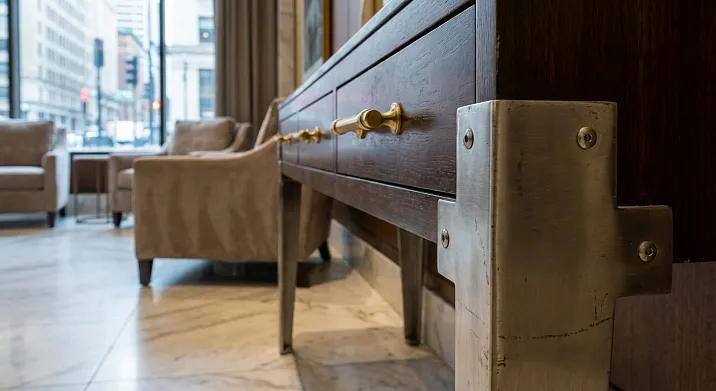
A hotel is not an apartment or an office. Here, furniture is used around the clock, without weekends, for years on end. Hundreds of different people open wardrobes, pull out drawers, move chairs, and load tables and cabinets every month. What home furniture endures over a decade, hotel furniture experiences in a year.Furniture HandlesandFurniture SupportsIn hotel rooms, restaurants, lobby bars, and conference halls must be designed and manufactured considering extreme operating conditions. Saving on hardware quality leads to constant repairs, replacements, guest complaints, and reputational losses.
What requirements does commercial real estate impose on furniture hardware? Why do standard household solutions fail here? How to choose handles and supports that will last not one or two years, but the full furniture lifecycle — ten to fifteen years of intensive use? This article is the result of analyzing the needs of the hotel business and years of experience producing professional furniture hardware for commercial properties.


Specifics of Furniture Use in the Hotel Business
Before discussing technical solutions, it's necessary to understand the context. Hotel furniture exists in a unique world with its own rules, unlike home use conditions.




Usage Intensity: Numbers and Facts
An average hotel with 70% occupancy serves about 250 guests per room per year. Each guest opens the wardrobe, pulls out nightstand drawers, and uses bathroom furniture at least twice a day. That's about 500 open-close cycles for doors and drawers per room per year. Over five years — 2,500 cycles; over ten — 5,000. For comparison: a home wardrobe experiences such load over 30-40 years of use.
Furniture supportThe support under a room chair bears the weight of different people — from 50 to 120 kilograms and more. Guests sit down abruptly, lean back, shift weight from one side of the chair to the other. Supports endure not only static load but also dynamic impacts, torque, and vibrations. Over a year of use, immense material fatigue accumulates.
Our factory also produces:




Diversity of Users and Handling Styles
Home furniture is used by a constant group of people who know its features, handle it carefully or at least predictably. Hotel furniture is used by hundreds of different people: careful and careless, calm and hurried, adults and children. Some pull the handle forcefully, some slam the door, some overload drawers with items.
Hotel staff also create load. Housekeepers open wardrobes daily for checks, move furniture during cleaning, sometimes use tables and cabinets as support for equipment. Maintenance staff periodically move furniture for repairs, carpet replacement, and servicing utilities.
Get Consultation
Hygiene and Cleaning Requirements
Hotel furniture undergoes daily wet cleaning with disinfectants. Wardrobe and drawer handles are wiped several times a day — these are points of maximum contact with guests' hands. Support surfaces are also regularly cleaned of dust and dirt.
Hardware materials must withstand contact with aggressive cleaning agents, not tarnish, oxidize, or absorb moisture. This excludes many household solutions that quickly lose appearance under intensive cleaning.
Criteria for Selecting Furniture Handles for Hotels
A handle in a hotel room is not a decorative element, but a working tool that must function flawlessly thousands of times a year. Selection criteria are strict and pragmatic.
Mechanical strength: withstands any handling
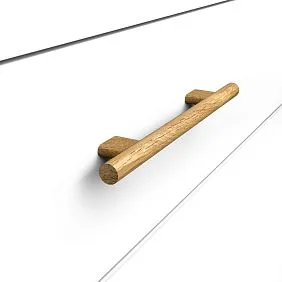
Wooden handlesfor hotels are made from hardwoods — oak, beech, ash. The material density must be at least 650 kg/m³, which ensures resistance to dents, chips, and abrasion. Softwoods like pine or linden are categorically unsuitable — they quickly deform under load.
Not only the hardness of the wood is important, but also the quality of processing. The fibers must be oriented along the axis of the handle so that it does not split during a sudden jerk. Adhesive joints, if the handle is composite, must withstand a pull-out load of at least 200 kgf — this is the standard for commercial furniture.
Resistance to abrasion and preservation of appearance
During a year of operation in a hotel, the handle comes into contact with hands thousands of times. Gradually, the surface wears away, especially at the grip points. Varnished handles begin to lose their gloss, matte spots appear, followed by scratches and chips in the varnish.
Professional solutions involve the use of ultra-durable polyurethane varnishes with the addition of ceramic particles that increase wear resistance. An alternative is high-concentration oil finishes with hard wax, which penetrate deep into the wood structure and create an elastic protective film resistant to abrasion.
The color of the handle also matters. Light woods with a transparent coating show less noticeable dirt and local wear. Dark tinted surfaces require more frequent renewal, as signs of wear are more visible on them.
Ergonomics: convenience for all guest categories
The hotel accommodates guests of all ages and physical abilities. The handle must be comfortably grasped by a child's hand and the hand of an elderly person with arthritis, be understandable for a person with poor eyesight, and open easily with limited hand strength.
The optimal shape for hotel handles is a moderately sized bracket (center-to-center distance 96-128 mm) with a rounded profile diameter of 18-22 mm. Such a handle is convenient for gripping with the whole hand, does not require precise finger placement, and opens easily even with minimal effort.
Knobs are suitable for light doors where no great force is needed for opening. For heavy hinged cabinet doors and deep drawers, brackets are needed, which allow significant force to be applied without the risk of slipping or injury.
Hygiene and ease of cleaning
A handle with deep relief, numerous recesses and protrusions is a trap for dirt and bacteria. In hotel conditions, smooth, streamlined shapes are preferable, which are easy to wipe with a damp cloth and do not accumulate dirt.
The coating must be non-porous, non-absorbent of moisture and cleaning agents. Wood coated with high-quality varnish or hard oil meets this requirement. It is important that there are no gaps at the ends of the handle and at the junction with the facade where dirt can get trapped.
Furniture supports: the foundation of stability and durability
If handles are visible and constantly in sight, then supports are hidden, but their role is no less critical. The quality ofof furniture legsdetermines stability, absence of squeaks, preservation of the body geometry, and durability of the entire structure.
Design loads: safety margin for commercial operation
A household furniture support is designed for static load with a safety factor of 1.5-2. For commercial furniture, this is insufficient. A safety margin of at least 3-4 times is necessary to withstand not only the weight of the contents but also dynamic loads, uneven weight distribution, possible impacts and jolts.
A typical wardrobe in a hotel room weighs 80-100 kg and holds up to 50 kg of guest clothing and belongings. With four supports, each bears about 35-40 kg of static load. But when a guest suddenly opens the door or leans on an open door, the load on the front supports can briefly increase to 100-150 kg.furniture legsmade of solid oak with a diameter of 50-60 mm withstand such loads without deformation.
Geometric stability: wood that does not "warp"
Wooden supports are subject to changes in linear dimensions with fluctuations in temperature and humidity. In a hotel room, the microclimate is relatively stable due to air conditioning, but periodic changes are inevitable — open windows, heating operation, increased humidity after a shower.
For the manufacture of professional supports, only kiln-dried wood with a final moisture content of 8-10% is used. This guarantees a minimal reaction to changes in air humidity. Additionally, the wood is stabilized by impregnation with deep-penetrating oils, which fill the capillaries and prevent active moisture absorption.
The orientation of the fibers is also important. Supports turned from a solid block along the grain are significantly more stable than those glued from individual laminates across the grain. This is one of the features distinguishing professional products from budget solutions.
Flooring protection: felt, silicone, adjustable glides
Hotels use different types of flooring: carpet, laminate, parquet, ceramic tile, linoleum. Furniture supports must be gentle on any of these materials, not leaving scratches, dents, or marks when moving furniture.
The classic solution is felt glides, which are glued or screwed to the lower end of the support. Felt is soft, does not scratch surfaces, and reduces noise when moving furniture. The drawback is that felt gradually wears out and requires replacement every 2-3 years under intensive use.
Silicone or polyurethane pads are more durable, do not wear out, and have anti-slip properties. They prevent spontaneous shifting of furniture on smooth floors — relevant for chairs and tables.
Adjustable glides with a threaded mechanism allow compensation for floor unevenness and leveling furniture strictly horizontally. This is important for case goods with hinged doors — even a slight misalignment leads to spontaneous opening or jamming of doors.
Aesthetics of Supports: A Visible Design Element
Unlike built-in furniture where supports are hidden by a plinth, freestanding hotel furniture often has visible legs. They become part of the room's overall design and must align with the interior's style.
Classical hotels prefer turned supports with traditional profiles—balusters, columns, rusticated forms. Modern urban hotels choose minimalist straight or slightly tapered supports without decoration. Boutique hotels may use carved or painted supports of unconventional shapes and colors, creating a unique image.
It is important that the style of the supports correlates with the overall concept of the furniture and interior. A mix of styles is a sign of a cheap solution, which guests subconsciously perceive as low quality of the entire hotel.
Materials for Commercial Hardware: Only Proven Solutions
Not all materials acceptable for home furniture are suitable for commercial use. Requirements for durability, stability, and environmental friendliness are significantly stricter here.
Oak: The Gold Standard for Hotel Hardware
Oak is deservedly considered the optimal material for manufacturing commercial-grade furniture handles and supports. Density of 650-750 kg/m³, Brinell hardness of 3.7-3.9, low tendency to warp and crack—all this makes oak ideal for intensive use.
Tannins contained in oak wood give it natural antiseptic properties. Bacteria and fungi are less likely to thrive on oak surfaces—an additional factor of hygiene for hotel furniture touched by hundreds of hands.
The texture of oak is expressive and noble. Large pores, distinct annual rings, and medullary rays create a recognizable pattern associated with quality, reliability, and respectability. For positioning a hotel in the mid and high segments, oak hardware is the right choice.
Beech: Strength and Aesthetics of Light Tones
Beech is comparable to oak in density (650-800 kg/m³) and hardness (3.8 on the Brinell scale) or even surpasses it. The main difference is color and texture. Beech wood has a light pinkish or creamy hue with a fine-pored, uniform structure.
For hotels decorated in light Scandinavian, minimalist, or Mediterranean styles, beech is ideal. It creates a sense of freshness, cleanliness, and airiness. At the same time, in terms of performance characteristics, beech is in no way inferior to oak.
The only nuance is that beech is slightly more hygroscopic than oak and requires high-quality protective treatment. But for furniture in air-conditioned hotel rooms with a stable microclimate, this is not critical.
Unacceptable Materials for Commercial Hardware
Soft coniferous species (pine, spruce) are categorically unsuitable for hotel hardware. They are too prone to dents, chips, and abrasion. A pine handle will lose its appearance after a year of intensive use; a support will deform under load.
MDF, even high-density, is also not recommended for load-bearing elements like supports. This material is good for facades, but for elements experiencing significant mechanical loads, solid wood is needed.
Plastic hardware is cheap but absolutely inappropriate in mid- and high-level hotels. It looks cheap, wears out quickly, and cannot be repaired. For budget hostels and dormitories—perhaps; for full-fledged hotels—no.
Technological Features of Professional Hardware Production
Quality commercial hardware is not just a beautifully processed piece of wood. It is the result of adhering to many technological subtleties at all stages of production.
Wood Selection: Only First Grade Without Defects
For manufacturingfurniture handlesFor handles and supports of commercial grade, first-grade wood is used, completely free of knots, resin pockets, cracks, rot, and traces of insect damage. Even a small healthy knot, acceptable for household furniture, is rejected in commercial production—it creates structural heterogeneity and a potential point of failure under prolonged loads.
Wood is harvested in the winter when sap flow is minimal and material density is at its maximum. This ancient rule of joiners remains relevant in modern production.
Drying and Conditioning: Stability for Decades
After sawing, the wood undergoes kiln drying using special regimes that ensure uniform moisture removal without cracking or warping. The final moisture content for furniture hardware is 8±2%. This is the standard at which wood remains stable under conditions of centralized heating and air conditioning.
After drying, the wood is conditioned—it is kept in a room with a controlled microclimate to equalize moisture throughout the material's thickness. This is especially important for massive blanks for supports. Hasty use of freshly dried wood leads to internal stresses and delayed deformations already in the finished product.
Mechanical Processing: Precision and Surface Cleanliness
Modern CNC equipment allows manufacturing hardware with precision to tenths of a millimeter. This is critical for furniture handles, which must perfectly match the holes in the facades. For supports, perpendicularity of the ends is important—even a deviation of 0.5 degrees at a support height of 150 mm causes furniture misalignment by several millimeters.
Surface finish cleanliness is also higher than for household hardware. Sanding is performed in several stages with a gradual reduction of abrasive grit to 320-400. The result is a perfectly smooth surface on which the protective coating applies evenly and lasts as long as possible.
Finishing: Industrial-Level Protection
Commercial hardware finishes are special compositions with increased wear resistance, resistance to chemical exposure, and UV radiation. Regular furniture varnish is not suitable—it cannot withstand intensive use.
Two-component polyurethane varnishes from professional series are used, often with the addition of ceramic nanoparticles or aluminum oxide to increase hardness. Such a coating has a hardness of up to 3H on the pencil scale, is resistant to abrasion, scratches, and the effects of alcohol-containing cleaning agents.
An alternative is hard oils and waxes based on modified natural oils with synthetic hardeners. They create an elastic yet very durable protective film that penetrates the wood structure and does not peel off even with local damage.
Hotel furniture design: a systematic approach to hardware
Hardware selection is not the final stage, but part of comprehensive furniture design. Properly designed furniture takes into account usage characteristics and is optimized for commercial loads.
Reinforced attachment points
Standard handle attachment with two M4 screws through a 16-18 mm thick front panel is sufficient for household furniture. For hotel furniture, reinforcement is recommended: using thicker front panels (20-22 mm), increasing screw diameter to M5, installing spacer bushings or metal reinforcing plates on the back side of the front panel.
For mountingof furniture legsNot self-tapping screws are used, but threaded connections with threaded inserts or studs. A threaded insert is a metal threaded bushing glued into the furniture body. The support is screwed into the insert, creating a strong connection that can be repeatedly disassembled and assembled without wood wear.
Number and placement of supports
For household furniture, placing four supports at the corners of the body is acceptable. For commercial furniture longer than 1000 mm, installing additional intermediate supports with a spacing of no more than 800-900 mm is recommended. This prevents the bottom from sagging under load and ensures even weight distribution.
Support height also matters. Too low supports (less than 80-100 mm) make cleaning under furniture difficult—a frequent complaint from hotel staff. An optimal height of 100-150 mm provides access for a vacuum cleaner and mop, visually lightens the furniture, and creates a ventilation gap for airing.
Interchangeability and repairability
Commercial furniture should be easy to repair. A broken handle or support must be replaced quickly, preferably by the hotel's own technical staff without calling external specialists.
This requires standardization: all handles within one facility should preferably be of the same model or have the same center-to-center mounting distance. All supports should be of the same thread size for inserts. Ideally, when ordering furniture, the supply of spare hardware kits for prompt repairs should be provided.
Economics of choice: initial costs versus total cost of ownership
For a private buyer, the price of furniture hardware may seem a secondary factor compared to the cost of the entire furniture. For a commercial facility equipping dozens or hundreds of rooms, economic calculations are critical.
Lifecycle cost comparison
A cheap pine handle costs 200 rubles, a quality oak one costs 800 rubles. When equipping a room with 10 handles, the difference is 6,000 rubles. For a 100-room hotel—600,000 rubles. A significant amount, and the temptation to save is great.
But let's calculate further. After two years, cheap handles begin to break, tarnish, and lose their appearance. Replacement is required. The cost of the handles themselves—the same 200,000 rubles (prices have risen over two years). Plus labor for removing old and installing new handles—at least 100 rubles per handle, another 100,000 rubles. Total 300,000 rubles after two years.
After another two years—replacement again. And so on. Over 10 years of operation, cheap handles will require 4-5 replacements, total costs will amount to 1,200,000—1,500,000 rubles.
Quality oak handles over the same 10 years will not require replacement, possibly only local coating renewal on particularly worn specimens—costs within 50,000—100,000 rubles. Final savings—over half a million rubles. And this is only on handles, not counting supports.
Intangible losses from low-quality hardware
Numbers are not the only argument. A torn-off handle, a wobbly table, a squeaky bed create a negative impression of the hotel for the guest. In the era of online reviews, one bad review can cost a hotel hundreds of potential bookings.
The guest pays for comfort, and any detail that disrupts this comfort is perceived painfully. Broken hardware is associated with a general disregard for quality, even if the hotel is otherwise impeccable. Reputational losses from saving on hardware can far exceed the amounts saved during procurement.
Frequently asked questions about hotel hardware
Can metal hardware be used instead of wooden?
Metal hardware (stainless steel, aluminum, brass) is also suitable for hotels and has its advantages: absolute moisture resistance, high strength, modern appearance. Disadvantages—higher price, cold to the touch, possibility of oxidation in budget alloys. The choice between wood and metal is a matter of interior style and budget. Combined solutions are often used: wooden handles with a metal base.
Does wooden hardware in hotels require special maintenance?
Quality wooden hardware with a professional finish does not require special maintenance. Regular wet cleaning with ordinary agents is sufficient. Every 3-5 years, an inspection is recommended: checking the reliability of fastenings, tightening screws if necessary, local renewal of the coating on areas of increased wear. These operations are performed by the hotel's own technical staff.
How to match hardware style to the hotel concept?
The style of hardware should match the hotel's overall design code. Classic hotels feature turned, carved forms and natural wood tones. Modern urban hotels feature minimalist straight lines, possibly painted in neutral colors. Boutique hotels feature unique designer solutions, unconventional shapes and finishes. When selecting, it's best to reference successful projects with similar positioning.
What type of wood is best for wet areas like bathrooms?
For hotel room bathrooms, moisture resistance is critical. Oak, due to its high tannin content, is the most moisture-resistant among traditional furniture woods. High-quality varnish that completely seals the wood is essential. An alternative is exotic woods like teak, but they are significantly more expensive. For budget projects in bathrooms, high-quality metal or plastic hardware is sometimes used, with wood reserved for the living area of the room.
Are there standards for commercial furniture hardware?
There are industry standards for furniture used in commercial spaces (public buildings, offices, hotels). In Russia, this is GOST 16371-2014 for furniture in public buildings. It regulates strength characteristics, durability, and safety. Quality hardware from reliable manufacturers meets or exceeds the requirements of these standards.
How long does quality wooden hardware last in a hotel?
With the correct material choice, quality manufacturing, and professional installation, wooden hardware lasts the entire service life of the furniture — 10-15 years for hotel furniture. This is comparable to the lifecycle of the room stock itself before major renovation. In practice, quality hardware is replaced not due to wear, but when updating the interior concept.
How to calculate hardware requirements for a hotel project?
The calculation is based on the number of rooms and the typical furniture specification. A standard room includes: a wardrobe (2-4 handles), bedside tables (1-2 handles each), a writing desk with a pedestal (2-3 handles), a TV stand (2-4 handles). On average, 10-15 handles per room. Supports — 16-24 pieces (4-6 per furniture item). Plus public areas: restaurants, lobbies, conference halls — calculated individually. A reserve stock of 10-15% is added to the calculated quantity for urgent repairs.
Can hardware be ordered with the hotel logo?
Yes, many manufacturers offer customization services: logo engraving, unique paint colors, custom sizes and shapes. This requires additional costs and extends production time, but creates a unique hotel identity. Especially relevant for high-end hotels and chain operators building a recognizable brand.
How to check hardware quality upon delivery?
Upon delivery of a large batch, visual inspection is necessary: absence of cracks, chips, coating defects; checking geometry (handles must be strictly symmetrical, supports must be the same height); testing fasteners (screws should enter threaded holes smoothly, without jamming); checking packaging (hardware must be protected from damage during transport). A quality certificate from the manufacturer and warranty obligations are desirable.
Where to find a reliable supplier of commercial hardware?
A reliable supplier is a manufacturer with a long history, a portfolio of completed commercial projects, its own production, and a quality control system. Important factors include feedback from current clients, availability of a stock program for prompt deliveries, and technical support at all project stages. Saving by choosing an unknown, cheap supplier often leads to problems with quality, deadlines, and lack of warranty support.
Conclusion: An investment in guest service quality
Furniture handles and supports are not just utilitarian parts, but elements that shape a guest's impression of the hotel. Every touch of a handle, every step in a room with stable furniture on reliable supports creates a feeling of comfort, reliability, and attention to detail.
Commercial operation requires professional solutions.Furniture Handlesmade from solid oak or beech with wear-resistant coating,furniture legswith a safety margin designed for decades of intensive use — this is not a luxury, but a rational choice that pays off by avoiding repairs, replacements, complaints, and lost reputation.
STAVROS has been manufacturing furniture hardware for commercial projects for over two decades. The portfolio includes dozens of completed projects: hotels, restaurants, office centers, public spaces.furniture legsmade from select solid wood, wooden handles with professional coatings, full production cycle with quality control at every stage, technical support for designers and supply managers, flexible discount system for large projects — all this makes STAVROS a reliable partner for the hotel business, which builds its reputation on the quality of details.


