












































































Article Contents:
- Why wood? Arguments that change perspective
- Wood species: what lies behind the choice of material
- Beech - the workhorse of the premium segment
- Oak - nobility for centuries
- Pine and spruce - affordability with character
- Birch - Russian classic
- Types of wooden furniture handles: a complete overview of shapes
- Wooden pull handle
- Knob handle
- Recessed handle
- Rail handle (profile)
- Set of wooden handles
- Wooden door handle: what is the fundamental difference from furniture handles
- How to choose a wooden handle to match the interior style
- Classic and neoclassic
- Scandinavian style and minimalism
- Provence and Country Style
- Rustic and eco-style
- Japandi (Japanese minimalism)
- Sizes of wooden handles: table and standards
- Finishing of wooden handles: oil, varnish, wax, paint
- Oil and oil-wax
- Varnish
- Wax
- Paint (enamel)
- Care for wooden handles: simple about the important
- Wooden handles in a set: how to properly equip a kitchen or dressing room
- How to combine wooden handles with other hardware
- Wooden handles and furniture hardware: a comprehensive approach
- Prices for wooden furniture handles: what affects the cost
- Installing wooden handles: step-by-step guide
- Wooden handles in different rooms: application specifics
- Kitchen
- Bedroom and dressing room
- Children's room
- Bathroom and Toilet
- Additional Wooden Interior Products: Create a Unified Ensemble
- Trends 2025–2026: Which Wooden Handles Are at the Peak of Popularity
- FAQ: Answers to Popular Questions About Wooden Handles
- STAVROS: A Manufacturer Trusted by Interiors
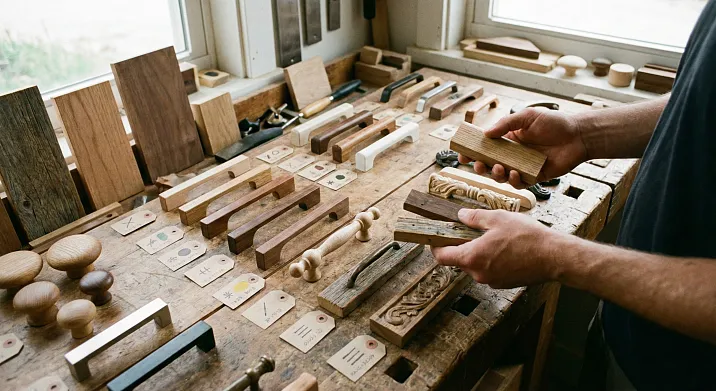
There are details that go unnoticed—until you notice them.Furniture Handles—is precisely such a detail. Small, almost unnoticeable against the backdrop of a massive wardrobe or kitchen set. But it is this detail that defines the first impression of an interior, sets the tone for the entire space, and speaks more about the owner's taste than expensive wallpaper or parquet. A wooden furniture handle is not just a piece of hardware. It's a philosophy. It's a choice in favor of natural, warm, and living. Wood breathes, retains the warmth of a palm, ages beautifully—not deteriorating, but acquiring a patina of time. And if you are currently selecting hardware for a wardrobe, kitchen, chest of drawers, or walk-in closet, this article is written specifically for you. We'll cover everything: from wood species to installation, from styles to specific recommendations for selection. No general phrases—only practice, experience, and real solutions.


Why Wood? Arguments That Change Perspectives
Before delving into types and standard sizes, it's worth answering a question many ask themselves: why choose wood at all when there's metal, plastic, ceramic? The answer isn't about fashion. The answer lies in physics and psychology.
Tactility. Metal chills the fingers. Plastic is slippery. Wood is the only material that feels like the hand holding it. The temperature of wood is close to that of the skin. This creates a sense of comfort and 'rightness' that is hard to explain in words but easy to feel.
Eco-friendliness. In an era when people are increasingly reading product ingredients and choosing natural cosmetics, it's logical to prefer natural materials in interiors as well.wooden furniture handlesdo not emit volatile organic compounds, do not cause allergies, and are safe for children and the elderly.
Style Versatility. Wood suits classic, Scandinavian minimalism, Japanese 'Japandi', Provence, rustic, eco-interior, boho. Metal fits into high-tech but looks alien in a country house. Wood is organic everywhere—from a city apartment to a country house with logs and a fireplace.
Durability with proper care. A quality handle made of solid beech or oak will last for decades. It won't peel, crack under normal humidity, or lose its shape. And finally—uniqueness: each piece of wood has its own grain pattern. Two absolutely identical wooden handles in texture do not exist in nature. This is not a flaw—it's a value that cannot be reproduced industrially.




Wood Species: What Lies Behind the Choice of Material
Not all wood is equally good for producing furniture hardware. For handles, hardness, density, resistance to mechanical loads, and the ability to hold a finish well are critically important.
Our factory also produces:




Beech — The Workhorse of the Premium Segment
Beech is one of the densest and hardest wood species in Europe. Its density is about 720 kg/m³, Brinell hardness is 3.8 units. This means that beech handles do not deform under years of load, do not dent from hand pressure, and do not split during fastening work. Beech's texture is fine-grained, uniform, and slightly shiny. It takes stain, oil, and paint well. Beech products can be painted any color—from deep black to milky white—and the texture beneath the coating will remain alive and expressive. This is precisely why beech is chosen by manufacturers who value both beauty and product longevity.
Get Consultation
Oak — Nobility for Centuries
Oak is heavier and harder than beech: density 750–800 kg/m³, pronounced large texture with characteristic medullary rays creating a 'feather' effect. An oak handle wooden set is no longer just hardware, but a style statement. Such products are appropriate in classic interiors, libraries, living rooms with leather furniture and dark panels. Oak takes tinting excellently—from light honey to almost black 'bog oak'. With proper care, a solid oak product does not lose its appearance after 30–40 years of use.
Pine and Spruce — Affordability with Character
Coniferous species are softer, but that doesn't make them worse—just their area of application is different. Pine and spruce are good where lightness, airiness, and a natural light color are important. A wooden handle for an interior in Scandinavian minimalism or Provence style is most often pine with a matte oil finish. It's important to note: coniferous species have resin pockets that, if improperly processed, can appear on the surface. A quality manufacturer always performs thermal treatment and proper priming before the final coating.
Birch — Russian Classic
Birch holds a special place in domestic woodworking. Density 650 kg/m³, even light texture, good workability. Birch easily accepts any coating, so it is often used to make handles for painting. White birch with matte paint is an ideal solution for children's rooms and light Scandinavian kitchens.
Types of Wooden Furniture Handles: A Complete Overview of Shapes
The world of wooden furniture hardware is much richer than it seems at first glance. Let's examine the main types—not formally, but with an understanding of where and how each of them works.
Wooden Pull Handle
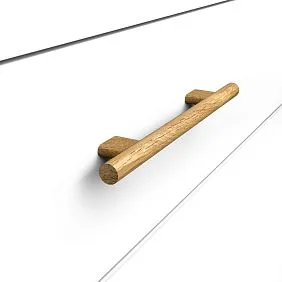
wooden hook handle—the most common type of furniture hardware. It is attached to the surface at two points, forming an arc that is convenient to grasp with fingers. The center-to-center distance (distance between mounting points) is the main parameter when choosing a pull: standard values are 96, 128, 160, 192 mm. There are also non-standard sizes for design projects.
A wooden pull handle provides a full grip for the hand—unlike a knob, which is convenient to pull but inconvenient to rotate. This is precisely why for heavy-duty drawers (kitchen drawers with pots, chests with bedding), a pull is preferable to a knob. The shape of the arc can be straight (strict rectangular profile), rounded (soft curve), or shaped (twisted, carved). The choice of shape is a matter of interior style.
Knob Handle
A push-button handle is a point element attached with a single bolt in the center. It is compact, concise, and looks good on small doors and drawers. In a set of wooden kitchen handles, buttons are often used on upper cabinets, while brackets are placed on lower heavy drawers. A wooden push-button handle can be round, square, mushroom-shaped, or teardrop-shaped — manufacturers' imagination is limited only by common sense and ergonomics.
Recessed handle
A recessed handle is an indentation in the body of a door or drawer that you can hook your fingers into. It does not protrude above the surface, making it ideal for minimalist interiors where clean lines are fundamentally important. Such solutions are popular in furniture with 'invisible fronts' style, built-in wardrobes, and kitchen units without visible hardware. A wooden recessed handle requires precise milling — this is factory work that cannot be done 'on the fly'.
Rail handle (profile)
A long handle made from a profiled wooden block — a rail — is used on wide panels, ovens, and large drawers. The length of rails ranges from 300 to 600 mm and more. They give a sense of monumentality and solidity, characteristic of classic kitchens with wooden fronts.
Set of wooden handles
Wooden handle set— the optimal solution when equipping new furniture or replacing old hardware. A set guarantees uniformity in color, texture, size, and finish of all items. Mismatched handles are one of the most common mistakes in DIY repairs, when handles are purchased individually from different places and end up not matching in shade or shape.
Wooden door handle: what is the fundamental difference from a furniture handle
A question that many have: how does awooden door handlediffer from a furniture handle? The answer lies in load, construction, and purpose.
A furniture handle experiences load only from pulling or turning. It is attached through through-holes in the front with a bolt and nut. The loads on it are moderate, daily, but not impact.
A door handle operates under completely different conditions. It withstands torsional loads (if it is a handle with a latch), impact loads from door slamming, and lateral forces when pushing open a tightly fitting door leaf. The requirements for fastening strength and the material itself are fundamentally higher.
A wooden handle for a door in an interior is typically either an overlay handle without a moving mechanism (for interior doors without a lock, in the 'barn door' style) or a wooden grip on a metal mechanism. In the latter case, the wood is a decorative element, while all mechanical work is performed by a steel core.
For interior and entrance doors, it is important to consider the type of fastening, compatibility with the locking mechanism, and the standard interaxial distance (85 mm — European standard). Wooden overlay handles for doors are a separate story: they are suitable for sliding doors, barn doors, gates, and decorative partitions. They are attached with screws or bolts directly into the door leaf.
Key takeaway: if you see the label 'wooden handle for door' in a catalog — clarify the type of fastening and purpose. Not every beautiful wooden handle is suitable for a heavy door with a spring door closer.
How to choose a wooden handle to match the interior style
Choosingof a wooden furniture handle— is not just a matter of aesthetics, it is a task of systemic thinking. The handle should not just 'look nice' — it should work in ensemble with the overall interior solution. Let's break it down by styles.
Classicism and neoclassicism
In a classic interior, forms with history are valued: figured brackets with curls, acorn-shaped buttons, rails with turned ends. Material — dark oak, walnut, stained beech with an 'antique' look. Finish — wax or oil, emphasizing the natural grain pattern. Metal fastening elements in classic style are typically hidden or chosen in 'bronze' and 'aged gold'.
Scandinavian style and minimalism
Here everything is different: clean forms, absence of decoration, emphasis on material. A birch push-button handle with a matte oil finish in a natural color is an ideal option. Or a straight bracket made of light beech with an interaxial distance of 128 mm. No curls, no carving. Beauty lies in the honesty of the material.
Provence and country
Provence loves wear, softness, 'grandmother's' coziness. Here, handles made of aged wood with intentionally uneven surfaces, imitating handcrafting, are appropriate. Colors — milky, gray-blue, ochre. Shape — simple, with rounded edges, without sharp lines.
Rustic and eco-style
Rustic is the rawness of the material as a virtue. Handles with bark texture, knots, unprocessed ends. A wooden bracket handle made from a branch or an unprocessed block — this is rustic in its pure form. Such solutions work well in kitchens with fronts under 'old wood', in country houses, in saunas.
Japandi (Japanese minimalism)
This style has been gaining strength in recent years. The principle of 'ma' — 'emptiness as beauty' — requires maximally restrained forms. Handles are almost unnoticeable: a thin straight bracket made of dark ash or black stained oak. No decoration. The material speaks for itself.
Sizes of wooden handles: table and standards
One of the most common problems when ordering handles is the mismatch of interaxial distance. The purchased handle does not fit the existing holes in the front. This is annoying and expensive: you either have to re-mill the front, drill new holes, or return the product.
Standard interaxial distances for brackets:
-
32 mm — small drawers, jewelry boxes
-
64 mm — small doors and drawers
-
96 mm — standard for lower row kitchen drawers
-
128 mm — universal size, most popular
-
160 mm — for wide fronts and heavy drawers
-
192 mm — for large panels, ovens
-
224, 256, 320 mm — rails and long handles
Before ordering, be sure to measure the distance between the centers of existing holes on the front. If the furniture is new — discuss the center-to-center distance in advance with the craftsman who will make the fronts.
Wooden handle finishes: oil, varnish, wax, paint
The finish is not just about aesthetics. It's protection. From moisture, from mechanical damage, from grease (especially relevant for the kitchen). Let's break down the main options.
Oil and oil-wax
Oil finish penetrates deep into the wood structure, nourishes the fibers from within, and highlights the natural grain. The surface remains matte, tactilely 'alive' — not slippery, not shiny. This finish requires periodic renewal (every 2–3 years depending on intensity of use), but is easily restored: simply treat the surface with a new coat of oil.Wooden handle setwith oil finish — the optimal choice for kitchen and living room.
Varnish
Varnish creates a film on the wood surface, protecting it from moisture and mechanical impact. The surface can be glossy, semi-matte, or matte. Varnish finish is more durable than oil, but if damaged requires complete restoration (sanding and reapplication). To the touch, varnish gives a characteristic 'plastic' effect, which not everyone likes.
Wax
Wax finish — a traditional method of treating wooden products, known for centuries. Wax gives the surface a soft matte sheen, slightly 'warms' the color. It is less water-resistant than oil or varnish, so it is less suitable for the kitchen. But in the bedroom, study, or living room — it's ideal.
Paint (enamel)
Opaque finish allows creating handles of any color, completely hiding the wood grain. White, gray, black, pastel, terracotta — the color palette is unlimited. Painted wooden handles look good in Scandinavian, Provence, and modern interiors. Important condition: quality primer and enamel with good adhesion — otherwise the paint may start peeling in areas of most frequent finger contact.
Caring for wooden handles: simple about the important
Wood is a living material, and it requires attention. But this attention is not complicated and takes minutes. Here's what you need to know:
Daily cleaning. Wipe handles with a soft, damp cloth. No abrasive sponges, no alcohol or aggressive detergents — they damage the finish.
Protection from moisture. In the kitchen, wooden handles should be wiped dry after washing dishes. Constant moisture causes fiber swelling and finish deterioration.
Annual maintenance. Apply a thin layer of furniture oil or wax to all wooden surfaces. This will restore the protective properties of the finish and refresh the appearance.
What to do if a handle cracks? A small crack can be filled with wood-toned furniture putty, sanded with fine-grit sandpaper, and treated with oil. Deep splitting — a reason to replace the item: a glued handle under load may break unexpectedly.
What to do if a handle becomes loose? Check the tightening of the mounting bolt. If the hole is worn — use a larger diameter washer or relocate the handle to a new spot with precise drilling.
Wooden handles in a set: how to properly outfit a kitchen or dressing room
Outfitting furniture with handles is a task requiring a systematic approach. Especially when it comes to a large kitchen with dozens of fronts or a spacious dressing room.
First of all — count the quantity: how many doors, how many drawers, whether rails are needed for the oven. Make a list specifying sizes and types.
Next — choose a unified system: one type of handle for all furniture or a thoughtful combination (e.g., knobs on small upper cabinets and 128 mm pulls on lower drawers). Mixing more than two types of handles in one space is risky in terms of visual harmony.
Always order with a 10–15% surplus from the calculated quantity: in case of drilling defects or layout changes. Handles from one batch may slightly differ in shade from the next batch — even from the same manufacturer.
wooden furniture handlesin a set — this saves money, time, and nerves. One order, one delivery, guaranteed unity of color and texture.
How to combine wooden handles with other hardware
Furniture handles do not exist in a vacuum. They work in an ensemble with hinges, drawer slides, locks, and supports. How to combine wood with metal so that the result looks like a unified whole, not a collection of random parts?
The 'matching metal' rule. If you choose wooden handles with metal inserts or mounting rosettes, the metal color should be repeated in the rest of the hardware. Bronze mounting bolts — bronze hinges. Matte black hardware — matte black hinges and slides.
Wood and metal as contrast. In modern interiors, intentional contrast is also a technique. Light wood against a black metal frame (in loft or industrial style) looks striking and contemporary.
Avoid random combinations. Gold hinges and silver bolts on a wooden handle create visual noise that the brain perceives as clutter, even if the observer cannot explain why they 'don't like something.'
Also seeSolid wood productsin the full range: wooden furniture legs, decorative elements, cornices, and moldings — all can be selected in a unified style and wood species, creating an interior where the details speak with one voice.
Wooden handles and furniture hardware: a comprehensive approach
When we talk about an interior as a system, it's important to understand: handles are the finishing touch, but not the only one. AllFurniture hardwareshould work in harmony. Hinges, drawer slides, supports — all must align with the overall concept. Wooden handles combined with quality mechanical hardware create furniture that is not only beautiful externally but also functions flawlessly for many years.
When choosing wooden handles, pay attention to what elements the entire furniture consists of. If the fronts are made of solid wood or veneered MDF, wooden handles are an organic continuation of the material. If the fronts are lacquered or laminated — wood will create an appropriate accent of naturalness on a smooth background.
Prices for wooden furniture handles: what influences the cost
The price range for wooden handles is wide — from affordable to designer. What shapes the price?
Wood species. Pine is cheaper than beech, beech is cheaper than oak, oak is cheaper than walnut. Exotic species (teak, mahogany, wenge) are in a separate price category.
Production method. Mass lathe production — one price. Hand carving, artistic processing, custom shapes — completely different.
Finish. Oil and wax — cheaper than multi-layer lacquer with intermediate sanding. Painting in non-standard colors — more expensive than standard staining.
Included hardware. Some manufacturers sell handles without mounting hardware — this must be considered when comparing prices.
Order volume. When ordering a set of wooden handles in bulk, the unit price is typically significantly lower than retail. This is especially relevant when outfitting a kitchen or walk-in closet.
General principle: don't skimp on handles at the expense of quality. This is the detail you interact with every day — directly, literally, with your hands. An unreliable handle that loosens after six months or peels from washing will cost more than a higher-quality product from the start.
Installing wooden handles: step-by-step guide
Installing a wooden handle is a task accessible to anyone who can hold a drill. But there are several important nuances that will save the front from mistakes.
Step 1. Marking. Determine the exact location for the handle. Standard placement: horizontal pull on a drawer — centered in width, 30–40 mm from the top edge. Vertical pull on a door — centered in height, 30–50 mm from the edge. Use a ruler, pencil, and painter's tape — it leaves no marks on the front surface.
Step 2. Drilling. Drill with a depth stop. Drill bit diameter — for the mounting bolt (standard M4 — 4 mm bit, M5 — 5 mm bit). Place a scrap piece of wood under the front to prevent tear-out when the bit exits.
Step 3. Installation. Insert the bolt from the front side of the front through the handle, tighten the nut from the back side. Tighten evenly, do not overtighten — the wood may deform.
Step 4. Check. Pull the handle several times in different directions. No play — everything is done correctly.
Wooden handles in different rooms: application specifics
Kitchen
In the kitchen, handles experience maximum loads: grease, moisture, mechanical impacts. The optimal choice — hardwoods (beech, oak) with oil or lacquer finish. Shape — pull or rail for lower drawers, knob — for upper cabinets. Avoid porous finishes and light, untreated woods: they quickly absorb stains.
Bedroom and closet
Here loads are minimal, so you can afford more delicate solutions: carved handles, thin knobs made of precious woods, delicate wax finish. Priority — aesthetics and alignment with the overall interior style.
Children's room
The main requirements are safety and hygiene. No sharp corners, no small parts that can be unscrewed. Round birch wooden knob handles with non-toxic oil treatment are the perfect solution. Bright paint is allowed, but only based on water-emulsion non-toxic dyes.
Bathroom and toilet
Wood in the bathroom is a risky decision if humidity is constantly high. If you still choose wooden handles for bathroom furniture, use only hardwoods (teak, oak) with a multi-layer waterproof varnish coating. Teak is especially good: it is a tropical wood with a high content of natural oils, naturally resistant to moisture.
Additional wooden interior products: create a unified ensemble
Wooden handles are just part of the large world of solid wood interior products. If you have already chosen wooden handles, it is logical to consider other elements that will create a unified material story in the space. The STAVROS website offers a wide rangeof solid wood: wooden furniture legs, decorative overlays, cornices, moldings, rosettes — all made from natural wood species with professional finishing. Wooden legs for sofas and armchairs, selected in the same wood species and finish as cabinet handles — this is not just beautiful. It is systemic thinking in interior design that distinguishes a professional result from an amateur one.
Solid wood cornices and moldings matching the color of furniture handles unite the ceiling, wall, and furniture tiers of the interior. This is a classic technique used by masters back in the 18th century — and it still works today. STAVROS polyurethane decor is also a worthy alternative for those looking for easy installation while preserving the visual effect of natural wood:hardware and decorative elementson the website will help you select a complete solution for any interior project.
Trends 2025–2026: which wooden handles are at the peak of popularity
The world of interior design changes quickly, and furniture hardware changes with it. What is relevant right now?
Dark wood. Bog oak, wenge, dark walnut — after several years of dominance of light Scandinavian tones, the market is turning towards deep, rich colors. A dark wooden handle bracket on a light kitchen facade is one of the most popular contrasting techniques.
Texture as the main character. Minimal surface treatment, preservation of the natural fiber pattern, visible pores and growth rings — all of this is trending. High processing and perfect smoothness are taking a back seat.
Non-standard shapes. Asymmetry, organic curves, handles shaped like natural objects (branch, stone, leaf) — designers are increasingly boldly moving away from standard rectangles and circles.
Combined materials. Wood plus metal, wood plus leather, wood plus ceramic — hybrid handles are conquering a niche in the premium segment. Such products are more complex to produce but visually significantly richer.
Large formats. Rail handles 400–600 mm long on large facades are one of the key trends in kitchen design. They provide scale and confidence that small knobs lack.
FAQ: answers to popular questions about wooden handles
Can wooden handles be used in the kitchen?
Yes, you can. Choose hardwoods (beech, oak) with oil or varnish coating. Wipe dry after washing dishes. With proper care, wooden handles in the kitchen last 10–15 years without losing their appearance.
What is better — wooden or metal handles?
This is a question of style and preference. Wood is warmer, more eco-friendly, more unique in texture. Metal is more durable in conditions of extreme humidity and easier to care for. In most interiors, wood looks livelier and richer.
How to choose the size of a bracket handle?
Measure the distance between the centers of the existing holes in the facade. This is the required center-to-center distance. Standards: 96, 128, 160 mm. For new furniture, the standard is chosen at the design stage.
What is the difference between a wooden handle set and a piece purchase?
A set guarantees uniformity of color, texture, and size of all items. A piece purchase creates a risk of shade mismatch between batches. When equipping a kitchen or wardrobe — always a set.
Do wooden handles need additional treatment after purchase?
Quality handles come with a ready-made coating and do not require additional processing before installation. Preventive application of furniture oil is recommended once every 1–2 years during use.
How are wooden handles attached?
Brackets and rails — through two through holes with M4 or M5 bolts. Knobs — through one central hole. Inset handles — by milling from the back side of the facade without visible fasteners.
Can a wooden handle be repainted?
Yes. Sand the surface with fine sandpaper, apply primer, then paint in 2–3 layers. Oil coating must be removed with solvent or mechanically before painting.
Which wood species is best for handles in a children's room?
Birch or beech with non-toxic oil coating. Rounded shapes without sharp corners. Light natural color or water-based pastel paint.
How many handles are needed for a standard kitchen with 20 fronts?
Count by fact: each door — 1 handle, each drawer — 1 handle. For a kitchen with 20 fronts (15 doors + 5 drawers), you need 20 handles plus 10–15% reserve = 22–23 pieces. Order a set.
Where to buy quality wooden furniture handles?
Choose trusted manufacturers working directly with woodworking production. STAVROS is a Russian manufacturer of solid wood and polyurethane decor products with a wide range of hardware and quality guarantee for each item.
STAVROS: a manufacturer trusted by interiors
Concluding this conversation about wooden handles, we must mention who stands behind the quality of the products you hold in your hands.
STAVROS is a Russian manufacturer of decorative products made from solid wood and polyurethane. The company works directly with production, without intermediaries, which allows offering high-quality products at competitive prices. The STAVROS assortment includes —Wooden furniture handlesvarious shapes and wood species, furniture legs, decorative moldings, cornices, rosettes, and other elements that form an expressive, cohesive interior.
STAVROS works with both private customers and professionals — designers, builders, furniture manufacturers. Custom sets for specific projects are possible, consultation on selecting wood species and finishes, delivery across Russia. Each product undergoes quality control at the factory.
Choosing STAVROS, you are not just choosing a handle — you are choosing a detail that will last long, look beautiful, and feel right every time you open a cabinet door or pull out a dresser drawer. It is in such details that a true interior lives.


