Article Contents:
- Baroque furniture: the language of curves and carving
- Curved lines: no right angles
- Carving: total coverage
- Velvet upholstery: tactile luxury
- Frame material: oak for strength, beech for carving
- Moldings with ornaments: architectural splendor
- Ceiling rosettes: centers of compositions
- Cornices with modillions: the upper boundary of space
- Wall moldings: frames for wallpaper inserts
- Capitals of columns and pilasters: vertical accents
- Ceiling composition: layering and drama
- Multi-level ceilings: physical depth
- Ceiling painting: illusory depth
- Chandelier: a crystal waterfall of light
- Carved baseboard: completing the composition from below
- Height and profile: the scale of Baroque
- Painting and gilding: connection with furniture
- Corners and joints: decorative elements
- Gilding: the alchemy of nobility
- Gilding techniques: gold leaf vs. gold paint
- Selective gilding: where to apply gold
- Patination before gilding: the effect of aged gold
- Frequently Asked Questions
- Conclusion: Baroque as a Lifestyle

Theater. Not in a building with red velvet and golden boxes, but in your home. An interior where every detail is an actor playing the role of luxury. A curved armchair with carved armrests upholstered in burgundy velvet. A ceiling rosette one and a half meters in diameter with rocaille scrolls, cherubs, and floral garlands. A cornice twenty-five centimeters wide with modillions featuring carved mascaron masks. A tall oak baseboard with milling that echoes the carving on the furniture legs. And all of this is covered in gold—not vulgar and solid, but selective, on the protruding parts of the carving, creating a play of light and shadow.Furniture in Baroque stylein combination withPolyurethane molding decor for wallsand ceilings creates interiors that can proudly be called palatial, where luxury doesn't shout but whispers—yet in a way that everyone hears. Baroque was born in the 17th century in Italy as a style of the Catholic Counter-Reformation, a way to visualize the power of the church and aristocracy through an abundance of forms, dynamic lines, and lavish decoration. Today, Baroque is the choice of those who are not afraid of luxury, who understand that excess is not a flaw but an aesthetic program. In this article, we dissect the anatomy of a Baroque interior: how to choose furniture with the right curves, how to select moldings with ornaments that rhyme with the furniture's carving, how to paint it all in gold so that it looks expensive, not cheap. Prepare for a journey to an era where more always meant better.



Baroque furniture: the language of curves and carving




Curved lines: no right angles
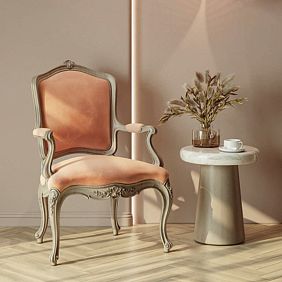
Baroque abolishes the straight line. Table legs, chair legs, and sofa legs curve in an S-shape (cabriole—the famous Baroque leg, which is convex outward at the top, concave inward in the middle, and convex again at the bottom, ending in a scroll or paw). Chair backs are curved backward, armrests undulate like waves. Commode fronts are convex (bombé—a commode with convex sides and front, resembling a barrel). Furniture cornices (horizontal projections at the top of cabinets, buffets) are not straight but wavy, with protrusions and recesses.
These curves are not accidental. They create dynamism: the furniture appears to be moving, alive, organic (like a plant or living creature, not a geometric object). The curves create a play of light and shadow: convex parts catch the light, concave parts sink into shadow, the volume is enhanced, and the furniture is perceived as more voluminous, massive, and rich.
Manufacturing curved furniture is technologically more complex than straight-line furniture. A cabriole leg is turned on a lathe from a solid piece of wood (oak, beech), then manually refined with chisels to achieve the final curved shape. The convex facade of a bombe chest of drawers is assembled from bent boards (boards are steamed, bent in a mold, dried in the bent state, then glued). The labor intensity explains the price: a Baroque armchair with curved legs and armrests costs 65,000-145,000 rubles compared to 35,000-75,000 rubles for an armchair with straight legs of similar size.
Our factory also produces:


Carving: total coverage
In Baroque, carving is everywhere. Legs are carved (acanthus leaves wrap around the leg from bottom to top), armrests are carved (scroll volutes at the ends, floral garlands along the length), the back is carved (a central carved overlay depicting a cartouche, mascaron, or coat of arms), stretchers (crosspieces between legs) are carved (a frieze with alternating rosettes and scrolls), the cornice is carved (a row of modillions - consoles with carving, imitating supports).
The depth of Baroque carving is 15-30 mm — this is sculptural relief, where individual elements (leaves, scrolls, flowers) almost separate from the background, perceived as three-dimensional objects. With side lighting, the carving creates dramatic shadows, enhancing volume and making the furniture visually even richer.
Motifs of Baroque carving: acanthus leaf (stylized leaf of the acanthus plant, with deep incisions, scrolls at the ends), rocaille (scroll in the shape of a shell, asymmetrical, dynamic), cartouche (decorative frame of irregular shape with scrolls along the edges), mascaron (face of a human or mythological creature), putti (chubby baby angels), garlands (chains of flowers, leaves, fruits).
Carving is performed in a combined manner: the main volume is cut on a CNC machine using a 3D model (precision, speed, repeatability), then a master carver manually refines the details (adds liveliness, uniqueness, corrects minor machine imperfections). Fully manual carving is possible but is 2-3 times more expensive and takes 5-7 times longer.
Get Consultation
Upholstery with velvet: tactile luxury
Baroque seating furniture (armchairs, sofas, chairs) is upholstered with richly textured fabrics: velvet, velour, jacquard, tapestry, genuine leather. Velvet is the king of upholstery fabrics for Baroque because it has a deep color (the pile absorbs light, making the color appear saturated, voluminous), shimmers when the viewing angle changes (the pile changes the direction of light reflection), and is tactilely luxurious (softness, plushness).
Colors of Baroque velvet: burgundy, emerald, sapphire, amethyst, golden ochre, dark brown. Bright, saturated, deep colors that, combined with the gilded carving of the frame, create contrast: dark upholstery + golden carving = a dramatic combination where each enhances the other.
Upholstery of Baroque furniture is performed using decorative nails (brass or gilded nails with large heads 15-20 mm in diameter, hammered along the perimeter of the upholstery at 30-40 mm intervals, creating a rhythmic line), carriage stitching (capitonné — upholstery with multiple buttons recessed into the fabric, creating a diamond-shaped relief), tassels and fringe (hanging decorative elements along the lower edge of the seat, on cushions).
The cost of velvet upholstery adds 25-40% to the furniture price: an armchair with a frame costing 85,000 rubles + premium-class velvet upholstery (Italy, Turkey) with carriage stitching and decorative nails = final price of 106,000-119,000 rubles.
Frame material: oak for strength, beech for carving
Baroque furniture is made from solid hardwood. Oak (density 700-800 kg/m³, Brinell hardness 3.7-3.9) — for load-bearing elements (legs, seat frame, stretchers), because it withstands loads, does not deform, and lasts for decades. Beech (density 680-750 kg/m³, hardness 3.8) — for carved elements (armrests, backs, overlays), because it is homogeneous in structure, without large pores, resulting in clear, detailed carving.
Combined construction: oak frame (strength), beech carved elements (carving detail). After assembly, everything is stained to a uniform color (dark brown, black, patinated gray-beige), the difference in wood species is not visually discernible, the furniture is perceived as solid.
Cheap Baroque imitations use MDF with carved polyurethane overlays painted to resemble wood. Visually in photos it may look similar, but tactilely and in weight the difference is huge: solid wood is heavy, dense, cool to the touch, with a dull sound when tapped. MDF is light, with a hollow resonating sound when tapped. True Baroque — only solid wood.
Molding with ornaments: architectural splendor
Ceiling rosettes: centers of compositions
polyurethane ceiling rosette molding120-180 cm in diameter — the heart of a Baroque interior. The rosette is installed in the center of the living room ceiling, frames the chandelier mounting point, creates a compositional center from which visual energy radiates.
A Baroque rosette differs from a neoclassical one in the abundance of ornament: not two or three rows of acanthus leaves, but four or five rows. Not strict radial symmetry, but dynamic asymmetry of rocaille scrolls. Additional elements: cherubs (winged baby angels), floral garlands, cartouches, mascaron.
The relief depth of a Baroque rosette is 25-40 mm — this is almost high relief, where individual elements (leaves, cherubs) protrude 3-4 cm from the background. When installing a chandelier with multiple lamps, the rosette creates a complex play of light and shadow: each scroll casts a shadow, each protruding element catches light, the rosette lives, pulsates, changes depending on the time of day.
The rosette size is determined by the room area. For a living room of 40-60 m², a 120-140 cm rosette is optimal. For a living room of 60-90 m², a 140-160 cm rosette is possible. For ceremonial halls with an area of 100+ m², a 160-180 cm rosette. A rosette that is too small gets lost on a large ceiling, one that is too large overwhelms a small room.
Coloring of a Baroque rosette: white + gold. The rosette background is white, the protruding parts of the ornament (leaf tips, rocaille scrolls, cherub faces) are covered with gold paint or gold leaf. The white-gold contrast creates Baroque luxury, where gold is not total but accent, which is more noble.
Cornices with modillions: the upper boundary of space
A ceiling cornice in Baroque is not a simple 100 mm wide cove, but a complex multi-level structure 200-250 mm wide with a profile consisting of several elements: cyma reversa (concave line) + torus (convex line) + dentils (a row of small rectangular projections) + modillions (large brackets with carving).
Modillions are the key element of a Baroque cornice. These are consoles 20-30 cm high, 10-15 cm wide, protruding 8-12 cm from the cornice, decorated with carved ornament (acanthus leaves, volutes, mascaron). Modillions are installed at 60-80 cm intervals around the room perimeter, creating rhythm, the illusion that the cornice rests on these brackets (in reality, the cornice is glued to the wall, modillions are decorative).
The cornice profile between modillions is filled with ornament: dentils (30-35 mm spacing), egg-and-dart (alternating convex ovals and sharp darts), a plant frieze (a continuous band of acanthus leaves or garlands). The ornament creates visual density, where there are no empty areas, everything is filled with decoration.
Cornice coloring: white background + golden modillions. Or: cream background + golden modillions + patina (dark brown paint in the recesses of the ornament, creating an aging effect). Patina adds depth, historicity, the impression that the cornice has been hanging here for two hundred years.
Wall moldings: frames for wallpaper inserts
Polyurethane moldings 80-120 mm wide create frames on walls sized 100×150 cm, 120×180 cm, inside which wallpaper inserts with ornament are placed. The classic Baroque scheme: the wall is divided into three horizontal zones (lower zone from floor to 80-100 cm height, middle zone from 100 cm to 200 cm, upper zone from 200 cm to ceiling). The middle zone is filled with molding frames (four to six frames, arranged symmetrically).
Inside the frames, Baroque-patterned wallpaper (damask, floral garlands, monograms) or fabric (velvet, silk, jacquard) stretched on a stretcher is glued. The molding is painted white or gold, creating contrast with the dark wallpaper or fabric inside the frame. Effect: the wall turns into a gallery of rectangular panels, each of which is a work of decorative art.
The profile of Baroque molding should be complex: not a simple rectangle, but a multi-level profile with rolls, cavettos, sometimes with fine ornamentation (beads, egg-and-dart). The complexity of the profile rhymes with the complexity of the carving on the furniture, creating a unity of formal language.
Capitals of columns and pilasters: vertical accents
Baroque interiors often use decorative columns (round vertical elements, standing freely or leaning against a wall) and pilasters (flat vertical projections on a wall, imitating columns). The capital is the upper decorative part of a column or pilaster, 30-50 cm high, adorned with carved ornamentation.
Baroque capitals are the Corinthian order taken to excess: not just two rows of acanthus leaves (as in antiquity), but three or four rows, leaves are large, deeply carved, with scrolls-volutes, rosettes, and sometimes mascaron between them. The capital is painted white with gilding on the protruding parts or entirely in gold.
Columns and pilasters are installed symmetrically: two columns on either side of a doorway, two pilasters on either side of a fireplace, four pilasters on a long living room wall (dividing the wall into three panels). The verticals of columns and pilasters contrast with the horizontals of cornices and moldings, creating an architectural grid that structures the space.
Ceiling composition: multi-layered and dramatic
Multi-level ceilings: physical depth
A Baroque interior benefits from a multi-level ceiling, where the central part of the ceiling is lowered by 15-25 cm relative to the perimeter (a coffer) or, conversely, raised (a dome). The change in level creates physical depth, enhances the perception of height, and adds drama.
Lowered central coffer: A drywall box 80-120 cm wide is mounted along the perimeter of the ceiling at a height of 15-20 cm from the main ceiling. Ornamented plasterwork (an acanthus frieze, a row of modillions) is installed on the vertical wall of the box (the frieze). A cornice is installed on the horizontal part of the box (the perimeter ceiling). A rosette and a chandelier are installed in the central lowered part (the coffer).
Effect: The eye, entering the room, first scans the perimeter (the high part of the ceiling with the cornice and frieze), then descends into the center (the lowered part with the rosette and chandelier). The multi-level nature creates a hierarchy; the center is perceived as the main zone.
Raised central dome: A round or oval dome 20-30 cm high, 2.5-3.5 meters in diameter, is mounted in the center of the ceiling. The interior of the dome is decorated with coffers (square or diamond-shaped recesses with rosettes in the center of each) or painting (frescoes imitating sky with clouds, angels). A chandelier is suspended from the center of the dome.
Effect: The dome creates an impression of height, monumentality, and formality. This is a solution for rooms with high ceilings (3.5+ meters), where there is an opportunity for a physical dome elevation without losing room height.
Ceiling painting: illusory depth
An alternative to a multi-level ceiling is painting that creates an illusion of depth. In the central part of the ceiling (inside the rosette or around it over an area of 3x3 meters), painting is done in grisaille technique (imitation of plasterwork in gray-white paints, creating an illusion of relief on a flat surface) or polychrome painting (depicting sky, clouds, angels floating in the heavens).
The painting is done by an artist by hand with acrylic paints on a primed ceiling. Cost: 12,000-28,000 rubles/m² depending on complexity (grisaille is cheaper, polychrome painting with many figures is more expensive). For an area of 9 m², the cost is 108,000-252,000 rubles.
Painting combined with plasterwork (a real three-dimensional rosette, with flat illusory painting around it) creates a play between real and illusory, which is very Baroque (Baroque loves trompe-l'œil, illusions, theatrum mundi).
Chandelier: a crystal waterfall of light
A chandelier, which must match the scale and luxury of the rosette, is suspended beneath the Baroque rosette. A multi-arm chandelier (8-16 arms) with crystal pendants is a Baroque classic. The chandelier frame is brass or bronze (polished or patinated), the arms are curved (S-shaped or in the shape of acanthus leaves), and crystal elements (drops, octagons, beads, prisms) hang all over the frame.
The diameter of the chandelier should be 60-75% of the rosette diameter: if the rosette is 140 cm, the chandelier is 85-105 cm in diameter. The height of the chandelier (from the mounting point on the ceiling to the lowest point) is 90-140 cm. The weight of a crystal chandelier of this size is 45-85 kg, which requires reliable mounting to a concrete slab (not to drywall).
When turned on, the chandelier creates cascades of light: each crystal element refracts light, creating rainbow highlights on the ceiling, walls, and furniture. The rosette with its relief ornament casts complex shadows. The room turns into a kaleidoscope of light and shadow, which is very Baroque (Baroque loves dynamism, changeability, play of light).
The cost of a premium-class crystal chandelier (Swarovski crystal, bronze frame) with a diameter of 90 cm and 12 arms is 350,000-850,000 rubles. Alternative: a chandelier with imitation crystal (acrylic pendants, visually similar to crystal), brass frame with gilding, cost 95,000-220,000 rubles.
Carved baseboard: completing the composition from below
Height and profile: the scale of Baroque
wooden baseboardThe baseboard in a Baroque interior should be high: 160-220 mm. A high baseboard creates a visual base corresponding to the scale of the wide cornice on the ceiling (if the cornice is 220 mm, the baseboard is 180 mm — the proportions are coordinated). A low baseboard (80-100 mm) gets lost in a Baroque interior and does not create the necessary solidity.
The baseboard profile should be complex: not a simple rectangle, but multi-level with a cavetto, rolls, and decorative grooves. Ideally, a baseboard with milled ornamentation: a continuous strip of plant ornament (stylized leaves, scrolls) 40-60 mm high, running along the upper part of the baseboard.
Milling is performed on a CNC machine: a 3D model of the ornament is loaded into the machine, a cutter 8-15 mm deep cuts the ornament into solid oak or beech. Milling accuracy is 0.1 mm, the ornament repeats identically along the entire length of the baseboard (20-30 meters along the room perimeter), creating visual unity.
Painting and gilding: connection with furniture
The baseboard is painted according to the interior's color scheme. Three main options:
Baseboard in the natural color of wood (oak under oil, tinted dark brown or black) + gilding of the ornament (the milled ornament is covered with gold paint). Rhymes with furniture if the furniture is made of dark wood with gilded carved elements.
Baseboard painted and patinated (base color ivory or white, patina gray-brown in the recesses of the ornament and profile) + gilding of the ornament. Rhymes with furniture if the furniture is patinated with gilding.
The baseboard is fully gilded (coated with gold paint or gold leaf). Maximum luxury, but requires caution: if there is too much gold (gilded furniture + gilded molding + gilded baseboard), the effect can be vulgar. A gilded baseboard works if the furniture and molding are not fully gilded, but have gold accents.
Painting a baseboard with gilding is done as follows: the baseboard is primed, painted with a base color (if a base is needed, not natural wood), patinated (if patina is desired), then gold paint is applied with a thin brush only to the protruding parts of the ornament, or gold paint is applied completely, then partially wiped from the recesses, leaving gold only on the protrusions. The cost of painting with gilding is 1800-3200 rub/m.
Corners and joints: decorative elements
Baseboard corners (internal room corners where the baseboard changes direction by 90°) are decorated with decorative corner elements made of polyurethane or wood, sized 20×20 cm with an ornament (carved rosette, cartouche, acanthus leaves, rocaille scroll). The corner element is installed in the corner, two baseboards meet it without mitering.
Decorative corners enhance the baroque feel: instead of a technical joint of two baseboards (a 45° miter cut, visually almost unnoticeable), an accent appears, an additional decorative point. In a room with four corners, four decorative elements create an additional rhythm.
The cost of a wooden carved corner element is 4500-8500 rubles per piece. For a room with four corners, an additional 18000-34000 rubles. Polyurethane corner elements are cheaper (2200-4000 rub/piece), but are less authentic to the touch (wood is warm, heavy; polyurethane is cold, light).
Gilding: the alchemy of nobility
Gilding techniques: gold leaf vs. gold paint
Gilding is the application of a thin layer of gold to the surface of furniture, molding, or baseboard. Two main techniques:
Gold leaf: sheets of pure gold 0.0001 mm thick (100 nanometers), approximately 8×8 cm in size. The surface is primed with gesso (chalk ground), sanded to perfect smoothness, coated with size (mordant). A sheet of gold leaf is picked up with a special brush (a gilder's tip brush, which electrostatically attracts the thin sheet), placed on the sized surface, and adhered. After drying, the gold is polished with an agate burnisher to a mirror shine.
Result: a deep, noble shine that does not tarnish for decades, does not oxidize (pure gold is chemically inert), and shimmers when the viewing angle changes. The cost of gold leaf gilding is 18000-45000 rub/m² (expensive because the material is costly, the work is labor-intensive, and requires high skill).
Gold paint: acrylic paint with metallic pigment (bronze powder, copper powder, aluminum powder with a golden tint). Applied with a brush or spray gun to a primed surface in two to three coats. After drying, it is coated with a protective varnish (matte or satin).
Result: a metallic shine, but not as deep as gold leaf. Over time (5-10 years), the paint may tarnish, oxidize (if the pigment is copper or bronze). But the cost is 6-10 times lower than gold leaf (2500-7000 rub/m²), making gold paint an affordable choice for most projects.
Selective gilding: where to apply gold
Gold in baroque is an accent, not a background. Fully gilded furniture (entire surface gold) looks vulgar, like a Christmas tree ornament. Selective gilding (gold only on individual elements) looks noble, refined.
On furniture, gild: protruding parts of carving (tips of acanthus leaves, crests of volutes, centers of rosettes), edges (sharp edges of legs, armrests), moldings (decorative overlays along the edges of facades). The base of the furniture (smooth surfaces of facades, aprons, tabletops) remains in wood color or patinated.
On molding, gild: protruding parts of rosette ornament (leaves, scrolls, cherubs), modillions of cornices (fully or only the central carved part), decorative overlays on moldings. The base of the molding (background of the rosette, body of the cornice, frames of moldings) remains white or cream.
On the baseboard, gild: milled ornament (fully or only protruding parts), sometimes the top bead (creates a gold line around the room perimeter). The base of the baseboard (body, lower part) remains in wood color or patinated.
Ratio: gold occupies 15-25% of the element's area, the rest is the base. This creates a balance where gold accents but does not dominate.
Patination before gilding: the effect of old gold
Before gilding, an element can be patinated: painted dark brown or black, then partially wiped the paint from the protrusions (it remains in the recesses), then apply gold to the protrusions. Effect: gold against a dark patina background looks brighter, more contrasting, creates the impression of antique gilding, where the patina of time has accumulated in the recesses.
The technique is called 'antique gold' or 'old gold'. Very baroque, because it creates an illusion of historicity, as if the furniture and molding have been here for two hundred years, the gold has tarnished in some places, patina has accumulated.
Frequently asked questions
How much does full decoration of a 50 m² living room in baroque style cost?
Baroque furniture: three-seater sofa with carved legs and armrests, velvet upholstery 285000 rub, two matching armchairs 2×98000 = 196000 rub, oval coffee table with carved apron 85000 rub, console with marble top 135000 rub. Total furniture 701000 rub. Molding: rosette diameter 150 cm with cherubs 48000 rub, cornice 220 mm with modillions, 28 meters = 28×1650 = 46200 rub, moldings for six wall panels, 48 meters = 48×850 = 40800 rub, two pilasters with capitals 2×18500 = 37000 rub. Total molding 172000 rub. Baseboard wooden carved 180 mm oak, 28 meters = 28×2200 = 61600 rub + painting with patination and gilding of ornament 28×2400 = 67200 rub. Total baseboard 128800 rub. Gilding: furniture (selective gilding of carved elements) 85000 rub, molding (modillions, protruding parts of rosette) 62000 rub. Total gilding 147000 rub. Crystal chandelier 12 arms 420000 rub. Installation work: molding 48000 rub, baseboard 24000 rub = 72000 rub. Total turnkey: 701000 + 172000 + 128800 + 147000 + 420000 + 72000 = 1640800 rub.
Is it possible to create a baroque interior in an apartment with 2.7-meter ceilings?
Yes, but with limitations. A wide cornice (220 mm) and a large rosette (140+ cm) will feel oppressive, visually lowering the ceiling. Optimal: cornice 160-180 mm, rosette 100-120 cm, baseboard 140-160 mm. Avoid multi-level ceilings (they consume height). Use techniques to visually increase height: vertical pilasters on walls, furniture on high legs (raised furniture creates air underneath, increases the feeling of height).
Is gilding mandatory or is baroque possible without gold?
Gilding is not mandatory, but desirable, because gold is one of the main markers of baroque. Baroque without gold is possible if gold is replaced with another accent color: silver (silver paint or silver leaf), bronze (bronze paint), copper (copper paint). Or use a contrasting combination of two colors: white molding + black patina in recesses (creates a graphic contrast, baroque drama without gold).
How to care for gilded furniture and molding?
Gilded surface (gold leaf or gold paint coated with varnish) is wiped with a dry soft cloth to remove dust once a week. Do not wash with water and detergents (may damage the varnish, gold may tarnish). If dirt appears on the gold, wipe with a slightly damp cloth (without detergents), then immediately dry thoroughly. Every 10-15 years, gilding restoration is possible: a specialist restores tarnished areas, applies a new layer of gold or paint.
Which furniture style pairs best with Baroque stucco: pure Baroque or a mix of styles?
Pure Baroque (Baroque furniture + Baroque stucco + Baroque textiles) creates maximum authenticity, immersion in the era, and theatricality. But it requires boldness because the result is very rich, not for those who love minimalism. A mix of styles (Baroque stucco + modern furniture or neoclassical furniture) creates contrast, eclecticism, and a more restrained result. It depends on temperament: if you are a maximalist, choose pure Baroque. If you love balance, choose a mix.
How long does it take to create a turnkey Baroque interior?
Design (measurements, 3D visualization, selection of furniture and stucco, material calculation, estimate) 3-4 weeks. Custom furniture manufacturing (carving, assembly, upholstery, gilding) 8-12 weeks. Manufacturing or ordering stucco (if non-standard elements are needed) 2-4 weeks. Stucco installation (rosette, cornices, moldings, pilasters) 1-2 weeks. Painting of stucco and baseboards (primer, base, patina, gilding, varnish) 1-2 weeks. Furniture delivery and installation 3-5 days. Total from the start of design to the final result: 14-20 weeks (3.5-5 months).
Conclusion: Baroque as a lifestyle
Baroque is not a style, but a philosophy. A philosophy where more is always better, where a straight line is boring, where carving covers every surface, where gold accentuates every projection, where velvet upholsters every seat. Baroque was born in an era when the Catholic Church and aristocracy wanted to visualize their power through architecture and interior. Today, Baroque is the choice of those who are not afraid of luxury, who understand that an interior is a theater where you are the main actor, and furniture, stucco, baseboards, gilding are the scenery that enhances your presence.
Creating a Baroque interior requires an understanding of balance: too much gold is vulgar, too little is boring. Too much carving is chaotic, too restrained loses its Baroque essence. The optimum: selective gilding (15-25% of the surface), abundant carving on furniture (legs, armrests, backs), complex stucco on the ceiling (rosette, cornice with modillions), high carved baseboard, velvet upholstery. All elements are aware of each other, rhyming through the repetition of patterns (acanthus on furniture, acanthus on stucco, acanthus on the baseboard), through color (gold on furniture, gold on stucco, gold on the baseboard), through scale (high baseboard 180 mm, wide cornice 220 mm, large rosette 140 cm — proportions are coordinated).
The STAVROS company has been creating Baroque interiors for over twenty years, where every element is executed at museum-quality level. Baroque-style furniture made of solid oak and beech — sofas with curved cabriole legs and carved armrests (from 265,000 rubles), armchairs with upholstery in Italian velvet and diamond tufting (from 85,000 rubles), tables with carved aprons and marble tops (from 125,000 rubles), consoles with gilded carved legs (from 115,000 rubles), buffets with convex bombé fronts and abundant carving (from 385,000 rubles). All carving is done combined: CNC milling of the main volume + manual finishing by a master carver, ensuring precision and liveliness. Upholstery is done by hand by upholsterers with 20+ years of experience, velvet is natural (Italy, Turkey), diamond tufting with buttons, decorative nails are brass. Gilding is done with professional-quality gold paint or gold leaf (client's choice), applied by hand to the protruding parts of the carving, creating the effect of antique Baroque gilding.
STAVROS polyurethane stucco for Baroque interiors — rosettes with a diameter from 100 to 180 cm with abundant ornamentation (acanthus leaves in four-five rows, rocaille, cherubs, garlands), relief depth 25-40 mm (almost high relief). Cornices with a width from 180 to 250 mm with modillions (carved consoles 25-30 cm high, acanthus + volutes + mascaron ornament), dentils, egg-and-dart ornament. Moldings with a width from 80 to 140 mm with complex profiles (cavetto + torus + beads). Pilasters with a height from 2.0 to 3.0 meters with Corinthian capitals (three-four rows of acanthus leaves, volutes, rosettes). Capitals separately with a diameter from 25 to 40 cm. All elements are primed white, ready for final painting, patination, gilding. Polyurethane density 290-330 kg/m³, ensuring clarity even of small ornament details, strength, durability 40-60 years. Cost 650-2400 rub/m depending on width, complexity of ornament.
Wooden baseboards made of solid oak and beech — height from 140 to 220 mm, profiles are complex multi-level (cavetto + torus + grooves), with milled ornamentation (plant frieze 40-60 mm high on the upper part of the baseboard, milling depth 10-15 mm). Baseboard is planed, sanded, moisture content 8-10%, ready for installation and finishing. Painting is done by hand: priming, base color (natural wood under oil, patinated, painted), gilding of the ornament (gold paint or gold leaf), protective varnish. Decorative corner elements made of carved oak (rosettes, cartouches, acanthus scrolls) size 18×18 cm, 22×22 cm. Cost of baseboard 1800-3200 rub/m, cost of painting with gilding 1800-3200 rub/m, cost of corner elements 4500-8500 rub/piece.
The STAVROS design bureau develops Baroque interior projects with photorealistic 3D visualization. You see how furniture combines with stucco, how patterns repeat (acanthus on furniture rhymes with acanthus on the rosette), how gold accentuates (gilded are the carved elements of furniture, modillions of the cornice, ornament of the baseboard), how color connects (burgundy velvet upholstery, white stucco, gold accents). The project includes furniture layout with dimensions and rotation angles (Baroque furniture is large, needs precise calculation to fit through doorways), stucco layout on ceilings and walls with profiles and ornaments, selection of baseboard with decorative corners, color scheme (base colors, patina, gilding, upholstery), material calculation accurate to the linear meter, estimate with prices, step-by-step implementation plan with deadlines for each stage. Project cost for a living room 40-60 m² — 65,000-95,000 rubles, which is deducted from the order cost when placing an order from 1,000,000 rubles.
When ordering a set (furniture + stucco + baseboard + gilding) for an amount from 1,000,000 rubles, STAVROS provides a 9% discount on all decorative elements (stucco + baseboard + decorative corners). For orders from 1,500,000 rubles — an 11% discount plus free delivery across Russia plus a free project with 3D visualization. For orders from 2,000,000 rubles — a 13% discount plus free delivery plus a free project plus a 6% discount on installation and finishing work plus two years of free service maintenance (gilding, furniture, stucco maintenance, minor repairs). Savings 110,000-320,000 rubles.
STAVROS installation and finishing teams are specialists in Baroque interiors. Furniture delivery and assembly with precise adjustment of all elements. Installation of polyurethane stucco on ceilings and walls with joint sealing (stucco is glued with special adhesive, joints are filled with sealant, sanded, become invisible). Painting of stucco and baseboard (priming, base color, patination, gilding, varnishing — all stages are done by hand by professional painters). Chandelier installation with mounting to concrete slab via anchor bolts (heavy crystal chandelier requires reliable mounting). Work across all of Russia, 3-year warranty on installation and finishing, 5 years on stucco, 10 years on furniture frames.
Choosing STAVROS, you get a partner in creating museum-quality Baroque interiors. Build theaters. Surround yourself with carving, velvet, gold, crystal. Live in interiors that are not ashamed of luxury, because luxury is not a sin, but an aesthetic program, tested by centuries. With STAVROS, Baroque is accessible, high-quality, professional.