












































































Article Contents:
- History of Baroque: From Roman Churches to European Palaces
- Rome as the Cradle of the Style
- Spread Across Europe: The Royal Style
- National Variations of Baroque
- Key Features of Baroque: How to Recognize the Style
- Curved Lines: Dynamics Instead of Statics
- Carving: Maximum Detail
- Gilding: Gold as Status
- Contrasting Colors: Drama in the Palette
- Expensive Materials: Display of Wealth
- Baroque Upholstered Furniture: Chairs and Sofas as Thrones
- Bergère Chair: French Classic
- Fauteuil Chair: Ceremonial, High-Backed
- Canapé: Baroque Sofa
- Upholstery: Capitonné Technique (Button Tufting)
- Decorative Nails: A Detail That Matters
- Baroque Case Furniture: Cabinets as Architecture
- Cabinet: A Treasure Chest
- Chest of Drawers: A French Invention
- Library Bookcase: Temple of Knowledge
- Interior Decor for Baroque: Details That Create the Style
- Wall Panels: Boiserie
- Ceiling cornices and rosettes
- Door and Window Casings
- Consoles and Shelves
- Baroque Colors: The Palette of Power and Passion
- Gold: The Metal of Kings
- White: Purity and Monumentality
- Red: The Color of Emperors
- Green: an alternative to red
- Blue: the royal color
- Black + gold: maximum drama
- How to create a Baroque interior with STAVROS
- Step 1: Choosing furniture as the style anchor
- Step 2: Adding wall decor
- Step 3: Carved overlays as accents
- Step 4: Ceiling cornice and rosette
- Step 5: Door trims
- Step 6: Textiles and accessories
- Mistakes when creating a Baroque interior
- Conclusion: Baroque as a choice for the bold

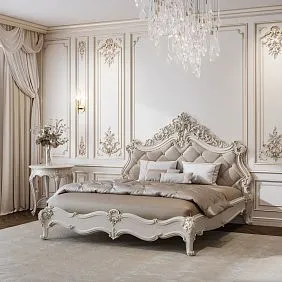
Baroque is not just an interior style, but a philosophy of excess, where more is better, where restraint is considered poverty of spirit, where gold, carving, marble, and velvet merge into a symphony designed to astonish, delight, and make one pause at the threshold.baroque furniture— this is the culmination of this philosophy, the embodiment of power, wealth, divine grandeur, which the absolute monarchs of the 17th-18th centuries sought to demonstrate with every item in their palaces. Today, Baroque is returning—not as a museum reconstruction, but as a living style thatClassic FurnitureSTAVROS andinterior decorationmade from solid wood allow recreating in modern homes, apartments, and country residences.




History of Baroque: from Roman churches to European palaces
Baroque originated in Italy at the turn of the 16th-17th centuries as the Catholic Church's response to the Reformation. Protestants preached asceticism, modesty, and the rejection of decoration in churches. Catholics responded with the opposite: churches that astonish with grandeur, gold, frescoes, sculpture, and chiaroscuro, creating a sense of divine presence. The goal—to bring back the faithful, to overwhelm, to make them feel small before the greatness of God.




Rome as the cradle of the style
Architect Giovanni Lorenzo Bernini (1598-1680) created key Baroque works: St. Peter's Basilica in Rome (the colonnade of the square, the baldachin over the altar—twisted columns 29 meters high, bronze, gilding), the Church of Sant'Andrea al Quirinale (oval space, light pouring from above, creating drama). Francesco Borromini (1599-1667) pushed Baroque curves to the limit: the Church of San Carlo alle Quattro Fontane—a wavy facade, oval dome, space that breathes and moves.
These architects created the language of Baroque: curved lines instead of straight ones, dynamism instead of stasis, excess of decor instead of minimalism, contrast of light and shadow instead of uniform lighting, fusion of arts (architecture + sculpture + painting + gilding form a single whole).
Our factory also produces:


Spread across Europe: the royal style
Baroque quickly moved beyond church walls, becoming the style of absolute monarchies. Louis XIV (the Sun King, reigned 1643-1715) turned the Palace of Versailles into a Baroque manifesto: the Hall of Mirrors (73 meters long, 357 mirrors, gilded bronze candelabras, painted ceilings), the King's Bedroom (where the king's morning is a ritual observed by hundreds of courtiers, furniture is carved and gilded, fabrics are brocade and velvet), gardens (formal, symmetrical, with fountains, statues, labyrinths—nature subordinated to the king's will).
Versailles became a model for imitation. Every European monarch wanted their own Versailles: Austria built Schönbrunn, Prussia—Sanssouci, Russia—Peterhof and the Winter Palace. Baroque became the language of power, a way to say: I am powerful, wealthy, divinely chosen.
Get Consultation
National variations of Baroque
Italian Baroque (17th century)—the original source, the most dramatic, emotional. Churches of Rome, palaces of Venice, Florence. Emphasis on sculptural quality (furniture looks like sculpture, carving is deep, three-dimensional), gilding (abundant, not spotty), contrasts (dark wood + gold, white marble + black).Italian Baroque Furniture— chairs with carved armrests-sphinxes, tables on griffin legs, cabinets resembling palace facades.
French Baroque (17th-early 18th century)—more restrained, elegant. Versailles—the standard. Emphasis on symmetry, order, elegance of lines (not crude power, but light luxury). Carving is finer, gilding more delicate (not solid gilding, but accents). Fabrics are more important than marble—tapestries, brocade, silk cover the walls. Colors: gold + white + pastels (blue, pink, green). Furniture with marquetry (intarsia—inlay with different types of wood, creating pictures on surfaces)—the Boulle dynasty (André-Charles Boulle, 1642-1732) created the technique: copper + tortoiseshell + wood form patterns.
Flemish Baroque (Flanders, Belgium, 17th century)—rich, commercial (Antwerp, Brussels—centers of European commerce). Furniture is massive, heavy, oak (dark), carving is large (grape clusters, hunting scenes, grotesque masks). Emphasis on displaying wealth through material (oak is expensive, requires skill), not gilding (less than in Italy/France).
Spanish Baroque (17th-18th century)—religious, somewhat gloomy (influence of the Inquisition, asceticism). Dark wood (walnut, chestnut), leather (embossed, with nails—Moorish influence), carving is deep but severe (not playful, as in France). Furniture is squat, heavy, angular. Decor often religious (crosses, saints, biblical scenes).
Russian Baroque (18th century, under Peter I, Elizabeth Petrovna) — belated but grandiose. Rastrelli (Francesco Bartolomeo Rastrelli, 1700-1771, an Italian in Russian service) created the Winter Palace, Smolny Cathedral, the Grand Palace of Peterhof — Baroque adapted to the northern climate (bright facade colors — turquoise, white, gold — contrasting with the gray sky), Russian scale (palaces are enormous, enfilades of halls endless), Russian materials (wood, not marble, due to the cold).
Key features of Baroque: how to recognize the style
Baroque is instantly recognizable. A set of formal features creates an atmosphere that is impossible to confuse.
Curved lines: dynamism instead of static
The Renaissance loved straight lines, rectangles, circles — geometric clarity. Baroque rejected straight lines. Furniture legs curve (cabriole — S-shaped curve), chair backs are wavy, tabletops are oval or have shaped edges, cabinet fronts are convex (bombé — bulging in the middle). The goal is to create movement, dynamism, a feeling that the furniture is alive, breathing.
Curved lines are more complex to manufacture (requiring cutting from thick boards, losing material, or steam-bending wood — labor-intensive), but create visual lightness, elegance, despite the massiveness.
Carving: maximum detail
Baroque furniture is covered in carving. Not fragmentary (as in the Renaissance, where carving is an accent), but total. Legs are carved, armrests are carved, backs are carved, stretchers (crosspieces between legs) are carved, cornices are carved. The carving is deep (relief 10-30 mm, creating dramatic shadows), complex (multi-layered — petals overlapping petals, creating volume), dynamic (scrolls, curves, asymmetrical elements).
Carving motifs:
Acanthus leaves — the main symbol of Baroque. Acanthus is a Mediterranean plant with carved leaves, used even in ancient Corinthian capitals. Baroque took acanthus and pushed it to the limit: leaves are large (height 10-20 cm), curved (tips curl outward, creating dynamism), multi-layered (upper petals overlap lower ones). Acanthus emerges from furniture corners, frames central rosettes, creeps up legs from bottom to top.
Volutes — spiral scrolls resembling snail shells or waves. Volutes finish chair armrests, adorn consoles, support cornices. Double volutes (S-shaped) create maximum dynamism.
Cartouches — oval or irregular shields framed by carving (leaves, scrolls, ribbons). In the center of the cartouche — a coat of arms, monogram, date, or simply an empty field. Cartouches adorn chair backs, cabinet fronts, panels.
Garlands and festoons — carved imitations of floral garlands, ribbons, draperies. A festoon is a garland sagging in an arc between two points. They adorn cornices, friezes, mirror frames.
Putti (cherubs) — carved winged infants, playing, holding attributes (wreaths, musical instruments). Religious Baroque (churches) is full of putti, secular Baroque uses them less often, but they appear in formal interiors.
Zoomorphic elements — lion heads, griffins, sphinxes, eagles. Furniture legs end in lion's paws, chair armrests end in lion or sphinx heads. These are symbols of strength, power, royalty.
Gilding: gold as status
Gilding in Baroque is not an accent, but a background. Gilded mirror frames, gilded carving on furniture, gilded candelabras, gilded ceiling moldings. Gold leaf (ultra-thin sheets of gold applied to carving) or imitation gold (Dutch metal, brass foil — cheaper but indistinguishable from afar) is used.
Gold is applied to the protruding parts of the carving (tips of acanthus leaves, crests of volutes, centers of rosettes), creating a play of gold and wood. Or solid gilding (entire surface is gold) — maximum luxury, but also maximum price.
Patination (applying dark paint into the recesses of the carving, then partially wiping it off) creates an effect of aging, antiquity, nobility. Gold + dark patina — a classic Baroque combination.
Contrasting colors: drama in the palette
Baroque loves contrasts. Not pastel transitions, but sharp juxtapositions:
Gold + white — the most common. White furniture (enamel) with gilded carving, white walls with gold moldings. The contrast creates clarity, purity, solemnity. Versailles, Peterhof, the Winter Palace — this triad.
Dark wood + gold — Italian, Spanish variant. Walnut, rosewood (dark brown, almost black) with gilded carving. The contrast is somber, luxurious, dramatic.
Red + gold — imperial palette. Red velvet (upholstery, walls) + gilded furniture. The color of power (Roman emperors, Vatican cardinals), passion, wealth.
Green + gold — an alternative to red, more calm. Emerald velvet + gold — luxury, but not aggression.
Blue + gold — royal palette (blue — the color of the sky, divinity, royal blood — sang bleu). Light blue or dark blue velour + gold.
Expensive materials: demonstration of wealth
Baroque uses materials that shout about price:
Solid noble woods — oak (strong, textured), walnut (dark, noble), rosewood (exotic, brought from colonies — Brazil, India), ebony (black, heavy, more expensive than gold in the 17th century).
Marble — tabletops, consoles, fireplaces. White Carrara (Italy), black Belgian, green (verde antico), pink (Portugal). Marble is cold, heavy, eternal — a status material.
Bronze — hardware (handles, lock plates), decorative elements (candelabras, clocks, vases). Bronze is patinated (artificially aged with acids), gilded, transformed into a jewel.
Velvet and velour — furniture upholstery, wall draperies. In the 17th century, velvet was woven by hand and cost as much as a house. Colors are deep (red, green, blue), the pile is long, creating a play of light.
Brocade — fabric with gold or silver threads interwoven with silk. Brocade shimmers, rings when touched (metallic threads), heavy. Draperies, upholstery for ceremonial armchairs.
Tapestries — woven carpets hung on walls. The French Gobelins Manufactory (founded 1662 by Louis XIV) created tapestries based on artists' paintings — hunting scenes, mythology, history. One tapestry took years to weave and cost a fortune.
Baroque upholstered furniture: armchairs and sofas as thrones
Baroque upholstered furniture is not just a place to sit, but a throne where the owner demonstrates status. Each armchair is a work of art where the frame (carved wood), upholstery (expensive fabric), proportions (monumental yet elegant) merge into a whole.
Bergère armchair: French classic
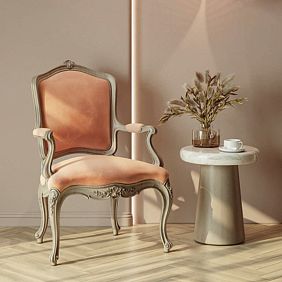
Bergère — a deep armchair with closed sides (no gap between armrest and seat — upholstery is continuous). Invented in France in the early 18th century. Back slightly reclined (105-110°), seat deep (55-60 cm), armrests soft. Cabriole legs, often with carved acanthus leaves at the base. Upholstery velvet or tapestry. Frame color: white with gold patina, natural wood (walnut), black with gold.
The bergère creates a cocoon-like feeling — you sit surrounded by softness, protected, comfortable. This armchair is for long conversations, reading, relaxation, not for formal receptions.
Fauteuil armchair: ceremonial, high
Fauteuil — an armchair with open sides (gap between armrest and seat, frame visible). Back high (100-110 cm from floor), straight or slightly curved. Armrests carved (often ending in volutes or lion heads), hard (not upholstered) or semi-soft. Legs carved, cabriole or straight with carving.
Fauteuil — a ceremonial armchair, for receptions, audiences, halls. You sit upright (posture important, demonstration of status), back does not recline. Upholstery: brocade with gold-thread pattern, velvet in saturated colors (burgundy, emerald), tapestry with a coat of arms or scene.
Canapé: Baroque sofa
Canapé — a sofa for 2-3 people, predecessor of the modern sofa. Back high, wavy (center higher, edges lower, creates dynamism), often divided into three sections (central + two side). Armrests curved, carved. Cabriole legs, 6-8 pieces (sofa heavy, needs support). Upholstery velvet, brocade, pattern often different on back (large medallion) and seat (small ornament).
Canapé for two persons sitting side by side, but not tightly (distance maintained — etiquette of the 17th-18th centuries). Modern sofa is for lying, canapé is for sitting in a ceremonial pose.
Upholstery: capitonné technique (deep buttoning)
Baroque introduced the deep buttoning upholstery technique — capitonné. The fabric is not simply stretched over the frame, but is buttoned down into the depth at several points, creating raised sections (diamonds, squares). At the buttoning points — buttons (covered with the same fabric) or decorative nails (bronze, gilded).
Capitonné creates volume, luxury, tactile variety (the raised areas are pleasant to the back). Classic pattern — diamonds (diamond tufting). Used on backs of armchairs, sofas, bed headboards.
Decorative nails: a detail that matters
Along the perimeter of the upholstery (where fabric attaches to the frame) runs a row of decorative nails with large heads (diameter 10-15 mm). Nails are bronze, brass, gilded, patinated. Placed densely (distance 1-2 cm) or sparsely (5-10 cm), creating a pattern (straight line, wave, zigzag).
Decorative nails — not function (fabric is held by staples inside), but decoration, which emphasizes the fabric-wood transition, adds metallic shine, creates rhythm.
Baroque case furniture: cabinets as architecture
Baroque cabinets are not just storage, but architectural structures imitating palace facades.
Cabinet: a treasury
Cabinet — a tall cupboard (180-220 cm) on legs or on a stand, with many drawers, doors, secrets (hidden compartments). Front decorated with carving, inlay, painting. Inside — velvet-lined drawers, mirrors, miniatures. The cabinet stored jewels, documents, collections (coins, stones, miniatures).
Baroque cabinet often on cabriole legs or on a stand with carved legs (so the floor under the cabinet is visible — visual lightness). Front convex (bombé) or flat, but framed by columns, pilasters (imitation of a portico). Cornice on top carved, with modillions (brackets).
Chest of drawers: French invention
Chest of drawers (commode — convenient) invented in France in the late 17th century, became a symbol of Baroque. Low (80-90 cm high), wide (120-150 cm), on short cabriole legs. Front convex (bombé — three or five convexities), covered with marquetry (inlay with different wood species) or carving. Top marble (white, colored). Handles bronze gilded, often zoomorphic (lion heads, masks).
Boulle commode (André-Charles Boulle) — the standard: black ebony wood + inlay with copper and tortoiseshell (Boulle technique: copper plate and shell cut to the same pattern, then swapped — resulting in two mirror patterns, one with copper background and tortoiseshell pattern, the other vice versa). Bronze mounts (masks, scrolls) gilded. Marble top (pink, green marble). Price of such a commode in the 17th century — like a townsman's house.
Library bookcase: temple of knowledge
Tall cabinet (floor-to-ceiling, 250-300 cm) with glass-paneled doors behind which books are kept. The lower section (up to 100 cm) features solid doors or drawers (for storing documents, maps, not books). The upper section is glass (to display book spines — showcasing the library, erudition, status).
Baroque library cabinet decorated with columns on the sides (pilasters with Corinthian capitals), a cornice with carved modillions, and a plinth with a carved frieze. Wood is dark (walnut, stained oak), sometimes with gilded overlays. Glass is framed (divided into sections by wooden mullions — 17th-18th century technology did not allow for large panes).
interior decorationfor Baroque: details that create the style
Baroque furniture is central, but without interior decor (walls, ceiling, floor) the style is incomplete.interior decorationsolid wood STAVROS allows for creating a Baroque environment, a framing for furniture.
Wall panels: boiserie
Boiserie (boiserie — wooden paneling) — dividing walls into rectangular panels using moldings, with wood, fabric, painting, or mirrors inside. Classic scheme: three tiers.
Lower tier (plinth, 30-50 cm) — clad in wooden panels painted darker than the main wall, or left natural (oak, walnut). The plinth protects the wall from mechanical damage (impacts from furniture, feet), creates a visual foundation.
Middle tier (main, 150-200 cm) — divided by vertical moldings into 3-5 rectangles. Inside: contrasting paint, expensive wallpaper (silk, flock), fabric (brocade, velvet stretched on frames), painting (grisaille — imitation of stucco with gray paint), mirrors (in wall spaces between windows — Versailles, Hall of Mirrors).
Upper tier (frieze, from the top of the middle tier to the ceiling or cornice) — can be decorated with carved friezes (horizontal bands with continuous ornamentation), painting, gilding.
Boiserie moldings — wide (8-15 cm), profiled (ovolo, torus, fluting). STAVROS produces moldings from solid oak and beech, dozens of profiles from classical to Baroque. Strip length 2-3 meters, joined at corners at 45° (requires precise cutting but creates seamless appearance).
Ceiling cornices and rosettes
Cornice — the wall-to-ceiling transition, in Baroque wide (15-30 cm high), carved, often gilded. The cornice conceals the technical gap, creates an architectural finish, visually lowers the ceiling (high ceilings of Baroque halls — 4-5 meters — the cornice makes the scale more human).
Ceiling rosette — a round or oval element in the center of the ceiling from which the chandelier descends. Rosette diameter 60-120 cm, carved (acanthus leaves, volutes, rays), gilded or white. STAVROS produces ceiling rosettes from solid wood and polyurethane (polyurethane ones are lighter, easier to install, cheaper; wooden ones — for projects where naturalness is critical).
Door and window casings
Casings in Baroque — not simple strips, but architectural elements. The casing frames a door or window opening, consists of vertical strips (on the sides) and a horizontal pediment (sundrick).
Sundrick — a horizontal element above the opening, imitating an entablature (part of a classical colonnade). Straight (like a shelf) or triangular (pediment). In Baroque, the sundrick is often broken (the center of the pediment is broken, with a cartouche, vase, bust inserted), wavy (not a straight line but curved). Carving on the sundrick — modillions (brackets supporting the projection), dentils (teeth), acanthus leaves.
Pilasters — vertical strips on the sides of the opening, imitating flat columns. Base (at the bottom), shaft (fluted — with vertical grooves, or smooth with carving), capital (at the top — Corinthian with acanthus leaves).
STAVROS casings — modular (you choose pilasters, sundrick, assemble a kit to fit the opening size), made of solid oak/beech, with various finishing options (natural wood, staining, enamel, gilding).
Consoles and shelves
Console — a wall-mounted shelf on brackets, a Baroque display element (vases, clocks, sculptures are placed on the console). The console is attached to the wall, has no legs reaching the floor (visually floats). Brackets are carved (volutes, acanthus leaves, caryatids — female figures supporting the tabletop).
Baroque console often has a marble tabletop (white, colored marble), a carved base of gilded wood, a mirror above it (console + mirror — a classic pair, the mirror doubles space, light, decorative effect).
STAVROS produces console brackets (carved elements that attach to the wall, support the tabletop), tabletops from solid wood (custom order), carved mirror frames (Baroque, with acanthus leaves, volutes, cartouches).
Baroque colors: palette of power and passion
Gold: the metal of kings
Gold in Baroque — not just a color, but a material (gold leaf, imitation gold). Used abundantly: gilded furniture carving, gilded moldings, gilded frames, gilded hardware. Goal — to create a sense of wealth, divinity (gold — the color of saints' halos, sun, eternity), power (golden crowns, scepters).
Modern Baroque uses gold in measured doses (not solid gilding, but accents — protruding parts of carving), to avoid kitsch. But accents are essential — without gold, Baroque is not Baroque.
White: purity and monumentality
White — background for gold. White furniture (enamel) with gilded carving, white walls with golden moldings. White creates light, purity, monumentality (white marble — association with antiquity, temples). Versailles, Peterhof — white + gold.
Shades of white in Baroque: not cold snow-white (bluish), but warm (cream, ivory, warm milk). Warm white combines with gold more softly, does not create harshness.
Red: The Color of Emperors
Red velvet is a symbol of power (Roman emperors, cardinals, kings). Red + gold is the most luxurious, dramatic Baroque combination. Red upholstery on armchairs, red drapery on walls, red carpet. Shades: bordeaux (dark red with a brown undertone), cardinal red (scarlet, bright), wine (red-purple).
Red is active, dominant, creates tension, passion, solemnity. Suitable for formal rooms (halls, dining rooms), not for bedrooms (too stimulating).
Green: An Alternative to Red
Emerald, malachite, dark green velvet + gold is a luxurious but calmer combination. Green is the color of nature, but in Baroque it is not pastoral greenery, but rich, precious (the color of malachite, emerald). Green + gold was used in libraries, studies, smoking rooms — masculine, serious spaces.
Blue: The Royal Color
Blue is the color of the sky, divinity, royal blood (sang bleu — blue blood of the aristocracy). Shades: sky blue (pastel, French Baroque, Rococo), dark blue, sapphire (saturated, deep). Blue velour + gold is an elegant, noble combination, less dramatic than red, but status.
Black + Gold: Maximum Drama
Ebony or black enamel + gilded carving — maximum contrast, drama, power. This is a variant of Italian, Spanish Baroque, where gloom combines with luxury. Black + gold requires a large space, high ceilings, abundant light (otherwise it feels oppressive, gloomy). But in the right dosage, it creates an unforgettable effect.
How to Create a Baroque Interior with STAVROS
Step 1: Choosing Furniture as the Style Anchor
Start with one or two key piecesclassic furnitureSTAVROS: Baroque armchair (with carved armrests, velvet upholstery), chest of drawers (with convex front, gilded handles), console (carved, with marble top). These pieces set the style; the rest of the interior is built around them.
STAVROS offers furniture made from solid oak and beech (species used in original Baroque), with carving done by CNC and finished by hand (machine precision + master's soul), upholstery from European fabrics (velour, velvet — Italy, France, Belgium — the same countries as 300 years ago).
Step 2: Adding Wall Decor
Create boiserie (panel system) on walls using STAVROS moldings. Minimum option: one or two rectangles behind key furniture (behind the armchair, behind the chest of drawers). Maximum: the entire wall divided into panels.
Moldings are glued to the wall (polyurethane adhesive), painted (to match the wall color or contrasting). Inside the panels, you can leave the wall as is (monochrome, play of relief) or add contrasting paint, wallpaper, fabric.
Step 3: Carved Overlays as Accents
Add STAVROS carved overlays to the centers of panels, on corners, on furniture cornices. A 20-30 cm overlay (cartouche, rosette, acanthus ornament) in the center of a wall panel creates a focal point, richness. Corner overlays (8-10 cm) at the corners of panels add detail.
Overlays are glued (PVA or polyurethane adhesive), painted (to match or contrasting — gold on white, white on colored). Effect: a simple wall transforms into Baroque, decorated, architectural.
Step 4: Ceiling Cornice and Rosette
Install a STAVROS ceiling cornice around the perimeter of the room (or at least on one wall — where the key furniture is). Cornice height 15-20 cm, classic profile, white or gilded. This creates an architectural finish, separates walls from ceiling, adds visual height.
If there is a chandelier, add a ceiling rosette around the mounting. Rosette diameter 60-80 cm, carved, white or gilded. This is a traditional Baroque element that instantly elevates the status of the interior.
Step 5: Door Casings
Replace simple door casings with Baroque STAVROS ones: with pilasters (vertical carved strips on the sides), pediment (top with a pediment or wavy). The door transforms from a utilitarian opening into an architectural element, a portal.
Step 6: Textiles and Accessories
Add Baroque textiles: velvet or brocade cushions on armchairs, heavy curtains with lambrequins (draped tops), carpet (Persian, with a medallion). Accessories: mirror in a carved gilded frame (above the console, above the fireplace), candelabra (bronze, on marble consoles), vases (porcelain, with painting).
Baroque loves excess, but modern Baroque requires moderation: not everything at once, but in doses, so that luxury does not turn into kitsch.
Mistakes When Creating a Baroque Interior
Mistake 1: Kitsch instead of luxury. Too much gold (everything golden), too bright colors (red + gold + blue + green in one room), cheap materials (plastic imitating gold, polystyrene imitating stucco). Baroque requires quality: natural materials (wood, marble, bronze, natural fabrics), thoughtful accents (gold on protruding parts, not all over), limited palette (2-3 colors maximum).
Mistake 2: Scale mismatch. Baroque furniture is large, monumental. In a small room (15-20 m²), a large Baroque armchair + a carved chest of drawers + wall panels will create pressure, claustrophobia. Baroque requires space: high ceilings (from 3 meters), large areas (from 30 m² for one room). In small spaces, use Baroque elements in doses (one armchair + minimal wall decor), not totally.
Mistake 3: Mixing styles without understanding. Baroque armchair + minimalist glass and chrome table = dissonance. Baroque + loft, Baroque + high-tech do not work (too opposite philosophies). Baroque combines with classicism (Renaissance, Neoclassicism — related styles), with luxurious modern (Art Deco, glam), with eclecticism (if skillful). But requires caution.
Mistake 4: Imitation instead of authenticity. Plastic "carving" (stamped, glued), polystyrene "molding", "wood-like" film on MDF give themselves away instantly. Baroque was built on material authenticity, craftsmanship. Modern Baroque requires the same: real wood (solid wood), real carving (CNC + manual finishing), real fabrics (velvet, not polyester under velvet).
Conclusion: Baroque as a choice for the bold
baroque furniture— it is not the background of life, but its manifesto. Choosing Baroque, you say: I am not afraid of luxury, I am not shy to demonstrate taste, status, love for beauty. I live not minimally, but fully, richly, surrounding myself with beauty that pleases the eye, nourishes the soul, creates an atmosphere of celebration daily.
Company STAVROS has been creatingclassic furnitureandinterior decoration, which allow recreating the splendor of Baroque in modern homes. STAVROS furniture is made from solid oak and beech (species used in original Baroque of the 17th-18th centuries), frames are assembled with mortise and tenon joints with glue (carpentry connection that lasts for centuries, as in antique furniture), carving is performed on 5-axis CNC machines (accuracy up to 0.1 mm, perfect repeatability) with subsequent manual finishing by craftsmen (removing burrs, sanding hard-to-reach areas, emphasizing edges).
Upholstery of STAVROS furniture — natural fabrics from European manufacturers: velour and velvet (Italy, Belgium — countries that wove velvet for Versailles), jacquard (with large floral patterns, reproducing historical fabrics), genuine leather (Italian, vegetable tanning, ages beautifully). Color palette — over 50 shades (from classic Baroque — burgundy, emerald, sapphire, golden — to modern interpretations — gray, graphite, powder).
STAVROS decorative elements — a library of Baroque forms: moldings (over 30 profiles — from simple classic to complex Baroque with acanthus leaves), carved overlays (over 200 models — cartouches, rosettes, acanthus leaves, volutes, garlands, putti), ceiling rosettes (diameter from 40 to 120 cm, carved or polyurethane), door trims (with pilasters, pediments, capitals), console brackets (carved, gilded, supporting countertops, shelves).
STAVROS finishing reproduces historical techniques: oil tinting (emphasizes wood texture, creates color depth), enamel (white, cream, black — smooth as porcelain), patination (dark paint in carving recesses, creating an aging effect), gilding (imitation gold leaf, applied to protruding parts of carving, creates Baroque luxury). Each product undergoes seven levels of quality control — from incoming raw material control (wood moisture 8-10%, no defects) to final inspection of the packaged product (checking finish, completeness, packaging).
STAVROS works with interior designers, architects, developers, private clients throughout Russia, CIS, Europe. For designers — service for developing custom elements (you send a sketch of a Baroque cartouche, overlay, leg — STAVROS models in 3D, manufactures a sample, after approval — a series). For developers — comprehensive furnishing of objects (hotels, restaurants, residences) with Baroque furniture and decor. For private clients — ability to order via website with delivery, designer consultations on element selection, creation of 3D visualization of the future interior.
With STAVROS, Baroque ceases to be an unattainable museum style and becomes a reality of your home — a space where every morning begins with touching the carved armrest of an oak armchair, every evening ends with contemplating the play of light on gilded carving, where luxury is not ostentatious, but genuine, expressed in material quality, craftsmanship, attention to details that turn the interior from function into art, and the home — from a place of residence into a work worthy of kings.


