Article Contents:
- History of the Style: Where This Splendor Came From
- Signs of Baroque Furniture: How to Recognize at First Glance
- Curved Lines and Dynamic Form
- Hand carving of wood
- Gilding and Patina
- Upholstery: Velvet, Tapestry, Silk
- Monumentality and Scale
- Baroque vs Classicism and Rococo: What's the Fundamental Difference
- Baroque vs Classicism: Excess vs Measure
- Baroque vs Rococo: Monumentality vs Elegance
- Materials and Decor: What Royal Furniture is Made Of
- Wood: The Species Decides Everything
- Hand Carving: What It Costs in Labor
- Gilding: Technology Without Compromises
- Fabrics: Velvet and Its 'Secret'
- Baroque Style Furniture in a Modern Interior
- The 'One Dominant' Principle
- 'Modern Baroque' as an Established Style
- Baroque in the Living Room: Layout Scenarios
- Baroque in the Bedroom: Bed as a Throne
- Baroque and Wooden Wall Decor: How to Create an Architectural Background
- Where to Buy Baroque Furniture in Russia: A Practical Guide
- Antique Market
- Italian Import Manufacturers
- Russian Production: STAVROS
- Caring for Baroque Furniture: How to Preserve the Royal Look
- Wooden Elements with Gilding and Lacquer Coating
- Upholstery: Velvet, Tapestry, Jacquard
- Room Conditions
- FAQ: Everything You Wanted to Ask About Baroque Furniture
- STAVROS: Baroque Furniture from a Russian Manufacturer

Imagine a hall. The ceiling is five meters high. The light is not electric, but candlelight, trembling in the faceted crystal of a chandelier. The walls are covered with gilded panels, the parquet reflects the flames with glints. In the center is a sofa with curved cabriole legs, upholstered in purple velvet, its back adorned with carved scrolls with matte gold overlays. This is not Versailles, not Peterhof, and not Schönbrunn. This is a fantasy of a space where life unfolds like a theatrical performance.
baroque furniture— this is precisely such a fantasy, embodied in wood, velvet, and gilding. A style that was born in the royal courts of the 17th century and lives to this day—not as a museum exhibit, but as an active principle of space design for those who are not afraid of luxury and know how to handle it. In this article—everything: history and essence, materials and details, differences from related styles, and practical advice on selection and purchase.




History of the Style: Where Did This Splendor Come From
The word 'baroque,' according to one version, comes from the Portuguese 'barroco'—an irregularly shaped pearl. This is an accurate metaphor: baroque does not strive for the correctness and symmetry of classicism. It strives for excess, movement, tension—for form to overwhelm space and suppress the viewer with its scale.
The style was born in Rome in the early 17th century as a tool of the church and monarchy: grand cathedrals, palaces, and their furnishings were meant to make a physical impression on the visitor—to stun, overwhelm, and inspire awe. Furniture in this context became part of the architectural spectacle: it did not merely exist in the interior; it participated in it on par with the walls, vaults, and paintings.
By the mid-17th to early 18th century, baroque reached its peak at the courts of Louis XIV in France and Charles II in Spain. It was during the era of Louis XIV that the model of the 'ceremonial interior' was created, where furniture—the throne, ceremonial chair, buffet, console—expressed hierarchical order: the place by the fire, the place facing the king, the place behind the monarch. Each item carried social significance.
Russian Baroque—a special chapter. Peter the Great's reforms brought this style to Russia in the early 18th century, and it fell on fertile ground of the Russian inclination toward monumentality and decorative richness. Peterhof, the Winter Palace, the Catherine Palace in Tsarskoye Selo—this is Russian baroque in its mature expression: more lavish than Italian, more coloristically intense than French.




Signs of Baroque Furniture: How to Recognize at First Glance
What makes a piece of furniture baroque? There are a number of unmistakable signs—and each carries its own aesthetic load.
Our factory also produces:




Curved Lines and Dynamic Form
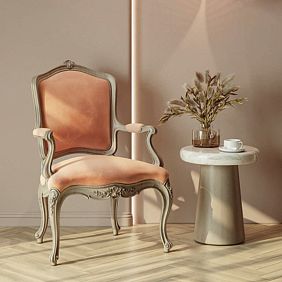
Baroque hates straight lines. Legs—curved, in the shape of cabriole (a leg curved twice with an outward 'knee'). Chair backs—with a smooth curve in the upper third. Armrests—with volutes (scrolls) at the ends. Table aprons—with a complex profile transitioning into decorative brackets.
Movement—the key word for understanding baroque form. Staticness—that's classicism. Baroque always creates the feeling that an object is about to change shape or position: a wave rises, a scroll unfurls, a chair back 'breathes.'
Get Consultation
Hand carving of wood
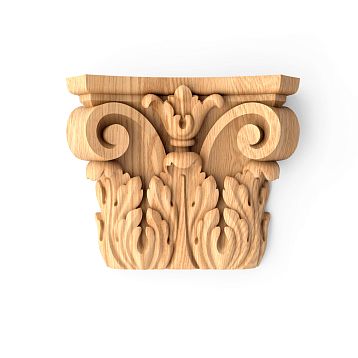
Carving in baroque furniture is not decoration. It is a language. Acanthus leaves—an ancient symbol of vitality. Volutes—scrolls symbolizing the movement of time. Cartouches—decorative shields with ornamentation or a coat of arms. Putti (figures of cupids)—an allusion to the luxurious painting of ceilings. Floral garlands—in honor of nature, tamed by man. Each carving motif has a source and meaning—and that is precisely whyFurniture in Baroque styleit 'reads,' not just is looked at.
Gilding and Patina
Gold—the main color of baroque. Matte gold with wear—not cheap plastic with glitter, but artistic treatment: a leaf of gold leaf is applied to a base, then polished with an agate stone to brightness where shine is needed, and left matte where depth is required. The result—a living, breathing coating that changes under different lighting.
Patina—artificial 'aging' of the surface: darker tones in the recesses of the relief imitate the natural accumulation of time. This is not an imitation of cheapness—it is an imitation of history.
Upholstery: Velvet, Tapestry, Silk
baroque furniturerequires fabric with character. Velvet—the main material of the era: its surface changes color depending on the angle of light. Tapestry with woven ornamentation—motifs of flowers, leaves, hunting scenes. Jacquard with damask or geometric patterns. Silk with embroidery using metallic thread. Carriage-style capitonné—deep diamond-pattern stitching on backs and seats—this is also an element of baroque, giving the surface volume and relief.
Monumentality and Scale
Baroque furniture is large. An armless sofa in the baroque style is rare. A chair with a delicate leg is nonsense. Everything here works on scale: wide seats, high backs, powerful armrests. This is furniture for rooms with ceilings from three meters, where it is proportional to the space and does not look alien.
Baroque vs. Classicism and Rococo: What Is the Fundamental Difference
Confusion between the three related styles is one of the most common in conversations about interior design. Let's break it down.
Baroque vs. Classicism: Excess vs. Measure
| Parameter | Baroque | Classicism |
|---|---|---|
| Lines | Curved, dynamic | Straight, strict |
| Decor | Excessive, multi-level | Restrained, symmetrical |
| Furniture legs | Cabriole, curved | Straight, tapered |
| Color | Dark wood + gold | Neutral tones, patina |
| Scale | Monumental | Proportional |
| Mood | Theatricality, drama | Formality, dignity |
Classicism is the Enlightenment, reason, and order. Baroque is absolutism, emotion, and power. Choosing between them is not a matter of taste, but an ideological question about man's relationship to space.
Baroque vs Rococo: monumentality versus elegance
Rococo is the child of Baroque. A style that emerged in France in the first third of the 18th century as a reaction to the heaviness of Louis XIV. Rococo is more delicate, lighter, more playful—and at the same time more sophisticated. Here are the main differences:
-
Scale: Baroque — large forms, Rococo — intimate, delicate
-
Color: Baroque — dark gold, rich fabrics; Rococo — pastels, silver, lilac, pistachio
-
Decor: Baroque — symmetrical, monumental; Rococo — asymmetrical 'rocaille' (shell form), deliberately avoiding straight lines and symmetry
-
Mood: Baroque — solemnity; Rococo — playfulness, flirtation, frivolity
Understanding the difference is simple: if you see a massive armchair with dark wood, a tall straight back, and purple velvet—that's Baroque. If the armchair is small, light-colored, with a curved cartouche-shaped back in the form of a shell and upholstery in 'powder pink'—that's Rococo.
Materials and decor: what royal furniture is made of
The question 'what's inside' is no less important than 'what it looks like on the outside.' Baroque furniture was made from the best materials of its time—and this tradition has not lost its relevance.
Wood: the species decides everything
The foundation of Baroque furniture is solid hardwood. Historically: walnut (the main wood of 17th-century Baroque, with a dark reddish-brown color and beautiful grain), mahogany (mahogany, which appeared in European furniture from the 18th century), oak (for monumental pieces, especially in German and Russian Baroque).
ModernClassic FurnitureBaroque-style furniture by STAVROS is made from oak and beech—two species that combine the required density (650–750 kg/m³), good workability with a chisel, and a noble texture. Beech is ideal for tinting to any historical shade: dark walnut, 'dark antique,' cherry. Oak—expressive texture, natural durability, possibility for multi-layered carving.
Hand carving: what it costs in labor
One carved element—acanthus leaves along the perimeter of a chair back—requires 8–20 hours of work from a woodcarver, depending on complexity. A fully carved console table—30–50 hours. This is precisely what determines the price of Baroque furniture: you are not paying for the wood, you are paying for the labor.
Mechanical milling can reproduce relief, but not carving in the full sense. Hand carving has lively, slightly 'breathing' lines with minor variations — this is precisely what distinguishes original carving from stamped ornamentation. A true connoisseur sees the difference immediately.
Gilding: Technology Without Compromise
Gold leaf — sheets of metal 0.1–0.2 microns thick — is applied to a pre-primed and sanded surface using a special adhesive (mordant). After drying, it is polished with an agate burnisher. One gram of gold leaf yields 50–60 sheets measuring 8×8 cm, each covering about 64 cm² of surface. It's delicate work requiring experience and concentration.
Imitations — aluminum leaf under 'gold', acrylic compounds with metallic pigments — yield a different result: brighter, less 'lively', without the depth created by real gold.
Fabrics: Velvet and Its 'Secret'
Velvet in a Baroque interior is not just beautiful. It has a physical property that makes it indispensable: the pile changes the perceived color at different viewing angles. Blue velvet appears almost black when lit at an angle, and bright ultramarine under direct light. This 'movement' of color is an integral property of the Baroque interior with its play of light and shadow.
Natural cotton velvet is rarely used today — in favor of polyester velvet with improved durability and wear resistance. When choosing — pay attention to the pile density (g/m²): less than 300 g/m² — wears thin quickly; 350–500 g/m² — the working range for upholstered furniture.
Baroque-style Furniture in a Modern Interior
This is where it gets most interesting. How to use the language of Baroque in an apartment or country house today — without the space turning into theatrical props?
The 'One Dominant' Principle
Baroque in a modern interior works as a dominant, not as a total style. One item — a Versailles sofa, an armchair with carved legs, a mirror in a gilded frame — sets the tone for the entire room. Around it can be a neutral background: white walls, light flooring, minimalist lighting. The contrast makes the Baroque item even more expressive.
This is what designers call a 'statement'. One Baroque item in a minimalist interior is conscious irony, a dialogue of eras. This is significantly bolder and more interesting than trying to reproduce Versailles in a 90 m² Moscow apartment.
'Modern Baroque' as an Established Style
Over the past decade, an independent interior style has emerged, which marketers call 'modern baroque' or 'contemporary baroque'. Its principles:
-
Baroque furniture items + neutral or dark wall background
-
Monochromatic palette (only white or only black) + gold accents
-
Mixing eras: Baroque armchair + contemporary minimalist table
-
Focus on one or two items with pronounced decoration
It is in this aesthetic that the Versailles armchairorConsole Versailles from STAVROS work most convincingly: they are expressive enough for a 'statement' and made with sufficient quality to withstand the closest scrutiny.
Baroque in the Living Room: Layout Scenarios
Scenario 1: Classic Ensemble. A high-back sofa in the center, two armchairs with armrests on the sides, a Versailles coffee table in front of them, mirror in a carved frame Versailles 008-002 above a console against the wall. Walls — dark: olive, indigo, burgundy. This is a 'palatial' living room without attempts at irony or compromise.
Scenario 2: Accent Item. One Versailles 004-001 armchair by the window against light gray walls. Everything else — neutral. This is a 'found' item — like an antique piece you discovered at an auction and brought home. Effect: the entire room starts working for it.
Scenario 3: Dark Library. Wooden wall panels made of STAVROS moldings, dark parquet, classic Versailles furniture in a 'dark walnut' finish, leather upholstery. Louis 008-003 mirror above the fireplace. This is a 'study' that inspires by its very existence.
Baroque in the Bedroom: The Bed as a Throne
A bedroom in Baroque style is built around the bed. The Versailles 001-001 bed from STAVROS (from 580,180 rubles) — is a piece with a carved headboard that is itself an architectural element. The headboard height is sufficient to create a 'niche' for the sleeping area: the space around the bed acquires the status of 'chambers', not just a 'room for sleeping'.
Addition: Versailles 012-001 nightstands (from 260,280 rubles) on the sides, Adele 010-001 dressing table (from 328,620 rubles) against the wall — and the bedroom transforms into a declaration of how you relate to the space where every day begins and ends.
Baroque andWooden decoration walls: how to create an architectural backdrop
Baroque furniture deserves a worthy backdrop. A smooth painted wall is not an enemy, but it's not the best context either. A wall with wooden moldings dividing it into paneled sections — that's what turns a room into a 'hall'.
STAVROS wooden moldings of the MLD-014–MLD-016 series with an expressive figured profile are the material for such a backdrop. Four horizontal moldings on the wall create three panels: a lower 'plinth' zone, a middle living zone, and an upper 'frieze'. Combined witha wide floor plinth PLT-001 and a ceiling cornice — a full-fledged 'palatial' wall without a single square centimeter of plaster.
Where to buy Baroque furniture in Russia: a practical guide
The Baroque furniture market in Russia is heterogeneous. Let's break it down by segments.
Antique market
Authentic Baroque furniture from the 17th–18th centuries is a rarity even at global auctions. The Russian antique market features 'late Baroque' from the 19th century — Biedermeier and Historicism with Baroque elements. These are expensive items with corresponding care and storage requirements.
Italian import manufacturers
Italian furniture manufacturing is traditionally the strongest in the classic and Baroque furniture segment. However, under current economic conditions, the availability of Italian brands in Russia is significantly limited: logistics have become more complicated, prices have risen, and delivery times have increased. The price of a Baroque upholstered furniture set from a renowned Italian manufacturer starts from 2,500,000 rubles and above.
Russian production: STAVROS
Choosing a Russian manufacturer with its own production facilities is not a compromise, it's pragmatism. No customs delays, no currency risks when converting euros, full transparency regarding materials and finishes, and the possibility of customization for the project. The Versailles collection by STAVROS is a specially developed line in Baroque and Neoclassical style, made from solid oak and beech with hand carving.
Versailles 004-001 armchair — from 196,780 rubles. Versailles 002-001 table — from 277,420 rubles. Versailles 006-001 console — from 488,960 rubles. Versailles 001-001 bed — from 580,180 rubles. These are the prices of a Russian manufacturer without intermediary markups — and that's precisely what makes them reasonable for products of this quality level.
Caring for Baroque furniture: how to preserve its royal appearance
Baroque furniture made from solid wood with hand carving and textile upholstery is not an item requiring special reverence. But it shouldn't be treated like particleboard furniture either.
Wooden elements with gilding and lacquer finish
Regular care: a soft, dry cloth or a soft brush to remove dust from the relief of the carving. Wet wiping — only with a slightly damp, soft cloth, without chemical agents containing solvents or aggressive surfactants.
Gilded surfaces: never polish with abrasive agents — the layer of gold leaf, 0.1 microns thick, cannot withstand mechanical impact. Only a soft, dry cloth.
Lacquer finish: every 6–12 months — apply special furniture wax to protect the lacquer layer. Scratches — use a wax pencil matching the finish tone.
Upholstery: velvet, tapestry, jacquard
Dust from velvet upholstery is removed with a soft vacuum brush, moving along the pile — never against it. Velvet that is flattened or 'smoothed' in one direction loses its uniform color.
Stains on fabric: immediately blot with a dry cloth without rubbing, then use a specialized agent for upholstery fabric care. The most reliable method is professional dry cleaning with a specialist called to your home for large items.
Prevention: decorative pillows on the sofa and armchair — not just for aesthetics, but also to protect the upholstery from direct contact with clothing and the body.
Room conditions
Stable humidity of 45–60% is a mandatory condition for Baroque furniture made from solid wood. At humidity below 30%, wood begins to crack. With constant high humidity — it warps. Use a humidifier in rooms with dry air (in winter with central heating, apartment humidity often drops to 20–25%).
Direct sunlight on textiles — causes fading. Even through standard glass, ultraviolet light destroys natural fabric dyes within 2–3 seasons. Use tulle or curtains in rooms with southern and western windows.
FAQ: Everything You Wanted to Ask About Baroque Furniture
Is Baroque Only for Large Spaces?
Not exclusively, but predominantly. For apartments with ceilings from 2.7 m, neoclassicism (the Marseilles STAVROS line) or 'contemporary Baroque' works well—one accent piece of Baroque form in a neutral setting. A total Baroque interior requires ceilings from 3.2 m.
What Is More Expensive—Baroque or Classicism?
Baroque is generally more expensive: greater volume of hand carving, higher material consumption for curved shapes, more complex upholstery technology. Classicism is more straightforward—literally.
Can I Buy One Piece of Baroque Furniture Without Furnishing the Entire Room?
This is the most correct approach for a modern interior. One expressive piece—an armchair, console, mirror in a carved frame—creates a 'statement' without overloading the space.
Is a Mirror in a Carved Frame Also Baroque?
A mirror in a carved gilded frame is one of the most characteristic elements of a Baroque interior. The Versailles 008-002 mirror (from 134,500 rubles) and Estelle 008-001 (from 145,470 rubles) STAVROS are precisely such pieces, functioning simultaneously as both a functional and architectural element.
Which Fabrics Will Withstand Long-Term Use in Baroque Upholstered Furniture?
Jacquard and tapestry are the most durable options. Velvet is more beautiful but requires more careful handling. Genuine leather is practical and durable but less 'Baroque' visually. The optimal choice for a heavily used sofa is jacquard with a density from 350 g/m².
How Long to Wait for Custom Manufacturing?
The manufacturing time for handmade furniture is from 4 to 12 weeks depending on the complexity and volume of the order. This is a normal timeframe for items where a carver spends 30–50 hours just on the decoration of one piece.
Can baroque be combined with Scandinavian style?
Yes, and this is one of the most interesting contemporary techniques. One Baroque armchair with velvet upholstery against a backdrop of white walls, light parquet, and clean lines is a visually strong contrast. Condition: the armchair must be genuinely Baroque in quality, not 'pseudo-Baroque' made of plastic with gold paint.
STAVROS: Baroque Furniture from a Russian Manufacturer
To talk aboutbaroque furniture—and not name the manufacturer that makes it according to all the rules—means writing half an article.
STAVROS is a Russian manufacturer of classic furniture and wooden decor with its own production. The Versailles collection is Baroque in the full sense: solid oak and beech, hand carving, multi-layer tinting with patina, gilded overlays, selected upholstery fabrics. Each item is made to order with the possibility of customization by tint color, upholstery fabric, and size.
In addition to furniture, STAVROS manufactures a full range of wooden decor for creating a Baroque interior:Wooden moldingsfor panel wall decoration,solid wood floor skirting boards, ceiling cornices,Mirror Framesand paintings,Baroque-style furniture legs. This means the interior can be built as a unified ensemble—from floor to ceiling—from one manufacturer, without issues of profile joining and shade matching.
Baroque is not nostalgia and not pretentiousness. It is the choice of a person who knows what they want and is not ready to settle for less. STAVROS makes this choice possible in Russia—without an ocean of logistical problems and without overpaying for a European brand.