






























































Article Contents:
- What is MDF floor skirting and why it is chosen
- In which interiors MDF floor skirting works best
- For Apartments
- For private house
- For light interiors
- For classic interiors
- For modern minimalism
- How to choose MDF floor skirting: 5 main parameters
- Height
- Thickness
- Color
- Finish
- Installation type
- White, paintable or wood decor: which option to choose
- White MDF skirting board
- MDF skirting board for painting
- MDF skirting board in wood decor
- Painted MDF skirting board
- How to choose an MDF skirting board to match the floor covering
- Under laminate
- For quartz vinyl
- For engineered board
- Under parquet
- For tiles in a warm interior
- When to choose MDF and when to choose wood
- MDF skirting board or polystyrene/duropolymer: what to choose for the floor
- Installing MDF skirting board for the floor: what's important to consider
- Wall preparation
- Adhesive mounting
- Fastener installation
- Angle cutting
- Working with joints and corners
- Curved walls
- What mistakes are made when choosing MDF floor skirting boards
- MDF skirting board with cable channel: when it is needed
- Where to buy MDF floor skirting board and what to order together with it
- Price of MDF floor skirting board: what makes up the cost
- Additional aspects: combining skirting board with moldings and decorative strips
- FAQ: Popular Questions and Answers
- About the Company STAVROS

There are questions that seem simple — until you start dealing with them. 'Which skirting board to buy?' is one of those. You go to a hardware store, see twenty varieties, take the first one you come across. Install it. And then for months you notice that something is wrong: the profile is too low, the color chills the warm floor, the white skirting board hurts the eye next to walnut doors.
MDF floor skirting board is not a product you buy once and forget. It is a finishing detail of the interior that everyone notices — even those who cannot articulate why they like or dislike a room. The correct oneMDF Skirting Boardworks imperceptibly: creates completeness, connects the floor with the wall, sets the proportion. The incorrect one — just as imperceptibly spoils everything you have invested in the renovation.
This article is a practical guide. No fluff, with specific answers to real questions: which MDF floor skirting to choose, what sizes are available and why they matter, how white differs from 'paintable', and how to avoid mistakes during installation. Plus — a comparison with wood and other materials, so you make an informed choice, not a random one.
Choose MDF floor skirting right now:
White MDF Skirting Board— ready-made color, immediate installation
STAVROS skirting boards: all options— wooden and MDF, 60–120 mm
Wooden baseboard— if you need a natural texture




What is MDF floor skirting and why it's chosen
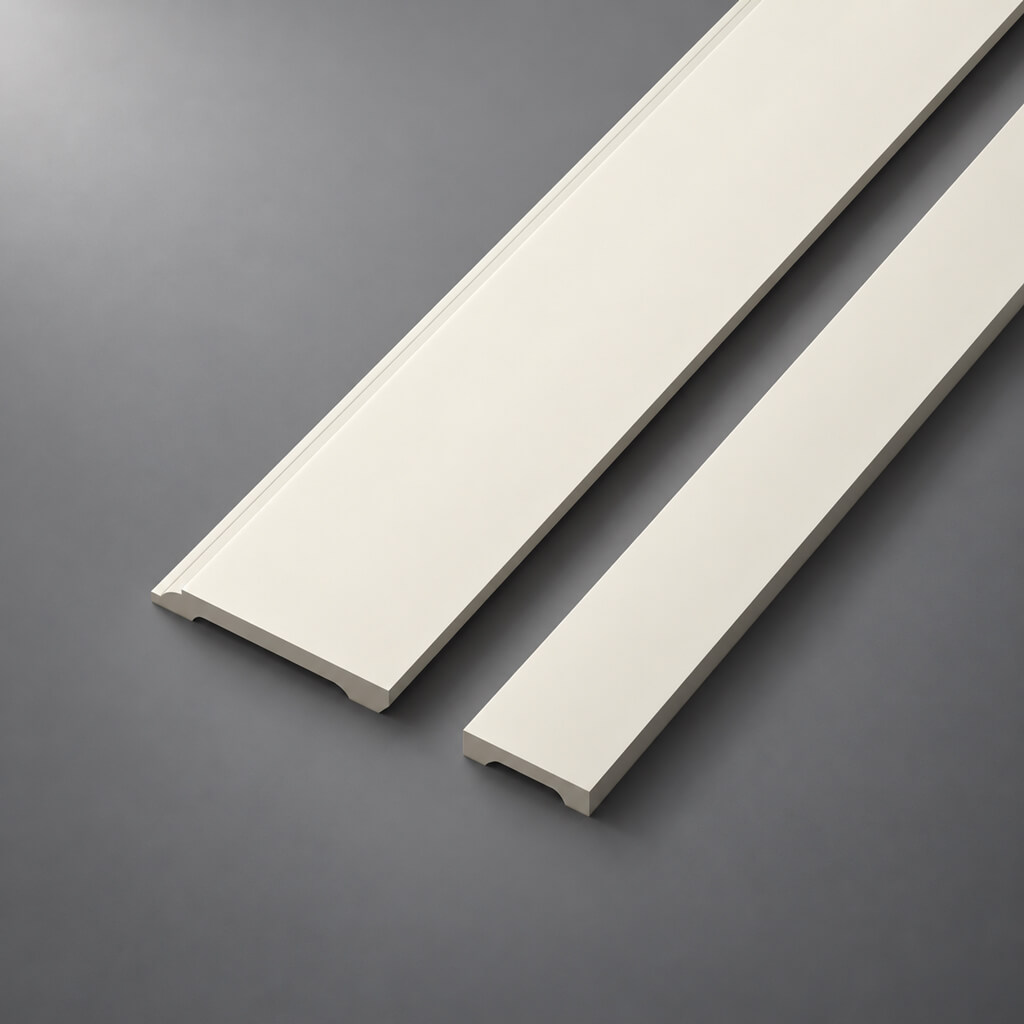
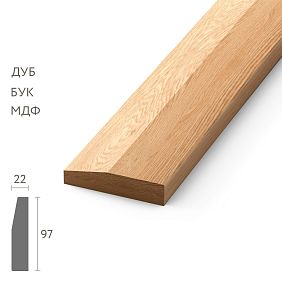
MDF is Medium Density Fiberboard. It's made from wood fibers compressed under high pressure and temperature. The binder is paraffin and modified resins with minimal formaldehyde content. The result is a dense, homogeneous material without knots, cavities, or unstable zones.
For floor skirting, this means: perfect geometry without bends, precise profile milling, a smooth surface that accepts any coating well — primer, paint, varnish, film. MDF floor skirting is easy to cut, doesn't chip when mitered, and doesn't deform with proper installation.
Why is it chosen more often than other options?
-
Stable geometry — no natural defects like solid wood, no brittleness like polystyrene
-
Smooth surface for painting — can be painted any color, perfectly matching doors, windows, walls
-
Wide height range — from 60 to 120 mm and above
-
Affordable price — significantly cheaper than solid wood, but higher class than plastic
-
Compatibility with any floor coverings — laminate, parquet, engineered board, quartz vinyl, tile
MDF floor skirting board — the number one choice for those creating a modern interior, wanting a uniform finish and valuing neat details. And it is this material that forms the basis of most professional finishes — from economy to premium segments.




In which interiors does MDF floor skirting board work best
There is no universal answer 'who MDF skirting board is suitable for'. There are specific scenarios — and in each of them it performs differently.
Our factory also produces:


For apartments
MDF floor skirting board in an apartment — the optimal solution for most living spaces: living room, bedroom, hallway, children's room. It pairs well with laminate and quartz vinyl — the most popular coverings in city apartments. White MDF skirting board in an apartment with white walls creates a monolithic space without unnecessary accents.
Get Consultation
For a private house
MDF skirting boards work in areas without extreme humidity. For zones with normal temperature and humidity conditions—living room, dining room, study, bedrooms—they perform perfectly. Where moisture is present (entryway, bathroom, boiler room), it's better to consider moisture-resistant options or useWooden baseboardfrom dense wood species.
For light interiors
White MDF floor skirting is an absolute favorite in light spaces. A white profile on a white wall with a white ceiling creates a sense of cleanliness and airiness. At the same time, it subtly 'raises' the ceiling, creating an illusion of greater volume.
For a classic interior
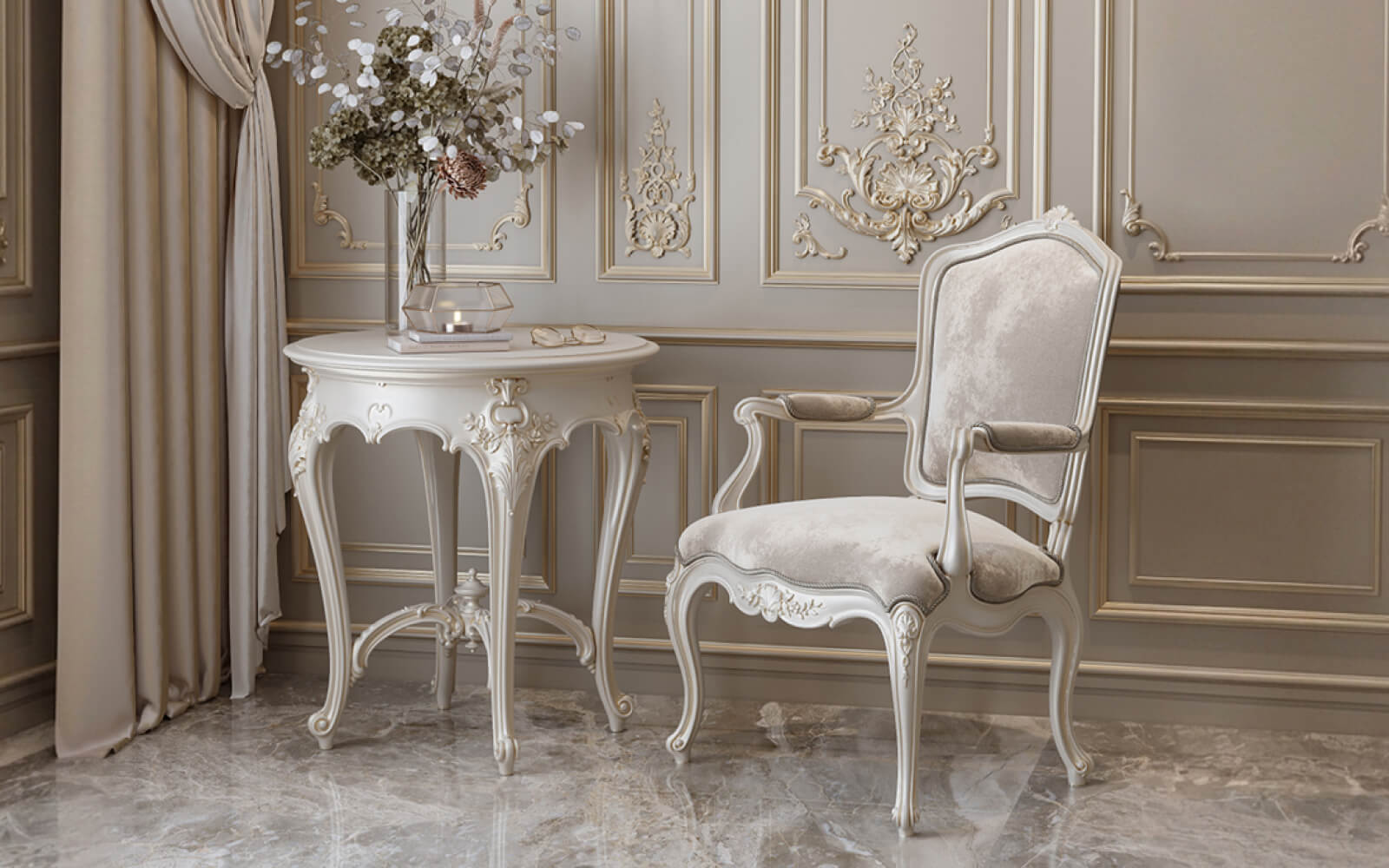
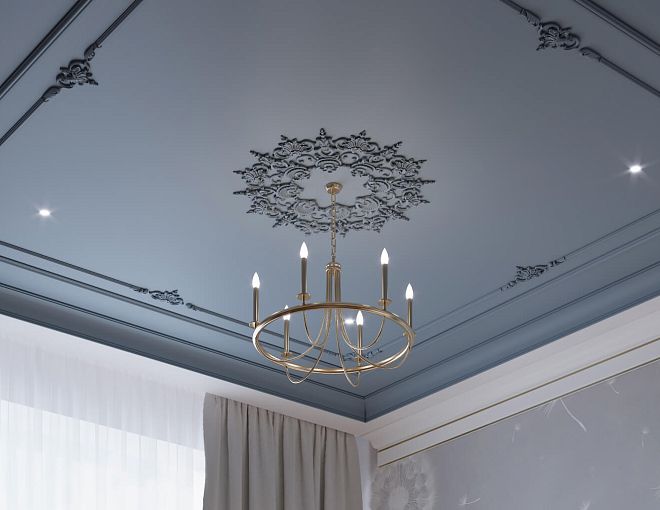
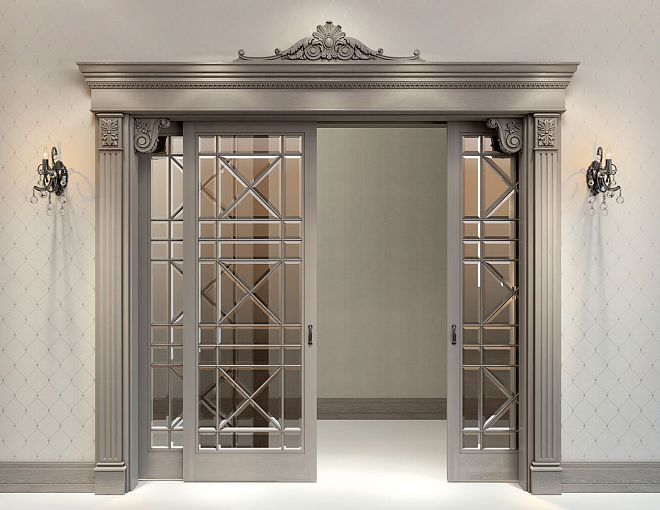
Classic style loves a profile with relief: coves, shelves, shaped transitions. MDF skirting in a classic style is a height from 80 mm, a pronounced architectural silhouette, painted white or cream with enamel. Such a profile picks up the rhythm of moldings, framed wall panels, and coffered ceilings.
For modern minimalism
Minimalism is contraindicated for decorativeness for the sake of decorativeness. Here, MDF floor skirting is taken with an absolutely flat front plane, without relief, as thin and neat as possible. Height—from 60 to 80 mm. Color—either matching the wall (invisible skirting) or matching the floor (horizontal frame).
How to choose MDF floor skirting: 5 main parameters
Choosing skirting is not intuition, but a system. Five parameters that need to be worked out before purchase will save you from mistakes that are expensive to correct later.
Height
This is the most important parameter. The height of MDF skirting should correspond to the ceiling height and the scale of the room.
| Ceiling height | Recommended MDF baseboard height |
|---|---|
| Up to 2.5 m | 40–60 mm |
| 2.5–2.7 m | 60–80 mm |
| 2.7–3.0 m | 80–100 mm |
| From 3.0 m and above | 100–120 mm and above |
MDF skirting board 60 mm — lightweight, almost graphic. Suitable for small spaces and modern interiors with low ceilings.
MDF skirting board 70 mm — slightly more pronounced, suitable for standard apartments.
MDF skirting board 80 mm — the most versatile size. It is the most popular in residential spaces with a height of 2.6–2.8 m.
MDF skirting board 100 mm — for high rooms and interiors with a pronounced classical or modern character.
MDF skirting board 120 mm — a large-scale profile for spacious rooms, high ceilings, and architecturally rich interiors.
Wide MDF skirting board — not just decoration: it visually strengthens the base of the wall, creating a sense of monumentality and completeness.
Thickness
Standard profile thickness — 12–18 mm. A thin profile (12 mm) looks delicate but performs poorly on curved walls — it does not bend, meaning there will be gaps. A profile with a thickness of 16–18 mm is the optimal compromise: rigid enough for straight walls and allowing slight bending during installation. For walls with serious irregularities, choose thin flexible profiles or correct the wall curvature before installation.
Color
Three main strategies for color selection:
-
Wall color — the baseboard disappears, the room visually expands, the space looks cohesive
-
Floor color — the baseboard ties in with the flooring, the wall gets a clear boundary
-
Contrasting — the baseboard becomes an independent accent, a graphic line that reads as an architectural element
MDF baseboard gray — works well with dark flooring and loft interiors. MDF baseboard black — bold, expressive, works in monochrome and industrial spaces. MDF baseboard beige — warm, soft, ideal next to parquet and wood.
Finish
Here are four options:
-
For painting — primed surface, ready for any paint application
-
Factory white — already painted, install and live
-
Laminated — covered with decorative film, imitates wood, metal, stone
-
Enamel / varnish — factory-applied finish with semi-matte or glossy effect
MDF baseboard enamel — the most presentable option: smooth, even surface without pores, slight shine, resistance to cleaning agents. It is used in high-end interiors.
Mounting type
MDF skirting boards are installed in two ways: with liquid nails/mounting adhesive or with special clip fasteners. Adhesive mounting is more reliable but permanent (cannot be removed without damage). Clip mounting allows the skirting board to be removed and reinstalled, which is convenient during repairs and cable laying.
Popular MDF skirting board options from STAVROS:
MDF skirting board 60 mm— lightweight and modern
MDF skirting board 80 mm— the most popular size
MDF skirting board 100 mm— for high ceilings
MDF skirting board 120 mm— scale and architecture
White MDF skirting board— classic choice
White, paintable, or wood finish: which option to choose
The finish is not just about aesthetics. It's about installation effort, long-term results, and compatibility with other interior elements.
White MDF skirting board
White MDF skirting board is the most replicated option in the world. It fits almost any interior, is compatible with white doors, white slopes, and white architraves. That's why it's often chosen 'by default', and often — correctly.
Nuance: white is not singular. Cool white (with a bluish undertone) — for modern interiors. Warm white (cream, ivory) — for classic interiors and those with wood. If you place cool white next to warm parquet, the contrast will be uncomfortable. Pay attention to the temperature of white when choosing.
You can buy white MDF skirting board in the catalogof STAVROS MDF skirting boards— several profile options are presented there with a ready-made white finish. More details about the features of the white profile — in a separate article aboutA white MDF baseboard creates visual continuity with white door casings, white ceiling cornices, and white window frames. When all architectural details are executed in the same color, they form a unified system, a spatial framework that connects disparate elements — floor, walls, ceiling, furniture — into an integral composition. This technique is fundamental to Scandinavian design, where white architectural decor creates a light shell within which the most diverse colors and textures can coexist..
MDF skirting board for painting
MDF skirting board for painting is a professional choice. It comes primed, without a finish coating. After installation, it is painted in the desired color—with acrylic or alkyd paint, enamel.
Why is this advantageous? Because you can precisely match the color of door trims, window sills, and wall moldings. Designers do exactly that: they take a skirting board for painting and paint all decorative trim in one color from one can. The result is a monolithic, professionally assembled space.
MDF skirting board for painting is the only way to achieve 100% color matching in an interior. No ready-made color will provide such accuracy.
MDF skirting board in wood decor
Laminated MDF skirting board with wood imitation is a popular choice for interiors with laminate 'under wood' or parquet boards. The film reproduces the texture, color, and even tactile relief of a specific wood species. With proper selection, such a skirting board is almost indistinguishable from natural wood—especially from a distance.
MDF skirting board in oak color is a bestseller. Oak in interiors is always relevant: warm, noble, and compatible with both modern and classic furniture.
Painted MDF skirting board
Painted MDF skirting board is a skirting board with a factory finish coating. It comes ready for installation: no additional painting, priming, or drying required. The coating is matte, semi-matte, or glossy enamel. MDF skirting board in glossy enamel looks especially expressive in classic interiors: the sheen adds depth to the profile.
How to choose an MDF skirting board to match the floor covering
This is a practical point that is often overlooked. The skirting board should not 'jump out' from the floor—it should either continue it or properly complete it.
Under laminate
MDF skirting board for laminate flooring is the most common combination. Laminate today comes in hundreds of shades 'under wood', under stone, in solid colors. For warm wood laminates, choose a skirting board in the same tone: laminated MDF with a similar decorative film. For solid colors — white or paintable to match the wall color.
For quartz vinyl
Quartz vinyl is a dense, stable, modern material. MDF skirting with clear geometry suits it well: a minimalist profile, smooth white or gray color. If the quartz vinyl imitates concrete or stone, choose skirting in a similar tone.
For engineered board
Engineered board is a premium flooring. Here, MDF skirting board with wood decor works well, but the best solution would beWooden baseboardfrom the same or similar wood species — it matches the texture and tone more precisely because it is made from the same material.
Under parquet
Parquet is a classic. MDF skirting board for parquet is chosen in two cases: either laminated to match the color of the parquet plank, or white — if the interior is light and the walls are painted. For dark parquet, skirting board in mocha oak or wenge shade works well.
For tiles in a warm interior
Tiles and porcelain stoneware are more common in the kitchen, hallway, bathroom. In areas with normal humidity, MDF skirting board is suitable, but it is important to properly seal it at the joint with the floor. For warm beige porcelain stoneware, skirting board in cream or beige color works well — it visually continues the warmth of the floor and does not introduce cold dissonance.
When to choose MDF, and when — wood
The question 'MDF skirting board or wooden' is one of the most common. And the answer to it depends not on which material is 'better', but on what exactly is needed in a particular interior.
| Parameter | MDF skirting board | Wooden skirting board |
|---|---|---|
| Geometry | Perfectly even, stable | May have slight curvature |
| Surface for painting | Excellent — smooth, without pores | Good, but requires knot puttying |
| Wood texture | Imitation (film or painting) | Natural solid wood texture |
| Price | Lower than wood | Higher than MDF |
| Moisture resistance | Standard MDF — medium | Depends on wood species and coating |
| Restoration | More difficult — cannot be sanded | Easier to sand and repaint |
| Combination with a massive floor | Worse — difference in materials | Better — uniform texture |
| For a white interior | Ideally | Requires thorough preparation |
When to choose MDF: white interiors, laminate, quartz vinyl, standard apartments, below-average budget, requires a smooth surface for painting.
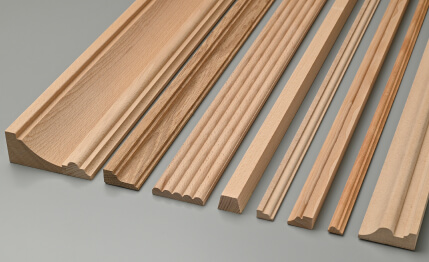
When to choose wood:Wooden baseboardindispensable where there is parquet, engineered board, solid wood staircase, expensive classic furniture. Natural texture cannot be imitated — it either exists or it doesn't. All solid wood skirting boards STAVROS — in the catalogSkirting made of solid wood.
For in-depth comparison and decision-making, read the articleWhich skirting board to choose for the floor and interior— there, the application scenarios for both materials are analyzed in detail.
MDF baseboard or polystyrene / duropolymer: what to choose for the floor
This choice is made by those who want to save money or are looking for easy installation. Let's break it down honestly.
Polystyrene is a foam-like material. Lightweight, cheap, installed with adhesive. The main problem: fragility. With any impact — chip, crack. After a year or two in the hallway, it looks bad. Polystyrene is a ceiling baseboard, not a floor one. On the floor, it cannot withstand operational loads.
Duropolymer is stronger than polystyrene, imitates gypsum molding. For the ceiling — good. For floor baseboard — questionable: heavier than polystyrene, requires precise cuts, vulnerable to point impacts.
MDF outperforms both in terms of overall characteristics:
-
Does not crumble upon impact
-
Does not fade over time
-
Accepts any paint
-
Has professional geometry
-
Lasts 15–25 years without replacement
The conclusion is simple: for floor applicationMDF Skirting Board— the right choice. Polystyrene and duropolymer in the floor zone are a compromise that often proves more expensive in the long run because they require replacement.
A detailed breakdown of this comparison is in the articleMDF or duropolymer skirting board.
Installing MDF floor skirting: what's important to consider
You can buy the perfect profile — and ruin the result with improper installation. That's why this section is not 'for builders,' but for everyone who wants to understand the process.
Wall preparation
Before installing MDF skirting, the wall must be clean, dry, and relatively even. Irregularities exceeding 3–4 mm per linear meter are a problem: the thin profile won't cover them, leaving gaps. If the wall is uneven — either level it, choose skirting with a more flexible base, or use silicone sealant matching the profile color to close the gaps.
Adhesive mounting
How to glue MDF skirting to the wall: apply mounting adhesive (liquid nails) in a zigzag or dots on the back side. Press the profile against the wall and secure it with painter's tape for 20–30 minutes until it sets. After complete drying (12–24 hours), remove the tape and seal the joints between the skirting and wall with acrylic sealant.
Fastener installation
How to attach MDF skirting board to the wall using clips: first, plastic or metal clips are fixed to the wall, then the skirting board snaps onto them. This installation allows the skirting board to be removed if necessary—for example, to access cables or when replacing flooring.
Cutting Angles
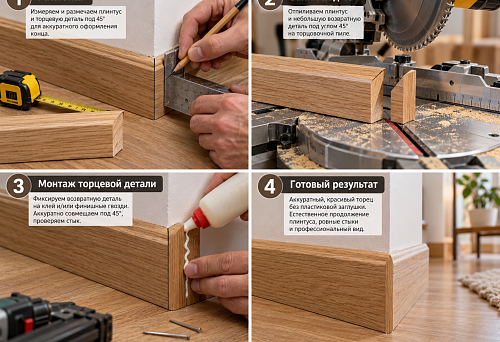
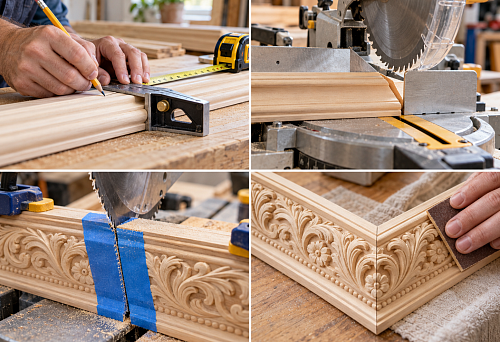
How to cut MDF skirting board: use a miter saw or miter box. For an internal corner—45° in the same direction on both pieces. For an external corner—45° in opposite directions. Before final installation, always check the cut dry: place the pieces, assess the joint. MDF provides a precise cut without chips with the right tool—a fine-toothed blade is essential.
What to cut MDF skirting board with: miter saw (best option), electric jigsaw with fine teeth, hand saw with fine teeth. Angle grinder—not suitable: causes thermal damage and uneven cuts.
Working with joints and corners
The joint of MDF skirting board on a straight section is made at a 45° angle to the profile axis—this hides possible seam opening during temperature changes. Corners for MDF skirting board—ready-made corner caps or miter cuts. Caps are simpler, miter cuts are more precise and aesthetically pleasing.
Uneven walls
MDF skirting board for uneven walls—a separate story. The standard 16 mm thick profile does not follow irregularities well. Solutions:
-
Thin profile (12 mm)—bends slightly better
-
Adhesive combined with acrylic sealant—compensates for small gaps
-
Wall leveling before installation—the ideal solution, but requires time
Detailed installation instructions and analysis of typical errors — in the articleMDF skirting board: types, sizes, installation and care.
What mistakes are made when choosing an MDF skirting board for the floor
Practice shows: 80% of problems with skirting boards arise already at the selection stage. Here are specific errors with analysis.
Error 1. Choosing a profile that is too low for high walls
A 40 mm high skirting board under a 3-meter ceiling creates a visual imbalance. The wall looks unfinished, and the skirting board gets lost near the floor. Rule: the higher the ceiling — the taller and more massive the skirting board should be.
Error 2. Choosing a white skirting board for a warm floor without analyzing the interior
If the doors are brown, the door frames are walnut, and the furniture is warm-toned wood — a cold white skirting board will create dissonance. You need either a warm white, a neutral beige, or a transition toa wooden skirting board.
Error 3. Not taking the profile thickness into account
A thin skirting board (10–12 mm) on uneven walls creates constant gaps. The optimal thickness for MDF skirting boards in standard residential spaces is 16–18 mm.
Mistake 4. Not coordinating the skirting board height across all floors
If the skirting board is 80 mm on the first floor and 60 mm on the second, it is perceived as a mistake or a forced measure. The skirting board height should be the same or progressively increase—from smaller to larger as ceiling heights rise.
Mistake 5. Choosing the size without reference to the specific room
"80 mm is the standard"—this is a useful rule, but not an absolute one. In a small kitchen, 80 mm may seem too much; in a spacious living room, 100 mm is just right. Measure the specific space, considering ceiling heights and the scale of the furniture.
Mistake 6. Forgetting about the cable channel
A tall MDF skirting board with a cable channel is a practical solution for areas where you need to hide wires from a TV, floor lamp, or computer. If you don't think about this before purchase, after installation the wires will hang over the skirting board.
Mistake 7. Buying less material than needed
Order MDF floor skirting boards with a 10–15% surplus for cuts, defects, and joints. Without a surplus, it inevitably turns out during installation that one piece is missing, and the required color is out of stock.
MDF skirting board with cable channel: when it is needed
MDF skirting board with cable channel — a functional option for modern interiors with lots of electronics. The cavity inside the profile hides wires: TV power cables, HDMI, audio cables, chargers.
MDF floor skirting board with cable channel is usually produced with a height from 60 to 80 mm — this is sufficient for a channel accommodating 3–5 cables. It is installed on clips — precisely to allow for removal of the skirting board and access to the cables when necessary.
If you are planning to mount a TV on the wall, have an audio system, or a desk against the wall — choose a skirting board with a cable channel from the start. Redoing it later is significantly more expensive.
Where to buy MDF floor skirting board and what to order together with it
Skirting board is a detail best ordered as part of a system: together with moldings, architraves, and corner pieces. This guarantees compatibility of colors and profiles.
Complete finishing set:
-
buy MDF skirting board— white, paintable, in wood decor
-
Wooden baseboard— if there is solid wood flooring or a staircase nearby
-
moldings, cornices, and baseboards— all decorative millwork in one section
-
Pogonazh iz massiva— for classic interiors with natural materials
-
STAVROS skirting boards: all options— wooden and MDF, 60–120 mm
What to see with MDF skirting board:
Solid oak and beech skirting board— a natural alternative
Moldings and cornices— for complete room finishing
Pogonazh iz massiva— battens, trims, additional elements
MDF floor skirting board: complete guide— detailed article on selection and installation
Price of MDF skirting board for floor: what makes up the cost
The cost of MDF skirting boards depends on several factors, and understanding this is useful — to avoid overpaying for marketing and not buying obviously low quality.
What affects the price of MDF skirting board:
-
MDF density — optimal density is 700–900 kg/m³. Lighter MDF is cheaper but less durable and holds milling worse.
-
Coating — paintable skirting is cheaper than pre-painted; laminated with film — in the mid-price range; veneered — most expensive.
-
Profile height — the higher, the more material, the more expensive.
-
Manufacturer — domestic producers typically offer the best price-to-quality ratio.
-
Plank length — standard 2400–2800 mm; longer planks are more convenient for installation in long corridors.
MDF skirting price per meter depends on all these factors. Aiming for the lowest price means getting a thin, lightweight profile that will start delaminating at corners in a year. Aiming for a product from a known manufacturer with clear specifications means paying correctly once.
See current MDF skirting prices in the STAVROS catalog on the page MDF Skirting Board.
Additional aspects: combining skirting with moldings and decorative battens.
A separate story — when skirting becomes part of a broader decorative system. In classic interiors, skirting is linked with cornices, wall moldings, and frame panels. In modern ones — with decorative battens and niches.
If you are engaged in full decorative wall finishing, read the article MDF skirting board: types, sizes, installation and care — complete guideThere, the principles of combining the profile with other interior elements are analyzed.
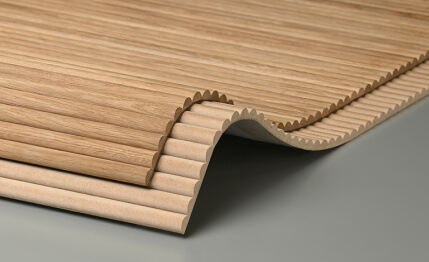
For projects where the skirting board is combined with wooden slats on the walls, the article is useful MDF Floor Skirting Board: How to Choose, Install, and Enjoy a Flawless Result— it examines practical application scenarios in different types of premises.
FAQ: Popular Questions and Answers
Which MDF floor skirting board is better to choose?
Depends on the interior. For white modern spaces — white MDF or paintable. For interiors with wood — MDF in wood decor or solid wood. For classic style — high profile with relief, painted with enamel. More details — in the catalog STAVROS skirting boards.
How does MDF skirting board differ from wooden?
MDF — homogeneous, without defects, perfectly smooth for painting, cheaper than solid wood. Wood — natural texture, can be restored by sanding, works better next to parquet and engineered board. Both materials are in the STAVROS assortment: Wooden baseboardandMDF Skirting Board.
Is MDF skirting board suitable for laminate?
Yes, it's one of the best combinations. For warm wood-like laminates — MDF in wood color. For light and plain ones — white or paintable.
Can you paint MDF skirting board?
Yes. MDF skirting board for painting is specially primed and designed for applying acrylic or alkyd enamel. A finished painted skirting board can also be repainted — after light sanding and new priming.
What size MDF skirting board to choose for an apartment?
For a standard apartment with ceilings 2.5–2.7 m — MDF skirting board 60–80 mm. For ceilings from 2.7 to 3 m — 80–100 mm. Above 3 m — from 100 mm and more.
What is better: white MDF skirting board or for painting?
If you want it quickly and without painting work — take ready-made white. If you need an exact color to match doors, windows, or walls — only for painting. More details — in the article A white MDF baseboard creates visual continuity with white door casings, white ceiling cornices, and white window frames. When all architectural details are executed in the same color, they form a unified system, a spatial framework that connects disparate elements — floor, walls, ceiling, furniture — into an integral composition. This technique is fundamental to Scandinavian design, where white architectural decor creates a light shell within which the most diverse colors and textures can coexist..
How to attach MDF skirting board to the wall?
With mounting adhesive (liquid nails) or on plastic clips. Adhesive — more reliable, clips — allow removing the profile. On uneven walls, additionally use acrylic sealant to close gaps.
How to cut MDF skirting board?
With a miter saw with a fine-toothed wood blade — this gives a clean cut without chips. An electric jigsaw with a fine tooth is also suitable. A handsaw can be used, but the cut will be less precise.
Is MDF skirting board suitable for curved walls?
With reservations. A thin profile (12 mm) bends slightly better than 18 mm. Gaps are sealed with acrylic sealant. For significant wall irregularities, preliminary leveling is recommended.
How much does MDF floor skirting board cost?
The cost depends on height, finish, and manufacturer. Current prices are on the page STAVROS MDF Skirting Board.
About the company STAVROS
STAVROS is a Russian manufacturer of architectural elements made from solid wood and MDF. The company produces MDF skirting boardsandwooden skirting boards made of oak and beech with heights of 60, 70, 80, 100, 120 mm — in white, paintable, and with natural wood texture.
The STAVROS catalog features a complete Pogonazh iz massivarange: skirting boards, moldings, cornices, architraves, battens, and decorative interior elements. All products are made from selected solid wood that has undergone chamber drying, with finishing on modern equipment.
STAVROS operates throughout Russia with delivery, accepts online orders, and provides consultation on profile selection for specific projects. If you are choosing MDF floor skirting board and want a unified solution for the entire space — start with the catalog moldings, cornices, and baseboardsand gather all decorative moldings in one place.