Article Contents:
- Hierarchy of Nobility: Classification of Modern Materials
- Natural Wood: Royal Grandeur
- Coniferous Species: Northern Practicality
- Composite Revolution: Technologies of a New Era
- MDF: Engineering Perfection
- Plywood: Multi-Layered Reliability
- Finishes and Decor: The Art of Surface
- Veneering: Natural Beauty
- Laminating: Practical Universality
- Ecological aspects: responsibility to the future
- Classification by Emission
- Certification of Sustainable Development
- Innovative materials: looking toward the future
- Bio-Composites: Natural Technologies
- Nanotechnology in Furniture Materials
- Technological Processes: From Raw Material to Masterpiece
- Cutting and primary processing: forming the base
- Pressing Composites: The Science of Precise Pressure
- Aesthetic Properties of Materials
- Color Characteristics
- Tactile Properties
- Concealment of utilities
- Sound Absorption
- Sound from Mechanisms and Hardware
- Production Technologies
- Mechanical strength
- Moisture Resistance
- Specialized Materials for Special Conditions
- Antibacterial Materials
- Fire-Resistant Materials
- Geographical and Climatic Factors
- Humid Tropical Regions
- Dry regions
- Northern Regions
- Economic aspects of selection
- Initial cost
- Processing Cost
- Operational costs
- Trends of development
- Material Personalization
- Intelligent Materials
- Biotechnologies
- Conclusion
Imagine a home where every piece of furniture lives its own life, breathes history, and preserves the warmth of human hands. Where beneath a noble surface lies not only beauty, but also a deep understanding that the material defines the character of the item for decades to come. But how to choose furniture material so that every touch brings pleasure, and each day confirms the correctness of the decision?
In an era of technological breakthrough, when innovative composites compete with traditional wood, and ecological requirements dictate new production standards, material selection becomes a true art. It is not merely a technical solution — it is a philosophy of life, reflected in the texture, color, and longevity of each element of your home.
Furniture made from properly selected materials becomes a silent companion to family traditions, a witness to children's laughter and adults' conversations. It does not merely serve — it inspires, creates an atmosphere, and shapes a space where one wishes to live, create, and dream.


Hierarchy of nobility: classification of modern materials
In the world of furniture materials, there exists its own aristocracy, where each representative occupies a strictly defined place depending on its origin, properties, and aesthetic qualities. Understanding this hierarchy will help make a reasoned decision based not on fashion, but on deep knowledge of materials science.




Natural wood: royal grandeur
Solid hardwoods rightfully occupy the throne in the furniture industry. Each tree species carries within it centuries of evolution, a unique genetic program that determines not only its appearance, but also its behavior under various conditions of use.
Oak is an indisputable monarch among wood species. Its density reaches 700-800 kg/m³, providing exceptional strength and durability. Tannins present in oak wood possess natural antiseptic properties, protecting the material from rot and insects. Oak's texture, with characteristic radial rays, creates a unique pattern that becomes even more expressive over time.
Ash impresses with its elasticity and resilience. This species is ideal for manufacturing furniture subjected to dynamic loads — chairs, beds, sports equipment. Ash's light-colored wood with contrasting annual rings creates an eye-catching visual rhythm on the surface of products.
Walnut is prized for its noble chocolate tone and silky texture. This species possesses unique stability — it is less prone to cracking and warping, making it ideal for crafting elite furniture.
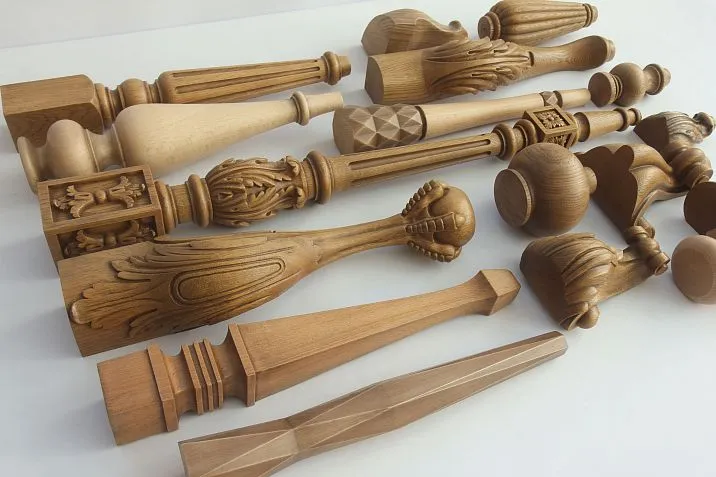
Our factory also produces:




Coniferous species: northern practicality
Spruce remains the most accessible and widely used species for furniture production. Its resin provides natural protection against moisture and pests, but requires special treatment before final finishing. The characteristic texture with clearly visible annual rings creates a cozy atmosphere in country homes.
Larch surpasses many deciduous species in density and durability. Its wood becomes only stronger over time, which explains its use in the construction of Venice. Its beautiful amber tone and expressive texture make it an excellent choice for crafting furniture in country or eco styles.
Cedar possesses unique aromatic properties. Essential oils contained in its wood create a healing microclimate and repel moths. Cedar furniture is especially valued for crafting wardrobe systems and bedroom sets.
Get Consultation
Composite revolution: technologies of a new era
Modern composite materials have overturned perceptions of what is possible in furniture production. They do not merely imitate natural materials — they surpass them in many performance characteristics, opening new horizons for design creativity.
MDF: engineering perfection
Medium-density fiberboard is a product of advanced technology, where each element is governed by strict scientific logic. Fine wood fibers, bonded with lignin and synthetic resins under high pressure and temperature, form a homogeneous structure without internal stresses.
The density of quality MDF is 720-850 kg/m³, comparable to hardwoods. At the same time, the material is completely free of natural wood defects — knots, resin pockets, structural inhomogeneity. This allows creating items of complex shapes with perfectly smooth surfaces.
Water-resistant MDF contains special additives that reduce water absorption to 8-12% compared to 18-22% in standard material. Such boards are dyed green for visual distinction and used in rooms with high humidity.
Fire-resistant MDF with flame retardants achieves Class G1 flammability, expanding its application scope. Such material is indispensable for manufacturing furniture in public buildings with heightened fire safety requirements.
Plywood: multi-layered reliability
Birch plywood is rightfully considered the benchmark of strength among sheet materials. The cross-oriented fiber arrangement in adjacent layers creates a structure capable of withstanding enormous loads without deformation. Flexural strength reaches 60-80 MPa, far exceeding the performance of particleboard.
Bakelite plywood is impregnated with phenol-formaldehyde resins, giving it exceptional water resistance and strength. Such material is not afraid of water, chemically aggressive environments, and extreme temperatures. Originally developed for the aviation and shipbuilding industries, it is now used in elite furniture.
Flexible plywood with scored cuts or special structure allows creating curved surfaces without complex bending technologies. Thickness from 4 to 12 mm ensures various bending radii for realizing the boldest design ideas.
Finishes and coatings: art of surface
Material selection for furniture is inseparably linked to its final finishing technologies. Modern coatings not only protect the base material, but also radically alter its aesthetic and performance properties.
Veneering: natural beauty
Natural veneer allows composite materials to achieve the noble appearance of valuable wood species while significantly conserving resources. Modern cutting technologies enable obtaining sheets from 0.4 to 1.5 mm thick with ideal geometry and minimal losses.
Radial veneer is cut along the radius of the trunk, creating a uniform striped texture without a distinct pattern. Such veneer is prized in minimalist interiors for its calm, unobtrusive beauty.
Tangential veneer showcases the full beauty of tree rings, creating expressive patterns on furniture surfaces. Each sheet is unique, allowing the creation of true works of art.
Root veneer from the base of the trunk or root caps possesses a fantastic texture with chaotic swirls and fiber interweavings. Such material is used to create accent elements in exclusive furniture.
Laminating: Practical Universality
Melamine coatings are created by impregnating decorative paper with thermosetting resins, followed by pressing at 180-200°C. The resulting coating has high wear resistance, scratch resistance, and chemical resistance.
CPL plastics (Continuous Pressure Laminate) are manufactured under continuous pressure, ensuring ideal structural uniformity. The coating thickness of 0.2–0.8 mm allows for creating relief surfaces that mimic natural materials.
HPL plastics (High Pressure Laminate) are produced under pressure up to 70 atmospheres, giving them exceptional strength. Such coatings withstand intensive use in public spaces without losing their appearance.
Environmental Aspects: Responsibility to the Future
In the modern world, the question of ecological safety of materials for furniture has become paramount. Understanding that how to properly choose furniture material from an ecological standpoint has become a moral imperative for a responsible consumer.
Classification by Emission
Class E0 represents materials with minimal formaldehyde content — less than 0.5 mg/L. Such panels are safe for use in children’s rooms and medical facilities. They are manufactured using special binders based on natural components.
Class E1 allows formaldehyde content up to 1.5 mg/L, which corresponds to European standards for residential spaces. Most quality furniture is produced from materials of this class.
Class E2, with formaldehyde content up to 5 mg/L, is permitted only for technical spaces and should not be used in residential interiors.
Sustainability Certification
FSC certification (Forest Stewardship Council) guarantees that the wood originates from forests managed according to sustainable development principles. Such wood is not only ecologically clean but also socially responsible.
PEFC certification (Programme for the Endorsement of Forest Certification) is a European system that unifies national forest certification schemes. It ensures traceability of wood from forest to finished product.
Cradle to Cradle — a revolutionary concept implying complete material recycling after the end of a product’s service life. Furniture certified under this standard leaves no ecological footprint.
Innovative materials: looking toward the future
The furniture industry is not standing still, constantly developing new materials that expand the boundaries of what is possible in design and functionality.
Bio-composites: Natural Technologies
Wood-plastic composites (WPC) combine the strength of plastic with the aesthetics of wood. Wood flour content reaches 70%, providing a natural appearance with excellent moisture resistance and dimensional stability.
Hemp-based composites use fast-growing technical hemp fibers as an alternative to wood. These materials have excellent strength characteristics and are fully biodegradable.
Mycelium-based composites (mycelium) represent a revolutionary direction in eco-friendly materials. Mushrooms grown on agricultural waste form a strong structure that, after drying, becomes an excellent alternative to polystyrene and even leather.
Nanotechnology in furniture materials
Nanocoatings impart unique properties to surfaces: self-cleaning, antibacterial, color change depending on temperature. Titanium dioxide nanoparticles create a photocatalytic effect, breaking down organic pollutants under light exposure.
Smart materials with shape memory effect can return to their original shape upon changes in temperature or humidity. Such materials open new possibilities for creating transformable furniture.
Composites with carbon nanotubes have exceptional strength at minimal weight. Although currently used limitedly due to high cost, the future of the furniture industry may be tied to such materials.
Technological Processes: From Raw Material to Masterpiece
Understanding the technological production processes helps assess material quality and predict furniture behavior during use.
Wood Drying: The Foundation of Stability
Kiln drying at controlled temperature and humidity reduces wood moisture content to 8–12% without internal stresses. Properly dried wood does not crack or warp during use.
Vacuum drying accelerates moisture removal and preserves the wood’s original color. This technology is especially important for light-colored woods prone to darkening during traditional drying.
High-frequency drying uses electromagnetic field energy for uniform heating of wood across its cross-section. This eliminates moisture gradient and minimizes internal stresses.
Composite Pressing: The Science of Precise Pressure
Flat pressing of MDF and particleboard occurs at a pressure of 25-40 kg/cm² and a temperature of 180-220°C. The correct pressing regime determines the final density and strength characteristics of the material.
Continuous pressing on ContiRoll lines allows producing boards of great length with perfectly uniform properties throughout the volume. This technology ensures the highest surface quality.
Calibration grinding levels the thickness of boards to an accuracy of 0.1 mm and creates a perfectly smooth surface for subsequent finishing.
Aesthetic properties of materials
The beauty of a material is determined not only by its appearance, but also by the tactile sensations it provides upon touch, the sound it emits, and even its aroma.
Color characteristics
The colorfastness of the material determines how long furniture will retain its original appearance. UV stabilizers in coatings protect against fading, while special pigments ensure even coloring.
Color temperature affects the perception of interior spaces. Warm wood tones create a cozy atmosphere, while cool tones of modern coatings emphasize technology and precision.
The play of light and shadow on textured surfaces creates a lively, changing scene throughout the day. Recessed coatings mimicking wood or stone textures add depth and expressiveness to furniture facades.
Tactile properties
Surface roughness affects tactile sensations and practical usability. Too smooth surfaces may feel cold and slippery, while overly rough surfaces may trap dust and hinder cleaning.
The thermal properties of the material determine the comfort of touch. Wood always feels warm due to its low thermal conductivity, metal feels cold, and plastic occupies an intermediate position.
Surface elasticity affects the sensation upon pressing. Natural wood possesses natural elasticity that is difficult to replicate with artificial materials.
Acoustic properties
The sound emitted by furniture during use affects living comfort and can become an important factor in material selection.
Sound absorption
Porous materials — MDF, natural wood — have good sound-absorbing properties. Furniture made from such materials creates a more comfortable acoustic environment in rooms.
Dense materials — metal, glass, plastic — reflect sound and may create echoes. In large rooms, this can be a problem requiring additional sound-absorbing measures.
The damping properties of the material affect how quickly vibrations decay. Good damping prevents resonance and unpleasant noises from operating mechanisms.
Sound from mechanisms and hardware
The quality of guides determines the quiet operation of sliding elements. Roller guides may produce noise during movement, while ball-bearing guides operate significantly quieter.
Dampers in hinges and guides not only ensure smooth closing, but also eliminate unpleasant clicks and impacts.
The material of the frame affects the resonant properties of the structure. Thick walls made of dense material vibrate less and create less noise.
Operational characteristics
Durability and reliability of furniture largely depend on the correct choice of material for specific operating conditions.
Mechanical strength
The bending strength is critically important for shelves, countertops, and sleeping areas. Solid wood withstands loads of 80-120 MPa, quality MDF — 35-45 MPa, particleboard — only 15-25 MPa.
Impact resistance determines resistance to sudden loads. Natural wood, due to its fibrous structure, better withstands impacts than composite materials.
Surface hardness affects resistance to scratches and dents. Measured by the Brinell method and varies from 1-2 HB for soft coniferous species to 6-8 HB for exotic hardwoods.
Moisture Resistance
Hygroscopicity — the ability of a material to absorb moisture from the air — is critically important for kitchen and bathroom furniture. Natural wood may change dimensions by 3-8% with humidity changes, while composite materials — by 0.1-0.5%.
The water resistance of coatings determines the possibility of wet cleaning and resistance to accidental water exposure. Melamine coatings withstand short-term water exposure, while lacquered coatings — longer exposure.
Moisture permeability affects the microclimate inside furniture. Natural materials "breathe," creating a healthier atmosphere for storing items.
Special materials for special conditions
Some operating conditions require the use of specialized materials with unique properties.
Antibacterial materials
Silver-containing coatings suppress the development of bacteria and fungi on furniture surfaces. Silver ions penetrate the cell walls of microorganisms, disrupting their activity.
Photocatalytic coatings with titanium dioxide break down organic contaminants under light. Such surfaces self-clean and neutralize unpleasant odors.
Copper-containing alloys for hardware have natural antimicrobial properties. Copper effectively kills viruses and bacteria within several hours.
Fire-resistant materials
Flame retardants in materials reduce flammability and slow the spread of fire. They are categorized as surface-applied (applied to finished products) and bulk (incorporated into the material matrix).
Non-combustible materials — mineral panels, metal, glass — do not support combustion and can be used in spaces with heightened fire safety requirements.
Intumescent coatings expand several times in volume when heated, forming an insulating layer that protects the underlying material from fire.
Geographical and climatic factors
Material selection for furniture must consider the climatic conditions of the region where it will be used.
Humid tropical regions
Biostability of materials in high humidity and temperature conditions is critically important. Natural preservatives in tropical wood — tannins, resins, essential oils — protect against decay and insects.
Termite protection is necessary for all wooden materials in tropical climates. Both chemical treatments and physical barriers made of stainless steel are used.
Ventilation of structures prevents moisture accumulation inside furniture. Perforated back panels and ventilation channels in bases ensure air circulation.
Arid regions
Polymer impregnation stabilizes wood, preventing cracking in low-humidity conditions. This treatment does not alter the wood’s appearance but significantly enhances its stability.
UV protection is especially important in regions with intense sunlight. Special filters in varnishes and paints prevent fading and polymer degradation.
Dust resistance of coatings affects furniture maintenance ease. Antistatic additives in coatings reduce dust accumulation on surfaces.
Northern regions
Material frost resistance is important for unheated spaces. Some adhesives and coatings lose elasticity at low temperatures and may crack.
Thermal insulation properties of materials affect furniture comfort. Wood with low thermal conductivity remains warm to the touch, while metal remains cold.
Condensation-resistant coatings prevent moisture formation on surfaces during sharp temperature fluctuations.
Economic aspects of selection
Material cost is an important, but not the only, economic factor. Proper calculation must consider the total cost of ownership over the product’s entire lifecycle.
Initial cost
Premium hardwoods require significant investment but are justified by longevity and prestige. Oak, walnut, and beech cost 3-5 times more than softwoods but last many times longer.
Composite materials offer optimal price-to-quality ratio. MDF costs 2-3 times less than solid wood but often matches it in performance parameters.
Innovative materials remain expensive due to low production volumes, but their cost decreases as production scales.
Processing cost
Processing complexity affects labor costs and, consequently, the final product cost. Hardwoods require more powerful equipment and specialized tools.
Material waste during cutting can significantly impact production economics. Panel materials generate less waste due to standard dimensions.
Worker qualification requirements vary by material. Working with natural wood requires high skill, while composite materials are more 'democratic'.
Operating Costs
Maintenance frequency depends on material type and usage conditions. Lacquered surfaces require renewal every 5-7 years, oil-based finishes every 2-3 years.
Repair costs for damage can vary significantly. Natural wood can be restored, while composite materials often require complete replacement of components.
Disposal of furniture at the end of its useful life is becoming an increasingly important factor. Natural materials can be disposed of without harming the environment, while composites require special recycling.
Trends in development
The furniture industry is in a state of constant evolution, developing new materials and technologies to meet changing consumer needs.
Material Personalization
Digital printing on furniture surfaces allows creating unique decorations based on individual designs. The high resolution of modern printers ensures photographic-quality images.
Laser engraving creates relief patterns on material surfaces. This technology allows personalizing furniture by engraving names, dates, logos.
Material modularity allows creating unique combinations from standard elements. The consumer can choose the color, texture, and size of each structural element.
Intelligent materials
Shape-memory materials can change configuration under external condition changes. Such materials open possibilities for creating next-generation transformable furniture.
Self-healing coatings can "heal" minor scratches and damage. Microcapsules containing repair compounds are embedded in the coating structure and activated upon damage.
Chromic materials change color depending on temperature, lighting, or electrical influence. Furniture made from such materials can adapt to the user's mood or time of day.
Biotechnology
Materials grown from mushroom mycelium or bacterial cellulose represent a revolutionary direction in eco-production. Such materials grow in a predefined shape, eliminating production waste.
Genetically modified wood with enhanced properties can solve the problem of quality raw material shortage. Trees with accelerated growth and improved wood characteristics are already being cultivated in experimental forests.
Biodegradable composites fully decompose under natural conditions after their service life. Such materials solve the problem of furniture waste accumulation.
Conclusion
The Art of Selection furniture materials It lies in the harmonious combination of aesthetic preferences, functional requirements, and economic possibilities. In today's world, where technologies develop at rapid speeds and ecological requirements become stricter, the right material choice becomes a strategic decision affecting quality of life for decades to come.
Each material carries a unique story — from ancient oaks remembering epochal changes to innovative composites born in scientific laboratories. Understanding these stories, knowing the properties and characteristics, helps make a decision that will bring joy for many years.
Furniture made from properly selected materials becomes not just a functional item, but part of family history, a silent witness to joyful moments and a faithful companion in daily life. It creates a home atmosphere, influences mood and well-being, and forms a space for creativity and rest.
In the era of mass production, an individual approach to material selection gains special value. Each home is unique, as are the needs and preferences of its inhabitants. A material ideal for one interior may be inappropriate for another. Therefore, it is crucial to understand not only technical characteristics but also the philosophy of the material, its ability to create the desired atmosphere.
The future of the furniture industry is linked to the development of eco-friendly technologies, personalized production, and integration of smart materials. However, no matter how innovative the technologies of tomorrow may be, the core principles of material selection will remain unchanged: harmony of beauty and functionality, responsibility toward nature and future generations, striving to create spaces that inspire and unite.
For many years, STAVROS has remained faithful to the traditions of quality furniture production, constantly introducing new technologies and using the best modern materials. Deep understanding of the properties of various materials, long experience working with them, and a pursuit of perfection allow STAVROS to create furniture that does not merely serve, but brings joy every day. Choosing STAVROS means choosing not only quality furniture, but also a philosophy of responsible relationship with materials, technologies, and the environment.