












































































Article Contents:
- How "rhythm" is perceived in interior design: psychology of vertical perception
- Nature of visual rhythm
- Horizontal wall accents
- Flat and turned balusters: aesthetics of frequency and form
- Turned balusters: classical luxury
- Flat balusters: geometric strictness
- Material as a component of rhythm
- Polyurethane wall moldings as the metronome of space
- Functions of moldings in staircase space
- Rules for placing moldings on staircase walls
- Choosing molding profile
- Color solution
- Connection nodes on landings: where rhythms meet
- Types of landings and their features
- Columns as rhythmic accents
- Alignment of height levels
- Rhythmic connection of stair flights
- Controlling proportions before installation: mathematics of beauty
- Calculating baluster spacing
- Height proportions
- Relationship between verticals and horizontals
- Tools for preliminary assessment
- On-site adjustments
- Materials: dialogue between wood and polymer
- Advantages of wooden balusters
- Advantages of polyurethane moldings
- Rules of combination
- Practical cases: when rhythm creates style
- Case 1: Classical staircase in a country house
- Case 2: Minimalist staircase in an urban apartment
- Case 3: Art Deco style staircase
- Mistakes and How to Avoid Them
- Error 1: Inconsistent rhythms
- Error 2: Ignoring Scale
- Error 3: Overload by Decoration
- Error 4: Incorrect Color Choice
- Error 5: Ignoring Lighting
- Modern Trends: Evolution of Rhythm
- Trend 1: Minimizing Verticals
- Trend 2: Combined Materials
- Trend 3: Asymmetric Rhythm
- Trend 4: Integration of Light
- Trend 5: Ecological Design
- Care and Maintenance of Beauty
- Care for Wooden Balusters
- Care for Polyurethane Moldings
- Prevention
- FAQ: Popular Questions about Rhythm of Staircase Space
- Conclusion: Symphony of Space

Architecture is frozen music. This phrase is attributed to various philosophers, but the essence remains unchanged: space possesses its own rhythm, tempo, melody. And if anywhere this metaphor is especially accurate, it is precisely in staircase constructions. Here, every detail—from the frequency of baluster installation to the height of wall moldings—creates a visual beat that either pleases the eye or causes inexplicable discomfort.
Why one staircase appears majestic and harmonious, while another—despite high-quality materials—seems 'off'? It’s all about rhythm. In that very architectural pulse, which our subconscious reads instantly, even before the mind has time to analyze details. A staircase is not merely a functional element for transitioning between floors. It is a complex organism, where vertical lineswooden balustersengage in dialogue with horizontal rows of wall decoration, creating a three-dimensional score of space.


How 'rhythm' is perceived in interior design: Psychology of Vertical Perception
The human eye is structured to automatically seek repeating elements and construct patterns from them. We perceive rhythm in the colonnades of ancient temples, in the window openings of Gothic cathedrals, in the regular gardens of Versailles. This perception mechanism operates in home interiors as well, though we rarely think about it.
Staircase space is a unique zone where rhythm becomes tangible. As we ascend the steps, we are in close proximity to the railing, our hand glides along the handrail, and our gaze automatically tracks the verticals of the balusters. And here begins the magic—or catastrophe—depending on how well this visual metronome is designed.




Nature of Visual Rhythm
Visual rhythm is formed by several factors:
Repetition Interval — the distance between identical elements. In the case of a staircase, this is the step between balusters. Too frequent installation creates a sense of 'caged' confinement, while too sparse an arrangement feels unsafe and visually empty.
Vertical Dominance — the height of the repeating element. A baluster 900 mm long creates a different visual effect than a post 1100 mm tall, even with the same installation spacing.
Element Plasticity — a precisely crafted baluster with multiple decorative elements 'sounds' differently than a strict flat rectangular post. The first evokes baroque opulence, the second — minimalist elegance.
Material and Texture — oak, beech, ash, coniferous species — each material has its own 'voice'. Dark wenge against light walls creates a contrasting rhythm, while light birch offers a soft and unobtrusive effect.
Our factory also produces:



Horizontal Wall Accents
While balusters strike the vertical beat, the walls of the staircase space require their own rhythmic organization. An empty vertical plane 3–4 meters high appears uncomfortable and unfinished. Here, horizontal elements come to the rescue: wallMoldings made of polyurethanedecorative bands, cornices, panels.
These elements serve a dual function. First, they divide the high wall into proportional sections, making the space more human-scaled and cozy. Second, they create a horizontal counterpoint to the vertical rhythm of the balusters, forming a complex yet harmonious composition.
Imagine a musical staff. The vertical beats of the balusters are the rhythm section, the percussion of the architectural orchestra. The horizontal moldings are the melodic line, connecting and organizing this rhythmic diversity. Without one element, the composition falls apart and loses its integrity.
Get Consultation
Flat and turned balusters: the aesthetics of frequency and form
Choosing between flat and turned balusters is not only a matter of style, but also the mathematics of visual perception. Each type of post dictates its own placement rules and creates a unique visual effect.
Turned balusters: classical luxury
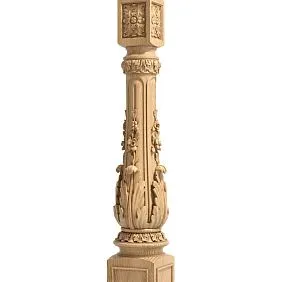
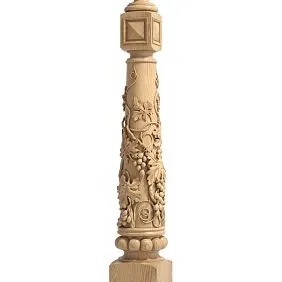
A turned wooden baluster is a small sculpture, a miniature column with a complex profile. Bases, turned bodies, capitals — all these elements create a play of light and shadow, making each post a self-contained decorative element.
When usingwooden balustersFor turned balusters, it is important to maintain the golden mean in the frequency of installation. The classical scheme implies installing two balusters on one step — at the edges of the tread. This ensures structural reliability and creates an even rhythm with a step of about 450-500 mm.
Installation options for turned balusters:
-
Two per step (at the edges of the tread) — the classic option for grand staircases, ensuring maximum visual density.
-
One per step (central installation) — a more modern approach, creating lightness while maintaining safety. Requires heavier balusters with a diameter of 50 mm or more.
-
Combined scheme — alternating single and paired installations on different sections of the staircase, allowing to emphasize certain zones.
Important nuance: the richer the decoration of a turned baluster, the greater the spacing it can withstand without losing visual integrity. A post with multiple carved elements "sounds" louder, so it can be installed less frequently than a simple turned form.
Flat balusters: geometric strictness
Flat wooden balusters— choice for modern interiors where minimalism and clear lines are valued. Rectangular or square cross-section, minimal decoration, emphasis on the material's texture — such posts create a completely different visual language.
A flat baluster functions as a graphic element. If a turned post is a volumetric sculpture, then a flat one is a line, a stroke, a vertical accent. Such balusters can be installed more frequently, creating almost a continuous vertical plane, or less frequently, creating a more sparse and airy rhythm.
Advantages of flat balusters in terms of rhythm:
-
Ability to create solid panels — flat posts can be placed closely together, creating a decorative surface with minimal gaps.
-
Playing with element width — varying the thickness of flat balusters from 30 to 80 mm allows creating different visual effects even with the same installation spacing.
-
Combining sizes — alternating wide and narrow flat balusters creates a complex syncopated rhythm, characteristic of modern design.
-
Integration with glazing — flat balusters combine easily with glass inserts, allowing to create light, transparent railings with punctual vertical accents.
Material as a component of rhythm
Wood is a living material with its own texture and character. Oak with pronounced annual rings creates one visual effect, smooth beech — another. When designing the rhythm of balusters, one must consider not only shape and frequency, but also the "expressiveness" of the material itself.
Dark woods (walnut, wenge, stained oak) — more expressive, each baluster becomes a noticeable accent. Light woods (birch, ash, white oak) — delicate, allowing to create a frequent rhythm without visual overload.
The texture of wood also affects perception. A strongly expressed texture creates visual noise on its own, so such balusters are better installed with a larger spacing. Materials with fine, uniform texture allow using a more frequent rhythm.
Wall moldings made of polyurethane as the metronome of space
If balusters are the vertical rhythm of the staircase, then wall moldings are its horizontal score. These elements transform an indifferent wall into a structured plane, creating visual anchor points and guiding the viewer’s gaze along a predetermined trajectory.
Functions of moldings in staircase space
Moldings solve several tasks simultaneously:
Visual division of height — a staircase landing often has a height of 3-4 meters. This is too much for a continuous wall. Horizontal moldings divide this height into logical parts: plinth, main field, frieze, cornice.
Wall protection — a practical function, especially relevant in areas of active movement.polyurethane wall moldingsProtect the surface from mechanical damage, scratches, and scuffs.
Joint masking - when combining different wall materials (paint, wallpaper, panels), moldings elegantly cover transitions, creating a finished look.
Creating historical context - classical interiors are unthinkable without molding decoration. Properly selected profiles refer to baroque, classicism, or modernism, creating stylistic unity.
Rules for placing moldings on a stair wall
Several proven schemes for organizing wall decor:
Classic three-part scheme:
-
Lower band (plinth) at a height of 70-90 cm from the step level
-
Middle band at a height of 140-160 cm
-
Upper cornice under the ceiling or at a height of 220-250 cm
This scheme is universal and works in most cases. It creates a clear rhythm without overloading the space.
Panel scheme:
The entire lower part of the wall (up to a height of 90-120 cm) is treated as a single panel framed by moldings. This is a classic English technique that makes the interior more intimate and cozy.
Multi-tiered scheme:
Use of 4-5 horizontal bands of moldings with different thicknesses at various levels. Suitable for high stair areas in the neoclassical or Empire style.
Minimalist scheme:
One or two moldings with restrained profiles, placed at key heights. Suitable for modern interiors where light structuring without excessive decoration is needed.
Molding profile selection
Polyurethane moldings offer a vast variety of profiles - from simple strips to richly decorated elements with ornamentation. The choice depends on several factors:
Interior style - classicism requires more complex profiles with curves and ornamentation, while modern styles favor minimalist, straight-line forms.
Room height - in low spaces, heavy moldings 'press down'; in high spaces, too thin moldings become lost.
Baluster rhythm - the more complex and parts the vertical rhythm of the railing, the simpler the horizontal moldings should be, and vice versa.
Lighting - under bright directional light, relief moldings create expressive shadow play; under diffused light, simpler forms are needed.
Color solution
Polyurethane moldings are easy to paint, which opens up wide possibilities:
In wall color - creates a subtle relief, perceived as a textural element of the surface itself.
Contrasting color - white moldings on colored walls or vice versa, create a clear graphic rhythm.
Metallic finish - gold, silver, bronze - for classical interiors where additional luxury is needed.
Patina - artificial aging gives moldings an antique look, emphasizing relief.
Connection nodes on landings: where rhythms meet
The landing is a critical zone where several rhythmic lines meet: vertical balusters of the lower flight, vertical balusters of the upper flight, horizontal wall moldings, and diagonals of the staircase itself. A thoughtful solution to this node turns the staircase into an architectural masterpiece; an error results in visual chaos.
Types of landings and their characteristics
Straight landing (180 degrees) - flights are arranged parallel but in opposite directions. Here, it is important to coordinate the placement of corner balusters - posts or reinforced supports that form the turn of the railing.
L-shaped landing (90 degrees) - landings converge at a right angle. The corner zone requires special attention: here, either a strong corner post or a group of balusters forming a corner module is needed.
Winder landing - steps follow a radius, without a clear rectangular landing. A complex variant where the baluster rhythm must smoothly follow the curvature of the trajectory.
Posts as rhythmic accents
On landings, non-standard balusters are usually installed, but reinforced posts - support posts with increased cross-section, often with decorative finishes. These elements serve as visual 'capital letters', marking the beginning and end of each flight.
Posts should be proportionate to balusters but distinct from them. Classic ratio: if a baluster has a diameter of 45-50 mm, the post is 80-100 mm. If a baluster is flat with a thickness of 40 mm, the post is 60-80 mm.
Post placement options:
-
At the corners of the landing - creates a clear frame
-
At points where flights converge - highlights the geometry of the structure
-
On both sides of the entrance to the flight - forms a portal composition
Height alignment
A common mistake is inconsistency in levels between wall moldings and baluster railing heights on the landing. A molding running exactly at the handrail level or slightly below creates a visual connection between vertical and horizontal elements.
Ideal solution: the main wall molding is placed at a height of 85-95 cm from the landing level, which roughly corresponds to the handrail height. This creates an illusion that the molding continues the handrail in the plane of the wall.
Rhythmic connection of flights
When transitioning from one flight to another, it is important to maintain rhythmic continuity. If balusters are installed two per step on the lower flight, the upper flight should have the same frequency. Changing the rhythm creates visual dissonance, a sense of 'off-beat'.
Exception - intentional change of rhythm to create a special effect. For example, a grand flight with frequent rhythm and rich decoration is followed by a more utilitarian second-floor flight with sparse baluster spacing. But this must be an intentional artistic decision, not a coincidence.
Proportional control before installation: the mathematics of beauty
Harmony of the staircase space does not arise by chance. Behind it lies precise calculation, proportion checking, visualization. Professional architects know: it is easier to prevent errors during the design stage than to correct them after installation.
Baluster spacing calculation
The basic formula is simple: the length of the flight (distance from the first to the last step along the handrail) is divided by the number of gaps between balusters. But the devil is in the details.
Initial parameters:
-
Number of steps in the flight
-
Tread width
-
Riser height
-
Total flight length along the incline
-
Baluster diameter (thickness)
-
Desired installation frequency
Safety first:
Building codes require that the distance between adjacent balusters (clearance) does not exceed 120-150 mm for residential buildings. This is especially important if there are children in the household - a child should not be able to fit their head between the posts.
Visual assessment:
Mathematically correct spacing does not always look harmonious. Therefore, it is useful to make a mock-up or visualization. The simplest method is to place battens or sticks in the desired rhythm and view the result from different points.
Height proportions
Guardrail height is regulated: not less than 900 mm for internal staircases in residential buildings. But this minimum often looks low. The optimal height is 950-1000 mm, creating a sense of security without excessive bulk.
The baluster height should match this parameter. If the handrail has a thickness of 50 mm and is mounted on top of the balusters, the baluster height will be 900-950 mm.
Vertical and horizontal proportions
Visually pleasing space has certain proportions. For the staircase area, the following ratios apply:
Golden Ratio rule: the height from the floor to the main wall molding should relate to the height from the molding to the ceiling approximately as 1:1.618. This creates a classically harmonious proportion.
Thirds rule: the total wall height is divided into three equal parts, and moldings are placed at the boundaries of these parts.
Modular grid: all dimensions are multiples of a certain module (e.g., 100 mm). This simplifies calculations and creates internal logic for the project.
Pre-assessment tools
Modern technologies allow you to see the result before starting work:
3D visualization - creating a three-dimensional model of the staircase with all details. Allows evaluating the composition from different angles and selecting materials and colors.
Physical mockup - installation of temporary elements (rails, battens) in real space. The most accurate method of assessment, but labor-intensive.
Scaled drawing - classic architectural method. Drawing the staircase at a scale of 1:10 or 1:20 with careful detailing of all elements.
Photo collage - overlaying images of selected elements onto a photo of real space. Fast and visually clear method.
On-site adjustments
Even with an ideal design, nuances may appear only during installation. It is useful to have some flexibility:
-
Additional balusters in case the step spacing appears too sparse
-
Moldings with extra length allowance for adjusting placement
-
Ability to shift individual elements by 20-30 mm without disrupting overall logic
Experienced craftsmen always do a "dry assembly" - preliminary layout without fastening, to evaluate the result and make final adjustments.
Materials: dialogue between wood and polymer
Modern staircases are often combinations of materials. Wooden balusters combine with polyurethane moldings, metal handrails with wooden posts. This hybridity opens new possibilities but requires understanding of material compatibility.
Advantages of wooden balusters
Wood - classic material for staircase railings. Its advantages are undeniable:
Naturalness and eco-friendliness - wood does not emit harmful substances, feels pleasant to the touch, creates a healthy microclimate.
Strength and reliability - properly prepared wood lasts for decades, withstands high mechanical loads.
Aesthetics - the texture of natural wood is unique, each baluster has an individual pattern.
Repairability - scratches and wear are easily sanded and re-coated with varnish.
Variety of forms - turning allows creating complex profiles, while milling enables geometric compositions of any complexity.
Advantages of polyurethane moldings
Polyurethane - modern material that successfully competes with traditional solutions in decorative finishing:
Ease of installation - elements are lightweight, easy to cut, adhere to any surface without complex fasteners.
Moisture resistance - unlike wood and plaster, polyurethane does not fear humidity, does not deform, does not crack.
Dimensional stability - no shrinkage, warping, or swelling. The element retains its geometry under any conditions.
Ability to reproduce complex forms - molding allows reproducing the finest ornament, which in wood would require hand-carving.
Cost-effectiveness - at comparable visual effect, polyurethane moldings are significantly cheaper than wooden or plaster analogs.
Combination rules
To make a composition of different materials appear cohesive, several principles must be followed:
Stylistic unity - wooden balusters in the classical style require moldings of the corresponding profile, modern flat posts require simple strips.
Scale correspondence - delicate balusters poorly match bulky moldings, and vice versa.
Color harmony - warm wood tones (honey oak, golden beech) require warm molding color tones, cool tones (white ash, gray walnut) require cool tones.
Rhythmic coordination - complex, frequent baluster rhythms are better balanced by simple moldings, and vice versa.
Practical cases: when rhythm creates style
Theory gains meaning only through application. Let us consider several typical situations where understanding architectural rhythm transforms an ordinary staircase into a work of art.
Case 1: Classical staircase in a country house
Initial data: two-flight staircase with a turning platform, floor height 3.2 m, flight width 1.2 m, interior style - English classic.
Solution:
-
Precision-turned oak balusters, complex profile with three bulges, installed two per step.
-
Corner posts with 100x100 mm cross-section with decorative capitals.
-
Wall moldings in three levels: base panel 80 cm high with wide cornice, middle band at railing level, top cornice under ceiling.
-
Color solution: dark walnut for wood, cream-colored walls, moldings painted two shades lighter than walls.
Result: a grand staircase where the vertical rhythm of balusters creates a sense of solemnity, while horizontal moldings structure the high space, preventing it from "falling apart".
Case 2: Minimalist staircase in an urban apartment
Initial data: straight-flight staircase to the second level of a studio apartment, height 2.8 m, width 90 cm, style - Scandinavian minimalism.
Solution:
-
Flat balusters made of white ash, 40x60 mm cross-section, installed one per step with slight offset toward the edge.
-
No corner posts; first and last balusters reinforced to 60x80 mm cross-section.
-
Single wall molding with simple rectangular cross-section at railing height, painted white.
-
Overall color scheme: light wood, white walls, metallic handrail.
Result: a minimalist, airy structure where the sparse rhythm of balusters and minimal decoration create a sense of freedom and spaciousness.
Case 3: Art Deco staircase
Initial data: spiral staircase with central column, diameter 2 m, height 3 m, style - modern interpretation of Art Deco.
Solution:
-
Flat balusters made of dark walnut, variable width (40-60-40 mm), creating syncopated rhythm.
-
Geometric brass inserts between wooden elements.
-
Radial moldings on the wall, repeating the staircase's trajectory, with gold trim.
-
Contrasting combination: dark wood, light-gray walls, gold accents.
Result: a dramatic composition where rhythm becomes the main expressive means, creating dynamism and luxury.
Mistakes and how to avoid them
Even understanding the theory, it's easy to stumble in practice. Here are the most common mistakes that spoil the impression of the staircase:
Error 1: Inconsistent rhythms
Manifestation: balusters are installed in pairs on the lower flight and singly on the upper one. Or the lower wall moldings do not correlate with the upper ones.
Consequence: a sense of disjointedness, inconsistency, as if the staircase was assembled by different crews at different times.
Solution: create a unified rhythmic scheme for the entire staircase before starting work. If changes are unavoidable, make them gradual with a transitional zone.
Error 2: Ignoring scale
Manifestation: thin balusters with a 35 mm diameter in a massive staircase with a wide oak handrail. Or huge baroque moldings 200 mm high in a small staircase space.
Consequence: visual disharmony, a sense of disproportion.
Solution: observe proportional relationships. A large staircase — massive elements, compact — elegant.
Error 3: Over-decorating
Manifestation: richly carved balusters combined with complex multi-profile moldings, plus carved appliqués, plus ornamented treads.
Consequence: visual noise, inability to focus the gaze, a sense of tastelessness.
Solution: choose one or two accents. If balusters are complex — moldings are simple. If walls are rich — the railing is minimalist.
Error 4: Incorrect color choice
Manifestation: balusters and moldings of the same color as walls, everything blends into a monotonous patch. Or excessive contrast: black balusters on a white background without color transitions.
Consequence: either loss of spatial structure, or excessive sharpness, cutting the eye.
Solution: create a color hierarchy. Walls — background, moldings — differ by half a tone, balusters — more pronounced contrast, but in a harmonious palette.
Error 5: Ignoring lighting
Manifestation: choosing complex relief forms for dark spaces or flat elements for brightly lit zones.
Consequence: in the first case, the relief is unreadable, in the second — absence of plasticity makes the composition flat.
Solution: consider lighting during element selection. For well-lit staircases, any forms are suitable. For shaded areas — more expressive relief is preferable, creating shadow play even under weak light.
Modern trends: evolution of rhythm
Architecture is not standing still. What was relevant yesterday may look outdated today. What trends define the modern approach to rhythmic organization of staircase space?
Trend 1: Minimizing verticals
Modern design leans toward openness and lightness. This is expressed in reducing the number of vertical elements. Instead of frequent 'picket fence' balusters — sparse posts or even abandoning them in favor of glass panels with point fasteners.
Trend 2: Combined materials
Wood plus metal, metal plus glass, wood plus polymers — a modern staircase is rarely monochromatic in material. This creates richness of textures and allows playing with the visual weight of elements.
Trend 3: Asymmetric Rhythm
Moving away from classical regularity. Balusters of different thicknesses, alternating installation steps, intentional disruption of symmetry — all are signs of modern design thinking.
Trend 4: Integration of Light
Step lighting, glowing balusters, moldings with built-in LED strips — light becomes part of the rhythmic structure, creating an additional dimension.
Trend 5: Ecological Design
Return to natural materials, but with a new interpretation. Unprocessed wood preserving its natural texture, minimal chemical coatings, emphasis on the material’s inherent beauty.
Care and Maintenance of Beauty
The created harmony requires maintenance. The staircase is an actively used element of the home and may lose its original appearance over time.
Care for wooden balusters
-
Regular dry cleaning with soft cloth or brush to remove dust.
-
Periodic treatment with special wood-specific compounds to maintain the protective layer.
-
Refinishing the lacquer coating every 3-5 years (with active use) or 5-7 years (with moderate use).
-
Immediate repair of scratches and chips using touch-up pencils or localized sanding.
Care for Polyurethane Moldings
-
Wet cleaning with mild cleaning agents (polyurethane is not afraid of water).
-
Removing dirt with a soft sponge without abrasives.
-
If necessary — repainting (polyurethane holds any paint exceptionally well).
-
Check the quality of adhesion; for peeling areas — spot re-adhesion.
Prevention
-
Control indoor humidity (optimal 40-60%) to prevent wood deformation.
-
Protection from direct sunlight, which causes fading.
-
Timely tightening of baluster fasteners, which may loosen due to vibrations.
-
Regular inspection for cracks, chips, and other defects.
FAQ: Frequently Asked Questions about Staircase Rhythm
What is the optimal spacing between balusters?
For turned balusters, the standard is 2 per step (spacing around 45-50 cm). For flat balusters, options range from 1 per step (spacing 25-30 cm) to more sparse installation. The main condition — the gap between balusters should not exceed 12-15 cm for safety reasons.
How many horizontal moldings are needed for a staircase wall?
For a standard height of 2.7-3 m, 2-3 moldings are optimal: a base molding at 70-90 cm, a middle molding at railing level, and a top molding near the ceiling. For taller spaces, additional intermediate levels can be added, but no more than 4-5 elements to avoid overloading the composition.
Should balusters and moldings be the same color?
Not necessarily. In fact, a slight color contrast helps structure the space. A classic option is dark wood balusters, light moldings, and medium-toned walls. Monochromatic solutions work well in minimalist interiors.
Can precise and flat balusters be combined on one staircase?
Theoretically possible, but it's a complex design task. Such a combination is typically used when you need to highlight a specific area (for example, a lower ceremonial stair with turned balusters and an upper utilitarian stair with flat ones). Mixing within a single stair usually looks eclectic.
How to calculate the height of wall moldings relative to the staircase?
The main reference point is the height of the handrail (usually 90-100 cm from the tread). The main wall molding should ideally be placed at the same level or slightly lower (85-95 cm) to create a visual connection between the railing and the wall.
Should polyurethane moldings be painted, or can they remain white?
Polyurethane moldings are usually supplied in white, ready for painting. They can remain white if it matches the design. Painting offers more opportunities to create the desired color scheme and integrate elements into the interior.
Which wood is better for balusters - oak or beech?
Both options are excellent but have nuances. Oak is harder, more durable, has a pronounced texture, and suits classic interiors. Beech is slightly softer, has a more uniform structure, is lighter in tone, and works well for modern styles. The choice depends on the overall style and personal preferences.
How often should the lacquered finish on balusters be renewed?
With active use (families with children, intensive use) - every 3-5 years. With moderate use - every 5-7 years. The indicator for renewal is the appearance of matte scratches, minor scratches, and loss of gloss.
Can moldings be installed on painted walls?
Yes, polyurethane moldings adhere excellently to any prepared surfaces - paint, wallpaper, plaster. The main thing is that the base must be clean, dry, and strong.
How to avoid visual chaos with a large number of elements?
Follow the rule: one element as an accent, the rest as support. If the balusters are complex and ornate, the moldings should be simple. If the walls are active (pattern, color, texture), the staircase elements should be restrained. Balance is the key to harmony.
Conclusion: symphony of space
The staircase is more than a functional element. It is a vertical connection between worlds, transitioning from the public first-floor zone to the private second-floor zone. It is the stage where everyday life in the home unfolds. And like any stage, it requires direction.
The rhythm of balusters and moldings is the language in which architecture speaks. Verticals of posts converse with horizontal cornices, creating spatial poetry. When this dialogue is harmonious, we do not notice individual elements — we simply feel beauty and comfort. When something is off, even without understanding why, we feel discomfort.
Creating a harmonious staircase space is an art, but an art based on precise calculation. Understanding proportions, sense of scale, knowledge of materials, consideration of style — all this combines into a single picture, where every detail is in its place.
STAVROS Company offers a full range of elements to create such harmony. Wooden balusters of various styles and shapes, polyurethane moldings of any profile, staircase components — everything needed to realize the boldest architectural ideas. Quality materials, precise execution, reasonable prices — the foundation for creating a staircase that will delight for decades.
The rhythm of space is not abstraction, but reality that can and should be controlled. A properly designed staircase is music that plays every day, turning a home not just into a place of residence, but into a true home in the highest sense of the word.


