Article Contents:
- Philosophy of spatial unity
- Vertical and horizontal planes in dialogue
- Psychology of perception of three-dimensional decor
- Material science: polyurethane as a revolution in decor
- Physicochemical properties of modern polyurethane
- Production technologies and quality control
- Architectural typology of elements
- Wall decorative systems
- Ceiling compositions
- Stylistic directions in three-dimensional decor
- Classicism: strictness and harmony
- Technological aspects of creating ceiling decoration
- Empire: grandeur and solemnity
- Modern: natural forms and smooth lines
- Art Deco: geometry and luxury
- Technical aspects of design
- Proportion calculation and scaling
- Engineering communications and hidden systems
- Lighting technologies in molded decor
- LED integration and smart lighting
- Accent lighting of relief elements
- Color solutions and decorative techniques
- Traditional monochromatic schemes
- Polychromatic solutions and artistic techniques
- Techniques of artificial aging
- Installation technologies
- Adhesive systems and adhesion
- Mechanical fastenings
- Operation and Maintenance
- Regular Maintenance
- Restoration and renewal
- Economic Aspects of the Project
- Cost analysis and budgeting
- Long-Term Economic Efficiency
- Impact on property value
- Investment attractiveness
- Regional Characteristics and Climatic Factors
- Adaptation to local conditions
- Logistical Advantages
- Trends in development and prospects
- Technological Innovations
- Integration of smart technologies
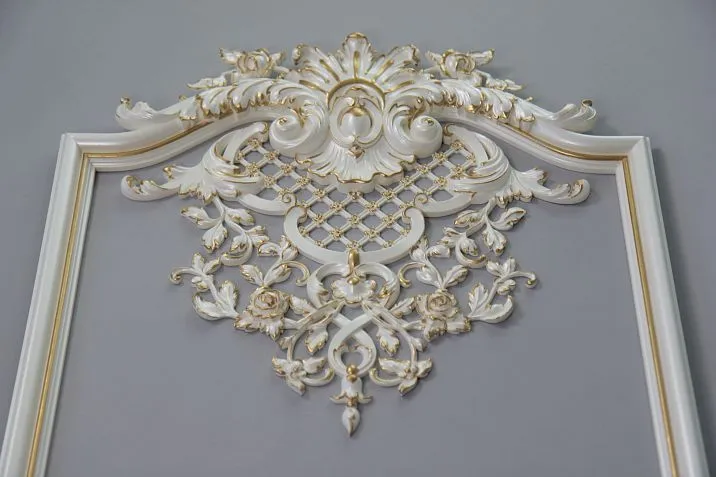
When we speak of the true beauty of interior design, we involuntarily raise our gaze to the ceiling and notice the walls. Here, in this tripartite architectural symphony, true design magic is born. Moldings on the wall, moldings on the ceiling represents not just decorative elements — it is the philosophy of a unified space, where each detail complements the other, creating a unique ensemble of beauty and elegance.
Have you ever thought about what makes a space truly special? Not furniture, not lighting, but those subtle details that create a sense of completion and harmony. Molded decoration — that’s the secret ingredient that turns an ordinary room into a work of architectural art.
Modern technologies have revived the ancient art of molding in a completely new quality. Polyurethane, this amazing 21st-century material, combines the beauty of classical forms with the practicality of modern life. It is as light as a feather, as strong as stone, and as malleable as clay in the hands of a master.


Philosophy of spatial unity




Vertical and horizontal planes in dialogue
True interior design art lies in the ability to make different planes of a space 'talk' to each other. Wall moldings and ceiling elements should not exist as separate decorative accents, but as a unified composition, where each element supports and complements the other.
Imagine an orchestra where violins play separately from cellos, and drums play alone. Dissonance, isn’t it? The same happens in interior design when wall and ceiling elements are not coordinated with each other. Harmonious combination creates a sense of wholeness, which is subconsciously perceived as beauty and comfort.
Rhythm — this is what unites walls and ceilings into a single whole. Repeating motifs that transition from one plane to another create visual music of space. This can be a common ornament, similar proportions, or a unified color palette.
Our factory also produces:


Psychology of perception of three-dimensional decoration
The human brain is structured in such a way that it strives to find order and logic in the surrounding space. Moldings on the wall, moldings on the ceilingExecuted in a unified style, it creates a sense of protection and stability. This is not accidental — in nature, symmetry and repeating patterns are often associated with safety and abundance.
Three-dimensional decoration affects our subconscious on a deep level. Relief surfaces create a play of light and shadow, which constantly changes throughout the day. This gives the interior liveliness and dynamism, preventing the feeling of boredom from a static environment.
The social aspect is also important — high-quality molded decoration is invariably associated with high status and refined taste. This creates a positive impression on guests and boosts the self-esteem of homeowners.
Get Consultation
Material science: polyurethane as a revolution in decoration
Physical and chemical properties of modern polyurethane
Polyurethane is a synthetic polymer that surpasses all traditional materials used in molded decoration in terms of performance characteristics. The density of the material is only 0.5–0.7 g/cm³, which is 8–10 times less than the density of plaster or natural stone. At the same time, its compressive strength reaches 30 MPa — a value unattainable by foam analogs.
Polyurethane’s temperature stability is remarkable: the material retains its properties within a range from -50°C to +90°C. This means that polyurethane moldings can be installed in unheated rooms, saunas, steam rooms, winter gardens — anywhere where traditional materials would perform poorly.
Water resistance is another indisputable advantage. The water absorption coefficient is less than 1%, allowing the use of molding in rooms with high humidity: bathrooms, kitchens, swimming pools. At the same time, the material does not lose strength or deform.
Manufacturing technologies and quality control
Modern production of polyurethane molding is based on the technology of injection molding into silicone molds. This process allows reproducing the finest ornament details with an accuracy of 0.1 mm. Every vein of the leaf, every swirl of the pattern is transferred with photographic precision.
Silicone molds are made from original samples — historical artifacts or contemporary original works. The lifespan of one mold is up to 1000 casts, ensuring consistent quality and precision in reproducing details.
Quality control on the production line includes checking geometric dimensions, material density, surface quality, and color match. Each item undergoes visual inspection for the presence of pores, pits, or other defects.
Architectural typology of elements
Wall decorative systems
Polyurethane wall panels are large-format elements that can cover significant areas of walls. Standard sizes range from 60×60 cm to 120×240 cm. This allows minimizing the number of joints and creating the impression of a monolithic molded surface.
Panels can imitate various architectural styles — from classical coffered ceilings to modern geometric compositions. The depth of relief reaches 15 mm, creating an expressive play of light and shadow.
Pilasters and columns add architectural expressiveness to interiors. Polyurethane columns can be both decorative and functional — concealing utilities or structural elements of the building. Column diameters range from 80 mm to 400 mm, and height can reach 3 meters.
Ceiling compositions
Ceiling rosettes remain a classic of the genre. Modern models with diameters ranging from 200 mm to 1500 mm allow selecting the optimal solution for any room. The ornamental variety is impressive — from strict geometric forms to lavish baroque compositions.
Modular systems allow creating complex multi-element compositions. A central rosette is complemented by concentric rings, corner elements, and connecting strips. This approach allows adapting decoration to any room size and configuration.
Cornices and moldings create architectural framing of ceiling space. Cornice profiles vary in complexity — from simple geometric forms to multi-level ornamental compositions. Profile height can reach 300 mm, allowing the creation of impressive architectural accents.
Stylistic directions in three-dimensional decoration
Classicism: strictness and harmony
Classic style in stucco on the wall, stucco on the ceiling Based on principles of ancient architecture. Main characteristics — symmetry, proportionality, use of order system. Doric, Ionic, and Corinthian orders are adapted for modern residential interiors.
Ornamental basis of classicism — plant motifs (acanthus, laurel, oak), geometric elements (meander, braided pattern), symbolic images (cornucopia, torches, musical instruments). Each element has its symbolic meaning and place within the overall composition.
Color palette of classical interiors is restrained — white, cream, ivory, with possible golden accents. Gilding is applied delicately, highlighting only the most important ornamental elements.
Baroque: theatricality and opulence
Baroque style requires maximum decorative saturation. Polyurethane moldings in Baroque style feature complex profiles, abundance of decorative elements, and dynamic compositions. Characterized by curved lines, asymmetrical details within overall symmetry.
Baroque ornamentation is rich and diverse — plant scrolls, cartouches, mascarons, putti, festoons. Often used narrative compositions, allegorical images, coats of arms and monograms.
Color solutions can be traditional (white with gold) or contrasting. Popular techniques include artificial aging, patination, and creating an effect of multi-century history.
Empire: grandeur and solemnity
Empire style is characterized by monumentality and solemn strictness. Ornamentation borrowed from Roman art — laurel wreaths, fasces, eagles, military insignia. Wall panels in Empire style often imitate marble slabs with relief inserts.
Geometric elements predominate over plant motifs. Often used straight lines, regular geometric shapes, strict proportions. Element sizes are significantly larger than in other styles — this emphasizes monumentality and grandeur.
Modern: natural forms and smooth lines
Modern style brought stylized natural motifs into architecture and decoration. Plant ornaments in Modern style are characterized by smooth lines, asymmetry, absence of rigid geometric structure. Popular are images of flowers (irises, lilies, poppies), leaves, plant stems.
Moldings on the wall, moldings on the ceiling In Modern style, elements often form complex compositions where wall elements smoothly transition into ceiling elements, creating a sense of organic growth. This is especially effective in rooms with complex configurations.
Art Deco: geometry and luxury
Art Deco style combines strict geometry with luxurious materials and finishing techniques. Characterized by zigzag lines, stepped forms, solar motifs, stylized plant elements.
Color solutions in Art Deco style are bold and contrasting. Popular are combinations of black and gold, silver and black, bright chromatic colors with neutral tones. Often used metallic finishes imitating bronze, chrome, gold.
Technical aspects of design
Proportion calculation and scaling
Correct proportion calculation is the foundation of a harmonious interior. For wall moldings, the rule is: the height of a decorative element should not exceed 1/8 of the wall height. For ceiling elements, the central rosette size is calculated as 1/7 of the sum of room length and width.
Polyurethane moldings of different widths are used to create element hierarchy. Main moldings have a width of 80-120 mm, additional ones — 40-60 mm, accent ones — up to 200 mm. This gradation creates visual depth and richness of composition.
Distances between elements also follow certain rules. The optimal distance between repeating elements is 1.5–2 times the width of the element itself. This creates a comfortable visual rhythm.
Engineering communications and hidden systems
Modern stucco decoration can conceal numerous engineering systems. Polyurethane cornices with built-in cable channels allow laying electrical wiring, internet cables, video surveillance systems.
Air conditioning and ventilation systems are integrated through decorative grilles styled to match the overall stucco design. Diffusers can be completely hidden behind decorative latticework.
Fire safety is ensured through use of quick-release elements at locations of smoke detectors and sprinklers. Special magnetic fasteners allow immediate access to safety systems.
Lighting technologies in stucco decoration
LED integration and smart lighting
LED technologies have opened new horizons in decorative lighting. Moldings on the wall, moldings on the ceiling may include built-in LED systems creating various lighting effects.
Cove lighting of cornices creates a floating ceiling effect. The strip is placed in a special groove, hidden from direct view, but providing soft diffused light. Control of brightness via dimmers allows creating various lighting scenarios.
RGB systems allow changing the backlight color. This is especially effective in entertainment zones, children's rooms, home theaters. Synchronization with music creates additional special effects.
Accent lighting of relief elements
Directional lighting transforms ordinary moldings into works of art. Spotlights installed at a specific angle create deep shadows in ornament recesses, emphasizing volume and detail.
Sliding light along the surface of wall panels creates a bas-relief effect. This technique is especially effective at night, when daylight does not compete with artificial lighting.
Wall sconces integrated into the molding composition become an organic part of it. Special covers allow hiding mounting elements and wiring.
Color solutions and decorative techniques
Traditional monochromatic schemes
The classic solution — white molding — remains relevant due to its versatility. White color highlights the purity of lines and architectural expressiveness of elements. Various shades of white (warm, cool, with cream undertones) allow fine-tuning the interior color palette.
Monochromatic gray schemes are gaining popularity in modern interiors. Graphite, pearl, silver — these shades create an elegant and restrained atmosphere. Polyurethane gray moldings are especially effective when combined with bright accent wall colors.
Polychromatic solutions and artistic techniques
Colored molding opens up limitless creative possibilities. Pastel shades create a romantic atmosphere, vibrant colors add energy and modernity. It is important to maintain balance — no more than three main colors in one composition.
Gradient transitions and ombre effects create depth and dimension. The technique requires high skill — paints must be applied in layers with careful blending of edges.
Metallic finishes — gold, silver, bronze, copper — give molding a luxurious look. Modern metallic paints provide realistic metallic sheen without oxidation or darkening.
Artificial aging techniques
Patination — a classical technique for creating an aged effect. Dark paint (umber, sienna, iron oxide) is applied into the recesses of the relief, then partially removed from raised areas. This emphasizes the ornament's volume and creates a sense of centuries-old history.
Crackle effect mimics the cracking of old paint. A special lacquer is applied over the base coat and, upon drying, forms a characteristic crackle pattern. The effect is enhanced by contrasting crack filler.
Flocking creates a velvet surface. Fuzzy fibers are applied to an adhesive base, creating a tactilely pleasant texture. The technique is especially effective on large wall panels.
Installation technologies
Adhesive systems and adhesion
The quality of installation determines the durability and aesthetic result. Modern polyurethane adhesives provide bonding strength up to 2.5 MPa — this means that one square meter of molding can withstand a load of up to 250 kg.
Open adhesive dwell time is 15–20 minutes, allowing adjustment of element positions. Full polymerization occurs within 24 hours at +20°C and 50–60% humidity.
Surface preparation is critically important. The base must be dry, degreased, and free of dust. Priming with acrylic primer improves adhesion and prevents staining.
Mechanical fastening
For large elements or in seismically active zones, combined fastening — adhesive plus mechanical fastening — is used. Special concealed-head screws are employed, which are masked with putty after installation.
Large wall panels can be mounted on a framing system. This is especially relevant for uneven walls or to conceal utilities. The frame is made of aluminum profiles or wooden battens.
Corner joints require special attention. Professional installers use special corner elements or precisely cut ends at a 45° angle. The quality of corner joints determines the overall impression of the work.
Operation and Maintenance
Regular Maintenance
Moldings on the wall, moldings on the ceiling Polyurethane does not require complex maintenance. Regular dry cleaning with a soft brush or vacuum cleaner with a soft attachment removes dust from recessed areas.
Wet cleaning is performed with slightly damp microfiber cloths and neutral cleaning agents. Avoid abrasive cleaners and stiff brushes — they may damage delicate ornament details.
Antistatic agents prevent rapid dust accumulation. Treatment is performed every 3–6 months depending on the intensity of room use.
Restoration and renewal
Mechanical damage to polyurethane molding is easily remedied. Small chips and scratches are filled with acrylic putty, which is sanded and painted after drying.
Serious damage requires replacing individual elements. The modular structure of most systems allows replacing a damaged fragment without dismantling the entire composition.
The coating can be renewed multiple times. Polyurethane holds paint exceptionally well, allowing for a complete change in interior color scheme. Preliminary treatment with primer ensures even application of the new coating.
Economic aspects of the project
Cost analysis and budgeting
Initial investment in quality moldings pays off through durability and aesthetic qualities. The cost of polyurethane moldings is 30-50% of the price of similar gypsum items, with significantly better performance characteristics.
Installation work accounts for 40-70% of material costs. Complexity depends on architectural features of the room, ceiling height, and required finish quality.
The service life of quality polyurethane moldings is 30-40 years. This makes initial investments economically justified even with high upfront costs.
Long-term economic efficiency
Minimal maintenance costs — an additional advantage. Unlike gypsum moldings, which require periodic restoration, polyurethane elements retain their original appearance for decades.
The ability to repaint multiple times allows updating the interior without replacing decorative elements. This is especially important when changing the design concept or wishing to refresh the ambiance.
Quality moldings significantly increase the market value of real estate. Buyers are willing to pay 15-25% more for apartments with ready-made high-end designer finishes.
Impact on property value
Investment Appeal
The uniqueness of the interior distinguishes the property from standard offerings. This shortens the sales time and allows achieving more favorable conditions. Wall panels and ceiling decor create a sense of exclusivity and high-end finish.
International practice shows that the presence of quality architectural decor increases the liquidity of real estate and reduces its volatility during crises.
Polyurethane moldings demonstrate excellent resistance to various climatic conditions. In northern regions, the material does not crack at low temperatures, while in southern regions, it does not deform from heat and UV radiation.
Adaptation to Russian climate
Adaptation to local conditions
The marine climate of coastal regions does not negatively affect polyurethane. Salt fog, increased humidity, and temperature fluctuations do not cause material degradation.
Seismic activity in some regions requires special attention to mounting methods. The elasticity of polyurethane and strength of modern adhesives ensure the preservation of decor even during significant building movements.
The lightness of polyurethane items significantly simplifies transportation. A full set of decor for a three-room apartment weighs no more than 50 kg and fits in a passenger car.
Logistical advantages
Resistance to mechanical impacts minimizes losses during transportation. Standard packaging in polyethylene film is sufficient for protection during delivery to remote regions.
The future of molding decor is linked to the development of 3D printing. Unique elements according to individual projects are already possible. Printing speed is increasing, while costs are decreasing, making personalized decor more accessible.
Trends and prospects
Technological Innovations
New polyurethane compositions have improved characteristics — self-cleaning properties, antibacterial effects, and the ability to absorb odors and harmful substances from the air.
New polyurethane compositions have improved properties — self-cleaning capabilities, antibacterial effects, and the ability to absorb odors and harmful substances from the air.
Bio-degradable polymers based on plant materials represent an ecologically clean future for decorative materials. While preserving all performance qualities, they minimize environmental impact.
Integration of smart technologies
Smart decor — the next stage of industry development. Built-in sensors can monitor the microclimate of the room, air quality, lighting levels, and automatically adjust parameters for optimal comfort.
Augmented reality will transform static moldings into interactive surfaces. Using mobile applications, ornaments can come to life, tell the story of the room, or provide useful information.
Wireless technologies will allow hiding Wi-Fi routers, charging stations, and security system components within decorative elements. This will create technologically advanced interiors without visible wires or devices.
Polyurethane — this is not just a fashion statement, but a conscious choice in favor of beauty, quality, and durability. Each element installed in the home becomes part of a personal story, a witness to joyful events, and a creator of a unique atmosphere. Moldings on the wall, moldings on the ceiling Choosing quality moldings means investing in your own well-being, creating a space that inspires every day. This decision pays off not only economically, but emotionally — through daily joy from being in a beautiful and harmonious interior.
STAVROS is a recognized leader in producing high-quality polyurethane moldings, combining rich traditions of decorative art with modern technologies. The long experience of artisans, strict quality control at every production stage, and constant pursuit of innovation allow STAVROS to create products that set industry standards. Choosing STAVROS means choosing quality assurance, reliable partnership, and confidence that your home will become a true work of architectural art, where beauty and functionality exist in perfect harmony.
Molding on walls and molding on ceilings — unity of spatial harmony | STAVROS Company