


























Article Contents:
- The mathematics of beauty: formulas for calculating rosette diameter
- Rule of seven: the classic proportion formula
- Height adjustment: vertical scale
- Rosette to chandelier ratio: the one-and-a-half rule
- Multi-level geometry: multiple rosettes in one composition
- Style dictates form: rosette as the character of the interior
- Classic chandeliers: ornamental richness
- Art Nouveau and Art Deco: geometric elegance
- Minimalism and modernity: restraint as a principle
- Provence and Country: Cozy Simplicity
- Installing a rosette: from marking to finishing
- Centering: geometric precision as the foundation
- Wiring: technical nuances of electrical installation
- Mounting: adhesive as the basis of reliability
- Painting: color as the finishing touch
- STAVROS ceiling rosette catalog: from compact to monumental
- Compact rosettes: twenty to forty centimeters
- Medium rosettes: fifty to seventy centimeters
- Large rosettes: eighty to one hundred twenty centimeters
- Custom solutions: beyond the catalog
- Frequently Asked Questions About Ceiling Rosettes
- Conclusion: rosette as the final chord of the ceiling composition
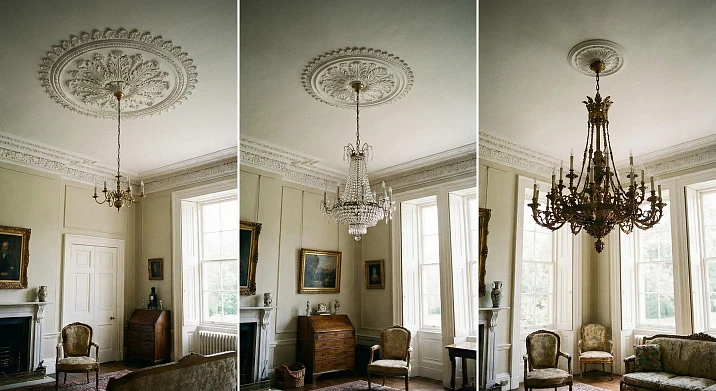
The ceiling is the fifth wall of your home. How many times have you lain in bed before sleep, looked up, and thought something was missing? A white plane with a protruding wire and a chandelier hanging on a hook—is that the limit of possibilities? No. The ceiling can tell a story, create a mood, transform a room from a functional space into a place where you want to be.
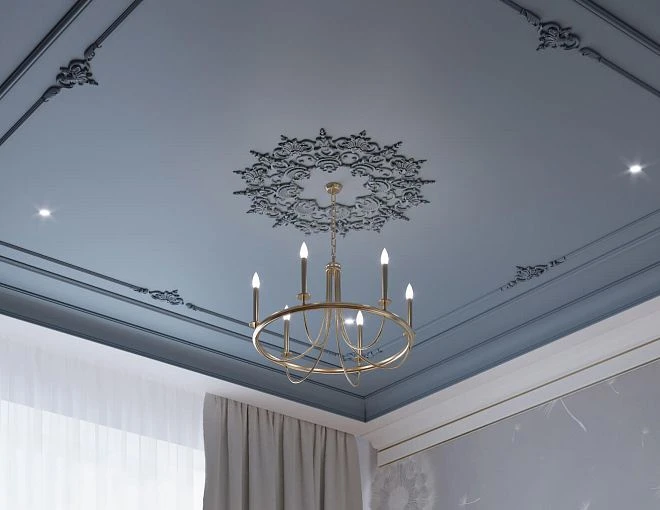
One element can change everything—Ceiling molding for chandelier. A rosette framing a light fixture works like a frame for a painting, a setting for a diamond, a pedestal for a sculpture. It doesn't just hide the technical details of mounting; it elevates the chandelier to the status of an architectural element. But how do you choose the right size? Why does one rosette look organic, while another either gets lost or overwhelms the space?
This article is a guide for those who don't want to make a mistake. There's no room for general phrases like 'choose according to taste.' Here, it's about the mathematics of proportions, the psychology of perception, and practical installation experience. Choosing the size of a ceiling molding rosette—is not fortune-telling with coffee grounds; it's a calculation based on room parameters, the type of light fixture, and stylistic patterns.
The mathematics of beauty: formulas for calculating rosette diameter
Beauty is not mysticism, but geometry. The ancient Greeks knew this when they created the Parthenon. Renaissance architects confirmed it while designing cathedrals. 21st-century designers apply the same principles when choosing the size of a ceiling rosette.


Rule of seven: the classic proportion formula
A formula that has survived centuries: the diameter of a ceiling medallion equals the sum of the length and width of the room, divided by seven. A room four by five meters? Four plus five equals nine. Nine divided by seven is approximately one meter thirty centimeters. This is the optimal medallion diameter for such a space.
Where did the number seven come from? From the practice of Baroque palaces and Classical mansions, where architects, through trial and error, found a balance between the scale of the room and the size of the decoration. Seven is not a magic number, but an empirical constant that works in most cases.
The formula provides a basic starting point. You can deviate from it depending on ceiling height, style, personal preferences. But you need to start with it. A room three by four — a one-hundred-centimeter medallion. A room six by eight — a two-hundred-centimeter medallion. Simple arithmetic that yields a visually correct result.
Our factory also produces:


Ceiling height adjustment: vertical scale
The formula of seven works for ceilings of standard height — two meters seventy to three meters. But what if the ceiling is low (two meters forty) or high (three meters fifty and above)? Correction is needed.
A low ceiling feels oppressive. A large medallion will intensify this feeling. Reduce the calculated diameter by twenty to thirty percent. A room four by five with a two-meter-forty ceiling: the basic calculation gives one hundred thirty centimeters, but with the adjustment, ninety to one hundred centimeters is optimal.
A high ceiling requires larger details. A medallion proportional to the floor will get lost at a great height. Increase the diameter by twenty to forty percent. A room four by five with a four-meter ceiling: the basic calculation is one hundred thirty centimeters; with the adjustment, one hundred sixty to one hundred eighty centimeters is optimal.
Visual perception works like this: the farther away an object is, the larger it must be to produce the same impression. A medallion at a height of four meters is perceived as smaller than the same medallion at a height of two meters seventy. Compensate for distance with size.
Get Consultation
Medallion and chandelier ratio: the one-and-a-half rule
The medallion frames the chandelier but should not compete with it. The optimal ratio: the medallion diameter is one and a half to two times larger than the chandelier diameter (measured at the widest points — from one edge of the fixture to the other, excluding hangers).
A chandelier with a diameter of fifty centimeters requires a medallion of seventy-five to one hundred centimeters. A chandelier with a diameter of eighty centimeters requires a medallion of one hundred twenty to one hundred sixty centimeters. This creates visual harmony where the medallion serves as the background and the chandelier as the soloist.
A medallion that is too small gets lost, creating a 'button on a bedsheet' effect. The chandelier seems glued to the ceiling, disconnected from the room's architecture. A medallion that is too large overwhelms the chandelier, turning the light fixture into a secondary detail. Balance is key.
Exception — minimalist interiors. There, the medallion can be comparable in size to the chandelier or even smaller, if executed as a simple ring without ornamentation. Minimalism plays by different rules, where decoration is kept to a minimum.
Multi-level geometry: several medallions in one composition
Complex interiors allow for compositions of several concentric medallions. The central (smaller) one frames the chandelier directly. The outer (larger) one creates a second contour, enhancing the accent.
Proportions here are critical. The outer medallion should be one and a half to two times larger than the inner one. Inner fifty centimeters — outer seventy-five to one hundred centimeters. Inner eighty centimeters — outer one hundred twenty to one hundred sixty centimeters.
The distance between medallions should be visually comfortable — not too narrow (creates a glued-together feeling), not too wide (breaks the composition). Optimal: the width of the gap equals half the radius of the inner medallion.
Multi-level compositions are suitable for large spaces (from thirty square meters) with high ceilings (from three meters fifty). In small rooms, they will create overload and consume visual space.
Style dictates form: the medallion as the character of the interior
Size is not the only parameter. The style of the medallion must match the type of chandelier and the overall interior concept. A Baroque medallion under a loft-style light fixture is dissonant. A minimalist ring under a crystal chandelier is incomplete.
Classical chandeliers: ornamental richness
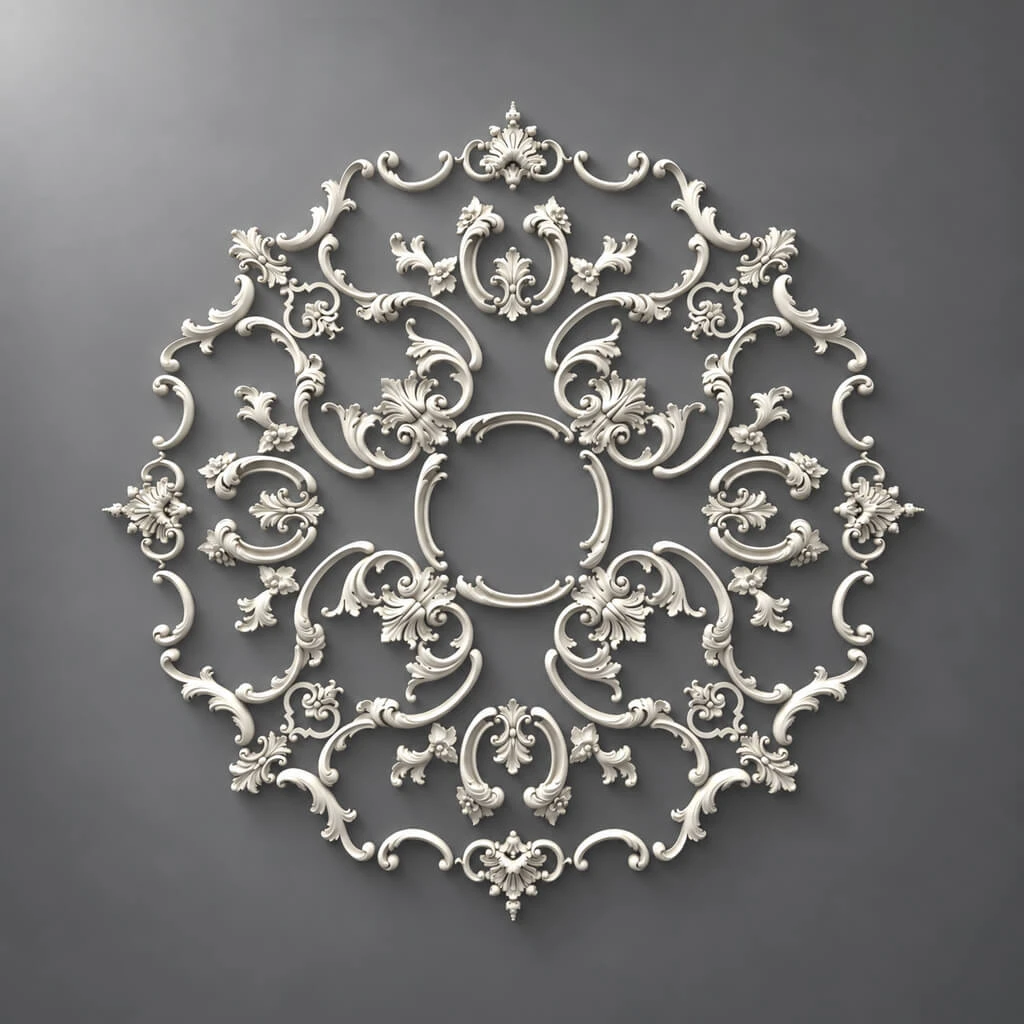
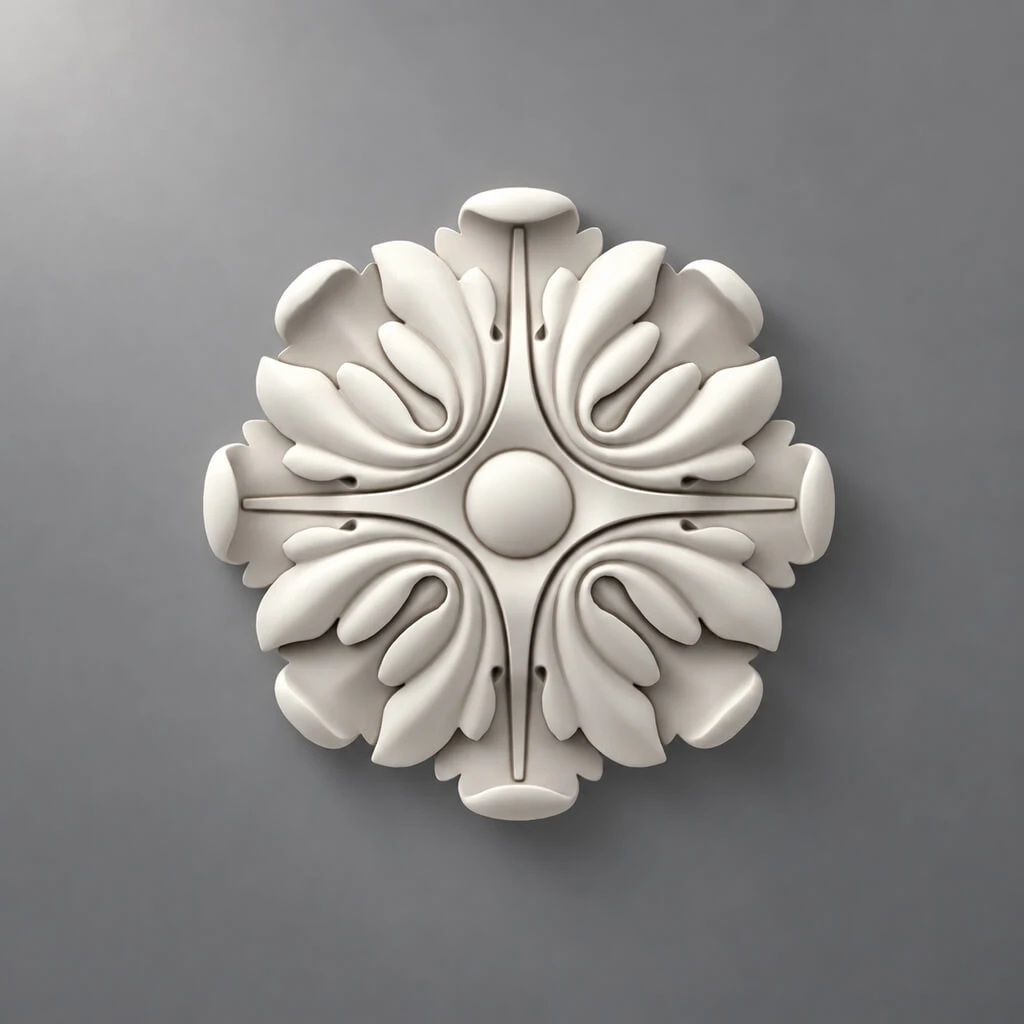
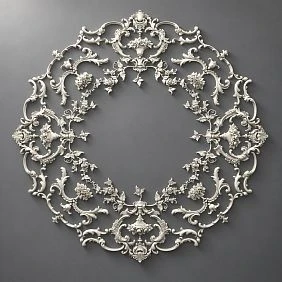
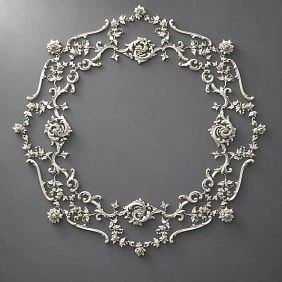
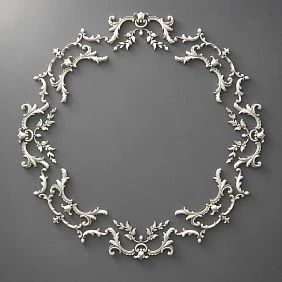
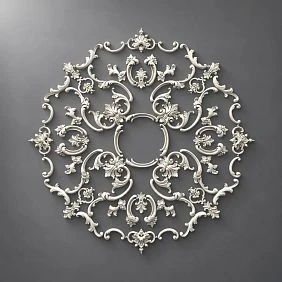
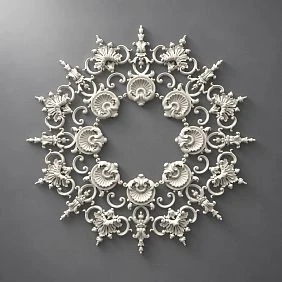
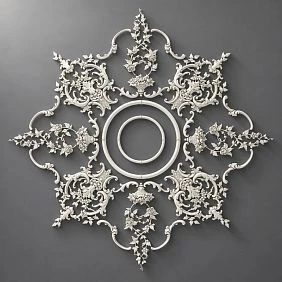
Crystal chandeliers, bronze candelabras, Empire or Baroque style fixtures with textile shades require an appropriate setting. The medallion should be ornamental, with deep relief, featuring plant motifs.
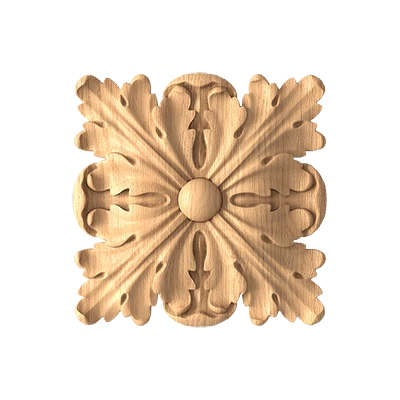
Acanthus, roses, laurel wreaths, grapevines — classical motifs tested by centuries. Relief with a depth of ten to twenty millimeters creates a play of light and shadow, emphasizing volume. When the chandelier is on, the relief medallion comes alive: protruding parts catch the light, recesses sink into shadow.
The diameter of a classical medallion is rarely less than sixty centimeters — ornamentation requires area to unfold. Small details on a small medallion will merge into an indistinct spot. The optimal range for classicism: seventy to one hundred twenty centimeters in standard rooms, one hundred fifty to two hundred in formal halls.
The shape of a classical medallion is round — a tradition dating back to antiquity. The circle symbolizes perfection, completeness, eternity. Oval medallions are permissible but less common and require special care in placement — an oval visually stretches or compresses space depending on its orientation.
Art Nouveau and Art Deco: geometric elegance
Light fixtures in the Art Nouveau style (flowing lines, plant motifs, asymmetry) and Art Deco style (geometric forms, rays, zigzags) require corresponding medallions. Here, classical acanthus leaves are inappropriate.
A modernist medallion can have an asymmetrical ornament, a curvilinear contour, stylized plant motifs. Irises, lilies, seaweed, tongues of flame — all in smooth, flowing lines. The relief is less deep than in classicism (five to ten millimeters), but with clear plasticity.
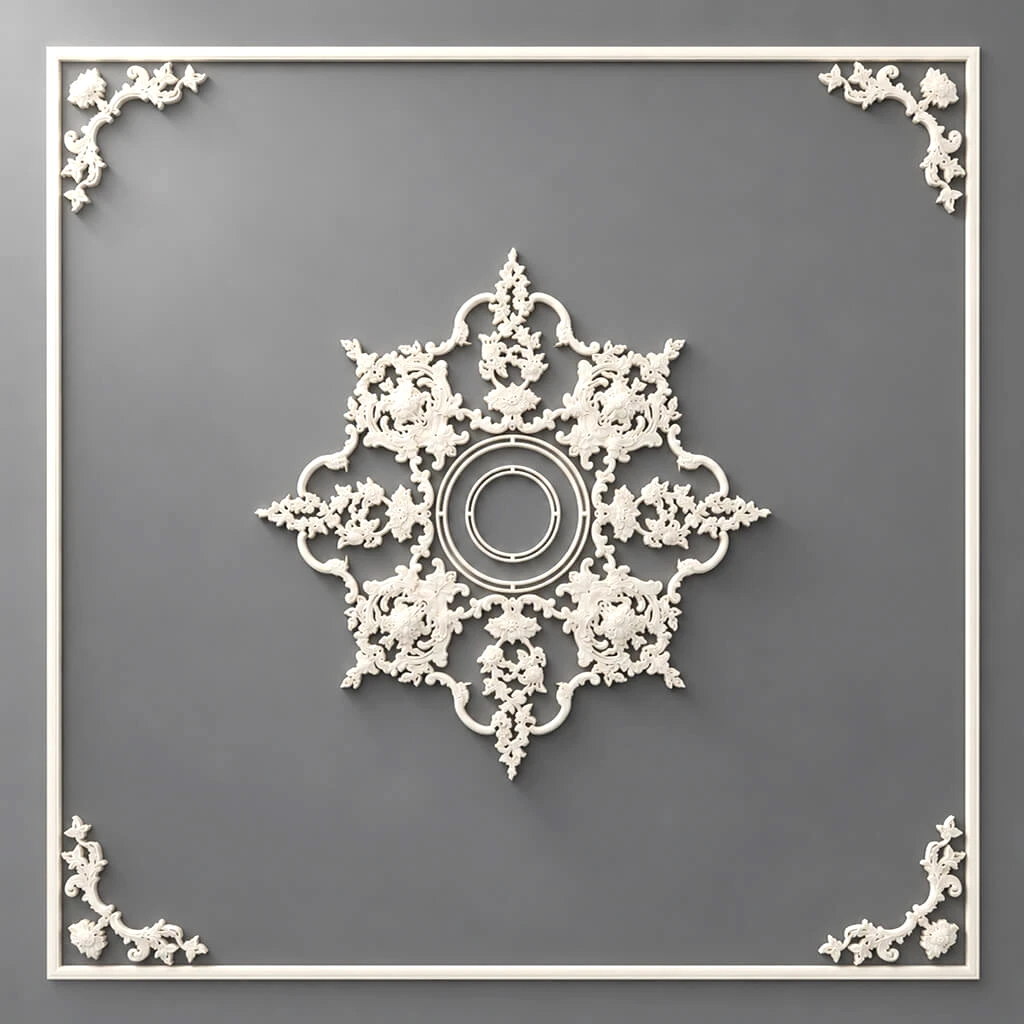
Art Deco prefers geometry: concentric circles, radial rays, stepped forms, zigzags. The medallion can have an octagonal or dodecagonal shape instead of a round one. The relief is strict, graphic, with a clear separation of light and shadow.
The sizes of Art Nouveau and Art Deco medallions are usually smaller than classical ones — sixty to ninety centimeters for standard rooms. The style does not require monumentality; the elegance of lines and graphic quality of forms are more important.
Minimalism and Modernity: Restraint as a Principle
Modern designer lighting fixtures — abstract forms, minimalist constructions, LED panels — require maximally laconic ceiling medallions. Here, ornamentation is often completely absent.
The ceiling medallion becomes a smooth ring, square, or rectangle. The relief is minimal (two to five millimeters) or absent altogether. Decorative effect is achieved not through ornament, but through perfect geometry and surface quality.
The diameter of a minimalist ceiling medallion can be smaller than calculated by the rule of seven. For a room four by five meters, instead of one hundred thirty centimeters, you can use eighty to one hundred centimeters. Minimalism allows for large gaps between elements; emptiness here is not a flaw but a virtue.
The color of a minimalist ceiling medallion is often contrasting: black on a white ceiling or white on gray. The contrast emphasizes graphic quality, turning the medallion into a deliberate accent, not an attempt to imitate historical decor.
Provence and Country: Cozy Simplicity
Lighting fixtures in the Provence style (textile lampshades, wrought iron details, pastel tones) or country style (wood, simple forms, natural materials) require corresponding ceiling medallions. Baroque opulence is inappropriate here, but minimalist severity is also unsuitable.
A ceiling medallion in the Provence style has a simple floral ornament: grapes, olive branches, lavender, sunflowers. The relief is shallow (five to eight millimeters), forms are soft and rounded. The diameter is medium: fifty to eighty centimeters.
Color is an important part of the stylistics. A white ceiling medallion suits most interiors, but Provence allows for pastel shades: beige, light gray, ivory. Patination (slight darkening of the relief recesses) creates an antique effect characteristic of the style.
Ceiling Medallion Installation: From Marking to Finishing
A correctly chosen ceiling medallion can be ruined by incorrect installation. Centering accuracy, mounting quality, neatness in working with wiring — all this affects the final result.
Centering: Geometric Precision as the Foundation
The ceiling medallion must be positioned strictly in the center of the ceiling. Even a shift of five to ten centimeters will be noticeable and create a sense of imbalance. How to find the exact center?
Diagonal method: Mark the corners of the room, draw (mentally or actually with chalk) two diagonals from corner to corner. The intersection point is the geometric center. This is where the center of the ceiling medallion (and chandelier) should be.
Measurement method: Measure the length and width of the room, divide in half, mark the midpoints of opposite walls. Draw lines from midpoint to midpoint — crosswise. The intersection is the center.
A laser level with a function for constructing perpendicular lines simplifies the task. Place the device on the floor in a corner, direct the beams upward — lines will appear on the ceiling, the intersection of which will give the center.
After finding the center, mark it with a pencil. Place the ceiling medallion (not yet glued), check that the central hole of the medallion aligns with the mark. If the medallion has no central hole (solid), mark the center on the back of the medallion before installation.
Wiring: Technical Nuances of Electrical Installation
A chandelier is attached to the ceiling via a hook or mounting plate, to which electrical wiring is connected. The ceiling medallion should conceal the mounting point and wire outlet, but should not interfere with the installation of the light fixture.
If a hook or mounting plate is already installed, ensure they are exactly in the center of the future ceiling medallion. If not — relocate them. This will require extending or moving the wiring. Electrical work is performed with the circuit breaker turned off, ideally by an electrician.
The central hole of the ceiling medallion must be sufficient to pass the wires and the decorative cap of the chandelier. Most medallions have a hole diameter of five to ten centimeters, which is sufficient for standard light fixtures. If the hole is absent, it needs to be cut out with a drill and a hole saw of the appropriate diameter.
Some modern light fixtures (especially recessed LED panels) have no visible mounting — they are installed on a concealed plate. In this case, the ceiling medallion is purely decorative; the central hole can be minimal or absent altogether.
Mounting: Adhesive as the Basis of Reliability
Polyurethane ceiling medallions are lightweight (weight of a medallion with a diameter of one hundred centimeters is two to four kilograms), so they are mounted with adhesive without additional mechanical fasteners. The right adhesive is half the success.
Polymer adhesives based on MS (modified silanes) — a universal solution. They bond with any surfaces (concrete, drywall, plaster, paint), are elastic (compensate for micro-movements), contain no solvents (safe in enclosed spaces). Examples: Tytan, Makroflex, Moment Crystal.
Acrylic adhesives — a budget option for small ceiling medallions (up to sixty centimeters). They work on absorbent substrates, set quickly, and are easily washed off with water before curing. Disadvantage — they hold weaker on smooth, non-absorbent surfaces.
Application technique: Adhesive is applied to the back of the ceiling medallion along the contour (as a continuous line or dotted line with an interval of five to ten centimeters) and with several dots in the center. Do not apply adhesive too thickly — excess will squeeze out when pressed, staining the ceiling.
Pressing: The ceiling medallion is applied to the ceiling, the central hole is aligned with the wiring outlet, and the medallion is pressed evenly over the entire area. Polymer adhesives set in ten to thirty seconds, after which the medallion can be released. Acrylic adhesives require fixation for five to ten minutes — hold the medallion with your hands or prop it up with a long board (from floor to medallion).
Excess adhesive squeezed out along the edges is removed immediately with a damp cloth. After curing, removal is difficult. Adhesive polymerization completes in twelve to twenty-four hours, after which the chandelier can be installed.
Painting: Color as the Finishing Touch
Polyurethane rosettes are supplied in white, ready for painting. Leaving them white or painting them is a decision that determines the final perception.
A white rosette on a white ceiling is a classic solution. The rosette stands out through its relief, not its color. Light from the chandelier creates shadows in the recesses of the ornament, emphasizing the volume. This is a universal option suitable for most interiors.
A rosette matching the ceiling color (if the ceiling is colored) — the fusion of decor with architecture. The rosette becomes part of the ceiling, not competing for attention. Suitable for interiors where restraint and the absence of bright accents are important.
Contrasting rosette — a graphic solution for modern interiors. A black rosette on a white ceiling, gray on a light one, gold on beige — the contrast attracts attention, turning the rosette into a deliberate accent. Suitable for interiors with clear lines, where decor is not hidden but showcased.
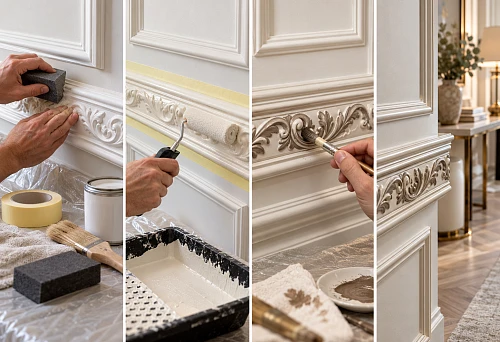
Patination — an artificial aging technique characteristic of classic interiors. The rosette is painted in a light base color (white, ivory, light gray), then a dark paint (brown, black, dark gray) is applied to the recesses of the relief to create patina. The protruding parts remain light, the recesses darken — creating the effect of years of dust settled in the relief. This adds a noble antiquity.
Gilding and silvering — applying metallic paint to the protruding parts of the relief. Base painting (white or colored), then gold (or silver) paint is applied with a brush or sponge to the protrusions. An effect of luxury, appropriate in Baroque, Empire, and Art Deco interiors.
Paints for polyurethane: water-based acrylic or latex. They are elastic, do not crack, and adhere firmly without primer. Applied with a brush (for relief elements, to paint all recesses) or a roller (for smooth elements). Two coats ensure even coverage.
STAVROS Ceiling Rosette Catalog: from compact to monumental
Choosing a size is easier when you have specific options in front of you. STAVROS offers ceiling rosettes in a diameter range from twenty to one hundred twenty centimeters, covering all possible needs — from intimate bedrooms to grand halls.
Compact rosettes: twenty — forty centimeters
Range for small rooms and spotlights. Hallways, bathrooms, dressing rooms, storage rooms — anywhere the area does not exceed ten square meters and compact fixtures are installed.
A rosette with a diameter of twenty centimeters — the minimum size suitable for a spotlight or small lampshade. The ornament on such a rosette should be simple; large details won't fit. Geometric motifs, simple radial compositions are the optimal choice.
A rosette thirty — forty centimeters — a universal option for small rooms with simple chandeliers. Enough area for a moderately complex ornament. Classic acanthus leaves, roses, grapes look harmonious and don't get lost.
Compact rosettes are often used in multi-level compositions as an inner element. A thirty-centimeter rosette in the center plus a sixty-centimeter rosette along the outer contour create a complex composition suitable for medium-sized rooms.
Medium rosettes: fifty — seventy centimeters
The most popular range, suitable for most living spaces. Living rooms, bedrooms, studies with an area of fifteen — thirty square meters and ceilings two meters seventy — three meters — a typical application zone.
A fifty-centimeter rosette — a compromise between visibility and restraint. It frames the chandelier without dominating. The ornament can be quite complex, with small details that are readable from a distance of three — four meters.
A rosette sixty — seventy centimeters — a full-fledged accent on the ceiling. Such a rosette is immediately visible upon entering the room, organizes the space, and sets the compositional center. Suitable for classic interiors with ornamental chandeliers.
Medium rosettes are stylistically universal. They work in classic, modern, Provence, even eclectic (mix of styles) interiors. The main thing is the correspondence of the ornament to the overall interior concept.
Large rosettes: eighty — one hundred twenty centimeters
Range for large rooms and high ceilings. Spacious living rooms, grand halls, lobbies, dining rooms with an area from thirty square meters and ceilings from three meters fifty — here large rosettes do not overload but balance the scale.
A rosette eighty — ninety centimeters — a powerful decorative element. The ornament can be multi-tiered, with deep relief, detailed. With the chandelier on, such a rosette creates an impressive chiaroscuro picture on the ceiling.
A rosette one hundred — one hundred twenty centimeters — a monumental element for palatial interiors. This is a choice for spaces where representativeness and solemnity are important. Hotels, restaurants, concert halls, museums often use rosettes in this range.
Large rosettes require corresponding chandeliers. A small chandelier under a huge rosette looks comical. The chandelier diameter should be at least half the rosette diameter. For a one-hundred-centimeter rosette, a chandelier of at least fifty centimeters is needed.
Custom solutions: beyond the catalog
Non-standard rooms (very large, asymmetrical, with unusual ceiling geometry) may require rosettes beyond the standard catalog. STAVROS offers manufacturing rosettes based on custom sketches.
Diameter from one hundred fifty centimeters and more — for halls with an area from one hundred square meters. Oval rosettes for elongated rooms. Square or polygonal for modern interiors. Combined compositions of several elements for complex ceiling structures.
Custom manufacturing includes consultation with a designer, 3D model development, approval, and production. Lead times — from two weeks for simple forms to two months for complex multi-tiered compositions. Cost is higher than catalog items, but the result is a unique rosette perfectly suited to your space.
Frequently Asked Questions about Ceiling Roses
Can a rosette be installed on a stretch ceiling?
Yes, but with limitations. The rosette is glued not to the stretch fabric (it cannot bear the weight), but to the base ceiling before installing the stretch ceiling. Then a hole is made in the stretch fabric through which the rosette on the base ceiling is visible. Alternatively, an overlay rosette is used, which is glued onto the stretch fabric through a special thermal ring that prevents the film from tearing. The second option is simpler but limits the choice — only lightweight rosettes of small diameter are suitable.
Does the ceiling medallion conceal the wiring or just decorate?
The ceiling medallion conceals the wire exit point and the chandelier mounting hardware, but not the wiring itself running from the junction box to the suspension point. The wiring must be concealed within the ceiling structure (chased channel) or behind decorative finishes (stretch ceiling, drywall). The medallion only masks the final node—where the wires exit and the chandelier is mounted.
How much does a polyurethane ceiling medallion weigh and will the ceiling support it?
A medallion with a diameter of fifty centimeters weighs about one kilogram; one with a diameter of one hundred centimeters weighs three to four kilograms. This is much lighter than plaster counterparts (which weigh four to five times more). Any ceiling (concrete, drywall, even old plaster) will support this weight if properly glued. Problems may only arise on ceilings with flaking plaster—there, the base needs repair first.
How to care for a ceiling medallion without damaging the relief?
Dust is removed with a soft brush, feather duster, or vacuum with a brush attachment once every month or two. Wet cleaning (with a slightly damp cloth and mild detergent) — once every six months. Do not use abrasive cleaners or stiff brushes—they will scratch the paint. Polyurethane is durable, but the painted surface requires careful handling.
Can a ceiling medallion be removed and reinstalled when moving?
Theoretically yes, practically difficult. A medallion glued with polymer adhesive holds very firmly. Removal may damage the medallion or tear off pieces of plaster from the ceiling. If it is removed carefully, cleaning off the old adhesive is difficult—it does not dissolve and is removed mechanically, which may damage the back of the medallion. It is easier and cheaper to buy a new medallion for the new space.
Is a ceiling medallion mandatory or is it just decor?
Purely decor. Functionally, a chandelier is mounted without a medallion. But the medallion solves several tasks: it conceals technical mounting details (hook, mounting plate, wires), masks possible ceiling defects at the wire exit point, creates a visual accent, and connects the chandelier with the room's architecture. In a historical interior (classical, Baroque, Empire), a medallion is not just desirable but necessary for stylistic integrity.
Is a polyurethane ceiling medallion suitable for wet areas?
Yes. Polyurethane is moisture-resistant, does not absorb water, and does not deform from steam. Medallions can be installed in bathrooms, kitchens, and pools. The main thing is to paint the medallion with moisture-resistant paint (latex or acrylic for wet areas) and coat it with a matte varnish. This will protect it from condensation and make maintenance easier.
How is a polyurethane ceiling medallion better than a plaster one?
Weight: polyurethane is four to five times lighter than plaster. This simplifies installation, eliminates the risk of collapse, and allows gluing onto drywall ceilings without reinforcement. Moisture resistance: plaster absorbs water and deforms; moisture does not linger in polyurethane. Strength: plaster is brittle and chips upon impact; polyurethane is flexible and absorbs shocks. Price: quality polyurethane is comparable to or cheaper than handcrafted plaster. The only advantage of plaster is historical authenticity for museum restorations requiring absolute technological accuracy.
Can a ceiling medallion be combined with other ceiling elements?
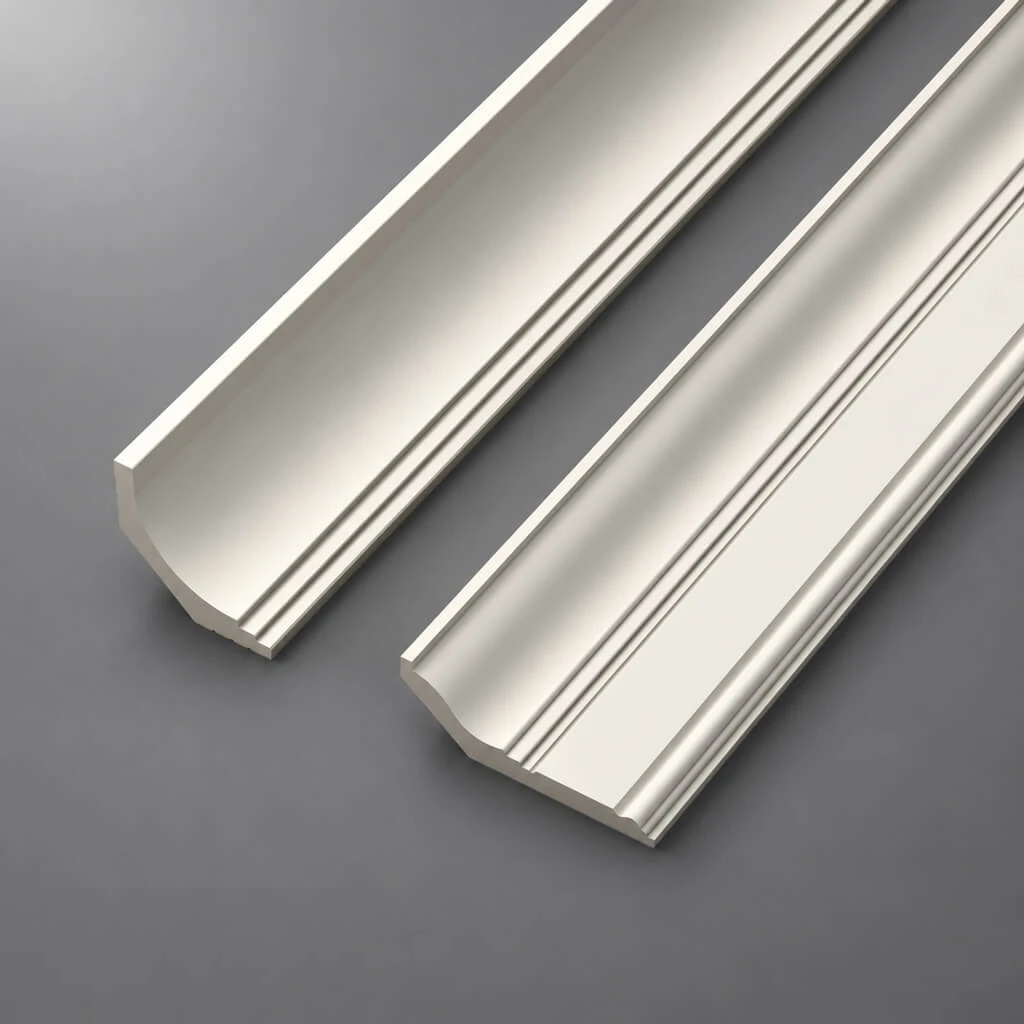
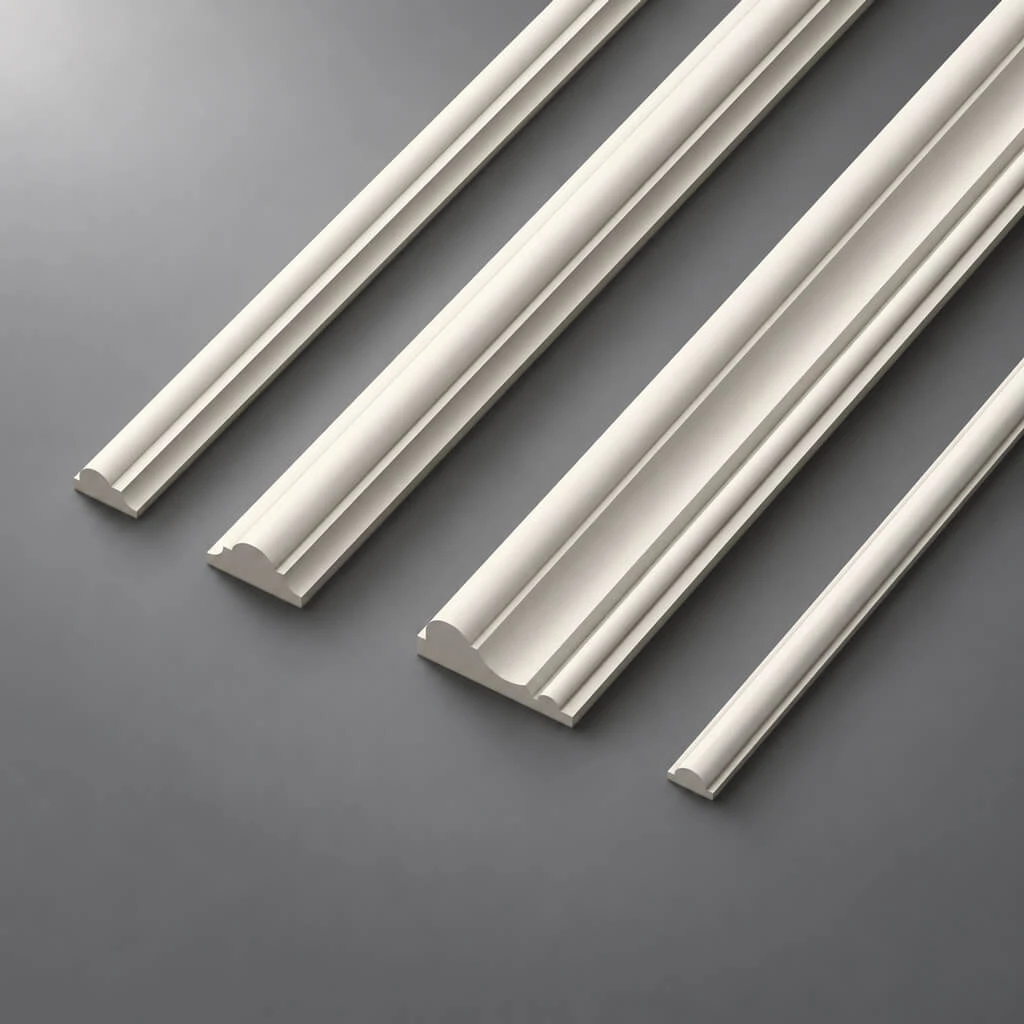
Not just can, but should be, to create an integrated composition. A medallion plus a ceiling cornice (coving) around the perimeter of the room is a classic combination. A medallion plus moldings forming geometric panels on the ceiling is a complex but effective solution for large spaces. A medallion plus corner elements at the junctions of cornices creates a finished composition. All elements should be maintained in the same style and scale.
How much does a polyurethane ceiling medallion cost?
Prices depend on diameter and ornament complexity. A simple medallion with a diameter of thirty centimeters — from five hundred rubles. A medium medallion sixty centimeters with medium ornament complexity — from two to four thousand. A large medallion one hundred centimeters with rich relief — from eight to fifteen thousand. Custom manufacturing — from fifteen thousand. Plus the cost of adhesive (three hundred to five hundred rubles), paint if needed (five hundred to one thousand rubles), installation if ordered from specialists (one to three thousand depending on region and complexity).
Conclusion: the ceiling medallion as the final chord of the ceiling composition
A ceiling without decor is a missed opportunity. The fifth wall, which you see every time you look up, can be not just a white plane but a work of architectural art. One element can change the perception of the entire space—ceiling molding rosette—making the chandelier not just a light source but a compositional center around which the interior is organized.
Choosing the size is not guesswork but calculation. The rule of seven provides a basic proportion, adjustments for ceiling height tailor it to the specific room, and the ratio with the chandelier creates visual balance. Stylistics determine the character: classic requires ornamental richness, minimalism requires geometric strictness. Installation requires precise centering and quality adhesive. Painting completes the image, integrating the medallion into the interior's color scheme.
Company STAVROS offers a full range of solutions—from compact twenty-centimeter medallions for small spaces to monumental one hundred twenty-centimeter medallions for grand halls. The catalog covers all styles: classic with acanthus leaves, Art Nouveau with flowing lines, Art Deco with geometry, minimalism with laconic forms. Material—European polyurethane, lightweight, durable, moisture-resistant. Production on modern equipment with manual finishing. The result—medallions that rival plaster in detail but surpass them in all performance parameters.
Twenty years of STAVROS experience—a guarantee of quality. Thousands of completed projects from cozy apartments to public spaces. Designer consultations help choose size and style, technical specialists explain installation nuances, and the delivery service brings the order intact and safe. Custom manufacturing of medallions based on client sketches allows the realization of any, even the most unusual concepts.
A ceiling medallion is not a luxury but completeness. An interior without it is like an unfinished sentence, a painting without a frame, a chord without resolution. A small detail creates a big effect: the space becomes organized, the chandelier becomes significant, the ceiling becomes interesting. The cost of the medallion is not comparable to the change it brings to the perception of the interior.
Start small. Choose a medallion suitable for the size of your room. Calculate the diameter using the rule, consider the ceiling height, correlate it with the chandelier size. Determine the style—classical, contemporary, transitional. Explore the STAVROS catalog, find a model that resonates with your taste. Order, install it yourself or entrust it to professionals. And enjoy the result: the ceiling gains character, the chandelier gains a worthy frame, the interior gains completeness.
A ceiling medallion under a chandelier is the period that completes the space. Without it, the interior remains unfinished. With it—it gains meaning. STAVROS provides the tools to create such interiors: quality materials, a thoughtful catalog, professional support. The rest is your vision, your taste, your decision to create a home that is not just functional but also beautiful. A home where every detail is considered. Where the ceiling is not forgotten. Where even the chandelier is framed as if it were a masterpiece worthy of a museum. Your home deserves such details. STAVROS is ready to provide them.