Article Contents:
- Architectural unity: the philosophy of a holistic house
- Reading the style: the first three seconds
- Material logic: polyurethane outside, wood inside
- Stylistic bridges: how to connect exterior and interior
- Facade: polyurethane stucco as the house's calling card
- Cornice: the horizontal line crowning the walls
- Window casings: framing that emphasizes openings
- Entrance portal: a theatrical curtain
- Rustication on corners: division of planes
- Staircase: wooden balusters as a bridge between floors
- Anatomy of a baluster: parts and proportions
- Support posts: vertical accents
- Baluster stylistics: classic, modern, eclectic
- Interior: polyurethane moldings along the staircase flight
- Molding panels on the wall along the staircase
- Ceiling cornice above the staircase
- Decorative ceiling rosettes in the hall
- Material compatibility: how polyurethane and wood work together
- Visual harmony: white and brown
- Tactile contrast: smooth and textured
- Durability: both materials last for decades
- Package: ordering facade stucco and balusters in one place
- Advantages of a comprehensive order
- Composition of a comprehensive order for a country house
- Delivery to Customs Union countries
- Frequently Asked Questions
- Conclusion: from the threshold to the second floor — a unified stylistic line

Architecture does not end at the threshold. A house is a holistic organism where the facade and interior speak the same language, where window casings outside rhyme with staircase balusters inside, where the cornice above the entrance door continues as molding on the hallway wall.polyurethane stucco for the house facadecreates a stylistic code that is read from the street: classic, neoclassical, modern, Provence. This code continues inside through wooden elements —buy balustersand installing them on the staircase means connecting the floors not only physically but also stylistically. Polyurethane on the facade, wood inside, moldings on the walls along the staircase flight — materials are different, but the logic is unified. In this article, we explore how to create architectural unity outside and inside, how facade stucco defines the style of interior decor, how to choose balusters that will continue the exterior stylistics, how to package an order for facade decor and interior elements in one place. Prepare for a journey from the entrance portal to the second floor, where every detail knows its place in the overall symphony.


Architectural Unity: The Philosophy of a Holistic House




Reading Style: The First Three Seconds
A person approaches a house. Three seconds is the time it takes to form a first impression. The gaze scans the facade from top to bottom: roof, cornice, windows with casings, entrance door with portal, plinth. If the facade is adorned with classical stucco (cornice with dentils, window casings with keystones, portal of the entrance group with pilasters and pediment), the brain registers: the house is classical, the owners value tradition, order, symmetry.
The person enters inside. The first thing they see in the hallway or foyer is the staircase to the second floor. If the staircase has turned wooden balusters of a classical profile, oak steps, massive posts with carved finials, the brain receives confirmation: the style is unified, the exterior and interior speak the same language. The impression is reinforced, trust in the owners' taste grows.
If, however, the facade is classical, but the staircase inside is modern minimalist (metal posts, glass railings, steps on bolts), dissonance arises. The brain registers a stylistic rupture, creating a sense of thoughtlessness, randomness of decisions.
Architectural unity is not a rigid copying of elements outside and inside, but a coherence in the language of forms, proportions, and decorativeness. If the facade is abundantly adorned with stucco, the interior should have corresponding decorativeness (carved balusters, wall moldings, ceiling rosettes). If the facade is restrained (minimal stucco, clean lines), the interior should have corresponding restraint (simple balusters, minimal decor).
Our factory also produces:


Material Logic: Polyurethane Outside, Wood Inside
Why polyurethane on the facade and wood inside? Because materials solve different tasks under different conditions.
The facade is subjected to extreme impacts: frost down to -30°C in winter, heat up to +40°C in summer, temperature fluctuations of 50-60° per day (night frost, daytime sun), rain, snow, wind, ultraviolet light.Polyurethane stucco for house facade windowswithstands these conditions for decades: frost resistance of 300+ freeze-thaw cycles, moisture resistance (polyurethane does not absorb water, does not swell, does not rot), UV resistance (does not fade, does not crack with proper painting using facade paint). Weight is minimal (density 350-400 kg/m³, which is 5-6 times lighter than plaster, 8-10 times lighter than concrete), simplifying installation and reducing load on the walls.
The interior is protected from extreme impacts: stable temperature of 20-25°C year-round, absence of precipitation, minimal ultraviolet light (windows with filtering glass). Here, aesthetics, tactility, and naturalness are paramount. Wood provides what polyurethane cannot: a living texture with annual rings, a warm surface (wood feels warm to the touch even in winter), pleasant tactile sensations (the hand glides over a wooden stair railing with pleasure), the scent of natural wood (barely perceptible, but present). Balusters made of solid oak, ash, or beech create a sense of solidity, naturalness, and connection with nature.
The combination of polyurethane on the facade and wood inside is material logic, where each material works optimally in its zone.
Get Consultation
Stylistic Bridges: How to Connect Exterior and Interior
Stylistic bridges are recurring motifs that appear outside and inside in different materials, creating an echo, a rhyme, a connection.
First bridge — profile. If the facade cornice has a classical profile with a cyma recta and torus, the interior ceiling cornice in the foyer has a similar profile (cyma recta + torus + dentils). If the window casings on the facade are simple rectangular with minimal decor, the wall moldings inside are also simple rectangular.
Second bridge — ornament. If the portal of the entrance group on the facade is adorned with a plant ornament (acanthus leaves on pilaster capitals), the staircase balusters inside have carved inserts with a plant ornament (stylized leaves, flowers). The ornament may not be identical (acanthus on the facade, grapevine on the balusters), but stylistically related (both plant-based, both classical).
Third bridge — proportions. If the facade stucco is large, massive (cornice width 250 mm, window casings width 150 mm), the interior elements are also large (balusters height 900 mm with a thick body of 80-100 mm, ceiling cornice width 180-200 mm). If the facade stucco is elegant, light (cornice 120 mm, casings 80 mm), the interior elements are elegant (balusters height 900 mm with a thin body of 50-60 mm, cornice 120-140 mm).
Fourth bridge — color. If the facade is painted light beige with white stucco, the interior foyer is painted light beige with white moldings. Wooden balusters are stained natural oak (brown), creating a warm accent against the light walls. The color scheme is unified: light background, white architectural elements, warm wood as an accent.
Facade: Polyurethane Stucco as the House's Calling Card
Cornice: The horizontal line crowning the walls
The facade cornice is a horizontal element 180-350 mm wide, installed at the junction of the wall and roof around the perimeter of the house. Functions: architectural completion of the walls (transition from the vertical wall to the sloping roof plane is not abrupt, but smooth via a profiled cornice), protection of the upper part of the wall from water running off the roof (the cornice protrudes 15-30 cm from the wall, creating a canopy), decorativeness (a cornice with a classical profile is the calling card of a classical house).
The cornice profile determines the style. A simple profile (straight lines, one or two curves) is for modern facades. A classical profile (cyma recta + torus + dentils) is for neoclassical, classical mansions. A Baroque profile (complex relief with scrolls, modillions, ornament) is for luxurious estates, palatial facades.
The cornice is mounted on polyurethane adhesive foam, additionally fixed mechanically (dowels into the wall through the cornice body every 60-80 cm). After installation, the cornice is primed and painted with facade acrylic paint in two to three coats. The color is most often white (classical) or matching the wall color (for modern facades, where the cornice creates relief but not color contrast).
The service life of a facade cornice made of polyurethane with proper installation and painting is 30-50 years without destruction, deformation, or loss of appearance.
Window Casings: Framing that Emphasizes Openings
Windows are the most noticeable elements of the facade. Polyurethane window casings 80-150 mm wide frame the openings around the perimeter, creating an architectural frame. A pediment or cornice (a small cornice 60-100 mm wide, protruding 10-15 cm) is installed above the window, which protects the window from rain and creates a decorative accent. A keystone is sometimes placed on the pediment — a decorative element in the shape of a trapezoid or semicircle with an ornament, which historically fixed the central stone of an arch and is now purely decorative.
The side parts of the casing (vertical strips to the left and right of the window) can be simple (rectangular cross-section) or profiled (with cyma recta, torus). The lower part of the casing (under the window) often has a windowsill — a horizontal strip 150-250 mm wide, protruding 8-12 cm from the wall.
A set of casings for one standard window 1200×1400 mm includes: two vertical strips 1600 mm high, one horizontal top strip 1400 mm wide, one pediment 1500 mm wide, one keystone, one windowsill 1400 mm wide. The cost of the set is 8500-15000 rubles depending on the width of the elements and complexity of the profile. Installation of the set is 3500-6000 rubles.
For a house with 12 windows, the cost of decorating windows with polyurethane casings: materials 102000-180000 rubles, installation 42000-72000 rubles, total 144000-252000 rubles. This is 8-12% of the cost of facade work, but the effect is disproportionate to the cost: the facade transforms from ordinary to architectural.
Portal of the entrance group: theater curtain
The entrance group is the most important part of the facade, which is perceived first and remembered most vividly. A polyurethane portal of the entrance group is an architectural framing of the door, consisting of pilasters (vertical elements on the sides of the door, imitating flat columns), an architrave (a horizontal beam above the door, resting on the pilasters), and a pediment (a triangular or semicircular finishing part above the architrave).
Pilasters with a height of 2500-3000 mm and a width of 200-350 mm consist of a base (the lower part, 300-500 mm high, with profiling), a body (the middle part, smooth or with flutes — vertical grooves), and a capital (the upper part, 400-600 mm high, with ornamentation — acanthus leaves, volutes, Ionic scrolls). Pilasters are mounted symmetrically on the sides of the door at a distance of 1500-2000 mm from each other.
An architrave with a width of 1800-2400 mm and a height of 250-400 mm is mounted horizontally above the door, resting on the capitals of the pilasters. The architrave can be smooth or profiled (with horizontal shelves, cymas).
A triangular pediment (for classical portals) or a semicircular one (for Baroque) with a height of 800-1200 mm crowns the portal. Inside the pediment, a decorative rosette, a cartouche with the owners' initials, or a coat of arms is often placed.
The entrance group portal kit includes: two pilasters, one architrave, one pediment. The cost of the kit is 35,000-85,000 rubles depending on size and ornament complexity. Installation is 18,000-35,000 rubles.
The portal transforms an entrance door into a grand entrance, creates solemnity, and emphasizes the status of the house.
Rustication on corners: division of planes
Rustication — rectangular protruding elements sized 150×300 mm, 200×400 mm, installed on the external corners of a building in a vertical row with a spacing of 350-500 mm. Rustication creates a visual division of the wall plane, emphasizes corners, and creates rhythm. Historically, rustication imitated large stone blocks from which castle and fortress walls were built. Nowadays, it is a purely decorative element.
Rustication is mounted on the corners of the house from the plinth to the cornice. For a two-story house with a height of 7-8 meters, 15-20 rustication elements are required per corner. For a house with four external corners, 60-80 rustication elements are needed. The cost of one rustication element is 800-1500 rubles, installation is 300-500 rubles per piece.
Rustication is painted to match the wall color or in contrast (if the walls are dark gray, rustication is light gray), creating facade graphics.
Staircase: wooden balusters as a bridge between floors
Anatomy of a baluster: parts and proportions
A baluster is a vertical element of a staircase railing, installed between a step and a handrail. The height of a baluster is determined by safety standards: a minimum of 900 mm from the step surface to the top point of the handrail. The standard height of balusters is 900-950 mm (considering that the handrail has a thickness of 50-70 mm, the height of the baluster itself is 850-900 mm).
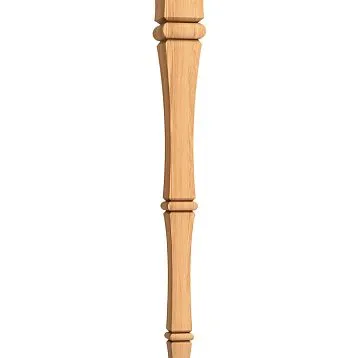
A baluster consists of three parts: a base (the lower part, 100-150 mm high, with a square or round cross-section, which is attached to the step), a body (the middle part, 600-700 mm high, where the decoration is concentrated), and a capital (the upper part, 100-150 mm high, which fits into the handrail rail under the handrail).
The body of a baluster can be turned (processed on a lathe, with vases — thickenings, waists, grooves) or carved (with hand or machine carving — plant ornaments, geometric patterns, figured elements). Turned balusters are cheaper (1200-2500 rubles/piece for oak), carved ones are more expensive (2800-6500 rubles/piece for oak).
The cross-section of the baluster body is 50-100 mm. Thin balusters, 50-60 mm — elegant, light, suitable for modern staircases with minimalist aesthetics. Medium, 70-80 mm — universal, suitable for most staircases. Thick, 90-100 mm — massive, solid, suitable for grand staircases in classical interiors.
The number of balusters on a staircase is determined by the installation spacing. The standard spacing is 120-150 mm between the axes of balusters (ensures safety — a child cannot squeeze between balusters). For a staircase with a width of 1000 mm and 14 steps, 90-110 balusters are required (including landings, turns). The cost of a set of turned oak balusters is 108,000-275,000 rubles, carved ones 252,000-715,000 rubles.
Support posts: vertical accents
Support posts — large vertical elements with a height of 1100-1500 mm, cross-section 100×100 mm, 120×120 mm, installed at key points of the staircase: starting post (at the beginning of the flight on the first floor), turning posts (on landings where the staircase changes direction), finishing post (at the end of the flight on the second floor). Posts serve a structural function (attaching the handrail, reinforcing the structure) and a decorative one (creating vertical accents).
A post consists of a base (the lower part, 200-300 mm high, with a square cross-section, which is attached to the floor or step), a body (the middle part, 600-900 mm high, with a round or square cross-section, turned or carved), and a finial (the upper part, 150-250 mm high, decorative — a ball, vase, acorn, carved capital).
Posts are more massive than balusters, and their decoration is more elaborate. If balusters are simple turned, posts are richly carved. If balusters are carved, posts are even more richly carved (more ornamentation, larger elements).
The cost of a turned oak post is 5500-12000 rubles/piece, a carved one is 15000-35000 rubles/piece. For a staircase with 14 steps and one turn, 3 posts are required (starting, turning, finishing). The cost of a set of posts is 16500-105000 rubles.
Baluster stylistics: classic, modern, eclectic
Classic balusters — symmetrical, with a clear three-part structure (base, body with 2-3 vases, capital), turned or with moderate carving (plant motifs, geometric ornaments). Color natural (brown oak, mahogany) or tinted in dark shades (walnut, wenge). Finish varnish with a slight sheen, emphasizing the texture. Classic balusters are suitable for houses with a classic facade (portal with pilasters, window casings with keystones, cornice with dentils).
Modernist balusters — asymmetrical, with smooth organic forms, without clear vases, with a wavy body. Carving is minimal or absent, emphasis on wood texture. Color natural light (bleached oak, ash) or contrasting (black stained wood). Finish matte or satin oil, preserving tactility. Modernist balusters are suitable for houses with a contemporary facade (minimal stucco, clean lines, large windows).
Eclectic balusters — a combination of classic proportions and unusual ornaments (ethnic motifs, Art Deco geometry, Art Nouveau vegetation). Carving is abundant but not strictly symmetrical. Color can be non-standard (gray, graphite, a combination of natural wood and painted parts). Eclectic balusters are suitable for houses with a mixed facade style (classic elements + contemporary materials).
Important: the style of balusters should correspond to the style of the facade stucco. If the facade is strictly classic (symmetry, order system, traditional proportions), balusters are strictly classic. If the facade is eclectic (a mix of eras, free composition), balusters are eclectic.
Interior: polyurethane moldings along the staircase flight
Molding panels on the wall along the staircase
The wall along the staircase flight is a large vertical plane (4-6 meters long, 5-7 meters high from the first-floor level to the second-floor ceiling), which looks empty and boring without decoration.Buy polyurethane molding for wallsand create molding panels — to transform an empty plane into an architectural composition.
Layout scheme: rectangular frames measuring 80×120 cm are marked on the wall, arranged vertically in two tiers (the lower tier at a height of 50-150 cm from the steps, the upper tier at a height of 200-300 cm). The gap between tiers is 40-60 cm. There can be 3-5 frames depending on the length of the staircase flight.
Molding 60-80 mm wide is glued along the perimeter of each frame. Inside the frames, the wall is painted in a contrasting color (if the main wall is light gray, dark gray inside the frames) or wallpapered with a classic pattern (damask, stripe). The moldings are painted white.
Effect: the wall is structured, creating a rhythm that corresponds to the rhythm of the balusters (vertical rhythm of balusters 120-150 mm, vertical rhythm of molding frames 800-1200 mm — the scales are different, but the principle of repetition is the same). The staircase space ceases to be a utilitarian passageway and becomes an architectural gallery.
Ceiling cornice above the staircase
The ceiling above the staircase flight (or the ceiling of the hall where the staircase is located) is decorated with a polyurethane ceiling cornice 120-180 mm wide along the perimeter. If the hall is double-height (5-7 meters high, without a floor slab between stories), the cornice is installed at the height of the second floor, framing the upper part of the space.
The cornice profile should correspond to the profile of the facade cornice. If the facade cornice has a classic profile with dentils, the ceiling cornice in the hall should also have dentils (the scale can be slightly smaller, but the style is the same). This creates a connection: outside, the cornice crowns the walls; inside, the cornice crowns the hall — the principle is the same.
Decorative ceiling rosettes in the hall
If the hall is large (25-40 m²), one or several decorative rosettes with a diameter of 80-120 cm are placed on the ceiling. The rosettes frame chandeliers and create compositional centers. The rosette ornament should echo the carving of the balusters: if the balusters have floral carving (leaves, flowers), the rosettes should have a floral ornament (acanthus leaves, roses). If the balusters are turned geometric (vases, balusters without carving), the rosettes should have a geometric ornament (concentric circles, radial rays).
Material compatibility: how polyurethane and wood work together
Visual harmony: white and brown
Polyurethane molding (facade and interior) is painted white. Wooden balusters, posts, and staircase handrails are coated with oil or varnish that preserves the natural color of the wood (brown oak, golden ash, reddish beech). The contrast of white molding and brown wood is a classic color scheme that has worked for centuries.
White molding creates architectural graphics, clear lines, and relief. Brown wood creates warmth, naturalness, and tactile richness. Together they create a balance: cold and warm, artificial (polyurethane is a product of chemistry) and natural (wood is a product of nature), smooth (molding after painting is perfectly smooth) and textured (wood with visible annual rings).
This color scheme is universal, suitable for 80% of projects, and does not require complex shade selection.
Tactile contrast: smooth and textured
Polyurethane molding feels smooth and cool to the touch (polymer does not retain heat), and is hard. A hand sliding along a polyurethane molding on the wall feels a perfectly smooth surface without irregularities.
A wooden baluster or staircase handrail feels warm to the touch (wood retains heat), with a barely perceptible texture (if coated with oil, the texture can be felt by fingers), and alive (wood breathes, reacts to humidity, slightly changes dimensions — by millimeters, but this creates a sense of a living material).
Tactile contrast enhances the impression: a person walks up the stairs, holding onto a wooden handrail (warm, pleasant), while their gaze slides over the white moldings on the wall (cool, smooth). The contrast creates a richness of sensations, making the space more interesting.
Durability: both materials last for decades
Polyurethane facade molding, when properly installed and painted, lasts 30-50 years without deterioration.Installing polyurethane molding on a facadeincludes priming, painting with facade acrylic paint in three layers, which protects the polyurethane from ultraviolet light, moisture, and temperature fluctuations.
Wooden balusters made of oak or ash, coated with varnish or oil, last 50-100 years (depending on the intensity of staircase use). Oak darkens over time (patinates), which only enhances its nobility.
Both materials are durable, allowing for the creation of homes where the exterior and interior last equally long, without requiring replacement of elements after 5-10 years.
Package: ordering facade molding and balusters from one place
Advantages of a comprehensive order
Ordering facade molding and interior balusters from one place offers several advantages: stylistic consistency (company specialists help select elements that match in style, profile, and proportions), a single supplier (one delivery, one contact, easier to resolve issues), discounts on comprehensive orders (many companies offer a 7-12% discount when ordering facade and interior decor for a total of 300,000 rubles or more).
Composition of a comprehensive order for a country house
Two-story house, area 180 m², classic facade. Order composition:
Facade molding: cornice 250 mm wide, 45 meters along the house perimeter = 45×1850 = 83,250 rub. Window casings for 12 windows, sets = 12×12,000 = 144,000 rub. Entrance portal (pilasters + architrave + pediment) = 65,000 rub. Rustication on 4 external corners, 72 pieces = 72×1,100 = 79,200 rub. Total facade molding 371,450 rub.
Balusters and staircase elements: turned oak balusters, 95 pieces = 95×1,800 = 171,000 rub. Carved oak support posts, 3 pieces = 3×18,000 = 54,000 rub. Oak handrails, 18 meters = 18×2,200 = 39,600 rub. Handrail fillets, treads, risers = 125,000 rub. Total staircase elements 389,600 rub.
Interior molding: wall molding along the staircase, 40 meters = 40×750 = 30,000 rub. Hall ceiling cornice, 28 meters = 28×980 = 27,440 rub. Ceiling rosette for the hall, 100 cm diameter = 12,500 rub. Total interior molding 69,940 rub.
Total materials: 371,450 + 389,600 + 69,940 = 830,990 rub.
For a comprehensive order, a 10% discount = 83,100 rub. Total materials with discount 747,890 rub.
Installation work: facade molding 165,000 rub, staircase 185,000 rub, interior molding 45,000 rub = 395,000 rub.
Total turnkey: 747,890 + 395,000 = 1,142,890 rub.
Delivery to Customs Union countries
Companies specializing in facade decor and staircase elements deliver not only across Russia but also to Customs Union countries: Belarus, Kazakhstan, Armenia, Kyrgyzstan. Delivery is organized by transport companies; products are packaged in protective film, cardboard (facade molding) or wooden crates (balusters, posts). Delivery cost depends on the volume and weight of the cargo, and distance. For orders of 700,000+ rubles, delivery within Russia and Customs Union countries is often free.
Frequently asked questions
Can polyurethane molding be used on facades in regions with frosts of −40°C?
Yes, high-quality facade polyurethane molding with frost resistance of 300+ cycles can withstand frosts down to −50°C. Proper painting with facade acrylic paint in three layers is important, as it protects the polyurethane from moisture penetration. Moisture is the main enemy: if water gets into micro-cracks, freezes, and expands, it destroys the material. Quality painting prevents moisture ingress.
Which wood species is better for balusters: oak or ash?
Both species are excellent. Oak is slightly harder (hardness 3.7-3.9 vs. 4.0-4.1 for ash, the difference is minimal), its color is warmer (golden-brown vs. light gray for ash). Ash is lighter, which suits modern interiors with a light palette. For classical interiors, oak is preferable.
How long does it take to manufacture and install a comprehensive order (facade + staircase)?
Manufacturing custom facade molding and balusters takes 3-5 weeks (depends on volume, carving complexity). Installation of facade molding takes 2-3 weeks (depends on weather — installation is only possible at temperatures above +5°C). Manufacturing and installation of a staircase takes 3-4 weeks. Installation of interior molding takes 1 week. Total from order to full completion is 9-13 weeks (2-3 months).
Is it mandatory to paint facade molding or can it be left with white primer?
Painting is mandatory. White primer is not a finish coating; it only protects the polyurethane during transportation and storage. On the facade, the primer will deteriorate in 1-2 years under UV and moisture exposure. Facade acrylic paint creates a protective layer that lasts 15-20 years.
Can wooden balusters of different styles be combined on one staircase?
Technically possible, but stylistically risky. Combining classical turned and carved balusters on one staircase can look eclectic-interesting if done professionally, or chaotic-random if done without taste. It's safer to use balusters of one style. If you want variety, you can alternate two types of balusters within the same style (e.g., two simple turned, one carved, two simple, one carved — a rhythm).
How to care for facade molding and wooden balusters?
Facade molding requires no maintenance, except for periodic washing (once a year with a high-pressure washer to remove dust, dirt) and repainting every 15-20 years. Wooden balusters are wiped with a damp cloth to remove dust once a month; varnish or oil is refreshed every 3-5 years (applying one coat).
Conclusion: from the threshold to the second floor — a unified line of style
A house begins with the facade. Polyurethane molding on windows, cornice, and the entrance group portal creates a stylistic code that a guest reads in three seconds. The house continues in the hall, where the staircase with wooden balusters supports this code, develops it, and translates it into the interior space. The house is completed by moldings on the walls along the staircase flight, the cornice on the hall ceiling, and rosettes that close the composition from above. Outside and inside — a unified line, where every detail knows its place, where polyurethane and wood work together, creating architectural unity.
Wall finishing in a private houseDecorating a country house with polyurethane molding combined with wooden balusters is not just decoration; it's creating a holistic environment where the exterior and interior speak the same language. Where a guest, entering through a portal with pilasters, sees a staircase with balusters that repeat the proportions of the pilasters. Where the ornament on the pilaster capitals rhymes with the carving on the staircase posts. Where the facade cornice and the hall ceiling cornice have a similar profile. This architectural unity creates the impression that the house was designed as a whole, from foundation to roof, from facade to interior, by one hand, with one idea.
Company STAVROS offers a full range of solutions for creating architectural unity for a country house. Facade polyurethane molding of European quality — cornices from 120 to 350 mm wide, window surrounds, entrance group portals, pilasters, columns, rustication, balustrades. Polyurethane density 350-400 kg/m³, frost resistance 300+ cycles, moisture resistance 100%, UV resistance with proper painting. All elements are supplied primed with white acrylic primer, ready for final painting with facade paint.
Wooden balusters and staircase elements made from solid oak, ash, beech — turned and carved, over 80 models from classical to modern. Balusters height 850-900 mm, cross-section 50-100 mm, made from select kiln-dried wood (moisture 8-12%), planed, sanded by hand to perfect smoothness. Support posts height 1100-1500 mm, cross-section 100×120 mm, with carved finials (spheres, vases, capitals with ornament). Handrails round cross-section diameter 50-70 mm, length up to 3.5 meters without joints. All elements undergo strict quality control, comply with GOST standards for strength and geometry.
Interior polyurethane molding — moldings of all widths from 40 to 150 mm, ceiling cornices, rosettes diameter from 40 to 150 cm, decorative overlays, corner elements. Density 250-300 kg/m³ (lighter than facade, sufficient for interior), primed white, ready for painting with interior acrylic paint.
STAVROS design bureau develops comprehensive design projects for country houses with 3D visualization of exterior and interior. You see how facade molding combines with the house architecture, how staircase balusters relate to facade elements, how interior moldings continue the exterior stylistics. The project includes layout of all elements, material calculation down to the piece, estimate with prices, step-by-step installation plan. Project cost for a house 150-250 m² — 35,000-65,000 rubles, which is deducted from the order cost when placing an order from 500,000 rubles.
When ordering a material kit (facade molding + balusters + interior molding) from 500,000 rubles, STAVROS provides a 9% discount on all decorative elements. For orders from 800,000 rubles — an 11% discount plus free delivery across Russia and Customs Union countries. For orders from 1,200,000 rubles — a 13% discount plus free delivery plus a free project with 3D visualization plus a 5% discount on installation work. Savings 65,000-210,000 rubles.
STAVROS product delivery is carried out across all of Russia and to Customs Union countries — Belarus, Kazakhstan, Armenia, Kyrgyzstan. Facade molding is packaged in protective film and cardboard, transported on pallets. Balusters and posts are packaged in corrugated cardboard with bubble wrap inside, transported in wooden crates. Delivery is organized by verified transport companies with experience in fragile cargo transportation. Delivery time within Russia 3-10 days, to Customs Union countries 7-14 days depending on distance.
STAVROS installation teams are specialists in comprehensive country house finishing. Installation of facade molding with priming, painting with facade paint in three layers, sealing joints. Manufacturing and installation of wooden staircases with installation of steps, balusters, posts, handrails, sanding, coating with varnish or oil. Installation of interior molding on walls and ceilings. Work across all of Russia, travel to Customs Union countries for projects from 800,000 rubles, 3-year warranty on installation, 5-year warranty on products.
Choosing STAVROS, you get a partner in creating homes where outside and inside — there is a unified line of style, where facade and interior are connected not by chance, but thoughtfully, where polyurethane on the facade and wood on the staircase work together, creating an architectural work. Build homes holistically. Start with the facade, continue with the staircase, finish with moldings in the hall. With STAVROS, it's accessible, quality, beautiful.