








































































Article Contents:
- Why a rosette is needed: functions of ceiling decor
- Visual base of the luminaire
- Enlarging the scale of the lighting center
- Masking technical imperfections
- Protecting the ceiling from overheating
- Acoustic Effect
- Typology of ceiling rosettes: from laconic to baroque
- Classification by diameter
- Stylistic categories of ornament
- Special Shapes
- Selecting a rosette for a chandelier: proportions decide everything
- Formula for selecting diameter
- Considering room area
- Ceiling height and rosette relief
- Ceiling cornices: framing the space
- Functions of ceiling cornice
- Choosing cornice width
- Combining rosette and cornice
- Installing a ceiling rosette: step-by-step technology
- Preparing the ceiling
- Center Marking
- Cutting a hole for wiring
- Applying adhesive
- Installation and pressing
- Additional fixation for heavy rosettes
- Installing a ceiling cornice: perimeter of perfection
- Marking the level
- Cutting and fitting corners
- Adhesive Application
- Joint sealing
- Decorative painting: from white to gold
- Preparation for Painting
- Choosing paint
- Painting Technique
- Patination and gilding
- Coffers and multi-level decor: ceiling composition
- Coffered ceiling
- Molding frames around the rosette
- Multi-level roses
- Answers to popular questions about ceiling decor
- Conclusion: the art of creating ceilings with STAVROS
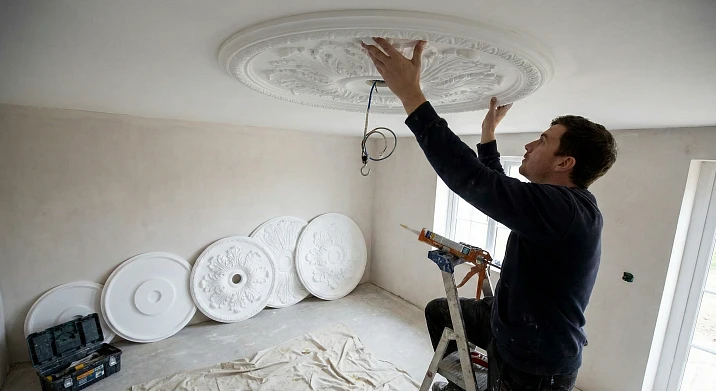
Have you ever seen chandeliers that look like they were just hung—a wire sticking out of a hole in the ceiling, surrounded by a messy patch of old paint? Now imagine the same chandelier framed by an elegant rosette with a carved 60-centimeter diameter pattern. The chandelier gains scale, the ceiling gains architecture, the room gains style.Polyurethane ceiling medallion for chandeliersworks this magic in just a few hours of work and on a modest budget.
Why do some interiors leave a lasting impression while others are forgotten as soon as you leave? It's not about the price of furniture or the size of the room. It's about the details. How the chandelier's light plays on the relief of the ceiling rosette, how the cornice frames the perimeter space, how moldings create rhythm on the walls.Decorative polyurethane ceiling moldingis the language of classical architecture, accessible to everyone. Once, such decor was the prerogative of palaces. Today, anyone who has held a mounting gun can install it.
But how do you choose the right rosette among hundreds of options? What diameter should the element be for a specific chandelier? Why isPolyurethane Ceiling Moldingsbetter than plaster? How to install without cracks and misalignments? How to paint to achieve the effect of antique plaster molding or modern minimalism?
Why a rosette is needed: functions of ceiling decor
When asked about the function of a rosette, most people answer: to hide the chandelier's mounting point. Yes, that's one of its tasks. But far from the only one, and not even the main one.




Visual base for the light fixture
A chandelier without a rosette floats in emptiness. It isn't connected to the room's architecture. Add a rosette twice the diameter of the chandelier—and the light fixture gains a visual base. It seems to grow from the ceiling, not just hang from a chain. Perception psychology works like this: the eye seeks support for every object. A chandelier without support subconsciously feels unstable. The rosette provides that support.
The effect is enhanced when the rosette's relief is concentric—circles of the pattern radiate from the center where the chandelier hangs. The eye follows the pattern from the edge to the center, focusing on the light source. The composition becomes cohesive.
Our factory also produces:

Enlarging the scale of the lighting center
A small 50-centimeter diameter chandelier in a large 30-square-meter living room looks disproportionate. Replace it with a large one? Expensive, and the style might not fit. Install an 80-100 centimeter diameter rosette—the lighting center will visually expand. The room will gain proper proportions.
This works in reverse too. A massive Baroque chandelier in a small 12-square-meter bedroom can feel overwhelming in scale. A compact 30-40 centimeter rosette will balance the composition, preventing the chandelier from dominating.
Get Consultation
Masking technical flaws
Old houses are full of surprises. The ceiling after removing a Soviet-era chandelier delights with a 15-centimeter hole, plaster chips, rust stains from wiring. Patching, leveling, painting—three days of work. Or glue on a rosette in two hours, completely hiding all defects. The rosette's center has a hole for wiring—the existing hole aligns perfectly, the rest is covered by the decor.
Moving a chandelier to a new spot leaves an old hole. Patching requires skill—you need to spackle and paint so the spot is invisible. With rosettes, it's simpler: a new rosette in the new spot, an old rosette in the old spot—two lighting centers for zoning, or nothing needed in the old spot at all, the rosette hid everything.
Protecting the ceiling from overheating
Powerful incandescent bulbs (100-150 W) heat the chandelier's canopy to 70-90 degrees. Heat rises to the ceiling. Paint yellows, plaster dries out, stretch ceilings can melt. A polyurethane rosette creates a thermal insulation buffer—heat dissipates over a larger area, reducing concentration. Plus, polyurethane withstands temperatures up to +80 degrees without deformation.
Now, with the shift to LEDs, the problem has faded—LED chandeliers barely heat up. But if you have a classic fixture with incandescent or halogen bulbs, a rosette will protect the ceiling.
Acoustic effect
An unexpected bonus: the rosette's textured surface scatters sound waves. In a room with a smooth ceiling, sound reflects, creating echo (especially in empty rooms without furniture, during renovation). The rosette disrupts proper reflection, distributing sound more softly. The effect is small but noticeable in rooms with high ceilings (from 3.2 meters).
Ceiling Rosette Typology: From Minimalist to Baroque
Polyurethane molding under the chandelierare classified by diameter, pattern style, and relief complexity. The right choice depends on chandelier size, room area, ceiling height, and overall interior style.
Classification by diameter
Compact rosettes with a diameter of 20-35 centimeters are used for spotlights, small pendants, minimalist chandeliers in bedrooms, studies, hallways. Also for multi-level lighting: a central large rosette with a chandelier plus four compact ones around the perimeter with spotlights.
Standard rosettes with a diameter of 40-60 centimeters are a universal option. Suitable for most chandeliers in rooms of 12-25 square meters. Medium-density pattern—visible but not overloaded. Easily integrated into any style from modern to classic.
Large rosettes with a diameter of 65-90 centimeters create a formal look in living rooms, dining rooms, halls of 25-40 square meters. Complex, multi-level pattern. Require high ceilings (from 3 meters)—on a 2.7-meter ceiling, a large rosette feels oppressive, visually lowering the height.
Monumental rosettes with a diameter of 100-150 centimeters are for special spaces: double-height halls, ballrooms, hotel lobbies, theater foyers, grand staircases. Baroque pattern, deep relief (up to 40-50 millimeters). Installation requires two or three people; the ceiling must be sturdy.
Stylistic Categories of Ornament
Classical rosettes with ornamentation of acanthus leaves, rosettes, palmettes, concentric circles, pearl borders (a row of beads along the perimeter). Symmetry is strict, relief is moderate 15-25 millimeters. Suitable for English classic, Italian style, American neoclassicism.
Baroque rosettes are maximally decorative. Ornamentation includes lush leaves, shells, volutes (spiral scrolls), putti (cherubs), floral garlands. Symmetry is observed, but there is a sense of movement and excess. Relief is deep 30-50 millimeters. The center is often accentuated with an additional element—a rosette, a medallion. For luxurious interiors in Baroque, Rococo, Empire style.
Modernist rosettes with ornamentation of stylized plant forms, asymmetrical lines, flowing volumes. Characteristic are curved stems of irises, water lilies, swans, female faces framed by hair. Relief is complex but not overloaded. For interiors in Modern, Art Nouveau style.
Art Deco rosettes with geometric ornamentation: concentric circles, rays, zigzags, stepped forms, stylized shells. Symmetry is strict, lines are clear, relief is graphic. For Art Deco interiors, 1920s-30s, Hollywood glamour.
Contemporary rosettes are minimalist. Ornamentation is absent or maximally laconic—several concentric circles, simple geometric divisions. Relief is low 5-10 millimeters. For contemporary interiors, Scandinavian style, minimalism, high-tech with decorative elements.
Special Shapes
Oval rosettes for elongated spaces: corridors, galleries, narrow dining rooms. Size 50×80, 60×100, 80×140 centimeters. Ornamentation is elongated, emphasizing the direction. For linear chandeliers (several lamps in a row) or for visually altering room proportions—an oval rosette placed across a narrow room visually widens it.
Square and octagonal rosettes for geometric interiors. Side length 40, 50, 60, 80 centimeters. Ornamentation repeats the shape—square frames, diagonal divisions. For square chandeliers (shades at the corners of a square) or for coffered ceilings, where all elements are square.
Domed rosettes are not flat but convex. The central part rises in a dome 30-80 millimeters above the ceiling level. Creates the effect of a coffer in the center of the ceiling. The chandelier is suspended in the center of the dome, enhancing the sense of depth. For interiors with high ceilings, where volume and drama are needed.
Selecting a rosette for a chandelier: proportions are everything
Beginner's mistake: buying a rosette that is visually appealing without correlating it with the chandelier's size. Result—disproportion. A small rosette under a large chandelier gets lost, looks like a saucer stand. A large rosette under a tiny chandelier overwhelms the fixture, creating a sense that the chandelier is an accessory to the rosette, not vice versa.
Diameter selection formula
Basic rule: the rosette diameter should be 1.5-2.5 times larger than the chandelier diameter. For classic interiors, coefficient 2-2.5; for contemporary, 1.5-1.8.
Chandelier diameter 40 centimeters → rosette diameter 70-100 centimeters (classic) or 60-70 centimeters (contemporary style). Chandelier diameter 60 centimeters → rosette 100-150 centimeters (classic) or 90-110 centimeters (contemporary). Chandelier diameter 80 centimeters → rosette 140-200 centimeters (classic)—such are rare, usually custom-made, or 120-140 centimeters (contemporary).
For chandeliers on a long suspension (80-120 centimeters from the ceiling, hanging low over a table) the coefficient can be reduced to 1.2-1.5. The chandelier is perceived separately from the ceiling; the rosette serves only as a decorative point for the suspension exit.
Accounting for room area
The chandelier-rosette proportion is adjusted by the room area. In a small room of 10-12 square meters, a large rosette with a diameter of 100 centimeters will occupy half the ceiling, creating overload. Better 50-60 centimeters even under a large chandelier.
In a spacious living room of 35-40 square meters, a 60-centimeter rosette will get lost even under a suitable chandelier. At least 80-90 centimeters are needed to create a substantial visual center.
Empirical formula: rosette diameter in centimeters is approximately equal to the square root of the room area in square meters, multiplied by 10. Room 16 square meters → square root of 16 = 4, multiply by 10 = 40 centimeters base rosette diameter. Room 25 square meters → 5×10 = 50 centimeters. Room 36 square meters → 6×10 = 60 centimeters.
This is the base size, to which coefficients are applied: for classic style +20-40 percent, for minimalist -10-20 percent, for Baroque +50-70 percent.
Ceiling height and rosette relief
Low ceilings 2.5-2.7 meters require rosettes with low relief (10-15 millimeters). Deep Baroque relief of 40-50 millimeters will visually lower the ceiling even more. Ornamentation should be flat, graphic.
Standard ceilings 2.8-3.0 meters allow medium relief 20-30 millimeters. Ornamentation is classic, moderately voluminous.
High ceilings 3.2-4.0 meters require deep relief 35-50 millimeters. A flat rosette on a high ceiling is not readable; the ornament blends. Expressive chiaroscuro is needed, which only deep relief provides.
Ceiling cornices: framing the space
The rosette under the chandelier is an accent. But an accent works when the space is framed.Polyurethane Ceiling Moldingsincludes cornices (crown molding) that run along the room perimeter at the wall-ceiling junction.
Functions of a ceiling valance
Visual separation of ceiling from walls. Without a cornice, the wall plane smoothly transitions into the ceiling—the boundary is blurred, the room appears lower. A cornice creates a clear dividing line; the ceiling is perceived as a separate plane, height visually increases by 5-10 centimeters.
Masking junction irregularities. A perfectly even wall-ceiling corner is rare. Usually, there are gaps, level differences, plaster waves. A cornice 80-120 millimeters wide completely conceals defects.
Concealed lighting. Cornices with a special profile (shelf set off from the wall by 50-80 millimeters) allow for LED strip placement behind them. Light is directed upward onto the ceiling, reflecting to create soft contour illumination. Floating ceiling effect—especially on glossy stretch ceilings.
Acoustic correction. Like rosettes, cornices with relief scatter sound, reducing the boominess of rooms with smooth walls.
Choosing cornice width
For low ceilings (2.5-2.7 meters), narrow cornices of 50-80 millimeters are optimal. Wide ones visually reduce the height. The profile is simple, relief is minimal.
For standard ceilings (2.8-3.0 meters), medium-width cornices of 90-120 millimeters are suitable. The profile is classic with several steps, relief is moderate.
For high ceilings (3.2-4.0 meters), wide cornices of 130-200 millimeters are needed. A narrow cornice will get lost, won't be readable. The profile is complex, multi-stepped, relief is deep.
Combining rosette and cornice
The style of the ornament must match. A Baroque rosette with lush leaves and a simple smooth cornice is a stylistic mismatch. A cornice with an ornament of the same type is needed: floral motifs, volutes, pearl beading.
Relief is proportional. If a rosette has a deep relief of 40 millimeters, the cornice must have a relief of at least 20-25 millimeters. A flat cornice with a three-dimensional rosette will create imbalance.
Color scheme is unified. Usually all stucco is painted one color — white, cream, light gray. For luxurious interiors, accentuation is used: a rosette with gilding of individual elements, a cornice with a thin gold line along the top edge.
Ceiling rosette installation: step-by-step technology
Installationpolyurethane stucco for a chandelierdoes not require professional skills. Anyone who can use a drill and a mounting gun can handle it.
Ceiling preparation
The ceiling must be clean, dry, and sturdy. Dust reduces adhesive adhesion by 60-80 percent. Wipe the installation area with a damp cloth, let it dry.
If the ceiling is painted with glossy paint or enamel, sand the area under the rosette with medium-grit sandpaper. Gloss prevents the adhesive from bonding. A matte surface will ensure strong adhesion.
Remove loose, crumbling areas (old whitewash, peeling paint) with a putty knife down to a solid base. Treat with deep-penetration primer, let dry for 4-6 hours.
Center marking
For a new installation, the center is determined by the planned position of the chandelier. Usually, this is the geometric center of the room (the diagonals of a rectangular room intersect at the center) or the center of a functional zone (over the table in the dining room, over the sofa in the living room).
For replacing an existing chandelier, the center is already there — where the old light fixture hangs. Remove the chandelier, leaving the wiring exposed. Mark the center with a pencil.
Cutting a hole for wiring
The rosette has a central hole, usually 80-120 millimeters in diameter, for wiring output. If there is no hole (some models come with just a recess), cut it with a sharp knife. Place the rosette face down on a flat surface, mark a circle in the center with a diameter 10-15 millimeters larger than the wiring exposed on the ceiling. Cut carefully — the edge must be smooth, without burrs.
If the wiring on the ceiling exits not from the center but from the side (old wiring, imprecise installation), there are two solutions. First: move the wiring output to the center — call an electrician, they will chase a channel and move the junction box. Second: buy a rosette with an eccentric hole or cut a hole not in the center of the rosette, but offset towards where the wiring exits. Install the rosette so the hole aligns with the wiring. Visually, the asymmetry won't be noticeable if the offset does not exceed 30-40 millimeters.
Applying adhesive
For ceiling stucco, polymer mounting adhesives like liquid nails are used. Best brands: Moment Montazh Express Decor, Titan Wild, Quelyd Mastik. The adhesive must be white (colored may show through thin polyurethane), with quick setting (30-90 seconds).
Apply adhesive to the back of the rosette in a snake pattern, spiraling from the center to the edge with a coil pitch of 40-50 millimeters. For a rosette 60 centimeters in diameter, adhesive consumption is 60-80 grams (about 1/5 of a cartridge). Don't apply too much — excess will squeeze out and stain the ceiling. Don't apply too little — the bond will be weak.
Along the edge of the rosette (the outer 20-30 millimeters), apply a continuous strip of adhesive. This ensures a seal around the perimeter — there will be no gaps between the rosette and the ceiling.
Installation and pressing
Lift the rosette to the ceiling, align the central hole with the exposed wiring, thread the wires through the hole. Apply the rosette to the ceiling, aligning the center of the rosette with the mark on the ceiling.
Press evenly over the entire area. Do not press pointwise — you will deform the soft polyurethane. Correct pressing: palms distributed over the area of the rosette, pressure moderate, time 60-90 seconds. The adhesive will set, the rosette will be fixed.
If the rosette is large (diameter over 80 centimeters), work with two people. One holds the center, the other presses along the perimeter, moving in a circle. This ensures even adhesion without air bubbles.
Excess adhesive squeezed out along the edges, remove immediately with a damp sponge before it hardens. Dried adhesive will have to be cut off with a knife and sanded — labor-intensive.
Additional fixation for heavy rosettes
Rosettes with a diameter over 100 centimeters and weight over 3 kilograms require additional mechanical fastening. The adhesive may not withstand the pull-off weight (especially if the ceiling is not perfectly level and voids remain in places between the rosette and the ceiling).
After gluing (when the adhesive has set but not fully cured — after 4-6 hours), drill 4-6 holes through the ceiling rosette around the perimeter, 100-150 millimeters from the edge. Use a 6-millimeter drill bit, depth 40-50 millimeters. Insert dowels, screw in countersunk-head screws, sinking the heads 3-5 millimeters below the surface of the rosette.
Fill the indentations over the screws with acrylic putty, let dry, sand with fine sandpaper. After painting, the fastening points will become invisible.
Ceiling cornice installation: the perimeter of perfection
Installing a cornice is more complex than a rosette due to the need for precise corner joining. But the technique is well-established; anyone can manage it.
Level marking
The cornice must be installed strictly horizontally. Even a 5-millimeter deviation over 4 meters is noticeable to the eye. Use a laser level or water level. Measure down from the ceiling a distance equal to the width of the vertical part of the cornice (the part adjacent to the wall). Usually 50-100 millimeters. Draw a horizontal line along the entire perimeter of the room. This is the line of the lower edge of the cornice.
Cutting and fitting corners
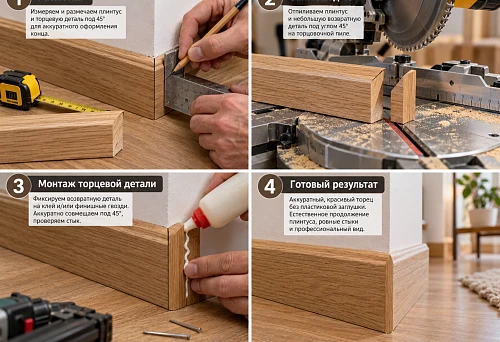
Cornices are supplied in 2-meter strips. For a room with an 18-meter perimeter, you need 9 strips (18 / 2 = 9). Start with the longest wall. Measure the wall length, cut the strip to the required length (usually from corner to corner, corners are cut at 45 degrees).
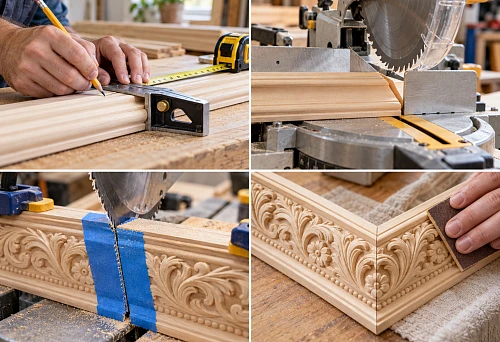
Corners are critical points. Internal corners (90 degrees) are cut with a miter box at 45 degrees. Two strips, cut at 45 degrees in opposite directions, join in the corner, forming a smooth connection without gaps.
For cutting, use a sharp utility knife or a fine-toothed hacksaw for metal. Polyurethane cuts easily, but a dull tool will crush edges and leave burrs. The cut must be clean, without chips.
External corners (270 degrees, protruding wall parts) are cut similarly, but in the opposite direction.
Adhesion
Apply adhesive to both adjacent surfaces of the cornice: the part that adheres to the wall and the part that adheres to the ceiling. The adhesive bead should be continuous, 5-7 millimeters wide.
Place the strip against the wall along the marking, press along its entire length simultaneously. For this, work with two people: one holds one end, the other holds the second, both press against the wall and ceiling. Hold for 60-90 seconds until the adhesive sets.
The next strip is joined to the previous one. The joint should be tight, without a gap. If there is a gap (the cut was inaccurate), fill it with acrylic sealant after installation.
Joint sealing
After installing the entire perimeter, inspect the joints. Micro-gaps (up to 1 millimeter) are filled with white acrylic sealant. Squeeze sealant into the gap, smooth with a wet finger or rubber spatula, remove excess. After drying (4-6 hours), the seam becomes invisible.
Wide gaps (more than 2 millimeters) indicate a cutting error. Fill the gap with a piece of polyurethane cut to shape, glue it, putty, sand. Or remove the inaccurate strip, recut it, and install it correctly.
Decorative painting: from white to gold
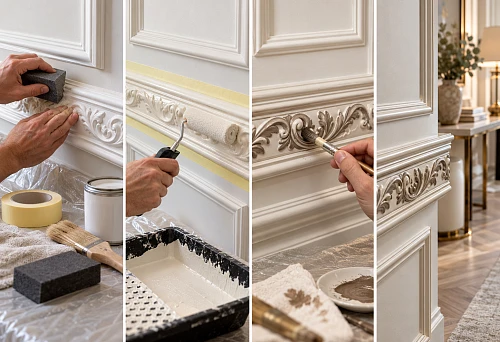
Polyurethane molding is supplied white, primed. It is ready for painting. You can leave it white — a classic option. Or paint it any color, add patina, gilding, an aged effect.
Preparation for painting
If the molding was installed on already painted walls and ceiling, and joints are sealed, you can paint immediately. If the walls are not yet painted, first paint the walls and ceiling, then the molding. This is easier than protecting the molding with painter's tape when painting walls.
Before painting, wipe the molding with a dry cloth to remove construction dust. Dust reduces paint adhesion, which can cause bubbles and peeling.
Paint Selection
For interior molding, water-based paints are used: acrylic, latex, silicone. They form a matte or semi-matte finish, do not yellow, are easily tinted to any color, odorless, and dry quickly (2-4 hours between coats).
For wet areas (bathrooms, kitchens), choose paints marked 'moisture-resistant.' They form a vapor-permeable but water-resistant coating that can be washed.
For a glossy effect (modern interiors, art deco), use semi-gloss or glossy acrylic paints. But note: gloss highlights all imperfections; the surface must be perfectly smooth.
Painting technique
Painting is done with a brush or roller. For rosettes with deep relief, a brush is more convenient — it reaches into all recesses. For cornices with a simple profile, a roller can be used — faster.
Apply the first coat thinly, evenly, without drips. The paint should soak into the primer, creating a base. Dries in 2-4 hours.
The second coat evens out the color, covering any thin spots. Apply in a direction perpendicular to the first (if the first coat was applied with horizontal strokes, the second with vertical). Dries in 2-4 hours.
The third coat is the finish. Needed if color unevenness remains after the second. Usually, two coats are sufficient for white and light pastel paints. For bright and dark colors, three may be required.
Patination and gilding
Patina — an aged effect where paint in the recesses of the relief is darker, creating an impression of centuries-old dust and natural darkening. Technique: after painting with a base color (white, cream, light gray), apply a dark patinating paint (umber, gray-brown, black, heavily diluted) with a brush into all recesses. Excess is immediately wiped off with a damp sponge, leaving darkening only in the depth of the relief. After drying, the rosette looks like antique plaster.
Gilding — applying gold, silver, or bronze paint to the raised parts of the ornament. Technique: after painting with a base color (usually white), apply metallic paint with a fine brush or sponge only to the convex parts — leaves, pearls, tops of volutes. The recesses remain white. Effect — luxury, formality, palace-like grandeur.
Coffers and Multi-Level Decor: Ceiling Composition
Rosette and cornice are the basic level of decor. For more complex interiors, coffers, molding frames, and multi-level compositions are used.
Coffered Ceiling
A coffer is a rectangular or square recess formed by moldings. A coffered ceiling is a grid of coffers covering the entire ceiling. The effect is monumentality, classical luxury, and visual complexity.
Scheme of a simple coffered ceiling for a 4×5 meter room: the ceiling is divided by moldings into 100×100 centimeter squares (4 rows of 5 squares = 20 coffers). Molding width 60-80 millimeters, medium relief. Inside each coffer — contrasting paint (e.g., ceiling white, inside coffers — light beige) or a small rosette with a diameter of 40-50 centimeters.
Installation: marking the ceiling into squares, installing longitudinal moldings, then transverse ones, joints at corners are cut at 45 degrees. For coffers, flat wide moldings or special polyurethane box beams are used.
Molding Frames Around a Rosette
An additional level of decor — concentric frames around the central rosette. A rosette with a diameter of 60 centimeters is framed by a round or square molding frame at a distance of 30-40 centimeters from the edge of the rosette. The effect — highlighting the light center, creating a focal point.
Installing round frames requires flexible molding — special flexible polyurethane moldings or pre-soaked regular ones (immersed in hot water for 30-40 minutes, become flexible, bent according to a template, fixed until cool, harden, retaining shape).
Square frames are simpler — regular straight moldings are cut and joined at 45 degrees.
Multi-tiered rosettes
For particularly formal interiors, composite rosettes consisting of several concentric levels of different diameters are used. Central rosette diameter 40 centimeters, around it a rosette-ring with a diameter of 70 centimeters, around — another ring with a diameter of 100 centimeters. Installation from center to periphery. The effect — maximum decorativeness, palatial luxury.
Answers to Popular Questions About Ceiling Decor
Can a rosette be glued to a stretch ceiling?
No, directly it cannot — the PVC film or fabric of the stretch ceiling will not support the weight of the rosette, will deform, and the adhesive will damage the coating. Solution: before installing the stretch ceiling, attach a wooden platform (plywood 10-12 millimeters thick) slightly larger than the rosette to the base ceiling (concrete slab). The stretch ceiling is installed, a hole is cut at the platform location, edges are treated with a thermal ring. The rosette is glued to the platform through the hole.
How much does a ceiling rosette weigh?
Depends on diameter and polyurethane density. Standard rosettes: diameter 30 centimeters — 200-300 grams, 50 centimeters — 600-900 grams, 70 centimeters — 1.2-1.8 kilograms, 100 centimeters — 2.5-3.5 kilograms. This is 8-10 times lighter than gypsum rosettes of similar size.
Can a rosette be used without a chandelier, just as decor?
Yes, a rosette is a self-sufficient decorative element. A spot light, decorative overlay can be installed in the center, or it can be left smooth. For modern interiors, asymmetrical placement of rosettes is used — not in the center of the ceiling, but offset, in groups of 2-3 pieces of different diameters.
How long does polyurethane molding on the ceiling last?
With proper installation and painting — for decades. Polyurethane does not rot, crumble, or yellow (if high-quality, with UV stabilizer for facade use also applied indoors). Manufacturers' warranty period is 10-15 years, actual service life is 30-50 years.
Can molding be installed independently without experience?
Yes, the technology is simple. Installing a rosette requires 2-3 hours of work by one person. For cornices along a room perimeter of 18 meters — one day of work for two people. The main things are accuracy, precise marking, sharp cutting tools, and quality adhesive.
Why is polyurethane better than gypsum for ceiling decor?
Weight is 8-10 times less — does not require ceiling reinforcement, easier installation. Absolute moisture resistance — can be installed in bathrooms, kitchens; gypsum absorbs moisture and deteriorates. Detail is higher — polyurethane is cast in precise molds, gypsum has a granular structure. Strength — polyurethane does not break when dropped, gypsum is fragile. Price is 2-3 times lower with the same relief quality.
Can ceiling molding be painted in dark colors?
Yes, but with caveats. Dark molding on a light ceiling creates graphic contrast, suitable for modern interiors. But dark color diminishes the relief — chiaroscuro works on light surfaces, dark ones look flat. Compensation: additional lighting with directional spotlights creating side light and revealing the relief.
What distance should be between the cornice and the rosette?
There is no strict rule. Visually comfortable when the distance from the edge of the rosette to the cornice is at least half the diameter of the rosette. A rosette with a diameter of 60 centimeters — distance from edge to cornice at least 30 centimeters. If the ceiling is small (room 3×4 meters), the rosette can almost reach the cornice, creating rich decor.
Is ceiling preparation needed before installing molding?
Yes, the ceiling must be clean (without dust, grease, soot), dry (humidity no more than 8 percent), strong (plaster not crumbling, paint not peeling). Loose areas are reinforced with primer. Irregularities up to 3-5 millimeters are compensated by adhesive; larger irregularities should preferably be leveled with plaster or putty before installation.
Conclusion: The Art of Ceiling Creation with STAVROS
Polyurethane molding under the chandelier— is not merely a way to conceal the lighting fixture mounting point. It is an architectural technique that transforms the ceiling from a technical plane into the fifth wall of the interior, a design element, a source of aesthetic pleasure.
A correctly chosen rosette creates a visual foundation for the chandelier, increases the scale of the lighting center, and connects the fixture with the ceiling architecture. Perimeter cornices frame the space, structure it, and create a sense of completeness. Coffers and molding frames add complexity, depth, and monumentality.
When selecting, consider proportions: the rosette diameter should be 1.5-2.5 times larger than the chandelier diameter; the ornament style should match the interior; the relief should be proportional to the ceiling height. Installation is simple — a clean, dry surface, high-quality adhesive, precise marking, careful pressing. Painting with two to three coats of water-based paint; optionally, patination or gilding for an antique and luxurious effect.
STAVROS company — a recognized leader in the Russian architectural decor market — offers the most comprehensive rangeof polyurethane ceiling moldingsof European quality. Over 200 models of ceiling rosettes with diameters from 20 to 150 centimeters in all styles: classic, Baroque, Empire, Art Nouveau, Art Deco, contemporary minimalism.
Material — European polyurethane with a density of 180-220 kilograms per cubic meter, ensuring color whiteness, clarity of the finest relief details, and strength without brittleness. Casting is done in high-precision molds made from handcrafted master models by sculptor-restorers. Every leaf, every groove of the ornament is reproduced with jeweler-like precision.
Ceiling cornices are available in over 150 profiles: from simple 50-millimeter-high coves to luxurious multi-tiered cornices 200 millimeters wide with modillions, dentils, and ornaments. All profiles come in a standard length of 2 meters; packaging protects against damage during transportation.
Moldings for creating coffers, frames, trims — over 80 profiles with widths from 20 to 150 millimeters. Flexible moldings for round shapes. Corner elements for all profile types, eliminating the need for complex miter cuts.
Installation accessories: professional polymer adhesives with fast setting, acrylic sealants for joint filling, facade paints in all colors, protective varnishes, patinating compounds, metallic paints for gilding.
Consultative support at all stages: assistance in selecting rosette models and cornice profiles considering chandelier size, room area, ceiling height, and interior style. Calculation of required material quantities accounting for joints and offcuts. Step-by-step recommendations for installation and painting. Video tutorials on the STAVROS website demonstrate all work stages from surface preparation to final coating.
Custom manufacturing is available for exclusive projects. Non-standard diameter rosettes (130, 175 centimeters), unique ornaments based on designer sketches, reproduction of historical samples from old mansions — STAVROS will create a master model, produce a mold, and cast the product according to your technical specifications. Custom production lead time is 6-10 weeks.
Contact us to confirm shipping to your destination. and Eurasian Economic Union countries. EAEU goods move without customs duties — you pay only the product price and shipping. Special packaging prevents damage even during long-distance transportation.
Visit STAVROS showrooms in Moscow and St. Petersburg to see samples in person, feel the material quality, assess relief detailing, and get samples for fitting in your interior. Or order through the website — detailed high-resolution photos, precise dimensions, and comprehensive descriptions will help you make the right choice from home.
Create ceilings you want to look at. Turn chandeliers into composition centers. With quality STAVROS moldings and proper installation techniques, your ceiling will become a work of architectural art that will delight for decades. Trust craftsmanship — trust STAVROS.