












































































Article Contents:
- Polyurethane Appliqués: A Universal Solution for Furniture Facades
- Advantages of PU Appliqués for Furniture Facades
- How to Choose Appliqués for Different Furniture Styles
- Base Elements: The Foundation of Composition
- Functional Purpose of Decorated Base
- Coordination with Baseboards
- Staircase Posts as an Architectural Focal Point
- Wooden Balusters: Classic Beyond Time
- Aligning Posts with Furniture Decoration
- Pattern Rhythm: Creating Harmonious Space
- Principles of Distributing Decorative Elements
- Vertical and Horizontal Lines
- Repeating Motifs as a Unifying Factor
- Color Palette: When White Is Not the Only Option
- Monochromatic solutions
- Toned Variants
- Coordination with the Color of Staircase Elements
- Materials and Their Compatibility
- Polyurethane versus Wood
- Density and Weight of Structures
- Installation technology: from theory to practice
- Surface Preparation
- Choosing the adhesive composition
- Positioning Accuracy
- Painting and final finishing
- Priming
- Base Layer
- Decorative techniques
- Care for Decorated Furniture and Staircase Elements
- Regular Cleaning
- Protection against damage
- Restoring damaged areas
- Stylistic Solutions for Different Rooms
- Living Room: Grandeur and Formality
- Dining Room: Coziness and Warmth
- Bedroom: Calmness and Intimacy
- Office: Rigor and Presentability
- Budget Solutions: Maximum Effect at Minimum Cost
- Selective Decoration
- DIY approach: painting yourself
- Combining expensive and budget elements
- Modern trends in decor
- Minimalism in classic style
- Geometry and abstraction
- Contrasting combinations
- Decor mistakes: what to avoid
- Style mismatch
- Over-decorating
- Ignoring proportions
- Incorrect installation
- Seasonality and interior transformation
- Festive decoration
- Updating without renovation
- FAQ: Frequently Asked Questions
- Conclusion

Interior is not just a set of items, but a complex symphony where each detail plays its part. When it comes to furniture and architectural elements, decorative finishing plays a special role.Polyurethane molding for furnitureand balusters can create an incredible sense of unity, transforming scattered items into a cohesive ensemble. But when exactly does decoration start 'working' with furniture, rather than against it? Let's explore this delicate art.
Modern interior design requires special attention to details. It's not enough to simply buy beautiful furniture and install an elegant staircase. It's important to create visual harmony between all elements of the space. It is precisely here that polyurethane appliqués and wooden balusters become the very 'bridges' that unite the interior into a harmonious whole.


Polyurethane appliqués: a universal solution for furniture facades
When we talk about decorating furniture, the first thing that comes to mind is heavy wood carving or expensive inlays. However, modern technologies offer a more practical and equally effective solution - polyurethane appliqués.




Advantages of PU appliqués for furniture facades
Polyurethane as a material for decorative elements possesses a number of indisputable advantages. First, it is lightweight yet visually impressive. An appliqué weighing only a few dozen grams can completely transform the facade of a cabinet or chest, giving it the appearance of antique furniture worth tens of thousands.
Secondly, polyurethane is not afraid of moisture and temperature fluctuations. This is critically important for kitchen furniture, where constant vapors from cooking and dishwashing quickly degrade wooden carvings.molded decoration elementPolyurethane appliqués will retain their original appearance even after years of use under such conditions.
Thirdly, the ability to paint in any color opens up endless possibilities for creativity. Today, the appliqué may be white, tomorrow - under patina, the day after - gold. And all this without the need to replace the element itself.
Our factory also produces:



How to choose appliqués for different furniture styles
Classic style requires symmetrical, precisely executed ornaments. Here, rosettes with floral motifs, cartouches with scrolls, and corner elements with acanthus leaves are appropriate. Such appliqués are ideal for bedrooms and living rooms styled in Baroque or Empire.
Neoclassicism is characterized by great restraint. Here, straight-line elements with minimal relief - reeded moldings, rectangular frames, geometric rosettes - work well. Such decoration does not overload facades but gives them a noble finish.
Modern classic or contemporary allows bolder experiments. It is possible to combine traditional motifs with smooth surfaces, creating an interesting play of textures. Appliqués here play the role of accents, placed point by point, rather than as a continuous carpet.
Get Consultation
Base elements: foundation of composition
The base of furniture is its foundation, both literally and figuratively. It is precisely from the base that the perception of the entire piece begins, and it is precisely this part that sets the tone of the entire composition.
Functional purpose of decorated base
In addition to its aesthetic function, a decorated base plays an important practical role. It visually lifts furniture off the floor, creating a sense of lightness even for heavy items. A cabinet or chest on a high base with appliqués looks more elegant than the same item "sitting" directly on the floor.
Moreover, the base decoration helps conceal technical flaws - floor unevenness, gaps, utilities. Properly selected appliqués turn these imperfections into invisible details, diverting attention with the beauty of ornamentation.
Coordination with baseboards
One of the secrets of professional design is coordinating furniture base decoration with baseboards. If the room uses tall baseboards with decorative elements, the furniture base must match them in style and height.
Imagine: the room has baseboards 150 mm high with a classic profile. Furniture stands on bases 80-100 mm high, adorned with appliqués in the same style. This solution creates a unified horizontal line, visually expanding the space and giving the interior a sense of completeness.
Staircase balusters as an architectural focal point
The staircase in a house is not just a functional element for moving between floors. It is a full architectural object that can become the center of the entire interior composition. And here, the balusters and newels play a key role.
Wooden balusters: classic beyond time
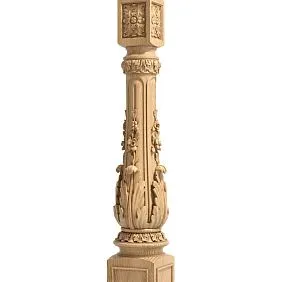
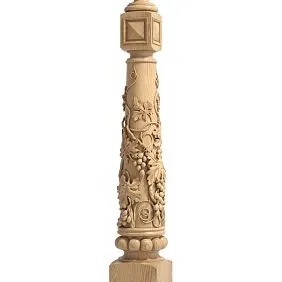
Balusters and posts made of woodThey possess a special energy. Natural wood brings warmth and coziness to the interior that no artificial material can provide. Each baluster, with its unique texture and wood grain pattern, is a work of art.
Modern wood processing technologies allow creating balusters of any complexity - from simple turned forms to intricate carved compositions. Oak, beech, ash, walnut - each wood species imparts its own character and mood to the item.
It is important to understand that wooden balusters require proper care and protection. They must be coated with special compositions that protect the wood from moisture, dirt, and mechanical damage. Lacquer or oil finish not only protects but also highlights the beauty of natural texture.
Coordinating newels with furniture decoration
Here begins the most interesting part - creating visual connections between different interior elements. Staircase newels and furniture appliqués must "speak" to each other in the same language.
If the newels feature carved rosettes, similar motifs should appear on the furniture. This does not mean using identical elements - sufficient stylistic similarity is enough. For example, a plant ornament on a newel can correspond to a smaller, more delicate pattern on cabinet facades.
It looks especially effective when decorative elements form a rhythmic pattern that transitions from the staircase to surrounding furniture. Imagine: as you ascend the staircase, your gaze glides from balusters to the buffet in the dining room, from there to the cabinets in the living room, and everywhere you encounter familiar decorative motifs, creating a sense of unity.
Rhythm of patterns: creating a harmonious space
Rhythm in interior design is the same as rhythm in music. It creates structure, guides the gaze, and forms mood. And decorative elements are the primary tool for creating this rhythm.
Principles of distributing decorative elements
The first rule - avoid chaos. Decoration should be placed thoughtfully, following a certain logic. If you use appliqués on furniture facades, they should create a clear system - symmetrical composition, diagonal pattern, or rhythmic repetition.
The second rule - alternating "strong" and "weak" accents. It is not necessary to decorate all surfaces with the same intensity. Let some items be more ornate, others more restrained. This creates dynamism and prevents the eye from getting bored.
The third rule - considering the scale of the room. In a spacious living room, you can allow large, expressive decorative elements. In a compact bedroom, it is better to choose more delicate and smaller appliqués that will not "weigh" down the space.
Vertical and horizontal lines
Staircase newels create powerful vertical accents that visually raise the ceiling and make the room appear higher. These verticals must be balanced with horizontal elements - cornices on cabinets, decorative strips on chests, horizontal appliqués on buffets.
An interesting effect is achieved by using appliqués that "transition" from vertical to horizontal planes. For example, an angular element on a furniture facade may start as a vertical stripe and then turn into a horizontal decorative band. Such a technique creates a sense of movement and connects different parts of the composition.
Repeating motifs as a unifying factor
One of the most reliable ways to create unity in the interior is to use repeating decorative motifs. This may be a certain type of rosette, a characteristic swirl shape, a specific plant ornament.
The key is not to overdo repetitions. If the same element appears too frequently, it begins to irritate and loses its expressiveness. Optimal is when the motif repeats 3-5 times within the visible range, creating recognizability without being intrusive.
It is also important to vary the scale of repeating elements. On a staircase newel, a rosette may be large - 100-120 mm in diameter. On a cabinet facade, the same motif appears in a reduced size - 60-80 mm. On a chest drawer, it is a miniature version, 30-40 mm. This creates hierarchy and makes the composition more interesting.
Color palette: when white is not the only option
Traditionally, polyurethane molding is associated with the color white. However, this is only one of many options, and not always the most suitable.
Monochromatic Solutions
White molding on light furniture is a genre classic that works reliably. But it's important to understand the nuances. If the furniture has a warm tone of ivory or milk, the appliqués should be painted in the same tone, not in cold, boiled white. The difference in color temperature creates a dissonance that will spoil the entire composition.
Dark furniture with white decor is a more risky approach, but when executed correctly, it is incredibly effective. Contrasting white appliqués on wenge or dark walnut create a dramatic effect, drawing attention to the beauty of the ornament. This solution suits modern classicism and art deco.
Toned variants
Gilding and silvering are traditional ways of finishing decorative elements that never go out of style. Gold appliqués on white or beige furniture give the interior a sense of luxury and grandeur. Silver works more coldly and strictly, suitable for modern interpretations of classic styles.
Patination is a technique that creates an effect of noble antiquity. Appliqués are first coated with a base color, then a contrasting shade—darker or lighter—is rubbed into the recesses of the relief. This emphasizes volume, making the decor more expressive and multidimensional.
Bronze and copper tones are especially good when combined with wooden balusters from warm woods—oak, walnut, cherry. They create a sense of material richness and luxury without vulgarity.
Coordination with the color of staircase elements
If the staircase posts are made of natural wood, the furniture decor should take their tone into account. Options may vary: full color match, contrasting combination, or harmonious transition through intermediate shades.
When fully matching, appliqués are tinted to match the color of the staircase wood. This creates the impression that the entire furniture is made from the same solid wood, even though the facades may be made of MDF or another material. The savings are significant, while the visual effect is expensive and noble.
Contrasting combinations require greater skill. If the posts are dark and the furniture is light, decorative elements can act as a 'bridge' between them. For example, coffee-with-milk colored appliqués on beige furniture will harmonize with dark wenge balusters, creating a smooth transition.
Materials and their compatibility
Choosing materials for decorative elements is not only an aesthetic question, but also a matter of practicality, durability, and ease of maintenance.
Polyurethane versus wood
Polyurethane has several advantages over wood. It does not crack, does not dry out, and does not deform from humidity. Polyurethane appliqués can be installed even in bathrooms and kitchens, where wooden decor quickly becomes unusable.
On the other hand, wood has an incomparable living texture, warmth, and nobility. Wooden balusters and posts create a completely unique atmosphere that is difficult to reproduce with artificial materials.
The ideal solution is a sensible combination of both materials. Main architectural elements, such as staircase posts and balusters, are made from solid wood. Furniture decor requiring greater resistance to external influences is made from polyurethane and tinted to match the wood.
Density and weight of structures
When choosing decorative elements, it is important to consider the load on the base. Heavy wooden appliqués require strong mounting and may not be suitable for lightweight furniture structures. Polyurethane elements weigh significantly less for the same visual effect.
For MDF or particleboard furniture, polyurethane is the optimal choice. Lightweight appliqués are attached with ordinary glue, without adding extra load to the frame. After painting, they are indistinguishable from wood carving.
Installation technology: from theory to practice
Correct installation of decorative elements is half the success. Even the most beautiful appliqués will look sloppy if installed crookedly or with gaps.
Surface preparation
Before installing appliqués, the furniture surface must be perfectly clean, dry, and degreased. Any contamination, dust, or grease stains will reduce adhesive bonding quality and may lead to decor peeling.
If the furniture is already painted, ensure the paint is fully dry. Installing appliqués on freshly painted surfaces is a common mistake that leads to problems after several months of use.
Choice of adhesive composition
Polyurethane appliqués require special polyurethane or acrylic adhesives. They provide strong bonding while remaining elastic, which is important during material thermal expansion.
Liquid nails are a popular but not always the best option. They provide strong bonding, but working with them requires care. Excess glue protruding from the edges of appliqués is difficult to remove and may spoil the appearance.
Two-component epoxy compositions provide maximum strength but require precise mixing proportions. They are worth using for large and heavy elements subjected to significant loads.
Positioning accuracy
Before gluing, make sure to mark the position. Use a level and tape measure to place elements strictly symmetrically. Even a small deviation of 2-3 mm will be noticeable to the eye and spoil the impression of the work.
For symmetrical compositions, find the center of the surface and mark it. Measure distances from the center to the appliqués; this guarantees even distribution of elements.
When working with corner appliqués, pay special attention to joints. They must fit perfectly together, without gaps or cracks. Use a sharp knife or fine-toothed saw for fitting.
Painting and final finishing
Painting polyurethane elements is a process requiring patience and care. The quality of painting determines whether the decor will look like cheap imitation or luxurious carving.
Priming
Priming is a mandatory step that many skip in an attempt to save time. This is a mistake. Primer improves paint adhesion, equalizes the surface's absorbency, and prevents stains.
Water-based acrylic primers are suitable for polyurethane. They dry quickly, have no strong odor, and are easy to apply with a brush or spray gun.
Base Layer
The first coat of paint is applied thinly and evenly. It is important to paint all recesses of the relief, leaving no unpainted areas. For this, a brush with long bristles is convenient, as it can reach the most complex parts of the ornament.
After the first layer dries, the surface is lightly sanded with fine sandpaper (grit 400-600). This removes minor imperfections and prepares the surface for the final finish.
Decorative Techniques
Patination is performed after the base layer is fully dry. Contrast paint (usually darker or lighter than the base tone) is applied into the recesses of the relief and partially onto raised areas. Excess is then wiped off with a damp sponge or cloth, leaving pigment only in the recesses.
Gilding can be done in several ways. Leaf gold is the most expensive and labor-intensive option, providing the most realistic effect. A more affordable alternative is gold paints or pastes, which are applied with a brush or sponge onto raised parts of the relief.
The aging effect is created using crackle varnishes. As they dry, they crack, forming a network of fine cracks that mimic the patina of time. Contrast pigment is then rubbed into the cracks, emphasizing the texture.
Care for Decorated Furniture and Staircase Elements
The beauty of decoration is preserved only with proper care. Polyurethane appliqués and wooden balusters require different approaches.
Regular cleaning
Polyurethane decor can be wiped with a damp soft cloth using mild cleaning agents. It is important not to use abrasive powders or stiff brushes, which may damage the painted surface.
Wooden elements are more delicate. They cannot be washed with water — only wiped with a slightly damp cloth and immediately dried. Special wood care products are used to remove stains.
Protection against damage
Relief appliqués on furniture are susceptible to mechanical damage. Ornamental raised parts are especially vulnerable and may be damaged during moving furniture or cleaning.
To minimize risk, place the most ornate decorated items in areas protected from accidental impacts. For example, a buffet with elaborate decor is better placed against a wall rather than in a high-traffic zone.
Restoration of Damaged Areas
If an appliqué is damaged, it can be restored. Small chips and scratches are filled with paint matching the color. To find the exact shade, mix several paints on a palette.
In case of more serious damage, the appliqué must be replaced. Fortunately, polyurethane elements are inexpensive, and replacement is not a major issue. The key is to keep information about the manufacturer and part number to order an identical element.
Stylistic solutions for different rooms
Each room in the house has its own purpose and, accordingly, requires a special approach to decoration.
Living Room: Grandeur and Formality
The living room is the face of the house, a place for receiving guests and family celebrations. Here, a more elaborate, rich decoration is appropriate. Furniture facades can be adorned with large appliqués featuring expressive relief.
If there is a staircase to the second floor in the living room, its posts become the central compositional element. Massive carved balusters topped with decorative capitals set the tone for the entire interior. Furniture should support this grandeur but not compete with the staircase for attention.
Dining Room: Coziness and Warmth
In the dining room, decoration should create a cozy, homely atmosphere. Medium-sized appliqués with botanical motifs — grapevines, oak leaves, wheat stalks — are suitable. They evoke abundance and fertility.
Buffet and sideboard are the main furniture pieces in the dining room. Their facades and bases should be decorated particularly carefully. A symmetrical composition of appliqués will create a sense of order and harmony.
Bedroom: Calmness and Intimacy
The bedroom is a place for rest; excessive decorative elements are unnecessary. It is better to choose small, delicate appliqués with soft, flowing lines. The color palette should be calm — white, beige, soft pastel shades.
If there is a staircase in the bedroom (e.g., in a two-level apartment), its elements should be painted in muted tones. Dark contrasting posts would appear too heavy and disrupt the relaxed atmosphere.
Office: Formality and Presentability
The office requires restrained but dignified decoration. Classical motifs are appropriate — geometric rosettes, reeded patterns, strict frames. Colors — dark wood, bronze, muted gold.
Furniture in the office demonstrates status and taste. Bookcases and desks can be adorned with appliqués imitating wood carving. It is important to maintain moderation — decoration should emphasize dignity, not turn the office into a museum hall.
Budget solutions: maximum effect at minimum cost
Creating a beautiful interior does not always require large sums of money. With a reasonable approach, impressive results can be achieved even with a limited budget.
Selective decoration
It is not necessary to adorn all furniture in the room with appliqués. It is enough to highlight 1-2 key pieces, making them focal points. For example, in the living room this could be a display cabinet for dishes, in the bedroom — the headboard, in the dining room — a buffet.
The remaining furniture remains undecorated or is adorned minimally — with one or two small appliqués. This approach creates focal points that attract attention while also saving money.
DIY approach: painting by hand
Polyurethane appliqués are sold unpainted, which is an excellent opportunity for creativity. Painting them yourself is not difficult, yet you can achieve the exact shade you need without paying for a ready-made solution.
Basic skills with a brush and a little patience — that’s all that’s required. Experiment with colors, try different techniques. Even if the first attempt is not perfect, the appliqué can always be repainted.
Combining expensive and budget-friendly elements
On staircase balusters, which are prominently visible and serve as compositional centers, it is advisable to use high-quality wooden balusters. However, furniture decor can be polyurethane, painted to match the wood tone. Visually, the difference is almost imperceptible, while savings are significant.
Modern trends in decoration
Interior design is constantly evolving, new trends and approaches emerge. Furniture and staircase decoration are not excluded from these processes.
Minimalism in classic style
One of the most interesting trends of recent years is simplifying classical forms. Appliqués become less ornate, ornaments — more minimalist. This is a kind of 'lightweight classicism' that retains the elegance of the style while eliminating excessive ornamentation.
This approach allows classic furniture to be incorporated into modern interiors, where space and openness are valued. One large, expressive appliqué can replace an entire composition of small elements.
Geometry and abstraction
Alongside traditional floral motifs, more modern ones — geometric patterns, abstract compositions — are appearing. Such appliqués look great in contemporary interiors and even in minimalist spaces.
Contrasting Combinations
Playing with contrasts — another popular technique. Black appliqués on white furniture, gold on dark wood, copper on gray backgrounds. Such solutions attract attention, create a dramatic effect, and make the interior memorable.
Decoration mistakes: what to avoid
Even the highest quality materials do not guarantee a good result if typical mistakes are made.
Style mismatch
The most common problem is mixing elements from different stylistic directions. Baroque appliqués on Provence-style furniture, strict geometric elements in Rococo — all this creates visual dissonance.
Before purchasing decor, study the characteristic features of the chosen style. In Classicism, strict symmetrical compositions are appropriate; in Baroque — lavish scrolls and volutes; in Empire — military symbolism and classical motifs.
Excessive decoration
The desire to decorate as many surfaces as possible leads to interior overload. Too much decoration is just as bad as its complete absence. The room begins to resemble a museum or antique shop, losing its residential atmosphere.
The rule of the golden mean is especially important here. It is better to use fewer elements, but larger and more expressive, rather than covering all surfaces with small decor.
Ignoring proportions
The size of the appliqués should correspond to the size of the furniture. Large elements on a compact chest of drawers will look ridiculous, while small ones on a large cabinet will disappear and fail to make an impression.
Incorrect installation
Poorly installed appliqués, visible glue marks, gaps at joints — all of this undermines the effort to create a beautiful interior. If you are not confident in your abilities, it is better to entrust the installation to professionals.
Seasonality and interior transformation
An interesting feature of polyurethane decor is its replaceability. Unlike wood carving, which is created once and for all, appliqués can be changed, allowing you to refresh the interior’s appearance.
Festive decoration
You can add snowflakes, pine branches, and other thematic elements to furniture for New Year's celebrations. After the holidays, they are easily removed, returning the interior to its everyday look.
Update without repair
If the current decor has become boring, it can be replaced with new ones. Remove the old overlays, install others — and the room looks fresh. This is much simpler and cheaper than replacing all the furniture.
FAQ: Frequently Asked Questions
Can polyurethane overlays be used on kitchen furniture?
Yes, polyurethane is ideal for the kitchen. It is not afraid of moisture, temperature fluctuations, and is easy to clean. The main thing is to choose quality paint that is resistant to washing and steam.
How to choose the size of overlays for furniture?
General rule: the overlay should cover no more than one-third of the height or width of the decorated surface. For a cabinet door 60 cm high, an overlay up to 15-20 cm high is suitable. For a drawer 40 cm wide, an element up to 10-15 cm wide is appropriate.
Can polyurethane overlays be painted with regular paint?
It is better to use special paints for polyurethane or universal acrylic compositions. Ordinary oil-based paint may not adhere well and may peel off over time.
How to coordinate furniture decor with wooden balusters?
If the balusters are wooden, you can stain the overlays to match the same color. Use stains, pigment pastes, or tinted paints. Perfect match is not required — closeness of shades is sufficient.
How long do polyurethane overlays last?
With proper installation and care, polyurethane decor lasts for decades. The material does not dry out, crack, or deform. The only thing that may be needed is repainting every 7-10 years.
Can overlays be removed without damaging the furniture?
Yes, if they were glued with quality adhesive. Carefully lift the edge of the element with a thin putty knife, gradually separating it from the surface. Remove any remaining adhesive with a solvent.
How to calculate the number of overlays needed for a room?
First, determine which furniture pieces will be decorated. Sketch the placement of elements on each facade. Calculate the total number and add 10-15 percent for reserve and possible defects.
What tools are needed for self-installation?
Minimum set: tape measure, pencil, level, glue gun, utility knife, fine-grit sandpaper. For painting, you will need brushes, primer, and paint.
Conclusion
Decorating furniture and coordinating it with staircase elements is an art that requires taste, knowledge, and attention to detail. Polyurethane overlays and wooden balusters are tools that, when used correctly, can transform the interior, making it cohesive and expressive.
The key is to remember the principle of moderation, follow the chosen style, consider the characteristics of the room and the functional purpose of the items. Decor should not merely adorn, but also contribute to the overall concept of the space, creating the very atmosphere in which you want to live.
STAVROS Company offers a wide range of decorative elements to realize the boldest design ideas. High-quality materials, thought-out shapes, diverse options — all this allows you to create the interior of your dreams, where every detail is in its place, and furniture and architectural elements speak the same language of beauty and harmony.


