Article Contents:
- Why skirting should not be chosen separately from slatted panels
- What happens when the choice is made incorrectly
- How the height of wooden skirting affects wall perception
- Skirting 40–60 mm: Scandinavian lightness
- Skirting 80–100 mm: classic proportion
- Skirting 120–150 mm and above: architectural statement
- Slatted geometry and wooden skirting: how they work together
- Vertical slats and horizontal skirting
- Horizontal battens and wide skirting board
- Diagonal and non-standard patterns
- Which combinations work for light and dark interiors
- Light interior: tonal unity or soft contrast
- Dark interior: material depth
- Neutral and natural tones
- How to avoid a cheap effect
- First mistake: different wood species without justification
- Second mistake: mismatched finishes
- Third mistake: gaps and imprecise joints
- Fourth mistake: ignoring corners
- Fifth mistake: mixing skirting board formats
- What's important during installation: joints, gaps, corners
- Installation sequence
- Expansion gap
- Internal corners
- External Corners
- Slat panels in different zones: skirting as a connecting element
- Living room: panel as the main architectural object
- Bedroom: material silence
- Hallway: durability and precision
- Study: system strictness
- Kitchen: function plus aesthetics
- Material combinations: oak, MDF, pine, ash
- Oak
- MDF for painting
- Spruce
- Ash
- Systematic approach: from concept to purchase
- Step one: define the concept
- Step two: choose the slat material
- Step three: select the skirting board as part of the same line
- Step four: calculate the quantity
- Step five: order with a margin
- Special cases: transitions between rooms, arches, columns
- Transition through a doorway
- Arches and rounded elements
- Columns
- Panel-to-baseboard lighting system
- Slat panels and baseboard: material compatibility table
- Frequently Asked Questions
- About the Company STAVROS
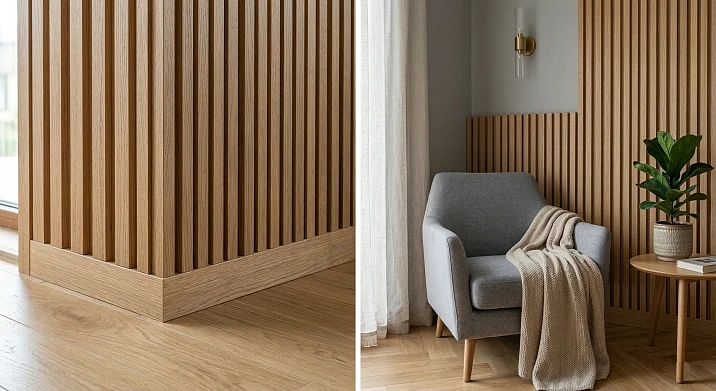
There comes a moment in renovation when everything seems done right—the wall looks beautiful, the floor is laid, the panels are installed—yet something feels subtly off. Your gaze drifts downward and hits a break: the wall lives separately from the floor. Between them lies a seam, a random baseboard from the nearest hardware store that has no relation whatsoever to the chosen wall material. Sound familiar?
This is precisely where the difference between 'a renovation was done' and 'an interior was created' begins.buy slatted panels—is only the first step. Choosing a wooden baseboard for them that picks up the rhythm, tone, and material of the panel is the second step, without which the first loses half its impact. In this article, we'll break down exactly how this system works, why it works this way, and what to consider so that the bottom of the wall becomes a complete architectural statement, not a random assortment of materials.
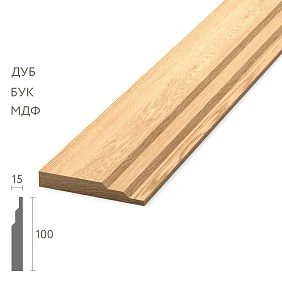
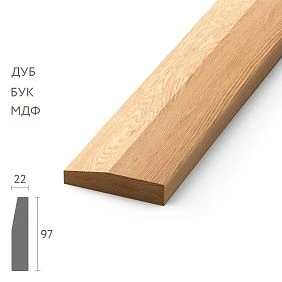
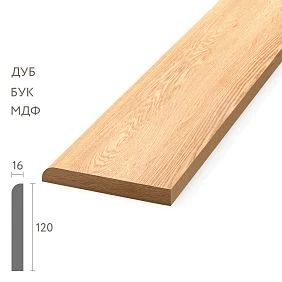
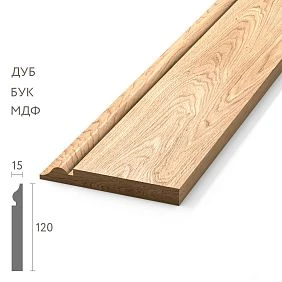
Why you can't choose a baseboard separately from a slat panel
This question seems obvious only to those who have already stepped on the rake. Most others typically choose the baseboard at the last moment—'whatever was left,' 'whatever matched the color,' or 'whatever was in stock.' And it's at this very moment that the interior loses its integrity.
A baseboard is not just a decorative strip hiding the seam between the wall and floor. In a system with a slat panel, it serves three fundamentally important functions.
The first function is completing the rhythm.Slatted wall panelscreate a distinct vertical or horizontal rhythm on the wall. The slats have spacing, thickness, depth. When this rhythm reaches the floor and meets the baseboard, the baseboard either continues the surface's logic or disrupts it. A wooden baseboard made from the same solid oak as the slats continues it. A white plastic baseboard with a rounded profile interrupts it. The difference is a few centimeters of material, but the visual effect is fundamental.
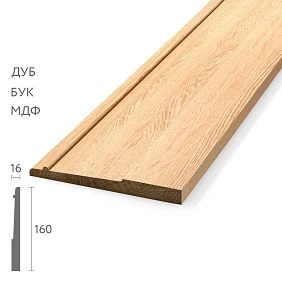
The second function is a large-scale anchor. The height and profile of the baseboard set the scale of the lower wall zone. A wide wooden floor baseboard (80–120 mm) creates a sense of solidity and architectural weight. A thin baseboard (40 mm) conveys lightness and Scandinavian restraint. In both cases, it is important that the chosen scale matches the scale of the wall battens.
The third function is material unity. When both the battens and the baseboard are made from the same wood species—or at least from materials of the same family—it creates the impression that the entire lower part of the wall is carved from a single block. This looks expensive, is perceived as expensive, and appears costly in the eyes of anyone who enters the room.




What happens when the choice is made incorrectly
The disharmony between the baseboard and the batten panel manifests in several recognizable symptoms:
-
The eye 'stumbles' at the wall-floor transition, not lingering on the beauty of the batten surface;
-
The wall seems 'ungrounded'—as if it is floating above the floor without support;
-
The entire costly panel material is visually devalued by a random finishing element;
-
Interior photographs don't turn out well—precisely because the lower boundary of the wall falls out of the overall system.
Our factory also produces:


How the height of a wooden baseboard affects the perception of the wall
Baseboard height is one of the most underrated tools of interior proportion. Most buyers choose a baseboard based on the principle of 'just to cover the seam.' Professionals choose it as an architectural element that controls the visual proportions of the space.
Get Consultation
Skirting Board 40–60 mm: Scandinavian Lightness
A low skirting board creates a feeling of weightlessness. The wall seems slightly lifted above the floor, making the space appear larger and more airy. Forslatted wall panelsin light tones within Scandinavian or Japanese-style interiors, it's the perfect solution. A 40–50 mm wooden floor skirting board made of light oak or ash doesn't compete with the wall surface here but merely softly defines its lower boundary.
Important nuance: with a low skirting board, the profile should be simple—a rectangular cross-section or with a minimal chamfer. Any complexity in the profile at a small height looks like overloading in miniature.
Skirting Board 80–100 mm: Classic Proportion
This is the most universal height range for a wooden floor skirting board. It is noticeable enough to become an architectural element but not so large as to 'eat up' the room's height. Combined with mid-spacing slatted panels (60–90 mm between slats), an 80–100 mm high skirting board creates a harmonious scale series.
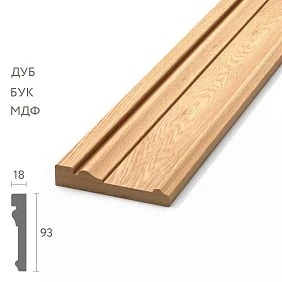
The profile in this range can be either simple or with a classic torus or a small curved transition. Buying a wooden skirting board of such a profile means adding that very 'academic' final chord to the slatted wall, which is understood without words.
Skirting Board 120–150 mm and above: Architectural Statement
A wide wooden skirting board is no longer just a finishing element. It is an architectural detail that makes a statement. Combined with robust solid oak slatted panels with wide spacing (100 mm and more), a skirting board of this height creates an almost museum-like space effect—substantial, significant, and designed for a long life.
For apartments with ceilings below 2.7 m, such a skirting board should be used cautiously: it will visually lower the room. For spaces with ceilings of 3 m and above, it is one of the strongest solutions in the lineup.
Batten geometry and wooden skirting: how they work together
The geometry of a batten surface is always about rhythm. Strict, repetitive, visually strong. And this rhythm needs the right 'landing place' at the floor.
Vertical battens and horizontal skirting
VerticalWooden slat panelscreate active vertical movement—the eye is drawn upward. In this case, the wooden floor skirting plays the role of a horizontal stop: it 'receives' the vertical rhythm and translates it into the horizontal plane of the floor. The cleaner this transition, the more convincing the interior.
Key condition: the skirting must meet the battens without visible gaps or misalignments. This is a requirement for installation precision.installation of slatted panelsmust consider the lower boundary: the last batten should not 'fall short' of the skirting with a visible gap or, conversely, extend under it.
Professional technique: the bottom batten is installed flush with the top edge of the skirting with a gap of no more than 1–2 mm, which is then filled with thin colored mastic or left as a designer shadow. This gap allows the wood room to expand with changes in humidity.
Horizontal battens and wide skirting
Horizontal batten orientation creates a different effect—the wall 'expands,' the space appears wider. In this case, the wooden skirting is a logical continuation of the horizontal rhythm: it adds another horizontal stripe, right at the floor.
Here, a wide wooden skirting (100–120 mm), aligned with the same grain direction as the battens, is especially effective. It creates an effect of continuous horizontal texture from the middle of the wall down to the floor.
Diagonal and non-standard patterns
If the slats are laid diagonally or form a non-standard pattern—herringbone, diamond, wave—the baseboard should be neutral. In this caseWooden baseboardwith a simple rectangular profile becomes a calm foundation that does not compete with the complex wall pattern but contains it within boundaries.
Which combinations work for light and dark interiors
The color logic of the 'slat panel—wooden baseboard' pair has its own patterns. Let's examine the main scenarios.
Light interior: tonal unity or soft contrast
In light interiors (white and beige walls, light floors, plenty of natural light), slat panels are most often chosen in light tones: white MDF, natural light-toned oak, ash. The wooden floor baseboard here can follow two paths.
First path—matching tone. Baseboard made from the same light oak as the slats. The baseboard tone matches the slat tone or is slightly darker (by 1–2 tones). This creates a smooth transition, the wall 'flows' into the floor. Works especially well on light parquet or laminate.
Second path—soft contrast. White slats plus a wooden baseboard in a warm natural oak tone. The baseboard serves as a warm wooden accent at the lower boundary of the white wall. This technique is popular in Scandinavian and modern classic styles.
What doesn't work in a light interior: dark brown or wenge baseboard under white slats. The contrast is too harsh and looks accidental, not intentional.
Dark interior: material depth
Dark slatted panels — anthracite, wenge, mocha, dark walnut — require a special approach to the skirting board. Two opposite solutions are possible here, both valid.
Exact tone match. A dark wooden skirting board under dark slats. The lower part of the wall becomes a single dark volume that 'pulls' the space towards the floor and creates a sense of solidity. The floor should then be either dark (creating a depth effect) or very light (creating a graphic contrast).
White or light skirting board. A light wooden skirting board on the lower edge of a dark slatted wall creates a clear line that separates the wall from the floor and adds graphic quality. This technique works in modern interiors with a pronounced contrast mindset.
Neutral and natural tones
Solid oak slat panelsin natural or softly tinted form — is the most common request. Oak is warm, lively, with a characteristic texture. A wooden floor skirting board made from the same solid oak is the perfect continuation: the same species, the same texture, the same tone or slightly richer.
Buying a wooden skirting board made of solid oak and slatted panels from the same solid wood is a solution that needs no design justification. It works on its own because natural material is consistent: oak next to oak is a dialogue, not a monologue.
How to avoid a cheap effect
A cheap effect in an interior with slatted panels and skirting boards does not come from using budget materials. It arises from incorrect combinations and neglect of details. An experienced designer can create an expressive interior from affordable materials, while an inexperienced one can ruin an expensive renovation with a careless final touch.
First mistake: different wood species without justification
Oak battens plus pine skirting. Walnut on the wall — pine at the floor. This is not a contrast or a concept — it's simply different materials bought at different times without a strategy. Wood within a single interior should be either from the same species or from species that are visually and tactilely compatible (oak + ash, walnut + oak, pine + spruce — acceptable pairs).
Second mistake: mismatched finish
The battens are coated with matte oil, the skirting — with glossy varnish. The same color, the same wood species, but different degrees of gloss create a sense of incompatibility. The type of finish coating must match or be from the same family: matte oil to matte oil, varnish to varnish. If the battens are for painting —wall panel battens for painting MDFare painted in the same shade as the skirting, with the same degree of gloss.
Third mistake: gaps and imprecise joints
The gap between the lower end of the batten panel and the upper edge of the skirting is the most visually destructive element. Even a 5 mm gap, through which a wall of a different color is visible, 'kills' the entire effect. Careful installation is not an option, but a condition.
If the walls are uneven and a perfect joint is impossible, the solution is a small cover strip or a transition molding in the tone of the material. This is more honest than hoping no one will notice.
Fourth mistake: ignoring corners
Internal and external corners are the points of greatest vulnerability in the system. Wooden floor skirting in corners requires either precise 45° miter cuts or special corner elements. The same applies to batten panels. A neat corner is a sign of professional work. A rough joint with a gap or void instantly reduces the visual value of the interior.
Mistake five: mixing skirting board formats
Wooden skirting in the living room, plastic in the hallway, aluminum in the bedroom. Each room has a different skirting material. This destroys the feeling of a unified apartment space. If you've decided on wooden skirting boards for your home, they should be everywhere. It's an investment in integrity that pays off many times over.
What's important during installation: joints, gaps, corners
Installation of slatted wall panelsand installing wooden skirting boards are two sequential processes that must be planned together before work begins.
Installation sequence
Correct sequence:
-
Leveling walls and preparing the base;
-
Installationslatted panels for wall finishing— from the level of the final skirting board upward, taking into account the height of the skirting board;
-
Laying the final floor covering (parquet, laminate);
-
Installing wooden skirting boards as the final finishing element.
Why exactly this way? Because the skirting board covers the lower end of the panel and hides the gap between the panel and the floor, which is necessary to compensate for wood deformation. If you install the skirting board before the panels, you'll either have to leave a gap above the skirting or trim the panels on-site, which increases complexity and work time.
Expansion gap
Wood is a living material.Wooden slat panelsand the wooden baseboard react to changes in indoor humidity: they expand when it increases and contract when it decreases. An 8–12 mm gap must be left between the bottom end of the slatted panel and the finished floor. The wooden baseboard covers this gap and should not be rigidly glued to the panel—only to the wall and floor.
This is important: if you glue the baseboard to both surfaces simultaneously, something will crack during deformations—either the baseboard or the panel.
Internal angles
Internal corner—the junction of two adjacent walls. Here, slatted panels meet each other, and baseboards connect. The recommended method for joining a wooden baseboard in an internal corner: a 45° miter cut with precise alignment of planes. An alternative for uneven corners: one baseboard runs to the corner, the second butts against it end-to-end (a 'tongue-and-groove' method without mitering)—this is simpler but less aesthetically pleasing.
For slatted panels in an internal corner, either an overlay corner profile (wooden or aluminum) or a butt joint with careful fitting is used.
External angles
External corner—the most vulnerable spot for wood in terms of mechanical damage. It is advisable to protect the wooden floor baseboard on an external corner with an overlay metal or wooden corner element. This is especially relevant in hallways, where wall corners are subjected to constant impact.
Slatted panels on an external corner require a special corner profile that simultaneously protects the ends of the slats and creates a clean, finished line.
Slatted panels in different zones: baseboard as a connecting element
Different rooms require different approaches to the 'panel—baseboard' system. Let's examine the key scenarios.
Living room: panel as the main architectural object
In the living roomSlatted panels in interior designserve as an accent wall. The skirting board here is the final element of this architectural statement. For the living room, it is recommended:
-
Wooden skirting board with a height of 80–120 mm;
-
The same material and tone as the slats, or 1–2 tones darker;
-
Profile with a small classic ogee or a strict rectangular one — depending on the style;
-
If the panel has backlighting — a skirting board with a niche for hidden LED strip will add a light accent at the floor.
Bedroom: material silence
slatted panels in the bedroomwork to create an atmosphere of tranquility. The wooden skirting board here should be restrained: medium height (60–80 mm), a profile without excesses, tone — matching the slats or slightly warmer. The goal is not to draw attention to the skirting board, but to complete the wall softly and unobtrusively.
Hallway: strength and precision
Slatted panels in the hallwayexperience increased mechanical load. The same applies to the wooden floor skirting board: in the hallway, it gets kicked, hit by a vacuum cleaner, struck by bags. Here, not only aesthetics but also the strength of the fastening is important. It is recommended:
-
Wooden skirting board made of hardwoods — oak, ash (not pine);
-
Mounting with liquid nails + dowels — combined;
-
Protective coating — varnish in 2–3 layers, not oil (more resistant to abrasion).
Study: system rigor
In a home studyslatted panels for wallscreate a working atmosphere. The wooden skirting board here is chosen in the same register: a strict profile, dark or neutral tones. Often in the study, the slatted paneling goes only behind the desk, while the skirting board runs along the entire perimeter. In this case, the skirting board acts as a unifying element: it runs along all the walls and connects the slatted accent with the rest of the space.
Kitchen: function plus aesthetics
Slatted panels in the kitchenare most often used in the backsplash area or on an accent wall in the dining area. A wooden skirting board in the kitchen must have a moisture-resistant coating: varnish or oil-wax with water-repellent properties. The wooden floor skirting board under the kitchen unit is covered by the unit's plinth, while in the dining area it remains exposed — here it must completely match the tone of the slatted panel.
Material combinations: oak, MDF, pine, ash
Choosing the wood species for the 'slatted panel — skirting board' pairing is both an aesthetic and practical decision.
Oak
Oak is a universal choice for both elements of the system. Dense structure, characteristic texture with rays, a wide range of tinting colors (from natural light to dark tobacco and wenge).Solid oak slat panelsplus a wooden skirting board made from the same solid wood — the most common and fail-safe combination.
Oak holds its shape well, warps little with humidity changes, and is resistant to mechanical damage. This is especially important for skirting boards.
MDF for painting
MDF Plank Panels— one of the most popular materials for wall finishing. They are perfectly flat, take paint well in any RAL and NCS color, and are dimensionally stable. A wooden skirting board for MDF slats for painting is chosen from the same type of MDF and painted the same color — this creates a monochrome system where differences in profiles and reliefs are read as architectural relief, not as a material mismatch.
Spruce
Pine is a more affordable species with a soft texture and a light amber tone. For slatted panels, pine is used less frequently due to its lower density and tendency to deform. For skirting boards, pine is acceptable in areas without intensive load. Important: pine absorbs oil well and, with proper coating, lasts a long time.
Ash
Ash is a close relative of oak in visual characteristics, but with a more pronounced linear grain pattern. Light ash plus a slatted panel made of light ash is a fresh, almost Scandinavian combination. Wooden skirting boards made of ash are less common on the market, but when available — they give a very harmonious result paired with slatted panels made of the same material.
A systematic approach: from concept to purchase
How to properly organize the process to buy slatted panels and a wooden skirting board as a unified system, not as two unrelated purchases?
Step one: define the concept
Before choosing specific materials, answer a few questions for yourself:
-
What is the interior style? (classic, neoclassical, Scandinavian, modern, loft)
-
What is the tone of the main color scheme? (light, dark, neutral)
-
What wood species or wood imitation?
-
Vertical or horizontal battens?
Answers to these questions narrow down the options to specific solutions.
Step two: choose the batten material
Buy slatted panels for wall finishing— means deciding on the base material. Solid oak — maximum naturalness and durability. MDF — maximum geometric precision and paintability. WPC — moisture resistance for specific zones.
Step three: select skirting as part of the same line
ChoosingWooden baseboard, base your choice on three parameters: material (same species or compatible), tone (matching or justified contrast), profile (appropriate to the scale of the battens). It's ideal when both products — battens and skirting — can be purchased from the same manufacturer. This guarantees matching toning and finish.
Step four: calculate the quantity
For batten panels, calculation is based on wall area, accounting for cutting waste (usually +10–15% to the net area). For wooden floor skirting — based on room perimeter, accounting for doorways and +10% for corner cuts.
Step five: order with a margin
Both battens and skirting boards are best ordered with a 10–15% margin — to compensate for defects, cutting errors, and possible future additions. If the material is produced in batches, the next batch may differ slightly in tone — and this color gap will be noticeable.
Special cases: transitions between rooms, arches, columns
When batten panels and wooden skirting boards are used in several adjacent rooms, the question of transitions arises.
Transition through a doorway
If batten panels are installed in the living room and hallway, through a common doorway, the wooden skirting board should be the same in both rooms. Different skirting boards on either side of the door create a visual break that disrupts the feeling of a unified apartment space.
Arches and rounded elements
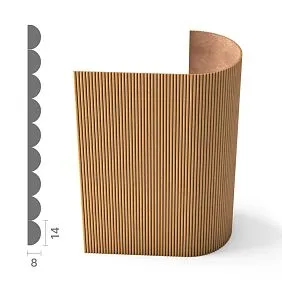
Flexible slatted panelsallow batten decor to be extended onto arched and radius surfaces. At the base of the arch, the skirting board transitions into a corner element that wraps around the rounded shape. Here, the wooden skirting board is either cut into short fragments fitted to the curve or replaced with a flexible MDF profile.
Columns
A column with batten panels is a striking architectural volume. The wooden skirting board around the column is installed similarly to a wall, but requires precise 45° miter cuts or a special corner profile. It is important that the skirting board at the base of the column matches the height and tone of the skirting board along the wall — otherwise, the column will look like a random object in the space.
Lighting in the panel-skirting system
One of the most expressive modern solutions is a floor-level light path.Slatted panels with lightingPlus a wooden skirting board with a niche for hidden LED strip — this is a system where light runs along the lower edge of the wall, creating a floating wall effect.
Technically, it is implemented as follows: the wooden skirting board has a selected niche on the back side or is installed with a gap from the wall — the LED strip is placed in this gap. The light is directed downward, onto the floor, and creates a soft light path.
This technique works well:
-
In long corridors — the light path emphasizes perspective;
-
In bedrooms — a floor-level night light without a glaring source;
-
In living rooms with dark slatted panels — a contrasting light outline at the base of the wall.
LED strip color temperature: for wood — warm white (2700–3000 K). For MDF slats in neutral tones — neutral white (3500–4000 K).
Slatted panels and skirting board: material compatibility table
Below is a summary table of recommended combinations for different interior concepts.
| Style | Slatted panel | Wooden skirting board | Baseboard Height |
|---|---|---|---|
| Scandinavian minimalism | White MDF / Light Ash | Light Oak / White MDF | 40–60 mm |
| Neoclassical | Natural Oak / MDF for Painting | Oak / MDF in Matching Tone | 100–120 mm |
| Modern Urbanism | Anthracite MDF / Dark Oak | Dark Oak / Anthracite MDF | 80–100 mm |
| Loft | Gray MDF / Dark Walnut | Dark Oak / Metal Insert | 60–80 mm |
| Classic | Oak / MDF for Painting | Oak / MDF, ogee profile | 120–150 mm |
| Japandi | Light oak / Beige MDF | Light oak | 40–50 mm |
Frequently Asked Questions
Can MDF skirting be used instead of wooden skirting with solid wood slat panels?
Yes, if the MDF skirting is painted in the same shade as the slats. Matching the color and sheen level is important, not necessarily the same material. However, upon close inspection, the difference in texture will be noticeable. For interiors emphasizing naturalness, solid wood skirting is better.
Which skirting to choose if the floor is dark parquet and the walls are white MDF slats?
The optimal option is white MDF skirting or wooden skirting painted white. It continues the color of the slats and creates a smooth transition to the dark floor. Dark skirting matching the floor tone is also acceptable—it will create a clear horizontal dividing line between the white wall and the dark floor.
Is it necessary to buy slats and skirting from the same manufacturer?
It is advisable but not mandatory. The main thing is matching the tone and type of finish. If buying from different suppliers, be sure to compare samples under the same lighting before ordering the main volume.
How to calculate the quantity of wooden floor skirting?
Measure the perimeter of the room in meters, subtract the width of door openings, add 10–15% for corner trimming. Round up to the standard skirting board length (usually 2.2 m or 2.5 m).
Does wooden skirting board require acclimatization before installation?
Yes. Solid wood skirting board should lie horizontally in the room for 48–72 hours before installation. This allows the material to adapt to the room's temperature and humidity and avoid deformation after installation.
How to attach wooden skirting board to a slatted panel?
The skirting board is attached to the wall and floor, but not to the slatted panel. To the wall — via a frame or directly with liquid nails + dowels. To the floor — not rigidly attached, leave an 8–10 mm gap concealed by the skirting board. This ensures independent deformation of the panel and skirting board.
Which skirting board profile is best suited for vertical slats?
For vertical slats with a rectangular cross-section — a rectangular or slightly beveled (with a chamfer) skirting board profile. This continues the geometric logic of the wall. Wavy and complex skirting board profiles compete with the vertical rhythm of the slats.
Can wooden skirting be installed in a bathroom?
Yes, if the skirting board has a water-resistant coating — varnish in 3–4 layers or oil-wax with hydrophobic properties. In areas of direct contact with water (by the bathtub, shower), wooden skirting board is not recommended — it is better to use PVC or stone profile.
About the company STAVROS
If you are looking for wherebuy slatted panelssolid oak and MDF, as well asWooden baseboardin a unified finishing system — refer to the product range of STAVROS company.
STAVROS is a Russian manufacturer and supplier of solid wood and MDF products for interior finishing. The company's catalog featuresSlatted wall panelsoak and MDF products, solid oak wooden floor skirting boards,moldings, cornicesand moldings — everything needed to create a systematic and cohesive finish from floor to ceiling.
STAVROS manufactures products to order: choice of wood species, tint tone, skirting board profile, slat spacing — everything is adapted to the specific project. Material selection consultation is included in the standard service. Orderslatted wall panels and wooden skirtingas a unified system — means getting an interior where every centimeter of the wall is thought out, from the first slat to the last skirting board.