Article Contents:
- What wall moldings are bought in St. Petersburg
- Wall moldings: geometry as architecture
- Polyurethane moldings: the best material for walls
- Paintable moldings: universal readiness for finishing
- Classical profiles: historical accuracy
- Decorative wall elements: stucco in the system
- What to choose: moldings, stucco, or decorative wall decor
- When you specifically need molding
- When stucco is appropriate
- When Additional Decorative Elements Are Needed
- How not to overload the wall
- How to choose wall moldings according to interior style
- Classic: maximum decorative register
- Neoclassicism: modern interpretation of classicism
- Modern Interior: Delicacy as a Principle
- Calm Walls for Painting: Monochrome Finish
- Accent Compositions: One Wall – All the Power
- How to choose wall moldings according to room
- Living Room: The Main Decorative Theater
- Bedroom: tranquility through delicacy
- Entryway: First Impression
- Study: 'Club' Feel Through Color and Molding
- Commercial Interior: Decor as a Status Transmitter
- What to Buy Together with Wall Moldings
- Stucco Decor: Ornamental Accents
- Corner Elements: Technical and Decorative
- Decorative Overlays: Relief Inserts
- Ceiling cornice: the upper boundary of the system
- Wooden moldings: for natural interiors
- Where to buy wall moldings in St. Petersburg
- Polyurethane moldings section: main catalog
- Molding and overlay section: ornamental layer
- Polyurethane products section: complete overview
- Wooden millwork section: natural moldings
- Catalog navigation: simple table
- Delivery in St. Petersburg and Across Russia
- Errors when choosing wall moldings in St. Petersburg
- Too wide profile for a small apartment
- Small relief on a large wall
- Weak symmetry logic
- Confusion Between Moulding and Stucco
- Choosing Facade Decor Instead of Interior Decor
- FAQ: Answers to Popular Questions About Wall Mouldings in St. Petersburg
- Where to Buy Wall Mouldings in St. Petersburg?
- Which moldings are best for an apartment in St. Petersburg?
- What is better: molding or stucco?
- Can I order moldings with delivery to St. Petersburg?
- Which moldings are suitable for painting?
- How to choose molding based on ceiling height?
- Are corner sockets needed in frame corners?
- How to Calculate the Amount of Molding?
- What to add to molding for a rich result?
- Which molding to choose for monochrome painting to match the wall color?
- Can molding be installed independently without renovation?
- Which profile to choose for dark walls?
- How do moldings relate to wooden interior elements?
- About the Company STAVROS
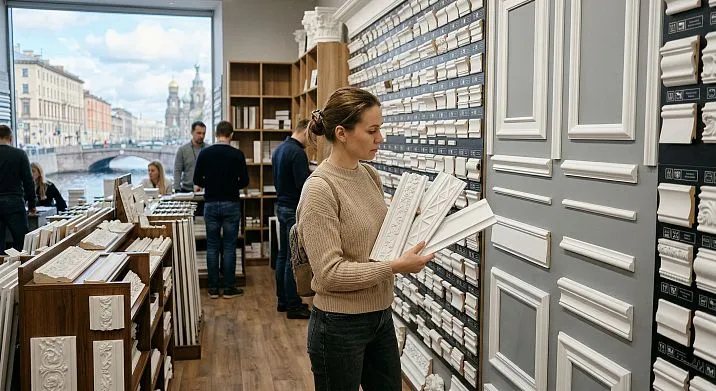
St. Petersburg is a city where architectural aesthetics are built into everyday life. Here, it's impossible to walk past facades with stucco, corner houses with rusticated surfaces, and grand entranceways with cornices every day—and remain indifferent to how your own walls look. That's why the query 'buy wall moldings in St. Petersburg'In St. Petersburg, this is not an impulse or a coincidence. It is a conscious decision by a person who wants their apartment to speak the same architectural language as the city around it.
But practical questions immediately arise. Which profile to choose — wide and embossed or delicate and smooth? What is more sensible for a specific wall — molding orStucco SPB? Where to look in the catalog to avoid wasting time on unnecessary sections? And finally — how to place an order with delivery to St. Petersburg without unnecessary complications?
This article is a direct and honest answer to all four questions. Without general discussions about 'the history of stucco' and 'seasonal trends'. Only practice: profile selection, application logic, breakdown of scenarios by rooms, typical mistakes, and specific links to catalog sections. Becausewall moldings St. Petersburgthey are not bought to read theory — they are bought to transform a space.




What wall moldings are bought in St. Petersburg
The St. Petersburg demand for wall decor is not monolithic. Behind the query 'buy wall moldings in St. Petersburg' lie completely different decorative tasks. Let's examine what exactly is being sought in each case.




Wall moldings: geometry as architecture
Wall moldings St. Petersburg— is the broadest query in this cluster. It implies decorative trim profile that is mounted on the wall in the form of frames, horizontal bands, vertical divisions. This is a tool that transforms a geometrically bland surface into an organized architectural object.
Why is wall molding especially in demand in St. Petersburg? St. Petersburg residents live in a city with a colossal heritage of architectural decor. Residential buildings of classicism and eclecticism are literally permeated with wall divisions: bands, niches, pilasters, framed window casings. This forms an aesthetic standard of perception — and a person moving into a new building with 'empty' walls intuitively feels: something is missing here.
Molding is exactly what's missing.
Our factory also produces:


Polyurethane moldings: the best material for walls
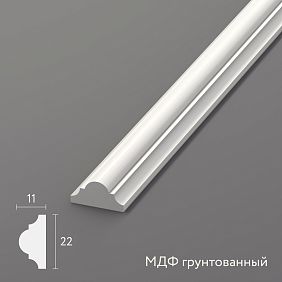
Polyurethane moldings St. Petersburg— the dominant choice for St. Petersburg apartments for a number of reasons. Polyurethane accurately reproduces any historical profile section, weighs 15–20 times less than plaster, is mounted with adhesive without anchors or drilling, and does not react to normal fluctuations in humidity and temperature in residential spaces.
For St. Petersburg — with its high average annual humidity — the latter is especially important. Polyurethane profiles under normal operating conditions do not deform, crack, or delaminate. With proper installation and finishing, they last as long as the apartment's interior finish itself.
Get Consultation
Paint-ready moldings: universal readiness for finishing
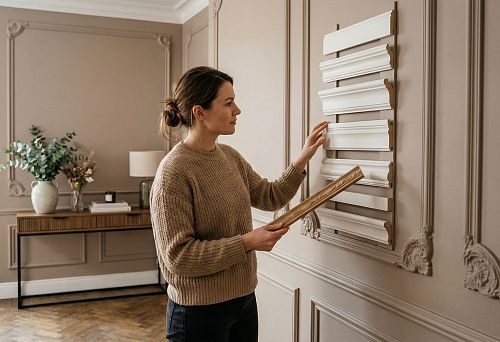
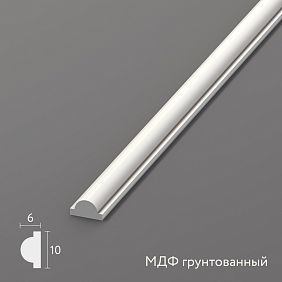
Most polyurethane profiles come with factory primer — meaning the surface is already ready for paint application without additional preparation. Acrylic paint in 2 coats with intermediate sanding using fine-grit sandpaper is the standard finishing program.
Paint-ready molding matching the wall color is one of the most requested scenarios among St. Petersburg buyers. A monochrome result, where the profile 'dissolves' in color but remains active through shadow, is 'invisible architecture.' A wall with molding in the same tone always appears 'more expensive' and 'more voluminous,' though the source of this impression cannot be pinpointed at first glance.
Classical profiles: historical accuracy
St. Petersburg is a city where classical architectural orders exist not as a museum concept, but as a living context. Therefore, classical profiles — with sections like ogee, scotia, torus, bead and reel — are especially organic here. In St. Petersburg apartments with high ceilings (especially in Stalin-era buildings and pre-revolutionary houses), wide, relief molding looks exactly as it should: convincing and appropriate.
Decorative wall elements: plasterwork in a system
Molding— a query that directly reflects the nature of St. Petersburg demand: people are looking not just for 'something for the wall,' but for a system of molding geometry and ornamental plasterwork. Rosettes. Cartouches. Decorative inserts. Corner overlays. All of these are elements of a unified decorative program, where molding creates the structure, and plasterwork adds accents.
What is better to choose: moldings, plasterwork, or decorative wall decor
This is a question that arises for everyone who seriously tackles wall decoration for the first time. And it deserves a direct, structured answer.
When molding is specifically needed
Molding is needed when the task is to create geometry on the wall. To divide a large surface into symmetrical fields. To draw a horizontal boundary between two finishing zones. To create architectural frames, inside which plasterwork can then be placed, colors changed, or a neutral field left.
Molding is the 'skeleton' of the decorative program. Without it, everything else is just 'stuck-on decorations' without a system. That is why molding always comes first in the decorative program.
When is plasterwork appropriate?
wall molding for saleis needed when the molding geometry is created — and an ornamental accent needs to be added at specific points. A corner rosette in the corner of a frame. A cartouche in the center of a decorative field. A medallion above the mantel shelf.
Plasterwork without a molding structure looks like randomly stuck-on decor.wall moldingwithin a molding system — as a deliberate architectural program. The difference is huge: one creates a feeling of 'stuck on for beauty,' the other — 'designed.'
When additional decorative elements are needed
Decorative wall moldingin the form of relief panels, friezes, overlays is used to enrich specific architectural details: decorating niches, fireplace portal decor, adorning the wall under the ceiling cornice. These are independent decorative objects that do not replace molding, but complement it in places where a special accent is required.
Polyurethane wall decor— a general term for this entire category: overlays, relief inserts, decorative cartouches, rosettes. All made of polyurethane, all compatible in material and finish with moldings from the same catalog.
How not to overload a wall
Professional principle: one decorative element requires 'air' around it — free space that allows it to 'work'. A wall overloaded with moldings in several rows, dense stucco, and overlays every 30 cm creates not a 'rich' but an anxious impression.
Practical rule for a St. Petersburg apartment: one accent wall with a full decorative program → the other walls with delicate molding or none at all. This concentrates the decorative energy in one point and creates a space you want to enter, not escape from.
How to choose wall moldings according to interior style
Style is not purely a matter of personal taste. It is an architectural task: each style implies a specific type of profile, a specific width, a specific relief. Mixing styles means creating decorative dissonance.
Classic: maximum decorative register
A classic interior in the St. Petersburg context is a historically organic choice. Wide relief molding 60–100 mm with a section from the arsenal of the order system. Three-zone program: cornice at the ceiling + frames on the walls + baseboard strip. Corner rosettes at the corners of the frames.
Uniform painting in white, cream, or ivory. With side lighting, each change in relief creates its own shadow — the wall literally 'comes to life' in the evening light. This is exactly how St. Petersburg grand staircases look, and this is the feeling transferred to a classic apartment.
Neoclassicism: modern interpretation of classicism
Neoclassical is classic that has undergone modern editing. Profile 40–60 mm, smooth or with delicate relief. Clean rectangular frames without corner overlays. Neutral colors: white, light gray, pearl, warm beige.
For St. Petersburg new buildings with ceilings 2.7–3 m — the optimal option. It creates 'expensive' architectural depth without the excess of the historical decorative system.
Modern interior: delicacy as a principle
In a modern neutral interiorwall moldings in St. Petersburgshould be a supporting, not a dominant element. A narrow smooth profile of 20–35 mm. Strict monochrome painting to match the wall. One or two frames on an accent wall—not a systematic program around the entire perimeter.
This is an approach professionals call 'invisible architecture': the structure is there, the decor is not visible. The feeling is a 'rich space' without explanation.
Calm walls for painting: monochrome finish
Monochrome painting 'molding to match the wall' is the most in-demand scenario in St. Petersburg apartments in recent years. White profile on a white wall. Gray on gray. Olive on olive. The profile retains its relief but loses color contrast—and the wall becomes voluminous without decorative 'noise'.
Accent compositions: one wall—all the power
The accent wall principle is the most effective approach for medium-sized St. Petersburg apartments. One wall (behind the sofa, at the head of the bed, behind the desk) gets the full program: molding frames + corner rosettes + a central cartouche. The others remain neutral. The result: a space with a decorative 'center of gravity'.
How to choose wall moldings by room
Each room has its own logic. The same profile in the living room and hallway works fundamentally differently. The right choice is always a choice based on the specific task of the room.
Living room: the main decorative theater
The living room is the only space where a full decorative register is appropriate. A wide relief profile (45–80 mm with ceilings of 2.6–2.8 m), a framing program on the main accent wall, a delicate molding strip on the others. Corner rosettes on the main accent wall.
In high-ceiling living rooms of Stalin-era and pre-revolutionary buildings (ceilings 3.0–3.2 m and higher), a full classical program is organic: cornice + frames + baseboard molding. It is precisely in such living roomsbuy wall moldings in St. Petersburg'and create a historical atmosphere — the most organic idea.
Bedroom: tranquility through delicacy
The bedroom requires a restrained profile. A narrow smooth molding 25–40 mm, one frame or a pair of frames at the head of the bed. Monochrome painting to match the wall color. A wide relief profile in the bedroom creates visual excitement instead of tranquility — this is directly opposite to the room's purpose.
The ideal result for a bedroom: the wall at the head of the bed with molding matching the main color — voluminous, structured, but without an active decorative signal. It is precisely this feeling that those who want a bedroom 'like in a good hotel' are after.
Entryway: first impression
The hallway is the architectural 'introductory chord' of the apartment. The first impression. With limited space, molding should work in a targeted way: a horizontal belt at a height of 130–140 cm from the floor (separates the lower and upper zones) + a decorative frame above the console or under the mirror.
For the hallway, a combination works especially well: molding for wall geometry + a smallBuy Molded Decorationin the form of a cartouche or rosette above the console. An ornamental accent at one point — without overloading the small space.
Study: a 'club-like' feeling through color and molding
The study is a space for concentration. Molding here creates a 'library' or 'club-like' feeling: molding frames on all walls + dark saturated painting (dark green, anthracite, deep navy, tobacco brown) + molding in the same color. A monochrome result with relief depth.
It is precisely this technique that is now actively used in the design of St. Petersburg studies, meeting rooms, and offices of legal and architectural firms. Molding in a dark monochrome program is 'seriousness through decor'.
Commercial Interior: Decor as a Status Transmitter
In St. Petersburg's commercial interiors—restaurants, private clubs, medical centers, hotels, meeting rooms—molding carries an additional load: it transmits the establishment's level. A space with a well-thought-out decorative program on the walls is read as a 'serious place' even before the visitor pays attention to the furniture or lighting.
Buy wall moldings in St. PetersburgFor a commercial object—a task with special calculations. The height of commercial premises is often significantly higher than residential ones (3.5–5 m), so the scale of the profile increases proportionally: 80–120 mm for main rooms.
What to buy together with wall moldings
Molding is the foundation of the decorative program. Its completion is a system of compatible elements working in a unified key.
Stucco decor: ornamental accents
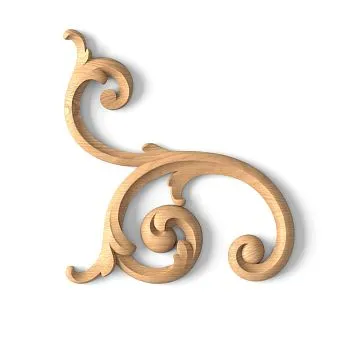
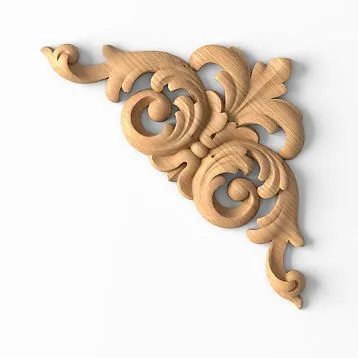
Molding for wallsMade of polyurethane—rosettes, cartouches, medallions—are the ornamental 'final touch' of the decorative program. They are installed after the molding: in the corners of frames, in the center of decorative fields, above key elements—mirrors, consoles, fireplaces.
Fundamental rule:wall molding for saleFrom the same series as the molding. One manufacturer—a uniform polyurethane composition, a uniform result when painting. Different manufacturers yield a different finish even with the same paint.
Corner elements: technical and decorative
A corner block covers the joint of profiles at the frame corner while simultaneously creating an ornamental accent. For the classic program — a relief rosette. For neoclassicism — a smooth square. For modern interiors — a sharp joint without an overlay.
The corner element simultaneously solves two problems: technically it hides the joint location (otherwise there is always a gap at 45°) and decoratively organizes the frame corner as an independent point of interest.
Decorative overlays: relief inserts
Decorative wall moldingin the form of relief inserts and friezes is used to enrich specific areas: a decorative frieze under the ceiling cornice, relief inserts in niches, ornamental overlays on pylons. This is not a replacement for molding, but an addition at points of maximum decorative emphasis.
Ceiling cornice: the upper boundary of the system
A molding program on walls without a cornice at the ceiling gives the impression of being 'unfinished'. The cornice is the architectural transition from wall to ceiling, the upper boundary of the system. It visually 'closes' the decorative program from above.
A cornice from the same catalog as the molding is a mandatory condition for stylistic unity.
Wooden moldings: for natural interiors
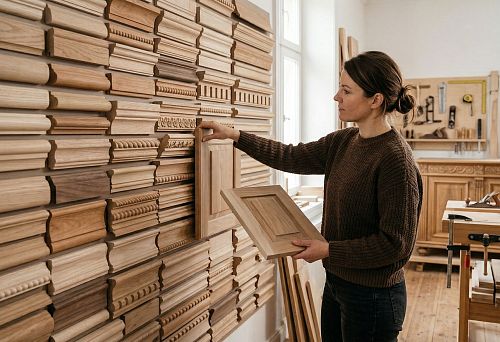
For apartments with parquet, natural furniture, wooden doors and frames —Wooden moldingsfrom the array they create a material consistency that polyurethane reproduces in form, but not in tactility.Wooden moldingfrom oak or beech under varnish or oil — a choice for natural interiors, wooden houses, eco-aesthetics.
Where to buy wall moldings in St. Petersburg
A specific catalog section — a specific answer to a specific request.
Polyurethane moldings section: main catalog
buy wall moldings in St. Petersburgfrom polyurethane — in the section of polyurethane moldings, cornices and skirting boards. Here the entire assortment of wall profiles is concentrated: smooth, relief, classical, neoclassical, profiles for painting with factory primer. Width — from 20 to 120 mm. This is the main catalog answer to a transactional request.
Stucco and overlay section: ornamental layer
wall molding— section of polyurethane overlay elements: corner rosettes, cartouches, medallions, decorative friezes, relief inserts. Here — the entire ornamental layer of the decorative program.
Polyurethane products section: full overview
polyurethane molding SPB— general section of all polyurethane products. Use for overview selection before detailed immersion into subsections. Here the full assortment is visible: from delicate modern profiles to rich classical systems.
Buy polyurethane stucco in Saint Petersburg— precisely this section covers the entire St. Petersburg geo-demand for polyurethane wall decor.
Wooden molding section: natural moldings
Moldings for walls to buyMade from solid wood — wooden molding section. Oak, beech, birch profiles for varnish, oil, or painting.
Catalog navigation: simple table
| Task | Catalog section |
|---|---|
| Polyurethane wall frames and belts | Polyurethane moldings |
| Rosettes, cartouches, medallions | Polyurethane overlays |
| Complete overview of polyurethane decor | Polyurethane products |
| Wooden profiles for varnish / oil | Wooden molding |
Delivery to St. Petersburg and all of Russia
Moldings shopSTAVROS works with customers across Russia and the CIS. For St. Petersburg buyers — full online catalog, ordering without trips to retail points with limited selection, delivery to St. Petersburg.
Mistakes when choosing wall moldings in St. Petersburg
These mistakes are not theory. They are real scenarios that are discovered after installation. Study them in advance.
Too wide a profile for a small apartment
A 90 mm molding in a room with a 2.5 m ceiling and an area of 14 sq. m is decorative self-destruction. The space is 'eaten up' by the heavy profile, the ceiling seems even lower, the wall even smaller. For standard St. Petersburg apartments with ceilings of 2.5–2.7 m, the optimal profile width is 30–55 mm. For Stalin-era and pre-revolutionary buildings with ceilings of 3.0–3.2 m — 55–80 mm.
Fine relief on a large wall
A 15–20 mm profile on a 4 × 3 m wall 'disappears' — the frames look not like an architectural program, but like random scratches. The minimally legible profile for a living room of standard proportions is 35–40 mm.
Weak symmetry logic
Frames of different sizes without a system, different indents from the edges on different walls, the axes of the frames not aligning with the axes of doors and windows — all this is perceived intuitively: the space is 'wrong,' but it's difficult to explain. Broken symmetry creates discomfort without an apparent reason. Before installation — a paper diagram with exact dimensions.
Confusion between molding and stucco
Buy Molded DecorationUsing stucco instead of molding — a classic mistake when first getting acquainted with the catalog. Molding is a linear profile for frames and belts. Stucco is three-dimensional overlays for ornamental accents. Different categories, different functions, different application scenarios. They complement each other — but do not replace.
Choosing facade decor instead of interior decor
Some buyers, inspired by St. Petersburg architecture, try to use facade elements in interiors: pediments, rusticated profiles, keystones. This can be stylistically justified, but technically requires calculation: facade elements are heavier, require different installation and different surface preparation.
FAQ: answers to popular questions about wall moldings in St. Petersburg
Where to buy wall moldings in St. Petersburg?
In the online catalog STAVROS with delivery to St. Petersburg. PolyurethaneWall moldings St. Petersburg— in the polyurethane moldings section. Wooden moldings are in the wooden trim section.
Which moldings are better for an apartment in St. Petersburg?
Для большинства петербургских квартир — полиуретановые молдинги с заводской грунтовкой. При высоких потолках сталинок и исторического фонда — широкий рельефный профиль 55–80 мм. В современных новостройках — гладкий 30–45 мм.
What is better: molding or stucco?
Different tools with different functions. Molding creates a geometric structure.wall molding for saleis needed for an ornamental accent within this structure. The best result is always their combination.
Can I order moldings with delivery to St. Petersburg?
Yes. STAVROS delivers throughout Russia, including to St. Petersburg. Orders are placed through the online catalog without the need to visit retail stores.
Which moldings are suitable for painting?
Polyurethane moldings with factory primer are the optimal choice. After installation — acrylic paint in 2 coats with intermediate sanding.
How to choose molding based on ceiling height?
Ceilings 2.5–2.7 m — profile 30–55 mm. Ceilings 2.8–3.0 m — 45–70 mm. Ceilings 3.0–3.5 m — 60–90 mm. Ceilings above 3.5 m — 80–120 mm.
Are corner rosettes needed in the corners of frames?
In a classic program — mandatory. They cover the joint of profiles and create an ornamental accent. In a modern minimalist version — optional: a 45° joint without overlay or a smooth corner block.
How to calculate the amount of molding needed?
Perimeter of each frame = (width + height) × 2. Sum of all perimeters + 15% margin = total linear meters. Standard profile length: 2400 or 3000 mm.
What to add to molding for a rich result?
Decorative wall molding— corner rosettes + a cartouche in the center of the field. Plus a ceiling cornice from the same series. This turns the molding program into a full-fledged classic decorative system.
Which molding to choose for monochrome painting to match the wall color?
Smooth rectangular or beveled profile without ornament. Width 30–50 mm. After painting to match the wall color — 'invisible architecture': the wall is voluminous, but the decor is not visible.
Can molding be installed independently without renovation?
Yes. Polyurethane molding is installed with acrylic adhesive over a painted or plastered wall. Joints are filled and touched up to match the wall color. General room renovation is not required.
Which profile to choose for dark walls?
For dark walls (anthracite, deep green, dark blue) — white molding creates a theatrical contrast effect. Molding matching the dark wall color — monochrome luxury with relief depth.
How do moldings relate to wooden interior elements?
For interiors with wooden floors, furniture, and doors —Wooden moldingsthey create material consistency. For mixed interiors — polyurethane molding for painting is neutral in material and coordinated in color.
About the company STAVROS
St. Petersburg knows how to demand architectural taste from its residents. A city with such heritage does not forgive carelessness in handling space. And that is precisely why Petersburgers who decide to decorate their walls deserve a catalog of the same level as their request.
Buy wall moldings in St. Petersburg, selectpolyurethane molding St. Petersburgfor ornamental accents, find wooden molding for a natural interior — all in one STAVROS catalog.
STAVROS is a manufacturer and supplier of architectural millwork and decor made of wood and polyurethane. Over 500 items: moldings, cornices, baseboards, stucco, overlays — a complete assortment for decorative programs of any complexity level and any style.
STAVROS works with private buyers, designers, and developers across Russia and the CIS. Delivery to St. Petersburg. Consultation on profile selection and material quantity calculation. A system of compatible elements in unified series — for those who want not just 'to stick on decor,' but to create architecture.
Because a good St. Petersburg apartment is an apartment where the walls respond to the city. And STAVROS helps give that response.