Article Contents:
- Comprehensive finishing: when a house becomes a masterpiece
- Advantages of a unified style
- Facade molding: the face of the house
- Main elements of facade decor
- Facade decoration styles
- Installation and Operation of Facade Moldings
- Wall moldings: interior architecture
- Moldings: the foundation of wall composition
- Decorative overlays: accents and focal points
- Wall panels: modern boiserie
- Ceiling molding: the sky above
- Cornices: ceiling framing
- Rosettes: Center of Ceiling Composition
- Coffers: Depth and Volume
- Furniture molding: when details create value
- Facade overlays: carving without carving
- Furniture cornices: architectural completion
- Legs and columns: supports with character
- Unity of style: harmony outside and inside
- Motif Repetition
- Proportional relationships
- Color Coordination
- Where to buy molding for the entire house: supplier selection criteria
- Range of product assortment
- Production quality
- Possibility of custom production
- Service and support
- Frequently Asked Questions
- How much does comprehensive house finishing with molding cost?
- Can polyurethane molding be installed independently?
- How Long Does Polyurethane Stucco Last?
- Can polyurethane molding be painted?
- How Does Polyurethane Moldings Differ from Gypsum?
- Is polyurethane molding suitable for climates with frost?
- How to coordinate molding on the facade and in the interior?
- Is special permission required for installing facade molding?
- Conclusion: an investment in beauty for decades

Thinking about transforming your house but don't know where to start? Can you imagine a solution that simultaneously enhances the facade, creates grandeur in the living room, adds elegance to the bedroom, and turns ordinary furniture into works of art? Today the opportunitybuy stucco for homecomprehensively — for all rooms and all surfaces — transforms a standard building into an architectural masterpiece. Molded decor has long ceased to be a privilege of palaces and mansions. Modern production technologies for polyurethane products have made this noble type of finishing accessible to everyone who values beauty, style, and durability. How to create a unified architectural image where external and internal spaces speak the same language? Let's examine in detail.


Comprehensive finishing: when a house becomes a masterpiece
Enter any historical mansion, palace, or old estate — and you will see a striking unity of style. Facade pilasters echo pilasters in ceremonial halls. The profile of the facade cornice is repeated in the ceiling cornices of interior spaces. Ornaments on window frames are reflected in furniture decor. This is not a coincidence — it is a thoughtful system where every detail is connected to others, creating a harmonious whole.
Modern comprehensive house finishing with molding revives this tradition, adapting it to the realities of the 21st century. Polyurethane has replaced fragile plaster and heavy stone while preserving the expressiveness of forms and detail of relief. Installation technologies have simplified, timelines have shortened, and costs have become affordable. But the principle remains the same — creating a unified architectural image from the foundation to the roof ridge, from the facade to the last handle on the furniture.




Advantages of a unified style
What does a comprehensive approach to home decoration with stucco provide?
Visual integrity transforms a building from a collection of disparate elements into a work of architecture. The facade does not exist separately from the interior but continues inside the house. A guest entering the home does not feel a disconnect between the external and internal spaces—the style declared on the facade is developed and deepened in the interiors.
Time and cost savings are achieved by working with a single supplier. Instead of searching for facade stucco from one company, interior stucco from another, and furniture decor from a third, you get the entire range in one place. A single order, single delivery, and a single discount system for large purchases.
Guaranteed compatibility of elements is ensured by the fact that all products are created at one production facility according to uniform standards. Profiles, ornaments, and proportions are coordinated with each other. The facade cornice matches the interior one in size and style. Furniture overlays repeat the motifs of wall panels.
Technological unity of materials simplifies installation and operation. All elements—facade, interior, furniture—are made of polyurethane, installed using similar methods, and painted with the same paints. Builders and finishers work with a familiar material at all stages.
Simplified design is achieved because the designer or architect selects elements from a single catalog, seeing the full range for all areas of the house. It is easy to create coordinated specifications, visualizations, and estimates.
Our factory also produces:
Facade stucco: the face of the house
The facade is the first thing people see when approaching the house. It is the facade that forms the impression, sets the style, and demonstrates the owner's taste.to buy facade moldingPolyurethane stucco is an investment in the status and durability of the building.
Get Consultation
Main elements of facade decor
A facade composition consists of many elements, each playing its role in the overall architectural picture.
Facade cornices are horizontal elements framing the building around the perimeter at different levels. The crowning cornice runs under the roof, visually completing the walls and creating a transition from the vertical to the roof. Interfloor cornices separate the floors, set a horizontal rhythm, and visually structure the facade. The plinth cornice separates the plinth from the main part of the wall, emphasizing the building's foundation.
The width of facade cornices depends on the height and scale of the building. For a two-story house, an optimal crowning cornice width is 200-300 mm; for a three-story house, 300-400 mm or more. The important factor is not the absolute size but the proportional relationship between the cornice width and the wall height.
Architraves frame windows, turning utilitarian openings into architectural elements. Side planks (vertical parts of the architrave) set the vertical rhythm of the facade. The pediment (horizontal element above the window) can be straight, triangular, or segmental depending on the style. The windowsill profile completes the window from below, creating a visual support.
Pilasters are vertical elements imitating columns but protruding from the wall plane by only a few centimeters. A pilaster consists of a base (foundation), a shaft (vertical part), and a capital (crowning element). Pilasters structure the facade, create vertical axes, and emphasize the entrance area or corner parts of the building.
Rustication—horizontal or vertical grooves on the wall surface imitating masonry made of large stone blocks. Rusticated corners of the building create visual reinforcement and emphasize the structural logic. Horizontal rustication on the plinth makes the lower part of the building more massive and weighty.
Arches and vaults are used above entrance doors, windows, in open galleries, and terraces. Arch elements—keystones, archivolts (arch frames), imposts (supporting parts)—create expressive accents on the facade.
Balustrades are railings for balconies, terraces, and roofs, consisting of balusters (vertical posts) and a handrail. A balustrade is not only functional but also decorative, creating a rhythmic pattern of repeating balusters.
Facade decoration styles
The choice of facade stucco style is determined by the building's architecture, surrounding development, and the owner's personal preferences.
Classicism is characterized by strict proportions, symmetry, and an order system. Pilasters with Ionic or Corinthian capitals, cornices with modillions and dentils, triangular pediments above windows, restrained ornamentation of meanders, egg-and-dart, and laurel wreaths. Color—predominantly white decor on walls painted in pastel tones.
Baroque—a style of dynamics and excessive decor. Curved lines, wavy cornices, lush capitals, abundant plant ornaments, cartouches, mascaron. Arched windows with complex pediments, rusticated corners, balustrades with massive balusters. Gilding is often applied to protruding decorative elements.
Art Nouveau brought smooth natural lines, asymmetry, and stylized plant motifs to facades. Architraves with curved frames, capitals with ornaments of irises and lilies, balcony railings with intertwined lines imitating plant stems.
The minimalism of modern architecture uses stucco sparingly—simple geometric profiles without ornamentation, clear lines, and a minimum of protruding elements. Simplified profile cornices, architraves in the form of strict frames, absence of capitals and excessive decor.
Installation and Operation of Facade Moldings
Installation of facade elements requires a professional approach, as they are exposed to aggressive external influences.
Base preparation begins with wall leveling. Facade stucco requires a flat surface for tight adhesion. Irregularities exceeding 5 mm per meter must be corrected with plaster. The surface is primed with deep-penetration compounds to improve adhesive bond.
Fastening of facade elements is combined—adhesive plus mechanical fasteners. Special polyurethane adhesives create a strong bond with the base. Additionally, large elements—cornices, pilasters—are secured with dowels through the element body into the wall. After installation, holes are filled with putty, and the surface is leveled.
Sealing joints is critical for durability. All connections between elements, as well as junctions with walls, window, and door openings, are filled with acrylic sealant. This prevents water from seeping under the elements, protects against freezing, and ensures structural integrity.
Painting of facade stucco is done with facade acrylic or silicone paints resistant to UV radiation, precipitation, and temperature fluctuations. Elements are primed before painting. Paint is applied in two to three coats to ensure coverage and coating durability.
Maintenance of polyurethane facade stucco is practically unnecessary. The material does not absorb moisture, does not crack from frost, and does not fade in the sun thanks to UV stabilizers in its composition. Every few years, it is sufficient to inspect the facade and, if necessary, touch up individual areas.
Wall moldings: interior architecture
If the facade is the face of the house, then the walls of the interior spaces are its character.wall molding for salemeans obtaining a tool for creating interiors of any complexity and style.
Moldings: the foundation of wall composition
Molding is a narrow decorative strip that is attached to the wall, creating relief, dividing the surface into zones, and framing functional elements.
Horizontal moldings divide the wall into belts. The classic three-part wall structure includes a plinth section 80-120 cm high, the main body of the wall, and a frieze under the ceiling 30-50 cm high. Moldings run along the boundaries of these zones, creating a clear horizontal structure.
Vertical moldings create panels, frame doors and windows, and form visual axes. The distance between vertical moldings is determined by the proportions of the room and the desired effect. Frequent division (panels 60-80 cm wide) creates a fractional rhythm characteristic of classic interiors. Rare division (panels 120-150 cm wide or more) gives a calmer, more modern look.
The molding profile is chosen depending on the style. Classic profiles include quarter round, ovolo, cyma reversa — elements derived from the order system. Modern profiles are simple rectangular or with rounded edges, without excessive detailing.
The width of the molding is coordinated with the scale of the room. For rooms with ceilings 2.5-2.7 m, moldings 40-70 mm wide are suitable. For high rooms 3.5-4 m and above — moldings 80-120 mm and more. A molding that is too narrow will get lost in a large space, while one that is too wide will overwhelm a small room.
Decorative overlays: accents and focal points
In addition to linear elements (moldings, baseboards, cornices), the wall composition includes piece overlays — decorative elements placed at specific points to create accents.
Corner elements are installed in the corners of frames formed by moldings. They turn a simple rectangular frame into an ornamented one. They can be symmetrical (classic) or asymmetrical (Art Nouveau), floral or geometric, modest or lavish depending on the style.
Central overlays are placed in the center of a panel, above a door, above a fireplace, on a frieze. They serve as a compositional center towards which the lines of moldings converge. The size of the central overlay should be proportional to the size of the panel — usually occupying 20-40% of the panel's width.
Cartouches are decorative overlays of oval or shield shape, often with floral or geometric ornamentation, sometimes with an empty central field for a monogram or inscription. Cartouches are characteristic of Baroque and Classicism, placed above doors, in wall spaces between windows, on friezes.
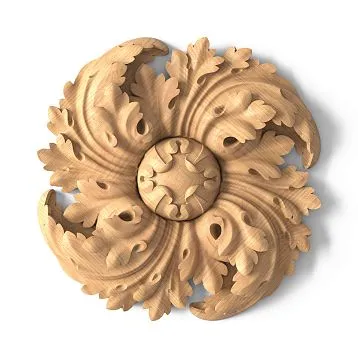
Rosettes are round or polygonal overlays with radial ornamentation. Used as independent decorative elements on walls or in combination with moldings. Small rosettes (diameter 50-100 mm) can be placed at the intersections of moldings, larger ones (150-300 mm) — as central accents of panels.
Wall panels: boiserie in a modern way
Boiserie — wooden panels covering the lower part of the wall — is a classic element of historical interiors. The modern interpretation uses polyurethane moldings to create an imitation of boiserie without the need to make expensive wooden panels.
The basic structure includes a horizontal molding at a height of 90-120 cm from the floor, forming the upper edge of the panel, and a baseboard at the bottom. The space between them is filled with a wall painted in a contrasting or similar color to the moldings, or wallpapered. Vertical moldings divide the panel into sections — panels 40-80 cm wide.
The filling of the panels can vary. Smooth painting is the simplest option, where the panels are simply painted a certain color. Wallpaper with a pattern inside the panels creates a more decorative solution. Relief overlays in the center of each panel add volume and complexity to the composition.
Color solutions for panels are diverse. The classic option is white moldings on walls painted in pastel tones (olive, blue, peach, lilac). The modern approach is a monochrome solution, where moldings and walls are painted the same color, creating a barely noticeable relief. The contrasting option is dark moldings (black, graphite) on light walls or vice versa.
Ceiling stucco: the sky overhead
The ceiling is the fifth wall of a room, which often remains undeservedly forgotten. Meanwhile, a properly designed ceiling visually increases the height of the room, adds volume, and creates a sense of completeness.Buy ceiling mouldingsis an opportunity to turn a flat white surface into an architectural element.
Cornices: ceiling framing
Ceiling cornice is a transitional element between the wall and ceiling, framing the room along the perimeter. The cornice performs several functions: visually completes the walls from above, creates a smooth transition from vertical to horizontal, masks the joint between the wall and ceiling where cracks often form.
The size of the cornice is chosen proportionally to the ceiling height. For standard ceilings 2.5-2.7 m, cornices 80-120 mm high are optimal. For high ceilings 3.0-3.5 m — cornices 120-180 mm. For very high rooms 4 m and above — cornices 200-300 mm and more, possibly multi-layer compositions of several profiles.
The cornice profile is coordinated with the interior style. Classic cornices include complex multi-step profiles with coves, fillets, quarter rounds, sometimes ornamented with dentils (teeth), egg-and-dart, modillions (brackets). Modern cornices are simplified, often one- or two-step, with clean geometric lines without ornament.
Installing cornices requires precision. Corners are joined at 45 degrees using a miter box. Straight sections are joined end-to-end with careful fitting for an invisible seam. The cornice is glued with polyurethane adhesive to the wall and ceiling simultaneously. After installation, the joints are filled with acrylic putty, sanded, and the cornice is painted.
Hidden lighting is a popular solution with ceiling cornices. The cornice is installed with a 50-100 mm offset from the ceiling, and an LED strip is placed behind it. The light, reflecting off the ceiling, creates a soft diffused glow that visually increases the height of the room.
Sockets: the center of the ceiling composition
Ceiling rosette is a round or polygonal decorative element placed in the center of the ceiling under a chandelier. The rosette creates a compositional center towards which the visual axes of the room converge.
The diameter of the rosette is determined by the size of the room. For rooms 12-20 m², rosettes with a diameter of 400-600 mm are suitable. For rooms 20-30 m² — rosettes 600-800 mm. For large halls 40-60 m² and more — rosettes with a diameter of 1000-1500 mm. A rosette that is too small will get lost on a large ceiling, while one that is too large will overwhelm a small room.
The style of the rosette ornament is coordinated with the overall interior style. Classic rosettes have radial symmetry with floral or geometric motifs radiating from the center to the periphery. Baroque rosettes are lavish, with abundant stucco, often asymmetrical elements. Modern rosettes are simplified geometric, with minimal relief.
The rosette is installed with adhesive in the center of the ceiling. The center of the ceiling is determined by the intersection of diagonals for a rectangular room. For rooms of complex shape, the center is chosen visually, taking into account furniture arrangement and functional zones. The electrical cable of the chandelier passes through the central hole of the rosette.
Coffers: Depth and Volume
A coffered ceiling is a ceiling divided into rectangular or square recesses by moldings. Coffers create depth, interplay of light and shadow, and visual complexity characteristic of classical interiors.
The coffered structure is formed by moldings glued to the ceiling in a grid pattern. The grid cells can be square (classic option) or rectangular (for elongated rooms). The cell size is typically 60-120 cm depending on the scale of the room.
Inside the coffers, the ceiling can be painted the same color as the surrounding surface or a contrasting one—often the recesses are made darker to create a depth effect. It is possible to place small rosettes in the center of each coffer or additional perimeter lighting around the coffers.
The profile of moldings for coffers should be expressive enough to create distinct shadows. The molding width is typically 50-80 mm. Too narrow a molding will not provide sufficient relief, while too wide will consume the cell space.
Furniture Molding: When Details Create Value
Furniture without decoration is merely a functional object. Furniture with thoughtful decoration is a work of art, a demonstration of taste, an investment in the aesthetics of everyday life.buy polyurethane molding for furnituremeans gaining access to a tool that transforms standard cabinets and dressers into exclusive interior pieces.
Overlays for Facades: Carving Without Carving
Polyurethane overlays for furniture facades imitate wood carving but surpass it in practicality. Lightweight, durable, and moisture-resistant, they do not crack, dry out, or get damaged by insects.
Ornamental overlays include plant motifs—acanthus leaves, grapevines, floral garlands, geometric patterns—meanders, interwoven lines, rosettes. Sizes range from miniature elements 30×50 mm for decorating drawers to large compositions 200×400 mm and more for central cabinet doors.
Corner overlays are placed at the corners of facades, creating a visual frame for the door or drawer. Four identical corner overlays at the corners of a rectangular facade turn it into a decorated frame without the need for full ornamentation coverage.
Central overlays are installed in the center of the facade, serving as a compositional accent. They can be vertical or horizontal depending on the facade proportions. Vertical overlays suit tall, narrow cabinet doors, while horizontal ones suit wide dresser drawers.
Overlays are attached to furniture using special polyurethane adhesives or universal mounting adhesives. The facade surface is degreased, the overlay is coated with adhesive, pressed onto the facade, and fixed with painter's tape until the adhesive dries (typically 24 hours).
Overlays are painted after installation along with the entire facade or separately beforehand. Acrylic paints provide a durable coating. Patination is possible—darkening the recesses of the relief to create an antique carving effect, or gilding the raised parts for a luxurious Baroque look.
Furniture Cornices: Architectural Finishing
Tall cabinets, sideboards, and display cases in classical style are crowned with cornices—horizontal profiled elements that give furniture an architectural character. A furniture cornice replicates architectural building cornices in miniature.
Furniture cornice profiles are similar to interior and facade ones but on a smaller scale. The width of a furniture cornice is typically 40-80 mm for furniture height of 2-2.5 m. The profile can be a simple two-step or a complex multi-layered one with coves, shelves, and quarter-rounds.
Furniture cornices are installed on the upper part of the furniture body. The cornice can be mounted flush with the facade or protrude forward by 20-40 mm, creating a canopy. Corners are joined at 45 degrees for a seamless connection. The cornice is glued and can additionally be secured with small nails or screws, followed by filling the holes.
Coordinating furniture cornices with architectural ones creates stylistic unity in the interior. If a room uses a ceiling cornice of a certain profile, the furniture cornice should replicate this profile on a smaller scale. This links the furniture with the room's architecture, making it part of a cohesive composition.
Legs and Columns: Supports with Character
Furniture legs define its style no less than facade decoration. Turned, carved, baluster-shaped legs transform a simple table or dresser into a stylish piece suitable for historical or classical interiors.
Turned legs have a round cross-section with a profiled surface—variable diameter creating relief from coves, shelves, and discs. The shape of a turned leg can be straight conical or with curves—cabriole (a leg with a double curve, characteristic of Baroque and Rococo).
Balusters—short turned columns used as legs for small tables, decorative posts in bed headboards, or balustrade elements. A baluster consists of a base, a body of variable diameter, and a capital. The proportions and profile of balusters correspond to historical models or are adapted for a contemporary look.
Columns—full-size vertical elements used in large furniture pieces like display cabinets, sideboards, and shelving units. A column is installed at the front corner of the furniture, creating an architectural accent. A column includes a base with a plinth and torus, a shaft (which can be smooth, fluted with vertical grooves, or twisted), and a capital of Ionic, Corinthian, or simplified style.
The material for legs and columns is solid wood or polyurethane. Wooden elements are heavier, require turning, but possess natural texture and weightiness. Polyurethane ones are lighter, do not crack or warp from humidity, and after painting are visually indistinguishable from wooden ones.
Style Unity: Harmony Outside and Inside
Comprehensive home finishing with molding gains meaning when the facade and interiors are united by a common stylistic concept. How to create this harmony?
Repetition of Motifs
The most direct way to link the facade and interior is by repeating decorative motifs. The ornament on facade architraves is repeated in furniture overlays. The profile of a facade cornice finds continuation in room ceiling cornices. Balusters of a facade balcony echo staircase balusters and furniture legs.
This does not mean absolute copying—rather, creating visual rhymes, recognizable echoes. A facade element can be larger, more massive, as it is designed for perception from a distance. An interior element is more delicate, detailed, intended for close viewing. But the basic form, proportions, and character of the ornament should be recognizably similar.
Proportional Relationships
In addition to ornamental motifs, unity is created by proportional relationships of elements. If pilasters with a height-to-width ratio of 10:1 are used on the facade, then pilasters in the interior, furniture legs, and vertical moldings should have similar proportions.
The module system is a classic architectural technique where all dimensions are multiples of a base unit. If the facade module is 100 mm, then the cornice width is 300 mm (3 modules), the pilaster capital height is 200 mm (2 modules), and the architrave width is 120 mm (1.2 modules). The same modular grid is applied in interiors — the ceiling cornice width is 120 mm, the molding width is 60 mm, and the baseboard height is 100 mm. Modularity creates a subconscious sense of order and harmony.
Color coordination
Color is a powerful tool for creating unity. If the facade molding is white against peach-colored walls, then the interior molding is also white on walls of a similar shade. Exact color matching is not necessary — lighter or more saturated tones can be used inside, but the overall color palette should be coordinated.
Contrasting accents can also link the facade and interior. If dark gray rusticated stones are used on the building corners on the facade, then dark gray pilasters on the walls or dark furniture legs in the interior will create a visual connection.
Where to buy molding for the entire house: supplier selection criteria
The decision for comprehensive finishing has been made. It remains to choose a supplier from whom to buy molding for the facade, interiors, and furniture. What criteria are important?
Completeness of assortment
For comprehensive finishing, a supplier offering a full range of products is needed — facade molding, interior molding, and furniture molding. This guarantees stylistic compatibility, simplifies ordering and logistics, and often provides price advantages for large purchases.
The assortment should include: facade cornices, architraves, pilasters, rustication, balusters, arched elements; ceiling cornices of various profiles and sizes, rosettes of different diameters, corner elements; wall moldings of a wide range of profiles, baseboards, decorative overlays, corner elements, central ornaments, cartouches, rosettes; furniture overlays with floral and geometric ornaments, furniture cornices, legs, balusters, columns.
Production quality
The quality of molding is determined by the material, manufacturing technology, and detail of the relief. Polyurethane should be of European production with high density — 180-220 kg/m³ for interior molding, 350-420 kg/m³ for facade molding. This ensures strength, clarity of relief, and durability.
The molds in which products are cast must be made from high-quality master models. Sharp edges, detailed ornamentation, absence of cavities and deformations are signs of quality production. Products should be perfectly white, without yellowing, with a smooth surface free of drips and defects.
Possibility of custom production
Standard products from the catalog suit most projects. But sometimes a unique element is required — a non-standard size, custom ornament, or special profile. A manufacturer with its own sculpting department can create a master model based on the customer's sketch, make a mold, and cast the required number of products.
This service is critical for restoration projects where historical elements need to be reproduced, for exclusive mansions where standard solutions are unsuitable, and for branded commercial objects requiring unique symbolism in decor.
Service and support
A comprehensive order requires qualified support. A manager should help calculate the material quantity, select compatible elements, and compile a specification. A designer can develop sketches for element placement and create visualizations of the future result.
Logistics should ensure delivery to any region, with packaging that protects products from damage during transportation. The possibility of phased delivery allows receiving material as the object becomes ready for installation, without occupying space on the construction site.
Product warranty is an indicator of the manufacturer's confidence in quality. Serious manufacturers provide a 5-10 year warranty on polyurethane molding, provided installation and operating conditions are met.
Frequently asked questions
How much does comprehensive house finishing with molding cost?
The cost depends on the size of the house, complexity of decor, and number of elements. Approximately: facade decor for a two-story house of 150-200 m² — 150-300 thousand rubles; interior molding for finishing 3-4 rooms — 100-200 thousand rubles; furniture decor for 5-7 pieces of furniture — 30-50 thousand rubles. Total comprehensive finishing — 300-600 thousand rubles. Custom products and complex ornaments increase the cost.
Can polyurethane molding be installed independently?
Interior molding — moldings, baseboards, overlays — can be installed independently with the right tools (miter box, saw, level) and care. Facade molding is better entrusted to professionals, as work at height, the need for mechanical fastening, and sealing require experience. Furniture decor is simple to install — glue and pressure.
How long does polyurethane molding last?
With proper installation and operation, the service life of interior molding is decades, effectively indefinite. Facade molding made of quality polyurethane with UV stabilizers lasts 25-30 years or more without loss of quality. When painted with facade paints, it may require coating renewal every 10-15 years depending on the climate.
Can polyurethane molding be painted?
Yes, polyurethane is excellent for painting. For interior molding, acrylic or latex water-based paints are used. For facade molding — special facade paints resistant to UV and precipitation. The molding is primed before painting. Paint is applied with a brush or roller in 2-3 coats.
How does polyurethane molding differ from gypsum molding?
Polyurethane is 5-10 times lighter than plaster, simplifying installation and reducing load on structures. Polyurethane is water-resistant, not afraid of moisture, suitable for bathrooms, kitchens, and facades. Plaster absorbs moisture and can deform. Polyurethane is impact-resistant, does not crumble under mechanical stress. Plaster is fragile and easily damaged. The cost of polyurethane is 2-3 times lower than plaster with comparable appearance.
Is polyurethane molding suitable for climates with frost?
Yes, quality polyurethane for facades withstands temperatures from -60°C to +80°C without loss of properties. Frost resistance exceeds 300 freeze-thaw cycles. This makes polyurethane molding ideal for the Russian climate — from Sochi to Yakutsk.
How to coordinate molding on the facade and in the interior?
Use elements of similar profiles and ornaments. The facade cornice and ceiling cornice should have an analogous profile structure, although the scale will differ. Repeat the ornaments of facade overlays in interior and furniture overlays. Work with a single manufacturer catalog where collections are initially designed for joint use.
Is special permission required for installing facade molding?
For a private house on one's own plot, permission is not required. For an apartment in a multi-apartment building, altering the facade requires coordination with the management company and the city architectural department, as the facade is common property. For historical buildings in protected zones, permission from monument protection authorities is required.
Conclusion: an investment in beauty for decades
Comprehensive house finishing with molding is not just cosmetic renovation. It creates architectural integrity, transforms a standard structure into a unique object, and is an investment in aesthetics that will bring joy for decades. When the facade, interiors, and furniture are connected by a unified stylistic language, a sense of harmony, thoughtfulness, and completeness emerges.
Modern polyurethane molding production technologies have made this type of decor accessible, practical, and durable. Ease of installation, moisture resistance, impact resistance, and low maintenance are qualities that favorably distinguish polyurethane from traditional materials. At the same time, visually high-quality polyurethane molding is indistinguishable from plaster, possessing the same relief detail and expressiveness of forms.
Supplier choice is critical for project success. A comprehensive range allows purchasing molding for all house areas from one company, ensuring stylistic compatibility and logistical convenience. Production quality guarantees durability and flawless appearance. The possibility of custom production opens the door to exclusive solutions.
Company STAVROS is your reliable partner in creating comprehensive solutions for house finishing with molding. Over 24 years of operation, STAVROS has accumulated unique experience in producing decorative elements from polyurethane and solid wood, creating a catalog of over 5900 items covering all directions of molding application.
STAVROS facade molding is made from high-density European polyurethane with UV stabilizers, ensuring decades of service without fading or degradation. Cornices, architraves, pilasters, rustication, balustrades — a full spectrum of elements for creating expressive facades in classical, baroque, and modern styles.
Interior molding includes ceiling cornices with over 100 profiles, rosettes from 200 to 1500 mm in diameter, wall moldings of all styles, baseboards, decorative overlays, and corner elements. All products feature clear relief, precise geometry, and a white matte surface ready for painting or use as is.
STAVROS furniture molding includes overlays with classical and modern ornaments, furniture cornices, legs, balusters, and columns made of polyurethane and solid wood. Lightweight, durable elements transform standard furniture into authorial interior pieces.
In-house full-cycle production with wood chamber drying, CNC machines, and a sculpting department for creating master models guarantees quality control at every stage. A multi-level inspection system prevents defective products from reaching customers.
The STAVROS design department develops comprehensive house decoration projects, creates 3D visualizations, and helps select coordinated elements for the facade, interiors, and furniture. Custom production based on customer sketches allows for implementing unique ideas.
STAVROS logistics ensures delivery across all of Russia — from Kaliningrad to Vladivostok. Sturdy packaging protects products during transportation. A large stock program allows shipping standard items on the day of order. Custom items are produced in 2-6 weeks depending on complexity.
STAVROS warranty — 5 years for interior molding, 10 years for facade molding when installation technology is followed. This is not just a formal obligation, but real responsibility to the customer and confidence in product quality.
Over 2000 partners — designers, architects, construction companies, furniture manufacturers — work with STAVROS on a permanent basis, considering the factory's products their competitive advantage. Thousands of completed projects — private houses, city apartments, hotels, restaurants, offices, public buildings — confirm the versatility and quality of STAVROS products.
Contact STAVROS for comprehensive molding finishing of your house. We will offer solutions for the facade, interiors, and furniture, coordinated in style, quality, and timing. We will help calculate quantities, select elements, create visualizations, ensure delivery, and recommend installers. STAVROS — from idea to implementation, from facade to furniture, from standard to exclusive. Create your dream home with a reliable partner, tested by time.