












































































Article Contents:
- Philosophy of systemic compatibility
- Basic elements of the staircase system
- Criteria for compatibility when selecting
- Role of fasteners in the system of compatibility
- Templates and marking tools
- Finish coatings: hidden compatibility
- Economics of a systemic approach
- Range of compatible elements
- Selection and Purchase Process
- Installation of a compatible system
- Typical errors of a non-systemic approach
- Maintenance and long-term operation
- Additional system elements
- Questions and Answers
- Conclusion

a staircase in a house is not a set of randomly selected elements, but a complex engineering system where each detail must perfectly match with others. When it comes to the need tobuy components for a wooden staircasemany encounter an unexpected problem: beautiful balusters do not match the chosen handrail, fasteners turn out incompatible with the step thickness, and the finish coating behaves differently on different types of wood. Why does this happen? The answer is simple — the absence of a systemic approach to selecting components.
A unified system of compatibility means that all staircase elements are designed and manufactured with mutual integration in mind. Fastener sizes correspond to baluster cross-sections, column bevel angles are coordinated with handrail slope, materials are treated with identical compositions for uniform finish coating appearance. This is not just convenience during installation — it is a guarantee of strength, durability, and aesthetic integrity of the structure.
in this article we will examine how to correctlystaircase componentsselect, which compatibility parameters to pay attention to, and why purchasing elements from a single production line saves time, money, and nerves. You will learn how to avoid typical mistakes and create a staircase that will serve for decades without creaking, loosening, or requiring constant repairs.


Philosophy of systemic compatibility
Imagine that you are assembling a puzzle where each element is cut from different sets. Pieces look similar, but do not fit perfectly — there are gaps here, overlaps there, and some simply do not connect.Balusters for staircasewhen purchased from one manufacturer, columns from another, and fasteners from the nearest hardware store.
Systemic compatibility begins with unified design standards. When all elements are developed within a single collection, dozens of interaction parameters are considered: pin and socket diameters, socket depths, joint angles, dimensional tolerances. The manufacturer pre-calculates how each element will connect with others, what loads will arise at the joints, and how the wood will behave during operation.
Material compatibility is the second critical aspect.components for wooden staircasesWooden elements from different species have different density, hardness, and coefficient of thermal expansion. Oak balusters and pine columns will react differently to changes in humidity, leading to gaps in joints. A unified system implies using one type of wood or carefully selected combinations with similar characteristics.
Technological compatibility determines the possibility of quality installation. If fastening elements do not match pre-drilled holes, if bevel angles require additional fitting, if protective coating does not lay evenly — installation time doubles, and the quality of the result deteriorates. A systemic approach means that elements arrive ready for installation with minimal additional work.
Aesthetic compatibility is often underestimated, but it is precisely this that creates visual harmony of the staircase. WhenBalusters and Posts for Staircasesdeveloped in a unified stylistic key, with coordinated proportions and ornaments, the staircase appears as a single artwork, not a random assembly of disparate parts.
The economic rationality of a systemic approach becomes evident over time. Yes, it is possible to find individual elements cheaper from different suppliers. But the costs of fitting, additional fasteners, repeat purchases due to incompatibility, increased installation time, and risk of defects outweigh the apparent savings. A systemic kit is worth its money.




Basic elements of the staircase system
Each wooden staircase consists of a strictly defined set of components, and understanding their functions is the first step toward proper selection. Let's start with load-bearing elements, which form the structural frame.
Steps are horizontal surfaces on which a person steps directly. They bear vertical loads and transfer them to the load-bearing structure. Step thickness is typically 40-50 mm for residential staircases, width 250-320 mm, length depends on the tread width. The most important compatibility parameter is the method of attachment to stringers or rails.
Newel posts are vertical strips that cover the space between steps. They give the staircase a finished look and additional rigidity. The height of a newel post is usually 150-200 mm, thickness 18-25 mm. In open staircases, newel posts may be absent, creating a sense of lightness.
Stringers are inclined load-bearing beams on which steps are laid. Their cross-section depends on the span and load, usually 60×250 mm or larger. Compatibility of stringers is determined by the method of attaching steps to them — inserting into grooves, mounting on brackets, or screwing from below.
Rails are inclined beams between which steps are mounted in end grooves. The cross-section is similar to stringers. A system on rails creates a more enclosed appearance of the staircase and requires high precision in groove manufacturing to ensure compatibility with steps.
Now let's move on to railing elements — these are most often the source of compatibility issues when purchasing from different manufacturers.
wooden balustersBalusters are vertical posts forming the railing fill. Standard height is 900 mm, round cross-section 40-50 mm, square 40×40 or 50×50 mm. Critical compatibility parameters: diameter and length of the tenon at the end for mounting, distance between axes during installation, compatibility of miter angles with the staircase slope.
Posts are larger-section railing support elements installed at the beginning and end of the tread, at turns. Cross-section 80×80 mm or 100×100 mm, height 1100-1200 mm. Posts must have compatible connection nodes with balusters for handrail and newel post mounting.
Handrails are the top horizontal railing element, which people hold onto while ascending. Cross-section is usually 60×40 mm or round with 50 mm diameter. The bottom part of the handrail must have a groove for mounting balusters, matching their tenons. Miter angles and radii of curvature at turns require precise compatibility with the staircase geometry.
Newel post — the bottom guide rail to which balusters are attached. Not always used, but significantly simplifies installation and ensures precise mounting. Cross-section 40×60 mm or close to it. Must have a groove or mounting system compatible with the bottom tenons of balusters.
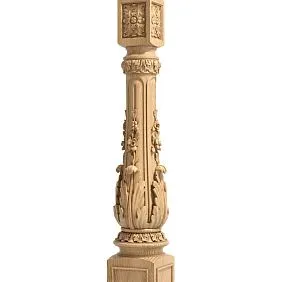
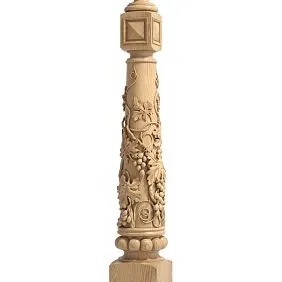
Our factory also produces:

Compatibility criteria for selection
When you decideWooden staircase components for saleFirst, assess the geometric compatibility of elements. This means checking the correspondence of sizes and shapes of mating parts.
Sizes of tenons and mortises — basic parameter for wooden joints. If the baluster tenon diameter is 12 mm, and the handrail hole is designed for 10 mm, the elements cannot be connected without modification. Standard tenon diameters: 8, 10, 12, 16 mm. Mortise depth should be 5-10 mm deeper than tenon length to accommodate glue and compensate for inaccuracies.
Miter angles of baluster ends must match the staircase slope angle. For a 35° staircase, balusters must have a bottom end mitered at the same angle for vertical installation. Even a 2-3° difference will be visually noticeable and cause problems with joint tightness.
Baluster spacing is determined by their width and safety requirements. The clear distance between balusters should not exceed 100 mm in homes with children. If balusters have a 50×50 mm cross-section, the axis spacing will be 150 mm. The handrail and newel post must be marked for this spacing.
Material compatibility includes coordination of wood species, moisture content, and surface treatments of elements. Mixing oak and pine in one structure requires accounting for differences in hardness and coefficient of expansion.
Wood species have different densities: oak 650-750 kg/m³, beech 650-680 kg/m³, ash 650-700 kg/m³, pine 450-500 kg/m³, larch 650-700 kg/m³. At the same air humidity, oak and pine exhibit different dimensional changes, which may lead to joint loosening. It is recommended to use elements of the same species or species with similar characteristics.
Moisture content of all elements must be identical and match the operating conditions — 8-12% for indoor spaces. If balusters are dried to 8%, while posts have 15% moisture, when moisture levels are equalized, posts will shrink and joints will loosen.
Pre-treatment of surfaces affects compatibility with finish coatings. Elements subjected to the same sanding and priming will uniformly accept varnish or oil. Inconsistent treatment will result in color and gloss differences even with the same finish.
Structural compatibility determines the strength and reliability of joints. Here, the methods of fastening, types of fasteners, and their compatibility with the structure are crucial.
Types of baluster connections to handrail and base: tenon in mortise, metal rods, screw systems, glued joints. All system elements must use one type of connection or provide multiple options. If the handrail has only a tenon groove and balusters have only threaded holes, connecting them without modification is impossible.
Fasteners must match the material and structure. For joining oak parts, use screws from hardened steel; ordinary screws may break during tightening. Screw diameter is chosen based on material thickness: for balusters 50 mm, use 6 mm screws; for posts 100 mm, use 8 mm screws.
Aesthetic compatibility creates visual harmony for the staircase. Even if elements are geometrically and structurally compatible, stylistic differences will ruin the entire project.
The stylistic elements must be consistent. Classical turnedbalustersbalusters with vase-shaped profiles are incompatible with modern minimalist rectangular handrails. Geometrically flat balusters require corresponding posts and handrails.
Element proportions must correspond to each other. Massive 100×100 mm posts look absurd with thin 30 mm diameter balusters. Optimal ratio: posts 2-2.5 times thicker than balusters.
Color palette is determined by wood species and finish treatment. Mixing light pine with dark oak requires toning to match tones. Elements of the same species with identical finish guarantee consistent color.
Get Consultation
Role of fasteners in system compatibility
Many underestimate the importance of fasteners, considering them secondary details. In reality, proper fastening ensures the strength and longevity of the entire structure.
Wooden dowels and tenons — traditional joinery fasteners. A dowel is a cylindrical rod of hardwood inserted with glue into coaxial holes in mating parts. Standard diameters: 6, 8, 10, 12 mm. Length is chosen so that the dowel penetrates each part to a depth of at least three diameters.
A projection is a protrusion on the end of a part that fits into a socket on the mating element. Projections can be round, rectangular, or trapezoidal ("bird's beak"). For balusters, round projections with a diameter of 10–16 mm and a length of 40–50 mm are typically used. The strength of a projection joint is higher than that of a dowel joint due to a larger bonding area.
Metal fasteners are used to strengthen joints or when wooden fasteners are insufficient.
Wood screws are the most common type of fastener. For stair constructions, screws with a diameter of 5–8 mm and a length of 50–120 mm are used, depending on the thickness of the connected parts. The head can be recessed (for concealed mounting with subsequent filling) or hexagonal (for secure tightening).
Threaded rods and bolts are used for critical joints requiring high strength. Posts are often secured to the load-bearing structure using through bolts M10–M16. The length is selected based on the thickness of the connected elements plus 30–40 mm for the nut and washer.
Metal plates, angles, and brackets are used to strengthen joints and connect elements at angles. Specialized stair fastening systems include adjustable baluster supports, concealed screw connections for handrails, and angular elements for joints at arbitrary angles.
Compatibility of fasteners with system elements is determined by several parameters. The sizes of fastener holes in pre-made elements must match the selected fastener type. If balusters have 10 mm dowel holes, using 12 mm rods will require drilling, which weakens the structure.
Fastener material must match the operating conditions. Zinc-plated screws are suitable for indoor stairs, while stainless steel is required for outdoor use. Black tempered screws are used for hardwoods.
The number and placement of fasteners are calculated based on loads. One screw per baluster is insufficient — at least two, positioned at an angle to each other to prevent rotation. Posts are secured with at least two bolts or four screws.
Templates and marking tools
The accuracy of stair installation depends on the quality of marking, which in turn depends on the presence of correct templates and tools. This is another aspect of system compatibility that is often overlooked.
Angular templates are used for precise trimming of ends of balusters, posts, and handrails. The angle of inclination of a staircase is rarely exactly 30° or 45° — it is usually intermediate values such as 33° or 38°. A universal protractor-compass allows fixing the actual angle and transferring it to blanks. For mass trimming, a rigid template made of plywood or MDF with an exact angle is manufactured.
Drilling templates ensure accurate positioning and perpendicularity. The simplest template is a wooden block with drill bushings that define the direction and depth of drilling. For installing balusters, it is critically important that the holes in the tread and handrail are coaxial — even slight misalignment will cause the post to be crooked.
Distance templates are used for evenly spacing balusters on treads. This can be a simple ruler with markings or a complex system of stops that quickly and accurately positions each baluster. The accuracy of placement determines the visual perception of the staircase — uneven baluster spacing is immediately noticeable.
Leveling and plumb bobs are necessary to check the verticality and horizontality of elements. A standard bubble level 600–1000 mm long — minimum. A laser level projecting vertical and horizontal planes significantly speeds up work and increases accuracy.
Measuring tools include a tape measure, square, caliper for checking diameters and depths. A digital protractor provides accuracy to 0.1°, which is critical for complex staircases.
All these tools and templates are part of a compatibility system. Professional manufacturersstaircase componentsoften provide template kits or detailed instructions for their manufacture, simplifying installation and guaranteeing correct results.
Finish coatings: hidden compatibility
The final stage of staircase creation is applying protective-decorative coatings. And here again, the question of compatibility arises: different wood species, different pre-treatments, different operating conditions require coordinated selection of finish materials.
Wood oils penetrate deeply into the structure, highlight the texture, and create a silky surface. Linseed, tung, and Danish oils — each has its own absorption characteristics and drying time. It is important that all staircase elements are treated with the same oil or compatible compounds; otherwise, differences in tone and gloss will appear.
Hard oils and oil-waxes combine wood penetration with the formation of a protective film on the surface. They are more wear-resistant than pure oils and are suitable for heavily used elements — handrails, treads.Handrails and balusterscan be covered with a thinner compound.
Lacquers create a strong protective film on the wood surface. Polyurethane lacquers have maximum wear resistance, alkyd lacquers provide a warm tone, water-based acrylics dry quickly and have no odor. Lacquer compatibility is critical: oil-based lacquer cannot be applied over acrylic primer, or different types cannot be mixed in one coating.
Stains and tinting compounds change the color of wood while preserving the texture visibility. They must be compatible with the finish coating. Water-based stains raise the nap and require intermediate sanding, alcohol-based stains dry quickly, and oil-based stains penetrate deeply.
Primers equalize the wood’s absorption capacity and improve the adhesion of the finish layer. For coniferous species with high resin content, a special primer-isolator is required. Hardwood species are easier to prime.
A systematic approach to finish treatment implies that all elements receive consistent preparation and are coated with compatible compounds in the correct sequence. Manufacturers of complete systems often offer recommended coating lines that have passed compatibility tests with their wood.
Economics of the systematic approach
It seems that buying all elements from one manufacturer should cost more than assembling a staircase from components of different origins. Practice shows the opposite — the systematic approach is economically advantageous.
Direct costs include the cost of materials, delivery, and fasteners. Bulk delivery usually provides a 10–15% discount compared to purchasing elements individually. Delivery by one vehicle is cheaper than multiple trips. Fasteners selected for a specific system are used without waste.
Hidden costs of fitting incompatible elements often exceed direct savings. Drilling holes, trimming ends, manufacturing transition elements, additional sanding — all this takes time and materials. A qualified craftsman’s hour is expensive, and fitting mismatched elements may take several days.
The risks of mismatch and rework sharply increase with a non-systematic approach. Items purchased in different placesWooden balusters pricewhich seemed attractive, may turn out unsuitable due to mismatched tenon sizes. You will have to purchase additional parts, spending time on searching and delivery, and incompatible elements will become scrap.
Warranty obligations for a complete purchase apply to the entire system. If something fails due to a defect, the manufacturer is liable. With a piecemeal assembly, it is difficult to determine the cause of the problem — whether the balusters are of poor quality, the fasteners are wrong, or the finish is incompatible.
Long-term savings are evident during operation. A systematically designed and correctly assembled staircase serves for decades without repair. A structure made of incompatible elements begins to loosen, creak, requires tightening of fasteners and replacement of worn parts.
An investment in quality pays off with comfort and peace of mind. A staircase is a home element with high usage intensity. Dozens of times a day, people walk over it. A reliable, silent structure is worth the money spent.
Assortment of compatible elements
Modern markets offer diverse rangesstaircase componentsdeveloped with consideration for mutual compatibility. Let's consider the main categories.
Classic turned collections include balusters, posts, and handrails with traditional profiles — vases, spheres, spindles. All elements of the collection have a unified style of turning, coordinated proportions, and standard connection joints. Wood species: oak, beech, ash, pine. Baluster height 900 mm, post height 1100–1200 mm, tenon diameter 12 mm, socket depth 40 mm.
Modern minimalist systems offer balusters with square or rectangular cross-sections and minimalist design. Chamfers and router profiling create detail without excess. Handrails with rectangular cross-sections 60×40 mm or 70×45 mm with soft rounded corners. Baluster mounting — concealed screw or tenon.
Flat carved collections are based on traditions of wooden architecture.Flat wooden balusterswith carved ornaments, posts with relief carving, handrails with profiling. Thickness of flat elements 30–40 mm, width 80–120 mm. Feature — the possibility of creating unique ornaments while maintaining standard connection joints.
Combined systems combine wood with other materials — metal, glass, cana. Wooden posts and handrails are complemented by metal balusters or glass panels. Require special fasteners and precise fitting of dissimilar materials.
Steps and treads are offered in various sizes and wood species. Standard step thickness 40 mm, width 300 mm, length 800–1200 mm. Tread thickness 20 mm, height 160–180 mm. Ends may be straight or profiled. Important parameter — method of attachment to the load-bearing structure.
Handrails are produced in various cross-sections and profiles. Round with diameter 50–60 mm, oval 60×45 mm, rectangular with rounded corners 70×50 mm. Bottom has a groove for installing balusters — width 12–16 mm, depth 40–50 mm. Handrails are sold as straight segments 2–3 meters and curved elements for turns.
Posts differ in size, profile, and mounting method. Support posts with cross-section 100×100 mm or diameter 90 mm are installed at the beginning and end of the flight. Intermediate posts 80×80 mm or diameter 70 mm — on long spans. The top of the post may have a mounting platform for the handrail, carved capital, or conical finish.
Fastening systems include concealed screw connections, adjustable supports, corner elements. Professional fastening ensures connection strength and precise fitting without visible elements.
Process of selection and purchase
How to properly organize the selection and purchase of components to obtain a compatible system? Follow the step-by-step algorithm.
Step one — measurement and design of the staircase. Precise dimensions: height between floors, opening length and width, slope angle, number of steps. These parameters determine which elements are required and in what quantity. The project can be done independently using online calculators or by a professional designer.
Step two — determining style and materials. Classic or modern? Oak or pine? Open or closed construction? These decisions determine the selection of element collections. It is important to consider the overall interior style and operational requirements.
Step three — selecting the manufacturer and collection. Study the assortment, ensure that all necessary elements are present in one line. Check for technical documentation with dimensions and fastening methods. Read reviews about product quality and compliance with standards.
Step four — calculating quantities and preparing a specification. How many steps, balusters, meters of handrail, posts are needed? Add 5–10% reserve for possible errors and damage. Don’t forget about fasteners, glue, and finishing coatings.
Step five — consultation with the manufacturer’s or supplier’s specialist. Describe your project, show drawings, clarify compatibility nuances. A professional consultant will advise which elements are best suited, what fasteners to use, and how to avoid typical mistakes.
Step six — placing the order and delivery. Check completeness, presence of quality certificates, warranty obligations. Arrange delivery so that all elements arrive simultaneously and can be stored under suitable conditions until installation.
Step seven — goods acceptance. Upon receipt, carefully inspect each element. Check critical dimensions — tenon diameters, socket depths, miter angles. Ensure absence of defects — cracks, knots, warping. Document any issues in the acceptance act.
Step eight — storage until installation. Wooden elements must acclimate under conditions close to operational ones, for no less than one week. Store in a dry room at 18–22°C temperature and 40–60% humidity, horizontally on supports.
Mounting a compatible system
Even perfectly matched compatible elements require proper installation. The installation process is also part of the system.
Foundation preparation — the first critical stage. The load-bearing structure of the staircase must be strong, rigid, and precisely executed. Steps must lie in a single plane, without misalignment or deflection. Deviations exceeding 2 mm per meter are unacceptable. If necessary, leveling is performed by grinding or installing adjustable supports.
Dry assembly — the most important stage, often skipped. All railing elements are assembled without glue and final fixation to check compatibility and geometry. Problems identified at this stage are easy to fix before final installation. Verticality of balusters, tightness of joints, and uniformity of spacing are checked.
Marking is performed using templates and measuring tools. The locations for installing balusters are marked on the steps and handrail. The accuracy of marking determines the visual appearance of the finished staircase. Use a laser level to control vertical and horizontal alignment.
Drilling holes requires maximum precision. The drill bit diameter must exactly match the tenon diameter — a 0.5 mm clearance is optimal. Depth is controlled by a drill stop or mark. Perpendicularity is ensured by a drill guide or drill press.
Component fitting is performed as needed. If the tenon fits too tightly into the mortise, it is lightly sanded with sandpaper. If too loose, the mortise is filled with wood shavings mixed with glue. The ends of balusters are fitted for angle and tightness of fit.
Glue joints are the foundation of strength for wooden staircases. Carpenter's PVA is used for interior structures, polyurethane glue for humid areas. Glue is applied in an even layer to both surfaces to be joined. Elements are joined with slight rotation to distribute glue. Excess is immediately wiped off with a damp cloth.
Mechanical fastening complements glue joints. Self-tapping screws are driven at an angle through pre-drilled holes slightly smaller than the thread diameter. Screw heads are countersunk 3-5 mm for subsequent filling with wooden plugs.
Geometry control is performed at every stage. Baluster verticality is checked with a level, spacing between them with a template, joint tightness visually and by touch. Detected deviations are corrected before the glue sets.
Final node finishing includes filling mounting locations, sanding, and staining. Wooden plugs are glued into screw holes, trimmed flush after drying, and sanded. Areas of trimming and mechanical processing are sanded with fine sandpaper.
Application of the final finish is the final step. The entire structure is coated with the selected product according to the manufacturer's technology. The first layer is applied generously for deep penetration. After drying, light sanding is performed to remove raised fibers. Subsequent layers are applied thinner until the required degree of protection and gloss is achieved.
Typical errors of a non-systemic approach
Studying other people's mistakes is the best way to avoid them. Let's consider the most common problems arising from purchasing incompatible components.
Mismatch of tenon and mortise sizes is the most common problem. Balusters with a standard 12 mm tenon do not fit into a handrail with a 10 mm mortise. Either the tenons must be filed down (weakening the joint), or the mortises must be enlarged (damaging the handrail). Both options reduce strength.
Different end-cut angles of balusters and staircase slope result in balusters standing not vertically or fitting loosely to the handrail. Even a difference of 3-5° is visually noticeable and creates gaps in joints. Re-cutting ends reduces the effective height of balusters.
Incompatibility of wood species manifests during operation. Oak posts and pine balusters have different coefficients of thermal expansion. With changes in humidity, elements deform differently, causing joint loosening and squeaks.
Different moisture content of elements is a hidden problem that manifests over months. If balusters purchased from one manufacturer have 8% moisture, and posts from another have 15%, after moisture equalization, posts will shrink and glue joints will weaken. The structure will begin to loosen.
Incompatibility of element styles creates visual dissonance. Classical turned balusters with baroque posts and minimalist rectangular handrails look ridiculous. Attempts to fix the situation with additional finishing rarely succeed.
Inappropriate fasteners are a source of strength problems. Screws designed for soft pine break when driven into oak. Too short screws do not provide reliable fixation. Black screws rust in high-humidity conditions, leaving dark stains on wood.
Incompatibility of finish coatings leads to uneven tone, stains, and peeling. Oil-based stain applied to some elements and water-based to others will produce different shades even with the same color name. Lacquer incompatible with primer may peel and flake.
Lack of spare parts leads to problems when defects are found or components are damaged during installation. Buying a single baluster may be impossible — the batch is already sold out, and the new batch differs in shade. A systemic approach implies purchasing with a 5-10% reserve.
Maintenance and long-term operation
A compatible system of components not only simplifies installation but also subsequent maintenance of the staircase. Let's consider how the correct choice of components affects operation.
Regular inspection should be conducted every six months. The strength of fasteners is checked — balusters should not wobble or rotate. Glue joints are inspected for cracks. The condition of the finish coating is checked — chips, scratches, color changes.
Fastener tightening is required upon detecting play. In systems with screw fasteners, simply tighten the screws. In glue joints, loosening is corrected by injecting additional glue through drilled holes or installing additional fasteners.
Finish coating renewal is performed as needed. Oil-based finishes require renewal every 2-3 years — a fresh layer of oil is applied to a cleaned surface. Lacquer finishes last longer but require complete resanding and reapplication if damaged.
Replacing damaged elements in a compatible system causes no problems. If one baluster breaks, you can buy an identical one from the manufacturer. Dimensions, wood species, and shade will be identical. In a non-systemic structure, finding a replacement is much more difficult.
Modernization and expansion of the staircase are possible with a compatible system. If additional spans or configuration changes are needed, elements from the same collection easily integrate into the existing structure.
Manufacturer's warranty service applies to the entire system when purchased as a complete set. If a defect in an element or deviation from specifications is found, the manufacturer must replace the part or refund the money. In a modular structure, determining responsibility is difficult.
Long-term operation confirms the advantages of a systemic approach. A properly designed and assembled staircase made of compatible elements lasts 30-50 years without major repairs. Only cosmetic maintenance and finish coating renewal are required.
Additional system elements
In addition to main components — steps, balusters, posts, handrails — a complete system includes numerous additional elements ensuring functionality and aesthetics.
decorative rose outletsUsed for decorating element connection points, concealing fasteners, and creating accents. Carved rosettes are installed on posts, at handrail-to-wall junctions, and at handrail ends. Size and style must match main elements.
Decorative brackets for shelvesCan be used to reinforce and decorate handrail-to-wall connection nodes. Carved brackets in a style matching the balusters create compositional unity.
Carved decorative elements are installed on balusters and stringers to enhance decoration. These may include plant motifs, geometric patterns, or emblems. Compatibility is determined by style, wood species, and mounting method.
End caps protect the ends of handrails, preventing moisture ingress into the end cut. Made from the same wood species as the handrail, they feature matching profiles and finish.
Handrail corner elements provide smooth 90° or other angle turns. Bent elements are manufactured from glued laminated wood using molding. Cross-section dimensions and profile fully match straight handrail sections.
Handrail connector elements conceal joints between straight sections. These may be concealed screw couplings or surface-mounted decorative elements. They ensure strong and aesthetically pleasing connections.
Staircase lighting has become a popular feature. LED strips are mounted under treads, in handrails, or along the stringer. Compatibility is determined by the presence of technological grooves and channels in main elements for concealed wiring routing.
Anti-slip inserts on treads increase safety. Rubber or abrasive strips, or wooden grooved inserts, are installed on the front edge of treads. They must match in color and not disrupt overall aesthetics.
Questions and answers
Can elements from different manufacturers be mixed in one staircase?
Technically possible, but strongly discouraged. Different manufacturers use varying standards for fastener sizes, miter angles, and profiles. Even if elements are matched, joint reliability and aesthetics suffer. A system approach using elements from one manufacturer guarantees compatibility.
Which wood is best suited for staircase components?
For interior staircases, hardwoods — oak, beech, ash — are optimal. They provide strength, durability, and longevity. Pine and spruce suit budget projects but require increased element cross-sections. For exterior staircases, spruce is preferred due to its natural moisture resistance.
How many balusters are needed for a standard staircase?
Quantity depends on the run length and chosen baluster spacing. At 150 mm spacing between baluster centers per meter, approximately 7 balusters are needed. For a 3-meter staircase — about 20 balusters. Add 5–10% extra for potential defects or damage during installation.
Is a stringer needed, or can balusters be mounted directly to treads?
Both options are acceptable. Mounting via a stringer simplifies installation, ensures precise placement, and adds extra rigidity. Direct mounting to treads saves material and appears visually lighter. Choice depends on staircase construction and aesthetic preferences.
How often should the finish on a staircase be renewed?
Oil finishes require renewal every 2–3 years, especially on high-use areas — treads and handrails. Lacquer finishes last 5–7 years with careful use. Hard oils and oil-varnishes fall in between — 3–4 years.
Can I install purchased components myself?
With basic carpentry skills, proper tools, and careful adherence to instructions — yes. A compatible system of components significantly simplifies installation. However, for complex staircases with turns and non-standard geometry, it is recommended to hire a professional.
What to do if an element is damaged after several years of use?
When purchasing components from a system line, contact the manufacturer to order an identical replacement. Keep documentation with part numbers and collection names. If the collection is discontinued, the manufacturer typically offers an equivalent from the current assortment.
Which fasteners are better — wooden or metal?
For main connections, optimal combination: glued mortise-and-tenon joints provide strength and aesthetics, while metal fasteners (screws, bolts) add extra reliability and adjustability. Pure wooden joints are attractive but require high precision.
Does element compatibility affect staircase cost?
Directly — no, a complete system may cost the same or even less due to bulk discounts. Indirectly — significantly reduces costs for fitting, modifications, and additional fasteners. Long-term savings appear in lower maintenance and repair expenses.
How to check component quality when purchasing?
Visually inspect the wood — absence of cracks, large knots, warping. Check moisture content with a moisture meter — should be 8–12%. Measure critical dimensions — tenon diameters, mortise depths, miter angles. Verify element compatibility — the baluster should easily fit its mortise in the handrail.
Conclusion
Creating a reliable, beautiful, and long-lasting wooden staircase is impossible without a systematic approach to component selection. A unified compatibility system means all elements — from treads to decorative inserts — are designed with mutual integration, made from coordinated materials, feature standardized connection joints, and share a consistent style.
Advantages of a systematic approach manifest at all stages: design is simplified through ready-made solutions and manufacturer recommendations, installation is accelerated due to precise element matching, risk of errors and defects is reduced, structural strength and reliability are ensured, and interior aesthetic cohesion is achieved.
The economic justification for purchasing compatible components from one manufacturer is proven by practice. The illusion of savings from assembling a staircase from mismatched elements is offset by costs for fitting, modifications, additional fasteners, and the risk of obtaining an unreliable structure.
When you decidepurchase wooden staircase componentsChoose not individual decorative elements, but a thoughtfully designed system where each detail is part of a unified whole. Check compatibility of dimensions, materials, and fastening methods. Consult with manufacturer specialists. Purchase with a small reserve for potential damage.
designed with mutual compatibility in mind. The catalog features various collections — from classic carved to modern minimalist, from strict geometric to ornate carved styles. All elements are crafted from carefully selected hardwoods, adhering to strict quality standards.
Company STAVROS offers a full range ofstaircase componentsdeveloped with mutual compatibility in mind. The catalog features various collections — from classic carved to modern minimalist, from strict geometric to ornate carved designs. All elements are crafted from select hardwoods, adhering to strict quality standards.
balusters, posts and handrailshandrails, treads, fastening systems — everything necessary to create a staircase of any configuration. Professional STAVROS consultants will help you select the optimal set of elements for your project, taking into account the room’s characteristics and your aesthetic preferences, and calculate the required amount of materials.
By choosing STAVROS, you are not just getting a set of parts, but a comprehensive solution with guaranteed compatibility of all elements, technical support at every stage from design to installation, quality proven by thousands of completed projects. Create a staircase that will serve your family for decades!


