












































































Article Contents:
- Why a Corridor Destroys Regular Finishes Within a Year
- Mechanical Impacts — The Main Enemy
- Abrasion and Soiling
- Thermal Fluctuations
- High Aesthetic Requirements
- Impact-Resistant Baseboards: The First Line of Defense
- High Profiles for Maximum Protection
- Reinforced Mounting for Reliability
- Flexible Options for Complex Geometry
- Wall panels: armor for the lower third of the wall
- Protective Belt 90–150 cm High
- Materials for Wall Panels
- Panel System Design for Entrances
- Cornices and Moldings: Finishing Elements of Durable Finishes
- Ceiling Cornices in the Risk Zone
- Wall Moldings for Zoning
- Decorative Rosettes and Brackets
- Polystyrene vs. Other Materials: An Objective Comparison
- Polystyrene vs. Plaster
- Polystyrene vs Polyurethane
- Polystyrene vs. Wood
- Practical Tips for Choosing Materials for the Corridor
- Assess the Actual Load
- Choose the Right Profile Height
- Don't Skimp on Mounting
- Plan the Painting
- Installation in Limited Space Conditions
- Working in Narrow Corridors
- Complex Corners and Niches
- Bypassing Pipes and Utilities
- Operation and Care: Maintaining Finish Freshness for Years
- Regular Cleaning
- Combating Stubborn Stains
- Minor DIY Repairs
- Design Solutions: Beauty and Strength Combined
- Modern minimalism
- Classic elegance
- Scandinavian simplicity
- Contemporary with Color Accents
- Where to Buy Quality Materials: Partnership and Guarantees

The hallway and corridor are the most heavily used areas in any home or office. Dozens of times a day, bags, suitcases, bicycles, strollers, and utility carts rush through here. Wet shoes, umbrellas, active pets, furniture during rearrangement — all this creates a colossal load on the finish. After six months of use, scuffs appear on the walls, baseboards become chipped, and cornices crack from accidental impacts. Traditional materials — gypsum stucco, wooden moldings, MDF panels — are not designed for such conditions. There is a solution:impact-resistant polystyrene profiles, high-strength wall panels, and specialized cornices that withstand the daily stress of high-traffic areas without losing their appearance.
High-traffic areas require a special approach to choosing finishing materials. You cannot simply buy a beautiful baseboard or elegant stucco and hope they will last long. In an apartment hallway with children or an office lobby with a flow of visitors, decorative elements must combine aesthetics with engineered strength. Impact-resistant materials are specifically designed for such conditions: they absorb impact energy, do not crack under mechanical stress, are easy to clean, and maintain their presentability for years. At the same time, modern technologies allow creating profiles of any shape and style — from laconic minimalism to rich classical stucco. Visually, it is almost impossible to distinguish high-quality polystyrene from gypsum, but the difference in durability and practicality is enormous.

Why a Corridor Destroys Ordinary Finishes in a Year




Mechanical Impacts — The Main Enemy
Imagine a typical morning: a person leaves the apartment with a heavy bag that hits the baseboard. They return in the evening with a suitcase after a business trip — the suitcase rolls down the corridor, scratching the walls and hitting corners. Children bring in bicycles, scooters, sleds from outside — all of this passes through the narrow hallway, leaving marks on the finish. The family dog runs around, hitting baseboards with its claws. Once a month, furniture is rearranged or a deep cleaning involves moving heavy objects.
A gypsum baseboard chips at the first strong impact. A wooden one cracks or detaches from the wall. An MDF panel crumbles under point pressure. Polyurethane elements are stronger but heavy, expensive, and difficult to install.impact-resistant polystyrene profileswithstand impacts with energy up to 150 J/m — this is equivalent to a heavy object falling from a height of one meter. The material does not crack; at worst, a small dent forms, which is practically unnoticeable and easily repaired.
Our factory also produces:


Abrasion and Stains
The lower part of the wall in the corridor is in constant contact with shoes, bags, and clothing. Dirt, dust, moisture, de-icing agents from winter footwear — all of this settles on baseboards and lower panels. A standard painted wall quickly wears out, the paint fades, and dark spots appear. Wooden elements absorb moisture, swell, and become stained. MDF begins to delaminate at chipped spots.
Polystyrene does not absorb water — water absorption is less than 0.1% by volume. Even with constant contact with wet footwear, the material retains its shape and strength. The smooth surface is easily cleaned with any household cleaners, leaving no streaks or stains. A high-quality coating withstands thousands of wet cleaning cycles without losing color or shine.
Get Consultation
Thermal Fluctuations
The entrance door constantly opens — in winter, cold air rushes into the hallway; in summer, hot air. Temperature fluctuations reach 20–30°C several times a day. Gypsum elements accumulate internal stresses under such fluctuations, and cracks appear over time. Wood warps and twists, especially if humidity also changes. MDF is more stable, but joints can still separate.
Impact-resistant polystyrene maintains stability in a range from -40°C to +80°C. The coefficient of linear expansion is minimal — only 0.06–0.08 mm per meter with a 10°C temperature change. With proper installation and compensation gaps, thermal deformations are fully compensated and visually unnoticeable.
High Aesthetic Demands
The paradox of high-traffic zones: they are under maximum load and yet must look presentable. The hallway is the first thing guests see when entering a home. An office lobby forms the first impression of a company. Worn walls, chipped baseboards, and peeling finishes create a sense of neglect, even if the rest of the rooms are perfect.
The traditional solution is regular cosmetic repairs every 2–3 years. This is costly in terms of time, money, and creates inconvenience. The modern approach is to install durable materials once that will maintain their appearance for 15–20 years.Impact-resistant baseboards, panels, and cornicesare created precisely for this: years of use without loss of presentability.
Impact-Resistant Baseboards: The First Line of Defense
High Profiles for Maximum Protection
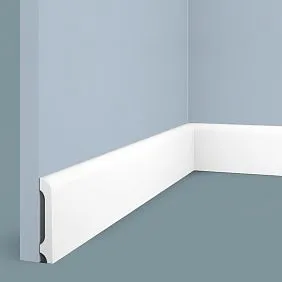
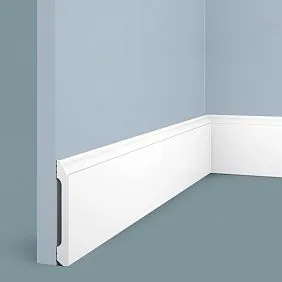
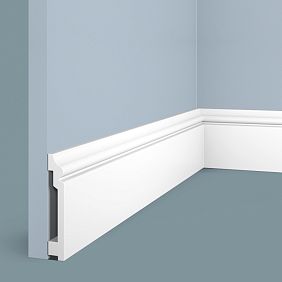
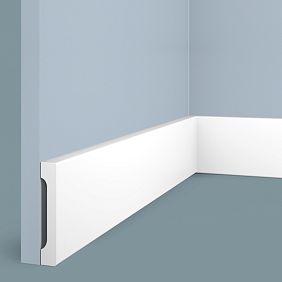
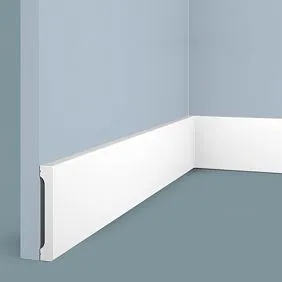
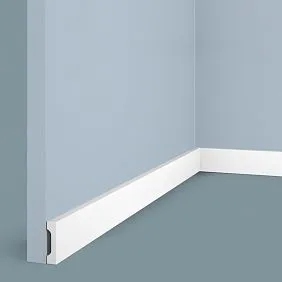
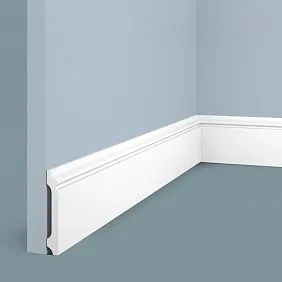
In corridors and hallways, an optimal baseboard height is 80–120 mm. This is not an aesthetic whim but a practical necessity. A tall baseboard protects a larger area of the wall from impacts, stains, and water splashes during floor washing. A suitcase or bag hitting the wall strikes the durable polystyrene, not the painted surface or wallpaper.
For particularly high-load zones — entrance areas of commercial premises, hotel corridors, public lobbies — baseboards with a height of 150–200 mm are used. This is no longer just a decorative element but functional protection that saves thousands of rubles on wall repairs.
Floor skirting boards made of impact-resistant polystyreneare available in dozens of profiles: from simple rectangular ones for modern interiors to luxurious carved ones for classical spaces. The material is easily molded, allowing for the creation of complex reliefs that look like expensive plaster molding but surpass it in strength many times over.
Reinforced fastening for reliability
In high-traffic areas, skirting boards cannot be attached with glue alone — additional mechanical fastening is required. The technology is simple: the profile is first glued with solvent-free polymer adhesive (important!), then additionally secured with screws or dowels at 40–50 cm intervals. The fastener heads are countersunk, the holes are filled with acrylic filler, and after painting, the fastening points become invisible.
Such reinforced fastening guarantees that even with a strong lateral impact, the skirting board will not tear away from the wall. At most, a small dent will form, but the structural integrity will be preserved. For comparison: a standard skirting board attached only with glue can break off in a whole piece if hit by a cart or bicycle.
Flexible options for complex geometry
Corridors often have complex configurations: columns, bay windows, curved walls. For such areas, flexible impact-resistant profiles have been created that bend to a radius without heating or structural damage. The minimum bending radius depends on the profile height — typically 30–50 cm.
Installing flexible skirting requires some skill: the profile is gradually bent using a template or directly against the wall, secured with adhesive and mechanical fasteners. After installation, it retains its shape for decades, does not straighten out, and does not deform. This is an elegant solution for custom interiors where straight lines are inappropriate.
Wall Panels: Armor for the Lower Third of the Wall
Protective belt with a height of 90–150 cm
The most vulnerable zone in a corridor is the lower third of the wall, at a height of 30–120 cm from the floor. This is where impacts from bags, suitcases, strollers, and cart handles occur. If this area is left as simply painted wall or wallpaper, scuffs, dents, and dirty marks will appear within a few months.
The solution is to cover the lower zone with wall panels made of impact-resistant material. The classic height of the protective belt is 90–100 cm, which corresponds to traditional wainscoting. In offices and public buildings, panels are raised to 120–150 cm for maximum protection. The upper part of the wall remains painted or wallpapered—impacts don't reach there.
Wall panels made of impact-resistant polystyreneare mounted on battens or directly onto the wall. The system can be smooth — solid sheets without relief, painted in a neutral color. Or decorative — with vertical or horizontal divisions, imitation of raised panels, relief inserts. The upper edge of the paneled zone is framed with molding, which creates architectural completeness.
Materials for wall panels
In addition to polystyrene, the following are used for protective panels in corridors:
Composite panels with a polystyrene base — a multi-layered structure where an external decorative layer is applied to a sturdy backing. Such panels withstand extreme loads and are used in shopping malls, airports, and train stations.
High-density MDF with protective coating — if a wood texture is desired, panels made of MDF with a density of 800–900 kg/m³ with wear-resistant lamination or multi-layer painting can be used. They are stronger than standard MDF but still inferior to polystyrene in moisture resistance and impact strength.
Combined solutions — the lower 30–50 cm are made of an especially durable material (polystyrene, composite), the middle zone (50–100 cm) — from decorative panels with moderate load-bearing capacity, the upper part (100+ cm) — painted wall. This optimizes costs while providing protection where it is truly needed.
Design of panel systems for hallways
Protective panels don't have to look utilitarian. Modern design offers a multitude of solutions:
Classic wainscoting — the wall is divided into rectangular sections using vertical and horizontal moldings. Inside the sections — smooth or relief raised panels. Painted in white, ivory, pastel tones. Suitable for classical and neoclassical interiors.
Vertical slats — a fashionable technique in modern design. The wall is clad with vertical slats 40–80 mm wide with a 5–10 mm gap between them. This creates a rhythmic structure that visually raises the ceiling and adds dynamism. Polystyrene slats can be painted any color, are easy to clean, and last for decades.
Horizontal 'board' panels — imitation of wooden board cladding. Panels are mounted horizontally, joints create shadow lines. Painted to resemble natural wood or in a solid color. Suitable for Scandinavian, country, and eco-interiors.
Smooth panels with a color accent — a solid smooth surface without divisions, painted in a color contrasting with the upper part of the wall. For example, a dark gray lower part and a light gray upper part. Or a terracotta lower part and a white upper part. The color accent creates architectural expressiveness while simultaneously protecting the wall.
Cornices and moldings: finishing elements of durable cladding
Ceiling cornices in the risk zone
It might seem that a ceiling cornice is high up and out of reach. But in narrow corridors, situations occur: carrying a tall object (skis, a board, a pipe), raising an arm with an umbrella or mop — and the cornice gets hit. Plaster molding chips, wooden profiles crack.
Ceiling cornices made of impact-resistant polystyrenewithstand accidental impacts without damage. The material is elastic, absorbs energy, and then returns to its shape. Even if deformation occurs, it is minimal and practically unnoticeable from floor level.
In corridors, a cornice height of 60–100 mm is optimal. Larger profiles (120–200 mm) are appropriate in high-ceilinged halls, but in standard apartments, they create visual heaviness and 'lower' the ceiling. Simple, laconic profiles suit modern interiors; carved, multi-step profiles suit classical ones.
Wall moldings for zoning
Moldings in the corridor serve several functions:
Framing the panel zone — a horizontal molding at a height of 90–120 cm separates the protective panels from the upper painted part of the wall. It creates a visual boundary, masks the joint of different materials, and adds architectural clarity. The molding profile can be simple (a single bead) or complex (multi-step relief).
Framing doorways — there are usually several doors in a corridor. Framing the openings with thin moldings creates architectural rhythm and makes the corridor more interesting. Moldings can match the color of the doors or be contrasting.
Vertical divisions — a long, narrow corridor is visually 'broken up' into sections by vertical moldings. This makes the space less monotonous and creates rhythm. Lighting fixtures, paintings, or mirrors can be placed between the moldings.
Corner protection — the external corners of walls in a corridor are particularly vulnerable. Installing corner moldings (special profiles for corners) protects them from chipping and abrasion. This is both a functional and decorative element.
Decorative rosettes and brackets
Even in a utilitarian corridor, an elegant interior can be created. Ceiling rosettes at lighting fixture mounting points, decorative brackets for shelves or coat racks — all made from impact-resistant polystyrene — last for decades without losing their appearance.
Rosettes are painted to match the ceiling or in a contrasting color (e.g., white ceiling with a gold-accented rosette). Brackets can imitate wood carving, antique capitals, or modern geometric shapes. The material is easily molded, allowing any designer's ideas to be realized.
Polystyrene vs. other materials: an objective comparison
Polystyrene vs. plaster
Plaster molding is a classic, used in finishing for centuries. However, for high-traffic areas, plaster has critical drawbacks:
Fragility — plaster cracks upon impact. A fallen object, a cornice bumped by a suitcase — and a chip forms, which is difficult and expensive to repair.
Weight — plaster is heavy and requires reinforced fastening. In old houses with loose walls, securely attaching a plaster cornice is problematic.
Moisture sensitivity — plaster is hygroscopic and absorbs moisture. In an entryway where moisture is constantly brought in from outside, plaster elements can yellow, stain, and even deteriorate over time.
Polystyrene lacks these drawbacks: it is impact-resistant, lightweight (8–10 times lighter than plaster), and completely moisture-resistant. With comparable aesthetics, it surpasses plaster in practicality in every respect.
Polystyrene vs Polyurethane
Polyurethane — a modern material, durable and long-lasting. But it has disadvantages for mass application:
Price — polyurethane elements are 3–4 times more expensive than polystyrene ones. For finishing a large corridor or several rooms, the budget difference is significant.
Weight — polyurethane is heavier than polystyrene, requires more reliable fastening, and is more difficult to install.
Excessive strength — polyurethane withstands extreme loads, which is excessive for most residential and office spaces. Impact-resistant polystyrene provides sufficient protection at a significantly lower cost.
Conclusion: polyurethane is justified in industrial conditions, warehouses, and production facilities. For corridors in apartments, offices, and public buildings, impact-resistant polystyrene is optimal — it provides the necessary strength at a reasonable price.
Polystyrene vs. wood
Wooden baseboards and panels are a traditional choice, creating a warm, natural atmosphere. But in high-traffic areas, wood has limitations:
Moisture sensitivity — wood absorbs moisture, swells, and can deform. In an entryway where moisture is constantly brought in from shoes and clothing, this is a risk.
Demanding maintenance — wood requires regular renewal of its protective coating; otherwise, it dulls and stains appear.
Price — high-quality wooden elements made from solid oak or beech cost 5–10 times more than polystyrene ones.
Polystyrene can be painted to resemble wood, creating a visually indistinguishable imitation. At the same time, it is moisture-resistant, requires no special care, and is incomparably cheaper. For those who value practicality, this is the obvious choice.
Practical tips for choosing materials for a corridor
Assess the actual load
A corridor in a one-room apartment of a young couple without children — one level of load. An entryway in a private house with three children, a dog, and an active lifestyle — a completely different load. An office lobby with a flow of 50 people per day — a third category.
For low load, standard impact-resistant polystyrene is suitable. For medium load — reinforced versions with increased density. For high load — maximum strength profiles or material combinations (polystyrene + composite panels in the most loaded areas).
Choose the correct profile height
Baseboards: for corridors, minimum 80 mm, optimally 100–120 mm. This will provide protection for a sufficient wall area.
Panels: protective belt height 90–100 cm for residential premises, 120–150 cm for offices and public buildings.
Cornices: 60–100 mm depending on ceiling height. For ceilings 2.5–2.7 m, cornices 60–80 mm are optimal; for 3.0 m and above — 80–100 mm.
Don't skimp on fastening
In corridors, fastening with only adhesive is unacceptable. Always reinforce with mechanical fasteners — screws or anchors spaced 40–50 cm apart. Yes, this is extra work for filling holes, but it guarantees that the profiles won't start falling off after a year.
Use solvent-free adhesives — 'Titan', 'Europlast', polymer 'liquid nails'. Solvents (acetone, toluene) destroy polystyrene, making the bond weak.
Plan for painting
Most profiles come in white for painting. This is a universal solution — you paint them in the desired shade after installation. Use acrylic or latex paints for interior work. They are safe, odorless, and form a durable coating.
For classic interiors, use patination: apply gold, silver, or bronze paint to the protruding parts of the profile, immediately wipe off the excess. This creates an effect of antique stucco.
For modern interiors, paint to match the wall color — the profiles will 'dissolve', creating clean graphics without decorative excess.
Installation in confined spaces
Working in narrow corridors
Corridors are often narrow — 90–120 cm. Installing long profiles (2–2.5 m) in such conditions is difficult. The solution is preliminary preparation. Cut the profiles into 1–1.5 m sections in another room or outdoors. Pre-cut the corners. Bring the prepared elements into the corridor and install them one by one.
Joints between short sections are sealed with sealant and become invisible after painting. Visually, it looks like a solid profile.
Complex corners and niches
Corridors have many corners, niches, and protrusions. Each case has its own technique:
Internal 90° corners — both profiles are cut at 45°, joined, and the seam is filled with sealant.
External 90° corners — same technique, but perfect cutting precision is crucial, otherwise the gap will be noticeable.
Non-standard angles — measure the actual angle with a protractor, divide it in half, and cut the profiles at the resulting angle.
Niches and protrusions — use flexible profiles or create composite structures from straight elements with multiple joints.
Bypassing pipes and utilities
Corridors often have heating risers, water pipes, and electrical panels. Profiles must bypass these obstacles. Technique: make a cardboard template of the obstacle, transfer it to the profile, carefully cut out the notch with a saw or jigsaw. The profile will bypass the pipe; fill the gap with sealant or cover it with a decorative rosette.
Operation and care: maintaining the finish's freshness for years
Regular cleaning
Wipe baseboards and panels with a damp microfiber cloth once a week. This is enough to remove dust and fresh stains. For textured profiles, use a soft brush to clean dust from recesses.
Once a month, do a wet cleaning with a neutral detergent — a drop of dishwashing liquid per liter of water. Wipe the profiles, then remove detergent residue with a clean damp cloth, and dry thoroughly. This preserves the paint's freshness and prevents dirt buildup.
Dealing with stubborn stains
In winter, shoes bring in reagents that leave white stains on dark surfaces. Reagents are washed off with a weak vinegar solution (a tablespoon per liter of water). Wipe the stain, then with clean water, and dry.
Greasy stains (from hands, food) are removed with an alcohol solution or special degreasers. Apply to a cloth, wipe the stain, and rinse with clean water.
Ink stains, marker traces — use a melamine sponge, but carefully, without strong pressure, to avoid damaging the paint.
Minor DIY repairs
Scratch — touch up with a fine brush using paint that exactly matches the profile color. After drying, polish with a soft cloth; the scratch will become unnoticeable.
Dent — fill with acrylic putty, let dry, sand with fine sandpaper (grit 220–320), touch up.
Chip (rare, but occurs from extreme impact) — fill with two-component epoxy putty. It is stronger than acrylic and will withstand further loads. After curing, sand, prime, paint.
Detached section — apply fresh adhesive to the back of the profile and the wall, press, secure with temporary fasteners (painter's tape, support) for 24 hours until fully set.
Design solutions: beauty and strength in one
Modern minimalism
Concise straight profiles painted in neutral colors (white, gray, beige). Simple rectangular-section skirting boards 80–100 mm high. Smooth panels, without relief, in wall color or a shade darker. Minimal cornices 50–60 mm high, almost unnoticeable. Emphasis on clean lines, material quality, flawless execution.
Classic elegance
Carved skirting boards 100–120 mm high with decorative coving. Boiserie panel system 100 cm high with division into rectangular sections framed by moldings. Ceiling cornices with rich relief — dentils, egg-and-dart, acanthus. Painted white, ivory with gold patination on protruding elements. Result — a noble classic interior, resistant to loads in high-traffic areas.
Scandinavian simplicity
White smooth walls, light wood (or wood imitation) panels in the lower third. White, simple skirting boards 70–80 mm high. Vertical polystyrene slats painted to resemble light oak create a rhythmic structure. Minimal decor, maximum light, natural shades, functionality.
Contemporary with color accents
Neutral walls (light gray), lower protective belt of panels 90 cm high painted in a saturated color (graphite, terracotta, emerald). Skirting boards and molding framing the panels — in panel color. Ceiling cornice white, simple. Result — a modern expressive interior with practical wall protection.
Where to buy quality materials: partnership and guarantees
Choosing materials for high-traffic areas is a responsible task. Low-quality products will not withstand loads and will require replacement within a year or two.Stavros Companyhas been operating in the finishing materials market for over 15 years, offering products from verified manufacturers with quality guarantees.
impact-resistant polystyrene profilesfrom leading brands — a combination of engineering strength, aesthetic versatility, and economic feasibility. A wide range of skirting boards, cornices, moldings, and panels allows implementing projects of any complexity and style.
Advantages of working with STAVROS:
Direct supplies from manufacturers — absence of intermediaries reduces price without compromising quality.
Technical support — specialists will help select optimal materials, calculate quantities, and advise on installation technology.
Quality guarantees — all products are covered by the manufacturer's warranty. If defects are found, the product is replaced.
Warehouse stock — most items are in stock, shipped on the day of order, prompt delivery across Russia.
Competitive prices — partnership with major manufacturers allows offering the best prices on the market.
The corridor and hallway deserve no less attention than the living room or bedroom.Impact-resistant skirting boards, wall panels, and cornicestransform these utilitarian zones into beautiful, durable spaces that retain freshness and presentability for many years. Modern materials, thoughtful design, quality installation — and the high-traffic area becomes the calling card of a home or office, rather than a source of constant problems and repair expenses.


