












































































Article Contents:
- Philosophy of Integrity: Why Components Must Be a System
- Round Handrails for Stairs: Ergonomics in Every Millimeter
- Handrail Shapes and Profiles
- Wood Species for Handrails
- Wooden Newels: From Support to Artwork
- Newel Shapes: Classification
- Sizes and proportions
- Posts: Architectural Accents of the Staircase
- Post Types
- Post Caps
- Handrails and Newels: Symphony of Safety and Beauty
- Structural Handrail Designs
- Wood Species: Choosing for Different Styles and Budgets
- Oak: Nobility and Eternity
- Beech: The Golden Middle
- Ash: Strength and Elasticity
- Larch: Moisture Resistance
- Spruce: Budget-Friendly Solution
- Staircase Styles: From Classic to High-Tech
- Classic style
- Baroque and Rococo: Luxury and Excess
- Scandinavian Style: Minimalism and Light Wood
- Loft: industrial aesthetics
- Modern: Organic Forms
- Modern Neoclassicism
- Installation Technology: From Project to Finish
- Design and Calculations
- Element Preparation
- Post Installation
- Newel Installation
- Handrail Installation
- Finishing
- Maintenance and Care: Preserving Beauty for Decades
- Regular Cleaning
- Recoating
- Prevention of Damage
- Repair of damage
- Cost and Budgeting
- Trends 2026: What's New in the World of Stairs
- Company STAVROS: Your Partner in Creating the Perfect Staircase
- Frequently Asked Questions

A staircase is not just a functional structure for moving between floors. It is an architectural composition, where each element plays its role in creating a harmonious whole. In 2026, staircase design is experiencing a true renaissance: from the revival of classic turned forms to bold minimalist solutions. But what unites all modern trends? An understanding that a staircase is an ecosystem of interconnected elements, wherecomponents for wooden staircasesmust not only match technically but also create a unified visual statement.
When you touch a smooth beech handrail, rest your hand on a carved baluster, or notice the play of light on a turned post — you are interacting with the result of centuries of carpentry craftsmanship. Modernround staircase handrailscombine ergonomics proven over generations with 21st-century wood processing technologies.Wooden balustershave transformed from simple supports into true sculptural elements. And posts have become not just structural nodes, but architectural accents that set the tone for the entire interior.
In this article, we will dive into the complete ecosystem of staircase components for 2026. You will learn how to choose the ideal combination of handrails, balusters, and posts, which wood species are best suited for different styles, how technical safety requirements align with aesthetic ambitions. We will examine classic and modern forms, study installation nuances, discuss durability and maintenance. Ready to create a staircase that will be the pride of your home for decades?



Philosophy of Wholeness: Why Components Must Be a System
A staircase is not a set of random elements, but a cohesive structure, where every detail affects the overall impression. Imagine a symphony orchestra: even if each musician is virtuosic, harmony arises only when all instruments play in unison. Similarly, withstaircase componentsthey must speak the same language of form, proportions, material, and finish.
In 2026, the concept of 'component ecosystem' takes center stage. This means that all elements — from steps to the finial of a post — are designed with mutual compatibility in mind. The diameter of a round handrail corresponds to the diameter of balusters at connection points. The height of decorative elements on posts is proportional to the turning pitch of balusters. The wood species, degree of processing, type of finish — all must be coordinated so that the staircase appears as a single artwork, not as a collection of parts from different collections.
Why is this important? Visual harmony affects the perception of space. When staircase elements combine perfectly, it creates a sense of professionalism, thoughtfulness, and quality. Dissonance — for example, when a massive carved post is paired with thin minimalist balusters — creates visual discomfort that may spoil the impression of the entire interior. Modern manufacturers, such as company STAVROS, develop complete collections where each element complements the others, creating ready-made designer solutions.




Round Handrails for Stairs: Ergonomics in Every Millimeter
The handrail is the element you interact with most frequently. That is whyround handrails for stairsmust not only be beautiful but also perfectly comfortable. The round shape is the result of centuries of evolution: it provides a natural grip for the palm, evenly distributes load, and has no sharp edges that could cause injury.
The standard diameter of a round handrail is 50 mm. This is not a random number: biomechanics research shows that this diameter is optimal for most people. An adult’s average-sized hand can fully encircle a handrail with a diameter of 45–55 mm, providing reliable support. A too-thin handrail (35–40 mm) is comfortable for children but does not provide a sense of stability for adults. A too-thick one (60–70 mm) cannot be fully encircled, reducing safety.
The material of the handrail is critically important not only for aesthetics but also for tactile sensations. Wood feels warm to the touch, unlike metal or plastic. In winter, when indoor temperatures may fluctuate, a wooden handrail remains comfortable, not chilling the hand. A surface treated with natural oil is silky and pleasant. It does not slip even with wet hands, which is especially important for the safety of elderly people and children.
Our factory also produces:




Handrail Shapes and Profiles
Although round handrails are the most common, there are other shapes, each with its own advantages. An oval profile (50×70 mm) combines the comfort of a round handrail with a more modern, dynamic appearance. A rectangular handrail with rounded edges (40×60 mm) suits minimalist interiors, where clean lines are important. A mushroom-shaped profile, wide at the top and narrow at the bottom, provides especially comfortable grip and is often used in public buildings.
In 2026, there is a return to classic round forms, but with modern processing. Smooth, impeccably polished surfaces without unnecessary decoration — this is the modern approach. Carvings and ornaments on handrails are rare, as they may be inconvenient to use and collect dust. Exceptions are end elements (finials), where decorative scrolls or geometric shapes are allowed, serving as visual accents.
Get Consultation
Types of wood for handrails
The choice of wood species for the handrail depends on budget, interior style, and usage requirements. Oak is the king among wood species for staircases. Its density of 700–750 kg/m³ and hardness of 3.7–4.0 on the Brinell scale provide exceptional strength. Oak handrails hardly wear out even with intensive use. Oak has an expressive texture with beautiful longitudinal rays. Color ranges from light brown to dark chocolate, depending on the finish.
Beech offers the optimal price-to-quality ratio. Its density of 650–700 kg/m³ is slightly lower than oak’s, but this is more than sufficient for residential staircases. Beech has a uniform fine-grained texture without a pronounced pattern, making it ideal for modern interiors where restraint is valued. Beech’s color is a soft rose-beige, creating an atmosphere of warmth and coziness. Beech handrails are easier to process, allowing for a mirror-smooth surface.
Ash is a wood with high strength and elasticity. Its texture resembles oak’s but is lighter and less contrasting. Ash withstands impact loads well due to its fibrous structure. It is an excellent choice for active families with children. Larch is a coniferous species with high resin content, making it moisture-resistant. Larch handrails are suitable for staircases in saunas, on verandas, and other areas with high humidity.
Balusters made of wood: from support to work of art
If the handrail is functionality, thenWooden balusters— it is aesthetics. Balusters are most often what define the staircase’s style, create its visual rhythm, and attract attention. By 2026, the variety of baluster forms, styles, and processing techniques has reached incredible breadth — from strict cylindrical posts of Scandinavian minimalism to luxurious carved balusters in the Baroque style.
Balusters perform three main functions. Structural — they support the handrail, ensuring the rigidity of the railing. The standard spacing between balusters is 100–150 mm, which meets safety requirements (prevents a child from slipping). Protective — they create a barrier preventing falls from the staircase. Decorative — they form the visual image of the staircase, establish the style, create rhythm and dynamics.
Baluster shapes: classification
Turned balusters — the most common type. They are made on lathe machines and have a round cross-section with various profiles. Turned balusters can be simple, with minimal elements (1–2 enlargements and tapers), or complex, with numerous details — vases, rings, twisted elements. Classic turned balusters are universal — they suit traditional, classical, and country-style interiors.
Carved balusters — an elite segment. Carving can be flat (ornament is cut into a flat surface), relief (elements protrude above the background), or three-dimensional (three-dimensional figures, plant motifs). Carved balusters are created by hand by master carvers or on CNC milling machines using complex programs. They suit luxurious interiors in Baroque, Rococo, and Victorian styles.
Flat balusters — a modern solution for minimalist interiors. These are not round posts but flat panels of various shapes — rectangular, trapezoidal, with cutouts, geometric patterns. Flat balusters are often used in loft interiors, where industrial aesthetics are valued. They can be painted in contrasting colors or coated with metallic finishes.
Combined balusters — a combination of wood with other materials. For example, a wooden base with metal inserts, glass elements, ceramic decorations. Such balusters suit eclectic interiors where different styles and eras are mixed.
Dimensions and Proportions
Standard baluster height — 900 mm from the top of the step to the bottom of the handrail. Diameter of a round baluster — 30–50 mm. Thinner balusters (30–35 mm) look elegant but require less spacing between them to ensure rigidity. Thicker ones (45–50 mm) create a sense of monumentality and suit spacious rooms with high ceilings.
Baluster proportions are critically important for visual harmony. The classic proportion is 1:3, where the lower third is thickened (base), the middle third is slender (shaft), and the upper third is thickened again (capital). This proportion is borrowed from classical architecture and creates a sense of stability and elegance. Modern designers experiment with proportions, creating asymmetrical, elongated, or low-profile balusters to achieve a specific visual effect.
Posts: architectural accents of the staircase
If balusters are rhythm, then posts are accents.Balusters and posts made of woodPosts are installed at key points of the staircase — at the start and end of the flight, at turns, on landings. They perform an important structural function, bearing the main load from the handrail, and at the same time serve as decorative focal points that attract attention.
Posts have significantly larger cross-sections than balusters — usually 80×80 mm, 100×100 mm, or 120×120 mm for square posts, and diameter 80–120 mm for round posts. Post height depends on staircase construction, but standard height is 1200–1500 mm from floor to top of the post’s capital. This height makes the post a noticeable element that structures the staircase space.
Types of posts
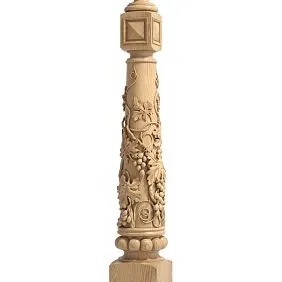
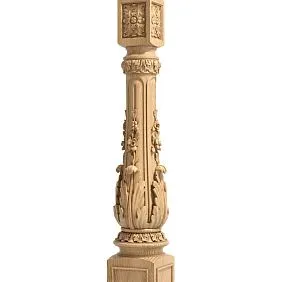
Support posts (start posts) are installed at the beginning of the staircase flight. They must be especially strong, as they bear the load from the entire handrail. Start posts are often made more massive and decorative than intermediate posts — with carved bases, finials in the form of spheres, pyramids, or decorative elements.
Intermediate posts are installed at turns and landings of the staircase. They may have the same design as start posts or be slightly simpler. Intermediate posts create visual rhythm, dividing long flights into sections.
Finish posts (end posts) complete the staircase on the second floor. They may be symmetrical to start posts or have a simplified form, depending on the designer’s intent.
Post finials
Finials (capitals) are decorative elements crowning the post. In classical interiors, popular finials are spherical, conical, acorn-shaped, vase-shaped. Finial size is usually 80–120 mm in diameter or height. Carved finials with plant motifs, geometric patterns, or heraldic symbols add luxury.
In modern interiors, finials are more minimalist — simple geometric shapes, cubes, pyramids, cylinders. Sometimes, finials are absent altogether, and the post ends with a simple angled cut or flat surface. This solution suits minimalist, Scandinavian, and loft interiors, where simplicity and functionality are valued.
Handrails and balusters: symphony of safety and beauty
The term 'handrail' is often used as a general designation for the entire staircase railing system, including the handrail, balusters, and mounting elements.Handrails and balusters for staircasesThey must comply with strict safety standards regulated by building codes.
Handrail height — not less than 900 mm for residential areas and 1200 mm for children’s facilities. The handrail must withstand a horizontal load of at least 100 kg without deformation. The distance between balusters — no more than 150 mm, to prevent a child from slipping. Fasteners must be secure, concealed, or aesthetically designed.
Handrail construction schemes
Traditional scheme: balusters are attached from below to the treads and from above to the handrail. This is a classic solution providing maximum rigidity. Each baluster is installed vertically, creating a uniform rhythm. The handrail is positioned at the same level along the entire length of the stair run.
Scheme with a sub-baluster: a horizontal plank (sub-baluster) is installed between the treads and balusters, to which the balusters are attached. This simplifies installation and allows easy replacement of damaged balusters. The sub-baluster can be a decorative element, with grooves or profiled edges.
Scheme with a stringer: balusters are attached to the inclined stringer (side board of the staircase). This construction is typical for enclosed staircases, where treads are inserted into the stringer’s grooves. In this case, the handrails run parallel to the staircase’s incline.
Modern solutions: glass panels between posts instead of balusters, metal cables or rods, combined constructions. These solutions suit ultra-modern interiors, but wood remains the most popular material due to its naturalness and versatility.
Wood species: selection for different styles and budgets
Selection of wood species forWooden staircase componentsAffects durability, appearance, cost, and ease of installation. Let’s consider the main species and their characteristics.
Oak: nobility and eternity
Oak — premium choice for staircases. Its density of 700–750 kg/m³ and hardness of 3.7–4.0 on the Brinell scale provide exceptional wear resistance. Oak components can last centuries without losing quality. Oak’s texture is expressive, with beautiful vertical rays (medullary rays) that create a distinctive pattern.
Oak’s color depends on treatment. Natural oak has a light brown tone with golden undertones. Weathered oak is dark, almost black, with a deep noble tone. White oak is light, gray-beige, ideal for Scandinavian interiors. Oak stains well, allowing any shade from natural to dark chocolate.
Oak’s drawback — high cost. Oak components cost 30–50% more than beech. Processing oak requires heavy equipment and professional skills due to its hardness. But for those who value quality and longevity, oak is an undeniable leader.
Beech: the golden middle
Beech — optimal combination of price, quality, and aesthetics. Density of 650–700 kg/m³ makes it sufficiently strong for heavy use, yet easier to process than oak. Beech wood has a uniform fine-grained structure without a pronounced pattern, making it ideal for finely detailed turned balusters.
Beech’s color — soft rose-beige with a slight peach tone. This warm palette creates a cozy atmosphere and fits beautifully into modern interiors. Beech polishes well to a mirror finish, is pleasant to the touch. After oiling, the texture becomes more pronounced, acquiring a silky sheen.
Beech is hygroscopic — sensitive to humidity changes and may deform under sharp fluctuations. Therefore, beech components require quality drying (humidity 8–10%) and stable operating conditions. For indoor staircases in heated rooms, beech is an excellent choice.
Ash: strength and elasticity
Ash has strength characteristics close to oak, but a lighter color and less contrasting texture. Ash’s fibrous structure provides high impact resistance — ash components do not crack under impact, which is important for active homes with children. Ash’s color ranges from light cream to gray-beige, with a beautiful longitudinal grain pattern.
Ash bends well when steamed, which is used for making curved handrails on spiral staircases. After drying, ash retains its given shape without deformation. Ash components cost slightly less than oak, but more than beech.
Larch: Resistance to Moisture
Larch — the only coniferous species actively used for staircases. Its density of 650–700 kg/m³ is comparable to beech, but larch contains a high amount of resin, making it exceptionally resistant to moisture, rot, and fungi. Larch components are ideal for staircases in saunas, baths, verandas, and other areas with high humidity.
Larch’s color — from light yellow to reddish-brown, with clearly defined annual rings. The texture is beautiful but less uniform than deciduous species. Over time, larch darkens, acquiring a noble dark brown tone.
Spruce: budget-friendly solution
Spruce — the most affordable species for staircases. Density of 500–550 kg/m³ makes it lighter and softer than hardwoods. Spruce is easy to process, reducing production costs. Spruce’s color — light yellow, with characteristic resin pockets and knots.
Spruce components are suitable for garden staircases, utility buildings, temporary structures. Spruce is not used in prestigious interiors due to low strength and unremarkable texture. Spruce requires mandatory protective treatment, as it is susceptible to rot and insect damage.
Staircase styles: from classic to high-tech
Choice of shape and finishstaircase componentsDetermined by the overall interior style. Let’s examine how different styles influence the design of staircase elements.
Classic style
Classic staircases — symmetry, proportionality, moderate ornamentation. Precision-turned balusters with several swellings (vases), round oak handrails, massive posts with carved capitals. Color — natural brown or stained in dark tones. Finish — lacquer with a slight sheen, highlighting the wood texture.
Classic balusters have a clear three-part structure: a massive base, a slender body with 2–3 swellings (vases), and a thickened capital. Posts are adorned with carvings — floral motifs, geometric ornaments, fluting (vertical grooves). Capitals — spheres, vases, acorns.
Baroque and Rococo: Luxury and Excess
Baroque interiors are characterized by luxurious carved balusters with abundant decoration. Twisted columns, plant motifs, masks, garlands — carving covers the entire surface of the baluster. Posts are monumental, with multi-level carved elements. Handrails may have complex profiles with carved inlays.
Color is dark and saturated, often with gilding of individual elements. Patination and artificial aging are used. Baroque staircases are a demonstration of wealth, the skill of carvers, and love for excess. Such staircases are appropriate in palace interiors, historical buildings, and luxurious mansions.
Scandinavian style: minimalism and light wood
Scandinavian staircases are maximum light, minimum decoration. Simple round or square balusters without turning, smooth handrails, posts with minimalist finials. Species — light beech, ash, birch. Finish — white paint or light oil, highlighting the natural color.
The distance between balusters can be increased up to 200 mm, creating a sense of lightness. Sometimes balusters are replaced with glass panels or are absent altogether, and the handrail is mounted to the wall using metal brackets. The main principle — nothing extra, only function and light.
Loft: industrial aesthetics
Loft staircases combine wood with metal. Wooden treads and handrails, metal frames, balusters made of metal rods or cables. If balusters are wooden, they have a rough, deliberately unpolished texture. Species — old wood with cracks, knots, traces of time.
Color — natural gray, graphite, black. Finish is minimal — transparent oil or none at all. Metal elements — black, with matte powder coating or visible corrosion (Corten steel). Loft staircases — brutality, openness of construction, honesty of materials.
Modern: organic forms
Modern is characterized by smooth, flowing lines, rejection of symmetry, plant motifs. Balusters may have asymmetric curves resembling plant stems. Handrails are curved, mimicking natural forms. Posts with carving in the shape of leaves, flowers, climbing vines.
Color — natural or tinted in warm tones. Often uses inlay with other wood species, metal, glass. Modern — art for art's sake, where each element of the staircase becomes a unique artwork.
Modern neoclassicism
Neoclassicism combines classical proportions with modern materials and technologies. Balusters have traditional shape, but simplified, without excessive decoration. Handrails are round or oval, with flawless finish. Posts may be square with routed fluting or round with minimalist finials.
Color — from light whitewashed oak to dark wenge. Often uses contrast: light balusters with dark treads or vice versa. Finish — matte oil or satin varnish. Neoclassicism — elegance without excess, respect for traditions with a view to the future.
Installation technology: from project to finish
Correct installationstaircase components— guarantee of safety and longevity of the structure. The process includes several stages, each requiring precision and professionalism.
Design and Calculations
Before installation, a detailed staircase project with precise dimensions of all elements must be created. The rise height, incline angle, number of steps, and tread width are determined. The number of balusters (usually 2 per step), posts (start, intermediate, finish), and handrail length are calculated.
Building codes are considered: handrail height not less than 900 mm, baluster spacing not more than 150 mm, tread width not less than 250 mm, riser height not more than 200 mm. All calculations must be verified and agreed upon before proceeding to manufacturing and installation.
Element preparation
All wooden elements must be acclimated — left in the room where the staircase will be installed for at least 5–7 days. This allows the wood to adapt to humidity and temperature, preventing further deformation. Before installation, elements are inspected for defects, and final sanding is performed if necessary.
Installation of posts
Installation begins with mounting support posts. The start post is secured to the floor and to the side beam of the staircase (stringer or rafter) using strong bolts or anchors. It is important to ensure perfect verticality of the post — a level and plumb bob are used. Intermediate and finish posts are installed similarly.
Fastening must be secure, as posts bear the main load from the handrail. For solid oak posts, M10–M12 anchor bolts are used; for beech, M8–M10. Bolts are countersunk flush with the surface or covered with decorative caps.
Installing balusters
Balusters are attached to treads and to the handrail. There are several methods of attachment. Method 1: using dowels. Holes of 8–10 mm diameter are drilled in the base of the baluster and in the tread. A wooden dowel (pin) is inserted into the baluster and then into the hole in the tread. PVA or polyurethane glue ensures secure fixation.
Method 2: using screws. Screws are screwed through the base of the baluster into the tread. Screws should be inserted at an angle for better fixation. Screw heads are countersunk and covered with wooden caps or filled with putty. Method 3: using a baluster support. A horizontal board (baluster support) is attached to the treads, to which balusters are then attached. This method simplifies installation and allows easy replacement of balusters if needed.
After installing all balusters, their verticality and even spacing are checked. The distance between balusters should be uniform along the entire length of the tread.
Handrail installation
The handrail is laid on the upper ends of balusters and posts. At connection points with posts, the handrail is cut at the required angle. Fastening is done from below through balusters using screws or with special connecting elements (metal brackets). Screw heads must be concealed.
On long treads, connection of several handrail sections may be required. For this, connecting couplings — metal or wooden elements — are inserted into the handrail and secured with bolts. The connection point should be inconspicuous, without steps or gaps.
Final finishing
After installation, final finishing is performed. All connections are checked for strength, and minor defects are corrected. Surfaces are sanded with fine sandpaper (grit 220–320) to remove possible contaminants and achieve perfect smoothness. Then a protective-decorative finish — oil, wax, or varnish — is applied.
Oil is applied in a thin layer with a brush or cloth, rubbed in with circular motions, and excess is wiped off. After the first layer (drying 12–24 hours), a second layer is applied. Oil enhances the wood’s texture, gives a silky finish, and protects against moisture. Varnish is applied with a brush or spray in 2–3 layers with intermediate sanding. Varnish creates a durable film, protects against scratches, and has varying degrees of gloss — from matte to glossy.
Care and Maintenance: Preserving Beauty for Decades
Woodenstaircase componentsWith proper care, they last 50–100 years or more. Maintenance depends on the type of finish and usage intensity.
Regular cleaning
Weekly: wipe handrails, balusters, and posts with a slightly damp soft cloth to remove dust. Do not use a wet cloth or excessive water — excess moisture may cause wood swelling. Monthly: perform more thorough cleaning using specialized wood cleaning products. These products contain natural oils and waxes that clean, moisturize, and protect the wood.
Recoating
Oil-treated elements require periodic reapplication. In high-use areas (handrails) — every 3–6 months; on balusters and posts — once a year. Process: clean the surface, lightly sand with fine-grit sandpaper (320–400), remove dust, apply a thin layer of oil, allow it to absorb, then wipe off excess.
Lacquered elements do not require reapplication of the finish, but over time the lacquer may lose its gloss or develop minor scratches. In this case, a recoating is required: remove the old lacquer by sanding, clean, and apply new lacquer in 2–3 coats.
Damage Prevention
Avoid striking balusters and posts with heavy objects. When moving furniture, protect wooden elements. Do not place hot items on handrails, and avoid prolonged exposure to direct sunlight, which may cause fading. Maintain stable humidity in the room (40–60%) using humidifiers or dehumidifiers.
Repair of damage
Minor scratches on oil-finished surfaces are repaired by reapplying oil to the damaged area. Deep scratches on lacquered surfaces require local sanding and recoating. Chips and cracks are filled with wood putty of matching color, sanded after drying, and finished.
In case of severe damage (cracks, splits), the element may need to be replaced. If you purchased components from the same collection, the manufacturer can produce an identical replacement.
Cost and Budgeting
Pricestaircase componentsDepends on wood species, complexity of processing, dimensions, and finish. Here are approximate prices (may vary depending on region and manufacturer).
Round handrails with 50 mm diameter:
-
Spruce: 800–1200 rubles/meter
-
Beech: 2000–3000 rubles/meter
-
Oak: 3000–5000 rubles/meter
Balusters with turned profile, 900 mm height:
-
Simple spruce: 200–400 rubles/piece
-
Classic beech: 500–800 rubles/piece
-
Complex oak: 1000–1500 rubles/piece
-
Carved balusters: 2000–5000 rubles/piece
Support posts 1200 mm high:
-
Spruce: 1500–2500 rubles/piece
-
Beech: 3000–5000 rubles/piece
-
Oak: 5000–8000 rubles/piece
-
With carving: 8000–15000 rubles/piece
For a staircase 3 meters long (14 steps), you will need: 6–7 meters of handrail, 28–30 balusters, 2–3 posts. The total cost of beech components will be 40,000–60,000 rubles, and for oak — 70,000–100,000 rubles. Add installation cost (30,000–50,000 rubles depending on complexity) to get the total staircase cost.
Trends 2026: What’s new in the world of staircases
Staircase design, like any interior design area, is subject to trends. In 2026, several key trends are observed.
Return to naturalness. More and more people are choosing natural, uncolored wood with its natural texture and color. Oil finishes instead of lacquer, light species (beech, ash), minimal processing. This trend is linked to growing ecological awareness and the desire to live surrounded by natural materials.
Minimalist forms. Simple balusters without excessive decoration, sleek posts, smooth handrails. Abandoning carving in favor of clean lines. Especially popular are round balusters with 30–35 mm diameter, with minimal turning or even none — simple cylinders.
Contrasting combinations. Light balusters with dark treads, dark handrails with light posts. Playing with contrasts creates visual dynamism, making the staircase expressive. Popular combinations include wood with black metal — metal brackets, cables, inserts.
Open constructions. Staircases without nosings, with minimal balusters or none at all (handrail on brackets). Such constructions look light, do not clutter space, and allow light to pass through. Suitable for modern interiors with high ceilings.
Combined materials. Wood + glass, wood + metal, wood + stone. Glass panels instead of balusters create a sense of transparency. Metal elements add a modern touch. Stone treads with wooden railings — classic, never going out of style.
Company STAVROS: your partner in creating the ideal staircase
When it comes to choosingstaircase componentsIt is important to trust proven manufacturers with years of experience and reputation. The company STAVROS has been working for more than two decades in the field of wooden products, thousands of completed projects, impeccable product quality.
STAVROS offers a full range of stair components:round handrailsof various diameters and lengths,balustersprecision-turned and carved in dozens of models, support and intermediate posts, finials, balusters, fastening elements. All items are made from carefully selected hardwoods — oak, beech, ash — in accordance with strict quality standards.
STAVROS’s production facilities are equipped with modern equipment: CNC turning and milling machines, drying chambers, humidity control systems. This allows producing components of any complexity with precision down to the millimeter. At the same time, traditional handcrafting techniques are preserved — final sanding, finishing of parts, creation of exclusive carved elements are performed by experienced masters.
The company offers not only standard models from the catalog, but also custom manufacturing according to the client’s sketches. If you have special requirements for design or dimensions — STAVROS will bring your idea to life in wood. Professional consultants will help select the optimal set of elements, take into account the specifics of your space, and calculate the required amount of materials.
STAVROS’s product quality is confirmed by compliance certificates and positive reviews from thousands of clients. The company works with both private clients and professional builders, designers, and architects. Delivery is performed throughout Russia with professional packaging, ensuring the preservation of the items.
Choosing STAVROS components means investing in quality that will last for decades, in beauty that will never become outdated, in safety proven by thousands of installed staircases. STAVROS is not just a manufacturer — it is a partner in creating a home, where every detail is thoughtfully designed and executed with love for craftsmanship.
Frequently asked questions
Can I combine balusters of different models on one staircase?
Yes, but it is necessary to maintain stylistic unity. For example, alternate two similar turned balusters to create rhythm. Or use carved balusters on support sections and simple turned ones on intermediate sections. The main thing is to maintain the same overall height, diameter, and color to ensure the composition looks harmonious, not random.
What is the optimal distance between balusters for children’s safety?
Building codes establish a maximum distance of 150 mm between vertical elements of railings. This ensures that a child’s head will not pass between balusters. For additional safety, you can install balusters with a spacing of 100–120 mm or use additional horizontal elements.
Do wooden components need protective coatings?
Yes, absolutely. Unprotected wood quickly gets dirty, absorbs moisture, darkens, and may develop mold. Minimum protection — oil or wax, which highlights the texture and protects against surface damage. For maximum protection — lacquer, creating a durable film. The choice depends on your preference for appearance and willingness to periodically renew the coating.
How to determine how many balusters are needed for my staircase?
Standardly, two balusters are installed per step — one at each end. For a step width of 900 mm, this ensures a distance of about 100 mm between balusters, accounting for their diameter. For wide staircases (over 1200 mm), three balusters per step may be required. The exact number is calculated based on the width of the stair run, baluster diameter, and safety requirements.
Can I install components made from different types of wood?
Technically yes, but visually it looks disharmonious if the wood species differ greatly in color and texture. It is acceptable to combine species with similar shades (beech and ash, oak and walnut) or create contrasting combinations (dark oak and light beech) as a design technique. It is important that this looks like an intentional decision, not a coincidence.
How long does it take to install components on a standard staircase?
For an experienced crew of two people, installing railings on a 14-step staircase takes 1–2 working days. This includes installing posts, balusters, handrails, and final finishing. Complex structures with carved elements or non-standard shapes may require 3–5 days. Self-installation without experience will take 2–3 times longer.
How to care for a wooden staircase during winter with heating on?
Heating reduces air humidity, which may cause wood to dry out and crack. It is recommended to use humidifiers to maintain humidity at 40–60%. Frequently renew the oil coating — oil moisturizes wood, preventing drying. Do not place heat sources (heaters, radiators) directly against wooden elements.
Can wooden balusters be painted in another color?
Yes, but the process is labor-intensive. The old coating must be completely removed by sanding or stripping. Then the wood is primed and painted in the desired color. You can use stains (change color while preserving texture), paints (fully cover wood), or tinted oils. It is easier to order components of the desired color directly from the manufacturer.
What components are best to choose for a spiral staircase?
Spiral staircases require curved handrails, made from flexible wood (ash, beech) or laminated strips. Balusters and posts are standard, but their installation requires precise angle calculations. It is better to entrust the design and installation of a spiral staircase to professionals, as any mistake may lead to structural instability.
How do 'Standard' and 'Premium' category components differ?
The 'Standard' category includes quality items without visible defects, suitable for most projects. Minor knots (filled) and slight color variations are allowed. The 'Premium' category features flawless quality with no knots, perfectly uniform color, and higher dimensional accuracy. It is used for prestigious projects where visual perfection of each element is crucial.


