












































































Article Contents:
- Treads: Horizontal Planes Bearing the Load of Life
- Risers: Vertical Planes Forming Rigidity
- Balusters: The Vertical Graphics of the Railing
- Handrails: Tactile Connection to Safety
- Newel Posts: Load-Bearing Points of the Railing
- Baseboards and Finishing Elements: Completing the Composition
- Wood species: characteristics and applications
- Production Technology: From Blank to Finished Component
- Finishing and Protection: Coatings for Durability and Aesthetics
- Installation and Assembly: Technology of Reliable Connection
- Frequently Asked Questions About Staircase Components
- Can different wood species be combined in one staircase?
- What tread thickness is optimal?
- How many balusters are needed for one step?
- How to avoid staircase squeaking?
- Do components require acclimatization before installation?
- How to choose the staircase finish color?
- What is the service life of a wooden staircase?
- Can wooden elements be installed on a metal frame?
- How to care for a wooden staircase?
- How much more expensive is a wooden staircase compared to metal or concrete?
- Conclusion: A System of Elements Creating Architecture

A staircase is not just a means of moving between floors. It is an architectural statement, an engineering structure, a sculptural object used daily by all inhabitants of the house.Complete set of wooden staircase componentsdetermine the safety, comfort, aesthetics, and durability of the entire system. Each element — tread, baluster, handrail, riser, newel post — plays a specific role, but they only work together, forming an integral organism. An error in choosing even one component disrupts harmony, reduces functionality, and creates risks. Understanding the purpose, characteristics, and interrelationships of all elements is the key to creating a staircase that will serve for generations, remaining safe, convenient, and beautiful.



Treads: Horizontal Planes Bearing the Load of Life
The tread bears the maximum mechanical load of all staircase elements. Each step is a dynamic impact, an instantaneous concentration of the human body's weight on an area of twenty-five to thirty centimeters of tread width. When ascending, the load increases by thirty to forty percent due to pushing off. Over a year of active use, a single tread undergoes tens of thousands of loading cycles.Wooden Steps and Balustersmust be made from dense, hard wood species capable of withstanding such intensity without deformation.
Oak is the classic choice for premium-class treads. A density of six hundred fifty to seven hundred fifty kilograms per cubic meter and a hardness of three point seven units on the Brinell scale provide exceptional wear resistance. An oak tread maintains its geometry and surface smoothness for decades. The grain is expressive, with clear annual rings and medullary rays. The color ranges from light golden to dark brown, allowing for matching the shade to the interior concept. Oak treads withstand abrasion in high-traffic areas — the central part of the tread where the foot lands with each ascent.
Ash is comparable to oak in mechanical properties and surpasses it in toughness — the ability to absorb impact loads without cracking. This is critical for staircases where impacts from carrying heavy objects or dropping items on treads are possible. The grain is contrasting, with wide annual rings creating a dynamic pattern. The color ranges from light cream to grayish-pink with a warm hue. Ash treads are lighter than oak treads with comparable strength, reducing the overall load on the supporting structure — important for cantilever staircases where treads are fixed at one end.
Beech combines sufficient hardness of six tenths of a unit on the Brinell scale with a uniform, fine-pored structure. A beech tread, after sanding, becomes almost smooth, like polished stone, but warm. The grain is delicate, without a pronounced pattern. The color ranges from light pink to yellowish-red. A drawback of beech is its increased hygroscopicity. Deformations are possible with humidity fluctuations, so beech treads require a stable microclimate — heated rooms with forty to sixty percent humidity.
Stair geometry is regulated by ergonomic standards. The tread width—the horizontal surface where the foot steps—should be twenty-five to thirty-two centimeters. With a width less than twenty-five centimeters, the foot does not fit completely, making descent uncomfortable and dangerous. With a width greater than thirty-five centimeters, the walking rhythm is disrupted, and ascent becomes tiring. The riser height—the vertical distance between treads—is optimal in the range of fifteen to eighteen centimeters. Steps that are too low require more steps, while steps that are too high are tiring, especially for elderly people.




Risers: vertical planes that provide rigidity
A riser is a vertical board that closes the space between treads. The functions of a riser go beyond a purely decorative role. Structurally, the riser connects adjacent steps, increasing the rigidity of the entire flight. A staircase with risers practically does not creak—sounds arise from mutual displacement of elements, and risers fix the steps, eliminating play. Visually, risers close the space under the staircase, creating a finished composition.
Open staircases without risers look lighter, more airy, and allow light to pass through. This design is relevant in modern interiors where visual transparency of space is valued. But structurally, open staircases require reinforced steps with increased thickness of forty-five to fifty millimeters instead of the standard forty. Without risers, the step works as a cantilever, experiencing bending load. A thick step resists this load without deflection. Additionally, open staircases require more frequent installation of supporting stringers or carriages.
The material of the risers does not necessarily have to match the steps. Combined solutions, where steps are made of oak or ash and risers are made of painted MDF, create contrast and reduce cost without compromising strength. The riser does not experience mechanical loads comparable to the step—it is not stepped on or struck. The main requirements for a riser are geometric stability and aesthetics. MDF with a density of seven hundred to eight hundred kilograms per cubic meter, painted with enamel, meets these requirements at a price half that of solid wood.
The height of the riser corresponds to the riser height of the step—fifteen to eighteen centimeters. The thickness of standard solid wood risers is eighteen to twenty millimeters. Thicker risers do not provide structural advantages but increase weight and cost. Risers are attached to steps in several ways: in a groove milled on the back of the tread; with glue and screws from below; via corner blocks. A quality connection eliminates creaks and play.
Our factory also produces:


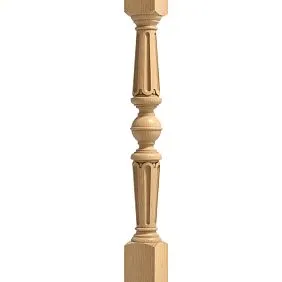
Balusters: vertical graphics of the railing
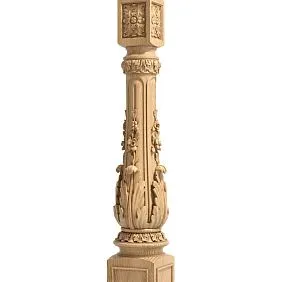
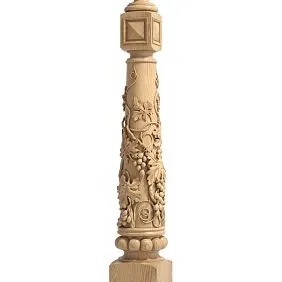
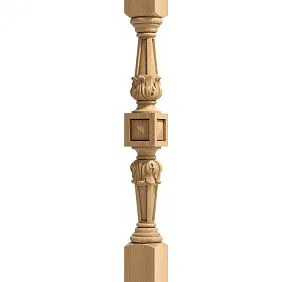
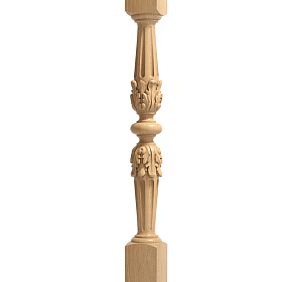
Balusters form the vertical infill of the staircase railing between the steps and the handrail. The function of balusters is dual: structural—supporting the handrail, preventing falls; aesthetic—creating rhythm, style, and visual character of the staircase. The variety of baluster shapes is practically endless—turned with smooth curves, carved with decorative elements, square and laconic, flat milled. The choice of baluster profile determines the style of the entire staircase—classical, modern, country, minimalist.
Turned balusters are manufactured on lathes. A workpiece with a square cross-section of fifty by fifty or sixty by sixty millimeters is clamped in a chuck and turned with cutters according to a given profile. Copy lathes with CNC produce balusters according to a digital program with absolute identity—each baluster repeats the profile with an accuracy of up to a tenth of a millimeter. Manual turning gives slight variation—each baluster is unique, which is valued in custom projects.
Carved balusters are created on CNC milling machines or manually by carvers. Relief elements—floral ornaments, geometric patterns, stylized figures—turn the baluster into a work of decorative art. Carved balusters are characteristic of classical interiors where decorativeness is valued above conciseness. The production of carved balusters is labor-intensive, costing two to three times more than turned ones, but the aesthetic effect justifies the investment.
Square balusters of constant cross-section are the choice for modern minimalist interiors. The simplicity of form is compensated by the quality of the material, purity of lines, and precision of installation. Square balusters with a cross-section of forty by forty or fifty by fifty millimeters are made from planed solid wood or laminated timber. The surface is carefully sanded and coated with enamel or clear varnish. Strict geometry creates a graphic composition relevant for modern architectural solutions.
The distance between balusters is regulated by safety standards—no more than one hundred twenty millimeters clear. This requirement eliminates the possibility of a child passing between the balusters. On one step of standard width ninety centimeters, two to three balusters are installed depending on their thickness. Frequent installation of balusters—three to four per step—creates a visually denser, more substantial railing characteristic of classical interiors.
Get Consultation
Handrails: tactile connection with safety
a round wooden handrail—an element that ensures safety and comfort when moving on the stairs. A round cross-section with a diameter of fifty millimeters ideally corresponds to the biomechanics of the human grip. The hand naturally wraps around a cylinder of such diameter, fingers close with slight overlap, providing reliable control without overstraining the hand muscles. Alternative profiles—oval, rectangular, shaped—are used less frequently as they are inferior to round ones in ergonomics.
The material of the handrail is identical to the material of the steps and balusters for visual unity. An oak handrail combines with oak steps and balusters, creating a monolithic composition. Contrast solutions, where the handrail is made of dark walnut on light ash balusters, create a visual accent and attract attention. Painted handrails—white, gray, black—are relevant in modern interiors where color is more important than demonstrating wood texture.
The installation height of the handrail is regulated by standards—nine hundred millimeters from the step level to the top of the handrail. At this height, the hand of an adult, freely lowered and slightly bent at the elbow, naturally rests on the handrail without the need to raise the shoulder or bend over. For people taller than one hundred eighty-five centimeters, a height of nine hundred fifty to one thousand millimeters is more comfortable. In homes with small children, an additional handrail of smaller diameter thirty-five to forty millimeters is installed at a height of six hundred to six hundred fifty millimeters.
The handrail is attached to the balusters via a groove milled on the upper end of each baluster, or via a handrail bracket—a horizontal rail fixed to the ends of the balusters. The first method creates a cleaner railing line without visible fastening elements. The second simplifies installation and allows easy removal of the handrail for repair or replacement. Joining handrails in length is done by cutting the ends at a forty-five-degree angle with gluing—such a joint after sanding is practically invisible.
Support posts: load-bearing points of the railing
Support posts are massive vertical elements installed at key points of the staircase. The starting post is installed on the first step of the flight, the ending post—on the last, turning posts—on landings when the direction of the staircase changes. Posts bear the main horizontal load from the handrail and transfer it to the load-bearing structure of the staircase. The cross-section of support posts eighty by eighty, one hundred by one hundred, one hundred twenty by one hundred twenty millimeters provides sufficient rigidity.
The starting post is often made more decorative compared to intermediate and ending ones. A carved finial, turned elements, an increased cross-section of one hundred twenty by one hundred twenty or one hundred fifty by one hundred fifty millimeters highlight the starting post, making it a compositional accent. This is logical—the starting post is the first to greet the person entering, setting the impression of the staircase. In classical interiors, the starting post can reach a height of one hundred twenty to one hundred fifty centimeters, significantly exceeding the height of the handrail, ending with a spherical or pyramidal finial.
Attaching support posts to the staircase structure is critical for safety and durability. The post is mortised into the step or stringer to a depth of fifty to seventy millimeters, fixed with a metal pin M8-M10 passing through the entire height of the mortise. Additionally, the joint is glued with polyurethane glue or PVA. Such fastening withstands a horizontal load of up to three hundred kilograms without deformation—a multiple safety margin relative to the standard one hundred kilograms.
For long straight flights of more than three meters, installation of an intermediate support post is recommended, even if there are no turns. A long handrail span without intermediate support may deflect under load, creating a feeling of unreliability. An intermediate post divides the span into two segments, each rigidly fixed at both ends. Such a structure is absolutely stable, has no play or deflection even under extreme loads.
Baseboards and finishing elements: completeness of the composition
Wooden skirting board for stairscloses the joint between the staircase flight and the wall if the staircase adjoins the wall on one side. The staircase baseboard differs from the floor baseboard in greater height—seventy to ninety millimeters instead of the standard fifty to sixty. The increased height is necessary to cover the gap, which may be uneven due to imperfect wall geometry. The staircase baseboard is installed with an inclination repeating the angle of the staircase flight, which requires precise cutting of the ends.
The material of the staircase baseboard matches the material of the steps for visual unity. An oak baseboard on oak steps creates solidity, the feeling that the staircase is carved from a solid piece of wood. The tinting of the baseboard is identical to the tinting of the steps—it is important to treat all elements with the same batch of dye for absolute shade matching. Even a slight difference in color is noticeable in daylight, disrupting harmony.
Finishing strips and overlays close technological gaps at the junctions of the staircase with walls, ceiling, and floor. These elements do not bear loads; their function is purely decorative—creating a neat, finished appearance. Strips are made from the same material as the main elements, with a thickness of ten to fifteen millimeters, width of thirty to fifty millimeters. They are attached with glue or thin headless nails, countersunk into the wood with subsequent puttying.
Handrail brackets—horizontal rails on which the handrail is laid. A strip with a cross-section of thirty by forty to fifty millimeters is attached to the upper ends of the balusters, creating a flat platform for mounting the handrail. Using a handrail bracket simplifies handrail installation, allows adjusting the height by precise fitting of the strip thickness, and provides the possibility of removing the handrail without damaging the balusters. In classical staircases, the handrail bracket is often hidden under the handrail; in modern ones, it can protrude as a decorative element of contrasting color.
Wood species: characteristics and application
The choice of wood species for staircase elements is determined by requirements for strength, wear resistance, aesthetics, and project budget. Oak is the leader in terms of overall characteristics. Density six hundred fifty to seven hundred fifty kilograms per cubic meter, hardness three point seven units on the Brinell scale, resistance to abrasion, dimensional stability, expressive texture, richness of shades. An oak staircase serves for a century without replacing elements, requiring only periodic renewal of the coating. The disadvantage of oak is high cost, but it is justified by durability and prestige.
Ash is close to oak in mechanical properties, surpassing it in viscosity and elasticity. Ash wood withstands impact loads without cracking, which is important for staircases in homes with children where impacts are possible during active play. The texture is contrasting, with wide annual rings. The color is lighter than oak—from creamy to light brown with a pinkish or grayish tint. Ash takes tinting well, allowing the creation of various color solutions. The cost of ash is ten to twenty percent lower than oak.
Beech offers decent characteristics at a more affordable price. Hardness six tenths of a unit on the Brinell scale is sufficient for residential staircases with moderate intensity of use. The texture is homogeneous, fine-pored, after sanding the surface is almost smooth. Color from light pink to reddish-brown. Beech takes tinting and painting well. A critical disadvantage of beech is high hygroscopicity. With fluctuations in humidity, the wood swells and dries more than other species, which can lead to warping and cracking. Beech staircases require a stable microclimate.
When using hardwoods and quality installation, a wooden staircase lasts fifty to seventy years without replacing elements. Historical staircases in European buildings function for centuries. Only periodic coating renewal is required — every three to five years for oil, every seven to ten for varnish. Local tread damage is repaired by sanding and refinishing. Wood does not degrade but becomes more refined with age, acquiring a patina.
Production Technology: From Harvesting to Finished Component
The quality of staircase components is eighty percent determined by the correctness of the production process. It all starts with wood selection. For treads and other load-bearing elements, radially sawn boards are used, where the annual rings run perpendicular to the face. Such wood is maximally stable and does not warp with changes in humidity. For balusters and decorative elements, tangential sawing with a more pronounced texture but lower stability is acceptable.
Drying in specialized chambers reduces wood moisture to eight to twelve percent — the operational level for heated rooms. The drying regime is individual for each species. Oak is dried at a temperature of forty-five to fifty-five degrees Celsius for twenty to thirty days. Accelerated drying at high temperatures leads to cracking and internal stresses. After chamber drying, the wood undergoes stabilization — it is stored in the workshop for at least a week to equalize moisture throughout the volume.
Mechanical processing is performed on high-precision equipment. Four-sided planers process blanks with an accuracy of zero point one millimeter, creating perfectly parallel planes and perpendicular angles. CNC milling machines cut grooves, profiles, and decorative elements according to digital programs. Lathes form round and shaped elements — balusters, handrails, and newel post finials. Modern equipment ensures repeatability — each part in a batch is identical with an accuracy of fractions of a millimeter.
Sanding is the final stage of mechanical processing, forming the surface of the finished element. The process is multi-stage with abrasives of increasing grit: P80 for rough leveling, P120 for intermediate processing, P180 for preparation for staining, P240-P320 for final sanding before coating. A properly sanded surface is silky, without scratches, tear-outs, or fuzz. Sanding is performed along the grain to prevent cross-grain scratches visible after staining.
Finishing and Protection: Coatings for Durability and Aesthetics
The final finish of staircase elements determines appearance, tactile feel, and protection from wear and soiling. Oil coating is the optimal choice for staircases where naturalness, tactile quality, and ease of maintenance are important. Oil penetrates deep into the wood structure by two to three millimeters, impregnating the fibers, making them moisture-resistant and wear-resistant. No film forms on the surface — the wood breathes, regulates humidity, and retains its natural micro-texture. The surface feels warm to the touch, slightly rough, providing anti-slip properties.
Hard oils and oil-wax blends create a more durable coating. Wax, after polymerization, forms a thin protective layer on the surface, increasing wear resistance without losing naturalness. Treads with an oil-wax coating withstand intensive use for three to five years before needing renewal. Renewal is simple: the surface is cleaned, lightly sanded with fine P320 abrasive, and coated with a new layer of oil. The treated area blends with the rest of the surface without visible boundaries.
Varnish coating creates a hard protective film on the wood surface. Polyurethane varnishes provide maximum wear resistance, suitable for staircases with intensive use. Water-based acrylic varnishes are eco-friendly, odorless, but less resistant to abrasion. The gloss level of varnish varies from deep matte to high gloss. For treads, semi-matte varnishes are preferable — they preserve the natural look, do not create glare, and provide better grip with shoe soles compared to glossy ones.
Staining expands the palette of color solutions while preserving the visibility of the wood grain. Water-based, alcohol-based, or oil-based stains penetrate the pores, coloring the wood from within. Light ash can be darkened to walnut color, beech can be given a mahogany tint, and the golden hue of oak can be emphasized. Contrast staining highlights the structure of the annual rings, making the texture more expressive. Oil-based stains both stain and protect, combining two processing stages.
Installation and Assembly: Technology of Reliable Joinery
Quality installation of staircase components ensures safety, durability, and the absence of squeaks. Treads are attached to the supporting structure — stringers or stringers — in several ways. When attaching to stringers, treads are placed on the horizontal platforms of the cutouts and fixed with screws from below through the stringer. Screws with a diameter of four to five millimeters and a length of fifty to seventy millimeters are screwed in with a countersunk head so they do not protrude above the stringer surface. Additionally, the joint is glued with polyurethane adhesive.
When attaching treads to stringers, mortise-and-tenon joints or mounting on cleats are used. Mortising into a groove is a traditional joinery method. A groove ten to fifteen millimeters deep, matching the tread contour, is milled into the stringer. The tread end is inserted into the groove and glued. Such a joint is invisible and creates a clean line. Mounting on cleats is simpler — wooden cleats with a cross-section of thirty by thirty millimeters are screwed to the stringer, and the tread is laid on them. The cleats are visible from the side, but this method is faster and allows for adjustment.
Balusters are installed into pre-drilled holes in the treads. The hole diameter is one to two millimeters smaller than the baluster tenon diameter for a tight fit. The hole depth is thirty to forty millimeters. The baluster tenon is coated with PVA wood glue or polyurethane glue, inserted into the hole, and the baluster is set vertically using a level in two planes. After the glue sets, the baluster is absolutely rigidly fixed. Additional fastening with screws from below through the tread reinforces the joint.
The handrail is mounted on the installed balusters via grooves on the upper ends or via a handrail bracket. When mounting into grooves, the handrail is sequentially placed onto the baluster tenons, which are pre-coated with glue. The handrail is tapped with a rubber mallet for a tight fit. After complete installation, the handrail is additionally fixed with screws driven from below through the baluster ends at an angle. The screw heads are countersunk, the holes are filled with wood-colored putty and sanded — the fasteners become invisible.
Frequently Asked Questions about Staircase Components
Can different wood species be combined in one staircase?
Yes, combining species is a common practice. A classic solution: treads made of hard oak or ash for maximum wear resistance, balusters made of more affordable beech to reduce cost, risers made of painted MDF for contrast. It is important to ensure visual harmony through uniform staining or contrasting combinations. It is illogical to combine species of similar but not identical shades — the difference will be noticeable and create a sense of randomness.
What tread thickness is optimal?
For treads with risers, installed on stringers or stringers, the standard thickness is forty millimeters. This is sufficient to prevent deflection under a load of one hundred and twenty kilograms. For open staircases without risers, a thickness of forty-five to fifty millimeters is required due to the cantilever action of the tread. For wide staircases over one hundred and twenty centimeters, a thickness of fifty millimeters is recommended to prevent deflection in the middle of the tread.
How many balusters are needed per step?
How many balusters are needed per tread?
It depends on the tread width and the type of balusters. For turned or square balusters with a cross-section of fifty by fifty millimeters, two balusters are installed on a ninety-centimeter-wide tread with a distance of forty-five centimeters between centers. For flat balusters with a thickness of thirty to forty millimeters, three pieces per tread are required to comply with the standard maximum clear distance of one hundred and twenty millimeters. Visually, more frequent baluster installation creates an impression of solidity.
How to avoid staircase squeaking?
Squeaking arises from mutual friction of elements due to play in the joints. Prevention of squeaking is ensured by quality installation: all joints are glued with polyurethane or PVA glue, screws are tightened with force that eliminates movement, and risers are mandatory for tying treads together. After installation, the staircase should rest for two to three days for complete glue polymerization before use.
Is acclimatization of components required before installation?
Definitely. All wooden elements must lie in the installation room for a minimum of forty-eight hours, optimally seven to ten days. During this time, the wood moisture will equalize with the room air humidity, preventing deformation after installation. Acclimatization is especially critical in winter with a large temperature difference between the warehouse and the heated house. Elements are laid horizontally with spacers for air circulation.
How to choose the staircase finish color?
The staircase color should harmonize with the overall interior. In light Scandinavian interiors, natural light shades are relevant — whitewashed oak, light ash, natural beech. In classic interiors, rich tones are preferable — dark walnut, fumed oak, mahogany. Modern minimalist spaces allow painting in white, gray, or black while preserving the wooden base for tactile qualities. Samples of stained wood will help make a decision before production begins.
What is the service life of a wooden staircase?
Can wooden elements be installed on a metal frame?
Yes, this is a common solution that combines the strength of metal with the aesthetics of wood. A metal frame made of channel or profile pipe creates a rigid load-bearing structure. Wooden steps, balusters, and handrails are mounted onto the frame. The metal is either concealed beneath wooden cladding or left visible as an element of industrial aesthetics. Combined staircases are optimal for large spans, cantilever structures, and complex configurations.
How to care for a wooden staircase?
Daily dry cleaning with a vacuum or soft brush removes dust and sand, which act as abrasives, wearing down the finish. Weekly wet cleaning with a well-wrung cloth removes dirt. Do not use excessively wet rags or aggressive cleaning agents. Steps with an oil finish require renewal every one to three years depending on the intensity of use. Lacquered finishes last five to seven years before needing renewal.
How much more expensive is a wooden staircase compared to a metal or concrete one?
The initial cost of a wooden staircase is comparable to or higher than a budget metal one with simple steps. However, the total cost of ownership over fifty years of operation is lower. A wooden staircase does not require replacement of elements, only periodic renewal of the finish. Metal ones rust, require repainting, and replacement of worn steps. Concrete ones require cladding, which wears out and needs replacement. A high-quality wooden staircase is an investment for generations.
Conclusion: a system of elements that creates architecture
Home interior decorachieves perfection when functionality and aesthetics are inseparable. A wooden staircase is a vivid example of such synthesis. Each element performs a specific role, but value is created only by their totality, precise fitting, and quality execution. A staircase is not a set of separate parts, but an integral organism, living in the rhythm of the home, receiving thousands of steps, connecting spaces, ensuring safety, and pleasing the eye.
Factory of interior decorSTAVROS specializes in manufacturing a complete set of elements for wooden staircases made from solid valuable wood species. Twenty years of experience, European high-precision equipment, a team of craftsmen and technologists who understand not only production but also architecture, ergonomics, and aesthetics. Each element undergoes multi-stage control—from wood selection to final geometry and finish quality checks.
STAVROS's range includes steps made of oak, ash, and beech, forty and fifty millimeters thick, twenty-five to thirty-two centimeters wide, and eighty to one hundred twenty centimeters long. Risers fifteen to twenty centimeters high made of solid wood or MDF for painting. Turned, carved, and square balusters—over one hundred profiles in the catalog. Handrails: round with a diameter of fifty millimeters, oval, and shaped. Support posts with cross-sections of eighty by eighty, one hundred by one hundred, one hundred twenty by one hundred twenty millimeters. All finishing options: natural oil, tinting in twenty shades, varnishing, and enamel painting.
STAVROS engineers provide technical support at all stages of the project. Assistance in calculating the required number of elements based on staircase dimensions. Recommendations for selecting wood species considering operating conditions and budget. Selection of baluster and handrail profiles to match the interior style. Consultations on installation, assembly sequence, and fastening methods. The company's goal is to ensure the successful implementation of the project, creating a staircase that will serve for decades, delighting with reliability, comfort, and beauty.
Choosing STAVROS components is a decision in favor of quality, durability, and professionalism. It is a guarantee that each element is made from properly dried wood, processed with precision to tenths of a millimeter, and finished in accordance with modern standards. It is an investment in family safety, in the comfort of daily use, and in the aesthetic value of the interior. A staircase made from STAVROS elements is the architecture of movement, embodied in warm, natural wood, connecting the levels of the home and life into a single harmonious space.


