Article Contents:
- Unity of Image: The Interconnection of Architectural Wall Finishes and Furniture Content
- Scale and proportions
- Style Compatibility
- Material unity
- Rhythm and Repetition of Motifs
- Furniture Upgrade: How Replacing Standard Handles with Carved Wooden Elements Changes Furniture Status
- Why Wooden Handles Change Perception
- Types of wooden furniture handles
- Installation and Upgrade
- Carved Overlays: The Next Level of Upgrade
- Classical Canons: Key Features of Furniture in Classical Style and Their Support by Wall Decor
- Symmetry and pairing
- Verticality and Proportions
- Materiality and texture
- Decorativeness and Carving
- Color and patina
- Molding as a Background: Using Molded Decorations to Create a 'Frame' Around Furniture Groups
- Panels Behind the Sofa
- Bed Framing
- Dining Group
- Display Cases and Cabinets
- Materials: Why Natural Wood in Hardware is Tactilely More Pleasant Than Metal or Plastic
- Warmth vs. Cold
- Texture vs. Smoothness
- Weight and Density
- Ecological Safety
- Aging and Patina
- Universality of Style
- Creating Family Heirlooms Through Interior Design
- Durability as a Foundation
- Uniqueness vs. mass production
- Emotional connection
- Transmission of Traditions
- Resistance to Trends
- Frequently Asked Questions
- Can Wooden Handles Be Used on Modern Furniture?
- How to Combine Wall Molding with Modern Furniture?
- Should All Furniture Handles Be Changed at Once or Gradually?
- Which Wood is Better for Furniture Handles — Oak or Beech?
- Can Wooden Handles and Overlays Be Painted?
- Polyurethane or Gypsum Molding — Which is Better?
- How to care for wooden hardware?
- Is it worth installing molding in a standard apartment?
- Conclusion: details create classic style

There are interiors that instantly convey the owner's status, culture, and taste. They don't shout or impose, but possess a magnetic force. Upon entering such a space, you feel: everything here is precise, thoughtful, assembled into a unified whole. And although the eye glides over the overall picture—elegant furniture, expressive walls, harmonious proportions—it is the details that create this magic.Furniture Handlescarved wood, which transform an ordinary dresser into an antique rarity.Sculptural decorationson the walls, creating architectural frames around furniture groupings. Carved overlays, cornices, moldings—all these are the building blocks from which a classic interior is constructed.
Classic style is not a seasonal fashion, but an eternal aesthetic, tested over centuries. It is based on principles of harmony, proportion, symmetry, and balance. But classic style can vary: strict English, luxurious French, solemn Italian. What unites all these directions is one thing—attention to detail. Because it is precisely the details that distinguish genuine classic style from its imitation. It is the details that create a sense of authenticity, heritage, and dignity passed down through generations.
Creating a noble interior is not a matter of budget. One can spend enormous amounts of money and end up with a space that is expensive but tasteless. Or one can invest wisely but precisely—and create an interior that breathes aristocracy. The secret lies in the correct selection of elements and their coordination.Classic Furnituremust interact with the architectural wall decor. Wooden hardware should echo wooden trim. Molding should create frames within which furniture looks like an exhibit in a museum. This is a system of interrelationships where each element enhances the other.


Unity of image: interconnection of architectural wall finishes and furniture content
Many make a typical mistake: first, they do the renovation—paint the walls, hang wallpaper, install molding—and only then start selecting furniture. Or vice versa: they buy furniture they like, and then try to adjust the interior to it. Both approaches lead to the same result—disunity. The furniture exists on its own, the walls on their own. There is no integrity.
A classic interior is built differently. Here, everything is conceived simultaneously: the architectural shell and the furniture content are born as a single organism. The walls are not just a background for the furniture. The walls are active participants in the composition. They support the furniture, frame it, create context for it.




Scale and proportions
The first level of interconnection is scale. The height of ceiling cornices, the width of moldings, the size of decorative wall overlays should correlate with the dimensions of the furniture. If the furniture is massive—a dresser 120 cm tall, a wardrobe nearly three meters high—the architectural decor should be proportionate. A large ceiling cornice 15-20 cm high, wide moldings 10-12 cm, large-scalePlaster ornaments for wallsmeasuring 50x50 cm or more. This creates visual balance: nothing dominates, nothing gets lost.
If the furniture is more compact, delicate—the architectural decor should also be more delicate. Thin moldings 5-7 cm, small decorative rosettes, modest cornices. A mismatch in scale is instantly perceived as disharmony: either the furniture gets lost against massive decor, or the decor looks skimpy next to large-scale furniture.
Our factory also produces:


Stylistic correspondence
The second level is stylistic. French classicism of the 18th century features curved lines, floral ornaments, lightness, and airiness. English classicism—strictness, straight lines, restraint. Italian—solemnity, marble, gilding, large-scale forms. If the furniture adheres to one style, the architectural decor should correspond to the same era and geography.
Imagine: you have an English oak dresser with rectangular panels, strict brass handles, straight legs. And on the walls—rococo-style molding in the spirit of French rococo with scrolls, shells, asymmetrical compositions. This is a conflict. The furniture speaks one language, the walls another. The interior falls apart.
The correct approach: if thefurniture collectionis executed in English classicism—the architectural decor should also be English. Rectangular wall panels framed by moldings. Restrained cornices with a simple profile. Minimal molding, maximum clear geometry.
Get Consultation
Material Unity
The third level is material. Wood is a key material in classic interiors. It is present both in furniture and architectural decor. But it is important that the wood species, tone, and finish are coordinated. If the furniture is made of solid oak, stained dark brown—the baseboards, casings, moldings should also be oak of the same tone. If the furniture is beech, light, oil-finished—the wooden trim should also be beech, light.
Molding made of polyurethane can imitate either plaster or carved wood. Its painting should harmonize with the overall color scheme. White molding is a classic choice, works with any furniture. Stained molding—to match wood, gilding, patina—should echo the furniture finish.
Rhythm and repetition of motifs
The fourth level is rhythmic.Carved overlays on furnitureshould rhyme with carved elements on the walls. If the cabinet facades feature overlays with floral ornamentation—acanthus leaves, roses, grapevines—the walls can feature molded panels with the same motifs. This creates a visual connection, an echo, a repetition of the theme.
If the furniture is adorned with geometric overlays—square, diamond-shaped—the moldings on the walls can form geometric panels of a similar shape. Round rosettes on the furniture—round molded medallions on the walls. Vertical fluting on table legs—vertical pilasters on the walls.
This doesn't mean copying elements exactly. It means that a unified formal language should be discernible. Looking at the interior, the viewer should feel: all of this was created by one author, with one logic, for one purpose.
Furniture upgrade: how replacing standard handles with carved wooden elements changes the status of furniture
You have solid furniture—perhaps not antique, but quality, made of solid wood or good MDF. But it looks ordinary. Why? Often the problem lies in the hardware. Standard mass-produced metal handles, identical on thousands of dressers and cabinets, kill individuality. The furniture becomes faceless, commonplace, no matter how much it cost.
Now imagine: you replace these handles withcarved wooden ones. Neat, with exquisite carving, made from solid oak or beech. Stained to an antique finish or coated with natural oil that highlights the wood grain. The effect is stunning: the same furniture transforms. It gains character, status, history. It ceases to be an anonymous object and becomes a unique piece.
Why wooden handles change perception
First, materiality. Wood is a noble material, carrying information about nature, time, and craftsmanship. Touching a wooden handle, you feel warmth, texture, a living surface. Metal or plastic are cold, lifeless. A wooden handle creates tactile pleasure that accumulates with each use. This is important: we interact with handles dozens of times a day, and each time we get either neutral contact or pleasant contact.
Second, uniqueness.Wooden furniture handles, especially carved ones, are never absolutely identical. Even made from the same model, they differ in wood grain, tone distribution, nuances of carving. This gives furniture authenticity, a sense of handmade work, uniqueness. Even if a chest of drawers is mass-produced, with wooden handles it looks custom-made.
Third, stylistic expressiveness. The shape and decor of a handle can radically change the stylistic reading of furniture. A simple smooth wooden pull handle makes furniture more modern, Scandinavian. A carved handle with a floral pattern makes it classic, vintage. A knob handle with faceted edges makes it Art Deco. The same piece of furniture with different handles turns into different objects.
Types of wooden furniture handles
Knob handles are the most common type. Round, oval, square, polygonal — there are many variations. They are attached with one screw, easy to install, suitable for cabinet doors, drawers. Knob handles can be smooth, with minimal processing — for modern interiors. Or carved, with ornament — for classic styles.furniture handle in the shape of a hemisphere with radial carving — an elegant solution suitable for a wide range of furniture.
Pull handles — elongated handles, convenient to grasp with the whole palm. They are attached with two screws, more reliable, suitable for heavy doors and wide drawers. Pulls can be simple, straight — for minimalism. Or curved, with decorative ends — for classic styles. A wooden pull can be combined with metal: a wooden grip on metal mounts is a practical and stylish solution.
Recessed handles — set into the plane of the facade, not protruding. This is a modern solution, creating a smooth, minimalist furniture front.Inset Handle made of wood is rare, but very effective. It combines the tactile pleasantness of wood with the conciseness of modern design.
Finger pulls — semicircular recesses in the facade, which you can hook your fingers into. A traditional solution for drawers. The pull can be a simple shape or decorated with carving along the edge. A wooden pull, stained a shade darker than the facade, creates a delicate contrast, highlighting the functional element.
Installation and upgrade
Replacing handles is the easiest way to update furniture. No repainting, restoration, or complex repair is required. Unscrew the old handles, screw in the new ones — and the furniture is transformed. The main thing is to correctly select the size and the center-to-center distance of the fasteners (for pulls).
If the old handles were surface-mounted and the new ones are also surface-mounted — no problem. If the old ones were recessed and the new ones are surface-mounted — holes will remain, which need to be filled with putty and painted over (or masked with decorative overlays). If the old handles were attached with two screws at a certain distance, and the new ones with one screw — you will have to either fill one hole or select new handles with the same center-to-center distance.
The choice of wood species and finish is important. If the furniture is dark — handles can be either matching (creating a monochrome harmony) or contrasting light (creating accents). If the furniture is light — handles can be stained, highlighting details. The finish of the handles should match the finish of the furniture: if the furniture is oiled — handles should be oiled too. If the furniture is varnished — handles should be varnished. If the furniture is enameled — handles can be painted to match the facade color or a contrasting one.
Carved overlays: the next upgrade level
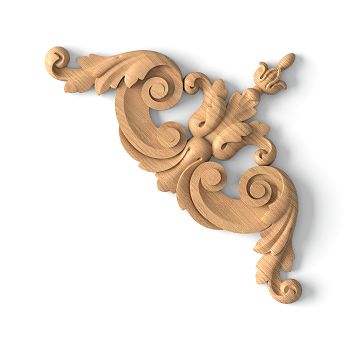
If replacing handles is the first upgrade level, installingcarved appliqués is the second. Carved wooden overlays are mounted on facades, doors, and sides of furniture, turning a simple shape into a decorated one. An overlay with a floral ornament in the center of a cabinet door. Corner overlays on the four corners of a drawer facade. Vertical pilaster overlays on the sides of a chest of drawers. Each element adds volume, detail, luxury.
carved appliqués are made by milling or hand carving from solid oak, beech, ash. They can be symmetrical and asymmetrical, large (up to 50x50 cm and more) and miniature (5x10 cm). The range of motifs is huge: acanthus leaves, roses, grape clusters, shells, volutes, geometric patterns, figures of animals and birds.
Overlays are attached with wood glue, sometimes additionally fixed with small nails or screws with subsequent masking. After installation, they are sanded flush with the surface (if smoothness is needed) or left in relief (for greater expressiveness). Then the overlays are finished together with the furniture: stained, patinated, varnished, painted.
Properly selected and installed carved overlays turn factory furniture into exclusive, a mass-produced chest of drawers into an antique rarity, a standard cabinet into a piece of joinery art.
Classical canons: main features of furniture in the classical style and their support by wall decor
The classical style in furniture is not an arbitrary set of beautiful elements. It is a system developed over centuries, based on certain principles. Understanding these principles helps create harmonious interiors where furniture and architectural decor work in unison.
Symmetry and pairing
Classicism loves symmetry. A pair of armchairs on either side of a sofa. A pair of nightstands on either side of a bed. A pair of sconces on either side of a mirror. Symmetry creates a sense of order, stability, balance. It calms, structures space, makes it understandable.
Wall decor should support this symmetry. If in the living room the sofa is centered on the wall, with armchairs on the sides — on the wall behind the sofa it is logical to place a symmetrical composition ofstucco decoration. A central panel (a plaster rosette, cartouche, overlay with ornament) exactly above the middle of the sofa. On the sides — paired decorative elements of smaller size. This mirrors the arrangement of the furniture, enhances symmetry, creates a visual connection.
Verticality and proportions
Classical furniture often features pronounced verticality. High backs of armchairs and chairs. Vertical pilasters on cabinet fronts. Long table legs. This verticality makes the furniture more elegant, slender, and aristocratic.
Wall decor can emphasize this verticality. Vertical moldings dividing the wall into panels. Vertical pilasters framing door or window openings. High baseboards visually elongating the walls. All this creates a vertical rhythm that resonates with the verticality of the furniture.
Proportions are critical. Classical aesthetics are based on the golden ratio and other mathematical relationships. The height of a chair back to the seat height, the width of a cabinet to its height—these are not random numbers but calculated proportions. Moldings on walls should also divide the plane in harmonious ratios: not arbitrarily, but following compositional rules.
Materiality and Texture
Classical furniture is made of solid wood, often with an open grain emphasized by staining or oiling. Oak with its expressive annual rings. Walnut with its rich color palette. Mahogany with its deep dark red hue. The wood grain is not something to hide. On the contrary, it is a value to be showcased.
Wall decor can echo this materiality. Wooden moldings and panels made from the same wood species as the furniture. Plasterwork painted to resemble wood, imitating carved wooden elements. Or, conversely, contrast: dark wooden furniture against white walls with white plasterwork. Contrast emphasizes both the furniture and the decor, making both more expressive.
Decorativeness and carving
Classical furniture is often adorned with carving. From delicate, barely noticeable, to lush, Baroque-style. Carving can be geometric (fluting, rosettes, beads) or floral (leaves, flowers, garlands). It adds volume, interplay of light and shadow, and a handmade quality to the furniture.
Wall decor in a classical interior is also decorative.Plaster ornaments for wallswith floral motifs, cartouches, ornaments. Moldings with complex profiles. Ceiling cornices with acanthus leaves. It is important that the level of decorativeness is coordinated: if the furniture is lavishly decorated, the walls can also be rich in decor. If the furniture is restrained, with minimal carving—the wall decor should also be more laconic.
Color and Patina
Classical furniture is rarely brightly colored. Preference is given to natural wood tones: from light beige to dark brown. Or complex colors: olive, gray-blue, dusty pink—often with a patina effect, creating a sense of age, history, and noble wear.
Wall decor follows the same color logic. White or cream plasterwork is a universal choice that works with any furniture. Patinated plasterwork—gold, silver, bronze, with an aging effect—supports the historicity of the furniture. Plasterwork toned to match wood creates material unity.
Plasterwork as a background: using plaster ornaments to create a 'frame' around furniture groups
One of the most effective techniques in a classical interior is using plasterwork to create architectural frames around furniture compositions. This transforms furniture from disparate items into cohesive groups, into exhibitions, into paintings framed by molding.
Panels behind a sofa
A classic example: a sofa stands against a wall. Above it—an empty wall or a painting. A standard solution, but not the most expressive. A professional approach: a panel composition made of moldings is created on the wall behind the sofa. A rectangular frame made ofpolyurethane moldings, sized to match the sofa (slightly wider or equal to the sofa's width, in height from the back to the ceiling or to a certain level).
Inside this frame, there can be contrasting paint, patterned wallpaper, decorative plaster. Or additional decorative elements: plaster appliqués in the corners of the frame, a central rosette or cartouche. This composition creates a focal point, makes the sofa the center of attention, and structures the wall.
If the sofa is long, the frame can be divided into several sections by vertical moldings. This creates several panels, establishing a rhythm. This solution works especially well in large spaces where the decor needs to be scaled to the size of the room.
Framing a bed
In a bedroom, the bed is the main piece of furniture. The wall behind the headboard is the main wall. Its design critically influences the perception of the entire room. Plasterwork here creates a solemn frame, turning the bed into a royal bed.
First option: a high panel behind the headboard, made of moldings and framed by them. The panel can be soft (upholstered in fabric) or rigid (painted, wallpapered). The moldings form a frame that visually integrates the headboard into the wall's architecture. The bed ceases to be just furniture against a wall and becomes part of an architectural ensemble.
Second option: plaster appliqués or rosettes, placed symmetrically on either side of the headboard. Two large appliqués with floral ornamentation at the height of the top of the headboard. They create a visual frame without using moldings. This is a lighter, more airy solution, suitable for bedrooms where one does not want to overload the wall.
Third option: a full architectural niche, created from drywall or deep moldings, into which the headboard is built. This is the most monumental solution, turning the bed into an architectural object. Built-in lights, shelves, or decorative elements can be placed on the sides of the niche.
Dining group
A dining table with chairs is another furniture group that benefits from architectural framing. On the wall adjacent to the table (if the table is not in the center of the room but against a wall), or on the nearest wall, a decorative composition is created.
This can be a series of vertical panels made of moldings, the number of which corresponds to the number of chairs. Or a horizontal panel at the level of the chair backs, visually linking the group. Or a large plaster rosette on the ceiling directly above the table, marking the center of the dining area.
An important point: the chandelier above the table. It should relate to the plasterwork. If there is a plaster rosette on the ceiling—the chandelier is attached to its center. If there is no rosette—the chandelier can be framed by a molding ring or square. This creates architectural logic: the light fixture does not hang in an arbitrary spot but is fixed in a specific, decoratively designated position.
Display cabinets and wardrobes
Tall wardrobes, display cabinets, sideboards—furniture that inherently has an architectural nature. They are vertical, large-scale, and structural. Plasterwork can emphasize this architectural quality, integrating the furniture into the wall.
Option: moldings on the wall on either side of the wardrobe, continuing its vertical lines upward to the ceiling. The wardrobe seems to grow into the wall, becoming part of it. Or moldings framing the wardrobe around the perimeter, creating the effect of a built-in niche. The wardrobe looks not like a freestanding item but like a built-in architectural element.
Another technique: carved overlays on cabinet fronts that echo the motifs of wall moldings. If the walls have plaster panels with botanical ornamentation, the cabinet doors feature overlays with the same pattern. This creates a visual dialogue, a conversation between furniture and architecture.
Materials: why natural wood in hardware feels more pleasant to the touch than metal or plastic
We live in an era where technology can imitate anything. Plastic that looks like wood, metal with a wood-like coating, composites indistinguishable from natural materials in appearance. But there are things that cannot be fully faked. And one of them is the tactility of natural wood.
Warmth versus cold
Wood is a warm material in the literal physical sense. Its thermal conductivity is low, so upon touch, wood does not draw heat from the hand. It feels warm, even in a cool room. Metal is a cold material. Its thermal conductivity is high; upon touch, it instantly draws heat away. A metal handle always feels cold, even in a warm room.
This physical fact has psychological consequences. Warmth is associated with pleasantness, friendliness, homeliness. Coldness is associated with detachment, foreignness, institutional sterility. Opening a drawer with a wooden handle gives a pleasant tactile sensation. With a metal one—a neutral or slightly unpleasant one (especially in winter or a cool room).
Plastic mimics the temperature of its surroundings. It is not cold like metal, but not warm like wood. Plastic is neutral, impersonal. It does not repel, but it does not attract either. It simply performs a function, adding no emotion.
Texture versus smoothness
Wood has texture. Even polished to a shine, it retains the micro-relief of fibers, pores, and growth rings. This relief is barely noticeable to the eye but distinctly felt by the hand. It creates additional information for tactile perception, making contact richer, more interesting.
Metal and plastic, when polished, are perfectly smooth. The hand glides over the surface, catching on nothing. This can be pleasant in certain contexts (smooth surfaces are associated with cleanliness, technological sophistication), but in an interior, especially a residential one, excessive smoothness creates a feeling of sterility, hospital-like coldness.
wooden hardwareWood provides the right balance: the surface is smooth enough to be pleasant, yet textured enough to feel alive. Every touch is a small event, a small pleasure.
Weight and density
Wood has optimal density. A wooden handle is not too light (like plastic) and not too heavy (like a solid metal one). The weight meets expectations; the hand feels solidity without strain. This creates a sense of quality, reliability.
A light plastic handle is subconsciously perceived as fragile, temporary, cheap. A heavy metal one—as excessive, inappropriately brutal for furniture. A wooden one is just right: sufficiently weighty to feel materiality, but not so much as to cause discomfort.
Oak skirting boards are an indispensable element of classic interior styles. In the English style, oak skirting boards with rich carving emphasize the aristocracy and solidity of the space. Dark wood tones harmonize beautifully with traditional materials — natural stone, leather, bronze.
Wood is a natural, renewable, biodegradable material. It does not emit harmful substances (provided safe finishes are used), does not cause allergies, and does not accumulate static electricity. In a home, especially with children, elderly people, or allergy sufferers, the eco-friendliness of materials is critical.
Plastic can emit volatile compounds, especially when heated (sunlight by a window, a nearby radiator). Plastic quality varies; cheap plastic is outright toxic. Metal is safe, but the cold contact can be unpleasant for people with sensitive skin, arthritis, or poor circulation in the hands.
Aging and patina
Wood ages beautifully. Over time, it darkens, acquires a patina; marks of use become part of its history. Wear on a wooden handle from thousands of touches is not a defect, but evidence of life, a sign that the item was used and valued. Furniture with patinated wooden handles looks authentic, lived-in, worthy of being passed down.
Metal and plastic age poorly. Metal tarnishes, scratches, can oxidize (if not stainless steel). Plastic fades, becomes brittle, develops micro-cracks. These signs of time do not add nobility; they indicate wear and the need for replacement.
Style versatility
wooden furniture handlesWood fits most interior styles. Classic, country, Provence, Scandinavian, eco, Japanese minimalism, even loft (with the right choice of form and finish)—wood is organic everywhere. Metal is more limited: it works excellently in high-tech, loft, modern styles, but is alien in Provence, country, classic. Plastic rarely looks appropriate in stylized interiors; it's for utilitarian spaces.
The versatility of wood provides freedom. When changing the interior style, it's not necessary to change all the furniture hardware. Wooden handles adapt, changing perception depending on the context.
Creating family heirlooms through interior design
What distinguishes a home from a rental apartment? What makes an interior not just beautiful, but meaningful, worthy of being passed to the next generation? It's the investment of soul, time, attention to detail. It's the choice of materials and elements that will outlive fashions, trends, and generations. It's the creation of family heirlooms.
Durability as a foundation
A family heirloom must be durable. Solid wood furniture lasts for decades, centuries. Wooden hardware does too. High-quality polyurethane moldings do not deform, yellow, or crumble for 50-70 years. These are not seasonal items; they are investments in the future.
ChoosingCarved wooden elementsBy choosing wood for furniture and interiors, you lay a foundation that will serve your children and grandchildren. A chest of drawers with carved wooden handles won't be thrown out in five years when it goes out of fashion. It will be restored, passed down, valued as a family relic.
Uniqueness vs. Mass Production
A family heirloom must be unique. Mass-produced items found in thousands of homes do not become family relics. They are impersonal, replaceable. Unique items, especially custom-made or chosen with particular care, gain individuality. They carry the history of their selection, acquisition, and use.
Hand-carved wooden handles. Plaster panels selected specifically for your interior. Carved overlays that transform a standard cabinet into a unique piece.Carved overlays on furnitureAll these are elements that create uniqueness, and therefore, value.
Emotional Connection
A family heirloom should be emotionally significant. We become attached to things we like, things we chose with love, things associated with important life moments. An interior created with attention to detail evokes pride. You show guests not just a room, but the result of your efforts, taste, and understanding of beauty.
Every wooden handle, every molded applique, every decorative element is a story of choice. You remember searching for that exact molding profile. How you found the perfect handles that matched the furniture perfectly. How you installed the molding and the room transformed. These memories connect you to the interior, making it part of your life.
Transmission of traditions
A classic interior is not just about aesthetics, but also about transmitting cultural codes. Your children grow up surrounded by beauty, harmony, quality materials. They absorb the understanding that things should be well-made, that details matter, that beauty requires effort. This shapes taste, standards, and attitude towards objects.
Someday your children will create their own interiors. And they might unconsciously draw on the experience of their parental home. They'll choose wooden hardware because they remember how pleasant it was to open drawers with wooden handles. They'll use molding because they associate it with nobility and elegance. This is the transmission of traditions through the material environment.
Resistance to trends
Trends come and go. What's fashionable today looks outdated tomorrow. Classic is beyond trends. It is based on timeless principles of harmony, proportion, and quality. An interior executed in a classic style using quality materials and elements will not become outdated in five years. It will remain relevant in twenty, thirty, fifty years.
This is precisely what creating family heirlooms is about: making what is created today serve for a long time, bring joy to generations, and become part of family history.
Frequently asked questions
Can wooden handles be used on modern furniture?
Absolutely. Wooden handles are universal. For modern furniture, choose laconic forms: simple brackets, geometric-shaped knobs, minimalist inset handles. Avoid carving and ornamentation, opt for a smooth surface finished with oil or matte varnish. Light woods (ash, birch, beech) suit Scandinavian style. Dark woods (wenge, fumed oak) suit minimalism.
How to combine wall molding with modern furniture?
A complex task requiring a delicate balance. The molding should be maximally laconic: simple rectangular profile moldings, without ornamentation. Paint it the same color as the walls or in a contrasting, but geometrically precise, color. Avoid lavish classical molding—it conflicts with modern furniture. Use molding for zoning, creating panels, but without Baroque excesses.
Should all furniture handles be changed at once or can it be done gradually?
It's better to do it all at once, especially if the furniture is in the same room or visible simultaneously. Different handles on different pieces create visual chaos and a sense of incompleteness. If the budget is limited, start with the most noticeable furniture (a chest of drawers in the living room, kitchen fronts), but have a plan to replace everything in the foreseeable future. Keep information about the handle model to purchase the same ones later.
Which wood is better for furniture handles—oak or beech?
Both are excellent options. Oak is harder, has a more pronounced texture with contrasting growth rings, and is more durable. Beech is slightly softer, with a fine-grained, more uniform texture. Oak is better for interiors where expressiveness, character, and solidity are valued. Beech is for interiors where restraint, delicacy, and softness are needed. Both are sufficiently durable for furniture handles and will last for decades.
Can wooden handles and appliques be painted?
Yes, wooden elements paint excellently. Use water-based acrylic enamels or special furniture paints. Always prime the surface before painting. Apply paint in 2-3 thin coats with intermediate sanding using fine sandpaper. Final coating—matte or semi-matte varnish for protection. Painted wooden handles look exquisite; you can match any color to the interior.
Polyurethane or plaster molding—which is better?
For residential interiors, polyurethane is preferable. It is lighter (doesn't load the walls), stronger (doesn't crumble), moisture-resistant (can be used in damp rooms), and easier to install. Plaster molding is heavy, fragile, fears moisture, and requires professional installation. The only advantage of plaster is authenticity for restoration projects and the possibility of creating unique elements from custom sketches. For most tasks, polyurethane is the optimal choice.
How to care for wooden hardware?
Wooden handles and appliques do not require complex care. Wipe them with a damp cloth as they get dirty. Do not use aggressive cleaning agents or abrasives. Once a year, you can refresh the finish: for oiled elements—wipe with a new coat of oil; for varnished ones—wipe with furniture polish. If scratches appear—lightly sand with fine sandpaper and apply a new coat of oil or varnish. With proper care, wooden hardware lasts for decades.
Is it worth installing molding in a standard apartment?
It is worth it if you like classical aesthetics and are ready to maintain the style throughout. In a standard apartment with low ceilings, use not overly large molding: thin moldings (5-7 cm), small cornices (8-10 cm), compact decorative elements. Avoid overloading—less is more, but precise. Molding in a standard apartment can look exquisite if selected proportionally to the space and coordinated with the furniture.
Conclusion: details create classic style
A classic interior is not a collection of expensive items. It is a system of interrelationships where each element enhances the other. Architectural decor supports the furniture. Furniture resonates with the decor. Hardware unifies the style. Molding creates frames within which life unfolds.
wooden furniture handles— are not just functional elements. They are points of tactile contact through which you interact with the interior dozens of times a day. They shape your experience of the space, creating pleasant or neutral sensations.Molded decorations on walls— are not just decor. They are an architectural language that structures space, creates proportions, and directs the gaze.
Details create classic style. It is they that distinguish a professionally designed interior from an amateur one. It is in the details that taste, understanding of style, and respect for tradition manifest. You can buy expensive furniture but ruin it with cheap plastic handles. You can install molding but ruin it with inconsistent scale. Or you can build a system where every detail is in its place, performs its role, and contributes to the overall harmony.
For over twenty years, STAVROS company has been helping to create classic interiors, providing all necessary elements from a single source.Solid oak and beech furniture handles— from minimalist to luxuriously carved.carved appliquésfor furniture — hundreds of models in various styles and sizes.Polyurethane moldings— moldings, cornices, rosettes, panels, pilasters for creating architectural decor.Classic Furnituremade of solid wood — chests of drawers, wardrobes, tables, armchairs, beds, crafted according to the canons of style.
Working with STAVROS, you get not just individual elements, but a comprehensive solution. Hardware, overlays, moldings, furniture — everything is created in a unified style, from coordinated materials, with the same level of quality. The company's designers will help select elements for your project, offer ready-made collections, or develop custom solutions. Production on modern equipment guarantees geometric precision, clean processing, and stable characteristics. The logistics service will ensure delivery to any point in the country.
STAVROS is a partner in creating classic interiors. Interiors where details are paramount. Where hardware and molded decor work together, creating a noble space. A space that will last for decades, be passed down through generations, and become a family heirloom. Because classic is forever. And details are what make classic truly authentic.