Article Contents:
- General characteristics of a classical mirror
- Frame as a work of art
- Materials and finishing techniques
- Forms and Proportions
- Sizes and Scale
- Compositional placement
- Baroque mirror: gold and opulence
- Philosophy of the Baroque mirror
- Characteristic features
- Decorative motifs
- Color palette
- Sizes and proportions
- Modern application
- Compositional solutions
- Psychological Impact
- Rococo mirror: romance and refinement
- Philosophy of Rococo
- Characteristic features
- Decorative motifs
- Color Palette
- Forms of Rococo mirrors
- Sizes
- Modern application
- Variants of placement
- Psychological Impact
- Empire mirror: strictness and status
- Philosophy of Empire
- Characteristic elements
- Materials and finishing
- Constructive features
- Color palette
- Sizes and proportions
- Modern application
- Application areas
- Psychological Impact
- Modern mirror: smooth lines and harmony
- Philosophy of Modernism
- Characteristic features
- Decorative elements
- Material and techniques
- Color Palette
- Forms of modern mirrors
- Sizes
- Modern application
- Usage options
- Psychological Impact
- Comparative characteristics of styles
- Baroque vs Rococo vs Empire vs Modern
- Select by room type
- Practical tips for selection
- Style defined by lifestyle
- Coordination with house architecture
- Compositional solutions
- Technical aspects of selection
- Quality of the mirror surface
- Mounting and installation
- Maintenance and care
- Conclusion: mirror as a reflection of the soul of the interior
A mirror in the classical style is not just a reflective surface, but a powerful decorative element capable of radically changing the perception of space. It expands the boundaries of a room, creates a wonderful play of light and shadow, emphasizes the status of the interior, and becomes a central element of artistic composition.
In classical interiors, the mirror always played a special role. It was an item of luxury, a symbol of wealth and refined taste. A Baroque mirror, a Rococo mirror, an Empire mirror, or a Modern mirror — each style interprets this item differently, endowing it with unique features and a special character.
A Baroque mirror will turn an ordinary room into a palace hall, a Rococo mirror will create a romantic boudoir, an Empire mirror will emphasize status and power, and a Modern-style mirror will add natural harmony and artistic beauty. Choosing a specific style is choosing between different eras, aesthetic ideals, and ways of expressing beauty through interior objects.
A correctly chosen classical mirror becomes not just a functional item, but a work of art, a family heirloom, a source of pride for the homeowners.


General characteristics of a classical mirror
Before delving into the specifics of each style, it is important to understand the general principles that distinguish a mirror in the classical style from modern equivalents. These principles were formed over centuries of development of decorative and applied arts.




Frame as a work of art
An elaborately decorated frame is the soul of a classical mirror. It can be crafted from solid wood of valuable species or cast in plaster and subsequently finished. The frame is not merely an enclosure for the mirror surface, but a standalone work of art, showcasing the skill of a carver, gilder, and decorator.
Furniture and interior items Luxury-class items always paid special attention to details, and mirror frames were no exception. Each swirl, each leaf is handcrafted, making each item unique.
Our factory also produces:


Materials and finishing techniques
Solid wood is the foundation of a quality frame. Oak provides strength and durability, allowing for intricate deep carving. Walnut delights with its noble texture and warm tones. Lime is ideal for delicate detailed carving due to its softness.
Plaster frames allow for even more complex and delicate decorative elements. Plaster easily takes any shape, opening up boundless creative possibilities for artisans.
Decorative techniques:
- Gilding with leaf gold — creates a luxurious and precious effect
- Patination — artificial aging of the surface to create an antique effect
- Silvering — a more restrained alternative to gilding
- Inlay — inserts of other materials: mother-of-pearl, ivory, metal
Get Consultation
Shapes and proportions
Classic mirrors differ in variety of shapes:
Rectangular — the most versatile, suitable for any interior. Proportions are usually close to the golden ratio.
Oval — creates a softer, more feminine impression. Particularly characteristic of Rococo and Art Nouveau.
Arched — reminiscent of church and palace windows, emphasizing the grandeur of the interior.
Circular — less common, but creates an especially refined impression.
Figurative — complex shapes mirroring the contours of decorative frame elements.
Sizes and scale
Classic mirrors tend toward large sizes. This is due to both technical capabilities of past eras (large mirrors were especially expensive) and aesthetic principles — the mirror should dominate the space, creating an impression of grandeur.
Standard sizes:
- Height: 120–200 cm
- Width: 80–150 cm for rectangular shapes
- Diameter: 80–120 cm for circular mirrors
Compositional placement
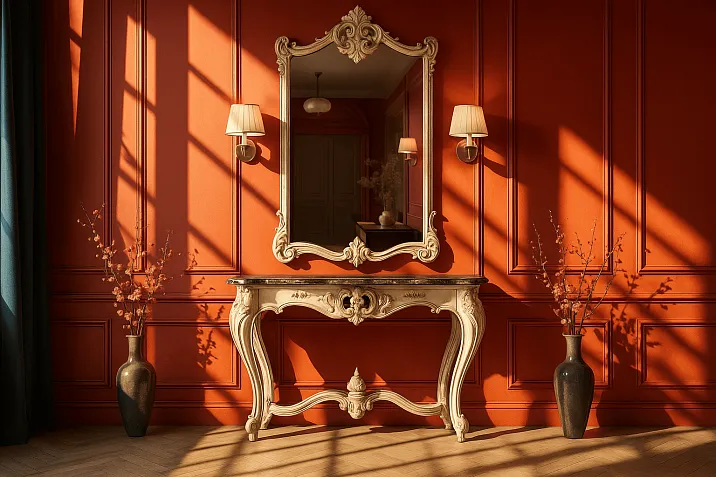
With a console — classic paired composition. The mirror hangs above a console, creating a unified ensemble.
Above the fireplace — traditional placement in the living room, emphasizing the fireplace’s central role in the interior.
In the space between windows — the mirror visually expands the space and adds light.
In the hallway — creates the first impression of the house, setting the tone for the entire interior.
Baroque mirror: gold and opulence
The baroque mirror is the peak of decorative art in mirror-making. The style, originating in the 17th century in royal palaces, transformed a simple mirror into a symbol of absolute power and unlimited wealth. Every baroque mirror is a small spectacle of luxury.
Philosophy of the baroque mirror
Baroque regarded the mirror as a magical object capable of doubling the beauty and grandeur of the interior. A baroque mirror should not merely reflect, but dazzle with the opulence of its frame, demonstrate the owner’s power, and create an atmosphere of palace grandeur.
Characteristic Features
Massiveness and monumentality
Baroque mirror frames are striking in their size and weight. A thick, voluminous frame may occupy up to one-third of the mirror’s total area, becoming an equal participant in the composition rather than merely a border.
Abundance of decorative elements
Every centimeter of the frame is adorned with carving, gilding, and inlay. Vegetal ornaments with acanthus leaves, grape clusters, and roses intertwine with mythological creatures, angels, coats of arms, and symbols of power.
Curvilinear forms
Straight lines in baroque are rare. The frame curves with complex wavy lines, creating a sense of movement and dynamism. Corners are softened, transforming into spiral scrolls.
Gilding as a Signature Feature
Gilded elements create a precious effect. In sunlight or candlelight, such a mirror literally glows with gold, becoming a source of light.
Decorative motifs
Acanthus leaves
Stylized leaves of a Mediterranean plant — the main motif of Baroque carving. Their complex form allows creating rich, three-dimensional compositions.
Cartouches and coats of arms
The central element of the frame is often decorated with a cartouche (decorative shield) featuring a coat of arms, monogram, or allegorical scene.
Mythological creatures
Angels, putti (winged infants), griffins, dragons inhabit Baroque frames, transforming them into theatrical decorations.
Musical instruments
Lutes, trumpets, drums — symbols of courtly life and culture.
Color palette
Baroque prefers contrasting, rich combinations:
- Gold on dark wood — a classic Baroque combination
- Black with silver — a more restrained, yet no less striking option
- White with gold — for light interiors
- Redwood with bronze — a warm, rich palette
Dimensions and proportions
Baroque mirrors tend toward large sizes:
- Height: 150–250 cm
- Frame width: 15–25 cm
- Total weight: may reach 50–80 kg
Such scales require sturdy walls and professional installation.
Modern application
A Baroque mirror is ideal for:
- Formal drawing rooms of 30 m² or more
- Hallways and entryways of country homes
- Interiors with high ceilings (over 3.5 meters)
- Rooms where the mirror is the main decorative accent
- People who appreciate luxury and are not afraid to display it
Compositional solutions
Above the fireplace
A Baroque mirror above a marble fireplace creates a classic palace interior composition.
In pair with a console
A massive console in the same style beneath the mirror forms a unified ensemble.
In a niche
Placed between two windows, it visually unifies them into a single composition.
Psychological impact
A Baroque mirror creates a special atmosphere:
- Sense of luxury and exclusivity
- Connection with historical traditions
- Aspiration for grandeur
- The desire to make an impression
- Understanding interior as a theater of life
Rococo mirror: romance and refinement
Rococo mirror is the complete opposite of baroque heaviness. While baroque overwhelms with grandeur, rococo enchants with elegance. The style of the 18th century brought lightness, playfulness, and intimacy into mirror art.
Philosophy of Rococo
Rococo is the art of enjoying beauty, a cult of elegance and sensuality. Rococo mirrors were created not for state halls, but for private rooms, boudoirs, intimate salons. This is a mirror for admiring one's own beauty, for morning toilettes, for quiet evening reflections.
Characteristic Features
Asymmetry and naturalness
Unlike the strict symmetry of baroque, rococo mirrors allow asymmetrical decorative elements. Ornaments may be unevenly distributed, creating a sense of naturalness, as in living nature.
Refined proportions
All elements strive for elegance and lightness. The frame is not heavy, decorative elements are delicate, the overall impression — airiness and grace.
Intimate scale
Rococo was created for private life, so mirrors are more compact, cozy, and proportionate to the human form.
Curved, flowing lines
All forms are soft, fluid, without sharp angles. The frame seems to flow, bending under invisible forces.
Decorative motifs
Rocaille
The main motif — stylized shells and stones, which gave the style its name. These elements create a sense of closeness to nature, to the sea.
Floral ornaments
Roses, lilies, forget-me-nots, leaves — interpreted lightly, without baroque heaviness. Flowers seem freshly plucked and carelessly scattered across the frame's surface.
Love-themed motifs
Amours, hearts, doves, musical instruments — everything associated with themes of love, pleasure, refined leisure.
Pastoral scenes
Shepherds, sheep, pastoral landscapes — idealized nature, a dream of simple, natural life.
Color palette
Rococo prefers soft, pastel tones:
- Pink-gold combinations — symbol of femininity and romance
- Blue with silver — cool, refreshing palette
- Cream with gold — warm, cozy atmosphere
- Lavender with white — refined elegance
- Mint with silver — freshness and lightness
Forms of rococo mirrors
Oval
The most characteristic form for rococo. The oval is associated with femininity, softness, and naturalness.
Figurative
Complex curved shapes, repeating the curves of decorative elements.
Composite
Several mirror segments within one frame, creating a play of reflections.
Dimensions
Rococo mirror is more compact:
- Height: 80-150 cm
- Frame width: 8-15 cm
- Total weight: 15-30 kg
Modern application
Rococo-style mirror is suitable for:
- Bedrooms of 15 sq.m. and larger
- Women's boudoirs and closets
- Bathrooms in classical style
- Romantic interiors
- Cafes and beauty salons
- People who value elegance over grandeur
Placement options
In the bedroom above the dressing table
Classic placement for morning routines and evening preparations.
In the boudoir
The central element of the women's beauty corner.
In the bathroom
Creates a spa salon atmosphere, turning daily procedures into a beauty ritual.
In the hallway
A small rococo mirror adds elegance without overwhelming the space.
Psychological impact
Rococo creates a special atmosphere:
- Refinement and grace
- Romantic mood
- Aspiration for beauty
- Value of intimacy
- Culture of femininity
Empire mirror: strictness and status
The empire mirror embodies imperial power and state grandeur. The style, formed during the Napoleonic era, turned the mirror into a tool of political propaganda, a material expression of the idea of empire.
Empire is the style of victors, the style of people who govern and make historical decisions. An Empire-style chair should inspire respect, demonstrate strength, emphasize the status of the owner. This is furniture for those accustomed to being at the center of attention and making important decisions.
Empire is the style of victors, the style of people who shape history. An empire-style mirror should inspire respect, demonstrate strength, and emphasize a connection to ancient grandeur. It is not merely a toilet accessory, but a symbol of power and achievements.
Characteristic elements
Geometric strictness
Ampire returns to ancient principles of harmony. Straight lines, sharp angles, mathematically precise proportions. No random curves — only deliberate geometry.
Architectural Elements
Empire-style mirror frames often include columns, pilasters, pediments, and capitals. The mirror becomes a miniature temple or triumphal arch.
Military and state symbolism
Eagles, laurel wreaths, fasces, swords, shields, trophies — symbols of military victory and state power. This symbolism emphasizes a connection to the era of great conquests.
Egyptian motifs
Sphinxes, pyramids, lotuses, hieroglyphs — tribute to Napoleon’s Egyptian campaign, adding exoticism and mystery.
Materials and Finishing
Wood
Dark, noble woods — redwood, rosewood, ebony. The surface is polished to a mirror-like sheen, highlighting the richness of texture.
Bronze elements
Massive appliqués, rosettes, decorative details in gilded bronze. Each element is a work of foundry art.
Marble inlays
Columns of white or colored marble add solemnity and luxury.
Constructive features
Rectangular shape
Most characteristic for empire. A strict rectangle emphasizes seriousness and solidity.
Columns on the sides
Mirrors are often framed by a pair of columns or pilasters, creating the impression of an ancient temple portico.
Pediment
The upper part of the frame may be crowned with a triangular or semi-circular pediment featuring military or state symbolism.
The lower part of the frame is often designed as an architectural base with appropriate proportions.
The lower part of the frame is often designed as an architectural base with appropriate proportions.
Color palette
Neoclassicism prefers a strict, 'imperial' palette:
- Black with gold — a classic combination of power and luxury
- Dark red with bronze — solemnity and strength
- Dark green with gold — nobility and stability
- Blue with silver — cold elegance and dignity
Dimensions and proportions
The neoclassical mirror corresponds to its solemn purpose:
- Height: 120–200 cm
- Width: 80-120 cm
- Frame width: 12-20 cm
- Total weight: 30-60 kg
Modern application
Choose a neoclassical mirror:
- Leaders of large companies and entrepreneurs
- Government officials and diplomats
- Owners of reception rooms
- Fans of strict, solemn aesthetics
- Antique collectors and history enthusiasts
Areas of application
Head of department's office
Emphasizes status, creates an atmosphere of seriousness and responsibility.
Negotiation room
Facilitates making important decisions, inspires respect from partners.
Grand foyer
For official receptions and formal events.
Office hallway
Makes a strong impression on clients, demonstrates company stability.
Psychological impact
Neoclassicism creates an atmosphere:
- Of one's own dignity and significance
- Confidence in decisions made
- Historical responsibility
- Respect from those around
- Connection with traditions of power and success
Modern mirror: smooth lines and harmony
Modernism attempted to create a fundamentally new art, free from historical imitation, yet not breaking with cultural traditions. The style of the turn of the 19th-20th centuries aimed to unite beauty and functionality, art and nature.
Philosophy of Modernism
Modernism proclaimed the unity of art and life, beauty and utility. A mirror in the modern style is not merely a bathroom fixture, but an artwork that should harmonize with the human being and the surrounding nature.
Characteristic Features
Natural Motifs
Flora and fauna are the main sources of inspiration for modernism. Mirror frames are decorated with stylized flowers, leaves, branches, silhouettes of birds, butterflies, dragonflies.
Smooth Lines
Sharp angles are rarely encountered. All forms are fluid, organic, resembling natural contours. Transitions between elements are soft and natural.
Asymmetry as a Principle
Modernism deliberately avoids classical symmetry, preferring dynamic balance. This creates a sense of liveliness, growth, and development.
New materials and technologies
Active use of bent wood, artistic glass, wrought metal, ceramics, stained glass.
Decorative elements
Floral ornaments
Iris, lilies, poppies, grapevines — favorite motifs of modernism. Ornamentation is executed in carving, marquetry, or casting techniques.
Female figures
Stylized female figures with flowing hair, often merging with plant forms. Symbolize the unity of man and nature.
Stylized animals
Swans, peacocks, butterflies, dragonflies — creatures symbolizing beauty, grace, and transformation.
Water motifs
Waves, splashes, aquatic plants — reflecting modernism’s fascination with fluid forms.
Materials and techniques
Wood
Light-colored woods — beech, oak, maple. Often bent wood is used to create smooth, curved forms.
Metal
Wrought iron, bronze, brass. Metal is treated as sculptural material, creating delicate, airy structures.
Glass
Stained glass inserts, frosted glass, colored glass create play of light and color.
Ceramic
Ceramic elements with plant motifs, tiles, majolica.
Color palette
Modernism prefers 'natural' colors:
- Green shades of all tones — from pale salad green to deep emerald.
- Brown tones — all shades of wood, earth, bark.
- Golden-yellow tones — sunny, honeyed, autumnal.
- Blue and purple — colors of water, sky, twilight.
- Beige tones — sandy, cream, natural.
Modernist mirror forms
Irregular, organic shapes
Repeating outlines of leaves, flowers, water flows.
Composite compositions
Several mirror elements of different sizes, creating a complex composition.
Integrated into furniture
Mirrors built into vanity tables, cabinets, screens.
Dimensions
Modernist mirrors are available in various sizes:
- Height: 80–160 cm
- Width: 60–120 cm
- Frame width: variable, follows the ornament shape
- Total weight: 20–40 kg
Modern application
Modernist style mirror is suitable for:
- Creative people and artists
- Nature and eco-consciousness lovers
- Modern apartments with classical elements
- Country houses in a natural setting
- Spa salons and wellness centers
- Those seeking a compromise between classic and modern
Usage options
In the living room
Creates an atmosphere of harmony with nature, stimulates creative thinking.
Bedroom
Adds romance and naturalness, promotes relaxation.
In the bathroom
Turns daily routines into spa rituals.
In the hallway
Creates the first impression of the house as a place of harmony and beauty.
Psychological impact
Modern forms an atmosphere:
- Harmony with nature
- Creative inspiration
- Aspirations toward uniqueness
- Ecological awareness
- Artistic perception of life
Comparative characteristics of styles
Baroque vs Rococo vs Empire vs Modern
|
Characteristic |
Baroque |
Rococo |
Empire |
Modern |
|
Atmosphere |
Palatial luxury |
Romantic intimacy |
Strict Grandeur |
Natural Harmony |
|
Size |
Monumental |
Elegant |
Representative |
Organic |
|
Colors |
Gold on dark |
Pastel tones |
Strict, Contrasting |
Natural, Warm |
|
Decor |
Abundant, Luxurious |
Delicate, Playful |
Geometric, Symbolic |
Botanical, Smooth |
|
Room |
From 25 sq. m |
From 12 sq. m |
From 20 sq. m |
From 10 sq.m |
|
Owner's Character |
Luxury Lover |
Romantic |
Leader |
Creative Personality |
|
Cost |
MDF with film |
Medium-High |
High |
Medium |
Selection by room type
Grand halls and living rooms
Baroque and Empire create the necessary grandeur and respectability.
Bedrooms and boudoirs
Rococo and modern ensure intimacy and romance.
Work offices
Empire emphasizes status, modern style stimulates creativity.
Bathrooms
Rococo creates a spa atmosphere, modern — harmony with nature.
Entrances
All styles are appropriate depending on the overall concept of the house.
Practical tips for selection
Defining style by lifestyle
For lovers of receptions and festivities
Baroque will leave an indelible impression on guests.
For romantic souls
Rococo will create an atmosphere of elegance and beauty.
For business people
Empire emphasizes status and seriousness of intentions.
For creative personalities
Modern resonates with non-standard thinking and artistic perception.
Combination with the house's architecture
Classic mansions
Any style will be appropriate with the right surroundings.
Modern homes
Modern integrates more easily; other styles require supporting classical elements.
Urban apartments
Rococo and adapted modern are the optimal choice for small spaces.
Country houses
Baroque and Empire create a residence atmosphere, modern emphasizes connection with nature.
Compositional solutions
With a console
Classic pair composition requires matching styles of furniture and mirror.
Above the fireplace
The mirror becomes the center of the fireplace composition in the living room.
In a group with other mirrors
Several mirrors in one style create a gallery wall.
As part of a furniture ensemble
Integration of mirror into a dressing table, cabinet, or chest of drawers.
Technical aspects of selection
Mirror surface quality
Mirror thickness
Classic mirrors use glass 4-6 mm thick to achieve quality reflection without distortion.
Coating
Silver amalgamation ensures a clean, bright reflection without a greenish tint.
Edge treatment
Edges must be polished and protected from moisture with special compounds.
Mounting and installation
Type of mounting
- French cleats — for heavy mirrors
- Anchor bolts — for mounting to brick walls
- Screws — for concrete surfaces
- Screws — for wooden structures
Load calculation
The wall must withstand the weight of the mirror with a double safety margin.
Protection from moisture
Additional protection of the frame from high humidity is required in bathrooms.
corner trim
Cleaning the mirror surface
- Ammonia-free mirror-specific cleaners
- Soft microfiber cloths
- Wipe from top to bottom to avoid streaks
Frame care
- Wooden frames: polishing every 6 months
- Gilded elements: gentle cleaning with a soft brush
- Metallic details: special polishes
Condition monitoring
- Regular inspection of fasteners
- Inspect for signs of tarnish on the amalgam
- Control of indoor humidity
Conclusion: the mirror as a reflection of the interior's soul
Choosing a mirror in a classic style is an opportunity to add a magical element to the interior that will transform an ordinary space into a dream. A Baroque mirror brings palace luxury and grandeur, a Rococo mirror adds romantic elegance and femininity, an Empire mirror emphasizes status and seriousness of intent, a Modern mirror creates harmony with nature and artistic inspiration.
Each style has its own area of application:
- To emphasize luxury — Baroque creates the desired impression
- For a romantic interior — Rococo is indispensable
- For a strict office or status home — Empire highlights achievement
- For a modern apartment with classical elements — Modern finds the ideal balance
Remember: a classic mirror for the living room or bedroom is not just a functional item, but a portal to the world of beauty, a tool for creating atmosphere, a way to express your individuality through space.
Classic Furniture STAVROS includes magnificent mirrors, created by masters who understand the subtleties of each classic style and the requirements of modern life. Each mirror is crafted with attention to detail, ensuring it becomes not just an interior item, but a family treasure.
STAVROS, with a quarter-century of experience, will help you choose a mirror that becomes the perfect addition to your home, creating an atmosphere that matches your personality and aesthetic preferences. This is the choice of those who understand: true beauty is timeless, and quality items can delight generations.