Article Contents:
- Height formula: mathematics of beauty
- Basic formula for baseboards
- Formula for ceiling cornice
- Formula adjustments
- The Three-Line Rule
- Non-standard rooms
- Thickness and overhang: the third dimension of decoration
- Profile thickness
- Cornice overhang
- Width-to-thickness ratio
- Impact of thickness on installation
- Visual perception of volume
- Profile compatibility: creating a harmonious ensemble
- Principle of stylistic unity
- Proportionality of dimensions
- Relief consistency
- Color solutions
- Combining profiles of different widths
- Features of combining in different styles
- Rules for low and high ceilings
- Low ceilings (up to 2.5 m)
- Standard ceilings (2.5–2.8 m)
- High ceilings (2.8–3.5 m)
- Very high ceilings (over 3.5 m)
- Selection mistakes: what to avoid
- Error 1: Ignoring formulas
- Error 2: Incompatibility of elements
- Error 3: Stylistic inconsistency
- Error 4: Ignoring room area
- Error 5: Ignoring profile thickness
- Error 6: Too many different profiles
- Error 7: Incorrect color scheme
- Examples for different rooms
- Example 1: Small kitchen-studio
- Example 2: Bedroom in classic style
- Example 3: Living room with high ceilings
- Example 4: Bathroom
- Example 5: Children's room
- FAQ: Frequently Asked Questions about Profile Selection
- Benefits of Partnering with STAVROS and Hi Wood
- Conclusion
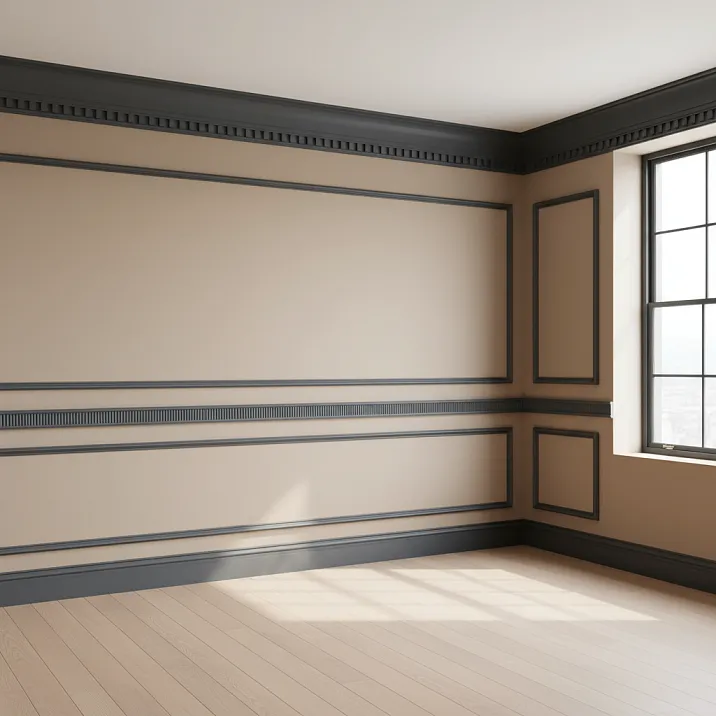
Creating a harmonious interior is an art where every detail matters. If wall color, furniture, and textiles immediately catch the eye, decorative profiles — baseboards, cornices, moldings — work on a subtler level of perception. It is precisely they that create the architectural structure of space, define proportions, and establish rhythm. However, incorrectly chosen dimensions of these elements can completely destroy visual harmony: an overly massive cornice in a low room creates a sense of pressure, while a miniature baseboard in a spacious room simply disappears.
There are proven formulas and rules that help accurately determine optimal decorative element sizes.Baseboard from Fitopolymer 80-120 mm, Cornice from Fitopolymer 70-120 mm, Narrow molding from Fitopolymer 20-30 mmThese dimensions are not random; they are based on the mathematics of visual perception and have been tested over decades of practice.
STAVROS partner Hi Wood produces decorative profiles in a wide range of sizes, allowing you to select the ideal solution for any room. In this article, we will reveal formulas for calculating profile height, examine the significance of thickness and projection, teach you how to combine elements together, and avoid common mistakes. Residents of Moscow, the Moscow region, St. Petersburg, and Leningrad Oblast can take advantage of professional consultations from STAVROS specialists to precisely select dimensions tailored to a specific room.
Height formula: the mathematics of beauty
Choosing baseboard height and cornice width is not a matter of personal preference, but of correct proportions. There are proven mathematical relationships that create visually balanced space.




Base formula for baseboard
The classic rule states: baseboard height should be approximately 1/20 of ceiling height. This ratio is rooted in classical architectural canons and works reliably.
For standard 2.7 m ceilings, the optimal baseboard height is 2700 mm / 20 = 135 mm. Rounding, we get 130-140 mm — these are the sizes most often chosen for standard apartments. For 2.5 m ceilings, the formula gives 125 mm, for 3 m — 150 mm.
However, this is a basic formula that is adjusted depending on room size. In small rooms up to 12-15 sq. m, even with 2.7 m ceilings, a high baseboard of 135 mm may appear bulky. Here, it is better to choose a 100-110 mm profile, which will visually appear more harmonious.
In spacious rooms over 25-30 sq. m, conversely, a baseboard calculated strictly by formula may appear insufficiently expressive. Here, you can confidently add 10-20% to the calculated value, choosing a 150-160 mm profile for 2.7 m ceilings.
Our factory also produces:


Formula for ceiling cornice
The same principle applies to ceiling cornices, but with slight adjustments. Cornice width should be approximately 1/30 of ceiling height, yielding slightly smaller values than for baseboards.
For 2.7 m ceilings, we get 2700 mm / 30 = 90 mm. This is the classic cornice width for most standard rooms. For 2.5 m ceilings — about 80 mm, for 3 m — 100 mm.
Alternative approach — cornice width equals or slightly exceeds baseboard height. This creates visual balance between the upper and lower parts of the wall. If a 120 mm baseboard is chosen, the cornice should also be 110-130 mm.
Cornice from Fitopolymer 70-120 mmHi Wood covers the entire range of standard rooms, allowing you to select the optimal size for any ceiling height.
Get Consultation
Formula adjustments
Basic formulas are a starting point that requires adjustments depending on specific conditions. Room area, natural lighting, interior style, room function — all these factors influence the final choice.
In narrow, elongated spaces (corridors, galleries), reduce the height of the skirting board and the width of the cornice by 10-15% from calculated values. This prevents a cluttered effect. In square, spacious rooms, conversely, you can increase dimensions by 10-20%.
In rooms with insufficient natural light (northern rooms, ground floors), heavier profiles will create a sense of heaviness. Here, it is better to choose sizes at the lower end of the range. In bright, sunny rooms, you can confidently use more expressive profiles.
Rule of Three Lines
When using skirting boards, cornices, and horizontal moldings on walls, it is important to maintain proportionality among all elements. Classic rule: all three elements should be proportionally matched to each other.
If the skirting board has a height of 120 mm and the cornice has a width of 110 mm, the horizontal molding dividing the wall should be 60-80 mm wide. That is, the molding is approximately 30-40% narrower than the main profiles. This creates a visual hierarchy where horizontal spatial boundaries (top and bottom) dominate, while intermediate divisions play a supporting role.
Non-standard Rooms
For rooms with very high ceilings (over 3.5 m), the 1/20 formula gives excessively large skirting board values (175 mm and more), suitable only for palace interiors. For modern rooms, it is better to limit height to 150-160 mm, compensating proportions through expressive profile relief.
For rooms with very low ceilings (under 2.4 m), the formula gives too small values (less than 120 mm). Such skirting boards look outdated. It is better to choose the minimum standard height of 80-90 mm and paint the profiles to match wall color to visually increase room height.
Thickness and Overhang: The Third Dimension of Decoration
In addition to height and width of profiles, their volumetric characteristics — thickness (height of protrusion from the wall) and overhang (distance the profile extends from the surface) — are critically important. These parameters determine the expressiveness of light and shadow play.
Profile Thickness
Thickness is the height of the profile's relief, its volume. Flat profiles with thickness of 5-10 mm create delicate lines, almost blending into the wall upon installation. Volumetric profiles with thickness of 15-30 mm create expressive shadows, emphasizing architectural character.
For minimalist interiors, flat profiles of minimal thickness are characteristic. They function as graphic lines, structuring space without excessive ornamentation.Narrow molding from Fitopolymer 20-30 mmWith thickness of 8-12 mm, ideal for such interiors.
Classic styles require volumetric profiles with high relief. Thickness of 20-30 mm creates deep shadows, emphasizing decorative richness.Figured profile from fitopolymerWith multi-level relief from Hi Wood, thickness is 25-35 mm, ensuring impressive expressiveness.
Cornice Overhang
Overhang is the horizontal distance the cornice extends from the wall. This parameter is especially important for ceiling cornices. Small overhang (30-50 mm) creates a compact profile, well-suited for small rooms. Large overhang (80-120 mm) provides dramatic light and shadow play, but requires appropriate room scale.
Cornice overhang should be proportional to its width. For a 80 mm wide cornice, optimal overhang is 40-60 mm. For a 120 mm cornice, it is 60-90 mm. Excessive overhang with small width creates an unproportional 'shelf,' while insufficient overhang makes the profile unexpressive.
When using hidden LED lighting behind the cornice, overhang must be sufficient to fully conceal the LED strip from direct view. Typically, this is a minimum of 60-80 mm. Hi Wood produces special cornices for lighting with optimally calculated overhang.
Width-to-thickness Ratio
There is an unwritten rule of proportions: profile thickness should be approximately 1/5 to 1/7 of its width. For a skirting board 100 mm wide, optimal thickness is 15-20 mm. For a cornice 120 mm wide, it is 18-24 mm.
Too flat, wide profiles look unexpressive, like glued paper strips. Too thick, narrow profiles appear bulky and disproportionate. Professional manufacturers, such as Hi Wood, carefully calculate proportions for each model, ensuring harmonious relationships among all dimensions.
Influence of Thickness on Installation
Profile thickness affects not only aesthetics but also installation technology. Thin, lightweight profiles (up to 15 mm thick) securely adhere with adhesive without additional fastening. Thick, heavy profiles (over 25 mm), especially wide cornices, may require additional mechanical fastening with self-tapping screws.
When installing on uneven walls, volumetric profiles better compensate for surface defects due to their thickness. Flat profiles replicate all irregularities, which may be noticeable. This must be considered when selecting profiles.
Visual Perception of Volume
Important point: perception of profile thickness depends on lighting. Under bright side lighting, even a small relief creates expressive shadows, making the profile appear volumetric. Under diffuse overhead light, shadows are minimal, and even a thick profile may appear flat.
When selecting profiles, consider the lighting characteristics in the room. In rooms with large windows providing directional light, flatter profiles can be used. In rooms with artificial diffuse lighting, more volumetric, relief profiles are needed to create expressiveness.
Profile Compatibility: Creating a Harmonious Ensemble
Baseboards, cornices, and moldings must work as a single ensemble, complementing and enhancing each other. Proper coordination of elements creates a cohesive architectural composition.
Principle of Stylistic Unity
The first and foremost rule — all profiles must belong to the same stylistic group. A classical cornice with rich ornamentation does not match a minimalist baseboard. A modern flat molding looks out of place next to a baroque cornice.
The ideal solution is to choose profiles from a single manufacturer's collection. Hi Wood develops coordinated series where baseboards, cornices, and moldings feature repeating decorative motifs, proportional dimensions, and a unified style. This guarantees harmonious coordination.
Consistency in decorative character
Proportionality of sizes
All elements' dimensions must be proportionally balanced. Basic rule: cornices and baseboards have approximately equal width/height (±10-20%), moldings are 30-50% narrower than main profiles.
For a room with a 120 mm baseboard, the optimal cornice is 110-130 mm, horizontal moldings 60-80 mm, narrow accent moldings 30-40 mm. This gradation creates a visual hierarchy among elements.
Disproportion creates disharmony. A 150 mm cornice with a 70 mm baseboard looks disproportionate — the upper part of the room appears overloaded, while the lower part is lightened. For visual balance, the difference between main profiles should not exceed 30%.
Relief consistency
The height and character of relief on all profiles must be consistent. If a baseboard has a pronounced volumetric decoration with 25 mm relief, the cornice must have a comparable volumetric ornament. A flat cornice 10 mm thick will appear disproportionate.
The degree of ornamentation should also be uniform. A richly decorated cornice with multiple elements requires a correspondingly decorated baseboard. A minimalist smooth cornice pairs well with a minimalist baseboard.
However, a gradation of complexity is permissible: the cornice may be slightly more decorated than the baseboard, moldings less decorated than main profiles. But the ornament style must remain consistent.
Color Solutions
Profile color is critically important for compatibility. The classical solution — all profiles in one color, usually white. This creates a unified architectural framing system for the space.
A modern approach allows for color variations. Baseboard and cornice may be white, while accent moldings are contrasting color. Or baseboard is contrasting (dark), while cornice and moldings match wall color. But in any case, no more than two different profile colors in one room, otherwise chaos ensues.
When painting profiles to match wall color, maintain volume. A monochromatic surface requires expressive relief; otherwise, profiles simply blend into the wall. Contrasting paint allows using flatter profiles — they stand out due to color.
Combining profiles of different widths
In one interior, profiles of two or three sizes are often used. Main (baseboard and cornice) — wide, horizontal moldings for dividing walls — medium, accent moldings for frames — narrow.
Clear gradations are essential. If main profiles are 100-120 mm, medium should be 60-80 mm, narrow — 25-40 mm. Blurred boundaries (100 mm, 90 mm, 80 mm) create an impression of arbitrary selection.
Narrow profiles serve an accent role — they frame mirrors and pictures, create small decorative borders. They should not compete with main profiles in width, otherwise the composition becomes overloaded.
Features of combining profiles in different styles
In classical interiors, all profiles are richly decorated, sizes maximally within reason (baseboard 120-150 mm, cornice 110-140 mm, moldings 60-100 mm). Relief is high, ornaments complex. Color traditionally white or light.
In neoclassical interiors, decoration is present but more restrained. Sizes moderate (baseboard 100-120 mm, cornice 90-110 mm, moldings 50-70 mm). Relief medium, ornaments minimalist. Color accents are permissible.
In modern styles (minimalism, contemporary, Scandinavian) profiles are maximally simple, often entirely without decoration. Sizes moderate (baseboard 80-100 mm, cornice 70-90 mm, moldings 30-50 mm). Relief minimal, forms geometric. Color often matches wall tones.
Rules for low and high ceilings
Ceiling height is a decisive factor in choosing profile sizes. Incorrect selection can visually further lower a low ceiling or create disproportion in a high room.
Low ceilings (up to 2.5 m)
Rooms with 2.3–2.5 m ceilings require a particularly thoughtful approach. Too wide profiles create a sense of pressure, visually reducing an already low space.
Optimal sizes: baseboard 70–90 mm, cornice 60–80 mm, moldings 30–50 mm. These are minimal sizes that still retain sufficient expressiveness without overloading the space.
Important technique: painting profiles to match wall color. When baseboard and cornice blend with walls in color, they stand out only through light and shadow play on relief. This visually elongates the wall, making the ceiling appear higher. Conversely, white contrasting profiles fragment space into zones, which is undesirable in low ceilings.
The profile relief should be moderate. Excessive decorative elements on a narrow profile will create a cluttered effect. Choose profiles with smooth lines, without sharp protrusions or deep recesses.
Avoid horizontal moldings that divide the wall vertically—they visually lower the ceiling. If zoning is necessary, use vertical moldings or moldings only in the lower third of the wall.
Standard ceilings (2.5–2.8 m)
This is the most common height range in standard apartments. Here, classic proportions work without special adjustments.
Optimal sizes:Baseboard from Fitopolymer 80-120 mm, Cornice from Fitopolymer 70-120 mm, moldings 40–80 mm. The specific choice within this range depends on room area and style.
For rooms 12–18 sq.m., choose values at the lower end of the range (skirting 80–100 mm, cornice 70–90 mm). For rooms 18–25 sq.m.—middle values (skirting 100–110 mm, cornice 90–100 mm). For rooms over 25 sq.m.—upper end (skirting 110–120 mm, cornice 100–120 mm).
Color solution can be any: classic white profiles, profiles matching wall color, or contrasting ones. Relief—from minimalist to elaborately decorated, depending on style.
High ceilings (2.8–3.5 m)
High ceilings are ideal for expressive decorative profiles. Here, maximum sizes can be used without risking overloading the space.
Optimal sizes: skirting 120–160 mm, cornice 110–150 mm, moldings 60–100 mm. Choose profiles with expressive relief and multi-level structure—they will appropriately fill vertical space.
At heights of 3 m and above, use horizontal wall zoning with moldings. Dividing into three zones (lower third, middle, upper under ceiling) creates proper proportions and prevents walls from appearing infinitely elongated.
Contrasting profile color solutions are especially effective with high ceilings. White cornices and skirtings on dark walls create a clear architectural structure, emphasizing the grandeur of the space.
Very high ceilings (over 3.5 m)
Rooms with ceilings over 3.5 m are typically historical buildings, lofts, or country homes with two-story spaces. Special rules apply here.
Profile sizes: skirting 150–200 mm and more, cornice 140–180 mm and more, moldings 80–120 mm. However, even with these sizes, it’s important to maintain proportion—too massive profiles will appear heavy.
Use multi-level horizontal wall zoning with moldings. Classic scheme: molding at 90–120 cm from floor (separates panel zone), molding at 2/3 wall height (divides main zone), cornice under ceiling. This creates three to four horizontal levels structuring the space.
At very high ceilings, it’s advisable to use multi-tiered cornices—profiles composed of several levels. They create rich light-and-shadow play and suit the scale of the room.
Errors in selection: what to avoid
Even knowing formulas and rules, it’s easy to make mistakes when selecting profiles. Let’s consider the most common ones.
Error 1: Ignoring formulas
The most common error—choosing profiles 'by eye,' without calculating proportions. A 150 mm skirting in a store may look nice, but in a room with 2.5 m ceilings, it will create a cluttered impression.
Always start with formula-based calculations, then adjust the result according to room area and style. Don’t rely solely on the visual impression of a sample—the perception in the context of a specific room will be different.
Error 2: Mismatched elements
A 150 mm skirting combined with a 60 mm cornice is a gross proportion error. The lower part of the room is overloaded, while the upper part is inadequately decorated. The difference between main profiles should not exceed 30%.
It’s also incorrect to use moldings of the same width as main profiles. If the skirting is 100 mm and the horizontal molding is also 100 mm, elements compete, and the composition loses hierarchy.
Error 3: Stylistic inconsistency
Combining profiles from different stylistic groups is guaranteed to fail. A Baroque cornice with ornate decoration combined with a minimalist smooth skirting creates stylistic chaos. Profiles must speak the same language.
Even within one style, consistency matters. A classical cornice with Greek meander does not match a skirting decorated with plant motifs in the modern style. Motifs must correspond.
Error 4: Ignoring room area
The formula considers only ceiling height, not area. As a result, in a small 10 sq.m room with 2.7 m ceilings, a 135 mm skirting board (according to the formula) looks bulky. In a spacious 40 sq.m living room with the same ceilings, the same skirting board appears insufficient.
Rule: the smaller the area, reduce the profile dimensions by 10-20% from calculated values. The larger the area, increase them by 10-20%.
Error 5: Ignoring profile thickness
Buyers often focus only on profile width, ignoring its thickness (volume). As a result, a wide but flat profile is purchased, which after installation looks like a glued paper strip.
Thickness should be proportional to width (approximately 1/6 - 1/7). For classic interiors, choose volumetric profiles with high relief; for modern interiors, opt for flatter profiles with clear geometry.
Error 6: Too many different profiles
The desire to use maximum variety leads to interior overload. One model of skirting board, another of cornice, three types of molding of different widths, corner elements, and outlets — ultimately, the room becomes a decoration exhibition.
Rule: no more than three to four types of profiles in one room. Main profiles (skirting board and cornice), horizontal molding for zoning, narrow molding for accents — that’s enough. Everything else is excess.
Error 7: Incorrect color solution
Painting profiles in different colors without a thought-out concept creates chaos. A white skirting board, gray cornice, beige moldings in one room — visual cacophony.
The color solution must be unified: all profiles one color, or main profiles (skirting board and cornice) one color, moldings another. No more than two profile colors in one room.
Examples of selection for different rooms
Let’s consider specific examples of correct profile selection for typical situations.
Example 1: Small kitchen-studio
Parameters: area 15 sq.m, ceiling height 2.55 m, style modern minimalism.
Skirting board calculation by formula: 2550 / 20 = 128 mm. Adjustment considering small area: reduce by 20%, resulting in 100 mm. Choose100 mm plant polymer skirting boardwith simple rectangular cross-section without decoration.
Cornice calculation: 2550 / 30 = 85 mm. Considering proportionality to skirting board, choose80-90 mm cornicewith minimalist shape.
Moldings: use only30 mm narrow moldingfor separating kitchen and living room zones. Color of all profiles — to match wall tone (light gray). Result: neat, visually spacious space.
Example 2: Bedroom in classic style
Parameters: area 20 sq.m, ceiling height 2.75 m, style classic.
Skirting board calculation: 2750 / 20 = 138 mm, rounded to standard 140 mm. Choose140 mm skirting boardwith light relief ornament.
Cornice calculation: proportionally to skirting board, choosefrom the same collection with similar decoration.from the same collection with similar decoration.
Moldings: horizontal molding 70 mm at 2/3 wall height to create panels,narrow molding 35 mmfor framing the headboard. Color of all profiles - white. Result: elegant classic space with proper proportions.
Example 3: Living room with high ceilings
Parameters: area 35 sq.m, ceiling height 3.2 m, style neoclassical.
Baseboard calculation: 3200 / 20 = 160 mm. No adjustment due to large area. Selectbaseboard 160 mmwith moderate classic decoration.
Crown molding calculation: select proportionalcrown molding 150 mmfrom the same series.
Moldings: horizontal molding 90 mm at 90 cm from floor (separates panel zone), molding 80 mm at 2/3 wall height, narrow moldings 40 mm for creating framed panels. Color: baseboard and crown molding white, moldings in wall color (beige). Result: harmonious space with properly structured high walls.
Example 4: Bathroom
Parameters: area 6 sq.m, ceiling height 2.5 m, style modern.
Baseboard calculation: 2500 / 20 = 125 mm. Adjustment considering very small area and functional purpose: reduce to 80 mm. Select moisture-resistantbaseboard 80 mmwith smooth surface.
Crown molding: select proportionalcrown molding 70 mmsimple shape.
Moldings: 50 mm molding to separate tiled zone from painted wall section. Color of all profiles - white. Result: neat, functional space where profiles do not overload small volume.
Example 5: Children's room
Parameters: area 16 sq.m, ceiling height 2.65 m, style Scandinavian.
Baseboard calculation: 2650 / 20 = 133 mm. Adjustment considering children's room (less formality, more lightness): reduce to 100 mm. Selectbaseboard 100 mmwith gentle rounding of top edge.
Crown molding:crown molding 90 mmsimple profile shape
Vertical moldingsmoldings 30 mmfor creating house-frame accents on accent walls. Profile color - white on pastel walls. Result: a bright, cheerful space with playful details.
FAQ: Frequently Asked Questions about Profile Selection
Can I use skirting and cornice of different widths?
Yes, but the difference should not exceed 30%. If the skirting is 100 mm, the cornice can be 80-130 mm. A large difference creates imbalance - the room appears visually skewed.
How to determine if the selected profile is not too wide?
Attach a profile sample to the wall and step back 2-3 meters. If the profile attracts more attention than the wall itself, it is too wide. Decoration should frame the space, not dominate it.
Is it necessary to use profiles from one collection?
Desirable but not mandatory. You can combine profiles from different collections if they share a similar style, are proportionally equal in thickness and relief character. However, collection sets guarantee perfect coordination.
What if the room has a non-standard ceiling height, for example, 2.43 m?
Round to the nearest standard value (in this case, 2.4 m or 2.5 m) and calculate using the formula. Precision to the centimeter is not critical here - overall proportionality is more important.
Can I use profiles of different thicknesses in one room?
Yes, this is allowed and even desirable for creating visual hierarchy. Main profiles (skirting, cornice) can be 20-25 mm thick, moldings - 15-18 mm, narrow accents - 10-12 mm. The key is to maintain the proportion of thickness to width.
How to choose profile sizes for a room with an irregular shape?
Base your choice on average ceiling height and room area. For rooms with variable ceiling heights (attics, lofts), use sizes calculated for the minimum height in the living zone - this prevents overloading the space.
Does wall color affect profile size selection?
Yes, dark walls visually reduce space, so profiles should be slightly smaller than calculated. Light walls, on the contrary, allow using more expressive sizes. Adjustment is approximately 10%.
Which profiles to choose for a room with a suspended ceiling?
Any fit-profiles are suitable for suspended ceilings, but cornice installation has specific features. Use mounting brackets for attachment. Cornice width is usually 70-120 mm - same as for standard ceilings.
Are moldings needed if there is already skirting and cornice?
Moldings are not mandatory, but desirable in rooms with high ceilings (from 2.8 m) for wall structuring. In rooms with ceilings 2.5-2.7 m, skirting and cornice are sufficient.
How to check the correctness of selection before purchase?
Most manufacturers offer profile samples. Take a sample home, attach it to the wall, photograph, and evaluate proportions on the photo. This gives a more objective view than visual assessment on-site.
Advantages of cooperation with STAVROS and Hi Wood
STAVROS is an official partner of Hi Wood manufacturer in Moscow, Moscow region, Saint Petersburg, and Leningrad region, offering comprehensive support in selecting correct profile sizes.
Professional consultations on size selection. STAVROS specialists will help calculate optimal profile sizes for your specific room, taking into account all factors: ceiling height, area, style, natural lighting.
Full size range. Hi Wood profiles are available in all standard sizes: skirting from 60 to 200 mm, cornices from 50 to 180 mm, moldings from 20 to 150 mm. This allows selecting exactly the sizes optimal for your space.
Coordinated collections. Hi Wood releases complete series where skirting, cornices, and moldings perfectly match in style and proportions. STAVROS offers full collections, simplifying the creation of a harmonious composition.
Samples for try-on. Opportunity to obtain profile samples for try-on in your room before purchase. This allows evaluating the actual perception of sizes in the context of your specific interior.
Calculation of required quantity. Specialists will help accurately calculate the required amount of profiles, taking into account room layout specifics, minimizing overpayment for extras.
Post-purchase technical support. Installation consultations, adhesive and paint recommendations, final finishing advice — STAVROS accompanies the project from selection to final result.
Conclusion
Correct selection of decorative elements' height and profile is not an intuitive choice, but an exact science based on proven formulas and rules of visual perception.Baseboard from Fitopolymer 80-120 mm, Cornice from Fitopolymer 70-120 mm, Narrow molding from Fitopolymer 20-30 mmThese dimensions correspond to architectural golden proportions and work reliably in most standard rooms.
The basic formula for skirting board height (1/20 of ceiling height) and cornice width (1/30 of ceiling height or proportional to skirting board) is a starting point, adjusted according to room area, natural lighting, interior style. Equally important are profile thickness and overhang, creating light and shadow play and defining decorative expressiveness.
All elements of the decorative system — skirting boards, cornices, moldings — must be coordinated with each other in style, dimensions, relief character, and color. Only a comprehensive approach creates a harmonious architectural composition, where each element complements and enhances the others.
Figured profile from fitopolymerHi Wood's products feature precisely calculated proportions of width, thickness, and relief height. Each model undergoes careful design development, adhering to classical ratios proven by centuries of architectural practice.
Typical mistakes — ignoring formulas, mismatched elements, stylistic inconsistency, ignoring room area — are easily avoided by following clear rules and recommendations from professionals. Remember: overly bulky profiles in small rooms create pressure, while overly narrow profiles in spacious rooms lose effectiveness and fail to fulfill their architectural function.
By choosing Hi Wood products through an official STAVROS partner, residents of Moscow, the Moscow region, Saint Petersburg, and Leningrad Oblast receive not only high-quality materials but also professional assistance in calculating optimal dimensions for a specific room. Company specialists will consider all nuances — from ceiling height to natural lighting characteristics — and help create a perfectly balanced composition.
Correctly sized decorative profiles transform ordinary housing into architecturally expressive spaces with clear structure, proper proportions, and harmonious atmosphere. This is an investment not only in beauty but also in comfort of spatial perception, which will delight the eye for decades. Create interiors based on laws of beauty and harmony, using profiles from proven manufacturers and supported by professionals.