












































































Article Contents:
- Anatomy of the Ideal Connection: Understanding Structural Features
- Structural Analysis of Loads
- Material science aspects of connections
- Classification of Fastening Methods: From Traditions to Innovations
- Handrail Support Board: A Universal Solution
- Dowel Connections: Traditional Elegance
- Dovetail Joints: Strength and Reliability
- Technological Nuances of Installation: Step-by-Step Guide
- Preparation stage: the foundation of quality
- Processing of Connection Surfaces
- Preparing the Handrail for Installation
- Specialized Techniques for Various Structures
- Straight Run Staircases: Standard Solutions
- Turn Staircases: Complexity of Geometry
- Helical Staircases: Maximum Complexity
- Quality Control and Testing of Joints
- Visual Quality Assessment
- Load testing
- Final Finishing and Concealment of Connections
- Sanding and Surface Preparation
- Staining and Protective Treatment
- Operation and Maintenance of Connections
- Regular Inspection and Preventive Maintenance
- Repair and Restoration
- Typical Errors and Ways to Prevent Them
- Errors in Material Preparation
- Technological violations
- Modern Trends in Connection Design
- Hidden Connections
- Composite Materials
- Conclusion
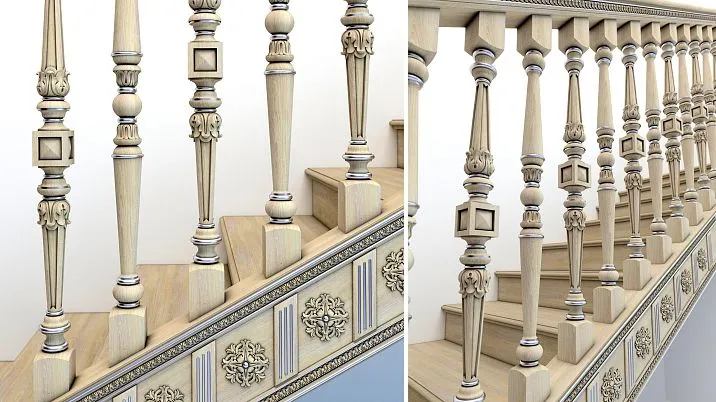
Have you ever wondered why some stair railings serve for decades, retaining their original strength and beauty, while others begin to loosen within just a few years? The secret lies in how to install handrails to balusters of a wooden staircase — this process requires not only technical knowledge but also an understanding of the subtleties of working with live material. Wood breathes, expands, and contracts, so every connection must account for these natural processes.
Imagine: you ascend the stairs, confidently relying on the handrail that holds firmly due to properly executed connections. Every touch of the handrails provides a sense of stability and safety. This is not coincidence — it is the result of a professional approach to installation, where every detail is thought out to the smallest detail.
Quality installation of handrails to balusters is an art that combines traditional carpentry techniques with modern technological solutions. The choice of connection method affects not only the durability of the structure but also its aesthetic appeal, as connection points should be practically invisible.


Anatomy of the Ideal Connection: Understanding Structural Features
Before diving into the technical aspects of installation, it is important to understand what a stair railing system represents. This is not simply a set of individual elements — it is a unified organism, where each detail plays its role in the overall symphony of strength and beauty.




Structural Analysis of Loads
Handrails experience multiple types of forces: vertical loads from their own weight, horizontal forces when a person leans on them, and dynamic forces during intensive use of the stairs. Balusters serve as a transfer element, distributing these loads to load-bearing structures.
Each baluster functions as a miniature column, receiving loads from the handrail and transferring them to the treads or stringers. At the same time, the connection to the handrail must provide rigidity in the horizontal plane while allowing for minor deformations associated with the natural movement of wood.
Our factory also produces:



Material aspects of connections
Wood is a living material that continues to change even after processing and installation. Seasonal fluctuations in humidity cause changes in the geometric dimensions of components, creating additional stresses at connection points.
Different wood species behave differently. Oak and beech, with their high density, provide strong connections but require pre-drilling. Coniferous species are more flexible but prone to cracking with improper fastening.
The moisture content of wood is critically important for the quality of connections. Material with moisture content above 12% will continue to dry after installation, leading to weakened fasteners and gaps.
Get Consultation
Classification of handrail attachment methods: from traditions to innovations
There are many ways to connect handrails to balusters, each with its own advantages and applications. The choice of a specific method depends on the structural features of the staircase, strength requirements, aesthetic preferences, and project budget.
Handrail support plank: a universal solution
Using a handrail support plank is a classic method that ensures even load distribution and adds additional rigidity to the structure. The plank is a wooden strip with a cross-section of 20×40 or 25×50 millimeters, installed over the balusters and serving as the base for attaching the handrail.
The advantages of this method are obvious: ease of installation, possibility of concealed fastening, even load distribution among all balusters. The handrail support plank compensates for minor height inaccuracies in balusters and ensures a perfectly straight handrail installation line.
The installation process begins with precise trimming of the upper ends of the balusters. All ends must lie in one plane, checked using a long straightedge and level. The handrail support plank is fastened to each baluster with 40-50 mm screws, driven in at a slight angle for better fixation.
Dowel Connections: Traditional Elegance
Wooden dowels with a diameter of 8-12 millimeters represent a classic carpentry solution valued for its ecological and aesthetic qualities. This method of attaching handrails to wooden staircase balusters is especially popular when creating railings in a traditional style.
Manufacturing high-quality dowels requires special skill. The wood must be completely dry, with moisture content no more than 8-10 percent. The fibers of the dowel must be aligned strictly along its axis, ensuring maximum strength against shear and bending.
The length of the dowel is calculated so that it extends into the baluster by 15-20 millimeters and into the handrail by 10-15 millimeters. An overly long dowel may cause wood cracking, especially when working with hardwoods.
Adhesive bonding plays a key role in the durability of dowel connections. Modern polyurethane adhesives create a water-resistant bond that does not degrade with changes in wood moisture. The open time of the adhesive is 10-15 minutes, allowing for adjustment of element positions.
Mortise-and-tenon joints: strength and reliability
Mortise-and-tenon connection is a more complex but also more reliable technology. A tenon of a specific shape — round, square, or decorative — is milled on the upper end of the baluster. A corresponding mortise is selected in the handrail.
The size of the tenon must ensure a tight fit with minimal clearance. For round tenons, the diameter is 12-16 millimeters; for square tenons, the cross-section is 10×10 or 12×12 millimeters. The depth of the tenon is usually 20-25 millimeters.
Milling tenons requires high precision and quality tools. Special wood milling cutters with carbide inserts are used, ensuring clean processing without chips or scratches.
Technological nuances of installation: step-by-step guide
Quality attachment of handrails to wooden staircase balusters begins with careful preparation of all elements. Each stage of work requires attention to detail and adherence to technological requirements.
Preparation stage: the foundation of quality
Preparation begins with checking the geometry of installed balusters. All balusters must be strictly vertical and equidistant from the edge of the steps. Deviations exceeding 2 millimeters are unacceptable and require adjustment.
The height of the balusters is measured from the top surface of the step to the upper end of the post. All dimensions must be identical to within 1 millimeter. If discrepancies are found, the higher balusters are trimmed.
The handrail installation line is marked using a laser level or a taut string. The line must be parallel to the staircase’s incline and located at a height of 900-950 millimeters from the front edge of the steps.
Processing of connection surfaces
The upper ends of the balusters must be perfectly flat and perpendicular to the post’s axis. Processing is done using a circular saw with a fine-toothed blade or a hand plane with a sharp blade.
For dowel connections, holes are drilled in the ends of the balusters with a diameter 0.5 millimeters smaller than the dowel diameter. The drilling depth is controlled using a stop or marking on the drill. The holes must be strictly perpendicular to the end surface.
For mortise-and-tenon connections, tenons are milled using a milling machine or a hand milling machine with special fixtures. The quality of processing must ensure a tight fit of the tenon in the mortise without gaps.
Preparing the handrail for installation
The handrail is supplied as long blanks that must be fitted to the specific staircase. The length is measured from the upper ends of the outermost balusters, accounting for overhangs beyond the support posts.
The ends of the handrail are milled at angles ensuring tight contact with support posts or walls. For spiral staircases, complex angled joints may be required.
When using a handrail support plank, a groove 8-12 millimeters deep and matching the plank’s thickness is milled into the bottom of the handrail. The groove must run the full length of the handrail with high precision.
Specialized techniques for different constructions
Different types of staircases require specific approaches to handrail attachment. Understanding these features allows selecting the optimal installation method and avoiding common mistakes.
Straight staircases: standard solutions
Straight staircases represent the least complexity for installing handrails. All balusters have the same height, and the handrail is installed at a constant angle, which simplifies marking and processing of components.
The main task is to ensure the handrail is parallel to the slope of the staircase. The angle of inclination is measured with a digital protractor and transferred to all structural elements. Deviations exceeding 0.5 degrees create visual discomfort.
Mounting handrails to balusters of a straight wooden staircase is typically done using a handrail support board, which ensures even load distribution and simplifies installation.
Curved staircases: geometric complexity
Staircases with curved sections require special attention to the geometry of connections. Balusters on turning steps have different heights, and the handrail curves in space, following the staircase's shape.
Marking the position of balusters on turning steps is done considering the variable radius of curvature. Each baluster has an individual height calculated separately.
Manufacturing curved handrails is a separate area of craftsmanship requiring special equipment. An alternative solution is using composite handrails made of short straight sections connected at calculated angles.
Helical staircases: maximum complexity
Helical staircases present the greatest complexity for installing handrails due to the constantly changing radius of curvature and various step turning angles. Each baluster is unique in size and cut angles.
Marking is performed using special templates or computer modeling. It is important to ensure the smoothness of the handrail line while maintaining regulatory requirements for guardrail height.
Handrails for helical staircases are manufactured by bending or gluing thin laminates. The second method is more accessible for self-manufacturing but requires precise calculations and quality glue.
Quality Control and Joint Testing
Completion of installation does not mean the end of work. Careful quality control allows identifying and eliminating possible defects before the staircase begins operation.
Visual quality assessment
All connections are inspected under good lighting using magnifying glasses to detect minor defects. The absence of gaps, chips, and unevenness at connection points is checked.
Geometric control includes checking the handrail's parallelism to the staircase slope, uniform height above steps, absence of bends or breaks in the line. Long straightedges, precision levels, and high-accuracy squares are used.
Connection quality is assessed by the absence of play, creaking, or vibration under load. Each connection must be absolutely rigid and show no visible deformations.
Load testing
Functional tests are conducted by applying a horizontal load of 100 kilograms per linear meter to the handrail. This corresponds to regulatory requirements for residential buildings. The structure must not exhibit residual deformations after load removal.
Dynamic tests include rhythmic impact on various handrail sections. Absence of resonant vibrations indicates correct installation and sufficient rigidity of all connections.
Long-term tests involve monitoring the condition of connections during the first months of operation. This allows identifying possible weakening of fasteners related to wood shrinkage.
Final finishing and masking of connections
The aesthetic appeal of the staircase railing largely depends on the quality of final finishing at connection points. Properly executed connections should be practically invisible.
Sanding and Surface Preparation
All connection points are carefully sanded with fine-grit sandpaper (220-320 grit). This ensures surface smoothness and removes minor defects that occurred during installation.
Excess glue is removed before it fully hardens. Dried glue is removed with a scraper or sharp knife, after which the area is sanded with sandpaper.
Minor defects are filled with wood putty matched to the base material's tone. After the putty dries, the surface is sanded again.
Staining and protective treatment
Connection points may differ in color from the base material due to varying wood density or glue effects. Tone is evened using water-based or alcohol-based stains.
Applying stain requires special care. The composition is applied in a thin layer using a brush or sponge, evenly distributed over the surface. Dwell time is controlled by the intensity of staining.
Protective coating is applied after the stain has fully dried. Polyurethane-based varnishes are used, providing high wear resistance and water protection. Each varnish layer is sanded with fine sandpaper before applying the next.
Operation and maintenance of connections
Properly executed connections require minimal maintenance, but complete elimination is impossible. Regular preventive measures extend the railing's service life and maintain it in ideal condition.
Regular inspection and preventive maintenance
Monthly inspection includes checking the strength of all connections, identifying any gaps, cracks, or other defects. Special attention is given to areas of maximum load — the start and end of the handrail, turning sections.
Loosened connections are tightened at the first signs of play. For threaded connections, appropriate wrenches are used; for glued connections, partial disassembly may be required with the addition of fresh glue.
Cleaning connections from dust and dirt is done with a soft brush or vacuum cleaner with a nozzle. Wet cleaning is performed with a well-wrung fabric without using aggressive cleaning agents.
Repair and restoration
Minor damage to connections is repaired by local repair without dismantling the entire structure. Cracks in wood are filled with special compositions based on wood dust and glue.
Replacement of individual elements may be required in case of serious damage. Thanks to the thoughtful design of fasteners, most elements can be replaced individually.
Complete coating renewal is performed every 5-7 years depending on usage intensity. The old coating is removed by sanding, after which a new coating is applied in full volume.
Typical errors and ways to prevent them
Analyzing the most common errors during handrail installation helps avoid problems and ensures high-quality work. Most defects are related to violation of technology or use of low-quality materials.
Errors in material preparation
Using wood with excessive moisture is one of the most serious errors. The material continues to dry after installation, leading to weakening of all connections and the appearance of cracks.
Incorrect acclimatization of wood in the room can also lead to problems. The material must be in operating conditions for at least 7-10 days before starting work.
Ignoring defects in wood — knots, cracks, warping — is unacceptable for load-bearing structural elements. Such defects may lead to connection failure under load.
Technological violations
Inaccurate marking is the source of many problems during installation. Deviations in dimensions and angles accumulate and lead to the inability to assemble the structure properly.
Violation of the sequence of operations may require redoing already completed work. It is especially important to observe technological pauses when using glued connections.
Using inappropriate fasteners or violating their installation technique reduces connection strength. Each type of fastener has its own application features that must be considered.
Modern trends in connection design
Advancements in technology and changes in aesthetic preferences lead to the emergence of new handrail connection methods. Modern solutions combine traditional reliability with innovative approaches.
Hidden connections
The trend toward minimalism in interior design requires connections that are as inconspicuous as possible. Special fastening systems are being developed that are completely hidden within structural elements.
Magnetic connections — a new direction in fastening technology. Powerful neodymium magnets embedded in structural elements provide secure fixation with the possibility of quick disassembly.
Using modern adhesive compositions allows creating connections that surpass mechanical fastening in strength. Structural epoxies provide monolithic integrity of the structure.
Combined materials
Combining wood with metal, glass, and composite materials creates new design possibilities for stair railings. Such structures require special connection methods that account for the different properties of materials.
Metal inserts in wooden elements increase connection strength and allow creating thinner, more elegant structures. The technology requires high precision machining and special tools.
Composite materials based on wood fibers combine the advantages of wood and polymers. They are not susceptible to drying or swelling, simplifying the creation of durable connections.
Conclusion
The art of attaching handrails to balusters of a wooden staircase is a complex craft requiring deep knowledge of materials, precision, and a creative approach. Each connection is the result of careful planning, quality preparation, and flawless execution of all technological operations.
Modern technologies open new possibilities for creating reliable and beautiful connections, but the fundamentals of craftsmanship remain unchanged. Understanding wood properties, mastering traditional carpentry techniques, attention to detail — these are what distinguish a true master.
Well-executed connections serve for decades, ensuring safety and delighting the eye with their beauty. They become part of the architectural heritage of the house, passed down from generation to generation.
For those striving for perfection in every detail, we recommend studying detailed information about attaching handrails to balusters of a wooden staircase, where time-tested methods and modern technological solutions are presented.
Remember: each connection is not just a technical necessity, but an opportunity to create something beautiful and long-lasting. Investing time and effort into learning proper techniques creates a foundation for safety and comfort for many years.
For many years, STAVROS has helped craftsmen and homeowners create unique staircase structures that combine traditional quality with modern technologies. Our experience and knowledge are always at your service to bring your most daring architectural visions to life.


