












































































Article Contents:
- Philosophy of unified finishing: from fragments to integrity
- Holistic spatial envelope
- Material unity: wood as a binding substance
- Skirting board typology: selection for integrated systems
- High skirting boards 100-140 mm: classical solidity
- Medium skirting boards 70-90 mm: universal standard
- Low skirting boards 50-60 mm: minimalist discreteness
- Figurative skirting boards: decorative accent
- Structural solutions: from simple to complex systems
- Basic system: skirting board plus vertical slats
- Integrated system: skirting board as the base for slats
- Complex envelope: skirting board, walls, ceiling
- Material solutions: wood species for integrated systems
- Solid oak: benchmark for premium solutions
- Solid Beech: Optimal Balance
- Solid ash: texture and strength
- MDF with Veneer: Stability and Cost-Effectiveness
- Color and texture solutions: creating visual unity
- Monochromatic solutions: unity of shade
- Contrasting Solutions: Playing with Opposites
- Texture solutions: from smooth to brushed
- System design: from concept to implementation
- Space analysis: height, proportions, illumination
- Material calculation: precision without excess
- Installation sequence: from base to top
- Stylistic Interpretations: From Classicism to Avant-Garde
- Scandinavian minimalism: light and air
- Modern Minimalism: Geometry and Contrast
- Neoclassic: Reserved Elegance
- Industrial loft: brutality and texture
- Eco-style: maximum naturalness
- Frequently Asked Questions
- Is it necessary to use the same wood species for skirting board and slats?
- What is the optimal slat installation spacing with a high skirting board?
- Can wooden skirting board be combined with MDF slats?
- Does an integrated system require special maintenance?
- What is the cost of a turnkey comprehensive finishing package?
- Can the system be implemented independently?
- Is comprehensive finishing suitable for wet areas?
- How long does a comprehensive wooden system last?
- STAVROS Company: comprehensive solutions for modern interiors

What unites walls and floor into a single architectural space? Which element creates a visual bridge between the vertical and horizontal, transforming a set of planes into an integral composition? Professionals know the answer — interior skirting boards and vertical wall battens, executed in a unified material, color, and style. By 2026, the trend for comprehensive solutions reached its peak. Designers are abandoning the fragmented approach, where skirting boards, wall panels, and ceiling decor are selected separately, often from different materials. The modern philosophy is the integrity of the spatial envelope, where each element harmoniously continues the other. A wooden skirting board transitions into vertical battens, the battens rise to the ceiling, creating a continuous visual flow. How to design such a system? Which materials ensure unity of texture under various functional loads? How to calculate proportions that guarantee harmony? Let's examine in detail, based on current design solutions.


The philosophy of unified finishing: from fragments to integrity
The traditional approach to finishing considered each plane of a room in isolation. The floor — one task, the walls — another, the ceiling — a third. Materials were chosen based on functional criteria: durable flooring, practical wall finishing, lightweight ceiling decor. The visual connection between elements was a secondary concern.
The result is predictable — the space breaks down into unrelated zones. A dark floor, light walls, white ceiling — a classic scheme, functional but lacking spatial integrity. The eye stumbles over boundaries, finds no continuous visual path encompassing the entire volume.




An integral spatial envelope
Modern architectural philosophy views the interior as a unified envelope flowing around the space. The floor transitions into the walls, the walls into the ceiling without sharp material and color breaks. Visual transitions are smooth, creating a sense of continuity, fluidity.
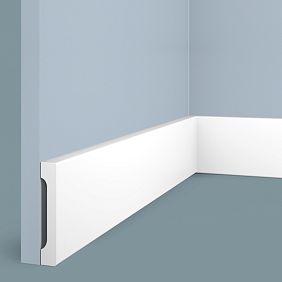
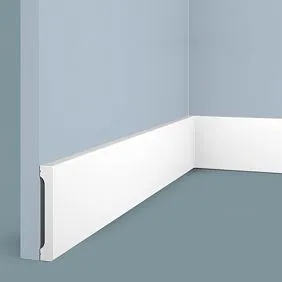
The interior skirting board becomes a critical element of this system. Historically, the skirting board concealed the technological gap between the wall and floor, protected the wall from damage. Today its role is broader — a visual adapter connecting the floor's horizontal plane with the wall's vertical plane. When the skirting board is made from the same material as the wall panels, the boundary blurs, the space gains integrity.
Interior slat panelsVertical wall battens, rising from the floor, visually continue the vertical lines established by the skirting board. If the skirting board is tall, 100-140 mm, and the wall battens are of the same width 20-30 mm, a visual resonance is created — the horizontal base and vertical lines mutually reinforce each other.
Our factory also produces:


Material unity: wood as the binding substance
Wood is the ideal material for creating unified finishing. Natural texture, visible growth rings, natural color variations — all this creates a visual connection between elements, even if they differ in shape. An oak skirting board and oak wall battens are perceived as parts of a whole, regardless of differences in cross-section.
Color coordination is critical. Wood of the same species, from the same batch, with identical finishing treatment creates monolithic composition. Different shades of oak — a light skirting board and dark battens — break the connection, create fragmentation. For unity, careful color coordination at the material procurement stage is necessary.
Textural unity enhances the effect. If the skirting board is brushed — the battens should also be brushed. If the skirting board is smoothly sanded — the battens similarly. Tactile and visual identity of surfaces creates the feeling that the entire space is clad in a single material, not assembled from different elements.
Get Consultation
Skirting board typology: selection for comprehensive systems
Not every skirting board is suitable for integration with vertical batten systems. The form, height, profile must harmonize with the vertical elements.
Tall skirting boards 100-140 mm: classic solidity
High legs visually lighten the furniture, creating a sense of airiness. The sofa seems to float above the floor, and the space beneath it is perceived as an extension of the room. This is especially valuable in small spaces, where every square meter counts.Wooden skirting boardsTall skirting boards are characteristic of classic and neoclassical interiors. A height of 100-140 mm creates scale, solidity, and substantiality. Such skirting boards visually 'raise' the floor, make the room appear taller.
The profile of tall skirting boards is often complex — a plinth (protruding lower part), a cavetto (smooth transition to the wall), decorative relief on the front surface. The complexity of the profile corresponds to classical styling, where detailing is valued.
Integration with vertical battens requires visual balance. A massive 140 mm skirting board and thin 15×30 mm battens create imbalance — the skirting board dominates, the battens get lost. The optimal combination is a tall skirting board with battens of medium cross-section 25×40 mm or 30×50 mm, creating proportionate vertical rhythm.
Color solution influences perception. A dark tall skirting board and light wall battens create contrast, emphasizing the horizontal. Skirting board and battens in the same color — integration, visual merging of elements. The choice depends on the design concept.
Medium skirting boards 70-90 mm: universal standard
Medium height is a compromise between visibility and discreteness. An 80 mm skirting board is expressive enough to frame the floor but does not dominate visually. Suitable for rooms of standard height 2.7-3.0 meters.
The profile is usually simplified — a light cavetto, rounded top edge, flat front surface. Minimal decorative excess — form follows function. Such skirting boards are universal, fitting into a wide spectrum of styles from neoclassicism to contemporary minimalism.
Combination with vertical battens is harmonious with close proportions. An 80 mm skirting board and battens with a cross-section of 20×40 mm create visual balance. A batten installation spacing of 100-120 mm forms a rhythm proportionate to the skirting board height. The composition reads as a unified system, not a set of separate elements.
Installation of medium skirting boards is simpler than tall ones — less weight, lower requirements for fastening strength. Adhesive and a few finishing nails spaced 600-800 mm apart are sufficient. For tall skirting boards, fastener spacing is reduced to 400-500 mm due to greater weight.
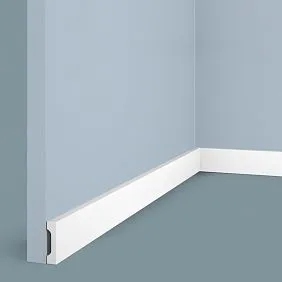
Low skirting boards 50-60 mm: minimalist discreteness
Low skirting boards are the choice for minimalist interiors, where visual lightness and the absence of massive elements are important. A height of 50-60 mm is the minimum necessary to protect the wall and cover the technological gap of the flooring.
The profile is extremely simplified—a rectangular cross-section with minimal edge rounding. Decorative elements are absent. The form is geometric, laconic, and does not attract attention. The skirting board fulfills its function while remaining visually neutral.
Integration with vertical slats requires subtlety. Low baseboards and robust 40×60 mm slats create imbalance — vertical elements overpower horizontal ones. Harmony is achieved by using thin slats measuring 15×30 mm or 20×30 mm, proportionate to the baseboard height.
Color matching the walls is a typical solution for low skirting boards. The skirting board blends with the wall, not creating a visual boundary. Battens of the same color form a vertical rhythm on a monolithic surface. The result is a minimalist composition where structure matters, not materiality.
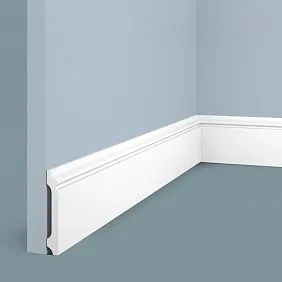
Molded skirting boards: a decorative accent
Skirting boards with complex molded profiles featuring carving, relief elements, multi-stage transitions—a choice for luxurious classic interiors. Height varies from 80 to 160 mm, the profile contains ovolos, dentils, flutes, and floral ornaments.
Production of molded skirting boards is labor-intensive—milling a complex profile, manual finishing of carvings, multi-layer final finishing. The cost is 3-5 times higher than simple geometric profiles. But for interiors where luxury is important, the costs are justified.
Integration with battens is possible under the condition of stylistic unity. A molded carved skirting board and simple smooth battens create a stylistic disconnect. Battens with decorative elements are necessary—carved capitals, inserts, relief. The result is a cohesive Baroque or classical composition.
Production of such systems is custom, for a specific project. Developing a set of elements—skirting board, battens, moldings, decorative inserts—takes weeks. The cost amounts to hundreds of thousands of rubles for the complete finishing of a room. But the result is an exclusive, museum-level interior.
Structural solutions: from simple to complex systems
Integration of skirting board and wall battens is implemented in several ways depending on the design concept and budget.
Basic system: skirting board plus vertical battens
The simplest configuration—a standard skirting board around the room's perimeter plus vertical battens on an accent wall. Skirting board and battens are made from the same wood species, same color, same finish. The visual connection is obvious, but the elements are not structurally integrated.
The skirting board is mounted traditionally—with adhesive and finishing nails to the wall. Battens are attached to upper and lower guides fixed to the wall. The lower guide is positioned at the skirting board height plus a 10-20 mm gap. This creates visual contact but not physical merging.
Advantage—simplicity of implementation, possibility to dismantle elements independently of each other. Replacing the skirting board does not require dismantling the battens and vice versa. Disadvantage—a visual break between the skirting board and battens, the 10-20 mm gap is visible and disrupts integrity.
The cost of the basic system is minimal—material costs plus standard installation. For a 20 m² room—30-50 thousand rubles turnkey depending on wood species and configuration complexity.
Integrated system: skirting board as the base for battens
A more complex solution—battens rest directly on the skirting board, structurally connected to it. The skirting board serves as the lower guide; the lower ends of the battens are inserted into its top surface. The result is a monolithic composition without visible breaks.
Technically, this requires modifying the skirting board. Grooves are milled or hidden brackets are installed on its top surface, into which the battens are inserted. The groove spacing corresponds to the batten installation spacing—100, 120, 150 mm. Battens are fixed in the grooves with adhesive, forming a rigid connection.
The upper guide is attached to the wall at a specified height—usually 2.2-2.7 meters, not necessarily to the ceiling. The upper ends of the battens are inserted into the guide's grooves similarly to the lower ones. The result is a vertical panel system structurally resting on the skirting board.
Advantage—visual integrity, monolithic construction, absence of gaps. Disadvantage—installation complexity, impossibility of independent skirting board replacement. Cost is 40-60% higher than the basic system due to labor intensity.
Comprehensive envelope: skirting board, walls, ceiling
The most complex system—wooden elements cover the skirting board, transition to the walls as vertical battens, and continue onto the ceiling as horizontal battens. The space acquires a continuous wooden envelope.
A skirting board 100-120 mm high forms the plinth zone. From it grow vertical battens with a cross-section of 30×50 mm at a spacing of 120-150 mm. The battens rise to a height of 2.4-2.6 meters, where they meet a horizontal guide. From the guide, the vertical battens smoothly transition into horizontal ceiling battens, wrapping around the wall-ceiling corner.
Structurally, this requires manufacturing corner transition elements—bent fragments connecting vertical and horizontal battens. A bend radius of 150-250 mm creates a smooth transition without sharp corners. Such elements are formed from steamed beech, bent according to a template.
The result is impressive—the space is enveloped by a wooden structure creating a three-dimensional texture. Light, penetrating through the battens, creates a moving pattern of shadows. A sensation of lightness, airiness, and naturalness. Cost—150-300 thousand rubles for a 20 m² room depending on complexity.
Material solutions: wood species for comprehensive systems
The choice of wood species determines the system's durability, stability, and aesthetics.
Solid oak: the benchmark for premium solutions
Oak skirting board and oak battens—a premium choice guaranteeing durability of 50-80 years. Density of 650-750 kg/m³ ensures mechanical strength, resistance to accidental impacts. The skirting board does not deform from contact with shoes, battens do not sag under their own weight over a length of 2.8 meters.
Dimensional stability is critical for comprehensive systems. With a 10% change in humidity, oak changes cross-sectional dimensions by 3-4%. An 80 mm wide skirting board will change by 2.5-3.2 mm, a 30 mm wide batten by 1.0-1.2 mm. The changes are synchronous—the system deforms uniformly, not creating internal stresses.
Oak texture is expressive, especially on radial cut. Medullary rays create characteristic 'mirrors' — light strokes against the main color. For comprehensive finishing, it is recommended to order all material from the same batch, ensuring texture and color identity.
The price of an oak system is 50-70% higher than beech. Skirting — 1200-1800 rub/linear meter, battens — 800-1200 rub/linear meter depending on cross-section. But durability and prestige justify the costs for premium projects.
Solid beech: optimal balance
Beech skirting and beech battens — the choice of most projects where price/quality ratio is important. Density of 620-680 kg/m³ provides sufficient strength for living spaces. Uniform texture of a delicate pinkish hue creates a calm aesthetic.
Beech workability is excellent — it sands to perfect smoothness, paints evenly without stains, absorbs oil deeply, emphasizing the texture. For painted systems where texture is hidden by color, beech is preferable to oak at a lower cost.
Hygroscopicity — the main risk. With humidity fluctuations exceeding ±15%, beech deforms more than oak. For rooms with unstable microclimate — dachas, first floors without waterproofing — beech is not suitable. But for apartments, offices with central heating, beech serves for decades.
The price of a beech system is 30-40% lower than oak. Skirting — 700-1100 rub/linear meter, battens — 500-800 rub/linear meter. For projects with a limited budget, beech is the optimal solution without critical loss of quality.
Solid ash: texture and strength
Ash skirting and ash battens — an alternative to oak for those who value contrasting texture. Density of 650-700 kg/m³ and hardness of 4.0 kN provide strength comparable to oak. Striped pattern of annual rings creates decorativeness surpassing uniform beech.
Ash color is lighter than oak — from creamy to golden-brown. For Scandinavian interiors where light wood is valued, ash is ideal. The possibility of tinting in gray shades creates a modern aesthetic, unattainable for warm oak.
Dimensional stability is slightly lower than oak, but acceptable for interior applications. With proper microclimate — temperature 18-24°C, humidity 45-65% — ash maintains geometry for decades.
Ash price is between beech and oak — 20-25% higher than beech, 25-30% lower than oak. Skirting — 900-1400 rub/linear meter, battens — 650-950 rub/linear meter. For projects where expressive texture is important without the premium price of oak, ash is the optimal choice.
MDF with Veneer: Stability and Economy
Skirting and battens made of MDF with veneer of valuable species — a compromise solution combining stability with the aesthetics of natural wood. MDF base with density of 750-850 kg/m³ does not react to humidity fluctuations, maintains dimensions under any conditions. Veneer thickness of 0.6-1.0 mm creates visual identity to solid wood.
For comprehensive systems, stability is critical. Skirting and battens made of MDF do not change dimensions synchronously with seasonal humidity fluctuations — they do not change dimensions at all. The system remains geometrically perfect for years.
Cost is 30-40% lower than solid wood of similar species. MDF skirting with oak veneer — 700-1000 rub/linear meter versus 1200-1800 rub/linear meter for solid oak. For large-scale projects, savings are substantial.
Environmental friendliness of modern MDF class E1 meets the requirements of living spaces. Formaldehyde does not exceed 0.1 mg/m³ — the level of natural wood. Odor is absent, safety is confirmed by certificates.
Color and texture solutions: creating visual unity
Material unity is insufficient — color and texture coordination is necessary.
Monochromatic solutions: unity of shade
Skirting and battens of the same color create maximum visual integration. Boundaries between elements blur, space is perceived as clad with a single material. The effect is enhanced when using identical finishing — both elements under oil or both under varnish of the same gloss.
Light monochromatic systems — whitewashed oak, bleached ash, natural light beech — visually expand space, create a sense of purity, airiness. Characteristic of Scandinavian and minimalist interiors.
Dark monochromatic systems — wenge-tinted oak, black painted beech — create drama, contrast with light walls. Characteristic of modern lofts, minimalist spaces where graphic quality is important.
Medium natural shades — golden oak, pinkish beech, honey ash — are universal, fit into a wide range of styles from neoclassical to eco. The warmth of natural wood creates coziness, comfort.
Contrasting solutions: play of opposites
Skirting and battens of contrasting colors create visual dynamics, emphasize the geometry of space. Dark skirting and light battens — the horizontal is accentuated, visually expands the room. Light skirting and dark battens — verticals dominate, visually raise the ceiling.
Black-white contrast — maximum graphic quality, characteristic of minimalism, art deco. Black skirting height 100 mm and white battens 25×40 mm with 100 mm spacing create a strict geometric composition.
Natural wood — painted contrast — a compromise between naturalness and modernity. Natural oak skirting and white painted battens. Oak texture creates naturalness of the base, white battens — modern lightness of verticals.
Tonal contrast within one species — light and dark oak, young and bog oak — creates soft visual differentiation without sharpness. Elements are distinguishable, but connection through material is preserved.
Texture solutions: from smooth to brushed
Smoothly sanded surface — a classic, suitable for most interiors. Skirting and battens are sanded with P180-P240 abrasive, creating mirror smoothness. Finishing coating — oil or varnish — emphasizes the texture without hiding it.
Brushed surface — hard wood fibers are removed with a metal brush, soft ones remain, creating relief. Texture becomes tactile, voluminous. For skirting and battens brushed identically, textural unity is created.
Combined textures — smooth skirting and brushed battens or vice versa — create textural contrast with material unity. Skirting as a smooth base, battens as textural verticals. Visual diversity without material break.
Patination, artificial aging, and distressing effects are used to create a sense of historicity and vintage aesthetics. They require identical treatment of the skirting board and slats—differences in the degree of aging create stylistic inconsistency.
System design: from concept to implementation
Competent design determines the success of comprehensive finishing.
Space analysis: height, proportions, lighting
Room height determines the scale of elements. Standard 2.7 meters require moderate proportions—skirting board 70-90 mm, slats 20×40 mm. High ceilings of 3.5-4.0 meters allow for large-scale solutions—skirting board 120-140 mm, slats 30×50 mm.
Room proportions influence the orientation of slats. A long, narrow room—vertical slats on short walls visually expand the space. A square room—slats on one accent wall, the others smooth.
Lighting determines the color scheme. Northern dark rooms—light-colored materials that maximally reflect light. Southern sun-drenched rooms—dark, dramatic solutions are possible. Artificial lighting—warm for natural wood, cool for painted systems.
Material calculation: precision without excess
Skirting board is calculated based on the room perimeter minus the width of door openings plus a 5-10% allowance for corner cuts. A room 4×5 meters: perimeter 18 m minus door 0.8 m = 17.2 m plus 10% = 19 linear meters of skirting board.
Slats are calculated based on the length of the wall being zoned, divided by the installation spacing plus the slat width. A wall 4 meters, spacing 120 mm, slat width 30 mm: quantity = 4000/(120+30) = 27 slats. Length of each—room height minus skirting board height minus gap. With a height of 2.7 m and skirting board 0.1 m: slat length 2.6 m. Total 27×2.6 = 70 linear meters of slats.
Guide battens for attaching slats—two pieces with a length equal to the wall length. For a 4 m wall—8 linear meters of batten with a cross-section of 40×60 mm. Fasteners—dowels 6×40 mm, screws 4×40 mm, polyurethane adhesive. Consumption is determined according to standards.
Installation sequence: from base to top
First stage—installation of skirting board around the room perimeter. Marking with a laser level, cutting corners at 45°, attaching with adhesive and finishing nails. Checking the horizontality of each segment. Filling joints and fastener points.
Second stage—installation of the upper guide for slats at the specified height. Checking horizontality with a laser level is critical—deviation will cause misalignment of all slats. Fastening with dowels at 400-500 mm intervals.
Third stage—installation of slats. Cutting to size with an accuracy of ±1 mm. Attaching lower ends to the skirting board (integrated system) or to the lower guide (basic system). Attaching upper ends to the upper guide. Checking the verticality of each slat.
Fourth stage—final finishing. Sanding joints, filling fastener points, applying oil or varnish. For pre-painted elements—only local touch-up of damages.
Stylistic interpretations: from classic to avant-garde
Comprehensive finishing adapts to any style through the choice of materials, proportions, and color.
Scandinavian minimalism: light and air
Light wood—bleached oak, ash, light beech. Low skirting board 60-70 mm and thin slats 20×30 mm with wide spacing 150-180 mm. Finish—oil or matte varnish, preserving naturalness. Color—white, light gray, natural light.
Philosophy—maximum light, minimum mass, functionality without decoration. Skirting board and slats perform their task without visually dominating. Emphasis on space filled with light, air, and naturalness.
Contemporary minimalism: geometry and contrast
Dark wood—toned oak, wenge, black painted. Medium skirting board 80 mm and slats 25×40 mm with clear spacing 100-120 mm. Finish—matte or glossy black varnish. Color—black, graphite, dark brown.
Philosophy—architectural quality, graphic clarity, contrast. Dark wooden elements on light walls create clear geometry. Horizontal lines of skirting board and vertical lines of slats form a coordinate grid of space.
Neoclassicism: Reserved Elegance
Light noble wood—bleached oak, ash, painted beech in ivory. High skirting board 100-120 mm of classic profile and slats 30×50 mm with medium spacing 120 mm. Finish—matte varnish, wax. Color—ivory, pearl gray, light beige.
Philosophy—classical proportions in a modern interpretation, restrained luxury, harmony. Skirting board and slats form an architectural order adapted to interior scale. Symmetry, balance, quality of materials.
Industrial loft: brutality and texture
Dark aged wood—oak or walnut with brush treatment. Massive skirting board 120-140 mm and thick slats 40×60 mm with spacing 100 mm. Finish—oil with patina effect. Color—dark brown, graphite, black with pronounced texture.
Philosophy—industrial aesthetics, contrast of rough wood with concrete and metal. Skirting board and slats—utilitarian elements that do not conceal materiality. Deliberately rough treatment, visible texture, powerful forms.
Eco-style: maximum naturalness
Unfinished light wood—beech, ash, oak under natural oil. Medium skirting board 80-90 mm and slats 25×40 mm of organic proportions. Finish—only oil, no varnish. Color—natural shades without coloring.
Philosophy—closeness to nature, rejection of artificiality, tactility. Skirting board and slats—living wood, preserving naturalness. Visible texture, tactile warmth, uniqueness of each element.
Frequently asked questions
Is it mandatory to use the same wood species for baseboards and slats?
Not mandatory, but desirable for visual unity. Combining similar species is possible — oak and ash, beech and birch. Color and texture matching is critical, achieved through identical toning and finishing.
What is the optimal installation spacing for slats with a high baseboard?
For a 100-120 mm baseboard, the optimal slat spacing is 100-120 mm with a width of 25-30 mm. Creates visual resonance — the horizontal mass of the baseboard is balanced by the vertical rhythm of proportionally scaled slats.
Can a wooden baseboard be combined with MDF slats?
Yes, provided the finishing is identical. MDF slats with veneer of the same species as the solid wood baseboard, painted the same color, are visually indistinguishable. Saves on slats while preserving aesthetics.
Does the integrated system require special care?
Standard care for wooden surfaces — wiping with a damp cloth, renewing the oil finish once a year. Slats collect less dust than horizontal surfaces, simplifying cleaning.
What is the cost of a turnkey integrated finishing system?
For a 20 m² room: basic beech system — 60-90 thousand rubles, integrated oak system — 120-180 thousand rubles, premium integrated shell — 200-350 thousand rubles. Depends on wood species, complexity, area.
Can the system be implemented independently?
Basic — yes, with a miter saw, level, screwdriver. Integrated — more difficult, requires precise marking, groove routing. Integrated shell — professionals only, requires manufacturing of curved elements.
Is integrated finishing suitable for wet rooms?
Yes, when using moisture-resistant species (larch, teak) and waterproof polyurethane varnish. Quality ventilation is mandatory. Direct contact with water is not recommended for wood.
How long does an integrated wooden system last?
With proper use — 30-50 years for beech, 50-80 years for oak. Possibility of local restoration — sanding, repainting — extends life practically indefinitely.
Company STAVROS: integrated solutions for modern interiors
Company STAVROS — a leading Russian manufacturer of wooden interior systems since 2002. Specialization — integrated solutions combiningBaseboards, panels, slats, moldings into a unified finishing system.
The catalog features over 40 baseboard models with heights from 50 to 140 mm and 35 slat profiles with cross-sections from 15×30 to 50×70 mm. All elements are produced from the same wood batches, ensuring identical color and texture. Materials — selected solid oak and beech with 8-12% moisture content after kiln drying.
Finishing options include natural wood under oil, painted in basic colors (white, black, gray, brown), primed for painting, brushed with patina. Custom painting in any RAL color when ordering a room set.
The project department develops integrated solutions for specific projects. Free designer consultation, creation of 3D visualization, selection of optimal elements, material calculation accurate to the linear meter. Technical installation support — mounting diagrams, work sequence recommendations.
Production facilities are equipped with high-precision European CNC equipment. Capability to manufacture custom baseboard and slat profiles according to individual drawings. Minimum order for custom profiles — from 50 linear meters, production time 10-14 working days.
Own warehouses in Moscow and St. Petersburg ensure shipment of popular profiles on the day of request. Constant availability of basic items. For complex orders — reservation of materials from the same batch, guaranteeing color identity of all elements.
Delivery across Russia via reliable transport companies. For Moscow and St. Petersburg — own courier service, next-day delivery. Packaging ensures safety during transportation. For large orders — delivery by manipulator to the entrance.
Over 5000 projects completed in 23 years of operation — apartments, private houses, offices, restaurants, hotels, public buildings. Portfolio includes projects from economy to premium segments. Recommendations from leading designers and architects of Moscow and St. Petersburg.
Showrooms are open for visits. The exhibition includes full-scale integrated solutions — you can assess the effect of baseboard and slat integration, compare various species and finishes, test surface tactility. Experienced consultants will give a tour and help with selection.
By choosing integrated solutions from STAVROS, you choose spatial finishing integrity, professionally designed and flawlessly executed. Systems where each element harmoniously complements the other, creating architectural expressiveness. Materials of European quality at Russian prices. Solutions that transform standard spaces into unique interiors.
Turn your home into a work of architectural art with integrated wooden systems from STAVROS! The unity of baseboard, wall slats, ceiling decor creates spatial integrity unattainable with fragmented solutions. Natural wood, impeccable processing, thoughtful proportions — all this is available today. Call toll-free 8 (800) 555-46-75, specialists will consult, develop a project, ensure professional implementation!


