Article Contents:
- Geometry as the foundation of modern design: from chaos to structure
- Skirting horizontals: the foundation of composition
- Batten verticals: rhythm and structure
- Coordinate grid: axis interaction
- Typology of interior skirting boards: form and function
- Rectangular minimalist profiles
- Profiled classical skirting boards
- Rounded transitional profiles
- High architectural skirting boards 120-160 mm
- Vertical battens: typology and application
- Thin decorative battens 15×30 - 20×40 mm
- Medium structural battens 25×40 - 30×50 mm
- Thick architectural battens 40×60 - 50×70 mm
- Sculptural shaped battens
- Materials science: wood for geometric systems
- Solid oak: strength and stability
- Solid Beech: Balance of Price and Quality
- Solid ash: texture and elasticity
- MDF with veneer: geometric stability
- Designing geometric compositions: from concept to implementation
- Proportional relationships: the golden ratio in interior design
- Color strategies: from monochrome to contrast
- Material calculation: precision without excess
- Installation technology: sequence of operations
- Stylistic interpretations: geometry in various designs
- Scandinavian minimalism: purity of lines
- Contemporary minimalism: graphic expressiveness
- Neoclassic: Reserved Elegance
- Industrial loft: brutal geometry
- Eco-style: organic geometry
- Frequently Asked Questions
- What skirting height is optimal for 2.7 m ceilings?
- What batten installation spacing is universal?
- Is it necessary for the skirting board and slats to match in profile?
- Can slats be installed without a frame?
- What is the cost of a turnkey geometric finish?
- Is geometric finish suitable for small spaces?
- Is Special Care Required?
- Can the system be implemented independently?
- STAVROS Company: Professional Geometric Solutions
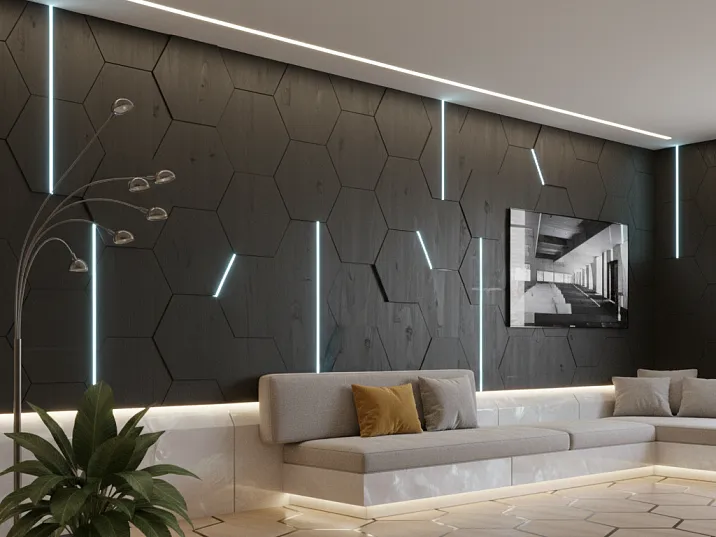
What transforms an ordinary room into an architecturally meaningful space? The answer lies not in expensive materials or complex structures, but in the geometric expressiveness of the finish. Interior skirting boards andwall-mounted interior rails— two elements capable of radically changing the perception of space by creating clear visual geometry. The horizontal lines of the skirting board and the vertical lines of wall slats form a coordinate grid that structures the volume of the room. In 2026, this approach became dominant in the work of leading architects and interior designers. Rejecting solid monolithic surfaces in favor of linear graphics creates dynamics, visual depth, and interplay of light and shadow. Why is the geometric approach displacing the decorative one? How to calculate the proportions of elements for a harmonious composition? Which materials ensure durability while maintaining visual lightness? Let's delve into the details of professional design.


Geometry as the Foundation of Modern Design: From Chaos to Structure
Traditional interiors operated with decorative elements—moldings, paintings, complex ornaments. The space was saturated with details creating visual richness through excess. Walls were covered with patterned wallpaper, ceilings were adorned with rosettes, skirting boards had intricate carved profiles. The result—visual overload that tires the eye.
The modern philosophy is diametrically opposite. Visual purity, a minimum of decorative elements, emphasis on geometric structure. Beauty arises not from an abundance of details, but from precision of proportions, clarity of lines, and a measured rhythm. The interior becomes an architectural object where every line has a function.




Skirting Board Horizontals: The Foundation of the Composition
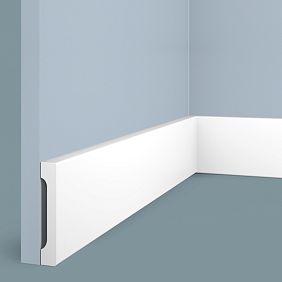
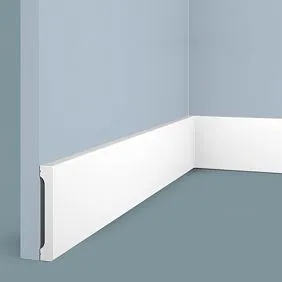
An interior skirting board is not just a technical detail hiding the gap between the wall and the floor. It is an architectural element creating a horizontal baseline from which the entire vertical composition of the wall is built. The height of the skirting board determines the scale of the other elements.
A low skirting board of 50-60 mm creates a minimalist foundation, almost unnoticeable, not distracting from the main wall composition. Suitable for rooms where the wall finish is complex—vertical slats, panels, decorative overlays. The skirting board performs its function while remaining discreet.
A medium skirting board of 70-90 mm is a universal standard, creating a noticeable but not dominant horizontal line. Visually frames the floor, creates a transition to the wall. Harmonizes with most wall solutions—from smooth painted surfaces to medium-density slat systems.
A high skirting board of 100-140 mm is an architectural statement, creating a powerful horizontal line that dominates the lower part of the composition. Visually 'raises' the floor, changes the proportions of the room. Characteristic of classical and neoclassical interiors where monumentality is important. Requires proportionate vertical elements—thick slats, massive panels.
Our factory also produces:


Vertical Slats: Rhythm and Structure
Vertical slats on the wall create a rhythmic structure that breaks the monolithic plane into modules. The eye does not slide over an empty wall but catches onto the vertical elements, reads the rhythm, and perceives the space as structured.
A frequent rhythm—slats 20-30 mm wide with a spacing of 50-80 mm—creates a dense graphic grid. Visual activity is high, the wall turns into a striped screen. Suitable for accent walls where expressiveness is important. For an entire room, a frequent rhythm is tiring.
A medium rhythm—slats 25-40 mm with a spacing of 100-120 mm—balances structure and openness. The wall reads as vertically organized but not overloaded. A universal solution for most interiors. A ratio of slat width to gap of 1:3 or 1:4 creates a rhythm comfortable for the eye.
A sparse rhythm—slats 30-50 mm with a spacing of 150-200 mm—minimal intervention in the wall plane. The slats create vertical accents without dominating. Suitable for minimalist interiors where visual lightness and airiness are important.
Get Consultation
Coordinate Grid: Interaction of Axes
When the horizontal line of the skirting board and the vertical lines of the slats are present simultaneously, they form a coordinate system for the space. The horizontal sets the base, the verticals structure the height. The result is a visual grid that organizes the perception of volume.
Geometric interaction creates visual illusions. A powerful high skirting board and thin vertical slats visually raise the ceiling—the base horizontal is emphasized, the verticals stretch upward. A thin skirting board and powerful verticals widen the room—the horizontal is unobtrusive, the verticals create rhythm.
Color scheme enhances or neutralizes the effect. Skirting boards and slats in the same color as the wall dissolve, creating structure without materiality. Contrasting dark elements on a light wall emphasize the geometry, making it graphic and expressive.
Typology of Interior Skirting Boards: Form and Function
Modern interior skirting boards are diverse—from extremely laconic rectangular profiles to complex multi-step ones.
Rectangular Minimalist Profiles
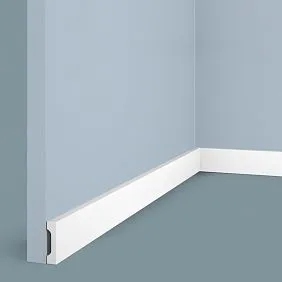
The simplest form—a rectangular cross-section with minimal edge rounding for safety. Thickness 15-25 mm, height varies from 50 to 140 mm. Decorative elements are completely absent—form follows function.
The geometric purity of such a skirting board perfectly matches minimalist aesthetics. A rectangular skirting board 80 mm high and 18 mm thick is a strict geometric object that does not claim decorativeness. Painted the same color as the wall, it creates a structural boundary without visual massiveness.
Production is extremely simple — sawing boards or MDF panels into strips of the required width, milling rounded edges with a radius of 2-3 mm, and final sanding. The cost is minimal, making minimalist profiles accessible for mass application.
Integration with vertical slats is harmonious while maintaining geometric rigor. The 80×18 mm rectangular skirting board and 30×20 mm rectangular slats form a family of related shapes. Visual unity is achieved through geometric identity.
Profiled classic skirting boards
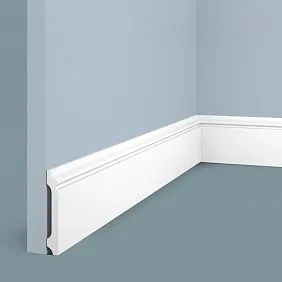
Complex profiles with a cove (a smooth transition to the wall), a torus (a projection at the floor), and decorative grooves — a legacy of classical architecture. Height is typically 100-140 mm, and the profile contains several transition steps that create volume.
The classic profile is visually heavier than the minimalist one. The complexity of the form creates a play of light and shadow, emphasizing volume. For neoclassical interiors where a connection to tradition is valued, the classic skirting board is an essential element.
Production is more complex — milling a multi-step profile requires special tools and precise machine setup. Each transition, each cove must be executed cleanly, without chips, with perfect smoothness. The cost is 2-3 times higher than that of rectangular profiles.
Combination with vertical slats requires stylistic consistency. A classic skirting board and simple, smooth slats create a stylistic disconnect. Slats with decorative elements — flutes, capitals, panels — that support the classical style of the skirting board are necessary.
Rounded transition profiles
Skirting boards with a pronounced radial transition to the wall — a compromise between minimalism and classicism. A radius of 15-30 mm creates a smooth junction of the skirting board with the wall without sharp corners. Height is 70-100 mm, the form is streamlined and soft.
Visually, such a skirting board is lighter than a classic one but softer than a minimalist one. The absence of sharp corners creates safety — relevant for children's rooms and high-traffic areas. The rounded shape better withstands accidental impacts — it doesn't chip or deform.
Production requires milling a radial profile with high precision. The radius must be uniform along the entire length of the skirting board, without waves or defects. Final sanding of radial surfaces is labor-intensive — it requires special tools.
Integration with slats is harmonious when using slats with rounded edges. Sharp rectangular slats next to a rounded skirting board create visual dissonance. Slats with radial edges of 3-5 mm support the softness of the skirting board.
High architectural skirting boards 120-160 mm
Monumental skirting boards that visually dominate the lower part of the composition. A height of 120-160 mm turns the skirting board into an architectural element, proportionate to door architraves and window reveals. The profile can be either simple rectangular or complex multi-step.
A high skirting board radically changes the proportions of a room. It visually 'raises' the floor by 10-15 cm, making the room appear taller. It creates a sense of solidity and substance, characteristic of premium interiors. The psychological effect is that the walls 'grow' from a massive base.
Structurally, high skirting boards require reliable fastening. The weight per linear meter of a 120 mm oak skirting board is about 1.5-2.0 kg. Fastening with glue alone is insufficient — additional finishing nails or hidden clips spaced 400-500 mm apart are necessary.
The cost of high skirting boards is 40-60% higher than standard 80 mm ones due to increased material consumption. A 140 mm oak skirting board costs 1800-2500 rubles/linear meter compared to 1200-1600 rubles/linear meter for an 80 mm skirting board. But for premium projects, the costs are justified by the visual effect.
Vertical slats: typology and application
The variety of vertical slats is determined by cross-section, material, and mounting method.
Thin decorative slats 15×30 - 20×40 mm
Minimal cross-section, creating visual structure without bulkiness. The slats are perceived as graphic lines, not volumetric elements. A thickness of 15-20 mm allows the slats to be attached directly to the wall with adhesive without additional guides.
Application — accent walls in minimalist interiors, zoning space without physical partitions, decorative inserts into the overall finish. Thin slats do not create a significant projection from the wall — 15-20 mm practically does not affect the room's dimensions.
Installation is simple — slats are glued to a pre-leveled wall with mounting adhesive. Marking verticals with a laser level ensures accuracy. The installation spacing varies from 80 to 200 mm depending on the desired rhythm density.
Cost is minimal — a linear meter of beech slat 20×40 mm is 150-250 rubles. For a 4×2.7 meter wall with 120 mm spacing, about 70 linear meters of slats are required. Material costs are 10-18 thousand rubles. Accessible for mass application.
Medium structural slats 25×40 - 30×50 mm
A universal cross-section, combining visual expressiveness with structural sufficiency. The slats are perceived as volumetric elements creating relief on the wall. A thickness of 25-30 mm provides rigidity — the slat does not sag under its own weight over a height of 2.8 meters.
Application — full-fledged slatted partitions, zoning, decorative panels, load-bearing elements for hanging shelves and decor. Medium slats are strong enough to support hanging loads of up to 5-7 kg per slat.
Installation requires a frame — horizontal guide battens 40×60 mm are attached to the wall with a spacing of 800-1000 mm. The slats are attached to the guides with screws or hidden clips. This creates a ventilated structure with an air gap of 40-60 mm between the wall and the slats.
Cost is medium — a linear meter of oak slat 30×50 mm is 400-600 rubles. For the same 4×2.7 m wall with 120 mm spacing, slat costs are 28-42 thousand rubles plus guides and fasteners. Accessible for mid-range and premium segments.
Thick architectural slats 40×60 - 50×70 mm
Massive cross-section creating pronounced three-dimensional relief. Battens protrude 40-50 mm from the wall, forming deep shadows between elements. Visual impact is maximal — the wall transforms into a sculptural object.
Application — accent architectural walls in spacious rooms, built-in furniture facades, decorative partitions. In small rooms, thick battens visually overload the space, 'consume' volume.
Installation requires a reinforced frame — 50×70 mm battens secured with 8×80 mm anchors at 400 mm intervals. Battens are fastened with heavy-duty 5×60 mm screws. Weight per square meter of oak batten wall with 50×70 mm cross-section at 120 mm spacing — approximately 25-30 kg. The structure is massive, requiring a solid base.
Cost is high — linear meter of ash batten 50×70 mm — 700-1000 rubles. For a 4×2.7 m wall, batten costs — 49-70 thousand rubles plus reinforced frame. A solution for premium projects where visual monumentality is important.
Sculptural shaped battens
Battens with complex cross-sections — featuring flutes, grooves, chamfers, roundings — create additional decorative effect. Produced by CNC milling according to custom profiles. Each batten becomes a decorative element, not just a line.
Application — classical and neoclassical interiors where detailing is valued. Shaped battens complement the style of classical skirting boards, architraves, moldings. Results in a cohesive composition in a unified style.
Production is labor-intensive — milling complex profiles, sanding relief surfaces, finishing. Cost is 2-4 times higher than simple rectangular battens. Mass production is impossible — only for specific projects.
Installation is similar to regular battens but requires greater care. Shaped battens must be installed strictly vertically — the slightest misalignment distorts the symmetrical profile, making defects noticeable.
Materials science: wood for geometric systems
Choice of wood species determines durability, stability, aesthetics of geometric finishes.
Solid oak: strength and stability
Oak skirting boards and battens — the benchmark for premium solutions. Density 650-750 kg/m³ ensures mechanical strength, resistance to accidental impacts, scratches, dents. Brinell hardness 3.7-4.0 kN makes the surface practically invulnerable in domestic conditions.
Dimensional stability is critical for geometric compositions. With a 10% change in humidity, oak changes cross-sectional dimensions by 3-4%. A 100 mm high skirting board will change by 3-4 mm, a 30 mm wide batten — by 1.0-1.2 mm. Changes are synchronous — the geometry of the system deforms uniformly, without internal stresses or ruptures.
Oak grain is expressive — distinct annual rings, medullary rays on radial cut. For geometric compositions where materiality is important, oak grain creates natural decorative effect. Grain uniformity within a batch is ensured by selecting wood from the same growing region.
Price of oak elements is 50-70% higher than beech.Wooden baseboardOak skirting boards — 1200-1800 rub/linear m, battens — 400-800 rub/linear m depending on cross-section. But durability of 50-80 years justifies the cost for premium-class projects.
Solid beech: balance of price and quality
Beech elements — the choice for most projects where price/quality/aesthetics ratio is important. Density 620-680 kg/m³ provides sufficient strength for interior applications. Uniform fine-pored structure creates a calm grain with a delicate pinkish hue.
Beech workability is excellent — mills without chipping, sands to mirror smoothness, stains evenly. For painted geometric systems where grain is hidden by color, beech is preferable to oak at a lower cost. White, black, gray — basic colors on a beech base look perfect.
Hygroscopicity — a risk factor. With humidity fluctuations exceeding ±15%, beech deforms more than oak. Not suitable for rooms with unstable microclimate. But for standard apartments, offices with central heating, beech serves for decades without problems.
Price of beech elements is 30-40% lower than oak. Skirting board — 700-1100 rub/linear m, battens — 250-500 rub/linear m. For projects with medium budget, beech — optimal choice without critical loss of quality.
Solid ash: grain and elasticity
Ash elements — an alternative to oak for those who appreciate contrasting striped grain. Density 650-700 kg/m³ and hardness 4.0-4.1 kN — absolute record among European species. Strength comparable to oak with more expressive grain.
Ash color is lighter than oak — from creamy to golden brown. For Scandinavian interiors where light wood is valued, ash is ideal. Ability to tint to cool gray shades creates modern aesthetics unattainable for warm oak tones.
Ash elasticity is higher than oak — less brittleness, greater resistance to impact loads. An ash skirting board when accidentally hit doesn't chip but springs back, restoring shape. For commercial spaces with high traffic this is an advantage.
Ash price is intermediate — 20-25% higher than beech, 25-30% lower than oak. Skirting board — 900-1400 rub/linear m, battens — 350-650 rub/linear m. For projects where expressive grain is important without premium oak price, ash — optimal.
MDF with veneer: geometric stability
Elements made of MDF with density 750-850 kg/m³ with veneer of valuable species 0.6-1.0 mm thick — a compromise between stability and aesthetics. MDF doesn't react to humidity fluctuations, maintains dimensions in any conditions. Veneer creates visual identity to solid wood.
For geometric compositions where precision is critical, MDF stability — an advantage. Skirting boards and battens don't change dimensions seasonally — geometry remains perfect for years. Absence of deformations, gaps, misalignments.
Cost is 30-40% lower than solid wood of similar species. MDF skirting board with oak veneer — 700-1000 rub/linear m vs 1200-1800 rub/linear m for solid oak. Battens — 300-500 rub/linear m vs 400-800 rub/linear m. For large-scale projects savings are substantial.
The eco-friendliness of modern E1-class MDF meets residential standards. Formaldehyde emission ≤0.1 mg/m³ — equivalent to natural wood level. Certificates confirm safety.
Designing geometric compositions: from concept to implementation
Competent design determines the harmony of geometric finishing.
Proportional relationships: the golden ratio in interior design
Classical proportions are applicable to modern geometric compositions. The recommended skirting board height to ceiling height ratio is 1:27 - 1:20. With a ceiling height of 2.7 m, the optimal skirting board height is 100-135 mm. With 3.0 m — 110-150 mm.
The ratio of slat width to installation spacing affects visual density. The classic 1:4 ratio (30 mm slat, 120 mm spacing) creates a balanced rhythm. A 1:3 ratio (30 mm slat, 90 mm spacing) — a denser graphic rhythm. A 1:5 ratio (30 mm slat, 150 mm spacing) — an airy, sparse rhythm.
The ratio of skirting board height to slat width determines the visual balance of horizontals and verticals. A 100 mm skirting board and 25-30 mm slats — a balanced composition. A 60 mm skirting board and 50 mm slats — dominance of verticals. A 140 mm skirting board and 15 mm slats — dominance of horizontals.
Color strategies: from monochrome to contrast
Monochromatic strategy — skirting board, slats, and wall in a single color. Geometry is created by relief, interplay of light and shadow, not color contrast. Suitable for minimalist interiors where structure is important, not decorativeness. White, light gray, beige — typical colors.
Contrast strategy — dark elements on a light wall or vice versa. Black skirting board and black slats on a white wall create maximum graphic quality. Geometry is emphasized to the utmost, reads like an architectural drawing. Suitable for modern lofts, minimalism.
Mid-tone strategy — elements 2-3 tones darker or lighter than the wall. Gray skirting board and slats on a light gray background. Geometry is noticeable but not contrasting. Soft visual differentiation without harshness. Suitable for neoclassicism, Scandinavian style.
Accent strategy — colored elements on a neutral background. Dark blue skirting board and slats on a white wall. Geometry becomes a color accent, a dominant feature of the interior. Suitable for eclecticism, modern experimental interiors.
Material calculation: precision without excess
Skirting board: room perimeter minus door opening widths plus 10% allowance for miter cuts. Room 5×4 m: perimeter 18 m minus door 0.9 m = 17.1 m plus 10% = 19 linear meters.
Slats: length of treated wall divided by (installation spacing + slat width), multiplied by installation height. Wall 5 m, spacing 120 mm, slat 30 mm, height 2.6 m: (5000/(120+30))×2.6 = 33 slats of 2.6 m each = 86 linear meters.
Guide battens: wall length multiplied by the number of horizontal levels (usually 2-3). Wall 5 m, three levels: 5×3 = 15 linear meters of 40×60 mm batten.
Fasteners: for skirting board — finishing nails 1.2×40 mm at 3 pcs/linear meter, dowels 6×40 mm — 2 pcs/linear meter. For slats — screws 3.5×40 mm — 4 pcs per slat (2 for each guide batten).
Installation technology: sequence of operations
First stage — leveling base surfaces. The floor must be perfectly horizontal — the skirting board follows the floor relief, unevenness is visible. The wall must be flat in plane — deviations over 5 mm over 2 meters create gaps between slats and wall.
Second stage — marking. A laser level projects horizontals for guides, verticals for slats. Marking accuracy ±1 mm ensures geometric purity. A 5 mm deviation over a height of 2.7 m is visually noticeable, distorts verticality.
Third stage — skirting board installation. Miter cutting at 45° on a miter saw with ±0.5° accuracy. Attachment with polyurethane adhesive plus finishing nails at 500-600 mm intervals. Checking the horizontality of each segment.
Fourth stage — installation of guide battens for slats. Attachment to the wall with dowels, strictly horizontal. Distance between guides — maximum 1000 mm to prevent slat sagging.
Fifth stage — slat installation. Cutting to size with ±1 mm accuracy. Attachment to guides with countersunk screws or hidden clips. Checking the verticality of each slat, checking spacing uniformity.
Sixth stage — finishing. Filling joints of skirting board, fastener points. Sanding, painting, or oil/varnish coating. For pre-finished elements — only local touch-up of damage.
Stylistic interpretations: geometry in various designs
The geometric approach adapts to any style through choice of proportions, materials, color.
Scandinavian Minimalism: Purity of Lines
Light materials — whitewashed oak, ash, light beech. Low skirting board 60-70 mm and thin slats 20×30 mm with wide spacing 150-180 mm. Finish — natural oil or matte white lacquer. Geometry is unobtrusive, creates structure without dominance.
Philosophy — maximum light, minimum visual mass, functionality. Skirting board and slats serve zoning, structuring purposes without attracting excessive attention. Emphasis on space filled with light and air.
Modern minimalism: graphic expressiveness
Dark materials — stained oak, wenge, black stained beech. Medium skirting board 80 mm and slats 25×40 mm with clear spacing 100-120 mm. Finish — matte or semi-gloss black lacquer. Geometry is contrasting, emphasized, graphic.
Philosophy — architectural quality, clarity, contrast. Dark lines on light walls create a coordinate grid of space. Horizontals and verticals form a visual framework structuring the volume.
Neoclassicism: Reserved Elegance
Light noble materials — bleached oak, beech painted ivory. High profiled skirting board 100-120 mm and medium slats 30×50 mm with 120 mm spacing. Finish — matte varnish, wax. Geometry is classical, proportional.
Philosophy — classical proportions in a modern interpretation, restrained luxury. Skirting board and slats form an architectural order of interior scale. Symmetry, balance, material quality.
Industrial loft: brutal geometry
Dark aged wood — brushed oak, walnut with patina. Massive skirting board 120 mm and thick slats 40×60 mm with 100 mm spacing. Finish — oil with patina effect, emphasizing texture. Geometry is powerful, material, brutal.
Philosophy — industrial aesthetics, contrast of rough wood with concrete and metal. Skirting board and slats are utilitarian elements, not concealing materiality. Visible texture, powerful forms, deliberate simplicity.
Eco-style: organic geometry
Natural untreated wood — beech, ash, oak under oil without tinting. Medium skirting board 80 mm and slats 25×40 mm of organic proportions. Finish — only natural oil. Geometry is present but not dominant, preserving naturalness.
Philosophy — closeness to nature, naturalness, tactility. Skirting board and slats are living wood, preserving naturalness. Visible texture, uniqueness of each element, tactile warmth.
Frequently asked questions
What skirting board height is optimal for 2.7 m ceilings?
For a standard height of 2.7 m, a skirting board of 80-100 mm is optimal. A ratio of 1:27 - 1:33 creates proportional balance. Height 80 mm — minimalist option, 100 mm — classic.
What slat installation spacing is universal?
Universal spacing — 100-120 mm with slat width 25-30 mm. A ratio of 1:4 creates a balanced rhythm, comfortable for perception. For accent walls, spacing of 80-90 mm is possible.
Is it necessary for the skirting board and slats to match in wood species?
Not necessary, but desirable for visual unity. Combining similar species with identical color and finish is possible. MDF slats with oak veneer combine with solid oak.
Can slats be installed without a frame?
Thin slats 15-20 mm can be glued directly onto a flat wall. Slats 25 mm thick and more require a frame to ensure rigidity and ventilation.
What is the cost of turnkey geometric finishing?
For a 20 m² room, a basic beech system — 50-80 thousand rubles, premium oak — 100-150 thousand rubles. Depends on wood species, skirting board height, slat cross-section, installation complexity.
Is geometric finishing suitable for small rooms?
Yes, with correct proportion selection. Thin light slats with wide spacing 150-180 mm do not visually overload. Thick dark slats with close spacing in small rooms create visual tightness.
Is special care required?
Standard care — wiping with a damp cloth as needed. Oil finishes require renewal once a year. Varnished — do not require additional care for 5-8 years.
Can the system be implemented independently?
With basic skills, tools (miter saw, laser level, screwdriver) — yes. Critical are marking accuracy and control of verticality/horizontality. For complex systems, professional involvement is recommended.
Company STAVROS: professional geometric solutions
Company STAVROS — Russian leader in wooden interior systems production since 2002. Specialization — comprehensive geometric solutions, uniting skirting boards, slats, moldings into a single architectural composition.
The catalog features over 40 profilesbaseboards with heights from 50 to 160 mm and 35 typesIt begins with understanding the basic principles of visual perception of space. The golden ratio, the rule of thirds, symmetry and asymmetry — all these classical principles are applied in wooden wall decoration.with cross-sections from 15×30 to 50×70 mm. All elements are produced from the same wood batches — solid oak, beech, ash with 8-12% moisture after kiln drying. Color and texture identity is guaranteed.
Finishing options: natural wood under oil, painted in basic colors (white, black, gray, brown), brushed with patina, primed for painting. Custom painting in any RAL color when ordering a set.
The project department develops individual solutions for specific projects. Free designer consultation, 3D visualization of geometric composition, selection of optimal proportions, material calculation. Technical installation support — diagrams, recommendations, control.
Production facilities are equipped with European CNC equipment — milling accuracy ±0.1 mm. Capability to manufacture custom profiles according to customer drawings. Minimum order quantity — from 50 linear meters, lead time — 10-14 days.
Own warehouses in Moscow and St. Petersburg — shipment of popular items on the day of request. For complex orders — reservation of materials from a single batch, ensuring identical quality of all elements.
Delivery across Russia via reliable transport companies. For Moscow and St. Petersburg — own courier service with next-day delivery. Packaging ensures safe transportation.
Over 5000 completed projects in 23 years — apartments, houses, offices, restaurants, hotels, public buildings. Portfolio ranging from economy to premium segments. Recommendations from leading designers and architects.
Showrooms are open for visits. The exhibition includes full-scale ready-made geometric compositions — evaluating the integration effect of skirting boards and slats, comparing wood species and finishes, testing proportions. Experienced consultants will help you make a choice.
By choosing solutions from STAVROS, you choose professionally designed geometric finishes where every element is precisely calibrated. Systems that transform standard spaces into architecturally meaningful environments. European-quality materials at Russian prices.
Transform your interior into a geometric work of architectural art with STAVROS systems! Precise proportions, clean lines, harmonious rhythm — all available today. Call toll-free 8 (800) 555-46-75, specialists will consult, develop a project, and ensure professional implementation!