












































































Article Contents:
- Wooden baguette — architecture for the image
- Wooden baguette profiles
- Wood Species for Molding
- Decorative wooden baguette — styles and eras
- Baroque
- Neoclassicism
- Neoclassicism
- Modern
- Minimalism
- Wooden moldings for paintings — creating compositions
- Framing a group of paintings
- Creating Coasters
- Dividing the wall into zones
- Connecting different frames
- Round wooden molding in picture decor
- Frame made of round slats
- Volumetric installation
- Accent shelf for paintings
- Baguette painting and finishing techniques
- Natural wood with transparent coating
- Staining
- Painting with opaque enamel
- Gilding
- Patination
- Mounting paintings in wooden frames
- Wall mounting
- Mounting height
- Lighting
- Answers to popular questions
- What baguette width suits a painting of a certain size?
- How to choose a frame color for a painting?
- Can the same frames be used for different paintings?
- How to care for a wooden baguette?
- Can a custom-sized baguette be ordered?
- How much does a custom wooden frame cost?
- Can I insert a painting into a frame myself?
- Conclusion: a painting finds its voice through the frame
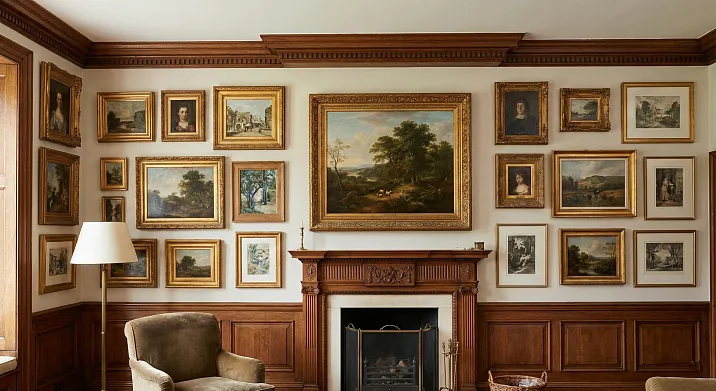
Imagine a wall without a single painting. Empty. Cold. Faceless. Now add a painting — immediately there is a focal point, energy, character. And now place that painting in a wooden frame with a carved baguette — and the space transforms completely.Interior Decor PicturesUsing wooden baguettes and moldings transforms a simple image into a work of art, a wall into a gallery, a room into a space with history. A frame is not just a border; it is the voice of the painting, its intonation, its context. Without a frame, the painting is silent. In the right frame, it speaks.
Wood as a material for frames possesses a unique ability to enhance any image: it makes oil painting more solemn, watercolor more delicate, graphics more austere, and photography more noble. This is due to its naturalness, the warmth that wood radiates, and the texture that creates an additional visual layer.Stylish interior decoris impossible without understanding how a frame works with a painting, how a baguette organizes the space around the image, how a molding connects individual paintings into a single composition.




Wooden baguette — architecture for the image
wooden molding buymeans choosing not just four slats of a certain width, but an architectural structure with its own profile, rhythm, and plasticity. A baguette is a profiled molding whose cross-section is designed to create transitions between the plane of the wall and the plane of the painting. These transitions can be sharp (stepped profiles) or smooth (rounded), wide (classical frames 80–120 millimeters) or narrow (minimalist frames 20–40 millimeters), simple (one or two elements) or complex (five to seven profile elements).




Profiles of wooden baguette
Flat profile — the simplest: a rectangular slat without relief. Suitable for modern interiors, graphics, black-and-white photography, minimalist posters. A flat baguette does not distract from the image, creates a clear boundary, and functions as a frame in the geometric sense — simply limiting the painting's space.
Profile with a bevel — a slat with a beveled inner edge. The bevel creates a smooth transition from the wall to the painting, directing the gaze into the image. The bevel angle varies from 15 to 45 degrees — the steeper the angle, the more active the profile, the more it draws attention to itself.
Ogee — an S-shaped profile, a classic element of baguette architecture. Two curves, convex and concave, create a wavy relief that plays with light and shadow. Ogee is suitable for traditional interiors, classical painting, portraits. It adds volume, makes the frame three-dimensional, visually heavier.
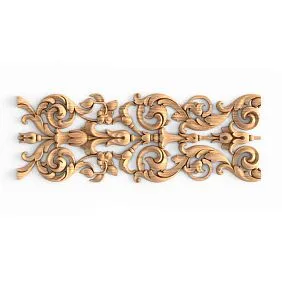
adds another level of complexity: a carved ornament is applied over the profiled base — floral motifs (leaves, flowers, grapevines), geometric patterns (meanders, rosettes), animalistic elements (birds, beasts), abstract compositions. The carving can be shallow (depth 3–5 millimeters, creates texture) or deep (10–20 millimeters, creates volumetric elements casting strong shadows).
Carved Wooden Moldingadds another level of complexity: a carved ornament is applied over the profiled base — botanical motifs (leaves, flowers, grapevines), geometric patterns (meanders, rosettes), animalistic elements (birds, beasts), abstract compositions. The carving can be shallow (3–5 millimeters deep, creating texture) or deep (10–20 millimeters, creating volumetric elements that cast strong shadows).
Our factory also produces:




Wood species for molding
The choice of wood species for a frame determines not only visual characteristics but also durability, resistance to deformation, and the ability to hold fine carving details.
Oak — the king of baguette making. Density 700–900 kilograms per cubic meter, exceptional hardness. An oak baguette doesn't just hold a painting — it creates a sense of monumentality, weightiness, status. Oak's texture is expressive: large pores, contrasting annual rings, play of light in the wood grain. Oak is ideal for large paintings (from a meter and up), for historical painting, for interiors where solidity is important. Oak's color varies from light yellow to dark brown, depending on treatment and wood age. Bog oak (aged in water for decades) acquires a black color with a greenish tint — an exclusive material for premium-class frames.
Beech — a balance of quality and price. Density 650–750 kilograms, high hardness, but lower than oak. Texture fine-grained, uniform, without sharp contrasts. Color light pink, yellows with age. Beech cuts excellently, holds fine details, accepts any coloring — from natural light to imitation black ebony. Beech baguette is a universal choice for most paintings, from modern graphics to classical painting. It is noble enough not to look cheap and affordable enough not to break the budget.
Ash — wood with character. Hardness comparable to oak, but the texture is more dynamic: striped, wavy, with pronounced annual rings. Color from light gray to brownish-yellow. Ash is suitable for frames in modern interiors, where wood texture is an active design element. Ash baguette emphasizes movement, energy, does not require additional decor — the wood itself speaks loudly enough.
Linden — wood for carving. Soft (density 450–500 kilograms), uniform, without resin pockets and knots. Linden cuts like butter, holds the finest details — individual petals, leaf veins, thin curls. Linden baguette is chosen for frames with deep, detailed carving, for icons, for miniatures. But linden is soft — scratches easily, requires careful handling and protective coating.
Walnut — wood for aesthetes. Density 600–700 kilograms, medium hardness, but incredible beauty. Texture varied, with veins, tonal transitions, play of shades from light brown to chocolate. Walnut cuts easily, holds details, polishes to a mirror shine. Walnut baguette is the highest class, for paintings that are works of art in themselves, for collection canvases, for interiors where every detail is precise.
Get Consultation
Decorative wooden baguette — styles and eras
Decorative wooden moldingreflects the aesthetics of eras, styles, cultures. A frame is not a neutral element; it carries a stylistic load, speaks the language of its time.
Baroque
Baroque frame — it's theater, excess, drama. Width 100–200 millimeters, profile complex, multi-stepped, carving abundant, deep: acanthus leaves, scrolls (volutes), cartouches, garlands, putti, mascaron. Color — gilding (gold leaf or imitation gilding), white enamel with gold accents, dark wood with gilded elements. A Baroque frame transforms a painting into a window to another world, creates a sense of spatial depth, solemnity. It is suitable for large historical canvases, religious subjects, formal portraits. In a modern interior, a Baroque frame works as a contrast, shock, a challenge to minimalism.
Empire
Empire — it's strictness, symmetry, imperial power. Frame rectangular, profile clear, carving restrained: laurel wreaths, military trophies (swords, shields, spears), columns, pilasters, eagles, lions. Color — gold (but not Baroque, lush, but strict, matte), black with gold (dramatic contrast), mahogany with bronze overlays. An Empire frame creates a sense of power, dignity, grandeur. It is suitable for portraits of statesmen, battle scenes, monumental compositions.
Neoclassicism
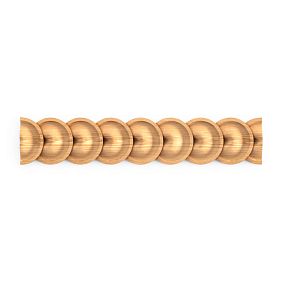
Neoclassicism — it's lightened classicism, adapted to modern proportions and rhythms. Frame medium width (60–100 millimeters), profile moderately complex, carving stylized, simplified: palmettes, meanders, rosettes, pearl molding (a row of round protrusions imitating beads). Color — natural wood (light oak, bleached ash), white, gray, contrasting combinations (black frame on a white wall). A Neoclassical frame is a compromise between love for tradition and the demands of modernity. It fits into most interiors, does not overload the space, creates structure without excess.
Modern
Art Nouveau (Art Nouveau) — it's flowing lines, plant motifs, asymmetry, organicity. Frame medium width (50–80 millimeters), profile wavy, fluid, carving stylized-plant: irises, lilies, bindweeds, stems, twisting like snakes. Color — natural wood with transparent varnish (emphasizes texture), dark tones (wenge, bog oak), gilding with patina (aged, not new). A frame in the Art Nouveau style creates a sense of naturalness, organicity, connection with the living world. It is suitable for landscapes, portraits in a romantic key, decorative panels.
Minimalism
Minimalism — it's reduction to the essence. Frame narrow (20–40 millimeters), profile simplest (rectangle, square, one bevel), no carving, no decor. Surface perfectly smooth, sanded to a matte sheen. Color solid — white, black, gray, natural light wood. A minimalist frame does not compete with the painting, does not distract — it simply marks the boundary, creates a clear frame. It is suitable for modern painting, graphics, photography, posters. In a minimalist interior, the painting itself is the accent, the frame is a functional element.
Wooden moldings for paintings — creating compositions
Wooden moldings for paintingsare used not only as frames for individual images but also as elements of complex wall compositions. A molding is a profiled slat that creates relief, divides planes, frames sections of the wall. In the context of decorating with paintings, moldings work in several ways.
Framing a group of paintings
When several paintings are placed on a wall (three, five, seven — an odd number creates dynamics, an even number creates stasis), a molding can frame the entire group, creating a single frame around the composition. The molding is glued to the wall at a distance of 100–200 millimeters from the outermost paintings, forming a rectangle or square. Inside this frame, the paintings are arranged freely, creating a gallery wall. The molding visually unites disparate images into a single whole, creates a sense of organization, structure.
Creating coffered ceilings
Coffering — is a recessed panel on a wall, framed by molding. In classical interiors, the wall is divided by moldings into rectangles, inside each rectangle a painting or wallpaper of a contrasting color is placed. Moldings are glued to the wall, forming a grid, paintings are hung inside the sections. Such design creates rhythm, symmetry, solemnity. Suitable for living rooms, studies, libraries, dining rooms — formal rooms.
Dividing a wall into zones
A horizontal molding installed at a height of 100–120 centimeters (the height of a chair back) divides the wall into two zones: the lower (panel) and the upper (frieze). Paintings are placed in the upper zone, while the lower zone is painted a different color or paneled with wood. The molding creates a boundary that organizes perception, prevents the wall from looking flat and monotonous.
Connecting different frames
If paintings in different frames (different widths, profiles, colors) are hanging on a wall, a molding running horizontally or vertically along the wall visually connects them, creating a common line, a supporting element. The molding can be painted in a color that echoes one of the frames or in a neutral color (white, gray) that unifies everything.
Round wooden molding in picture decoration
Round wooden balusters— an unconventional but interesting solution for framing pictures in modern interiors. Round molding (cylindrical-section slats with a diameter from 10 to 50 millimeters) is used to create three-dimensional frames that protrude from the wall plane, creating a depth effect.
Frame made of round slats
Four round slats (diameter 20–30 millimeters) are joined into a rectangle to form a frame. The slats are painted in a contrasting color (black, white, metallic) or left in the natural wood color. Such a frame looks light, graphic, and modern. It is suitable for posters, photographs, graphics, and minimalist paintings. Round slats do not create heaviness, do not overload the composition, and work as lines that limit the image space.
Three-dimensional installation
Round slats of different lengths are installed vertically or horizontally, creating a three-dimensional structure inside which paintings are placed. The slats protrude from the wall by 50–100 millimeters, creating depth, and play of light and shadow. Paintings are hung on thin cables or leaned against the slats. Such an installation turns the wall into an art object, where the paintings are part of a three-dimensional composition.
Accent shelf for paintings
A horizontal round slat (diameter 40–50 millimeters, length 1–2 meters) is attached to the wall at a height of 120–150 centimeters, functioning as a shelf. Framed paintings are placed on it (not hung, but leaned against the wall). The advantage of this system is flexibility: paintings can be rearranged, added, or removed without drilling holes in the wall. The round slat looks lighter than a regular shelf, creating a sense of airiness.
Techniques for painting and finishing picture frame molding
The color and texture of a frame radically change the perception of a painting. The same image in a gold Baroque frame and in a black minimalist one looks like two different paintings.
Natural wood with a transparent finish
Oil, wax, or clear varnish emphasizes the wood grain, leaving the color as natural as possible. This finish is suitable for frames made of oak, ash, walnut — woods with expressive grain. A natural frame creates a feeling of warmth, organicity, and connection with nature. It works well with landscapes, still lifes, and ethnic themes.
Staining
Stain changes the color of the wood while keeping the grain visible. Light linden or beech can be stained to resemble walnut, wenge, mahogany. Stain allows for the imitation of expensive exotic woods, saving budget. A stained frame is suitable for classical painting, portraits, reproductions.
Painting with opaque enamel
Enamel completely hides the wood grain, creating a solid, smooth surface. The color can be any: white (universal, neutral), black (dramatic, graphic), gray (modern, restrained), colored (blue, green, red — for bold interiors). A painted frame is suitable for modern painting, graphics, photography.
Gilding
Gilding — applying a thin layer of gold (leaf or imitation) to the surface of a frame. Genuine gold leaf is sheets a few microns thick, which are glued onto special adhesive and then polished. Gilding can be glossy (polished to a mirror shine) or matte (with slight roughness). A gilded frame creates a feeling of luxury, solemnity, and historical value. It is suitable for antique canvases, icons, museum reproductions.
Patina
Patina — artificial aging: a contrasting paint (usually dark — brown, green, black) is applied over a painted surface and rubbed into the recesses of the carving, creating a time-worn effect, as if the frame had hung for decades in an old house, accumulating dust, oxidation, and traces of life. A patinated frame creates a feeling of history, nostalgia, and authenticity. It is suitable for vintage interiors, reproductions of old masters, retro-style photographs.
Mounting paintings in wooden frames
Proper mounting ensures that the painting will not fall, warp, and will hang straight for decades.
Wall mounting
On hooks. The most common method. Metal hangers (D-shaped or triangular) are attached to the back of the frame, onto which a cable, fishing line, or wire is looped. The ends of the cable are attached to two hangers, forming a loop in the middle that hooks onto a wall hook. The hook must support the weight of the frame with the painting (an average frame measuring 60×80 centimeters weighs 3–5 kilograms). For concrete and brick walls, wall plugs are used; for drywall, special 'butterfly' anchors are used.
On a hanging system. For galleries where paintings are changed frequently, a hanging system is used: a horizontal rail is attached to the wall or ceiling, onto which cables or rods are hung, to which the paintings are attached. The system allows changing the height and position of paintings without drilling the wall.
On a shelf. Paintings can be placed on a shelf (wooden or metal), leaning them against the wall, instead of being hung. This method is convenient for frequently changing the display and creates an informal, homely atmosphere.
Mounting height
The center of the painting should be at eye level for an average adult—approximately 150–160 centimeters from the floor. This ensures comfortable viewing: there's no need to tilt your head back or bend down. If there are several paintings, align them along the central axis (a horizontal line passing through the centers of all paintings) or along the bottom/top edge.
In rooms where people are primarily seated (dining room, study), paintings are hung slightly lower—the center at 130–140 centimeters. In rooms with high ceilings (over 3 meters), paintings can be hung higher, creating vertical compositions.
Lighting
A painting requires proper lighting. Ideally, use directed light from a separate fixture (spotlight, projector) mounted on the wall or ceiling. The light should fall from above at a 30–40 degree angle, evenly illuminating the entire surface without glare. The fixture's power depends on the painting's size: for small ones (30×40 centimeters), 3–5 watts LED is sufficient; for medium (60×80), 7–10 watts; for large (100×120 and above), 15–20 watts.
Avoid direct sunlight—ultraviolet rays fade colors, especially in watercolors and color photographs. If there's a window nearby, use curtains, blinds, or UV filters on the glass.
Answers to Popular Questions
What frame width is suitable for a painting of a certain size?
General rule: the larger the painting, the wider the frame. For small paintings (up to 30×40 centimeters), a frame width of 20–40 millimeters is sufficient. For medium ones (50×70, 60×80)—40–80 millimeters. For large ones (100×120 and above)—80–150 millimeters. But the rule is not absolute: in a minimalist interior, even a large painting can have a narrow frame, while in a Baroque style, a small one can have a wide frame.
How to choose a frame color for a painting?
The frame color should either repeat one of the painting's colors (integrating the frame into the image) or contrast (making the painting stand out). For neutral paintings (black-and-white graphics, monochrome art), neutral frames (white, black, gray, natural wood) are suitable. For colorful ones—either matching the dominant color or contrasting.
Can the same frames be used for different paintings?
Yes, this creates a sense of series and organization, especially if the paintings vary in size and style. Identical frames visually unite disparate images into a collection. This works for gallery walls with many paintings of different subjects.
How to care for a wooden frame?
Wipe with a dry, soft cloth to remove dust. Avoid wet cleaning (water can damage the finish). For carved frames, use a soft brush to remove dust from crevices. Once a year, you can refresh the finish (oil, wax) if the frame is natural wood.
Can a custom-sized frame be ordered?
Yes, most manufacturers make frames to order for specific painting sizes. You specify the inner frame size (matching the painting's dimensions), choose the profile, wood type, finish, and the frame is made in 1–3 weeks.
How much does a custom wooden frame cost?
The cost depends on size, wood type, profile complexity, and finish. Approximate price for a 50×70 centimeter painting frame: simple pine frame—from 2000 rubles, classic beech—from 5000 rubles, carved oak with gilding—from 20000 rubles.
Can a painting be inserted into a frame independently?
Yes, if the frame is disassemblable (with a back panel on clips or screws). Remove the back panel, place the painting, and close it. If the frame is non-disassemblable (permanently glued), insertion is done by a framing workshop: the painting is secured inside the frame with special staples or glue.
Conclusion: a painting finds its voice through the frame
Why does the same painting look different in different frames? Because a frame is not just a border—it's context, intonation, a way of interpretation. The frame says: 'Look at this as classical art' (gilded Baroque frame) or 'This is modern graphics' (black minimalist), or 'This is part of nature' (natural wood without paint). The frame creates distance between the viewer and the image or, conversely, reduces it, making the painting closer, more intimate.
Interior Decor PicturesWorking with wooden frames and moldings is the art of creating a dialogue between the image and space, between the artist and viewer, between past and present. A wooden frame is not a lifeless object—it's living matter that breathes, changes, ages with the painting, acquires a patina of time, becomes part of history.
The company STAVROS has been creating wooden frames and moldings for framing paintings, mirrors, panels, and creating wall compositions for over twenty years. STAVROS's assortment includes over 200 frame profiles—from simplest flat ones to complex multi-step ones with carvings, widths from 20 to 150 millimeters, wood types from pine to oak. Each profile is designed considering laws of visual perception, balance of proportions, play of light and shadow.
Carving is done using a combined method: rough processing on CNC machines, final finishing by hand by master carvers. This ensures precision repeatability (important for serial production) and liveliness, individuality of each piece. Every acanthus leaf, every curl, every rosette is detailed with attention, creating not just a decorative element, but a small sculpture.
Wood types are selected based on purpose: beech for frames under paint (uniform texture, takes enamel well), oak for frames under transparent finish (expressive texture, noble appearance), linden for carved frames (soft, easy to cut, holds finest details). Wood moisture is controlled at every stage—kiln drying to 8–10%, guaranteeing stability, no deformation, cracks.
Finishing is done with professional compounds: Osmo oils (Germany), Sayerlack varnishes (Italy), Borma Wachs stains (Italy), Teknos acrylic enamels (Finland). Custom coloring in any RAL, NCS catalog color is possible, as well as patination, gilding (imitation gold leaf), silvering, bronzing. For exclusive projects, real gold leaf is used—sheets 0.2 microns thick, applied by hand with special glue, polished with agate tools to a mirror shine.
STAVROS works not only with private clients but also with art galleries, museums, interior designers, architects. Experience framing Konstantinovsky Palace, the Hermitage, the Russian Museum, dozens of private collections has taught understanding what museum-level quality is—a frame that not only holds the painting but enhances it, creates the right context, protects from damage.
STAVROS offers not only ready-made catalog profiles but also custom frame production. If you need a uniquely shaped profile, with custom ornamentation, non-standard finish—it's achievable. Provide a sketch or description, and STAVROS technologists will develop the profile, make a sample, coordinate with you, launch production. Minimum order—from 20 linear meters.
For those decorating interiors independently, STAVROS provides consultations: how to choose frame width for a specific painting, which profile suits the interior style, how to calculate frame quantity, how to create a composition with multiple paintings. Consultants help avoid costly mistakes—an incorrectly chosen frame can spoil the painting's perception, devalue it.
STAVROS showrooms in St. Petersburg and Moscow are open for visits: here you can see samples of all profiles, apply them to your painting (bring it with you), compare different options, assess how the image's perception changes depending on the frame. For complex projects (framing a collection, creating a gallery wall), an on-site consultant visit is possible for measurements, layout planning, frame selection, cost estimate.
Buying frames from STAVROS is a choice for quality that lasts decades, beauty that doesn't age, professionalism visible in every detail. It's an investment not in decor, but in how you see art, how you relate to beauty, how you create space worthy of the finest works.
Contacts: phone 8 (800) 555-46-75, website stavros.ru, showroom addresses are listed on the site. Call, visit, choose — STAVROS will transform your painting collection into an exhibition where every frame works to make the image resonate louder, brighter, deeper.


