












































































Article Contents:
- Mirrors as Architectural Elements in Interior Design: Functions and Possibilities
- Covering Defects
- Managing Light and Reflections
- Decorative Function and Compositional Accents
- Trends 2026: New Shapes and Approaches to Mirror Design
- Arched Mirrors: Architecture in Interior Design
- Round and Oval Mirrors: Softness of Forms
- Asymmetrical and Organic Shapes
- Stylistic Solutions: Mirrors in Different Interior Design Directions
- Minimalism: Purity of Lines and Functionality
- Neoclassicism: Symmetry, Proportions, Elegance
- Loft: Industrial Aesthetics and Contrasts
- Provence: Romance and Coziness
- Frame Materials: Wood, Metal, Combinations
- Solid Wood: Classic and Reliable
- Metal Frames: Modernity and Graphic Appeal
- Combined Solutions: Wood and Metal
- Mirrors for Different Rooms: Selection and Placement Specifics
- Entryway: First Impression
- Living Room: Compositional Center
- Bedroom: Intimacy and Function
- Bathroom: Moisture Resistance and Practicality
- Technical Aspects: Choosing a Quality Mirror
- Glass Thickness and Quality
- Reflective Coating and Protection
- Mounting and installation
- Caring for Interior Mirrors: Maintaining Cleanliness and Shine
- Frequently Asked Questions About Interior Mirrors
- About STAVROS Company: Craftsmanship Traditions and Modern Production
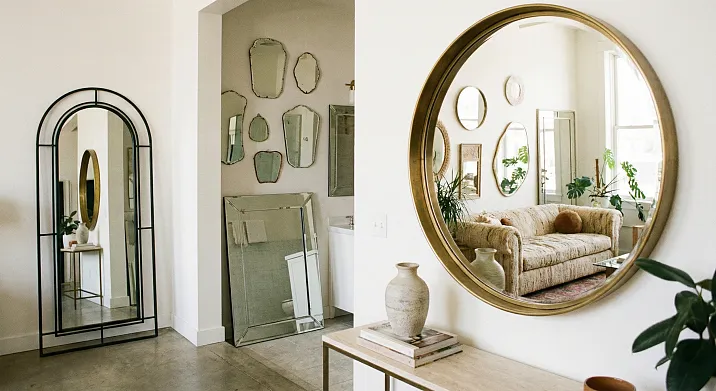
What can transform a room in just moments—without renovation, without rearranging furniture, without radical interventions?Interior mirrorA mirror is capable of this. The reflective surface doubles light, expands spatial boundaries, and creates an illusion of depth where it physically doesn't exist. But a modern mirror is not just a functional item for checking one's reflection; it is an independent decorative element that can become the compositional center of an interior. A properly chosen mirror sets the tone for the entire space, supports the style, and shapes the atmosphere.
In 2026, mirrors have moved beyond traditional rectangular shapes and modest functions. Round, oval, arched, asymmetrical—the variety of forms allows for finding a solution for any interior, from strict minimalism to lavish Baroque. Frame materials have evolved: natural wood coexists with metal, glass, and composite materials. Sizes range from compact accent mirrors with diameters of 40-50 cm to monumental floor-standing structures over two meters tall.


Mirror as an Architectural Element in Interior Design: Functions and Possibilities




Visual space expansion
A mirror multiplies space—not physically, but perceptually. A narrow corridor lined with a mirrored surface on one side appears twice as wide. A small room with a full-wall mirror on the side opposite the window feels more spacious and brighter. The effect is achieved by doubling the visible volume—the brain processes the reflection as an extension of the real space.
The placement of the mirror is critical for achieving the expansion effect.wall-mounted interior mirrorsMirrors placed opposite windows double the light flow, making the room brighter. A mirror at the end of a long, narrow room visually reduces disproportionality, creating an illusion of more balanced proportions. In a corner placement, two mirrors on adjacent walls create an infinite reflection effect, generating a sense of multidimensional space.
The size of the mirror determines the scale of its impact. A large-format mirror with an area of 2-3 square meters can radically transform the perception of a room. Small mirrors with diameters up to 80 cm create local accents without changing the overall sense of scale. For maximum space-expanding effect, a mirror should occupy at least 60-70% of the wall's height and at least half of its width.
Our factory also produces:


Managing Light and Reflections
A mirror is a passive light source. It does not emit but redirects, doubles, and diffuses light flow. In a room with one window, a mirror on the opposite wall returns natural light back into the space, compensating for insufficient sunlight. In rooms with artificial lighting, a mirror multiplies the effect of light fixtures, reducing the required power of the light sources.
The quality of reflection is determined by the characteristics of the mirror coating. Modern mirrors use silver plating with a thickness of 0.15-0.30 microns on the back of the glass. A protective layer of copper and special varnishes prevents oxidation and degradation of the coating. The reflection coefficient of a high-quality mirror is 85-95%, meaning minimal loss of light energy.
The angle of light incidence affects the nature of the reflection. Direct light from a ceiling fixture, reflected in a mirror, creates a bright local spot. Side light from a floor lamp or sconce forms soft, diffused highlights. Backlighting from behind the mirror creates a glowing frame effect, turning the mirror into a light object.
Get Consultation
Decorative Function and Compositional Accents
Mirror with frameA mirror becomes an independent artistic object. A carved wooden frame in Baroque style with gilding transforms the mirror into a piece of decorative art. A minimalist metal border 10-15 mm wide creates a graphic accent, emphasizing clean lines and geometric form. A solid wood frame with a natural wood grain texture brings the warmth of natural material into modern interiors.
The shape of the mirror determines the nature of its interaction with the interior. A round mirror with a diameter of 80-100 cm softens the rigid geometry of rectangular rooms, creating a visual contrast with corners and lines. An oval mirror 120-150 cm tall is elegant in classic interiors, echoing traditional proportions. An arched shape with a semicircular top evokes associations with architectural openings, adding monumentality.
Grouping mirrors creates complex compositions. Three round mirrors of different diameters, placed asymmetrically on one wall, form a dynamic composition. A symmetrical pair of vertical mirrors on either side of a dresser or fireplace emphasizes the central axis of the room. A gallery-style arrangement of 5-7 mirrors of different shapes and sizes turns the wall into an art object.
Trends 2026: New Forms and Approaches to Mirror Design
Arched Mirrors: Architecture in the Interior
The arched shape has become an absolute favorite in recent seasons. A classic semicircular arch 180-200 cm tall and 80-90 cm wide creates the impression of an architectural opening, a window into another dimension. Such a mirror is especially effective in narrow wall sections, corridors, and on end walls of rooms. The arched shape visually increases ceiling height, stretching the space upward.
Variations of the arched form are diverse. A Gothic pointed arch with a sharp top suits interiors with historical references. A shallow segmental arch with a slight curvature at the top is more neutral, fitting into modern interiors. A Moorish horseshoe arch that widens in the central part is exotic and requires an appropriate context.
The material of the arched mirror's frame influences its perception. A thin metal border in a golden or bronze hue emphasizes the elegance of the lines. A wooden frame made of oak or walnut, 50-80 mm wide, adds massiveness and solidity. A frameless design with a beveled edge creates an effect of weightlessness.
Round and Oval Mirrors: Softness of Forms
The round mirror is the second most popular solution in 2026. Diameters range from compact 50-60 cm for local accents to large-scale 120-150 cm for compositional centers. The circle as a shape is universal—it organically fits into any style, from loft to classic. The absence of corners creates a sense of softness, completeness, and harmony.
Oval mirrors offer a compromise between rectangle and circle. A vertical orientation oval 140-160 cm tall and 80-100 cm wide is elegant for placement above console tables in hallways. A horizontal oval 120-140 cm wide and 70-80 cm tall is suitable for placement above sofas, fireplaces, or dressers.
Frames for round and oval mirrors are often minimalist. A narrow metal rim 15-25 mm wide does not compete with the shape but merely emphasizes it. A wooden frame for a round mirror can be wider—40-60 mm—creating a more massive accent. Combined frames of wood with metal inserts combine the warmth of natural material and the graphic quality of metal.
Asymmetrical and Organic Forms
Free, flowing forms are a new trend for 2026. Mirrors in the shape of a drop, amoeba, or irregular polygon bring unexpectedness to the interior. Such forms are especially relevant in modern eclectic spaces where styles and eras are mixed. Organic forms create a sense of spontaneity, lightness, and creative freedom.
Asymmetry requires boldness in the interior. A mirror of irregular shape becomes a dominant feature that attracts attention. It cannot be a background element—either it's an accent, or such a solution is abandoned. Placing an asymmetrical mirror requires balance with other interior elements. Surrounding objects should be calmer, more neutral, to avoid creating visual chaos.
Frameless execution is characteristic of organic forms. A bevel along the entire perimeter creates a soft refraction of light on the edge. A bevel width of 15-20 mm is optimal for mirrors with an area of 0.5-1.5 square meters. A wider bevel makes the perception heavier, while a narrower one is visually unnoticeable.
Stylistic Solutions: Mirrors in Different Interior Directions
Minimalism: purity of lines and functionality
In minimalist interiors, a mirror primarily serves a function, and only secondarily a decorative one. Rectangular or round forms without complex frames, ornaments, or excess. The frame is either completely absent or is a thin metal border 10-20 mm wide. Colors are neutral—black, white, silver, matte chrome.
The placement of mirrors in minimalism is subordinated to logic and geometry. The mirror is strictly centered relative to the furniture piece beneath it or an architectural element. The installation height is calculated to the centimeter to ensure visual balance. Mirror groupings are symmetrical or follow a strict modular grid.
Buy an Interior MirrorFor a minimalist interior, go for a large size — the effect is achieved through scale, not decorativeness. A floor-to-ceiling mirror 100-120 cm wide creates a powerful visual accent with minimal means. The absence of a frame makes such a mirror almost invisible as an object, leaving only the function of reflection.
Neoclassicism: symmetry, proportions, elegance
Neoclassical interiors use mirrors as elements of architectural composition. The shape is usually a vertical rectangle with an aspect ratio of 1:1.5 or 1:2. The frame is made of solid wood, 60-100 mm wide, with a milled profile — fluting, Ionic motifs, geometric patterns. Noble colors — natural oak, stained walnut, white enamel with patination, gilding, or silvering.
Wall-Mounted Interior Mirror in FrameMade of oak with carved decor in the upper part — a classic solution for neoclassicism. The upper cartouche with floral motifs, acanthus leaves, or symmetrical volutes adds decorativeness. The lower part of the frame is more restrained, sometimes complemented by a small console shelf.
Mirror placement in neoclassicism is strictly symmetrical. A pair of identical mirrors on either side of a fireplace, console, or door is a typical solution. A single large mirror is centered on the room's axis of symmetry. The height of the mirror's lower edge above furniture is standard — 15-25 cm, ensuring a visual connection between objects.
Loft: industrial aesthetics and contrasts
In loft interiors, mirrors contrast with rough textures — brickwork, concrete, metal structures. Frames are made of black metal, aged iron, industrial profiles. Shapes are either strictly geometric rectangles or circles — imitating industrial portholes, factory windows.
Mirror sizes in a loft are usually large — from 100×150 cm and up. The massiveness balances the brutality of the surrounding finishes. The frame can be deliberately rough — weld seams are not cleaned, metal has a rust patina, rivets are visible. Such aesthetics emphasize the industrial nature of the style.
Wall interior mirrorsIn a loft, mirrors can be grouped into compositions of several fragments. Four square mirrors 60×60 cm, mounted with a 5-10 cm gap, form a single composition with an area of about 1.5 square meters. The gaps between fragments enhance the industrial character.
Provence: romance and coziness
The Provence style uses mirrors in light wooden frames with a patination and aging effect. The wood is painted white, milky, soft blue, or lavender, then locally wiped to reveal the base. The effect of layered paint creates a sense of history, time, and lived-in comfort.
Mirror shapes in Provence are soft — ovals, rectangles with rounded corners, sometimes complex figured contours. The frame is often decorated with carved floral motifs — grapevines, lavender, olive branches. The carving is shallow, soft, without aggressive protrusions.
Mirror sizes in Provence are medium — 70×100 cm for vertical, 90×70 cm for horizontal. Too large mirrors disrupt the intimacy and coziness of the style. Mirrors are placed above dressers, vanities, in wall spaces between windows. The installation height is comfortable for use — the center of the mirror at 140-160 cm from the floor.
Frame materials: wood, metal, combinations
Solid wood: classic and reliable
Classic mirrors in solid wood framesMade of oak and beech combine the aesthetics of natural material with durability. An oak frame withstands significant mechanical loads and does not deform over time. The texture of oak with pronounced annual rings creates a rich visual pattern.
Beech as a frame material is more uniform in texture. The light pinkish hue of natural beech creates a warm atmosphere. Beech frames take paint well, accepting any shades from white to dark brown. For curved frames of complex shape, beech is preferable to oak due to its lower density and better workability.
A wooden frame requires protective treatment. Varnishing creates a protective film that prevents moisture absorption and dirt. Oil coating preserves the tactile quality of the wood and emphasizes the texture. Wax finishing gives a soft silky sheen but requires regular renewal.
Metal frames: modernity and graphic quality
Metal in mirror frames is represented by a wide range of solutions. Stainless steel with a polished or matte surface creates a cold, modern accent. Brass or bronze with natural or artificial patina adds warmth and nobility. Blackened metal with powder coating is graphic, suitable for minimalism and loft.
The profile of a metal frame varies from a thin rod 10-15 mm in diameter to a wide strip 40-60 mm. A thin profile creates a light contour that does not compete with the reflection. A wide metal frame becomes an independent decorative element.
The method of attaching a metal frame to the mirror panel differs. The frame can encircle the mirror around the perimeter with fixation using adhesive and mechanical fasteners. An alternative option — the mirror is glued to a metal backing, and the decorative frame is mounted on top. The second method provides greater reliability for large-format mirrors.
Combined solutions: wood and metal
The combination of wood and metal in one frame creates a rich textural interplay. A wooden base 60-80 mm wide is complemented by metal overlays, rosettes, corner pieces. Metal elements can be functional — reinforcing the structure — or purely decorative.
The color combination of materials determines the character of the frame. Light oak with brass overlays is elegant, suitable for neoclassicism and modern classic. Dark walnut with blackened metal is brutal, organic in loft and industrial interiors. White wood with chrome details is fresh, relevant for Scandinavian style.
Technologically, combined frames are more complex to produce. The wooden part and metal elements are manufactured separately, then joined with adhesive, screws, or hidden fasteners. Assembly quality is critical for durability — poor connection will lead to frame loosening.
Mirrors for different rooms: selection and placement specifics
Entryway: first impression
In the hallway, a mirror primarily serves a utilitarian function — checking one's appearance before leaving. The mirror's height should allow seeing oneself at full height — minimum 160-170 cm. A width of 50-70 cm is sufficient for individual use; for a family, a width of 80-100 cm is optimal.
Mirror placement in the hallway is determined by the layout. In narrow corridors, the mirror is mounted on a long wall, visually expanding the space. In square hallways, the mirror is placed on the wall opposite the entrance door or to the side of it. The lower edge of the mirror at a height of 30-40 cm from the floor allows seeing shoes.
The mirror frame in the hallway should be practical. Smooth surfaces without deep relief are easier to clean from dust. Dark frame tones mask minor stains better than light ones. A protective coating—varnish, enamel—is essential for durability.
Living room: the compositional center
In the living room, a mirror often becomes a key decorative element. The size is large—from 100×150 cm and above—to create a visual impact. The shape corresponds to the interior style: rectangular for classic, round for modern, arched for eclectic.
Typical placement is above the fireplace, sofa, or console table. A mirror center height of 140-170 cm from the floor ensures comfortable viewing for seated people. If the mirror is placed above furniture, the gap between the top of the furniture and the bottom edge of the mirror is 15-30 cm.
Lighting the mirror in the living room enhances its decorative effect. Wall sconces on the sides create a symmetrical composition. A directional ceiling light fixture draws attention to the frame. Contour lighting from inside the frame creates a glowing effect.
Bedroom: intimacy and function
The mirror in the bedroom is often associated with a dressing table or wardrobe area. The size is medium—70×100 cm is sufficient for makeup and assessing the upper part of the figure. For trying on clothes, a full-length mirror with a minimum height of 160 cm is necessary.
Mirror lighting in the bedroom should mimic daylight. Lamps with a color temperature of 4000-5000K ensure accurate color rendering for makeup. Light fixtures are placed on the sides of the mirror at face level for even lighting without harsh shadows.
The mirror style in the bedroom supports the overall atmosphere of the room. Romantic interiors use oval mirrors in light wooden frames with patina. Modern bedrooms prefer round or rectangular mirrors in minimalist frames.
Bathroom: moisture resistance and practicality
The mirror in the bathroom is exposed to high humidity and temperature fluctuations. Moisture-resistant treatment of the back of the mirror panel is mandatory. An additional protective layer of special varnish or film prevents moisture from penetrating the reflective coating.
The mirror frame in the bathroom must be moisture-resistant. Solid wood with a multi-layer varnish coating withstands bathroom conditions. Metal frames made of stainless steel or with powder coating are not prone to corrosion. MDF or plywood frames in the bathroom are not durable even with protective treatment.
The size of the mirror in the bathroom is determined by the area of the room. For compact bathrooms of 3-4 square meters, a 60×80 cm mirror above the sink is sufficient. In spacious bathrooms, the mirror can occupy the entire wall above the washbasin, creating a space-expanding effect.
Technical aspects: choosing a quality mirror
Glass thickness and quality
The thickness of mirror glass affects reflection quality and durability. For mirrors with an area of up to 0.5 square meters, a thickness of 4 mm is sufficient. Mirrors with an area of 0.5-1.5 square meters require a thickness of 5-6 mm to prevent reflection distortion. Large-format mirrors over 1.5 square meters are made from glass 8-10 mm thick.
Glass quality determines the purity of the reflection. Premium-grade float glass has no inclusions, bubbles, or color distortions. Low-grade glass gives a greenish tint to the reflection due to iron impurities. Only high-grade glass is used for quality interior mirrors.
Mirror edge processing affects safety and aesthetics. A polished edge is smooth and safe but has a sharp angle. A bevel—a 45-degree angled edge 15-30 mm wide—creates decorative light refraction. A bevel enhances the visual value of frameless mirrors.
Reflective coating and protection
Modern mirrors use silver spraying on the back of the glass. A silver layer thickness of 0.15-0.30 microns provides a reflection coefficient of 85-95%. A thinner coating reduces reflection quality, while a thicker one is economically impractical.
Protective layers prevent silver oxidation. The first layer of copper, 0.05-0.10 microns thick, protects the silver from chemical exposure. The second layer of special varnish isolates the metal coatings from moisture. The third layer of paint mechanically protects the entire coating system.
The quality of protective coatings determines the mirror's service life. Low-quality mirrors begin to darken at the edges after 3-5 years of use. Premium-class mirrors with full protection maintain reflection quality for 20-30 years.
Mounting and Installation
The method of mirror mounting depends on its size and frame type. Mirrors in heavy wooden frames weighing over 15 kg are mounted on the wall using special hinges or hidden hangers. Light mirrors up to 10 kg can be attached with double-sided mounting tape or adhesive.
Large-area frameless mirrors are mounted with adhesive and additional mechanical fixation. Specialized mirror adhesive contains no acids that destroy protective coatings. The adhesive is applied in dots or strips 5-10 cm from the edge. Additional support brackets at the bottom bear the main weight of the structure.
The distance from the wall to the back surface of the mirror should provide ventilation. A gap of 3-5 mm is sufficient for air circulation and preventing moisture condensation. Tight contact between the mirror and a cold wall leads to fogging and accelerated coating degradation.
Caring for interior mirrors: maintaining cleanliness and shine
Regular cleaning of the mirror surface maintains reflection quality. Dust and dirt reduce image brightness and clarity. Weekly wet cleaning is sufficient for mirrors in living areas. In bathrooms, cleaning is required more often—2-3 times a week—due to condensation and water droplets settling.
Mirror cleaning products should not contain abrasives or aggressive chemicals. Specialized glass cleaners with an antistatic effect repel dust. A solution of vinegar or citric acid effectively removes limescale from dried water droplets. Wipe with a soft, lint-free cloth or microfiber in circular motions.
Frame care depends on the material. Wooden frames are wiped with a damp cloth without excess water. Deep relief on carved frames is cleaned of dust with a soft brush. Metal frames are wiped with specialized products for the corresponding metal—polishes for brass, products for stainless steel.
Frequently asked questions about interior mirrors
What is the optimal mirror size for an entryway?
For an entryway, a mirror with a minimum height of 160-170 cm is recommended for a full-body view. A width of 60-80 cm ensures comfortable use. If space is limited, a mirror with a height of 120-140 cm for viewing the upper part of the figure is acceptable.
How to properly place a mirror to visually expand space?
For maximum expansion effect, place the mirror opposite a window or light source. The mirror should occupy at least 60-70% of the wall height. In narrow rooms, mount the mirror on a long wall for visual expansion.
Can a regular mirror be used in a bathroom?
A bathroom requires a mirror with moisture-resistant treatment on the back. A regular mirror without protection will begin to darken from the edges within 1-2 years. The frame should also be moisture-resistant—solid wood with varnish coating or metal.
What mirror shape is universal for any interior?
A round mirror with a diameter of 70-90 cm fits universally into most styles. The absence of corners makes the circle a neutral shape that harmonizes with different styles. A rectangular mirror with an aspect ratio of 1:1.5 is also universal.
How to care for a mirror in a wooden frame?
The mirror surface is wiped with glass cleaner or a vinegar solution. The wooden frame is cleaned with a slightly damp cloth without excess water. Carved elements are cleaned with a soft brush. Periodically, the wooden frame is treated with wax or wood polish.
What distance should be between a mirror and the furniture beneath it?
The optimal gap between the top of the furniture and the bottom edge of the mirror is 15-25 cm. A smaller distance creates a feeling of tightness, a larger one breaks the visual connection between objects. For tall furniture over 100 cm, the gap can increase to 30-40 cm.
Are large mirrors safe in a home with children?
Large-format mirrors should have a protective film on the back. The film prevents shattering into fragments if broken. The mounting must be as secure as possible with a safety margin. In children's rooms, mirrors in sturdy frames that protect the edges are preferable.
About STAVROS: Craftsmanship Traditions and Modern Production
STAVROS creates mirrors by combining classical traditions of furniture craftsmanship and modern production technologies. EachMirror made from solid woodundergoes a full processing cycle—from wood selection to finishing—under the supervision of experienced craftsmen.
Production uses selected wood species—oak and beech, kiln-dried to a moisture content of 8-12%. This moisture level ensures the stability of the product geometry during use. The wood undergoes quality control for the absence of defects, cracks, and loose knots.
Mirror frames are manufactured on high-precision CNC equipment. Profile milling and decorative element carving are performed with an accuracy of up to 0.1 mm. Final detailing of small parts and sanding are done manually, ensuring perfect surface quality.
Mirror panels meet the highest quality standards. Float glass with a thickness of 4-8 mm is used, depending on the product size. Silver coating is applied with multi-layer protection, guaranteeing the durability of the reflective surface. Edges are polished or beveled for safety and aesthetics.
Assortmentclassic mirrorsSTAVROS includes over 50 models of various shapes and styles. Oval, round, rectangular, and arched shapes are presented in frames ranging from strict minimalist to richly decorated Baroque. Sizes vary from compact 50×70 cm to monumental floor mirrors with a height of 200 cm.
Custom production allows creating mirrors based on customer sketches. Size, shape, frame profile, and finish type are adapted to a specific interior. The production time for a custom order is 3-6 weeks, depending on complexity.
Delivery is available throughout Russia. Mirrors are packaged in multi-layer protection—film, cardboard, wooden crating for large items. Transportation is carried out by specialized carriers with experience in handling fragile goods. The warranty for STAVROS mirrors is 12 months, confirming confidence in product quality.
Consultation support helps decide on the choice of mirror shape, size, and style. STAVROS specialists consider room features, overall interior style, and functional requirements. Recommendations on placement and care ensure maximum product longevity.
STAVROS is reliability, quality, and beauty in every detail.Furniture and interior itemsfrom STAVROS create an atmosphere you want to live in.


