Article Contents:
- System Thinking in Finishing: From Chaos to Order
- Base Wood Species and Color: The Foundation of the System
- Wood Species: Oak, Beech, or Exotic
- Color: Natural, Stained, or Painted
- Logic of Sequence: From Floor to Walls, From Walls to Accents
- Stage One: Baseboard — The Baseline of the Interior
- Stage Two: Moldings — The Architecture of Walls
- Stage Three: Mirror and Picture Frames — Accents in the System
- The Technique of Profile Repetition: When Details Reinforce Each Other
- Full Profile Repetition
- Partial Repetition: Common Elements
- Repetition of Carved Motifs
- Common Mistakes: When Elements Conflict
- Mistake 1: Mixing Wood Species
- Mistake 2: Style Conflict
- Mistake 3: Color Mismatch
- Mistake 4: Different Scale
- Mistake 5: Mixing Materials
- Examples of Systemic Solutions for Different Styles
- Classical Interior: Tradition and Monumentality
- Neoclassical: balance of tradition and modernity
- Modern Interior: Minimalism and Purity of Form
- Provence and Vintage: Romance of Aged Wood
- How STAVROS Helps Build the System
- Unified Production Base
- Coordinated Collections
- Custom Finishing for the Project
- Designer Consultations
- Practical Tips for Building the System
- Tip 1: start with a sample
- Tip 2: choose a base
- Tip 3: select a baseboard
- Tip 4: match moldings to the baseboard
- Tip 5: match frames to the system
- Tip 6: order unified finishing
- Tip 7: check the system before installation
- Frequently asked questions about systematic interior design
- Conclusion: the system as the foundation of a quality interior

Why does one interior look cohesive, assembled, and well-thought-out, while another looks like a collection of random elements? Why in one room does every detail support the others, while in another, beautiful things clash with each other? The secret lies in systematic thinking. A professional designer perceives finishing not as a collection of disparate parts, but as a single organism whereWooden baseboard, framed mirrorandMoldingseverything is connected by a common logic, rhythm, material, and color. When this system is built correctly, the interior gains harmony, respectability, and character. When it's broken — even expensive elements lose their power.


Systematic thinking in finishing: from chaos to order
A typical mistake in DIY renovation is buying elements based on the principle of 'I like it.' You saw a beautiful baseboard in the store — you bought it. You found an impressive mirror in a carved frame — you took it. You ordered wall moldings — you installed them. Everything individually is good, quality, beautiful. But together it doesn't work. The baseboard is a simple rectangular one made of light oak, the mirror frame is a gilded Baroque-style carved frame, the moldings are white matte polyurethane. Three different languages, three different eras, three different characters. The result — visual conflict, a sense of incompleteness, lack of style.
A systematic approach is the opposite. First, the basic idea is determined: the interior style, wood species, color scheme, level of decorativeness. Then this idea is consistently implemented through all finishing elements. Baseboards, moldings, mirror frames, casings, cornices — everything is made from the same material, in the same profile, in the same color, with a unified level of detail. This doesn't mean everything has to be absolutely identical. But there must be a common thread that connects the elements, creating a sense of kinship, belonging to the same family.
Imagine a classic interior.Wooden High Skirting BoardSolid oak, stained walnut color, with a classic profile (ogee, beads, fillet). Wall moldings made from the same oak, with the same stain, with a similar profile. The mirror frame again oak, again walnut, with carving that complements, not contradicts, the relief of the moldings. All elements speak the same language. They repeat each other, reinforce each other, create a unified space. This isn't boring — it's professional.




Base wood species and color: the foundation of the system
The first decision that determines everything else is the choice of wood species and color. This is the foundation from which all elements 'dance.'
Our factory also produces:


Wood species: oak, beech, or exotic
Oak — a classic, universal, the king of interior wood species. Expressive texture with large pores, high strength, durability. Oak suits all styles: from strict classic to modern neoclassical. The color of natural oak is light golden with a gray undertone. Oak takes stain well: from light bleached to dark wenge. If your choice is oak, all elements (baseboards, moldings, frames) should be made of oak. Mixing oak with beech or exotic species is a mistake; the textures conflict.
Beech — a more delicate, uniform wood. Fine-pored structure, even light tone without contrasting stripes. Beech is ideal for painting with enamel: the smooth surface allows for a flawless finish without raising the grain. If you plan a white, gray, cream interior with painted elements — beech is the best choice. All elements made of beech, all painted the same color — that's a system.
Ash — an expressive striped texture, similar to oak, but lighter and more contrasting. Ash is good for modern interiors where the natural wood texture is valued. If ash is chosen — all elements are made of ash.
Exotic species (wenge, mahogany, teak, merbau) — for prestigious, expensive interiors. Dark saturated tones, unique textures, high price. Exotic wood sets the tone of luxury but requires absolute consistency: all elements from one species, otherwise the effect is lost.
Get Consultation
Color: natural, stained, or painted
After choosing the species, the color is determined.
Natural wood color (clear varnish or oil without pigment) — for those who value the natural beauty of wood. Oak remains golden, beech creamy, wenge chocolate. Natural color is good for Scandinavian, eco-friendly, rustic interiors. All elements in natural color, without stain — a pure, honest system.
Staining (wood stain, oil with pigment) — changing the color of the wood while preserving the texture. Light oak can be stained to walnut, dark oak, wenge. Beech can be stained to gray, graphite. Staining adds depth, nobility, allows adapting the wood to the interior's color scheme. Important: all elements are stained the same color, with the same composition. Baseboard walnut, moldings walnut, mirror frame walnut — this works. Baseboard walnut, moldings wenge, mirror frame mahogany — chaos.
Painting with enamel (opaque paint, hiding the texture) — for modern, minimalist, neoclassical interiors. White, gray, black, cream, pastel tones. Enamel creates a smooth, uniform surface where form and profile are more important than texture. All elements in the same enamel color — a perfect system. White baseboard, white moldings, white mirror frame — this is the classic of neoclassicism, pure, elegant, timeless.
Patination (artificial aging with contrasting pigment in recesses) — for vintage, Provence, shabby chic interiors. The base is usually white or cream, patina is gray, brown, gold. All elements are patinated the same way — this creates the feeling that they all come from the same old mansion, having lived together for decades.
Logic of sequence: from floor to walls, from walls to accents
A systematic interior is built in a specific sequence. You cannot start with a mirror frame and then select a baseboard to match it. The logic is reversed: from the base to the accents, from the floor to the walls.
Stage one: baseboard — the baseline of the interior
The baseboard is the first element to be determined. Why? Because the baseboard runs along the entire perimeter of the room, it sets the lower horizontal line, it connects the floor and the wall, it is always and everywhere visible. The baseboard is the baseline from which everything else is built.
When choosing a baseboard, you simultaneously choose the wood species, color, profile, height, and degree of decorativeness. For example, you decide: a high baseboard, one hundred twenty millimeters, made of solid oak, painted matte white, with a classic shaped profile (ogee, two beads, a fillet). This is a decision. It is fixed.
Now all subsequent elements must correspond to this decision. Wall moldings — oak (or beech, which paints just as well), matte white enamel, a profile close to that of the baseboard (not necessarily identical, but related — the same ogees, beads, coves). Mirror frame — again oak or beech, again white enamel, again a classic profile.
If you chose a baseboard made of oak stained walnut, a simple rectangular profile with a chamfer, height eighty millimeters (a modern minimalist option) — moldings and frames must follow the same logic. Oak, walnut, simple profiles, conciseness, restraint. No carving, no gilding, no Baroque curls. Otherwise, conflict.
Stage two: moldings — the architecture of the walls
After the baseboard is determined, the moldings are chosen.Moldings for wallsMoldings create the architectural structure of the walls: frames, panels, horizontal belts, door/window trims. They should be in the same style as the baseboard but can differ in size and profile complexity.
Principle: moldings must be proportionate to the baseboard. If the baseboard is high (one hundred to one hundred twenty millimeters), the moldings must be sufficiently wide (sixty to eighty millimeters) so as not to get lost. If the baseboard is narrow (sixty to seventy millimeters), the moldings should also be delicate (thirty to fifty millimeters).
The profile of the moldings should echo the profile of the baseboard. If the baseboard has an ogee and a bead, the moldings should also have similar elements. If the baseboard is rectangular with a chamfer, the moldings are also simple, geometric, without complex classical elements.
The color of the moldings should match the baseboard. White baseboard — white moldings. Walnut baseboard — walnut moldings. This creates solidity, a feeling that the entire architectural shell of the room is made from one material, as a single structure.
Contrast is permissible, but it must be deliberate. For example, a white baseboard and white moldings on a light gray wall. The contrast between white and gray is graphic, modern, works excellently. Or a dark walnut baseboard and dark walnut moldings on a white wall. That also works. But a white baseboard and walnut moldings on a gray wall is overkill, three colors, no system.
Stage three: mirror and picture frames — accents in the system
Mirror and picture frames are chosen last. They should complete the system, be its logical continuation.framed mirrorThe frame is an accent, but an accent that does not contradict the base.
If the baseboards and moldings are white, the mirror frame is also white. If the baseboards and moldings are stained walnut, the frame is walnut. The wood species is the same (oak or beech). The profile of the frame can be more complex than that of the baseboard and moldings — the frame allows for more decorativeness, carving, details. But the style must match. If the baseboard and moldings are classical (with coves, beads, ogees), the frame is classical (with carving in a classical style: floral motifs, symmetrical scrolls, cartouches). If the baseboard and moldings are modern (simple, geometric), the frame is also modern (straight or beveled profile, minimal decor, clean lines).
The mirror frame can be a contrasting color, but in the same style and from the same wood species. For example, baseboards and moldings are white oak, and the mirror frame is natural (golden) oak. There is contrast, but the material is the same, the texture is recognizable, the style is common — the system is preserved.
What is unacceptable: baseboards and moldings are white classical oak, and the mirror frame is modern black metal. Or baseboards are simple modern walnut, and the frame is Baroque gilded with lush carving. This is conflict, a break in the system, visual dissonance.
The technique of profile repetition: when details reinforce each other
One of the most effective techniques in a systematic interior is profile repetition. The baseboard has a certain relief: a sequence of ogees, beads, fillets, coves. This relief is repeated (fully or partially) in the profile of the moldings and frames. The eye recognizes the repetition, the brain reads the system, creating a feeling of order, thoughtfulness, professionalism.
Full profile repetition
The strictest option: the baseboard, moldings, and mirror frame have absolutely identical profiles. This creates maximum solidity, a feeling that everything is made from the same trim, just of different sizes. This technique is good for strict classical interiors where symmetry, order, and discipline of forms are important.
For example,Baseboard PLT-001The baseboard has a certain profile. Moldings are chosen with the same profile but a smaller width. The mirror frame — with the same profile, but a greater width and with the addition of carved overlays. The profile is unified, decorativeness increases from the baseboard to the molding, from the molding to the frame. The system is built like a pyramid.
Partial repetition: common elements
A more flexible option: the profiles are different but contain common elements. The baseboard has an ogee and one bead. The molding has the same ogee but two beads. The frame has an ogee, beads, plus additional elements (cove, torus). The common element (ogee) connects all the details, creates kinship, but allows each to have its own individuality.
This is the golden mean: enough unity for the system to be readable, enough variety to avoid boredom. Professional designers most often use partial repetition: it provides a visual connection without rigid monotony.
Repetition of carved motifs
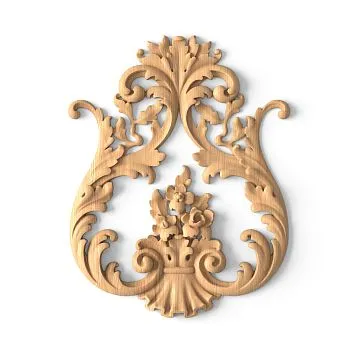
If carved elements are used in the interior, their motifs should also be repeated.carved appliquésThe baseboard can have carved corner elements with a floral ornament (acanthus leaves). Wall moldings are decorated with overlays featuring the same ornament. The mirror frame has carving with the same acanthus leaves. The motif is repeated, recognized, and connects the space.
If the baseboard has geometric carving (meander, Greek key), the moldings and frames should have geometric carving, not floral. Mixing floral and geometric motifs in one interior is a mistake; they conflict stylistically.
Typical mistakes: when elements conflict
Even high-quality, expensive elements may not work together if systematicity is violated. Let's consider common mistakes.
Mistake 1: mixing wood species
Oak baseboard, beech moldings, ash mirror frame. Three different textures, three different colors (even if all are varnished without tinting). Oak is warm golden with large pores, beech is cold creamy smooth, ash is contrasty striped. Together they do not create an ensemble but compete for attention. Correction: all elements from one wood species.
Mistake 2: style conflict
Modern baseboard (simple rectangular, sixty millimeters high, walnut, minimalist), and a Baroque mirror frame (gilded, with lush carving, scrolls, cartouches, cupids). Two different worlds, two different eras. The baseboard says 'twenty-first century, laconicism, functionality,' the frame screams 'eighteenth century, luxury, excess.' Conflict is inevitable. Correction: either a modern baseboard and modern frame (simple, geometric, without carving), or a classic baseboard (tall, profiled, with decor) and classic frame (carved but restrained, without Baroque excesses).
Mistake 3: color mismatch
White baseboard, gray moldings, black mirror frame. Three shades, three different messages. White is light, gray is neutral, black is heavy. Together they create visual noise. Correction: either everything in one color (white, gray, or black), or two colors with thoughtful contrast (white baseboard and moldings, black mirror frame as the only accent).
Mistake 4: different scale
Tall baseboard (one hundred twenty millimeters), massive, expressive, and thin moldings (thirty millimeters), inconspicuous, lost. Or vice versa: narrow baseboard (sixty millimeters), and wide moldings (one hundred millimeters), overwhelming everything else. The scale of elements should be proportionate. A tall baseboard requires sufficiently wide moldings, a narrow baseboard requires delicate moldings.
Mistake 5: mixing materials
Wooden baseboard, polyurethane moldings, plastic mirror frame. Three different materials, three different qualities, three different levels. Wood is noble, alive, expensive. Polyurethane is practical but artificial. Plastic is cheap, unreliable. Together they kill the status of the interior. Correction: all elements from one material—wood (solid wood or MDF for painting) or all from polyurethane (if the budget is limited and the style allows).
Examples of systemic solutions for different styles
Theory is clear. Now practice: how to build a system for specific interior styles.
Classic interior: tradition and monumentality
Basic solution: solid oak, walnut tint (medium warm brown), classic profiles with coves and beads, high degree of decorativeness.
Baseboard: height one hundred—one hundred twenty millimeters, oak, walnut, figured profile (cove, two beads, shelf, fillet). Carved corner overlays with floral ornament are possible.
Moldings: width sixty—eighty millimeters, oak, walnut, profile close to the baseboard (the same coves and beads, but in a different sequence). Moldings form on the wallsboiserie panels—rectangular frames, inside which the wall is painted or wallpapered.
Mirror frame: oak, walnut, wide molding (eighty—one hundred twenty millimeters), classic profile plus hand carving (floral motifs: acanthus leaves, grape vines, rosettes). Carving is moderate, not Baroque, restrained.
Additional elements: door and window architraves from oak, in walnut tint, with a profile close to the moldings. Ceiling cornice from oak, walnut, with a classic profile. All elements work in one system, enhance each other, create a monumental classic interior.
Rooms: study, library, dining room, formal living room. Classic requires space, high ceilings (from two hundred seventy centimeters), quality materials.
Neoclassicism: balance of tradition and modernity
Basic solution: solid oak or beech, painting in matte white or light gray enamel, simplified profiles, moderate decorativeness.
Baseboard: height eighty—one hundred millimeters, oak or beech, matte white enamel, profile with cove and one bead (simpler than in full classic, but not flat). Carving is not used, purity of lines.
Moldings: width fifty—seventy millimeters, oak or beech, white enamel, profile with cove. Moldings create frames on the walls, but not as densely as in classic. There is enough space between frames, the wall breathes.
Mirror frame: oak or beech, white enamel, profile with cove and bead, carving minimal or absent. Delicatecarved appliquéscan be added at the corners of the frame (small rosettes, leaves), but without overload.
Color variations: instead of white, light gray, beige, soft blue can be used. The main thing is all elements in one color, monochrome, purity.
Rooms: modern living room, bedroom, hallway.Furniture in neoclassical style from the STAVROS collections harmoniously complements such finishes, creating a balance between history and modernity.
Modern interior: minimalism and purity of form
Basic solution: solid oak, tinted in natural light or gray, simple geometric profiles, minimal decor.
Baseboard: height sixty to eighty millimeters, oak, natural light or gray, rectangular profile with a chamfer (one beveled edge, no complex elements). No carving, no overlays, pure geometry.
Moldings: rarely used. If used — narrow (thirty to fifty millimeters), oak, same color, simple rectangular profile. Moldings do not create frames but work as horizontal lines zoning the space.
Mirror frame: oak, natural or gray, thin molding (forty to sixty millimeters), straight or slightly beveled profile, no decor. Or a frameless mirror (panel with a finished edge) if the style demands maximum minimalism.
Alternative to wood: in modern interiors, MDF moldings and baseboards, painted in matte white, gray, black are acceptable. MDF provides a perfectly smooth surface, valued in minimalism.
Spaces: modern apartment, loft, Scandinavian interior. Simplicity, functionality, airiness, light.
Provence and vintage: the romance of aged wood
Basic solution: solid oak or beech, painted white or cream with patination (artificial aging), classic profiles, moderate decorativeness.
Baseboard: height eighty to one hundred millimeters, oak or beech, white enamel with gray or brown patina in the profile recesses, a worn effect (light sanding after painting, revealing layers). Classic profile with curves.
Moldings: width fifty to seventy millimeters, white enamel with patina, same aging effects. Moldings create wall frames, but not strict ones — slightly casual, romantic.
Mirror frame: white or cream enamel with patina, classic profile, floral carving (flowers, leaves, grapevines), antique effect. The frame looks as if inherited from a grandmother, having lived in the house for a hundred years.
Spaces: bedroom, children's room, kitchen-dining room in rustic style. Provence loves light tones, natural materials, coziness, romance.
How STAVROS helps build a system
Creating a systematic interior requires not only understanding principles but also access to coordinated elements. Here lies the problem: manufacturers rarely offer complete lines where baseboards, moldings, frames are executed in a unified style. One has to assemble elements from different suppliers, hoping they match in color, profile, quality. Often they don't.
The company STAVROS solves this problem comprehensively. STAVROS manufactures the full range of wooden interior elements: Baseboards, Moldings and cornices, Mirror Frames, carved appliqués, architraves, balusters, wall panels boiserie. All from the same material (solid oak, beech, ash), all with the possibility of unified finishing (tinting, painting, patination), all with coordinated profiles.
Unified production base
All STAVROS elements are produced at the same facility, on the same equipment, by the same craftsmen. This guarantees profile identity, color repeatability, uniform processing quality. If you order baseboard PLT-001 in walnut tint and moldings in walnut tint, they will be absolutely the same color — tinting is done with the same composition, same technology.
Coordinated collections
STAVROS develops collections of elements where baseboards, moldings, frames are initially designed as a unified system. Profiles are coordinated, dimensions are proportionate, decor is harmonious. You are not assembling an interior from random elements; you are choosing a ready-made system that is guaranteed to work.
For example,STAVROS Classic collection includes not only furniture but all interior elements: baseboards, moldings, frames, overlays, cornices — all executed in a unified style, from unified material, with unified finishing. This is a ready-made solution for those who do not want to engage in selection but want a guaranteed harmonious result.
Custom finishing for the project
STAVROS offers factory finishing of elements: tinting in any color (from light bleached oak to dark wenge), enamel painting in any shade from RAL and NCS catalogs, patination, gilding. You can order all elements with unified finishing, done professionally in factory conditions with quality guarantee. No need to find a painter to paint baseboards one color, moldings another, frames a third. Everything arrives ready, in a unified color, with perfect coating.
Designer consultations
STAVROS provides consultations with professional designers who help build an interior system. The designer selects skirting boards, moldings, frames, cornices, coordinates them with furniture, calculates proportions, and creates visualizations. You see the result before purchase, adjust details, and receive a finished project where everything is thought out, coordinated, and systematic.
Practical tips for building a system
How to build a system yourself if you are not a designer but want a harmonious interior?
Tip 1: start with a sample
Find a reference—a photo of an interior you like. Study it: what skirting board (height, profile, color), what moldings (width, profile, placement), what mirror frames (style, color, decor). Record the characteristics. This is your sample to guide you.
Tip 2: choose a base
Determine the wood species and color. This is the foundation. Write down: 'Oak, walnut stain' or 'Beech, white matte enamel.' All subsequent elements must match this base.
Tip 3: select the skirting board
Choose a skirting board that matches the base and style. Order a sample (a piece thirty to fifty centimeters long). Place it against the wall, assess the scale, color, profile. If satisfied—this is your skirting board, the base of the system.
Tip 4: select moldings to match the skirting board
Find moldings whose profile echoes the skirting board. Not necessarily identical, but related. Order samples, place them next to the skirting board sample, assess the visual connection. If the profiles 'get along'—these are your moldings.
Tip 5: select frames for the system
Choose mirror frames (or order custom-made ones) that continue the logic of the skirting board and moldings. Same wood species, same color, similar profile. The frame can be more decorative, but not from a different 'opera.'
Tip 6: order unified finishing
If elements require painting or staining, order finishing from one contractor, at the same time, with the same materials. This ensures color identity. STAVROS factory finishing is the best option: everything is painted in factory conditions, in a single batch, with quality control.
Tip 7: check the system before installation
When all elements are manufactured and delivered, before installation, lay them out side by side: skirting board, molding, frame. Assess visually: do they work together? Do the colors match? Do the profiles harmonize? If yes—the system is built, you can install. If not—find where the mismatch is and adjust.
Frequently asked questions about systematic interiors
Can wood and MDF be mixed in one system?
Yes, if everything is painted with enamel. White MDF skirting board, white MDF moldings, white solid oak mirror frame—this works because enamel hides the material, leaving only form and color. But if wood is varnished (texture visible) and MDF is painted—no, the wood texture and MDF smoothness conflict.
Do all elements have to be the same color?
Not necessarily, but preferably. Monochrome (one color for all elements) is the safest solution that guaranteed works. Contrast is acceptable, but well-considered: for example, everything white, and the mirror frame black as the only accent. But three to four different colors—that's already chaos.
How to choose skirting board height for a system?
Skirting board height depends on ceiling height. For ceilings two meters forty to two meters sixty centimeters—skirting board sixty to eighty millimeters. For ceilings two meters seventy to two meters ninety centimeters—skirting board eighty to one hundred millimeters. For ceilings three meters and above—skirting board one hundred to one hundred twenty millimeters. Moldings should be proportionally narrower than the skirting board (approximately one and a half to two times).
Can new elements be added to an existing system after several years?
Yes, if elements are produced serially (like at STAVROS). You order the same PLT-001 skirting board in the same walnut stain after three years—you get an identical element. Custom elements (custom carving, unique color) are harder to replicate; samples need to be preserved.
What to do if liked elements are not from the same manufacturer?
Order custom manufacturing of missing elements. STAVROS produces elements based on individual sketches. If you have a skirting board from another manufacturer but need moldings and frames in the same style, STAVROS can manufacture them, replicating the profile, color, and wood species of your skirting board.
How much does a systematic interior cost?
Depends on the scale of the project, wood species, complexity of profiles, type of finish. Approximately: baseboards for a seventy-square-meter apartment — fifty — one hundred twenty thousand rubles. Mouldings for the same apartment (if making wall panels) — eighty — one hundred fifty thousand. Mirror frames (two — three mirrors) — thirty — eighty thousand. Total from one hundred sixty to three hundred fifty thousand for the systematic finishing of an apartment. For a house of two hundred — three hundred square meters, the budget is multiplied by three — four times.
Is it worth hiring a designer to build the system?
Yes, if the budget allows. A designer sees the whole picture, understands proportions, knows how to coordinate elements, and avoid mistakes. A designer consultation costs five — fifteen thousand rubles, a full project with visualization — thirty — eighty thousand. This is an investment that pays off by avoiding rework, mistakes, and uncoordinated purchases.
Conclusion: the system as the foundation of a quality interior
An interior is not a collection of beautiful things. An interior is a system where each element supports another, where baseboards, mouldings, and mirror frames speak the same language, creating a unified space. When the system is built professionally, the interior gains integrity, harmony, and character. When the system is broken — even expensive elements cannot save it, a feeling of chaos, incompleteness, and lack of taste arises.
It is possible to build the system yourself, but it requires an understanding of principles, patience, and attention to detail. Wood species, color, profile, scale, style — everything must be coordinated, thought through, and consistently implemented. From floor to walls, from walls to accents. From baseboard to mouldings, from mouldings to mirror frames. Logic, discipline, system.
The company STAVROS has been creating interior elements from natural wood for over twenty years, understanding the importance of a systematic approach. STAVROS produces not individual parts, but holistic collections where baseboards, mouldings, frames, cornices, and overlays are designed as a unified system. Each element is coordinated with others in material, profile, color, and style. You are not assembling an interior from random fragments — you are choosing a ready-made system that is guaranteed to work.
STAVROS offers a full cycle: from designer consultation and element selection to production with unified factory finishing and delivery throughout Russia. You receive not just baseboards, mouldings, and frames — you receive a system that transforms a house into a space with character, style, and soul. A space where every detail is in its place, where form follows function, where beauty serves comfort.
Invest in systematicity. Choose quality that is visible in the details. Create interiors that do not become outdated, do not irritate, and do not require rework after a year. Choose STAVROS — choose a system tested by time, craftsmanship, and thousands of completed projects.