












































































Article Contents:
- Entryway: The Face of the Home
- Hallway functions: more than just storage
- Problems of standard hallways
- Arrangement strategy: minimalism + quality
- Wooden skirting board 70-80 mm: hallway standard
- Why exactly 80 mm for the hallway
- Material: why solid wood
- Skirting board profile: classic or minimalist
- Skirting board color: contrast or unity
- Mirror above console: functionality
- Why exactly above the console
- Mirror placement height
- Mirror lighting
- Choosing mirror height: 100-120 cm
- 100 cm mirror: compact option
- 120 cm mirror: optimal standard
- 140-160 cm mirror: extended version
- Mirror width: matching the console
- Uniform wood species: oak or beech
- Oak: classic and durable
- Beech: European elegance
- Uniform species: why it matters
- Finishing options: natural or painted
- Solid wood console table: finishing touch
- Console functions in the hallway
- Console dimensions for the hallway
- Console style: matching the overall style
- Material and finish
- Lighting: sconce or mirror backlight
- General lighting: ceiling fixture
- Local lighting: sconce by the mirror
- Decorative lighting: console backlight
- Motion sensors: modern convenience
- Color palette: harmony of elements
- Neutral palette: versatility
- Contrast palette: expressiveness
- Color accents: individuality
- Practical tips for hallway arrangement
- Shoe storage: organization
- Clothes hanger: hooks or rod
- Seating area: bench or pouf
- Questions and Answers
- What height of baseboard to choose for a narrow hallway?
- Can you hang a mirror without a console?
- What type of wood is best for hallway baseboards?
- What lighting is best for a windowless hallway?
- How much does it cost to furnish a hallway with wooden elements?
- Can different wood species be used?
- How to place a console in a very narrow hallway?
- Is mirror lighting needed if there is ceiling light?
- What color console to choose for a light hallway?
- How to care for wooden hallway elements?
- Conclusion

The hallway is the first thing guests see when crossing the threshold. In those few seconds while taking off shoes, hanging coats, and glancing in the mirror, the first impression of the home is formed. A chaotic hallway with a narrow plastic baseboard, a tiny mirror, and no furniture says one thing. A thoughtful hallway withwooden baseboard80 mm height,framed hallway mirror120 cm and an elegant solid wood console says something completely different.
Creating the perfect hallway is not a matter of large square footage. Even a compact hallway of 3-4 square meters can be functional and stylish if the elements are chosen correctly. Three key components form the foundation: baseboard, protecting walls and creating architectural completeness;wall mirror in a frameallowing one to check appearance before leaving; console, providing space for keys, bags, decor. When these elements are made from the same wood species and maintained in a unified style, a harmonious ensemble is created.


Entryway: the face of the home
Why is the hallway so important? Because it forms the first impression, sets the tone for the entire home, creates anticipation for what lies beyond. A neglected hallway says: in this home, details aren't valued, impressions aren't considered, life is rushed. A thoughtful hallway communicates: here live people who value beauty, pay attention to details, respect guests and themselves.




Hallway functions: more than just storage
The hallway performs several functions simultaneously:
Buffer zone — the space between the street and home where outerwear, shoes are removed, and umbrellas, bags are left. This is a barrier protecting interior spaces from street dirt, moisture, and cold.
Wardrobe function — storage of seasonal clothing, shoes, accessories. Cabinets, hooks, shoe racks, shelves — a storage system that ensures order.
Mirror function — the ability to check one's appearance before leaving. Are the buttons fastened, is the hair neat, are there any stains on the clothes — the mirror answers these questions.
Decorative function — creating a first impression, demonstrating style, taste, attitude towards the home. The hallway as a calling card.
Psychological function — the ritual of coming home. Crossing the threshold, taking off street shoes, hanging up a coat, a person mentally switches from "street" mode to "home" mode. The hallway is the space of this transition.
Our factory also produces:


Problems of typical hallways
Typical apartments often have hallway-corridors: narrow (80-120 cm wide), long (3-5 meters), dark (without windows), inconvenient (the door opens inward, eating up space). Designers call such hallways a challenge — how to fit everything necessary in a minimal area without creating a feeling of clutter?
Key problems:
-
Lack of light: no windows, the only source is a ceiling lamp or light from adjacent rooms
-
Narrowness: impossible to place a full-sized wardrobe, only hooks on the wall remain
-
Length of the corridor: creates a tunnel effect, psychologically uncomfortable
-
Lack of seating: one has to change shoes standing up, which is inconvenient, especially for the elderly
The solution — maximizing the functionality of every centimeter, visual techniques for expanding space, proper lighting, quality materials that create a sense of value with minimal area.
Get Consultation
Furnishing strategy: minimalism + quality
For a small hallway, the principle applies: fewer items, but each of high quality. Not cheap furniture made of chipboard with plastic finish, filling all the walls. But a minimal set: a solid wood console, a mirror in a wooden frame, hooks for clothes, a shoe rack — but everything is made of quality materials, thoughtfully placed, creating a sense of spaciousness with full functionality.
Buy a wall-mounted framed mirrorA 120 cm solid oak console is more expensive than a cheap mirror in a plastic frame of 60 cm. But the effect is incomparable. A quality mirror creates a sense of the value of the space, becomes a decorative element, serves for decades. A cheap one — just a function, without aesthetics, without durability.
Wooden skirting board 70-80 mm: standard for a corridor
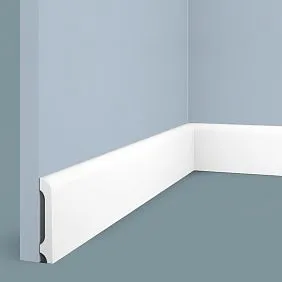
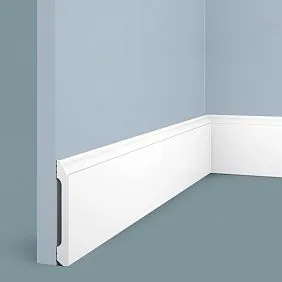
The skirting board in the hallway performs a critically important function: it protects the walls from mechanical damage, dirt, moisture, which are more prevalent here than in any other room. A height of 70-80 mm is the optimal standard, providing reliable protection with harmonious proportions.
Why exactly 80 mm for the hallway
The standard height of skirting boards in living spaces is 60-70 mm. For the hallway, it is recommended to increase it to 80 mm for several reasons:
Increased wall protection — in the hallway, walls are subjected to increased load: impacts from bags, umbrellas, shoe boxes, scratches from shoes being taken off, splashes from wet umbrellas and coats. An 80 mm high skirting board protects the wall at a greater height, reducing the risk of damage to wallpaper or paint.
Visual solidity — the hallway is a formal space where first impressions are important. An 80 mm high skirting board creates a sense of solidity, quality of finish, attention to detail. A narrow 50-60 mm skirting board looks cheap, temporary, disrespectful to the space.
Proportionality — corridors often have high ceilings (2.7-3 m) with narrow width. An 80 mm skirting board restores proportions, creating a visual base from which the vertical of the walls grows.
Hiding utilities — in an 80 mm high skirting board, you can hide electrical wires (for lighting, sockets), internet cables, which is relevant for modern hallways with lighting, intercoms, Wi-Fi routers.
Material: why solid wood
For the hallway, the skirting board should be as strong, wear-resistant, resistant to moisture and mechanical damage as possible. Solid oak or beech is the optimal choice.
Advantages of Wooden Skirting Boards:
-
Strength: oak and beech are hardwoods, resistant to impacts, scratches, dents
-
Moisture resistance: with proper coating (varnish, oil), a wooden skirting board is not afraid of moisture, does not swell from wet shoes
-
Durability: serves for decades without losing appearance, can be restored (re-sanded, repainted)
-
Eco-friendliness: natural wood does not emit harmful substances, unlike MDF or plastic
-
Aesthetics: noble wood texture, the ability to choose a shade (from light ash to dark wenge), compatibility with any interior style
Alternatives (MDF, plastic, polyurethane) are cheaper but inferior in strength, durability, and tactile qualities. For an entryway where wear resistance is important, saving on baseboards results in the need for replacement within 5-7 years.
Baseboard profile: classic or minimalism
An 80 mm high baseboard can have different profiles:
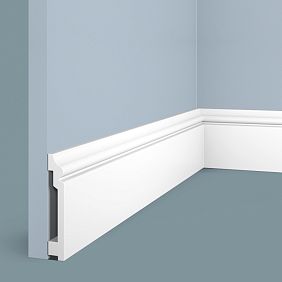
Classical profiled — a complex shape with protrusions, roundings, and coves (concave elements), creating a play of light and shadow. Suitable for classical, neoclassical, and traditional interiors. Visually rich, respectable.
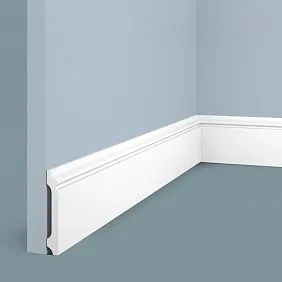
Modern with a chamfer — the top edge of the baseboard is beveled at an angle, creating a soft transition to the wall. Simpler than classical but more elegant than rectangular. Suitable for modern, Scandinavian, and eclectic interiors.
Minimalist rectangular — a smooth plank without relief. Maximally simple, modern, and laconic. Suitable for minimalist, loft, and high-tech interiors.
The choice of profile is determined by the interior style. If the entryway is decorated in a classical style (console with carving, mirror in a carved frame) — the baseboard should be classical profiled. If the style is modern (simple console, mirror in a minimalist frame) — the baseboard should be minimalist.
Baseboard color: contrast or unity
The color of the baseboard affects the perception of the entryway space:
Baseboard matching the wall color — visually continues the wall to the floor, making the walls appear taller and the corridor wider. Creates an effect of continuity and unity. Suitable for narrow entryways where visual expansion is important.
Baseboard matching the floor color — creates a unified horizontal floor plane, visually expanding it. Suitable for dark floors (dark oak, wenge), where a dark baseboard supports the floor.
Contrasting baseboard — a white baseboard against a dark floor and light walls creates a clear, graphic boundary. A modern, expressive option. Requires perfectly even walls.
For a classical entryway, a baseboard in a natural wood color (oak, beech) with a transparent varnish or oil finish is often chosen. This is a universal option that combines with any color scheme, emphasizing the naturalness of the material.
Mirror above the console: functionality
Mirror for the entryway— is not just decor, but a functional necessity. It allows checking one's appearance before leaving the house, assessing how clothing fits, whether the hairstyle is neat, and if there are any stains or inconsistencies. Placing a mirror above the console is a classic solution, creating a functional composition.
Why exactly above the console
The composition 'console + mirror above it' is a classic technique used in interior design for centuries. Reasons for its popularity:
Visual logic — the mirror visually continues the vertical line of the console, creating a unified composition. The brain perceives them as a cohesive ensemble, not as separate items.
Functionality — the console serves as a place for items needed before leaving (keys, phone, bag). The mirror above the console allows checking one's appearance while simultaneously taking necessary items from the countertop. Everything in one place, saving movement.
Decorativeness — the console is often decorated with decor (vase with flowers, candlesticks, books, photo frames). The mirror reflects this decor, visually doubling it, creating depth and richness in the composition.
Visual expansion of space — the mirror reflects the opposite wall, creating an illusion of additional space. In a narrow entryway, this is critically important.
Placing a mirror above the console creates an organized, functional, and visually appealing zone, becoming the center of the entryway.
Mirror placement height
The correct height for placing the mirror ensures functionality and harmonious proportions. The lower edge of the mirror should be 10-20 cm above the console countertop. This creates a visual connection between the console and the mirror, leaving space for decor on the countertop (lamp, vase) that is not obscured by the mirror.
The height of the console is usually 75-85 cm (standard table height). The lower edge of a 120 cm high mirror, placed 15 cm above an 80 cm high console countertop, will be 95 cm from the floor. The upper edge of the mirror — at 215 cm (95 + 120). This is a comfortable height, allowing people of average and tall height to see themselves from head to chest.
If you need to see more (to the waist or hips), choose a mirror 140-160 cm high. For a full-length reflection — 180-200 cm (but such a mirror above the console creates a disproportion in scale; it is better to place it separately on the wall).
Mirror lighting
A mirror in the entryway requires good lighting. A typical ceiling light creates shadows on the face, distorting the perception of appearance. The optimal solution is mirror lighting.
Lighting options:
-
Sconces on the sides of the mirror: two wall-mounted lights at face level create even lighting without harsh shadows. A classic, proven option.
-
Light fixture above the mirror: a horizontal fixture (sconce or spotlight) above the top edge of the mirror illuminates the face from above. More compact than side sconces, but may create shadows under the chin.
-
LED perimeter lighting around the mirror: an LED strip built into the mirror frame creates even, soft illumination. A modern, stylish option.
-
Table lamp on the console: does not illuminate the face directly, but adds localized light, creating a cozy atmosphere.
Light temperature is important: warm light (2700-3000K) is cozier but may distort colors (especially important for makeup). Neutral light (4000K) renders colors more accurately but may seem cold. A compromise is warm white 3000-3500K.
Selecting mirror height: 100-120 cm
The height of the mirror determines which part of the body you will see in the reflection. For an entryway, the optimal height is 100-120 cm, allowing you to see yourself from head to chest or waist.
100 cm mirror: a compact option
A mirror 100 cm high is the minimum size for an entryway that ensures functionality. It allows you to see the face, hairstyle, and upper part of clothing (shirt, blouse, jacket up to chest level). Suitable for small entryways (3-4 m²) where compactness is important.
Advantages:
-
Does not overwhelm a small space
-
Costs less than large mirrors
-
Lighter in weight, easier to mount
-
Sufficient for checking hairstyle, face, and upper clothing
Disadvantages:
-
Does not show the full outfit
-
Cannot assess how a skirt, pants, or shoes fit
-
Less decorative effect
A 100 cm mirror is suitable if there is a separate full-length mirror in the entryway (in a wardrobe, on a door) or if seeing the upper part is sufficient for you.
120 cm mirror: the optimal standard
A mirror 120 cm high is the golden mean, optimal for most entryways. It allows you to see yourself from head to waist or hips (depending on height and placement), sufficient for evaluating most of the outfit.
Advantages:
-
Shows face, hairstyle, outerwear, accessories (scarves, jewelry), and the upper part of undergarments
-
Harmonious proportions for placement above a console
-
Sufficient decorative expressiveness
-
Visually expands the space more than a compact mirror
Disadvantages:
-
Does not show full height (if critical — 180+ cm is needed)
-
Requires more wall space
A 120 cm mirror is a universal choice, suitable for entryways from 4 to 10 m², providing functionality with harmonious proportions.
140-160 cm mirror: an extended version
A mirror 140-160 cm high shows almost the full outfit (from head to knees or mid-calf). Suitable for spacious entryways (8+ m²) where there is room for a large mirror.
Advantages:
-
Almost full-length reflection
-
Maximum functionality for evaluating the outfit
-
Powerful decorative effect
-
Visually doubles the height of the room
Disadvantages:
-
Requires a high ceiling (2.8+ m) and a spacious wall
-
Heavy, requires reliable mounting
-
More expensive than compact mirrors
-
May create a proportion imbalance over a standard console (a more massive console is needed)
Mirror width: matching the console
The mirror width should match the console width. The optimal ratio: the mirror is 10-20 cm narrower than the console or equal to it in width.
Examples:
-
Console width 80 cm — mirror 60-80 cm
-
Console width 100 cm — mirror 80-100 cm
-
Console width 120 cm — mirror 100-120 cm
A mirror wider than the console creates a visual imbalance: the console appears too small, squashed. A mirror significantly narrower than the console gets lost and fails to create compositional unity.
Uniform wood species: oak or beech
A harmonious interior is created by repeating materials, textures, colors. In an entryway, where the key elements are the baseboard, mirror frame, and console — using a uniform wood species creates visual unity and integrity.
Oak: classic and durable
Oak is the most popular wood species for furniture and architectural elements. Reasons for its popularity:
Exceptional strength — oak is a hardwood (Brinell hardness 3.7-4.0), withstands mechanical loads, and does not dent from impacts.
Moisture resistance — oak contains tannins, providing natural moisture resistance. With proper finishing, oak products are not afraid of moisture, do not swell, and do not warp.
Expressive texture — contrasting annual rings, large medullary rays (especially on radial cuts) create a noble, easily recognizable pattern.
Color palette — natural oak has a warm light brown color. When stained, it can range from white (whitewashed oak) to black (ebonized oak, wenge).
Durability — oak products last for centuries without losing strength and can be restored.
Oak baseboard, oak mirror frame, oak console in the entryway — a classic, time-tested solution that creates a sense of solidity, respectability, and quality.
Beech: European elegance
Beech — the second most popular wood species for furniture and finishing. Characteristics:
High density — beech is denser than oak (density 650-750 kg/m³), ensuring strength and wear resistance.
Uniform texture — beech's annual rings are less contrasting than oak's, the texture is fine and even. This creates a calmer, more restrained appearance.
Light shade — natural beech has a light pinkish-cream shade, warm and cozy.
Takes stain well — beech's uniform structure allows it to be evenly stained in any color and create effects (patina, aging).
Eco-friendliness — beech grows faster than oak, making it a more eco-friendly choice (rapid forest regeneration).
Beech baseboard, beech mirror frame, beech console — European classic, more visually restrained than oak, but not inferior in quality.
Uniform wood species: why it's important
When all wooden elements in the entryway are made from the same wood species (oak or beech), visual unity is created. The wood texture repeats on the baseboard, mirror frame, and console — the brain perceives this as integrity, thoughtfulness, and harmony.
Mixing wood species (oak baseboard, beech frame, pine console) creates visual noise and disjointedness. Each element visually exists separately, failing to form an ensemble.
Exception: intentional contrast, when elements made from different wood species create a decorative effect. For example: a light beech console against a dark oak baseboard and a dark oak mirror frame. But this requires design flair and an understanding of contrast proportions.
Finishing options: natural or painted
Wooden elements can have a natural finish (clear varnish or oil that preserves the grain) or a painted finish (enamel that hides the grain).
A natural finish emphasizes the nobility of the wood, its grain, and natural beauty. Suitable for classic, traditional, and eco-styles. Creates warmth, coziness, and a connection with nature.
A painted finish allows you to choose any color that matches the interior's color scheme. White, gray, and pastel tones are popular for Scandinavian, Provence, and shabby chic interiors. Black and graphite tones are for modern, loft, and minimalist styles.
Important: if a painted finish is chosen, all elements (baseboard, frame, console) must be painted the same color. Different shades of white (a cool white baseboard + a warm white frame) create visual dissonance.
Solid wood console table: the finishing touch
The console is a key element in furnishing an entryway. It provides a horizontal surface for placing items, creates a decorative accent, and serves as the base for a composition with a mirror.
Functions of a console in an entryway
The console serves several functions:
Place for keys and small items — the console surface serves as a spot for keys, phone, wallet, documents — everything you need to grab before leaving or put down upon arrival. This organizes the space and prevents loss of important items.
Place for decor — the console is decorated with a vase of flowers, candlesticks, photo frames, books, sculptures. This creates visual appeal, individuality, and showcases taste.
Functional surface — you can place a bag, shopping bags while changing shoes, sort mail, or set down purchases on the console.
Composition base — the console + mirror above it form the compositional center of the entryway, a focal point that draws the eye.
Console dimensions for an entryway
Standard console dimensions:
-
Height: 75-85 cm (standard table height, comfortable for use)
-
Width: 60-120 cm (depends on the width of the entryway)
-
Depth: 30-40 cm (enough for placing decor, but doesn't eat up walkway space)
For narrow entryways (100-120 cm wide), the console should be shallow — 25-30 cm, leaving a minimum walkway of 70-80 cm. For spacious entryways (150+ cm wide), the console can be deeper — 40-50 cm, providing more space for placing items.
Console style: matching the overall style
The console should match the style of the entryway:
Classic console — with carved legs, decorative elements, possibly with gilding or patina. Suitable for classic, neoclassical, and Provence interiors. Creates elegance, respectability, and sophistication.
Modern console — with simple straight legs, minimal decor, and clean lines. Suitable for modern, minimalist, and Scandinavian interiors. Creates lightness, functionality, and visual purity.
Loft console — with metal legs (black metal, stainless steel), a rough wooden tabletop, and industrial aesthetics. Suitable for loft, industrial, and eclectic interiors.
The console, baseboard, and mirror frame should speak the same stylistic language. A classic carved console + a minimalist rectangular baseboard + a modern thin mirror frame — stylistic chaos.
Material and finish
A solid wood console (oak, beech) harmonizes with a wooden baseboard and wooden mirror frame, creating material unity. The console's finish should match the finish of the other elements:
-
If the baseboard and frame are natural oak with oil, the console is natural oak with oil
-
If the baseboard and frame are white enamel, the console is white enamel
-
If the baseboard and frame are dark wenge, the console is dark wenge
Exception: contrasting countertop. A console with a dark countertop (wenge, walnut) and light legs (whitewashed oak) can be paired with a light baseboard and light frame, creating an accent.
Lighting: sconces or mirror backlighting
Hallway lighting is critically important. This is a windowless room; no natural light enters. The quality of artificial lighting determines how comfortable the hallway is and how accurately you see yourself in the mirror.
General lighting: ceiling fixture
The base level is general ceiling lighting. This can be:
-
Chandelier: a classic option for spacious hallways with high ceilings
-
Surface-mounted ceiling light: a compact option for low ceilings
-
Recessed spotlights: a modern option that creates uniform lighting without accents
-
Track lighting: a flexible system that allows directing light to desired zones
General lighting should be bright enough (150-200 lux) but not harsh. Warm white light (3000K) creates coziness, neutral (4000K) creates alertness.
Local lighting: sconces by the mirror
Local lighting of the mirror area provides comfortable reflection without shadows on the face. Options:
Two sconces on either side of the mirror is a classic solution used in bathrooms, dressing rooms. Fixtures are placed at face level (160-170 cm from the floor), 60-80 cm apart. They create even facial lighting from both sides, eliminating harsh shadows.
Sconce above the mirror — a horizontal fixture (sconce or soffit with multiple lamps) above the top edge of the mirror. More compact than side sconces, but lighting is less even (light from above creates shadows under the chin, nose).
LED backlighting in the frame — a modern option: an LED strip is embedded in the mirror frame around the perimeter or on two vertical sides. Creates soft, even glow, looks stylish, modern. Requires connection to the electrical network (hidden wiring).
Local mirror lighting should be brighter than general lighting (200-300 lux), of a neutral or cool shade (4000-4500K) for accurate color rendering.
Decorative lighting: console backlighting
An additional level is decorative console backlighting. An LED strip placed under the console countertop creates a soft glow that illuminates the floor, creating atmosphere. This is not functional light, but decorative, operating in the evening, creating coziness.
A table lamp on the console (if space allows) also creates local light, coziness, visual interest.
Motion sensors: modern convenience
For the hallway, motion sensors are convenient, automatically turning on the light upon entry. This saves electricity (light doesn't stay on), is convenient (no need to search for a switch in the dark), and modern.
The sensor can be installed for general ceiling lighting or for local mirror lighting. Upon entry, the light turns on automatically; after a set time (1-3 minutes) after motion stops, it turns off.
Color scheme: harmony of elements
The hallway's color scheme is created by the combination of wall, floor, baseboard, furniture, and mirror frame colors. A harmonious scheme unites elements, creating integrity.
Neutral palette: versatility
A neutral palette (white, gray, beige, natural wood) is a universal choice for the hallway. It visually expands the space, creates a sense of cleanliness, light, and doesn't overwhelm.
Neutral palette options:
-
White walls + light floor + natural oak baseboard + natural oak console + natural oak mirror frame: Scandinavian aesthetic, light, naturalness
-
Gray walls + dark floor + white baseboard + white console + white mirror frame: modern graphic quality, contrast, elegance
-
Beige walls + medium parquet + natural beech baseboard + natural beech console + natural beech frame: warmth, classic, coziness
Contrast palette: expressiveness
A contrast palette uses a combination of light and dark to create expressiveness and visual interest.
Contrast palette options:
-
Dark walls (graphite, blue) + light floor + white baseboard + white console + white frame: drama, modernity, depth
-
Light walls + dark floor (wenge, black oak) + dark baseboard + dark console + dark frame: elegance, strictness, classic
A contrast palette requires caution in small hallways—an excess of dark color visually shrinks the space.
Color accents: individuality
A neutral or contrast base can be complemented with color accents: a bright door, colored coat hooks, a bright vase on the console, colored cushions on a bench. Accents add personality, liveliness, and prevent the boredom of neutrality.
Important: accents should be dosed (10-15% of the total color mass), otherwise they cease to be accents, turning into visual chaos.
Practical tips for arranging a hallway
Shoe storage: organization
Shoes are the main problem in hallways. Randomly placed shoes create chaos, dirt, and an unsightly appearance. Solutions:
-
Closed shoe cabinet: a cabinet with flip-down shelves that hides shoes. Compact, neat, but requires space
-
Open shoe shelf: under the console or separate, shoes are visible but organized. Requires maintaining order
-
Shoe drawer: a pull-out drawer in the lower part of the console or bench, hides shoes, saves space
Clothes hanger: hooks or a rod
Clothing requires space for hanging. Options:
-
Wall hooks: compact, cheap, easy to install. But clothes hang openly, creating visual clutter
-
Rod in a closet: if there is a built-in closet, clothes are hidden. Ideal, but requires space
-
Floor-standing hanger: freestanding, mobile, but takes up space, can tip over
Seating area: bench or pouf
Changing shoes while standing is inconvenient, especially for elderly people. A seating area is an important element.
Options:
-
Bench: a narrow seat with a soft cushion, often with a storage drawer for shoes underneath. Functional, compact
-
Pouf: soft, mobile, can be moved. Less functional (no storage), but takes up minimal space
-
Console-bench: a console with a built-in seat—combines functions
Questions and answers
What height baseboard to choose for a narrow hallway?
For a narrow hallway, a baseboard of 70-80 mm is optimal. It provides wall protection without visually overloading. A too high baseboard (100+ mm) in a narrow hallway can create a feeling of tightness.
Can you hang a mirror without a console?
Yes, a mirror can be hung on an empty wall without a console. But the 'mirror + console' composition is more functional and decorative. If space does not allow for a console, choose a narrow shelf (15-20 cm deep) under the mirror.
What type of wood is best for a hallway baseboard?
Oak or beech are optimal. Hard, durable, moisture-resistant species that can withstand the loads of an entryway. Pine is too soft and easily damaged.
What is the best lighting for an entryway without windows?
Multi-level: general ceiling lighting (150-200 lux) + local lighting at the mirror (200-300 lux) + decorative lighting (console backlight). Light temperature warm (3000K) for coziness.
How much does it cost to furnish an entryway with wooden elements?
Depends on size, wood species, complexity. Approximate budget: oak baseboard 80 mm (1200-1800 rub/m, for an entryway with a 4 m perimeter — 5000-7000 rub), 120 cm mirror in an oak frame (15000-30000 rub), oak console (25000-60000 rub). Total: 45000-97000 rub.
Can different wood species be used?
Technically yes, but not advisable. Different species (oak, beech, pine) have different textures, colors — creating visual inconsistency. A single species or painting in one color is better.
How to place a console in a very narrow entryway?
Choose an ultra-narrow console with a depth of 20-25 cm or a wall-mounted shelf-console without legs (attached to the wall like a shelf). This saves space while maintaining functionality.
Is mirror lighting needed if there is ceiling light?
Desirable. Ceiling light creates shadows on the face, distorts perception. Local mirror lighting (sconce, LED) provides comfortable reflection.
What color console to choose for a light entryway?
For a light entryway, both a light console (natural oak, white), continuing the lightness, and a contrasting dark one (wenge, walnut), creating an accent, are suitable. Depends on the desired effect.
How to care for wooden elements in the entryway?
Regular dry cleaning (once a week), wet cleaning (once a month) with a slightly damp cloth. Avoid aggressive chemicals, abrasives. Renew the wax coating on the console once a year. Baseboard with varnish coating practically requires no maintenance.
Conclusion
The perfect entryway is not a matter of large budgets or huge areas. It's a matter of thoughtfulness, attention to detail, understanding that even a compact space can be functional, beautiful, creating the right first impression. WhenWooden baseboardan 80 mm high baseboard protects the walls, creating an architectural foundation; whenwall mirror in a framea 120 cm high mirror allows you to assess your appearance while visually expanding the space; when a solid wood console provides a place for necessary items and decor — the entryway transforms from a transit zone into a full-fledged, thoughtful, respected space.
Mirror for the entryway in a frame— is not just a function, but a compositional center, a visual accent, an element that doubles light and space. Placed above the console at the correct height, with thoughtful lighting, it creates a functional zone where checking appearance, taking keys, a last glance before leaving become a convenient ritual, not chaotic fuss.
Material unity — using one wood species (oak or beech) for the baseboard, mirror frame, console — creates visual integrity, harmony, a feeling that the entryway is designed as a single space, not assembled from random elements. Natural wood texture adds warmth, naturalness, tactile quality unattainable by artificial materials.
Entryway lighting — multi-level, thoughtful, creating comfort — turns a dark room without windows into a bright, welcoming space. General ceiling lighting, local mirror lighting, decorative console lighting create layers of light, atmosphere, functionality.
The company STAVROS has been creating wooden elements for interiors for over two decades, from architectural details to furniture.Baseboards made of solid oak and beechBaseboards of all heights — from standard 70 mm to monumental 150 mm — are manufactured on high-precision equipment from selective wood that has undergone chamber drying to 8-10% moisture. Each baseboard is milled, sanded, coated with a protective compound in factory conditions, guaranteeing quality, durability, perfect geometry.
Mirror FramesMirror frames by STAVROS are handmade by master carpenters from solid oak or beech. The assortment includes frames of all sizes — from compact 60×80 cm to full-length 100×200 cm, all styles — from minimalist rectangular to carved classic, all finishing options — from natural oil to enamel coatings of any colors. Frame corners are joined with tenons, glued, reinforced, ensuring strength, no separation under the weight of the mirror.
Console tables by STAVROS are created as ready-made items (from the catalog) or custom-made according to customer sketches. Sizes are adapted to the specific entryway: from ultra-narrow consoles 25 cm deep for tight corridors to full-fledged tables 50 cm deep for spacious halls. Styling varies from classic consoles with carved legs and decor to modern minimalist ones with simple forms. Solid oak or beech is used, connection technology guarantees strength, durability.
STAVROS offers a comprehensive solution for the entryway: baseboards, mirror frames, consoles from a single wood species, maintained in a single style, with a single finish. This guarantees harmony, eliminates the need to select elements from different sources, risking mismatched shades, styles, quality. All elements from one manufacturer, mastering wood processing technologies, understanding proportions, valuing quality.
Custom design allows adapting elements to the specific entryway. Need a baseboard of a certain profile? A mirror of non-standard size? A console of exact width, fitting into a niche? STAVROS will manufacture, considering all parameters, creating elements perfectly matching your space.
Create an entryway that is not just functional, but also beautiful, not just convenient, but also creates the right first impression, where material quality, thoughtfulness of details, harmony of elements speak of the values of the people living here. STAVROS — a partner in creating entryways where wooden baseboards, mirror frames, consoles from solid oak or beech form a space worthy of being the face of your home.


