Article Contents:
- Overview of the HIWOOD series: philosophy of thoughtful design
- Material: European quality duro-polymer
- Geometric precision: perfect joints
- White color for painting: universal application
- Accessories available in variety
- Heights and geometries: profile for every task
- HIWOOD B70N: classic standard
- HIWOOD B90V1: enhanced protection
- HIWOOD BL100: modern minimalism
- HIWOOD BE100: elegant classic
- HIWOOD BE150: maximum expressiveness
- Impact resistance: tested by reality
- Density and flexural strength
- Scratch resistance
- Longevity in use
- Behavior in humid conditions
- Joining external and internal angles: technology of perfect connections
- Internal angles: two ways
- External angles: higher requirements
- Straight joints: continuation of line
- Gap filling
- Painting: final transformation
- Surface Preparation
- Choosing paint
- Painting technique
- Decorative Effects
- Interior case studies: HIWOOD in real projects
- Case 1: Modern apartment in new build
- Case 2: Classic living room in Stalinist building
- Case 3: Children's room
- Case 4: Office in business center
- Case 5: Country House
- Conclusion: A thoughtful choice for any interior
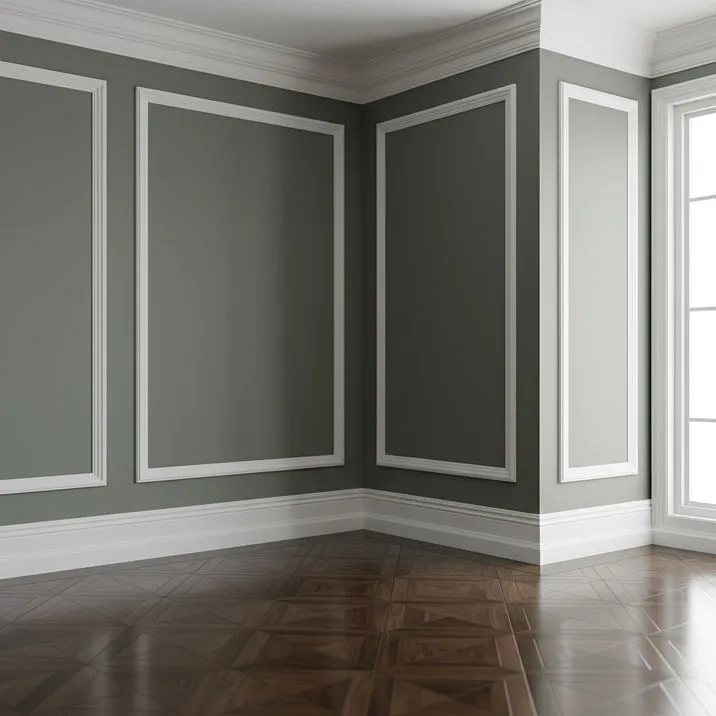
The repair is complete. The floor is laid perfectly, the walls are painted ideally, the ceiling is stretched without a single wrinkle. But you stand in the middle of the room and realize — something is missing. The joints between the floor and walls show technical gaps. The edges of the flooring are visible. The room looks unfinished, like a painting without a frame.
Baseboards solve this problem, but the choice is vast. Hundreds of manufacturers, thousands of profiles, dozens of materials. How not to drown in this variety? How to find a solution that combines quality, aesthetics, durability, and reasonable price? Many spend days searching, comparing, doubting, never making a final decision.
HIWOOD — a line of baseboards developed specifically for those who value thoughtful solutions. You don’t need to be an expert in materials science to choose the right profile. The series is logically constructed: each model solves a specific task, heights are selected for standard ceilings, geometry is thought out down to the millimeter.
HIWOOD B70N Baseboard for standard rooms, HIWOOD BL100 Baseboard for modern interiors, HIWOOD BE150 Baseboard for high ceilings — the choice logic is obvious. We will examine each model in detail, its characteristics, and applications.


HIWOOD Series Overview: Philosophy of Thoughtful Design
HIWOOD is not just a brand. It is a concept of baseboards where every detail — from profile geometry to packaging — is thought out from the standpoint of user convenience and product durability.




Material: European-quality duro-polymer
The foundation of the HIWOOD line is duro-polymer, high-density polystyrene. Density of 350-420 kg/m³ ensures strength 8-10 times greater than ordinary expanded polystyrene. These are not fragile profiles that break from accidental impact, but durable items that withstand years of use.
The production technology includes extrusion followed by compression under pressure and temperature. Air bubbles in the structure collapse, the material becomes monolithic. The surface is smooth, without visible pores, and after painting resembles premium-grade plastic.
Ecological safety is confirmed by certificates. The material is inert, does not emit harmful substances under normal conditions, suitable for residential spaces including children’s rooms. This is not cheap Chinese plastic with an unclear composition, but European quality with a complete documentation package.
Absolute moisture resistance. Duro-polymer does not absorb water, does not swell, does not lose strength in humid environments. Can be used in kitchens, bathrooms, laundries — anywhere where high humidity would destroy wooden or MDF baseboards.
Our factory also produces:


Geometric precision: perfect joints
HIWOOD production uses high-precision equipment with tolerances ±0.5 mm. This means that all profiles from one batch are absolutely identical in size. The joints produce minimal gaps, easily concealed with putty.
The length of the planks is standardized — 2.4 meters. This is the optimal length for transportation and installation. Long enough to minimize the number of joints, but not so long as to create difficulties during delivery and installation.
The ends of the profiles are cut strictly perpendicular. When joining end to end, the gap is practically nonexistent. This simplifies installation — no need to spend time on additional trimming to align surfaces.
Get Consultation
White color for painting: versatility of application
All HIWOOD profiles are supplied in white, ready for painting. This provides maximum flexibility in color solutions. Paint in the wall color to visually increase their area. In the floor color to continue the flooring upward. In contrasting color for clear framing.
The surface is optimized for painting. Smooth, without pores or roughness, it accepts paint evenly with the first layer. No need for multiple priming and sanding, unlike cheap polystyrene.
Compatibility with any water-based paints expands possibilities. Water-emulsion, acrylic, latex — all of them lay perfectly. You can create decorative effects — patina, metallic finish, pearl — duro-polymer accepts any coating.
Accessories in assortment
HIWOOD offers corner elements — internal and external angles, connectors, caps. This simplifies installation in rooms with complex configurations, where many angles and protrusions are present.
Corner elements eliminate the need for precise 45-degree trimming. Simply insert the profiles into the corner element — and the angle is perfectly finished. Especially useful for beginners who find it difficult to cut angles correctly the first time.
Compatibility of all elements is guaranteed. Angles fit all profiles of corresponding height, connectors are universal. No need to select parts from different manufacturers, risking mismatched dimensions.
Heights and Geometries: Profile for Every Task
The HIWOOD ruler includes five main models of different heights and configurations. Each is designed for specific conditions and interior styles.
HIWOOD B70N: Classic Standard
HIWOOD B70N Baseboard — Basic model 70 mm high. This is a classic height, proven over decades of use. Suitable for rooms with ceilings 2.5–2.7 m — standard for most apartments.
The profile has simple geometry with a smooth rounded top edge. The front surface is slightly convex, creating soft shadows and visual depth. The bottom part is straight and fits tightly to the floor.
The 22 mm profile width provides sufficient contact area with the wall for secure adhesion. At the same time, the profile does not protrude too much, not consuming useful room area.
Application is universal. Suitable for any living spaces — bedrooms, living rooms, children's rooms, offices. The height is sufficient to protect walls from damage, but does not visually overload small rooms.
Compatible with all interior styles. Classic, neoclassic, modern, Scandinavian — 70 mm baseboard looks natural everywhere. This is the golden middle, rarely mistaken.
HIWOOD B90V1: Enhanced Protection
HIWOOD B90V1 Skirting Board Height of 90 mm — the next level. Additional 20 mm height provides better wall protection against mechanical damage. Vacuum cleaners, mops, furniture legs — all of these come into contact with the skirting board, without reaching wallpaper or paint.
Profile geometry is more expressive. The upper part has a decorative profile with several smooth transitions, creating a play of light and shadow. This adds architectural expressiveness without excessive ornamentation.
Visual effect — the room appears higher. 90 mm height is more noticeable than 70 mm, vertical emphasis is stronger. In rooms with ceilings 2.7–3.0 m, this enhances perceived height.
Application — living rooms, dining rooms, offices, where presence is important. In bedrooms it may be excessive — too visually active. In children’s rooms it is optimal — enhanced wall protection against active play.
Combination with tall door casings creates visual unity. If casings are 80–100 mm wide, the 90 mm skirting board harmonizes with them in scale. The interior appears thoughtfully designed and proportionate.
HIWOOD BL100: Modern Minimalism
HIWOOD BL100 Baseboard Height of 100 mm — model for modern interiors. Geometry is maximally minimalist — rectangular cross-section without decorative embellishments. Clean geometry, suitable for minimalism, Scandinavian style, loft.
Height of 100 mm — European standard gaining popularity in Russia. It is a compromise between classic 70 mm and tall 150 mm. Sufficient for expressiveness, but does not overload space.
Upper edge is strictly straight, without rounding. This creates a clear horizontal line, emphasizing the room’s geometry. Combined with minimalist furniture, it creates a strict, refined look.
Application — modern apartments, offices, commercial spaces in minimalist style. In classic interiors it looks foreign — too minimalist. But in modern interiors it fully reveals its potential.
Painting in wall color makes the skirting board almost invisible. It functions as a practical element, protecting walls, but does not draw attention. The space is perceived as unified, without fragmentation into small details.
HIWOOD BE100: Elegant Classic
HIWOOD BE100 Skirting Board Height of 100 mm — classic profile with traditional geometry. Unlike the minimalist BL100, the BE100 model has a pronounced decorative relief on the upper part.
Profile includes several smooth transitions, creating complex shadow play. Upper part with a small cornice, middle with slight recess, lower part straight. This is a classical architectural form used for centuries.
Height of 100 mm with classic geometry creates a sense of solidity without heaviness. This is modern classicism — traditional forms in current scale. Suitable for neoclassical, eclectic interiors.
Application — living rooms, dining rooms, offices in classic or neoclassical style. Coordinates with wall moldings, ceiling cornices, creating a unified decorative line. The interior achieves completeness.
Contrasting color accentuates the relief. White skirting board on dark walls, or vice versa. Decorative techniques — patina, gilding — can be used to enhance the classic character.
HIWOOD BE150: Maximum Expressiveness
HIWOOD BE150 Baseboard Height of 150 mm — the tallest model in the line. This solution is for rooms with ceilings 3 meters and higher, where standard skirting boards disappear, not matching the scale.
Geometry is complex, with several levels of decorative relief. Upper part with pronounced cornice, middle with fillet, lower with plinth. This is an architectural profile characteristic of historical interiors.
Visual effect is maximal. 150 mm height makes the skirting board a dominant element, attracting attention. The room is perceived as a thoughtfully designed architectural space, not just a finished box.
Application — rooms with high ceilings in classic style. Living rooms in Stalinist buildings, private homes, reconstructed historical buildings. In standard apartments with 2.7 m ceilings, it is excessive — visually lowers the ceiling.
Combination with tall doors, wide casings, ceiling cornices creates a palace-scale interior. This is the choice of those who are not afraid of expressive forms and appreciate classical architecture.
Impact Resistance: Tested by Reality
HIWOOD DuroPolymer is not just a dense material. It is the result of engineering solutions aimed at maximum resistance to mechanical impacts.
Density and Flexural Strength
Density of 350–420 kg/m³ ensures flexural strength of about 15–20 MPa. This is 5–10 times higher than that of expanded polystyrene. In practice, this means the profile withstands significant local loads without damage.
Impact resistance tests show resistance to falling objects weighing 2–3 kg from a height of 1 meter without cracks or chips. A fallen book, toy, or tool will leave no trace. For comparison: polystyrene skirting boards would break under the same conditions.
Compressive strength allows skirting boards to withstand pressure from furniture leaning against walls. A sofa, cabinet, or shelf — their weight does not deform the profile. Polystyrene would dent under such pressure.
Scratch Resistance
The surface of HIWOOD DuroPolymer is hard and resists scratches. Accidental contact with shoes, pet claws, or stiff brushes during cleaning leaves no noticeable marks. The material retains smoothness for years.
For comparison, conduct a test. Run a sharp object over a polystyrene skirting board — a deep groove remains. The same on HIWOOD DuroPolymer — minimal trace, almost invisible. The difference is obvious.
Painted surface is additionally protected by a layer of paint. Quality acrylic paint creates a hard film, enhancing scratch resistance. Two to three layers of paint — and the surface is practically scratch-resistant under household conditions.
Long Service Life
Service life of HIWOOD skirting boards on floors — 25–30 years without loss of functional or aesthetic qualities. The material does not chemically age, does not lose strength, does not yellow over time. After twenty years, the profile looks the same as on the day of installation.
Comparison with alternatives is clear. Polystyrene skirting boards on floors last 5–7 years — then require replacement due to accumulated damage. Wooden skirting boards last 10–15 years, but require periodic repainting. MDF is afraid of moisture, swells in bathrooms and kitchens.
Economic Efficiency is evident in the long term. HIWOOD is 2–3 times more expensive than polystyrene at purchase, but lasts 4–5 times longer. Calculated per year of use, duro-polymer is cheaper, plus no replacement costs.
Behavior in Humid Conditions
Absolute moisture resistance of duro-polymer has been proven by practice. HIWOOD skirting boards are installed in bathrooms, saunas, pool areas — they work for decades. Direct contact with water, steam, condensation — none of this affects the material.
Freeze-thaw cycles, critical for unheated cottages, duro-polymer withstands without damage. Monolithic structure has no weak points where degradation could begin. This is a clear advantage over polystyrene, which may delaminate along granule boundaries.
External and Internal Corner Joints: Technology of Perfect Connections
Corner quality determines the overall visual impression. Gaps, misalignments, profile mismatches are immediately noticeable.
Internal Corners: Two Methods
First method — cut at 45 degrees and join. Use a miter saw with a fine-toothed blade for a clean cut. A miter box works, but a miter saw is more precise, giving an ideal angle without adjustment.
Cut both profiles at 45 degrees, apply to the corner, check the joint tightness. If there is a micro-gap, trim one profile by 0.5–1 mm, achieving perfect fit. Patience at this stage pays off in the result.
Adhere the first profile, then the second, pressing them tightly together at the corner. Fill micro-gaps up to 0.5 mm with acrylic sealant, smooth with a damp finger. After painting, the joint is invisible.
Second method — use pre-made corner elements. Insert profiles into the corner element from both sides — the corner is finished. Fast, simple, requires no precise trimming. But the corner element may be visually noticeable, especially before painting.
External Corners: Higher Requirements
External corners are visible, gaps here are especially noticeable. Cutting accuracy is critical. Use only a miter saw verified for angle precision. Even a 1-degree deviation creates a gap of several millimeters at the external corner.
Cut both profiles at 45 degrees, apply to the corner, check from both sides. Gaps are unacceptable. If present, trim until perfect fit. Any mismatch is visible at external corners.
Adhere the profiles, additionally fix with a finishing nail or screw in the corner. External corners are more susceptible to contact than straight sections; additional fastening prevents peeling.
HIWOOD pre-made external corner elements eliminate the need for precise trimming. Simply insert the profiles — and the corner is ready. For beginners, this is a lifesaver; for professionals — time-saving.
Straight Joints: Continuation of the Line
On long walls, multiple boards must be joined. Cutting ends strictly at 90 degrees ensures tight fit. HIWOOD profile’s geometric precision gives a gap of less than 0.5 mm, almost invisible.
Place joints in least noticeable locations — behind furniture, in far corners from entry. Even distribution around the perimeter looks better than clustering in one spot.
HIWOOD connecting elements mask joints. A small insert is placed at the connection point of two boards, hiding the gap. After painting, the connector blends with the profile.
Gap Filling
Fill micro-gaps up to 0.5 mm with white acrylic sealant. Apply a thin bead into the gap, smooth with a damp finger, remove excess. After drying and painting, the gap is invisible.
Gaps 0.5–2 mm require acrylic putty. Fill the gap, smooth with a putty knife, let dry 2–4 hours. Sand with fine grit, paint. The joint will be visible up close, but invisible from afar.
Gaps over 2 mm — installation defect. Recut profiles until tight fit is achieved. Attempting to fill a large gap with putty will leave a noticeable seam, even after painting.
Painting: Final Transformation
Painting HIWOOD skirting boards — final stage, determining visual impression. Proper technique yields a professional result.
Surface preparation
After installing all profiles, fill joints and mounting points with putty. Let dry, sand with fine grit 180–220. Surface must be perfectly smooth — paint will reveal any imperfections.
Remove dust after sanding with dry cloth or vacuum with soft attachment. Wipe with damp cloth, let dry. Even the smallest dust under paint will create roughness.
Priming is not necessary for duro-polymer — surface is dense, paint adheres well. But if you want a perfect result, prime with acrylic primer. This equalizes absorption, improves final color.
Paint Selection
Any water-based paint — emulsion, acrylic, latex — is suitable for HIWOOD duro-polymer. Alkyd and oil-based paints can be used, but water-based are more convenient — odorless, dry quickly, easy to clean.
Choose the gloss level to your liking. Matte paints hide minor defects and do not create reflections. Semi-gloss and satin finishes create a subtle silk-like sheen. Glossy finishes highlight quality but require perfect surface preparation.
Paint quality affects the durability of the coating. Premium paints create a harder film, are easier to clean, and retain color longer. Saving on paint will result in repainting every 3-5 years.
Painting Technique
Paint with a brush or small roller. A 40-50 mm wide brush is optimal for skirting boards — it reaches all recesses of the profile, leaving no unpainted areas. A roller provides a smoother surface on flat profiles.
First layer — primer, thin. Dilute paint with water by 10% for better penetration. Apply evenly, ensuring no drips. Allow to dry 2-4 hours depending on the paint.
Second layer — main. Do not dilute the paint; apply in a thin, even layer. Work quickly and do not repaint already dried areas — this causes streaks and buildup. Check the result after 2-4 hours.
Third layer if needed. If the base is visible after the second layer, apply a third. Three thin layers give better results than two thick ones. The final layer determines the coating quality.
Decorative Effects
Patina is created using dark paint in the recesses of BE100 and BE150 profile reliefs. Apply dark paint (brown, gray) over the entire profile. While still wet, wipe the raised parts with a damp sponge. The paint remains in the recesses, creating an aged effect.
Metallic finish imitates gold, silver, or bronze. After the base coat, apply metallic paint with a dry brush to the raised parts of the profile relief. This creates a gilded effect, suitable for classic interiors.
Two-tone painting creates contrast. Bottom part of the skirting board is one color, top part another. Use painter’s tape for a clean line. This technique suits children’s rooms and eclectic interiors.
Interior Cases: HIWOOD in Real Projects
Theory is good, but how do HIWOOD skirting boards work in real interiors? Let’s examine typical application scenarios.
Case 1: Modern Apartment in a New Build
Two-room apartment 55 m², ceilings 2.7 m, style modern minimalism. Floor — light oak laminate, walls painted light gray, ceilings white suspended.
Solution: HIWOOD BL100 Baseboard Along the entire perimeter, painted to match wall color. The profile’s clean geometry matches the style. Painting to match wall color visually increases wall area, making the room appear more spacious.
Result: a clear horizontal line emphasizes the space’s geometry. The floor-to-wall transition is neatly finished, without visual breaks. The skirting board protects walls from vacuum cleaners, remaining unobtrusive. The interior appears cohesive.
Case 2: Classic Living Room in a Stalinist Building
Living room 28 m², ceilings 3.2 m, style neoclassicism. Floor — dark oak parquet, walls with moldings painted beige, ceiling with ornate cornice white.
Solution: HIWOOD BE150 Baseboard white color. Height 150 mm matches the scale of the room with high ceilings. The relief geometry complements the ceiling cornice and wall moldings.
Result: the interior achieves architectural completeness. The high relief skirting board creates a sense of respectability, fitting the historical era of the building. White contrasts with dark parquet, emphasizing the boundary.
Case 3: Children’s Room
Children’s room 15 m², ceilings 2.65 m, style modern with Scandinavian touches. Floor — light beech laminate, walls painted soft blue, ceiling white.
Solution: HIWOOD B90V1 Skirting Board white color. Height 90 mm provides enhanced wall protection against active children’s play. Durapolymers withstand toy impacts without chipping.
Result: walls are protected up to 90 mm — the main contact zone during play. White skirting on blue walls creates a fresh contrast. The material is eco-safe and mechanically durable — ideal for children’s rooms.
Case 4: Office in a Business Center
Office 120 m² open plan, ceilings 3.0 m, style minimalism with industrial elements. Floor — vinyl tiles imitating concrete, walls painted in various shades of gray, ceiling Armstrong.
Solution: HIWOOD BE100 Skirting Board painted dark gray. Height 100 mm protects walls from office chairs, carts, and cleaning equipment. Classic geometry softens industrial rigidity.
Result: skirting boards withstand intensive commercial use without damage. Dark gray is practical — it hides marks from shoes and chairs. The office looks upscale, despite minimalist finishes.
Case 5: Country House
Living room in a country house 45 m², ceilings 3.5 m, style modern classic. Floor — solid oak planks, walls with decorative panels painted cream, ceiling wooden coffered.
Solution: HIWOOD BE150 Baseboard painted to match the color of wooden panels. Maximum height corresponds to the room’s scale. Painting to match wood integrates synthetic material into a wooden interior.
Result: skirting boards are perceived as part of the wooden finish. Height 150 mm creates an architectural scale matching the coffered ceiling. Durapolymers are resistant to humidity fluctuations typical of country houses.
Conclusion: Thoughtful Choice for Any Interior
The HIWOOD line is a system of skirting boards, where each model solves a specific task.
HIWOOD B70N Baseboard for standard apartments,
HIWOOD B90V1 for enhanced protection,
HIWOOD BE100 for classic style,
HIWOOD BE150 for high ceilings.
European-quality durapolymers ensure a 25-30 year lifespan. Impact resistance, moisture resistance, and geometric stability — properties proven by thousands of installations. This is not cheap polystyrene requiring replacement every 5-7 years, but a reliable solution for decades.
Geometric precision of profiles simplifies installation. Joints become tight with minimal gaps. Pre-cut corner elements eliminate the need for precise trimming. Even a beginner can install HIWOOD skirting boards with professional results.
Paintable surface offers flexibility in color choices. White to match walls, contrasting, with decorative effects — any concept can be realized. Durapolymers accept any water-based paint, creating a smooth, long-lasting coating.
STAVROS Company — official supplier of HIWOOD skirting boards. Full range of models, accessories, professional consultations. Assistance with quantity calculation, installation and painting recommendations, quality guarantee.
Choose HIWOOD — choose a thoughtful solution. You don’t need to be an expert to achieve professional results. Simply follow the series logic, choose the model suited to your conditions, and install according to instructions. The interior will achieve completeness that will delight for decades.