Article Contents:
- Dining Tables: The Centerpiece of the Dining Room and Kitchen
- Coffee Tables: Low Accents for the Living Room
- Console Tables: Narrow Wall-Mounted Accents
- Desks: Workspaces
- Wood Species for Tables: From Pine to Oak
- Tabletop Shapes: From Rectangle to Custom
- Table Bases: Underframes for Self-Assembly
- Popular Base Models
- Mounting the Tabletop onto the Base
- Where to Buy: STAVROS — Manufacturer Since 2002
- How to buy
- Frequently Asked Questions About Solid Wood Tables

A table is not merely a utilitarian horizontal surface for placing plates, documents, or books; it is the architectural axis of a space, a social focal point around which family life, business negotiations, and friendly gatherings are formed.classic tableA solid oak table with carved legs 75 centimeters high, a top measuring 180×90 cm, oval or rectangular, seating 6-8 people, is not just furniture but a ritual, a tradition materialized in wood. The dining table is the place where the family gathers twice daily (breakfast, dinner), exchanges news, makes plans, argues, laughs, and creates a shared history. A coffee table 45 centimeters high, with a 100×60 cm top in front of the sofa, is not just a stand for remotes and magazines but the center of the living area, organizing space for tea parties, reading, and conversations. A writing desk 140×70 cm with drawers is a workstation where concentration and productivity depend on the quality, ergonomics, and aesthetics of the surroundings.
A chipboard table with a melamine coating for 8,000 rubles is a cheap, functional minimum, sagging under the weight of dishes (12 plates, pots, pans — 15-20 kilograms per square meter of tabletop), scratching from knives and forks, swelling from spilled water, and deteriorating after 5-7 years.where to buy a wooden tableA solid, stable, beautiful table that serves for 30-50 years without degradation, passed down to children and grandchildren as a family heirloom?Where to buy a wooden tableNot as a consumable item, changed every 10 years along with the renovation, but as a constant, a material anchor around which the home is built?
Furniture hypermarkets offer pine tables — cheap (a 160×90 dining table for 15,000-25,000 rubles), soft (pine with a density of 500 kg/m³ scratches and dents easily), resinous, with the simplest legs (straight conical without carving or turning). Salons import tables — Italian, Spanish — high-quality but with a 150-300% markup for the brand (an oak dining table 180×90 for 80,000-150,000 rubles). The optimal solution is a manufacturer specializing in solid wood furniture, offering a catalog of ready-made tables in classic styles, the possibility of custom sizing, and selling separatelyTable frames(underframes) for self-assembly with a tabletop. The company STAVROS — a St. Petersburg manufacturer since 2002 — offerssolid wood tablestables made of oak and beech: dining (160×90, 180×100, 200×100 cm, extendable up to 240-280), coffee (100×60, 120×70), console (120×40, narrow wall-mounted), writing (140×70, 160×80). Prices range from 25,000 to 120,000 rubles depending on size, wood species, and leg complexity. Pluscarved table bases30+ models (underframes with turned, carved legs, and aprons), priced from 15,000 to 60,000 rubles — for those who have a tabletop (stone, slab, solid wood) and need only the base.


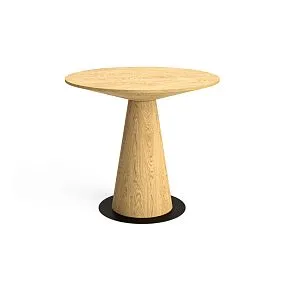
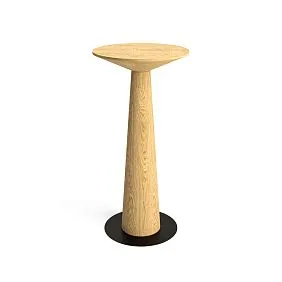
Dining Tables: The Centerpiece of the Dining Room and Kitchen
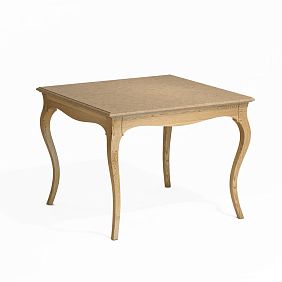
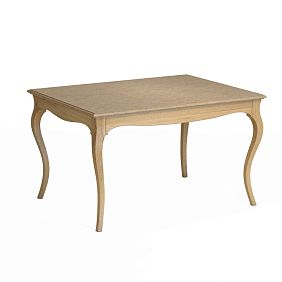
The dining table is the largest, most heavily loaded (dishes, food 20-30 kg), and most social piece of furniture in the home. The size of a dining table is calculated based on a standard of 60 centimeters of width per person: a 180×90 cm table seats 6 people (two along each long side 180÷60=3, one at each end), a 200×100 cm table seats 8 people (three along each long side, one at each end). The standard height for a dining table is 75 centimeters from the floor to the top of the tabletop (optimal for chairs with a seat height of 45 cm, ensuring comfort while eating — elbows rest naturally on the table, back is straight, legs are free under the table).
The shape of a dining tabletop determines style, capacity, and spatial integration. A rectangular top 180×90, 200×100 cm is classic, universal, optimally using space (the table is placed along a wall, in the center of the dining room, between windows), and seats the maximum number of people. The rectangular shape is characteristic of classic, neoclassical, English, and Scandinavian styles. An oval top 180×100, 200×110 cm is elegant, soft, safe (no sharp corners — important for children), and visually lighter than a rectangular one (rounded edges create smoothness and airiness). The oval shape is characteristic of French, Victorian, Provence, and Rococo styles. A round top with a diameter of 120-150 centimeters is democratic (all seated are equidistant from the center, conversation is general, not breaking into pairs), compact (a round table 120 cm in diameter seats 4-5 people, occupying an area of 1.2×1.2=1.44 sq.m, while a rectangular 120×80 cm table seats 4 people, occupying 0.96 sq.m, but the round one leaves uniform passageways on all sides). The round shape is optimal for small dining rooms, kitchens of 10-16 square meters, and bistro, country, and modern styles.
An extendable dining table is a transformer, increasing in length from 160-180 to 240-280 centimeters when hosting guests, for holidays, or feasts. The extension mechanism is classic: the tabletop consists of two halves sliding on guides in opposite directions, creating a gap of 60-80 centimeters where an additional section (leaf) is inserted, stored under the tabletop or separately. The synchronized mechanism (one hand pulls the edge of the tabletop, both halves extend symmetrically via springs, blocks, or gear racks) is convenient, requiring 5-8 kilograms of force. The unsynchronized mechanism (each half is extended manually) is cheaper, requires two hands, and is physically heavier. An extendable solid oak table 180×100 cm (extends to 240) from STAVROS costs 65,000-95,000 rubles — more expensive than a non-extendable one (45,000-75,000) due to the cost of the mechanism, additional leaf, and complex underframe construction.
An extendable table is justified if: a family of 4-5 regularly hosts guests (once a month gatherings of 8-10 people — weddings, birthdays, holidays), the dining area is limited in space (in normal mode, a 180 cm table occupies 1.8 sq.m, a 240 cm table occupies 2.4 sq.m, a difference of 0.6 sq.m is critical for a dining room of 12-16 sq.m). An extendable table is not needed if guests are rare (once a year — it's easier to rent an extra table for the holiday), or the dining room is spacious (a permanent large 240 cm table is not in the way).




Coffee Tables: Low Accents for the Living Room
A coffee table (occasional table, tea table) is a low piece of furniture, 40-50 centimeters high, placed in front of a sofa or between armchairs in the living area. The coffee table is functional: cups and mugs are placed on it during tea parties and conversations; remotes, magazines, books, and phones are placed on it; it is used as a footrest (putting feet up on the edge of the coffee table while lying on the sofa is a common domestic gesture). The coffee table is decorative: the tabletop is a platform for compositions (a vase with flowers, a stack of art albums, candles, figurines); the legs are sculptural elements, visible from all sides (the coffee table stands in the center of the area, not against a wall, and is viewed from all angles).
The size of a coffee table is chosen to match the size of the sofa: for a sofa 200 centimeters long, a table 100-120×60-70 cm is optimal (half the length of the sofa to avoid blocking passage from the sides); for a 240 cm sofa, a 120-140×70-80 cm table. A height of 40-45 centimeters is standard, slightly lower than the sofa seat height (45-50 cm), convenient for placing cups (the arm from the sofa lowers naturally) and reading (a book on the table is at eye level for a seated person). A height of 50-55 cm is elevated, convenient for eating (dinner in front of the TV) and working on a laptop (screen at eye level).
Coffee table shapes are diverse. A rectangular tabletop 100×60, 120×70 cm is classic, spacious, parallel to the sofa lines, creating geometric order. An oval 100×60, 120×70 cm is soft, safe (rounded edges are safe for children running in the living room), elegant. A round table with a diameter of 80-100 cm is compact, democratic (all seated are equidistant), characteristic of modern, art deco, and contemporary styles. A square 80×80, 100×100 cm is symmetrical, static, suitable for square living rooms, centered compositions (table in the center of the room, surrounded symmetrically by four armchairs).
A solid oak coffee table top 30-40 millimeters thick weighs 15-25 kilograms (oak density 750 kg/m³, top 100×60×3 cm = 0.018 m³ × 750 = 13.5 kg + aprons, legs). A solid top is stable (doesn't tip over if a child leans on it), durable, and tactilely warm. An alternative to solid wood is veneer (MDF top 16 mm, veneered with 0.6 mm oak veneer, varnished) – lighter, cheaper (a 100×60 cm table from solid wood costs 35,000-60,000, from veneer 18,000-35,000 rubles), but lacks the depth and authenticity of solid wood.
Coffee table legs are a decorative dominant, as the table is low, and legs visually occupy half the height. Turned legs (balusters) with classic profiles (flutes, balls, vases) are characteristic of classic and neoclassical styles. Carved legs (cabriole – S-shaped curve, characteristic of Baroque, Rococo) create sculptural quality and dynamism. Straight tapered legs are minimalist, modern, Scandinavian. A cross-shaped underframe (four legs joined by a cross) is traditional, rustic, country.
Our factory also produces:


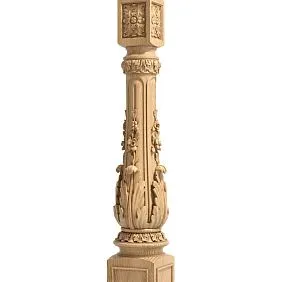
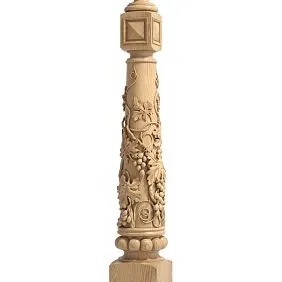


Console tables: narrow wall-mounted accents
A console table (console) is a narrow wall-mounted table 30-40 centimeters deep, 100-150 cm long, placed against a wall in an entryway, hallway, or living room. A console is functional: keys, wallets, phones are placed on it upon entry; vases, photo frames, and lamps are placed on it in the living room. A console is decorative: a narrow tabletop and high legs (a console is usually higher than a dining table – 80-90 cm) create vertical graphics, visible upon entry, organizing the space of a hallway or entryway.
A console table is placed against a wall, does not require passage around it, and optimally uses narrow spaces (a hallway 120 cm wide – a console 40 cm deep leaves an 80 cm passage, which is sufficient). A console tabletop 120×40 centimeters accommodates a table lamp (base diameter 20 cm), a vase (diameter 15 cm), a 20×30 photo frame, a key holder – functionally sufficient for an entryway. In a living room, a console is placed behind a sofa (the sofa is not against the wall but in the center of the room, the console between the sofa back and the wall – a narrow space 40-50 cm), under a mirror, or between windows.
Console tables are often carved – cabriole legs, milled or carved aprons with acanthus leaves – because the console is visible, not hidden by chairs or dishes, so decorativeness is critical.Carved table frameA console-type frame from STAVROS – an underframe 80 cm high, 120 cm wide, 40 cm deep, with four cabriole legs, carved aprons, connected by S-shaped braces for rigidity – costs 25,000-45,000 rubles (without the tabletop). The client purchases the tabletop separately: wooden (solid oak 120×40×3 cm costs 8,000-12,000), stone (marble, granite 120×40×2 cm – 15,000-30,000), glass (tempered glass 120×40×1 cm – 5,000-8,000). Total cost of a console table: frame 35,000 + tabletop 10,000 = 45,000 rubles.
Advantage of buying a frame separately: freedom to choose the tabletop (you can use a slab – a cross-section of a whole tree trunk 5-8 cm thick with bark, creating a natural effect, costing 20,000-50,000, or composite stone like Corian, or even an old board found at a dump, sanded and oiled), the ability to replace the tabletop after 10-20 years (the frame lasts 50 years, the tabletop wears out – only replace it). Disadvantage: the need to independently attach the tabletop to the frame (screws from below through the aprons or glue).
Get Consultation
Desks: workspaces
A writing desk (work desk, study desk) is a table for work, writing, reading, computer use, sized 120-160 centimeters long, 60-80 cm deep, 75 cm high. A writing desk differs from a dining table by having drawers (usually 3-5 pull-out drawers on the right and/or left under the tabletop for storing documents, stationery, small items), greater depth (80 cm vs. 90-100 for a dining table – so a computer monitor is placed 50-60 cm from the eyes, plus a 40 cm keyboard, plus a 10 cm margin to the edge of the table).
A writing desk made of solid oak 140×70 cm with three drawers on the right from STAVROS costs 45,000-75,000 rubles. Construction: solid oak tabletop 30-40 mm thick, four turned legs (two free on the left, two on the right integrated into a drawer pedestal), milled aprons, drawers on ball-bearing slides (smooth extension), hidden fasteners (screws countersunk, covered with plugs). Finish: natural oil (8 shades to choose from) or semi-matte varnish.
A writing desk is placed by a window (natural light from the left for a right-handed person, from the right for a left-handed person – prevents hand shadow when writing), against a wall (the wall in front of the desk – space for a monitor, shelves, a notice board), in a corner (L-shaped configuration – desk along one wall, shelving along another, forming a work corner). A writing desk requires space: at least 120 cm in front for a chair, moving back, standing up; 50 cm on the sides for freedom.
A desk for two (two-person desk) – a long table 240-300 centimeters, where two people work face-to-face or side-by-side. A two-person desk is optimal for married couples working from home (each has their own workspace, space-saving – one large table instead of two small ones), children's rooms (two children do homework at one table, each on their own half). A two-person desk made of solid wood 240×80 cm with six drawers (three on each side) costs 65,000-95,000 rubles.
Wood species for tables: from pine to oak
Pine – an affordable species (a 160×90 cm pine dining table costs 18,000-30,000 rubles), soft (density 500 kg/m³), light (yellow-white), resinous. A pine table scratches easily (knives, forks, hot dishes leave marks), dents (dropping a heavy object leaves a dent), requires careful handling. Pine is optimal for country houses, secondary tables (a desk in a child's room, a coffee table on a terrace), where the budget is limited and wear is acceptable. For a main dining table used daily for 10-15 years, pine is not durable enough.
Beech – mid-range (a 180×100 cm beech dining table costs 35,000-60,000), a hardwood (density 650 kg/m³), uniform structure (fine pores, almost no visible grain), light pink color. A beech table is strong (withstands loads of 50-80 kg on the tabletop – dishes, food, elbows, leaning), mills well (turned, carved legs come out crisp), stains well (evenly accepts stains, creating rich tones). Beech's disadvantage is hygroscopicity (absorbs moisture, swells with humidity changes, requires a stable microclimate, protective varnish finish). A beech table lasts 20-30 years, optimal for interior spaces with heating, ventilation, where price is more important than prestige.
Ash – close to oak in hardness (density 700 kg/m³), lighter (white-yellow, cream), with expressive contrasting grain (dark annual rings on a light background). Ash is elastic – withstands impact loads better than oak, absorbs shock. An ash table lasts 30-40 years, optimal for modern, neoclassical, Scandinavian interiors, where light wood with grain and strength without the massiveness of dark oak is valued. Price comparable to oak (a 180×100 cm ash table costs 45,000-75,000).
Oak – a premium species (a 180×100 cm oak dining table costs 50,000-90,000), the hardest (density 750 kg/m³), with expressive grain (large pores, medullary rays, color variations). An oak table withstands loads up to 150 kilograms (you can stand on the tabletop – it won't sag), resistant to scratches (knives, forks leave minimal marks), moisture-resistant (contains tannins – tannic substances that protect against rot). An oak table lasts 50+ years, is passed down through generations, optimal for main dining tables, classic, English, study interiors, where durability, solidity, and prestige are important.
Tabletop shapes: from rectangle to non-standard
Rectangular tabletop – universal, optimally uses space, accommodates the maximum number of people. The length-to-width ratio of a dining table is usually 2:1 (180×90, 200×100) – a balance between capacity and compactness. A 180×90 cm tabletop accommodates 6 people, occupies 1.62 sq.m. A 200×100 cm tabletop accommodates 8 people, occupies 2 sq.m. Rectangular shape suits any interior, placed against a wall, in the center, between windows.
Oval tabletop – a rectangle with rounded ends, creating softness, elegance, safety (no sharp corners). An oval tabletop 180×100 cm accommodates as many people as a rectangular one (6-8), but visually lighter, more elegant. Oval shape is optimal for classic, French, Victorian interiors, where smooth lines and the absence of sharp angles are valued. An oval tabletop is more complex to manufacture (requires milling ends to a radius), 10-20% more expensive than a rectangular one.
Round tabletop with a diameter of 120-150 centimeters – democratic (all seated are equidistant from the center), compact (a round table 120 cm in diameter accommodates 4-5 people, occupying a circle with a radius of 60 cm, area π×0.6²=1.13 sq.m). Round shape requires a central leg or four legs at the edges (central leg – a massive column 20-30 cm in diameter or a cross-shaped underframe – provides legroom under the table; four legs at the edges interfere with seated people, especially when seating 5-6). Round shape is optimal for small dining rooms, kitchens, bistros, country styles.
Square tabletop 100×100, 120×120 cm – symmetrical, compact, accommodating 4 people (one on each side). Square shape is optimal for kitchen tables in apartments where 2-4 people eat, for game tables (cards, board games – a square is more convenient than a circle, as cards, chips are laid out in corners). A square 100×100 cm oak table costs 25,000-45,000 rubles – cheaper than a 160×90 cm rectangular one (smaller area: 1 sq.m vs. 1.44, saving material).
Non-standard shapes – polygonal (hexagon, octagon), irregular (slabs – cross-sections of trunks with bark, repeating the natural shape of the tree), combined (rectangle + semicircular ends). Non-standard tabletops are custom-made, cost 30-100% more than standard ones (include development, non-standard cutting, complex edge processing), suitable for unique projects, author interiors, where the table is an art object.
Table frames: underframes for self-assembly
Table framesTable frames (underframes) – ready-made bases made of solid oak, beech, consisting of legs, aprons (horizontal beams connecting legs), stretchers (lower crossbars for rigidity), without a tabletop. Frames are sold separately for self-completion with a tabletop – wooden (solid wood, slab), stone (marble, granite, quartz agglomerate), glass (tempered glass 10-12 mm), composite (Corian, acrylic stone). Advantages of buying a frame: freedom to choose the tabletop material (you can buy rare wood species, exotic stone, vintage boards), savings (frame + simple tabletop is cheaper than a ready-made premium-class table), the ability to replace the tabletop (after 10-20 years the tabletop is worn, scratched, stained – only replace it, the frame lasts 50 years).
STAVROS producesTable frames30+ models: for dining tables (height 75 cm, width 90-100, length 160-200), coffee tables (height 40-50, width 60-70, length 100-120), console tables (height 80-90, depth 35-40, length 100-140), writing desks (height 75, depth 70-80, length 120-160). Styles: minimalist (straight tapered legs, simple aprons), classic (turned baluster legs, milled aprons), baroque (carved cabriole legs, carved aprons with acanthus). Price 12,000-60,000 rubles depending on size, complexity, wood species.
Popular frame models
Frame STL-001 — minimalist, four straight tapered legs with a 60×60 mm cross-section, aprons 80×40, cross-shaped stretcher, height 75 cm, width 90, length 160. Made of beech 15,000 rubles, made of oak 22,000. Suitable for dining tables in modern, Scandinavian styles. Supports a tabletop weighing up to 80 kg (solid wood, stone).
Frame STL-020 — Carved, four cabriole legs with carved acanthus leaves at the top, aprons carved with cartouches, curved carved stretcher, height 75, width 100, length 180. Made of oak 55,000 rubles. Suitable for dining tables in baroque, rococo, premium classic interiors.
Frame STL-015 — console, four cabriole legs with a double curve, shaped carved aprons, S-shaped braces between legs for rigidity, height 80, depth 40, length 120. Made of oak 35,000, made of beech 25,000. Suitable for console tables in hallways, living rooms, classic, French interiors.
Frame STL-008 — coffee table, four turned baluster legs, simple aprons, height 45, width 60, length 100. Made of oak 18,000, made of beech 12,000. Suitable for coffee tables in classic, neoclassical styles.
Mounting the tabletop to the frame
The tabletop is attached to the frame with screws from below through the aprons: holes with a diameter of 5-6 mm are drilled in the aprons, screws 40-50 mm long are screwed from bottom to top, pass through the apron, and enter the tabletop by 20-30 mm. For a frame 160 cm long, 8-12 screws are needed (4-6 on each long side, 2 on the ends). An alternative to screws is metal brackets (steel L-shaped plates, one side is attached to the apron, the other to the tabletop with screws) — more reliable, allows for compensation of wood thermal expansion. An alternative to mechanical fasteners is adhesive (polyurethane, epoxy) — used for stone, glass tabletops that cannot be drilled.
A solid wood tabletop is made independently or ordered: oak, beech boards with a thickness of 30-40 mm, width 100-200, length 200-250 are purchased (cost 8000-15000 rubles per square meter), glued into a panel of the required size (PVA wood glue, clamps), sanded (sander with grit P80, P120, P180, P220), edges are milled (straight or rounded with a radius of 5-10 mm), coated with oil, varnish (3-4 coats). Labor intensity is 10-20 hours of work with tools and skills. Alternative — order a tabletop from a carpenter (cost of labor + material: a 180×90×3 cm oak tabletop turnkey 20,000-35,000 rubles).
Where to buy: STAVROS — manufacturer since 2002
The company STAVROS specializes in manufacturing furniture from solid oak and beech since 2002. Its own 7000 square meter production facility in St. Petersburg is equipped with woodworking machines (four-sided planers, milling, CNC lathes for turning legs, sanding machines), Italian drying chambers, and a carpentry workshop where craftsmen assemble, sand, stain, and varnish products. Staff of 80 people, including 40 carpenters, 10 carvers.
Table assortment: dining (sizes 160×90, 180×100, 200×100, extendable up to 240-280, shapes rectangular, oval, round with a diameter of 120-150), coffee (100×60, 120×70, height 40-50), console (120×40, 140×40, height 80-90), writing (140×70, 160×80, with drawers, without). Wood species — oak, beech. Finish — natural oil (8 shades), matte/semi-matte polyurethane varnish. Legs — straight tapered, turned baluster, carved cabriole. Price 25,000-120,000 rubles for a finished table depending on size, wood species, complexity.
Frame (table base) assortment: 30+ models for dining, coffee, console, writing tables, height 40-90 cm, length 100-200, styles minimalism, classic, baroque. Price 12,000-60,000 for a frame without a tabletop. Lead time: standard models in stock (shipment 3-5 days), non-standard sizes, custom projects — 6-10 weeks.
How to buy
Online catalog stavros.ru — photos of tables, 3D visualizations in interiors, dimensions (table length, width, height, base height), wood species, finish, price, availability. Filters by type (dining, coffee, console, writing), size, wood species, style, price. The customer selects the model, size, wood species, finish, and places an order.
Designer consultation — if the customer is unsure which table is suitable (size for the room, tabletop shape, height), they send a photo of the dining room, kitchen, living room, dimensions, number of people, interior style, the designer recommends the optimal model, size, shape, calculates whether it will fit considering walkways, chairs. Consultation is free, takes 1-2 hours. Contact via website form, email, WhatsApp, phone.
Custom project — if catalog tables are not suitable (non-standard size, unique tabletop shape, specific leg carving), STAVROS develops a table according to the customer's sketch. Process: the customer sends ideas (photos of inspiring tables, sketches, dimensions), the designer creates a 3D model, coordinates it, carpenters manufacture. Lead time 8-12 weeks, cost 30-50% higher than catalog.
Production and shipment — standard tables of popular sizes (dining 180×100, coffee 100×60) in stock made of beech (shipment 3-5 days). Tables made of oak, non-standard sizes, carved — made to order, lead time 6-10 weeks.
Delivery of large furniture: within St. Petersburg with own transport (cargo van, two movers), cost 3000-8000 rubles depending on distance, floor, presence of assembly. A table disassembled (legs, aprons, tabletop separately) weighs 40-80 kg, packaging volume 0.5-1.0 cubic meters. To Moscow via partner logistics 3-5 days, 8000-15000 rubles. To regions via transport companies 7-21 days, cost according to carrier tariffs (table weighing 60 kg, volume 0.8 cubic meters, St. Petersburg — Yekaterinburg ~5000-7000, St. Petersburg — Novosibirsk ~8000-11000).
Assembly — instructions included, assembly takes 40-90 minutes with tools (screwdriver, wrenches). Sequence: attach legs to aprons (bolts, screws), lay the tabletop, attach from below with screws. If no experience, it is recommended to order assembly from a specialist — 2000-5000 rubles.
Frequently asked questions about solid wood tables
What size dining table for a family of 4?
Minimum 120×80 cm (60 cm width per person, two on long sides), optimum 140×90 or 160×90 (extra space for guests, dishes in the center). If you often host guests — an extendable table 160 (extends to 220-240).
Does a wooden table creak?
A properly assembled solid wood table with tightened fasteners does not creak. Creaking occurs if fasteners are loose (tighten bolts), wood has dried out (treat joints with wax), construction is poor (cheap pine tables with thin aprons creak). STAVROS tables made of oak, beech with massive aprons do not creak for 10-20 years.
Can you place hot items on a wooden tabletop?
Not advisable without a trivet. A hot pot (100-150°C) leaves a white spot on a varnished tabletop (varnish becomes cloudy from heat), a dark spot on an oiled one (oil burns). Use trivets for hot items (cork, wood, silicone).
How to care for a solid wood table?
Wipe with a damp cloth after meals (remove crumbs, spills), polish once a week (dry microfiber). Renew the finish once a year: wipe an oiled tabletop with oil (1-2 coats), polish a lacquered one with polish. Avoid prolonged contact with water (do not leave puddles, wipe immediately).
How long does an oak table last?
An oak table with proper care (stable humidity, no direct contact with water, renewing the finish once a year) lasts 50-100 years. Antique oak tables from the 18th-19th centuries are still functional.
where to buy a wooden tablehigh-quality, durable, beautiful, made with integrity?Where to buy a wooden tablenot as a disposable item for 10 years, but as a family heirloom passed down through generations? The company STAVROS offersclassic tablesmade of solid oak, beech — extendable dining tables, carved coffee tables, narrow console tables, writing desks with drawers — 50+ models of sizes, shapes, styles from minimalism to baroque. PlusTable frames30+ models — ready-made table bases for self-assembly with a wooden, stone, or glass tabletop, creating a unique table for your project. Manufactured in Saint Petersburg, warehouse stock available, delivery to Moscow in 3-5 days, to other regions in 7-21 days, on-site assembly, 3-year warranty. Create homes where the table is not just furniture, but the center of the family universe, where dinners gather, conversations unite, traditions are born, where wood breathes, lives, ages nobly, where every meal is not a household necessity but a ritual, where the table serves for 50 years, surviving renovations, moves, generations, remaining sturdy, beautiful, indispensable.