Article Contents:
- Anatomy of Beauty: Classification of Decorative Elements
- Appliqués: The Universal Soldiers of Decoration
- Rosettes: Circular Symmetry and Centripetality
- Cartouches: Heraldry in Interior Design
- Volutes: The Spiral as an Architectural Form
- Corner Elements: The Connecting Links of Composition
- Stylistic Affiliation: Each Era Has Its Own Decor
- Baroque: The Apotheosis of Decorativeness
- Classicism: The Discipline of Antiquity
- Art Deco: geometry of luxury
- Minimalism: when less is more
- Geography of Application: Where Decorative Elements Live
- Furniture: From Utility to Art
- Walls: The Architecture of Vertical Planes
- Ceiling: The Fifth Plane of Interior
- Combinatorics of Beauty: Rules for Combining Elements
- Rule of Stylistic Unity
- Rule of Scale Hierarchy
- Rule of Rhythm and Repetition
- Rule of Symmetry and Balance
- Rule of Color Coordination
- STAVROS Author Collections: Decor with Style Guarantee
- Classic Collection: Timeless Proportions
- Baroque Collection: Opulence of Forms
- Art Nouveau Collection: Flowing Lines
- Minimal Collection: The Aesthetics of Simplicity
- Frequently Asked Questions about Decorative Elements
- Conclusion: when details create the whole
- Quality, proven over time
- Service at Every Stage
- Start Your Transformation Today

What distinguishes an interior from a simple set of furniture in a room? Why does one house look like a museum set, while another feels like a genuine living space filled with meaning? The answer lies in the details. Eachdecorative ornamentation element— is not just a beautiful trinket, it is the language through which a space tells its story. A carved appliqué on a dresser facade, a ceiling rosette above a chandelier, a cartouche over a doorway — these are all letters of the architectural alphabet that form the text of your home.
The modern market offers thousands of typesdecorative accents, and it's easy to get lost in this diversity. Baroque swirls coexist with minimalist slats, classic rosettes compete with modernist geometric shapes. How to figure out exactly what your interior needs? How to select elements so that they work together rather than conflict with each other? This article is a guide to the world of decorative elements, where each type of ornament will find its place, its explanation, its area of application.


Anatomy of Beauty: Classification of Decorative Elements
Decor is not chaos. Behind the apparent diversity of forms lies a strict system developed over centuries of architectural practice. Understanding this system is the first step towards a conscious selection of elements for your interior.




Appliques: The Universal Soldiers of Decor
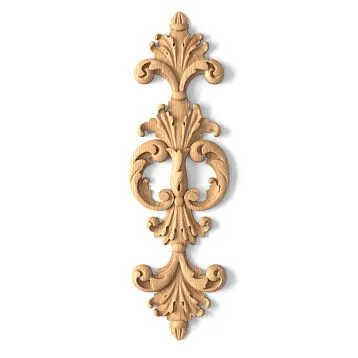
Appliques are the most numerous and diverse class of decorative elements. These are flat or relief details that are attached to a surface (furniture, wall, door, ceiling), giving it volume, texture, and ornamental richness.
Furniture appliques transform the fronts of cabinets, dressers, tables, turning simple furniture into unique pieces. Sizes range from miniature (30×30 mm) to impressive (500×500 mm and larger). Shapes can be geometric (square, rectangle, rhombus), botanical (leaves, flowers, grapevines), zoomorphic (birds, lion heads, dragons), or abstract (scrolls, volutes, arabesques).
Wall appliques work as local accents or as elements of complex molding compositions. One large applique above a fireplace creates a focal point. Four symmetrically placed appliques at the corners of a wall panel establish rhythm and structure.
Ceiling appliques are usually combined with moldings, creating frames for coffers, rosettes, and light fixtures. They can be corner (filling the angle where two moldings meet), central (decorating the middle of a straight molding section), or connecting (masking the joint of two moldings).
Door appliques turn a smooth panel into a paneled door, imitating a classic construction. This is a budget-friendly way to update an old door or give an inexpensive door a noble appearance.
The material of appliques determines their aesthetics and durability. Wood (oak, beech, ash) provides natural texture, warmth, and the possibility of tinting and patination. Polyurethane ensures sharp relief, lightness, moisture resistance, and ease of installation. MDF with milling is a compromise between price and appearance.
Our factory also produces:


Rosettes: Circular Symmetry and Centripetality
A rosette is a round or polygonal element with radial symmetry, where the ornament radiates from the center to the periphery. The name comes from its resemblance to an open rose flower—a classic motif of European decor.
Ceiling rosettes are traditionally placed in the center of the ceiling, framing the chandelier suspension point. They serve a dual function: aesthetic (decorating the ceiling, creating a compositional center) and practical (hiding electrical wiring, light fixture mounting, masking ceiling defects at the installation point).
Wall rosettes work as independent accents or as elements of complex wall compositions. A rosette above a door emphasizes the importance of the entrance. A rosette in the center of a wall panel framed by moldings creates a focal point.
Furniture rosettes adorn cabinet fronts, central parts of dressers, chair and bed backs. Here they are usually smaller in size (from 50 to 200 mm), but no less detailed.
The size of the rosette should correspond to the scale of the room. A room 3×4 meters with a ceiling height of 2.7 m requires a rosette with a diameter of 300-400 mm. A spacious living room 6×8 meters with a 3.5 m ceiling—rosettes of 600-800 mm and larger. A rosette that is too small will get lost; one that is too large will overwhelm the space.
The ornamentation of rosettes reflects the style of the era. Classicism prefers geometric motifs: meander, braid, radial compositions. Baroque loves vegetation: acanthus leaves, roses, grape clusters. Empire style uses military symbolism: laurel wreaths, torches, shields. Art Nouveau introduces flowing asymmetrical forms, reminiscent of seaweed or tongues of flame.
Get Consultation
Cartouches: Heraldry in the Interior
A cartouche is a decorative element in the shape of a shield, scroll, or plaque, often framed by scrolls, ribbons, and botanical motifs. Historically, cartouches were intended for placing coats of arms, monograms, inscriptions—this is a heraldic element transferred to architecture and furniture.
Facade cartouches are placed above the entrance, on pediments, between windows. They can bear a family coat of arms, the owner's initials, or a family motto. Even an empty cartouche (without filling the central part) looks significant, turning an ordinary facade into a mansion with history.
Interior cartouches adorn the walls of formal rooms—living rooms, studies, libraries. A cartouche above a fireplace is a classic placement, emphasizing the status of this zone. Cartouches on either side of a mirror or between windows create a symmetrical composition.
Furniture cartouches are located on cabinet fronts, on the backs of armchairs and chairs, on the pediments of tall cabinets and secretaries. A miniature cartouche on a dresser drawer is an elegant accent, turning a utilitarian object into a piece of furniture art.
The shape of a cartouche can be shield-shaped (resembling a medieval shield), scroll-shaped (imitating a partially unrolled parchment scroll), tablet-shaped (a rectangle with a figured frame), or figured (a complex curvilinear contour with scrolls and volutes).
The framing of a cartouche is an important part of its decorativeness. A simple cartouche is just a shield with a smooth edge. A rich cartouche is framed by scrolls (volutes), entwined with ribbons, adorned with botanical garlands, and topped with a crown or helmet (in heraldic versions).
The central part of a cartouche can be empty (smooth), relief (with ornament), or carved (openwork, pierced). In classic interiors, the center is left empty to apply a coat of arms or monogram with paints or gilding. In modern applications, the center is often filled with ornament, turning the cartouche into a purely decorative element.
Volutes: The Spiral as an Architectural Form
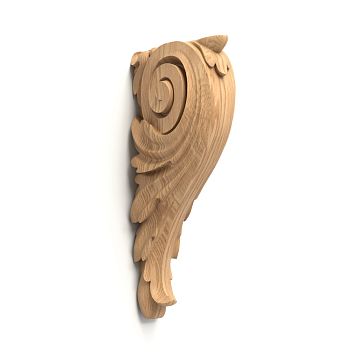
A volute is a decorative element in the shape of a spiral, a scroll, coiled in several turns with an 'eye' in the center. This is one of the oldest architectural motifs, coming from antiquity.
Order volutes are a component of Ionic and Corinthian order capitals. Two spirals, symmetrically coiled on either side of the capital, create the recognizable silhouette of an Ionic column. In interiors, capital volutes are used on pilasters, half-columns, and decorative columns.
Console volutes are S-shaped elements that function as brackets, supporting (actually or visually) cornices, shelves, balconies. The S-shaped profile of a console volute creates visual lightness: it seems that a heavy cornice rests not on a massive support, but on an elegant scroll.
Pedimental volutes are large spirals that frame the pediments of Baroque facades, creating a smooth transition from the vertical wall to the horizontal cornice. Famous Baroque churches (Il Gesù in Rome, Santa Maria Novella in Florence) use huge volutes as a key element of the facade composition.
Furniture volutes adorn chair arms, table legs, and chair backs. Miniature volutes on cabriole carved legs give furniture grace and dynamism. Volutes on chair arms transform a functional element into a decorative accent.
The size of a volute is determined by the architectural task. Small volutes (50-100 mm) serve as finishing elements of moldings and furniture decorations. Medium ones (200-500 mm) serve as consoles and frames. Large ones (500-1500 mm) serve as facade dominants and pedimental elements.
The number of spiral turns influences visual perception. A one- or two-turn volute looks laconic and graphic. A three- or four-turn volute looks more decorative and rich. A multi-turn volute (five or more) creates an effect of complexity, almost Baroque excess.
Corner elements: connecting links of the composition
Decorative corner elements— specialized parts designed for finishing corners: internal (concave) and external (convex), right (90°) and arbitrary.
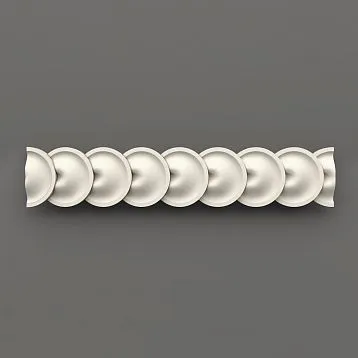
Corner elements for moldings solve the task of joining two molding strips that meet at an angle. The simplest option is mitering moldings (at 45°) with tight fitting. But this requires precision and does not always look decorative. A corner element turns a technical joint into a decorative accent.
The shape of a corner element can repeat the molding profile (creating a smooth junction) or contrast with it (creating an accent). A smooth molding with a carved corner element is a classic technique where decoration is concentrated at the nodal points of the composition.
Corner rosettes are round or polygonal elements placed in the corner of a rectangular molding frame. They fill the emptiness of the corner, turning it into positive space. Four corner rosettes plus four molding segments create a complete wall panel composition.
Corner overlays on furniture finish the edges of the case, protecting them from damage while simultaneously decorating. A carved corner overlay on a cabinet turns a simple edge into an architectural element.
Internal corner elements (for concave corners) are usually less decorative than external ones. In an internal corner, the element is partially hidden, and excessive decorativeness is lost. An external corner (protruding edge) is fully exposed to view, and here the decoration works to its maximum.
Installing corner elements requires precise marking. The element must be positioned exactly at the vertex of the angle, symmetrically relative to both sides. Asymmetry of even 2-3 mm is noticeable and disrupts the harmony of the composition.
Stylistic affiliation: to each era its own decoration
Decorative elements do not exist outside of style. Each historical era, each artistic movement developed its own visual language, its own system of forms and ornaments. Understanding this language allows for a conscious choice of elements, creating a stylistically consistent interior.
Baroque: the apotheosis of decorativeness
Baroque (17th-18th centuries) is a style of excess, where decoration seizes all available space. The straight line is replaced by the curve, the plane by relief, symmetry is complemented by dynamism.
Baroque overlays abound with plant motifs: acanthus leaves with deeply incised edges, lush roses, grapevines with clusters and tendrils. The relief is deep (20-40 mm), creating strong light and shadow contrasts. The forms are asymmetrical, emphasizing the movement, growth, and development of the ornament.
Baroque rosettes are explosions of decorativeness. The central motif (often a rose or a solar disk) is surrounded by several tiers of petals, leaves, and scrolls. Each tier is more complex than the previous one, creating an effect of increasing lushness from the center to the periphery.
Baroque cartouches are framed by large volutes, entwined with ribbons, and adorned with garlands of fruits and flowers. The central part is often concave (forming a niche for a coat of arms), while the frame protrudes, creating deep relief.
Volutes are the king of Baroque decoration. They are present everywhere: on capitals, consoles, cartouche frames, furniture legs, and door handles. The S-shaped profile of a volute is the quintessence of the Baroque curved line.
The color scheme of Baroque tends towards gold. Gilding (gold leaf, imitation gold leaf, gold paint) is applied to the protruding parts of the relief, leaving the recesses dark. This enhances the contrast, making the decoration even more dramatic.
Applying Baroque decoration requires scale. In a small room, Baroque opulence will overwhelm the space. Baroque needs high ceilings (from 3.5 m), spacious rooms (from 30 m²), where the decoration can unfold without a feeling of crowding.
Classicism: the discipline of antiquity
Classicism (late 18th — early 19th century) is the antithesis of Baroque. A return to ancient principles: symmetry, proportionality, restraint of decoration, the primacy of architectural form over ornament.
Classicism overlays are geometric and strict. Rectangular frames, circles, ovals, rhombuses. Plant motifs are present but subordinated to geometry: laurel wreaths form a perfect circle, acanthus leaves are arranged in symmetrical pairs.
Classicism rosettes are radially symmetrical with mathematical precision. A central circle is surrounded by rays of equal length; between the rays are leaves or petals, also identical. There is no asymmetry, no randomness — only order.
Classicism cartouches often have the shape of an oval medallion framed by a laurel wreath. This is a reference to ancient cameos — carved stones with portraits or allegorical scenes.
Volutes are present in Classicism, but in strictly regulated places: capitals of Ionic pilasters, consoles under cornices. They do not grow arbitrarily, as in Baroque, but are subordinated to the order system.
Classicism ornamentation includes ancient motifs: meander (a continuous broken line at a right angle), palmette (a fan-shaped motif resembling a palm leaf), acroterion (an ornament at the corners and apex of a pediment), beads (a row of balls), egg-and-dart (egg-shaped elements alternating with darts).
The color palette of Classicism is restrained: white, beige, light gray for main surfaces; gold for accents. But gold is used delicately, not covering the entire element, but highlighting individual details.
The application of classical decoration is universal. It works in spaces of any size, from intimate studies to grand halls. The main thing is to maintain proportions and not overload the space.
Art Deco: geometry of luxury
Art Deco (1920s-1930s) is a style that combines classical symmetry with modernist geometry and exotic motifs. It is luxury, but not Baroque opulence, rather geometric rigor.
Art Deco overlays use geometric shapes: zigzags, stepped pyramids, stylized sun rays, concentric circles. Floral motifs are present but abstracted into geometric patterns.
Art Deco rosettes often have octagonal, hexagonal, or star-shaped forms. The ornament is built on the alternation of protruding and recessed elements, creating a rhythmic play of light and shadow.
Art Deco cartouches are framed not by volutes, but by stylized rays, zigzags, geometric borders. The central part may contain abstract patterns inspired by African, Egyptian, Aztec art.
Volutes in Art Deco transform into angular spirals, where a smooth curve is replaced by a broken line. This is a compromise between classical form and modernist aesthetics.
The materiality of Art Deco is emphasized by contrasts: dark wood (ebony, rosewood) is combined with light inlay (ivory, mother-of-pearl, light wood species). Metal inserts (bronze, chrome, nickel) add an industrial touch.
Art Deco color palette: black, white, gold, silver as base; emerald, sapphire, ruby as accents. Contrasts are sharp, without smooth transitions.
The application of Art Deco decor creates an atmosphere of 1920s elegance. This is a style for living rooms, halls, studies, where representativeness is needed without heaviness.
Minimalism: When Less Is More
Minimalism (second half of the 20th century — present day) — a philosophy of extreme simplification, rejection of excessive decor. But this does not mean a complete absence ofdecorative accents— they simply become extremely laconic.
Minimalist overlays — geometric shapes without ornament. Rectangle, square, circle made of smooth wood or metal. The function of the overlay is not decoration, but accentuation: it highlights an area (e.g., a cabinet handle), creates a contrast of textures (smooth wood on a matte surface).
Minimalist rosettes — concentric circles or simplest geometric figures. No ornament, only form and material. Contrasting combinations are often used: a wooden rosette on a white ceiling, a metal one on a wooden surface.
Cartouches are absent in minimalism as a category — they are too decorative, too associated with historical styles. Instead — simple geometric panels, plaques without framing.
Volutes are alien to minimalism. The S-shaped curve is a Baroque heritage, incompatible with the minimalist aesthetic of the straight line.
Corner elements in minimalism are maximally simple: a beveled corner, a chamfer, a rounding. Decorativeness is achieved not by ornament, but by the quality of surface treatment: perfect polishing, precise geometry of edges.
Minimalist materials: light wood (ash, maple, birch), tinted white or gray; metal with a matte or polished surface; plastic with impeccable geometry.
Color scheme: white, gray, black, natural light wood. Accents — red, yellow, blue — are used extremely sparingly.
The application of minimalist decor creates a sense of space, light, air. This is a choice for modern apartments, where functionality and visual purity are valued.
Geography of application: where decorative elements live
Eachdecorative ornamentation elementhas its preferred zones of application. Understanding this geography helps avoid mistakes when an element ends up "out of place."
Furniture: from utility to art
Furniture is the natural habitat of decorative overlays, rosettes, cartouches. Here, decor works up close, it is viewed from arm's length, and detailing is important.
Cabinet fronts are the main field for overlays. A central overlay on each door creates a symmetrical composition. Four overlays at the corners of the door plus one in the center form a cross — a classic scheme. An overlay above each drawer of a chest creates a vertical rhythm.
Pediments of tall cabinets are adorned with rosettes or cartouches. A central rosette on the pediment is its semantic center, similar to a ceiling rosette. A cartouche on the pediment is especially appropriate on cabinets in a historical style, where it recalls heraldic traditions.
Table and chair legs — the zone for carved elements. Turned legs with applied volutes transform a simple furniture support into a sculptural element. Carved overlays at the junction of the leg and tabletop (apron) mask a technical joint, turning it into a decorative one.
Chair and armchair backs — a grateful zone for overlays and rosettes. A central rosette on the back creates an accent, attracts attention. Carved overlays along the edges of the back frame it, like a picture frame.
The size of furniture decor must correspond to the scale of the item. A 2-meter tall cabinet can support overlays of 200×200 mm. A 1-meter tall chest requires overlays of 100×100 mm. A small overlay on a large front gets lost. A large one on a small one overwhelms the furniture proportions.
The placement of overlays follows the laws of symmetry and rhythm. One overlay — strictly in the center. Two — symmetrically relative to the vertical axis. Four — at the corners of a rectangle with equal indents from the edge. A row of overlays — with equal intervals.
Walls: architecture of vertical planes
Walls are the largest surfaces in an interior, and their decoration defines the character of the space. Decorative elements on walls work from afar and up close, requiring thoughtful composition.
Panels made from moldings with corner elements are a classic way to structure a wall. The wall is divided into rectangular sections, each framed by molding. The corners of the sections are decorated with corner rosettes or overlays. This creates rhythm and visually enriches a flat wall.
Central overlays in panels are the next level of decoration. Inside each rectangular section framed by molding, a central overlay or rosette is placed. This fills the void, turning the frame into a picture.
Over-door compositions are a zone of concentrated decor. Above the door, a cartouche, rosette, or complex composition of overlays and moldings is placed. This emphasizes the importance of the door, turning it into a portal.
Wall spaces between windows are another zone for decor. The narrow vertical plane between two windows is decorated with a vertical composition: a pilaster with a capital and base, or a vertical row of overlays, or a mirror in a carved frame with overlays on the sides.
Corn
ers of a room are decorated with corner overlays or corner pilasters. This turns a technical edge (the junction of two walls) into an architectural element that organizes the space.
The height for placing decor on walls is determined by human height. The main visual zone is 120-180 cm from the floor, at eye level of a standing person. The most significant elements are placed here. The zone above 200 cm is perceived in less detail—larger, more graphic elements are appropriate here. The zone below 80 cm is the plinth area, where decor is minimal.
Ceiling: the fifth plane of the interior
The ceiling is often ignored in decorative concepts, remaining just a white plane. Yet it is a huge surface, visible from any point in the room, and its decoration radically changes the perception of space.
Central rosette—a basic element of ceiling decor. It frames the chandelier, creates a compositional center, and attracts the eye. The size of the rosette is critical: too small gets lost against the ceiling, too large creates a oppressive feeling.
Ceiling cornices (cove moldings)—the transition between ceiling and wall. A decorative cornice turns this transition from technical to architectural. The cornice can be smooth (simply a profiled strip) or decorated with overlays at corners and on straight sections.
Coffers—recessed sections of the ceiling, framed by beams or moldings. Each coffer is decorated with a central rosette. A system of coffers creates a rhythmic ceiling structure, visually raises it, and adds volume.
Ceiling panels made from moldings—a flat version of coffers. The ceiling is divided by moldings into rectangular or square sections. The corners of the sections are decorated with corner elements, the centers with rosettes. This decorates the ceiling without creating actual volume.
Beamed ceilings—decorative (non-load-bearing) beams imitating structure. Carved overlays, consoles, and brackets are placed on the beams. This creates a sense of massiveness and solidity, characteristic of rustic styles.
Combinatorics of beauty: rules for combining elements
Choosing individual elements is half the battle. It's important to combine them so that a harmonious composition results, not a chaotic set of details.
Rule of stylistic unity
All elements in one composition (room, furniture set) should belong to one style or stylistically compatible directions. A Baroque rosette and a minimalist overlay in the same room create dissonance. A Classicism rosette and Art Deco overlays are a possible combination if united by a common color scheme and scale.
Stylistic compatibility is determined by common features: type of ornament, proportions, degree of decorativeness. Classicism and Empire are compatible (both use antique motifs, symmetry, restraint). Baroque and Rococo are compatible (both favor curved lines, vegetation, excess). Minimalism and Art Nouveau are partially compatible (both value simplicity of form, although Art Nouveau is more decorative).
Rule of scale hierarchy
Elements in a composition should have a scale hierarchy: large (dominants), medium (supporting), small (accent). If all elements are the same size, the composition becomes monotonous. If the sizes differ too much, visual conflict arises.
Optimal size ratio: the dominant is 2-3 times larger than supporting elements, supporting elements are 1.5-2 times larger than accent elements. For example: a ceiling rosette with a diameter of 600 mm (dominant), corner elements sized 200×200 mm (supporting), central overlays on wall panels 100×100 mm (accents).
Rule of rhythm and repetition
Decorative elements create rhythm—repetition at a certain interval. Rhythm can be regular (elements repeat at equal intervals) or progressive (intervals change according to a rule).
Regular rhythm creates calm, order, predictability. A row of identical overlays at equal intervals on a cabinet facade is a regular rhythm. This is a classic technique.
Progressive rhythm creates dynamics, movement, progression. Overlays increasing in size from the edge to the center of a composition is a progressive rhythm. This is a more complex technique requiring precise calculation.
The number of repetitions affects perception. Two repetitions are the minimum to create rhythm. Three is optimal for most situations. Five or more are possible in large compositions but require significant area.
Rule of symmetry and balance
Symmetry is a universal principle of harmony. A symmetrical composition is perceived as balanced, stable, correct. Asymmetry creates dynamics but requires balance—visual equilibrium of masses.
Axial symmetry is a mirror reflection relative to a vertical or horizontal axis. A central overlay on the axis, with identical overlays on both sides at equal distances. This is the simplest and most reliable way to create harmony.
Central symmetry is the rotation of elements around a central point. A rosette is a typical example of central symmetry: the ornament radiates from the center, repeating at a specific angle (60°, 72°, 90°, 120°).
Asymmetry with balance is a more complex technique. A large element on the left is balanced by several small ones on the right. Visual weight does not coincide with physical weight—a bright, colorful element "weighs" more than a neutral one of the same size.
Rule of color coordination
The color of decorative elements should harmonize with the interior's color scheme. A monochromatic scheme (elements of the same color as the surface) creates subtle, delicate decorativeness—emphasis on relief, not color. A contrasting scheme (elements of a contrasting color) creates graphic quality and emphasizes the decor.
Natural wood requires matching shades. Warm species (oak, walnut, cherry) pair with warm wall colors (beige, sand, terracotta). Cool species (bleached ash, maple) pair with cool colors (gray, blue, lilac).
Painting elements opens wide possibilities. White elements on a colored wall—a classic technique that visually lightens the decor. Colored elements on a white wall—an accent technique that attracts attention. Patination (gold, silver, bronze) adds historicity and works in classic interiors.
STAVROS Author Collections: Decor with a Style Guarantee
Selecting decorative elements from different sources is risky—they may not match in style, scale, or execution quality. STAVROS solves this problem by offering author collections where elements are already composed into stylistically consistent systems.
Collection "Classic": Timeless Proportions
The "Classic" collection is based on the principles of classicism and empire: symmetry, proportionality, antique motifs. Every element of the collection—from miniature furniture overlays to large ceiling rosettes—is executed in a unified stylistic key.
The collection's ornamentation includes meanders, palmettes, laurel wreaths, and acanthus leaves in a restrained, geometric interpretation. Medium-depth relief (10-15 mm), creating clear but not dramatic shadows.
The collection's overlays are available in sizes from 60×60 to 400×400 mm, covering all tasks—from furniture decor to wall compositions. Shapes: square, rectangle, circle, oval—basic geometry, easily combined.
The collection's rosettes, with diameters from 200 to 800 mm, are suitable for ceilings with heights from 2.7 to 4 meters. Radial symmetry with 8, 12, or 16 rays creates clear graphics visible from a distance.
The collection's corner elements solve all molding junction tasks: internal and external corners, 90° connections, and arbitrary angles. The decor of the corner element is coordinated with overlays and rosettes—the same motifs are repeated in different elements.
The collection's material is solid oak or beech, kiln-dried, with 8-10% moisture content. This guarantees geometric stability and absence of deformation with humidity changes.
Finishing—customer's choice: natural wood (with clear varnish preserving the texture), tinting to any color with stains, painting with enamels, patination with gold or silver. The ability to choose finishing allows adapting the collection to any interior color scheme.
Collection "Baroque": Opulence of Forms
The "Baroque" collection embodies the aesthetics of the 17th-18th centuries: abundance of plant motifs, deep relief, dynamic compositions. This is the choice for interiors requiring representativeness, luxury, and historical authenticity.
The collection's ornamentation: acanthus leaves with deeply incised edges, roses in full bloom, grapevines with leaves and clusters, rocaille (C- and S-shaped scrolls), cartouches with ribbons and garlands.
The collection's overlays feature deep relief (20-40 mm), creating strong chiaroscuro effects. Shapes are asymmetrical, emphasizing movement and organic growth of the ornament.
The collection's rosettes are multi-tiered compositions where a central motif is surrounded by 3-5 tiers of petals, leaves, and scrolls. Diameters from 400 to 1200 mm—this is decor for high ceilings (from 3.5 m) and spacious rooms (from 40 m²).
The collection's cartouches are central elements for over-door compositions, furniture pediments, and centers of wall panels. The cartouche framing includes volutes, ribbons, and floral garlands. The central part can be empty (for placing a monogram) or filled with ornament.
The collection's volutes are S-shaped consoles of various sizes (from 100 to 600 mm in height), used as brackets, framings, and finishing elements. The volute surface is adorned with carvings repeating the overlay motifs.
Material—solid oak (preferred for large elements) or beech (for small and medium ones). Finishing often includes patination: gold on protruding parts of the relief, dark patina in recesses—this enhances the drama characteristic of Baroque.
Collection "Art Nouveau": Flowing Lines
The "Art Nouveau" collection is based on the aesthetics of the Art Nouveau (Art Nouveau) style of the early 20th century: smooth, flowing lines, plant motifs, asymmetry, rejection of the right angle.
The collection's ornamentation: stylized irises, lilies, water lilies; female profiles with flowing hair (a characteristic Art Nouveau motif); wavy lines reminiscent of flowing water or tongues of flame.
The collection's overlays are often asymmetrical, with vertically elongated proportions. The relief is smooth, without sharp transitions, creating soft shadows.
The collection's rosettes are not round but curvilinear, with variable radius. These can be stylized flowers (iris, poppy), marine motifs (shell, wave), abstract compositions of flowing lines.
The cartouches of the collection are framed not with volutes, but with plant stems that wrap around the central part, creating an organic frame.
The corner elements of the collection use smooth line blending instead of a sharp angle. The transition from one side to the other follows a curve, creating a sense of continuity.
Material — preferably beech, whose wood holds fine carving with smooth transitions well. Finish: tinting in natural tones (walnut, mahogany) or painting in muted colors (olive, gray-blue, lilac) — the Art Nouveau palette.
Collection "Minimal": the aesthetics of simplicity
The "Minimal" collection is designed for modern interiors where decor should be as restrained as possible, almost unnoticeable, working on tactility and material quality, not ornamental richness.
The overlays of the collection are simple geometric shapes without carving. Square, rectangle, circle made of smoothly sanded wood. Decorativeness is achieved through texture contrast (smooth wood on a matte surface) or color contrast (dark on light).
The rosettes of the collection are concentric circles with minimal relief (2-3 mm). Outer circle, middle, inner — simple graphics that work from a distance.
The corner elements of the collection — beveled corners, 45° chamfers, minimal radius rounding. No ornament, only precise geometry.
The moldings of the collection — rectangular cross-section or with a minimal profile (one or two coves). Emphasis on surface quality, not shape complexity.
Material — light woods (ash, maple, birch) or dark woods (fumed oak, walnut). Finish: transparent oil emphasizing the grain, or matte enamel (white, gray, black) concealing it.
Applying the collection creates interiors in the spirit of Scandinavian minimalism, Japanese wabi-sabi aesthetics, modern loft — anywhere simplicity, air, and purity of lines are valued.
Frequently Asked Questions about decorative elements
Is it possible to combine elements from different materials in one composition?
Theoretically yes, practically risky. Wooden and polyurethane elements have different textures, age differently, and react differently to painting. If placed side by side, the difference will be noticeable. If separated (wood on furniture, polyurethane on the ceiling), they can be combined, especially if unified by a common paint color.
How much do quality decorative wooden elements cost?
Prices vary widely depending on size, carving complexity, and wood species. A simple 100×100 mm beech overlay starts from 500 rubles. A complex carved overlay of the same size in oak starts from 2000 rubles. A large ceiling rosette 600 mm in diameter — from 8000 to 25000 rubles.
How to attach decorative elements: glue or nails?
Depends on size and weight. Light overlays (up to 100 g) are glued with woodworking PVA or mounting adhesive. Medium (100-500 g) — glue plus a few finishing nails (thin, headless). Heavy (over 500 g) — screws with countersunk heads and subsequent puttying.
Is it necessary to coat wooden elements with a protective compound?
For interior elements (not facade), at least impregnation with oil or application of varnish is mandatory. This protects the wood from dirt, facilitates maintenance, and emphasizes the grain. For facade elements — multi-layer protection is mandatory: antiseptic, primer, finish coating (glaze or paint).
Is it possible to paint wooden elements a color different from natural wood?
Absolutely yes. Modern paints allow painting wood any color, preserving the grain (semi-transparent glazes) or concealing it (opaque enamels). Before painting, the element is sanded, primed, then paint is applied in two to three coats.
Which elements are suitable for a loft-style interior?
Loft leans towards minimalism but allows industrial accents. Simple geometric overlays without carving, wooden elements with rough, deliberately unfinished texture, metal corner elements are suitable. Avoid classical rosettes, cartouches, volutes — they contradict the industrial aesthetics of loft. The best choice is the "Minimal" collection with emphasis on wood texture, not ornament.
How to calculate the required number of corner elements for wall panels?
Count the number of corners in your composition. One rectangular panel made of moldings has 4 corners. If you are making, for example, 6 panels on a wall, you need 24 corner elements (6×4). Add 2-3 spares in case of defects or installation errors. Total: 26-27 elements.
Do elements for furniture differ from elements for walls in construction?
Functionally they are identical, differences are in scale and detailing. Furniture elements are usually smaller (50-200 mm) and more detailed, as they are viewed up close. Wall elements are larger (150-500 mm) and can be less detailed, as they are perceived from a distance. But technically the same element can be used both on furniture and on a wall — it all depends on the scale of the object.
What relief depth is optimal for different styles?
Minimalism: 2-5 mm (barely noticeable relief, working on tactility). Classicism: 8-15 mm (clear but restrained relief). Art Deco: 10-20 mm (geometric, contrasting relief). Baroque: 20-40 mm (deep, dramatic relief with strong shadows). The deeper the relief, the more expressive the chiaroscuro effects, but the more difficult the installation and maintenance.
Is it possible to use decorative elements in damp rooms (bathroom, sauna)?
Wooden elements in wet areas require special protection: multi-layer impregnation with moisture-resistant compounds, coating with yacht varnish or special oils for wet areas. Moisture-resistant species (larch, teak) are preferable. Polyurethane elements are ideal for bathrooms—they are not afraid of moisture, do not rot, and are easy to clean. For saunas, wood is preferable (polyurethane can deform at high temperatures).
How to choose the size of a ceiling rosette for your room?
General rule: the diameter of the ceiling medallion should be 1/5 to 1/7 of the shorter side of the ceiling. For a room 4×5 meters: the shorter side is 4 meters = 400 cm, the medallion diameter is 400÷6 ≈ 65 cm. For high ceilings (over 3.5 m), you can increase the diameter by 20-30%. For low ceilings (under 2.7 m) — reduce it by 20-30%. If the medallion seems too large after installation, it cannot be 'shrunk' — it's better to start with a smaller size.
Are special tools needed for installing decorative elements?
Minimum set: tape measure, pencil, level (preferably laser), glue (PVA for wood or mounting adhesive for polyurethane), brush for applying glue, spatula for removing excess, weight or clamps for fixation during drying. For nailing or screwing: drill, drill bits, finishing nails or screws, putty for concealing fasteners. Professional tools are not required—everything is available at a regular hardware store.
How to care for carved elements with deep relief?
Dust in the recesses of the relief is removed with a soft brush, brush, or vacuum with a brush attachment. Wet cleaning—with a soft, slightly damp cloth, without excess water. For varnished surfaces, furniture polishes can be used. For painted surfaces—soft cleaning agents without abrasives. Carved elements require more attentive care than smooth ones, but with regular cleaning (once a month) they remain perfect for decades.
Can I order an element based on a custom sketch?
At STAVROS—yes. It is possible to manufacture elements based on your sketches, photographs, descriptions. The process includes: consultation with a designer, development of a 3D model, approval, creation of a prototype, and upon approval—serial production. Lead times for custom elements: from 2 weeks for simple forms to 2 months for complex carved compositions. The cost is higher than for catalog items, but the result is a unique element that no one else has.
Conclusion: When Details Create a Whole
Interior is not the sum of walls, ceiling, floor, and furniture. It is a space filled with meaning, where every detail tells part of a story.decorative ornamentation element— is not just a beautiful trinket, it is a word in the language of your home. An overlay on a chest of drawers facade speaks of your understanding of classicism. A ceiling rosette tells that you see beauty not only at eye level but also above your head. A cartouche above the door communicates that you respect traditions but live in the present.
Choosing decorative elements is a creative process that requires knowledge, taste, understanding of proportions, and stylistic patterns. You cannot simply buy 'pretty things' and stick them anywhere. Each element must be in its place, must match the style, scale of the room, and other elements of the composition. Only then does harmony arise, when details create a whole greater than their sum.
Typology of elements—overlays, rosettes, cartouches, volutes,Decorative corner elements—provides structure, helps navigate the diversity of forms. Understanding the stylistic affiliation of elements helps avoid dissonance and create cohesive compositions. Knowing the application areas—furniture, walls, ceiling—helps use each element most effectively.
Rules of combination—stylistic unity, scale hierarchy, rhythm, symmetry, color coordination—are the grammar of the language of decor. Mastering this grammar, you can create complex, multi-layered compositions that look natural, as if they have always existed in that form.
STAVROS offers not just a catalog of decorative elements—it is a system of solutions for creating stylistically cohesive interiors. Author's collections free you from the agonizing selection of elements from different sources—everything is already composed by professionals, tested for compatibility, and executed in a unified stylistic key.
Quality proven over time
For over twenty years, STAVROS has been creating decorative elements from natural wood. During this time, immense experience has been accumulated: which wood species are best for which tasks, what relief depth is optimal for different styles, how to achieve clarity in the smallest carving details, how to protect wood from time and use.
Production is equipped with modern equipment: high-precision CNC machines for milling and carving ensure part repeatability with millimeter accuracy. But technology does not replace manual labor—the finishing of each element is done by craftsmen by hand. It is precisely the combination of technology and craftsmanship that yields results impossible to achieve by purely machine or purely manual methods.
Materials are carefully selected: oak and beech from verified suppliers, kiln-dried to stable humidity, free of knots and wood defects. This guarantees that the element will not deform after installation, will not crack, and will serve for decades.
Service at all stages
Designer consultation helps determine the style, select a collection, calculate the number of elements. Visualization shows how the elements will look in your interior—this eliminates disappointment after installation. Technical specialists will explain installation features, recommend adhesives and fasteners, and advise on how to treat elements before installation.
Production of elements based on custom sketches—an opportunity to create unique decor not found in catalogs. Bring a photo of an antique element you want to reproduce. Draw a sketch of the motif you envision. Describe it in words if you cannot draw—STAVROS designers will turn your vision into a real element.
Delivery is organized throughout Russia and CIS. Careful packaging prevents damage: each element is wrapped in protective film, placed in a box with cushioning pads. Carved elements with fine details are packed especially carefully, with protection for protruding parts. Tracking the shipment allows you to monitor the location of your order along the entire route.
Start the transformation today
Decorating interiors with decorative elements is not a large-scale renovation requiring months of work and a huge budget. It is a targeted intervention that gives maximum effect with minimal investment. A few overlays on a wardrobe facade transform the furniture. A ceiling rosette turns a bland ceiling into an architectural plane. A composition of moldings and corner elements on a wall creates structure, depth, interest.
Start small. Order a small element—an overlay that will adorn your favorite chest of drawers. Or corner elements for decorating one wall panel. Install it, evaluate the result. Feel how the space changes, how a detail costing a few hundred rubles creates an effect worth thousands. Then add more elements, gradually building a decor system.
Visit the STAVROS catalog, explore the collections, find elements that resonate with your taste. Do not rush to buy a lot at once—start with key elements. Consultants will help calculate how much and what is needed to realize your concept. Designers will create a visualization showing the result before work begins.
Decorative elements are not just ornaments. They are a tool for creating an interior that reflects you, your taste, your understanding of beauty. A home where every detail is chosen consciously, where elements work together creating harmony, where decor does not shout but whispers about beauty—such a home becomes not just a dwelling, but a space that inspires, calms, and delights every day.
STAVROS is your partner in creating such a home. Twenty years of experience, thousands of completed projects, hundreds of satisfied clients, a catalog of several thousand items, possibility of custom manufacturing, professional consultations, reliable delivery—all this is at your service. Do not just buy decorative elements. Create an interior that will delight you and your guests for years, decades, possibly—generations.
Decorative ornamentation elements do not just create beauty. They create a home with soul, character, history. Your home deserves such elements. STAVROS is ready to help bring your concept to life—with quality, professionalism, and attention to every detail of your project.