Article Contents:
- Eco-Style as a Protest Against the Plastic World
- Material Honesty: Texture Matters More Than Form
- Locality as a Value
- Wooden Handles: Micro-Contact with Nature a Hundred Times a Day
- Brushed Texture: When Roughness Becomes a Virtue
- Knots and Cracks: Imperfection as Uniqueness
- Oil Finish: Wood Breathes
- Slatted Partition: Zoning Without Isolating
- Unfinished Slat: When Wood Speaks for Itself
- Distance Between Slats: The Rhythm of Nature
- Vertical or Horizontal: The Psychology of Lines
- Furniture Decor: When Minimalism Meets Texture
- Simple Form, Complex Texture
- Wood and Metal: Contrast of Materiality
- Wooden Baseboard: Completeness from Floor to Wall
- Tall or Short: A Question of Proportions
- Color Matching the Floor or Contrast
- Color in Eco-Style: Palette of Forest, Earth, Sky
- Earthy Base
- Green Nuances
- Blue Accents
- Practice: Where to Start Transforming into Eco-Style
- Step One: Replace the Handles
- Step Two: One Slatted Wall
- Step Three: Replace the Baseboards
- Step Four: Add Live Plants
- Step Five: Textiles from Natural Fibers
- Frequently Asked Questions About Eco-Style
- Is creating an eco-interior expensive?
- Can eco-style be combined with modern technologies?
- Is eco-style suitable for a city apartment?
- How to care for untreated wooden surfaces?
- What to do if there is little light in the apartment?
- Can eco-style be combined with other design directions?
- Where to buy quality wooden elements for an eco-interior?
- Conclusion: home as an extension of the forest

Concrete jungles require an antidote. When asphalt and glass are outside the window, the home should become an oasis of authenticity — a place where the texture of wood reminds of forests, where the warm surface of a handle under the fingers creates a connection with nature, wherea slatted partition made of untreated solid wooddivides the space but does not break it. Eco-style of 2026 is not just a Pinterest trend, but a manifesto of returning to the roots, a rejection of synthetic facelessness, a choice in favor of materials with history and soul.Wooden handles for furniture, preserving knots and irregularities. Slats with a brushed texture. Baseboards that smell of real oak. Let's figure out how to create an interior where every detail breathes, lives, and ages nobly.



Eco-style as a protest against the plastic world
Synthetics are everywhere. Laminate imitates wood but is cold as ice. Plastic panels pretend to be stone but ring hollow to the touch. Vinyl wallpapers mimic textiles but smell of chemicals. This is a world of appearances, where everything is fake, where touches bring no pleasure, where there is no connection with materiality.
Eco-style is a conscious reaction to this artificiality. It is a choice of materials that do not pretend but exist in their authenticity. Wood remains wood — with texture, smell, the ability to age and change shade. Stone remains stone — with coolness and mass. Fabric remains fabric — with the weave of threads and the ability to breathe.




Honesty of material: texture is more important than form
What makes an interior eco-friendly? Not the number of plants in pots (though they are important), but the honesty of the materials used. Honesty means: the material does not hide its nature, does not masquerade as something else, is not ashamed of its peculiarities.
Wooden products for interiorin eco-style are not polished to a mirror shine to look like plastic. On the contrary, natural features are emphasized: the direction of fibers, annual rings, knots, micro-cracks from drying. These are not defects requiring concealment, but evidence of authenticity, telling the story of a specific tree.
Unprocessed does not mean rough. It is balancing between preserving natural texture and ensuring functionality. A wooden handle with a brushed surface is tactilely rich, massages the palm when grasped, yet sanded enough not to leave splinters.
Our factory also produces:


Locality as a value
Eco-style of 2026 is critical of globalization. Transporting materials from the other side of the planet leaves a carbon footprint that negates eco-friendliness. A teak board delivered by sea from Indonesia (three months of travel) cannot be considered eco-friendly, even if the wood itself is grown in a certified forest.
Locality is the new luxury. Oak slats from a forest 200 kilometers from the city. Ash balusters carved from trees growing in your region. This reduces the transport footprint, supports local producers, and creates a connection between the home and the local ecosystem.
For Russia, this means: oak, ash, beech, birch, pine, larch — our species, adapted to our climate, available without crossing oceans. Exotic woods are beautiful, but their environmental cost is too high.
Get Consultation
Wooden handles: micro-contact with nature a hundred times a day
How often do you touch furniture handles? In the morning, you open the wardrobe for clothes — five touches. Preparing breakfast, opening kitchen cabinets — twenty touches. In the evening, again wardrobes, dresser drawers, closet doors — another thirty. Over the day, a hundred touches to handles accumulate.
If the handle is plastic or metal — it's a hundred cold, indifferent contacts. Ifthe handle is wooden, made of solid wood with a natural texture— it's a hundred micro-pleasures, reminders of nature, tactile confirmations: yes, you are home, you are safe, you are surrounded by living materials.
Brushed texture: when roughness becomes a virtue
Brushing is a technique where soft wood fibers are removed with a stiff brush, leaving the hard annual rings protruding. The surface becomes textured, tactilely rich, and visually deep.
In a photo, a brushed handle might appear rough. But take it in your hand — and feel how your palm fits perfectly into the relief, how your fingers naturally wrap around the shape, how the slight roughness creates a secure, non-slip grip. This is ergonomics derived not from calculations, but from nature.
BrushedFurniture handles made of oak are especially expressive. Oak is a ring-porous species with a pronounced difference between earlywood and latewood. After brushing, the contrast is enhanced: the hard, dark lines of the annual rings stand out above the light, soft zones, creating a three-dimensional map of time that can be read with your fingers.
Knots and cracks: imperfection as uniqueness
Industrial production strives for uniformity. Every plastic handle in a batch is a clone of another. Zero differences, zero individuality. This is convenient for the assembly line, but it kills the soul.
Wooden handles in the eco-style embrace imperfection. Moreover, they seek it out. A knot on a handle is a place where a branch once grew. A micro-crack is the result of natural drying. Uneven color is evidence that different parts of the trunk received different amounts of nutrients.
Each such handle is unique. In a batch of twenty handles, there are no two alike. This is not a defect, but a value. Your dresser, fitted with such handles, is the only one in the world, because each handle tells the story of a specific tree.
Oil finish: wood that breathes
Varnish creates a film on the surface — durable, waterproof, long-lasting. But this film seals the wood, turning it into a plastic-like substance. The wood stops breathing, regulating humidity, being a living material.
Oil works differently. It penetrates the wood structure, fills the pores, protects from within, but does not create a surface film. The wood remains open, tactilely warm, capable of absorbing and releasing moisture.
A wooden furniture handle with an oil finish changes over time. From frequent touches, it becomes polished, acquires a noble sheen, darkens in areas of constant contact. After five years of use, it doesn't look worn — it looks lived-in, loved, filled with history.
Slatted partition: zoning without isolating
Open-plan layouts gave freedom but took away privacy. When the sleeping area is visible from the entrance, when the work desk is in the same space as the bed, psychological discomfort arises. Boundaries are needed, but not solid walls.
A solid oak slatted partition solves the dilemma. It creates a visual and psychological boundary while remaining permeable to light and air. The space is divided but not torn apart. A sense of separate zones arises while maintaining the integrity of the volume.
Unfinished slat: when wood speaks for itself
Industrial slats are sawn, sanded to smoothness, and coated with varnish. They are geometrically perfect, impeccably smooth, absolutely identical. They are also as faceless as plastic.
Slats for eco-interiors retain traces of their origin. The cut may not be perfectly straight — minor irregularities following the natural grain are acceptable. Sanding is moderate — removing splinters but preserving the texture. The finish is minimal — oil or wax, not hiding the structure.
When such slats are mounted with gaps, a vertical forest of wooden trunks is created. Light passing through the partition creates a play of shadows — a moving pattern that changes throughout the day as the sun moves. This is living architecture, responsive to the time of day.
Distance between slats: the rhythm of nature
Dense installation of slats (5 cm gap with a 5 cm slat width) creates an almost solid surface with narrow gaps. This offers maximum privacy while maintaining lightness. Suitable for zoning a bedroom in a studio.
Medium installation (10 cm gap with a 5 cm slat width) — a balance between openness and zoning. Silhouettes are visible through the partition, but not details. Works for separating a work area from a living room.
Sparse installation (15-20 cm gap with a 5 cm slat width) — maximum permeability. The partition hints at a boundary but does not insist. Suitable for light visual zoning in large spaces.
Important: the distances should not be mathematically precise. Minor variations (±5 mm) following the natural imperfection of the wood are acceptable. This adds organic quality and prevents a mechanistic feel.
Vertical or horizontal: the psychology of lines
Vertical slats reach upward, creating a sense of growth, connection with the sky, spirituality. They are associated with trees in a forest — stable yet reaching for the light. A vertical slatted partition visually raises the ceiling, making the space feel taller.
Horizontal slats run along, creating a sense of expanse, calm, stability. They are associated with the horizon, the line of the earth, rootedness. A horizontal partition visually expands the space, making it feel wider.
The choice depends on the proportions of the room and the desired effect. A low ceiling calls for vertical lines. A narrow, long room calls for horizontal lines. A square room allows for both options or even a combination.
Furniture Decor: When Minimalism Meets Texture
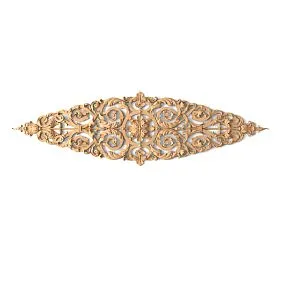
Eco-style is minimalist in the number of elements, but maximal in the quality of each.decorative inlays for furnitureThey should not be baroque rosettes with cherubs. But they should be textured, telling about the material.
Simplicity of form, complexity of texture
An overlay can be geometrically simple—a rectangle, square, circle. But its surface carries information about the wood: the direction of the grain, transitions between growth rings, slight waviness from natural growth.
Carving, if present, follows natural forms: leaves, branches, waves, stones. No cherubs, crowns, heraldic lilies. Natural motifs, stylized but recognizable.
Dimensions are restrained. Large decorative panels overload the eco-interior, creating visual noise. Small overlays 50×50 mm or 80×120 mm are sufficient to mark the center of a facade, create a compositional accent, without shouting for attention.
Wood and metal: the contrast of materiality
Eco-style does not forbid metal. But the metal must be honest: black patinated steel, untreated copper, cast iron. No chrome, polishing, shine. Matte finish, roughness, traces of forging.
The combination of wooden decor with metal elements creates a contrast of warmth and coolness, organic and industrial. A wooden overlay can be framed with a metal border. A wooden handle can be fastened with a metal screw with an intentionally large head.
This contrast emphasizes the merits of both materials: wood appears warmer against the cold metal, metal appears sharper against the organic wood.
Wooden baseboard: completeness from floor to wall
A baseboard is an inconspicuous element that becomes noticeable only when it is missing or incorrect. In an eco-interiorskirting made of solid woodit is a mandatory detail that creates completeness, connecting the floor and walls.
High or low: a question of proportions
A low baseboard 60-70 mm is a modern solution, not drawing attention, delicate. It works in minimalist interiors where decorativeness is not needed.
A high baseboard 100-120 mm is more traditional, creating architectural expressiveness. It suits rooms with high ceilings, where a low baseboard would get lost.
A very high baseboard 150-200 mm is a bold solution, turning the baseboard into an architectural element, almost a panel. It works in spacious rooms where monumentality is needed.
Color matching the floor or contrast
A baseboard matching the floor color visually expands the floor area, making the room more spacious. This works when the floor is made of the same material as the baseboard—an oak floor and oak baseboard merge into a single surface.
A contrasting baseboard creates a visual frame, clearly marking the boundary between floor and walls. A dark baseboard against light walls is a classic technique, adding graphic quality.
In eco-style, the first option is preferable: unity of material and color creates integrity, a monolithic space. Contrast is acceptable, but soft—not black on white, but dark oak on light beige.
Color in eco-style: the palette of forest, earth, sky
Eco-interiors avoid acidic colors, neon accents, loud combinations. The palette is built on shades that exist in nature.
Earthy foundation
Beige, sandy, terracotta, ochre, clay—colors of earth, soil, sand. They are warm, calm, create a sense of rootedness. Walls in these shades are an ideal background for wooden elements.
Brown across the entire spectrum: from light cappuccino
to deep bitter chocolate. This is the color of bark, fallen leaves, humus. Brown tones can dominate in furniture, accent walls, textiles.
Green nuances
Green is a mandatory color for an eco-interior, but not bright lime, rather muted natural: olive, swamp, mossy, coniferous, sage. These shades are present in living plants, textiles, individual furniture elements.
Green reduces stress, is associated with growth, renewal, and life. An accent wall in soft olive is a bold but effective solution for a living room or bedroom.
Blue accents
Sky and water are blue elements present in the eco-palette. But not electric blue, rather complex dusty shades: gray-blue, indigo, turquoise with a hint of gray, sea green.
Blue creates coolness, freshness, and depth. It is used in moderation—in textiles, ceramics, and individual decor items. An excess of blue in a wooden interior creates coldness and destroys coziness.
Practice: where to start transforming into eco-style
A complete interior overhaul is expensive, time-consuming, and radical. But eco-style allows for gradual changes. You can start small, adding elements sequentially.
Step one: replace the handles
The simplest and most effective action is replacing all plastic and metal handles with wooden ones. This doesn't require renovation, takes a couple of hours, costs moderately, but instantly changes the atmosphere.
Choose handles from the same wood species and in a unified style—for the entire apartment. This creates visual unity. Install them yourself (only a screwdriver is needed) or call a professional.
Step two: one slatted wall
Choose one wall for an accent. This could be the wall behind the sofa in the living room, the headboard of the bed, or a section in the hallway. Order solid wood slats and mount them on a frame.
Even one slatted surface changes the perception of the entire room. The space becomes structured, a focal point appears, and a natural rhythm enters the home.
Step three: replace the baseboards
Plastic baseboards are the weakest link in an interior. They are cheap and practical but visually ruin any attempt to create a quality space. Replace them with solid wood baseboards—of the same color and wood species as the floor (if the floor is wooden) or contrasting ones (if the floor is tiled or poured).
Step four: add live plants
Eco-style is unthinkable without plants. Large floor plants (ficus, monstera), medium-sized ones on shelves, climbing plants on walls. Plants purify the air, increase humidity, and create a visual connection with nature.
Choose low-maintenance species that match the lighting in your home. Planters should be made of natural materials: terracotta, wood, concrete, jute.
Step five: textiles made from natural fibers
Synthetic curtains, bedspreads, pillowcases—out with them. Replace them with linen, cotton, wool. They breathe, feel pleasant on the skin, and age gracefully.
Colors should be natural: unbleached linen, natural cotton, wool in natural shades (white, gray, brown). Dyed textiles should be in muted, natural tones.
Frequently asked questions about eco-style
Is creating an eco-interior expensive?
Quality solid wood is more expensive than particleboard. Natural textiles are more expensive than synthetics. But eco-style is an investment, not an expense. Wooden elements last for decades, can be restored, and passed down. Particleboard needs replacement after 5 years. Consider the cost of ownership, not the initial price.
Can eco-style be combined with modern technology?
Absolutely. Built-in appliances, smart home systems, LED lighting integrate organically. Appliances are hidden behind wooden facades, wires are concealed in baseboards, screens are recessed into walls. Modern functionality does not contradict the naturalness of materials.
Is eco-style suitable for a city apartment?
Perfectly suitable. Especially in the city, surrounded by concrete and asphalt, the home should become a natural refuge. Eco-style restores the connection with the organic world, reduces stress, and creates a feeling of a home-nest.
How to care for untreated wooden surfaces?
Wipe with a damp cloth without aggressive chemicals. Renew the oil coating (if present) once a year. Don't be afraid of scratches and wear—they are part of the material's life and history. Wood shouldn't look new after ten years—it should look lived-in and loved.
What to do if the apartment has little light?
Choose light wood species: ash, birch, bleached oak. They reflect light and visually expand the space. Dark walnut or stained oak absorb light and are only suitable for spacious, sunlit rooms.
Can eco-style be combined with other design directions?
Yes. Eco-style is flexible. It pairs with Scandinavian minimalism (light woods, simple forms), with loft (unfinished surfaces, industrial elements), and with Japanese style (naturalness, restraint). It's important to maintain the priority of natural materials.
Where to buy quality wooden elements for an eco-interior?
Look for manufacturers working with solid wood, providing information about wood origin. Avoid mass-market with cheap imitations. Quality is critical — it's better to have fewer items, but made from real wood.
Conclusion: home as an extension of the forest
Eco-style in 2026 is not a decoration or a trend. It's a philosophy of life based on respect for nature, care for health, and a pursuit of authenticity.Wooden handles on furniture, a slatted partition made of untreated solid wood, baseboards with preserved texture — these are not just finishing elements, but conduits between urban artificiality and natural organic forms.
Every touch of a wooden handle reminds one of the forest. Every glance at a slatted partition activates biophilic instincts, reduces stress, and restores a sense of rootedness. The home ceases to be a box in concrete jungles and becomes an extension of nature, a space where materials breathe, age, and tell stories.
STAVROS company has specialized in the production ofsolid wood products for interiors. The assortment includes furniture handles made of oak, ash, beech with natural oil finish, brushed texture, and preserved natural features. Wooden slats of various cross-sections and profiles for creating partitions, accent walls, ceiling structures. Baseboards, door casings,Decorative Inserts — all made from selected solid wood, dried to 8-12% moisture content, treated with eco-friendly oils of European production.
STAVROS works with responsible wood suppliers, supporting sustainable forestry. All products are manufactured at our own 6000 m² facility in St. Petersburg, allowing control over every stage from board selection to final sanding. Company specialists will help select elements for your project, advise on wood species and treatment, and organize delivery to any region.
Create interiors where every detail tells the story of the wood, where touching a handle provides tactile pleasure, where a slatted partition divides space without breaking it, where the home becomes part of nature brought into the urban environment. Eco-style is not a rejection of modernity, but its harmonization through a return to living materials, authentic textures, and honest forms.