












































































Article Contents:
- Three Materials, Three Philosophies: Solid Wood, MDF, Plastic
- Solid Wood Skirting Board: Naturalness, Durability, and the Real Price
- What is a 'Real' Wooden Skirting Board
- Key Advantages of Solid Wood
- Features of Solid Wood to Consider
- Types of Solid Wood by Species: Oak, Beech, Pine
- MDF Skirting Board: Technological, Wide Choice, and Real Limitations
- What is MDF and Why It's So Convenient to Work With
- Advantages of MDF Skirting Board
- Real Limitations of MDF Skirting Board
- Wooden MDF Skirting Board: Proper Application Area
- Plastic Skirting Board: Moisture Resistance, Cable Channel, and Honest Drawbacks
- PVC Skirting Board — What It Really Is
- Where PVC is Undeniably Better
- Honest Drawbacks of PVC Skirting Board
- Where PVC is Appropriate
- Comparison Table: Solid Wood, MDF, and Plastic by 10 Parameters
- Pine Finger-Jointed Skirting Board: A Separate Discussion
- Why Pine Deserves a Separate Section
- Pine vs. MDF: Who Wins
- Types of Wooden Skirting Boards: Classification by Profile and Purpose
- How to Choose a Profile Depending on Interior Style
- Wooden Skirting Board with Cable Channel: Does It Exist
- When Solid Wood Skirting Board is the Best Choice, Despite the Price
- Five Situations Where Saving on Skirting Board is a Mistake
- When MDF or PVC is a Reasonable Choice
- FAQ: Answers to Popular Questions About Material Comparison
- About the Company STAVROS

The question 'wooden skirting board or MDF' is asked by thousands of people every year. And most receive either a promotional answer from an interested seller or a vague 'it depends on the situation' from those who are not sure themselves. This article is different. Here, each material receives an honest assessment based on specific parameters, without deceit or marketing omissions.
The three main materials in the skirting board market today aresolid wood baseboard, MDF skirting board, and plastic (PVC) skirting board. Each has its own audience, its own logic of application, and its own fundamental limitations. Understanding this means buying the right material for a specific task, rather than spending money twice.


Three materials, three philosophies: solid wood, MDF, plastic
Before diving into the numbers, it's worth understanding the basic philosophy of each material. This will help avoid the mistake many make: choosing a skirting board based on a single parameter (most often price), ignoring everything else.
Solid wood is a natural material with a living structure. Oak, beech, pine — each tree is unique in texture, density, and response to finishing. Solid wood is durable, repairable, and aesthetically unique. The price is correspondingly high.
MDF is an engineered material: wood fibers compressed under pressure with a binding agent added. It is uniform, predictable, and mills well into any profile. Cheaper than solid wood, but fundamentally different in use.
Plastic (PVC) is a fully synthetic material. Functional, moisture-resistant, cheap. It has nothing in common with wood except its shape. Its audience is strictly utilitarian.
None of these materials is 'best' in an absolute sense. Each is best in its own niche. The task is to find yours.




Solid wood skirting board: naturalness, durability, and the real price
Our factory also produces:


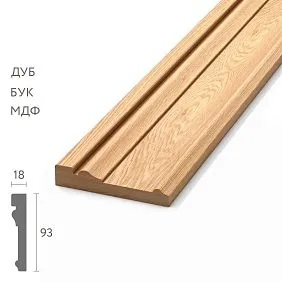


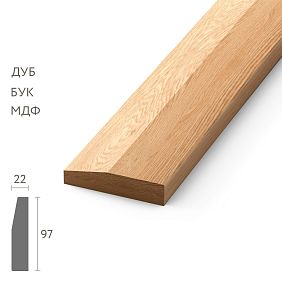
What is a 'real' wooden skirting board
When people say 'wooden skirting board,' they mean a product made from solid or finger-jointed natural wood. Not plywood, not MDF with a decorative 'wood-look' film, not laminated PVC — but a slice of living wood where you can see the annual rings, feel the pores of the fiber, and sense the warmth of the natural material.
Wooden skirting board K-series STAVROS is made from oak and beech — the two most stable and durable species for interior use. Oak with a density of 700 kg/m³ is one of the best materials for skirting boards: hard, resistant to scratching, holds finishes well, and is not afraid of loads.
Get Consultation
Key advantages of solid wood
Unmatched durability. A properly installed and finished oak skirting board lasts 30–50 years. MDF swells and loses its shape from a single incident of getting wet. Laminated MDF cannot be restored if the film is damaged. Solid wood can be sanded and refinished 3–5 times over its entire lifespan.
Repairability. A chip can be filled, sanded, and painted over. Scuff marks can be rubbed with oil or repainted. If the finish wears out — sanding and a new coat. MDF with a film finish cannot be repaired if the film is damaged: only plank replacement.
Open texture. Solid wood under varnish or oil shows the visible, living texture of the wood. Neither MDF nor PVC can achieve this effect. For interiors with expensive parquet, natural wood furniture, and a warm color palette — solid wood is the only full-fledged choice.
Eco-friendliness. Wood without a finish or with a natural oil finish is an absolutely clean material. MDF contains a binding agent (urea-formaldehyde or melamine-formaldehyde resins). Emission class E1 (up to 0.1 mg/m³ of formaldehyde) is safe, but for children's rooms and bedrooms, pure solid wood is preferable.
Tactile quality. Wood feels warm to the touch. MDF is neutral, plastic is cold. This is a subtle but significant sensation in a living space.
Features of solid wood to consider
Price. Solid oak skirting board is 2–4 times more expensive than MDF counterparts, and 5–8 times more expensive than plastic. It's fair to admit: budget matters.
Moisture. Solid wood does not like water. For bathrooms, kitchen areas near sinks, and rooms with high humidity — a finish (varnish, oil) and careful use are needed. MDF tolerates moisture better (with a finish), PVC — without limitations.
Seasonal movement. Wood is alive: it expands slightly in summer and shrinks in winter. With proper moisture content during installation (8–10%) and normal operating conditions (air humidity 40–60%) — movements are minimal and practically unnoticeable. If conditions are violated — cracks in the joints.
Weight. Weight of wooden skirting made of oak with a cross-section of 90×20 mm: approximately 1–1.1 kg/linear meter. This is heavier than MDF (700–800 g/linear meter) and significantly heavier than PVC (200–300 g/linear meter). During installation — reliable fasteners are needed: dowels, not just glue.
Types of solid wood by species: oak, beech, pine
Oak. The most durable, dense (700 kg/m³), resistant to mechanical damage. Large, beautiful texture. Price — higher than all other species.
Beech. Density 680–730 kg/m³, very similar to oak. Texture is more uniform, fine-grained. Slightly lower in price. Takes paint well in any tone.
Pine (solid and finger-jointed). Finger-jointed pine wooden skirting board — the most affordable option for natural wood. Density 500–520 kg/m³ — noticeably softer than oak, scratches more easily. Coniferous resins — a plus (natural antiseptic) and a minus (can 'bleed' through the finish when heated). Well-suited for country houses, budget projects with wooden interiors. For white paint — an excellent choice in terms of price/appearance ratio.
MDF Skirting Board: Manufacturability, Wide Selection, and Real Limitations
What is MDF and Why It's So Convenient to Work With
MDF (Medium Density Fibreboard) is a medium-density fiberboard. It is produced by pressing fine wood fibers with a binder under high pressure and temperature. The result is a homogeneous board without internal stresses, knots, or defects, perfectly suited for milling.
MDF skirting board is a milled profile, coated either with white enamel at the factory (ready for installation), or with decorative PVC film (imitation wood or colored coating), or with paper melamine coating.
Why MDF is So Popular Among Skirting Board Manufacturers:
-
Perfectly homogeneous material: the output profile is always geometrically precise, without knots, cracks, or fiber distortions
-
Easily milled into complex profiles with fine details
-
Accepts factory enamel painting well
-
Cheaper than solid wood in production
Advantages of MDF Skirting Board
Homogeneity and predictability. Each MDF plank is perfectly identical. There is no tone variation (as with wood from different batches), no profile variation. For a builder working on a production line, this is important.
Wide selection of profiles. MDF can be milled into any profile: from a simple rectangle to complex classical cornices. On the Russian market, there are hundreds of MDF skirting board profiles, whereas with solid wood, the choice is limited by the complexity of milling hard wood.
Price. MDF skirting board is 2–4 times cheaper than solid wood. For budget renovations or large footage (800+ linear meters), the difference is significant.
Ready for installation. MDF skirting board in white enamel is sold ready-to-use: unpack and install. Solid wood is most often installed unfinished (without coating) and painted/varnished on-site.
Less movement. MDF hardly reacts to humidity changes in the range of 40–60%: there is no seasonal expansion and shrinkage as with solid wood. Joints are more stable.
Real Limitations of MDF Skirting Board
Moisture is the main enemy. MDF swells irreversibly upon contact with water. A wet rag left near the skirting board, wet cleaning with a lot of water, a leak — and the bottom edge of the MDF skirting board swells, the coating bubbles. This cannot be repaired — only replacement.
Cannot be repaired if the film is damaged. PVC or melamine film on MDF cannot be restored if scratched or chipped. Putty will not match the color and texture of the film. The only option is to replace the plank.
Lifespan of the skirting board — 10–15 years. Under normal use, MDF skirting board lasts 10–15 years. After that — the film begins to peel at the edges, the bottom edge near the floor darkens, corners chip. Solid wood at this time is just 'coming into its own.'
Lack of natural texture. MDF with 'wood-like' film is an imitation. Next to oak parquet or solid oak furniture, MDF skirting board 'under wood' looks cheap. This is subjective, but important for interiors above 'standard.'
Cannot be repainted a different color. The film coating on MDF does not accept paint. White MDF skirting board with factory enamel can theoretically be repainted (sanding + primer + paint), but it is labor-intensive and the result is unstable.
Wooden MDF Skirting Board: Proper Application Area
Skirting board made of MDF— a good choice in three specific situations:
-
Budget renovation, where price is critical, and durability is on a 10–15 year horizon
-
Standard rental apartment: no point in installing expensive solid wood in rental housing, where the coating will get mechanical damage anyway
-
Quick turnkey renovation: MDF in white enamel installs quickly, no painting needed, the result looks clean
Plastic Skirting Board: Moisture Resistance, Cable Channel, and Honest Drawbacks
PVC Skirting Board — What It Really Is
Plastic (PVC) skirting board is a product made of polyvinyl chloride. Comes in two types: rigid (extruded profile of constant cross-section) and soft (flexible, for non-standard angles and curved walls). Often has a built-in cable channel — a cavity for hidden wire routing.
Surface of PVC skirting board: either solid color (white, black, gray), or with wood or marble imitation film — self-adhesive.
Where PVC is undeniably better
Moisture resistance. PVC is absolutely not afraid of water. In the bathroom, toilet, or by the kitchen sink — it's the only completely safe material. Solid wood here requires perfect coating and careful use; MDF is bad when water gets on it. PVC — you can pour water on it.
Cable channel. A built-in cable channel is a unique feature of PVC skirting boards. For apartments with a lot of floor cables (home theater, floor sockets, Internet cable) — convenient and neat.
Installation. PVC skirting board on clips — the fastest installation on the market. Press the clip to the wall, click the skirting board — done. No hammer drill, no dowels. For rooms where you don't want to create dust — this is convenient.
Price. PVC skirting board is the cheapest on the market. 5–8 times cheaper than solid oak.
Flexibility. Soft PVC skirting board bends, following a curved wall. Where solid wood would leave gaps, PVC fits tightly.
Honest disadvantages of PVC skirting board
Service life — 5–12 years. White PVC turns yellow after 5–8 years (photoaging). Skirting boards near windows yellow faster. PVC becomes brittle upon impact. Corners crack. A 10-year-old skirting board in an apartment looks old.
Not repairable. A chip on PVC — only replacement. Putty doesn't stick to PVC. Cannot be painted — paint doesn't adhere to PVC without special primer (and even then it's unstable).
Ecology questionable. PVC contains stabilizers and plasticizers. When heated (radiator near the floor) — volatile emissions are possible. For children's rooms and bedrooms — an undesirable choice.
No aesthetics. This is the most rigid and subjective disadvantage, but it cannot be ignored. PVC 'wood-look' — visible from two meters away. No film reproduces the live texture of solid wood. For interiors of 'comfort' level and above — PVC skirting board drags the whole interior down.
Where PVC is appropriate
-
Bathroom and toilet
-
Technical rooms (boiler room, pantry)
-
Economy-class rental housing
-
Rooms with floor cable routing
Comparison table: solid wood, MDF, and plastic by 10 parameters
| Parameter | Solid wood (oak/beech) | MDF with coating | PVC plastic |
|---|---|---|---|
| Price (per linear meter, approximate) | 105–2,755 rub. | 40–180 rub. | 20–80 rub. |
| Service life | 30–50 years | 10–15 years | 5–12 years |
| Repairability | High (putty, sanding, repainting) | Low (replacing the plank) | Absent |
| Ecological | High (natural wood) | Medium (E1 class) | Low (PVC, plasticizers) |
| Moisture resistance | Requires coating | Low (swells when wet) | High (100%) |
| Painting and repainting | Any color, multiple times | White enamel only (limited) | Impossible |
| Appearance | Natural texture, unique | Uniform, imitation | Synthetic appearance |
| Installation | Requires tool (hammer drill) | Similar to solid wood | Clips, no hammer drill needed |
| Weight (per linear meter) | 0.9–1.2 kg/linear meter | 0.6–0.9 kg/linear meter | 0.15–0.35 kg/linear meter |
| Seasonal movement | Minor under normal humidity | Minimal | None |
Pine finger-joint wooden skirting: a separate discussion
Why pine deserves its own section
Among all types of wooden skirting boards, finger-joint pine holds a special place: it is the most budget-friendly natural wood option, and it is often compared to MDF in the category of 'what to choose to avoid overpaying.'
Finger-jointed pine wooden skirting board— this is solid coniferous wood, finger-jointed along its length. It has visible glue seams, so it is installed only under opaque paint.
Pine vs. MDF: which is better
| Parameter | Finger-joint pine | MDF with enamel |
|---|---|---|
| Price | Comparable or slightly higher | Below |
| Service life | 20–30 years | 10–15 years |
| Repairability | High | Low |
| Moisture resistance | Medium (coniferous resins — a plus) | Low |
| Texture under paint | Structure visible (living wood) | Homogeneous |
| Ecological | Higher (natural wood) | Medium |
Conclusion: at comparable prices, finger-jointed pine for painting is more durable and eco-friendly than MDF. The only drawback is resinousness: resin 'sweating' may occur when heated (e.g., near a radiator). Solution: apply an insulating shellac primer before painting.
Types of wooden skirting boards: classification by profile and purpose
How to choose a profile depending on interior style
When talking abouttypes of wooden skirting boards, primarily refer to the profile—the cross-sectional shape. The profile determines both the visual style of the skirting board and its manufacturing complexity, and consequently, its price.
Rectangular (Recto). A strict rectangle in cross-section. No bevels, no curves. Style: loft, minimalism, high-tech. Simplicity means a lower price when made from solid wood—this profile in wood is cheaper than a shaped one.
Simple beveled. A rectangle with one or two beveled edges (chamfers). A slightly more traditional look while maintaining simplicity. Style: Scandinavian, contemporary.
Classical convex (single radius). The front face is a smooth arc. The traditional 'school' skirting board. Neutral style, compatible with most interiors. Profiles K-006, K-016 STAVROS.
Shaped classical. A complex profile with multiple elements: curves, shelves, heels. Classic, neoclassical, Renaissance. Profiles K-009, K-018, K-066. Requires precise milling—hence the price.
Wide monumental. Height 100–200+ mm. An architectural element that changes the proportions of a room. For high ceilings (3.2 m and above). Profiles K-066, K-104 STAVROS.
Wooden skirting board with cable channel: does it exist
Yes—and it's a rarely discussed but in-demand option. A wooden skirting board with a cable channel is a wide plank (from 70 mm) with a milled cavity on the lower part of the back side. Cables are placed in the cavity, covered by a decorative trim plate on magnets or clips.
An alternative to PVC skirting boards with cable channels for those unwilling to sacrifice aesthetics for function.
When solid wood skirting board is the best choice, despite the price
Five situations where saving on skirting boards is a mistake
1. Solid wood parquet. If the floor is oak or ash parquet, an MDF skirting board 'under wood' next to it looks like a fake in an expensive jewelry store. Onlysolid wood baseboard of the same species creates a systemic aesthetic.
2. Long-term project. A renovation for 20–30 years—within this timeframe, solid wood is cheaper than MDF. MDF will need replacing in 10–15 years: removing the old one, buying new, installing—it's expensive and troublesome. Solid wood remains untouched for decades.
3. Children's room and bedroom. Where eco-friendliness is important—solid wood without coating or with natural oil is the only uncompromising choice.
4. House with wooden elements. Wooden doors, wooden windows, wooden stairs, wooden furniture—a wooden skirting board completes the system. MDF or PVC in such a context creates dissonance.
5. Possibility of repainting in the future. If you plan to change the interior in 10 years but don't want to replace the skirting board—solid wood can be repainted without limitations. MDF with film—cannot.
When MDF or PVC is a reasonable choice
Honesty requires admitting: solid wood is not always the right answer.
-
Bathroom: PVC without alternatives
-
Rented office: economy MDF—reasonable savings
-
Temporary housing: MDF or PVC—the logic of 'we'll live for a couple of years and sell'
-
Budget is strictly limited: finger-jointed pine—a compromise between price and naturalness
FAQ: answers to popular questions about material comparison
Can MDF and solid wood be combined in one apartment?
Formally—yes. Practically—not recommended within the same room: the difference will be noticeable. In different rooms (bedroom—solid wood, bathroom—PVC, hallway—MDF)—a logical and common option.
Is MDF skirting with 'Supra' or 'Duropol' coating the same as regular MDF?
Plank 'Supermatt' surface or similar enhanced MDF coatings are more resistant to scratches and moisture than standard enamel. But fundamentally the material does not change: the base is MDF, with all its limitations in moisture resistance and repairability.
Is wooden skirting heavier than MDF - is that a problem for installation?
A slight difference in weight is not a problem with proper fastening. For dowel nails in concrete, a difference of 200-400 g/rm is insignificant. Weight problems only occur when installing exclusively with adhesive without mechanical fastening - which is a mistake in any case.
Best wooden skirting - oak or beech?
Oak is harder (700 kg/m³ vs. 680 kg/m³ for beech), has a more pronounced texture, looks better under clear coating. Beech has a uniform texture without a pronounced pattern, better suited for opaque coating or tinting. Durability is practically identical. Choice is based on aesthetics and budget (beech is slightly cheaper).
Why does plastic skirting turn yellow?
Yellowing is a result of photoaging of PVC under ultraviolet exposure. Stabilizers that slow this process do not eliminate it completely. Expensive PVC skirting with UV stabilizers yellows slower. Cheap ones - within 3-5 years. Solid wood and MDF under paint are not subject to this.
About the company STAVROS
In the competitive world of skirting, where MDF and PVC occupy most of the market due to low price,solid wood baseboard STAVROSmaintains its position thanks to one indisputable argument: it is the best material that lasts longer than all analogues and provides aesthetics that cannot be reproduced with synthetic materials.
Over 30 K-series profiles from kiln-dried oak and beech. Moisture 8-10%, P180 sanding, profile accuracy according to GOST 8242. In a unified ensemble:carved wooden casings, KZ-series cornices, decorative wooden rosettes, Wooden furniture handles- a unified system of wooden decor from a single source.
Samples: 180 rub./set. Consultation on material and profile selection for a specific interior: 8 (800) 555-46-75.
STAVROS - because solid wood skirting costs more exactly as much as it is better than everything else.


