Article Contents:
- Bedroom and skirting board — how this element affects the atmosphere of rest
- Three roles of a wooden skirting board in the bedroom
- Why wood, not PVC
- Height of wooden skirting board for the bedroom — 50–70 mm as optimum
- Proportional calculation for the bedroom
- Why a too narrow skirting board in the bedroom is a mistake
- Wide skirting board 80–100 mm in the bedroom: when appropriate
- Skirting board profile and the character of the bedroom
- White skirting board + light floor — Scandinavian bedroom
- Logic of a white skirting board in a light bedroom
- Light parquet and white skirting board: three coordination options
- Floor skirting board for laminate in the bedroom: color principles
- Dark oak + dark skirting board — elegant classic bedroom
- Dark parquet and dark skirting board: principle of unity
- Wooden bedroom trim: skirting board + molding + door frame
- Dark walls and dark skirting board: nuance
- Coordinating skirting board with bed frame and nightstands
- Wooden skirting board at the base of the bed — key point
- Bedroom skirting board matching the bed color: combination table
- Bedside nightstands — second coordination element
- Wooden furniture legs as a connecting element
- Skirting board and curtain rod in the bedroom — unified wooden decor
- Curtain rod and skirting board as a paired system
- Curtain rod stylistics matching the skirting board
- Skirting board and curtains: tonal connection
- Wooden skirting board for parquet in the bedroom — coordination rules
- Tone on tone: when skirting board repeats the parquet
- Contrast between skirting board and parquet
- Herringbone or straight-laid parquet flooring — does it make a difference for the baseboard?
- Scandinavian bedroom — wooden baseboard as a key element
- The principle of 'visible naturalness'
- White baseboard in a Scandinavian bedroom
- Care: how to clean the baseboard under the bed — practical tips
- Why the area under the bed is a special zone
- Cleaning tools for hard-to-reach areas
- How to clean a wooden baseboard in the bedroom
- Protecting the baseboard from mechanical damage in the bed area
- Wooden bedroom finishing as a unified system
- Door casings — vertical 'partners' of the baseboard
- Moldings in the middle part of the wall
- Bedroom furniture handles — the final accent
- FAQ - answers to popular questions
- About the Company STAVROS

The bedroom is the only room in the house where a person is alone with themselves. Guests are not received here, feasts are not held, status is not displayed. Here, one rests. And that is why the highest demands are placed on the details of the bedroom: they should not impress, but calm. Not shout, but quietly delight. Work for the atmosphere, not against it.
Wooden baseboard in the bedroom— an element rarely discussed separately, yet one that forms the visual foundation of the room in the literal sense. It runs along the base of all walls, it is visible from the bed, it participates in every color solution of the room. And when chosen correctly — it goes unnoticed. That is success.
In this article, we will cover everything: from optimal height to principles of coordination with parquet, bed, curtains, and cornice. With specific parameters, real examples, and a professional perspective on details that determine the mood in the bedroom.





Bedroom and baseboard — how this element influences the atmosphere of rest
There is an architectural phenomenon well-known to designers and largely unfamiliar to most homeowners: horizontal lines at the base of walls set the 'weight' of a space. The more pronounced this line — the more 'earthy', stable, and calm the room feels.
The baseboard — is precisely that line. In the bedroom, where the goal of the environment is peace and relaxation, a correctly chosenwooden baseboard in the bedroomcreates a sense of spatial balance. It 'grounds' the walls, visually anchors the space near the floor, and prevents the room from 'floating away' toward emptiness and blandness.




Three roles of a wooden baseboard in the bedroom
First role: architectural frame. The baseboard is the lower horizontal in the 'floor — wall — ceiling' system. Like a picture frame, it marks the boundary between the vertical plane of the wall and the horizontal of the floor. Without this boundary, the transition looks raw and unfinished. With it — the room gains completeness, each wall becomes a distinct 'canvas'.
Second role: material accent. In the bedroom, soft surfaces often dominate — textiles, carpets, upholstered furniture. Wood introduces a solid, structural element into this 'soft' world. The visible texture of wood fibers, the tactile density of the material, the natural warmth of the tone — this contrast enriches the bedroom, making it multi-layered.
Third role: color mediator. The floor and wall rarely match in tone — they need to be 'reconciled'. A wooden baseboard, taken from the same color palette as the parquet or laminate, creates a smooth transition. Or, conversely, an accent baseboard of a different tone — deliberately separates the floor and wall, creating a decorative note.
Our factory also produces:





Why wood, not PVC
In the bedroom, where the air should be clean and chemical exposure minimal, natural wood has an undeniable advantage over polyvinyl chloride. Wood does not release plasticizers, does not change odor when heated, does not 'gray' over time. The wooden surface remains alive — lightening or darkening under light exposure, 'acquiring' patina. This is a dynamic quality you appreciate years later.
Get Consultation
Height of wooden baseboard for the bedroom — 50–70 mm as optimum
The height of the baseboard in the bedroom is a parameter driven not by taste, but by geometric logic. Let's examine it.
Proportional calculation for a bedroom
Standard bedroom in an apartment: ceiling height 2,600–2,800 mm, area 14–18 m². The golden ratio for skirting boards in such a room: the skirting board height should be 2–3% of the ceiling height.
For a 2,700 mm ceiling: 2,700 × 0.025 = 67.5 mm. Rounded to standard sizes — 60 or 70 mm. This is why '60 mm wooden skirting board for a bedroom' is a stable professional standard. A 60–70 mm skirting board is visually proportionate to a standard bedroom: noticeable enough to fulfill an architectural role, but not so wide as to 'weigh down' the lower tier.
For a 3,000 mm ceiling: 3,000 × 0.025 = 75 mm. Here, an 80 mm skirting board can already be considered — and it will look organic. For a 2,400 mm ceiling: 2,400 × 0.025 = 60 mm. For low ceilings — 50–60 mm, no more.
Why a too narrow skirting board in a bedroom is a mistake
A 30–40 mm skirting board in a bedroom with a 2,700 mm ceiling looks random — as if leftover materials from another room were used during renovation. It doesn't create an architectural accent, doesn't serve as a 'frame,' and visually 'gets lost' at the base of the walls. In a bedroom with rich textiles (heavy curtains, bedspreads, decorative pillows) — such a skirting board simply isn't visible.
Minimum skirting board height in a bedroom for it to function as a decorative element: 50 mm.
Wide 80–100 mm skirting board in a bedroom: when appropriate
WideWooden baseboard80–100 mm in a bedroom — a solution for classic interiors with high ceilings and developed decor. A formal bedroom with cornice moldings, frescoes, heavy velvet curtains, a massive bed with a carved headboard — here a wide skirting board is organic. It 'participates' in the architectural hierarchy, where each decorative element has weight and scale.
In a modern bedroom with minimalist furniture, a wide 100 mm skirting board creates excessive 'bulk' at the base of the walls and disrupts the lightness of the space. Here, 60–70 mm is the perfect fit.
Skirting board profile and bedroom character
Height is one parameter. Profile is another, no less important.
Flat skirting board — for Scandinavian bedrooms, minimalism, modern classic. Clear rectangular contour, no relief. White or matching the wall color — almost disappears. Matching the floor color or contrasting with the wall — a clear graphic line.
Coved profile (with a smooth curve at the top edge) — a universal choice. The soft arc softens the transition to the wall, adds a bit more 'character,' without becoming overtly decorative. Works in bedrooms from Scandinavian to transitional styles.
Multi-profile skirting board with shelves and coves — for classic and neoclassical bedrooms. A developed architectural profile, creating a complex play of shadows. Requires high ceilings and coordination withprofile moldingsanddoor casings.
White skirting board + light floor — Scandinavian bedroom
A Scandinavian bedroom — it's not just a style. It's a philosophy of rest: minimal distracting details, maximum light, natural materials that don't shout but are present. And a white wooden skirting board for a bedroom — the perfect element of this system.
The logic of a white skirting board in a light bedroom
A light bedroom with white or cream walls, light parquet (ash, birch, oak in a 'white oil' tone) and a white skirting board creates a 'dissolving' boundaries effect. The floor transitions into the wall seamlessly — the skirting board matches the wall tone. The space becomes maximally open, airy. This is the 'white on white' principle — not monotony, but sophistication.
Nuance: the skirting board should not be the exact same white as the wall. Undertone matters. If the wall is a 'warm white' (RAL 9010 or 9001), and the skirting board is a 'cool white' (RAL 9016) — the difference is noticeable and looks like a mistake. Always coordinate the skirting board tone with the wall within the same color temperature.
Light parquet and white skirting board: three coordination options
Option one: skirting board matching the wall. White skirting board against a white wall. The light parquet 'reads' independently, the skirting board is a transitional element. A minimalist, light solution. Good for small bedrooms: doesn't 'eat up' visual space.
Option two: skirting board matching the floor. Light skirting board matching the parquet tone — 'extends' the floor vertically. The floor seems to 'rise' onto the skirting board. The wall starts higher. The effect — visual lowering of the ceiling (bad for low ceilings) and visual expansion of the floor (good for small rooms).
Option three: contrasting thin accent. Light parquet, white walls and a skirting board in a 'natural oak' or 'ash' tone — a natural wood tone. This is a contrast, but a soft, warm one. The skirting board becomes a visible accent, emphasizing the floor/wall transition and adding warmth to a cool white palette.
Floor skirting board for laminate in a bedroom: color principles
Laminate in a bedroom — a frequent choice. When coordinating a skirting board with laminate, the same rule applies as with parquet: one color temperature (warm tones with warm, cool with cool) and a conscious choice between 'matching' and 'contrasting'.
Laminate 'grey oak' — cool tone. White skirting board — appropriate (both cool). Skirting board in a 'warm walnut' tone — conflict of color temperatures. Laminate 'warm walnut' — white skirting board creates a contrast, but an appropriate one (white is neutral). Skirting board in a 'cool grey' tone — inappropriate.
Dark oak + dark skirting board — an elegant classic bedroom
If Scandinavian bedroom is morning light, then classic dark bedroom is evening coziness. Heavy drapes, deep tones, massive furniture, subdued lighting. Andwooden baseboard in the bedroomdark tones are an organic part of this system.
Dark parquet and dark skirting board: the principle of unity
Dark oak parquet (shades like "wenge", "mocha", "dark walnut", "black oil") with a skirting board of the same tone creates a monolithic foundation. The floor and skirting board form a unified dark "base", against which walls and ceiling are perceived as a light "sail". This is a classic architectural combination: dark at the bottom, light at the top — stability, balance, tranquility.
This solution works well with ceiling heights from 2,700 mm. With low ceilings, the dark foundation "presses down", making the room heavier — in which case it's better to choose a skirting board matching the wall color or 1–2 shades lighter than the floor.
Wooden bedroom trim: skirting board + molding + door casing
In a classic bedroom, the skirting board is the lower element of the vertical wooden decor system. The system is built in tiers:
-
Lower tier: wooden skirting board 80–100 mm in "dark oak" tone
-
Middle tier (optional):wooden moldingin the middle of the wall — divides the wall into a panel (below the molding) and a field (above)
-
Upper tier:Ceiling cornice— finishes the wall at the ceiling, symmetrical to the lower skirting board
-
Verticals:wooden door casingsof the same profile — tie the system together
All elements of the same tone and profile — this architectural coherence transforms the bedroom from "an interior with furniture" into "a space with character".
Dark walls and dark skirting board: nuance
Dark wall + dark skirting board = loss of the skirting line. If the wall is dark gray or dark blue, and the skirting board is in "wenge" tone — they will blend together. This may be a desired effect (the skirting board "disappears"), but then its architectural role is lost. In a dark bedroom, a dark skirting board is appropriate only if it's one or two shades darker than the wall and creates a barely noticeable, "velvety" transition to the floor.
Alternative: dark walls + white skirting board. A bold contrast where the skirting board acts as a "frame" for the dark wall canvas. Striking in modern "cocoon" bedrooms with rich color palettes.
Coordinating skirting board with bed frame and nightstands
This section is the most practical and least frequently discussed. Meanwhile, it's precisely the relationship between skirting board and furniture in the bedroom that creates or destroys visual harmony.
Wooden skirting board at the bed base — key point
The bed stands against the wall — and the skirting board runs behind the headboard and along the sides. This means the skirting board and bed are visible simultaneously from any point in the room. Their tonal and stylistic alignment is not an option, but a necessity.
If the bed frame is light wood (ash, oak in natural tone, birch): skirting board — light or white. Unity of natural tone creates a sense of "wooden" space, warm and organic.
If the bed frame is dark (wenge, dark walnut, painted gray or black wood): skirting board — dark, matching the frame tone or slightly lighter. Dark skirting board "echoes" the bed frame and creates tonal unity between furniture and finish.
If the bed frame is gray, metallic, lacquered (modern beds without pronounced "wooden" character): wooden skirting board takes on the role of a "warm" element and can be in natural oak or beech tone — as a "warm entry" into a cold color scheme.
Bedroom skirting board matching bed color: combination table
| Bed frame color | Recommended baseboard tone | Effect |
|---|---|---|
| White / cream | White | Unity, lightness |
| Light oak / ash | Natural oak | Organic warmth |
| Dark walnut / wenge | Dark oak / wenge | Monolithic classic |
| Gray / anthracite | White or natural | Contrast, accent |
| Black | White or dark | Depends on the overall palette |
| Rosewood (pink tint) | White | Neutral background |
Bedside tables — the second coordination element
Bedside tables stand flush against the wall — literally 'resting' visually on the baseboard. If the table is light and the baseboard is dark — a sharp boundary forms between the furniture and the finish in the lower zone of the room, which 'cuts' the space. If the table and baseboard are coordinated in tone — the lower tier of the room is perceived as a single whole.
Practical rule: the baseboard should be no more than 2 tones darker than the table on the Munsell scale. Or — in white for any table: white baseboard is neutral and does not conflict with any furniture.
Wooden furniture legs as a linking element
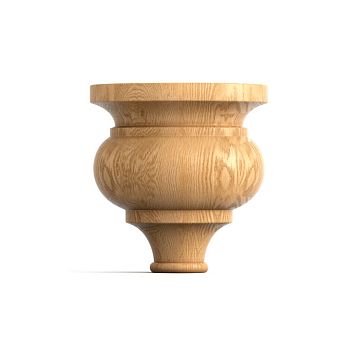
If the bed and bedside tables stand onwooden furniture legsoak or beech legs — a baseboard made of the same wood species and tone creates a vertical 'rhyme': wood at the floor (baseboard) and wood above the floor (legs) are coordinated. This is a subtle designer move that gives the interior a systematic feel.
Baseboard and curtain cornice in the bedroom — unified wooden decor
Curtains in the bedroom — one of the key elements of the atmosphere. Heavy blackout curtains for complete darkening, light linen for light filtering, multi-layer drapes for classic style — in any option, the curtain cornice is in constant view. And its relationship with the baseboard determines the harmony of the vertical 'floor — wall — ceiling'.
Cornice and baseboard as a paired system
Design rule: the curtain cornice and floor baseboard should be 'paired' elements — of the same material, same tone, same stylistic solution. A wooden cornice matching the bedroom parquet + a wooden baseboard in the same tone — this is a visual framing of the wall from top and bottom.
When this works especially expressively: in a bedroom with plain light walls. The wall is a pure 'canvas', bounded below by a dark baseboard, above by a dark cornice. Like a painting in a frame — only here the painting is the wall itself.
Cornice style matching the baseboard
If the baseboard is flat and minimalist — the cornice should be of the same geometry. A profiled cornice with decorative curls above a flat baseboard — a stylistic contradiction. If the baseboard has a molded profile — a cornice with a soft profile that matches in character.
STAVROS wooden moldings and cornicesare made from the same wood species and in the same tones as the baseboards — this guarantees stylistic unity when ordering from the same catalog.
Baseboard and curtains: tonal connection
Curtains occupy a large area—they visually dominate the bedroom. A baseboard coordinated with the tone of the curtains creates a 'rhyme' between the textile and the finish. It doesn't have to be the exact same tone—it's about the same color temperature.
Warm beige linen curtains + warm natural oak baseboard—a unified warm palette. Cool gray curtains + cool grayish-white baseboard—a unified cool palette. Mixing warm curtains and a cool baseboard is a 'restless' combination that disrupts rest.
Wooden baseboard for parquet in the bedroom—coordination rules
Parquet and baseboard are the closest 'pair' in the bedroom. They literally stand side by side, with the baseboard covering the technical gap between the parquet and the wall. Their coordination is not just about aesthetics but also physical logic.
Tone on tone: when the baseboard matches the parquet
A baseboard in the same tone as the parquet is a classic, foolproof solution. The floor 'extends' onto the baseboard, the boundary between them is minimal, and the eye doesn't 'catch' on the seam. The room looks cohesive.
Important nuance: 'in the same tone' does not mean 'from the same batch.' Parquet is a horizontal surface, lit from above. The baseboard is a vertical surface, lit from the side. The same tone on horizontal and vertical surfaces is perceived differently: the baseboard appears darker. To achieve visual unity, choose a baseboard one tone lighter than the parquet.
Contrast between baseboard and parquet
Intentional contrast is a design decision that requires confidence. Dark parquet + white baseboard: a white line against a dark base—clear graphics, concise and expressive. Light parquet + dark baseboard: a dark line against a light floor—a 'frame' that highlights the floor space as a separate architectural element.
Contrast works in modern bedrooms with clean lines and minimal decor. In classic interiors, contrast between the baseboard and parquet violates the principle of finish unity.
Herringbone or straight-laid parquet—does it make a difference for the baseboard?
The geometric pattern of parquet installation indirectly influences the choice of baseboard. Herringbone parquet creates a diagonal rhythm—a baseboard with a soft profile, not too 'rigid' in character, suits it organically. Straight-laid planks (parallel to the wall) create a horizontal rhythm—a profiled baseboard with horizontal 'shelves' complements this horizontality.
Scandinavian bedroom—wooden baseboard as a key element
Scandinavian style is not just 'lots of white.' It's about balance: white as a backdrop, wood as warmth, minimalism as a principle. In a Scandinavian bedroom, a wooden baseboard is one of the few 'warm' elements, and its role in creating atmosphere is significant.
The principle of 'visible naturalness'
In a Scandinavian bedroom, wood should look like wood: visible grain texture, matte or semi-matte finish, natural tone without heavy staining. An oak or ash baseboard in a natural oil finish tone is 'speaking' wood. The same baseboard in dark 'wenge' lacquer is 'fake' wood, repainted in an alien tone. In Scandinavian style, such a solution violates the principle of material honesty.
White baseboard in a Scandinavian bedroom
A white wooden skirting board is the second option for Scandinavian style. Not white PVC (which feels plastic), but specifically a wooden skirting board with white acrylic paint. The difference is noticeable upon closer inspection: the wood beneath the white paint retains the profile relief, slight irregularity (it's a natural material), and tactile warmth. White PVC is uniform, 'lifeless,' and identical everywhere.
A 60 mm white wooden baseboard with light parquet in a Scandinavian bedroom—zero extra details and maximum organic feel.
Care: how to clean the baseboard under the bed—practical tips
A practical section usually not discussed until the problem arises. The baseboard under the bed is the least accessible cleaning area. Yet, this is where dust accumulates the fastest.
Why the area under the bed is special
Air currents in the bedroom (from ventilation, open windows, or movement while walking) push dust precisely under furniture. A 'dust pocket' forms under the bed—dust settles on the floor, bed legs, and the lower part of the baseboard. With a profiled baseboard, dust gets trapped in the profile recesses.
Tools for cleaning inaccessible areas
-
Long flat brush (flounder) 120–160 mm wide—allows reaching under the bed for the length of the handle
-
Vacuum 'spatula' attachment—a thin crevice nozzle for cleaning in gaps
-
Microfiber cloth on a flexible handle—for wet wiping the baseboard under the bed
Frequency: baseboard under the bed—full cleaning with bed moving every 2–3 months. Between full cleanings—use a long brush weekly.
How to clean a wooden baseboard in the bedroom
Baseboard with acrylic coating:
-
Daily: dry or slightly damp microfiber cloth
-
Monthly: warm water with neutral soap, immediate drying
-
Stubborn stains: isopropyl alcohol on a cotton pad
Oil-finished skirting board:
-
Dry cleaning is the priority
-
Wet cleaning only with a slightly damp cloth, no soaking
-
Annually: oil finish renewal — light sanding with P320 + oil
What is strictly prohibited: steam cleaner (damages the finish and raises wood grain), abrasive sponges, concentrated household cleaners.
Protecting skirting boards from mechanical damage in the bed area
When moving the bed during cleaning — bed legs often hit the skirting board. Result: dents and scratches on the lower section of the skirting board.
Protection: felt pads on bed legs (same as for parquet). When moving the bed — lift it, don't slide it on the floor. For very heavy beds — a small wooden spacer between the leg and skirting board when temporarily shifting furniture.
Wooden bedroom trim as a unified system
We've already talked about paired elements — skirting boards and curtain cornices. But a holistic approach to wooden bedroom trim includes several more elements that form a complete system.
Door casings — vertical 'partners' of the skirting board
Wooden door casings in the bedroom— vertical elements that work in tandem with the horizontal skirting board. In classic interiors, the casing 'continues' the skirting profile: same motif, same tone, same wood species. The casing seems to 'grow' from the skirting board — visually and tectonically.
In modern interiors, the casing can match the skirting board tone with a different profile. Or — white casing with a dark skirting board (door frame lighter than the base).
Moldings in the middle section of the wall
HorizontalMoldingat a height of 900–1,100 mm from the floor divides the bedroom wall into two zones: lower (panel) and upper (field). This is a classic wall paneling technique that gives the bedroom a formal character without excessive decoration.
The lower panel is often painted in a tone contrasting with the upper zone — this creates a visual 'tier', adding depth to the space. The skirting board in the same tone as the lower panel completes this tier at the floor.
Furniture handles in the bedroom — the final accent
wooden furniture handleson nightstands, dresser, and wardrobe — a detail visible from the bed. Coordinating them with the skirting board tone is the final touch of the bedroom wooden decor system. Light handles with light skirting board. Dark handles with dark skirting board. Or — intentional contrast: dark handles on light furniture with light skirting board.
FAQ — answers to popular questions
Which skirting board is better for the bedroom — oak or pine?
Depends on style and expected durability. Oak — harder, more durable, noble texture, holds finish well. Pine — warmer in tone, softer to the touch, organic in Scandinavian and rustic interiors. For classic bedroom — oak. For Scandinavian or country — pine.
Can you use dark skirting board with light walls in a small bedroom?
Yes, if the ceiling is not lower than 2,600 mm. Dark skirting board with light walls and light ceiling creates a clear 'base' — the space doesn't shrink but gains stability. In a very small bedroom under 10 m², dark skirting board may create a feeling of 'compression' at floor level — in that case, white or wall-tone is better.
Should the skirting board match the bedroom door color?
Not necessarily, but desirable — matching color temperature. Warm-tone door + warm-tone skirting board (not necessarily the same color). If door casings and skirting board are the same tone — this creates maximum consistency.
How to properly coordinate skirting board with parquet boards of different shades in different bedroom zones?
If the bedroom has parquet of the same pattern, but areas (under the bed, by the window) have slightly different tones due to fading, the skirting board is chosen to match the 'average' tone of the parquet. If the room has different floor materials (e.g., carpet by the bed and parquet by the window), the skirting board is coordinated with the parquet; the carpet is neutral to the skirting board.
Is a gap needed between the skirting board and the parquet?
Technically, parquet (and laminate) is installed with an 8–12 mm gap at the wall to compensate for expansion. This gap is covered by the skirting board. The skirting board is not nailed to the floor—only to the wall. There should be no gap between the skirting board and the parquet: the skirting board rests on the parquet, concealing the technical gap at the wall.
How to remove dust from a profiled skirting board under the bed without moving the bed?
A long, flat brush with soft bristles (a 120 mm flounder brush) + a vacuum cleaner with a crevice nozzle. Use the brush to sweep dust out of the profile recesses and the vacuum to immediately collect it. The flexible handle of the brush allows reaching under the bed 60–80 cm from the edge.
About the company STAVROS
The bedroom is the most personal space. And a wooden skirting board in it is not just 'hardware.' It is a choice in favor of a natural, durable, warm material that will be there every morning and every evening. Without chemical odors, without plastic uniformity, without a 'disposable' feel.
STAVROS is a Russian manufacturer of wooden architectural decor made from solid oak and beech.Wooden skirting boards for the bedroomin the STAVROS range feature precise dimensions, stable moisture content of 8–10%, P320 sanding ready for any finish, and a unified system of profiles and tones across the entire catalog.
The STAVROS range includes a complete set of wooden bedroom trim:moldings, cornices, and baseboards, wooden door casings, Furniture HandlesandFurniture Legsmade from oak and beech. Everything is from one manufacturer, within a unified system of tones and profiles. Because the bedroom deserves a systematic approach, not a random assortment of parts.