Article Contents:
- Standard Wooden Skirting Board Dimensions: Width, Height, Thickness
- Three Dimensions of One Profile
- Standard Size Range in K-Series STAVROS
- Stick Length — Standards
- Wooden Skirting Board Dimensions by Category: Low, Medium, High
- Low skirting board: up to 50 mm
- Medium Skirting: 50–80 mm
- High and Wide Skirting: 80–120 mm and Above
- Square Skirting: 30×30, 40×40, 50×50
- What is a Square Profile
- Square Skirting vs Flat: Visual Differences
- How to Calculate the Optimal Height for a Wooden Skirting Board
- Proportion Formula: Skirting and Ceiling
- Correction Coefficients
- Visual Effects of Different Heights in One Room
- Relationship: Ceiling Height → Skirting Height → Molding Scale
- Order System: Three Horizontal Belts
- Casing: Vertical Connecting Element
- Furniture and Skirting: Proportional Relationship
- Width of Wooden Skirting Boards: How It Affects the Interior
- Width vs Height: Two Different Dimensions
- Standard Overhang Values
- Impact of Width on Installation
- Standard Skirting Length and Linear Meter Calculation for a Room
- Standard Stick Length
- How to Calculate Linear Meters of Wooden Skirting
- Calculation Table: Standard-Size Rooms
- Purchasing Errors in Linear Meter Calculation
- Wooden skirting board in large sizes: 100 mm, 120 mm and above — installation nuances
- Installation features of wide skirting boards
- Combining wide skirting boards with other elements
- FAQ: Answers to Popular Questions
- About the Company STAVROS

Some questions seem simple — until you start delving into them. 'What size wooden skirting board should I choose?' is exactly such a question. At first glance: buy any, place it against the wall, and that's it. Upon closer inspection — it's a decision that determines the visual proportions of the entire room, the coherence of the interior's architectural ensemble, and that elusive feeling of 'completeness' that is either present in a good interior or absent.
Wooden skirting board dimensions— it's not just width and height in millimeters. It's a system of interrelationships: the height of the skirting board relative to the ceiling height, the width relative to the profile depth, the thickness relative to the wall material. Properly selected dimensions make the skirting board 'belong' in the interior. Incorrect ones — and it either gets lost or feels oppressive.
In this article — everything you need to know about wooden skirting board dimensions: standard parameters, dependencies and calculation formulas, features of square profiles, methodology for calculating linear footage. Read sequentially — each section builds upon the previous one.


Standard dimensions of wooden skirting boards: width, height, thickness




Three dimensions of one profile
A wooden skirting board is characterized by three linear parameters. They need to be clearly distinguished because in different contexts 'skirting board size' means different things.
Height — the vertical dimension of the skirting board: the distance from the bottom edge (at the floor) to the top edge (at the wall). Height is the main parameter determining the visual weight of the skirting board in the interior. Range: from 20 mm (cove) to 200+ mm (formal profiles).
Width (or projection) — the horizontal dimension: the distance from the wall to the front face of the skirting board. Determines how much the skirting board 'protrudes' into the room space. Range: from 16 mm (flat profiles) to 50–60 mm (wide molded profiles).
Thickness — the dimension of the skirting board body in the attachment area (at the wall). For molded profiles with a 'shelf' — body thickness 18–25 mm. For flat profiles — 14–20 mm.
It's important to understand: for molded profiles, height and width often differ significantly. For example, profile K-070 — height ~110 mm, projection ~35 mm. Skirting board K-034 — height ~60 mm, projection ~16 mm. Square profile 50×50 — height equals width, both parameters 50 mm.
Our factory also produces:



Standard size range in the K-series STAVROS
STAVROS K-series moldingscovers practically all commonly required heights:
| Profile | Height | Projection | Category | Price from |
|---|---|---|---|---|
| K-034 | ~60 mm | ~16 mm | Low, flat | 230 rub./lm |
| K-125 | ~70 mm | ~18 mm | Medium, flat | 270 rub./lm |
| K-105 | ~70 mm | ~22 mm | Medium, Euro | 300 rub./lm |
| K-006 | ~80 mm | ~28 mm | Medium, shaped | 440 rub./lm |
| K-016 | ~85 mm | ~30 mm | Medium, shaped | 490 rub./lm |
| K-070 | ~110 mm | ~35 mm | Tall, shaped | 950 rub./lm |
| K-009 | ~130 mm | ~40 mm | Tall, Empire | 1,420 rub./lm |
| K-018 | ~150 mm | ~45 mm | Tall, formal | 1,630 rub./lm |
| K-066 | ~170 mm | ~50 mm | Wide, formal | 2,580 rub./lm |
| K-104 | ~200 mm | ~55 mm | Maximum | 6,060 rub./lm |
Get Consultation
Stick length — standards
The standard stick length for wooden skirting in the K-series is 2.4 m and 3.0 m. This is a production standard determined by the dimensions of drying chambers and milling machines.
Why this matters for procurement: stick length affects the number of joints on straight sections and the percentage of waste during cutting. A long stick (3.0 m) is more advantageous for rooms with long walls — fewer joints and less loss on cuts.
Wooden skirting dimensions by category: low, medium, high
Low skirting: up to 50 mm
Wooden skirting board up to 50 mm high is a minimalist 'lower horizon'. It is barely noticeable, almost blending with the wall or floor. Used where the goal is to cover the expansion gap without creating a visual accent.
When to choose skirting board up to 50 mm:
-
Rooms with ceilings 2.3–2.5 m: even the slightest increase in skirting board height works against you here — it 'eats up' the height.
-
Attics and mezzanines with sloping ceilings: low skirting board is organic in 'tight' spaces.
-
Technical rooms, dressing rooms, storage rooms: function without aesthetics.
-
Interiors with pronounced horizontal zoning, where the skirting board is intentionally made 'invisible'.
Wooden profiles up to 50 mm:
Cove and triangular profile — 20–40 mm. This is the minimal wooden molding used on parquet and stair junctions.
Important note: skirting board below 40 mm practically does not cover the expansion gap of parquet with wide planks (180+ mm). For wide planks, the minimum skirting board height is 60 mm.
Medium skirting board: 50–80 mm
The 50–80 mm range is the most in-demand. This is where the bulk of demand forwooden skirting board sizein modern residential spaces is concentrated.
Why 60–80 mm is the 'golden' range:
-
Reliably covers the expansion gap of any flooring
-
Works with ceiling heights of 2.4–3.0 m without visual overload
-
Sufficient for shaped profiles: the relief is 'readable' at this height
-
Does not require complex miter cuts in corners: at 60–80 mm height, the precision of 45° miter cuts is not as critical as at 150–200 mm
Profiles K-034, K-125, K-106, K-006 — all in the 60–85 mm range. This is the 'workhorse' series for standard apartments and houses.
Where it is used:
-
Apartments with ceilings 2.6–3.0 m: universal solution
-
Bedrooms, living rooms, kitchens, children's rooms
-
Business-class office spaces
-
Country houses with wooden floors
Tall and wide skirting board: 80–120 mm and above
Wooden Skirting Board Height80 mm and above — this is already an architectural statement. Skirting board of this height ceases to be a 'technical element' and becomes part of the interior's order system.
Skirting board 80–120 mm (K-006, K-070):
Optimal range for classic interiors with ceilings 2.8–3.2 m. K-006 (~80 mm) — restrained classic for most rooms. K-070 (~110 mm) — for formal rooms and living rooms with rich decor.
For skirting board heights of 100–120 mm, unity with the profiles ofcasingsandwooden cornices of the KZ-series is recommended.For curtains: three horizontal interior belts should be "rhymed" in profile style.
Skirting board 120–150 mm (K-009, K-018):
Formal range. For rooms with ceilings from 3.0 m, with molded ceiling cornices, rich door architraves. K-009 (~130 mm) — Empire tradition in a modern interpretation. K-018 (~150 mm) — for historical interiors and restoration projects.
Wooden skirting board 100 mm — a special category of requests. This is a "borderline" height between medium and high. 100 mm is precisely the mark at which the skirting board begins to "work" as an architectural element, not just as a covering strip. Profiles K-006 (~80 mm) and K-070 (~110 mm) — the closest to this request from the K-series.
Wooden skirting board 120 mm — corresponds to profile K-009 (~130 mm). Used in interiors with a clear classical structure: skirting board at the bottom, cornice at the top, architraves vertically.
Square skirting board: 30×30, 40×40, 50×50
What is a square profile
Square wooden skirting board — is a profile where the height is approximately equal to the width (projection). Triangular or close to square cross-section. This is a special category: it combines the functionality of a cove with the visibility of a standard skirting board.
Wooden skirting board 30×30
Minimal square profile. Height 30 mm, projection 30 mm. Applications:
-
On parquet and parquet boards — covers the expansion gap with minimal visual load
-
In the junctions of steps to the wall on wooden stairs fromK-series accessories
-
In furniture junctions — kitchen unit worktop to wall
For rooms with ceilings below 2.5 m — recommended option if the task is to "remove" the skirting board from the field of view as much as possible.
Wooden skirting board 40×40
The most popular square size. Height and projection 40 mm each. Occupies an intermediate niche between a cove and a standard flat skirting board.
Visually: when looking at the wall, the 40×40 skirting board appears "flat" — its width equals its height. This creates a neutral effect: the skirting board is present but does not claim a role.
Applied:
-
Apartments with ceilings 2.5–2.7 m, Scandinavian and contemporary style
-
Stairs — on treads and risers
-
Kitchens — junction of tiles to floor
Wooden skirting board 50×50
Square profile 50×50 — is already a noticeable interior element. With a height of 50 mm, it is comparable to the lower range of "medium" skirting boards, and its square shape creates a pronounced "volumetric" effect at the base of the wall.
Used in contemporary minimalist interiors where a clear geometric "plinth" at the floor is needed without complex relief. Looks good painted in dark tones (black, anthracite): a square profile in a dark color gives a clear graphic outline.
Square skirting board vs flat: what is the visual difference
| Parameter | Square 40×40 | Flat K-034 (60×16) |
|---|---|---|
| Height | 40 мм | 60 мм |
| Projection | 40 мм | 16 мм |
| Visual volume | "Cubic", noticeable | "Flat", neutral |
| Shadow from the baseboard | Pronounced (wide band) | Minimal |
| Style | Modern, loft | Scandinavian, minimalism |
| Installation in corners | 45° miter cut is more difficult (equal sides) | Standard |
Important installation nuance for square profiles: a 45° miter cut on a square requires special precision — with equal height and width, the slightest angle deviation creates a noticeable gap. For square profiles, a miter saw with laser marking is preferable.
How to calculate the optimal height of a wooden baseboard
Proportion formula: baseboard and ceiling
There is a classic rule of proportions developed through interior design practice: the height of the baseboard should be 3–5% of the ceiling height. This empirical rule does not work perfectly in all cases but provides an excellent starting point.
Let's calculate:
| Ceiling Height | 3% | 4% | 5% | Recommended range |
|---|---|---|---|---|
| 2.4 m | 72 мм | 96 мм | 120 мм | 60–80 mm |
| 2.6 m | 78 мм | 104 мм | 130 мм | 70–100 mm |
| 2.8 m | 84 мм | 112 мм | 140 мм | 80–120 mm |
| 3.0 m | 90 мм | 120 мм | 150 мм | 100–140 mm |
| 3.2 m | 96 мм | 128 мм | 160 мм | 120–160 mm |
| 3.5 m | 105 мм | 140 мм | 175 мм | 140–200 mm |
| 4.0+ m | 120 мм | 160 мм | 200 мм | 160–220+ mm |
Why is the recommended range sometimes lower than calculated? Because the 3–5% formula is for "formal" interiors with full classical order design (baseboard + door casings + ceiling cornice). In modern apartments with neutral ceilings without moldings, a baseboard at the lower end of the range (3%) looks more organic.
Adjustment coefficients
Pure mathematics is a good foundation, but the actual choice is adjusted by several factors.
Interior style. Classical interior — baseboard at the upper end of the range or higher. Minimalist — at the lower end or lower.
Baseboard color. White baseboard in a white interior — can be taken slightly above calculated: it "dissolves." Dark or colored baseboard — better below calculated: dark draws attention.
Width of the floorboard. Wide board (180+ mm) requires a baseboard not lower than 70–80 mm — otherwise, the proportions of the floor and baseboard are uncoordinated.
Presence of furniture against walls. If furniture (cabinets, sofas) is placed along the wall, covering most of the baseboard — there is no point in overpaying for a high profile. It will only work on open sections.
Height of door frames. In a room with door openings of 2.0 m and a ceiling of 2.6 m — the space above the frame is 60 cm. A wide formal baseboard will "compete" with the door opening. Stick to the lower end of the range.
Visual effects of different heights in one room
Sometimes different heights occur in one room — for example, a main room with a 2.6 m ceiling and an adjoining niche vestibule with a 2.3 m ceiling. Is it necessary to change the baseboard?
Answer: if the rooms are visually connected (open doorway without a door) — the baseboard should be uniform in height for visual consistency. If separated by a door — each room can have its own baseboard. But a transition from high to low in one visual field creates "awkwardness."
Dependency: ceiling height → baseboard height → scale of moldings
Classical order system: three horizontal belts
In classical interior architecture, there exists a strict system of interrelationships: the baseboard at the floor (lower band), the wall (middle band), and the cornice at the ceiling (upper band). These three elements form an order structure, where each element is scaled proportionally to the others.
The baseboard at the floor and the cornice at the ceiling are the 'frame' of the wall. They should be visually comparable. If the baseboard is K-034 (60 mm) and the ceiling cornice is 150 mm, the frame is 'skewed': the top is heavy, the bottom is light. Rule: the height of the baseboard should be 60–80% of the height of the ceiling cornice.
Examples of coordinated pairs:
-
Baseboard K-034 (60 mm) + ceiling cornice 80–100 mm — a light, neutral pair
-
Baseboard K-006 (80 mm) + cornice 100–130 mm — a standard classic pair
-
Baseboard K-070 (110 mm) + cornice 140–180 mm — a rich classic pair
-
Baseboard K-009 (130 mm) + cornice 160–200 mm — a formal pair for ceilings 3.0+ m
-
Baseboard K-066 (170 mm) + cornice 200–250 mm — for palace interiors
If the room is planned to havewooden cornices KZ-seriesfor curtains, they also 'enter' this system: their profile should be stylistically coordinated with the baseboard.
Casing: the connecting link vertically
Doorway casing is a vertical element connecting the lower horizon (baseboard) with the upper one (ceiling cornice). The height of the casing head should be comparable to or slightly greater than the height of the baseboard.
Rule from practice: the width of the casing at the doorway (horizontal cross-section) ≈ baseboard height ±20%. This creates a visual rhythmic unity of horizontal and vertical trim elements.
Casings and baseboards should be from the same K-series STAVROS — or stylistically compatible series. Inconsistency between casing and baseboard profiles is one of the most common mistakes in interior design.
Furniture and baseboard: proportional connection
There is another rarely mentioned aspect: the ratio of baseboard height to furniture leg height.
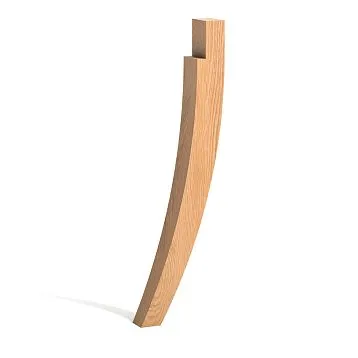
with a height of 100–150 mm — the baseboard should be of a comparable scale: 80–120 mm. Otherwise, massive legs 'overhang' a fragile baseboard, and the transition 'furniture — floor' looks uncoordinated.wooden legsWith low furniture legs (40–60 mm) or furniture without legs (directly on the floor) — a baseboard of 60–80 mm is organic.
Width of wooden baseboards: how it affects the interior
Width vs height: two different dimensions
Width of wooden baseboards
is the projection from the wall, the horizontal dimension. Its influence on the interior is fundamentally different from that of height.Baseboard height creates a vertical accent: the 'lower band' of the room. Baseboard width is a horizontal volume: how much the baseboard 'projects' into the space.
A baseboard with a large projection casts a wider shadow on the floor, creating a pronounced 'step' at the base of the wall. This enhances the feeling of solidity and massiveness of the interior.
A baseboard with a small projection — a 'flat' profile — is pressed against the wall, almost creating no shadow. The wall appears 'thin,' the space — open.
Standard projection values
16–20 mm: flat profiles (K-034, K-125). Minimal projection. Shadow at the base of the wall — 2–4 mm, practically invisible. Modern minimalist style.
-
22–30 mm: medium figured profiles (K-006, K-016). Moderate projection. Shadow at the base of the wall — 10–15 mm. Classic neutral style.
-
35–45 mm: high figured profiles (K-070, K-009). Pronounced projection. Shadow — 20–30 mm, clearly noticeable. Classic formal style.
-
35–45 mm: high decorative profiles (K-070, K-009). Pronounced overhang. Shadow — 20–30 mm, clearly visible. Classic formal style.
-
50–60 mm: maximum projection (K-066, K-104). Wide, deep shadow. For palace and formal interiors.
Effect of width on installation
Important practical aspect: a skirting board with a large projection is more difficult to install on uneven walls. If a wall has a deviation of 5–8 mm per linear meter, a skirting board with a 50–60 mm projection will 'vary' in depth—sometimes pressed tightly against the wall, sometimes with a 5–8 mm gap.
For a skirting board with a 40+ mm projection—the wall must be leveled to a deviation of no more than 3–4 mm per linear meter. The flat K-034 skirting board with a 16 mm projection 'forgives' deviations up to 6–8 mm.
Standard skirting board length and linear meter calculation for a room
Standard length of a piece
As mentioned above, the piece length of a K-series wooden skirting board is 2.4 m or 3.0 m. Knowing this, you can accurately calculate the requirement.
Why piece length affects the calculation: each piece produces waste when cut. The shorter the piece length relative to the wall length—the more joints and waste.
Example: a wall 5.4 m long with a 2.4 m piece—requires 3 pieces (2.4 + 2.4 + 0.6 m). Waste from the third piece: 2.4 − 0.6 = 1.8 m. With a 3.0 m piece—requires 2 pieces (3.0 + 2.4 m, the second is cut to 2.4 m). Waste: 3.0 − 2.4 = 0.6 m. A longer piece is more economical.
How to calculate the linear meters of wooden skirting board
Calculating linear meters is a simple operation, but with nuances.
Step 1. Measure the room perimeter.
Measure the length of each wall with a tape measure. Add all walls. Example: 4.2 + 3.8 + 4.2 + 3.8 = 16.0 m.
Step 2. Subtract door openings.
Each door opening is an area where skirting board is not needed (or only needed at the edges). A standard 0.9 m opening—subtract 0.9 m from the perimeter. Two 0.9 m openings—subtract 1.8 m. Example: 16.0 − 0.9 = 15.1 m.
Step 3. Add a margin for cuts and defects—10–15%.
Each cut at a corner 'consumes' a piece of skirting board. For 4 internal corners and 1–2 external ones—losses of 0.5–1.0 m. Additionally 5–7%—for possible defects and grain matching.
Final calculation: 15.1 × 1.12 = 17.0 m including a 12% margin.
Step 4. Recalculate into pieces.
17.0 m ÷ 2.4 m = 7.08 pieces → 8 pieces (always round up).
17.0 m ÷ 3.0 m = 5.67 pieces → 6 pieces.
The 3.0 m piece is more economical for this room—6 pieces versus 8.
Calculation table: rooms of standard sizes
| Room | Perimeter | With 12% margin | 2.4 m pieces | 3.0 m pieces |
|---|---|---|---|---|
| 12 m² (3×4) | 14.0 m | 15.7 m | 7 pcs. | 6 pcs. |
| 15 m² (3×5) | 16.0 m | 17.9 m | 8 pcs. | 6 pcs. |
| 18 m² (3×6) | 18.0 m | 20.2 m | 9 pcs. | 7 pcs. |
| 20 m² (4×5) | 18.0 m | 20.2 m | 9 pcs. | 7 pcs. |
| 25 m² (5×5) | 20.0 m | 22.4 m | 10 pcs. | 8 pcs. |
| 30 m² (5×6) | 22.0 m | 24.6 m | 11 pcs. | 9 pcs. |
Table does not account for doorways. Subtract 0.9 m for each doorway.
Purchasing errors in footage calculation
Error 1: Calculating "exactly" without margin. Skirting is a piece material. It is impossible to purchase the exact same batch with the same texture and shade. A 10–15% margin is insurance, not wastefulness.
Error 2: Ignoring the length of the rod. They buy "14 linear meters" without considering that 2.4 m rods will create cutting waste. Count rods, not meters.
Error 3: Not accounting for external corners. An external corner requires two 45° cuts — losses of 60–80 mm on each. For a room with two external corners — losses of 0.3–0.5 m in addition to the standard margin.
Error 4: Forgetting about the test cut. The first cut on a new miter saw or miter box is a practice cut. This is an actual 200–400 mm of skirting. Account for it in the calculation.
Large wooden skirting: 100 mm, 120 mm and above — installation nuances
Installation features of wide skirting
Wide wooden skirting — from 100 mm and above — is a different weight category in all installation parameters. What changes:
Weight. Skirting K-070 (~110 mm, beech) weighs about 700–750 g/lm. K-104 (~200 mm) — 1.3–1.5 kg/lm. This is important when choosing the fastening method: liquid nails for wide skirting must be applied more densely — a "snake" pattern with a 15–20 mm pitch (versus 25–30 mm for narrow).
Accuracy of the 45° cut. With a skirting height of 150–200 mm, even a 0.5° deviation in the cut creates a 1.5–2 mm gap in the corner. For wide skirting — only a miter saw, no miter box.
Wall flatness. The wider the skirting, the larger the area of its back surface — and the more critical the wall flatness. For K-070 and above — the wall must be leveled to 3 mm/lm.
Acclimatization. Wide solid wood skirting contains more material — it "reacts" to humidity changes more intensely. Acclimatization for 48–72 hours is strictly mandatory.
Combining wide skirting with other elements
A wide wooden skirting board in the interior requires a systematic solution. If you install K-066 (170 mm) or K-104 (200 mm) — without coordinatedwooden cornices of the KZ-series is recommended. at the ceiling and shapedcasings on the doors, the interior will be 'heavy at the bottom' and empty at the top.
A wide skirting board is a responsible decision. It either completes the architectural ensemble or destroys it.
FAQ: Answers to popular questions
What size wooden skirting board to choose for an apartment with a 2.7 m ceiling?
Optimal range: 70–100 mm. K-125 (~70 mm) — a neutral option. K-006 (~80 mm) — classic. K-070 (~110 mm) — if the interior has rich decor. For a minimalist style — K-034 (60 mm) or K-125.
What is the difference between a 40×40 and a 50×50 wooden skirting board?
Size and visual volume. 40×40 — smaller, more neutral, suitable for ceilings 2.4–2.6 m. 50×50 — more noticeable, creates a more pronounced 'plinth' at the floor. 50×50 is used in rooms with ceilings from 2.6 m.
How to calculate the linear meters of skirting board for a 20 m² room?
Room perimeter 4×5 m = 18 lm. Minus one door opening 0.9 m = 17.1 lm. With a 12% reserve = 19.2 lm. Round up: 20 lm. Divide by the length of the piece: 20 ÷ 3.0 = 7 pieces (3.0 m) or 20 ÷ 2.4 = 9 pieces (2.4 m).
100 mm wooden skirting board — for what ceiling height is it suitable?
For ceilings from 2.7 m. For 2.7–3.0 m — 100 mm is organic. For 3.0–3.5 m — consider 120–140 mm. For a 2.5 m ceiling — 100 mm will be excessive.
Is the standard length of a wooden skirting board piece 2.4 m or 3.0 m?
Both options are standard for the STAVROS K-series. For long walls (from 3.5 m) — a 3.0 m piece is more advantageous: fewer joints and less waste when cutting.
Is it necessary for the skirting board and architrave sizes to match?
Stylistically — yes. The width of the architrave (horizontal cross-section) should be comparable to the height of the skirting board: ±20%. This creates visual unity of the trim in the room.
About the company STAVROS
Size is the starting point. But behind it is production that ensures the accuracy of this size along the entire length of the piece and across the entire batch. When the K-070 skirting board claims a height of 110 mm — it must be 110 mm in the first piece and in the twentieth. That is production discipline.
wooden K-series millworkSTAVROS — 30+ profiles from K-034 (from 230 rub./lm, height 60 mm) to K-104 (from 6,060 rub./lm, height 200+ mm). Solid beech and oak, kiln-dried 8–10%. 3D milling. Manual sanding P180. Profile geometry is stable in every piece.
To a skirting board of any size —K-series casingsFor doors,wooden cornices KZ-seriesfor curtains,Furniture legs from the same solid wood. For stairs —beech and oak accessories. For wet areas —KPU-series from polyurethane.
Samples — from 180 rub. Stock program. Shipment on the day of order. Delivery throughout Russia and CIS countries.
STAVROS — is when the size on the website matches the size in your hands. No surprises.