










































































Article Contents:
- Wooden Floor Skirting in Moscow: Why It's a Strong Solution for Interior
- What Wooden Floor Skirting Can Be Bought in Moscow
- Oak Skirting Boards
- Beech Skirting Boards
- Modern Wooden Profiles
- Classic Wooden Profiles
- How to Choose Wooden Skirting by Wood Species
- When oak is better
- When beech is better
- What to Choose for an Apartment
- What to choose for home
- How to choose wooden skirting board by height and profile
- 60–70 mm for compact rooms
- 80 mm as a universal option
- 100–120 mm for prestigious interiors
- Straight Profile
- Shaped Profile
- How to choose wooden skirting board for floor covering
- Under parquet
- For engineered board
- Under laminate
- For wooden floors
- How to choose wooden skirting board for interior style
- For classic style
- For neoclassical style
- For Modern Interiors
- For minimalism
- How to choose wooden skirting board by room
- living room
- for the bedroom
- For the hallway
- For Apartments
- For Country Houses
- What to combine wooden skirting board with in interior
- With wooden moldings
- With wooden cornices
- With slatted panels
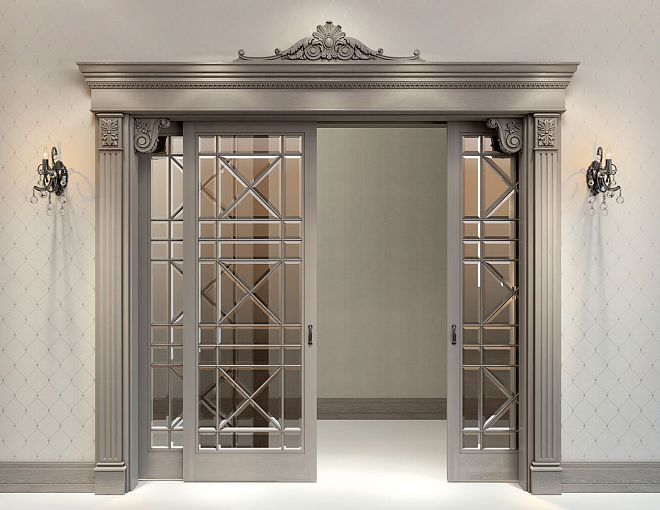
- With doors and architraves
- Comparison table: oak vs. beech for baseboards
- Where to buy wooden floor baseboards in Moscow
- Common mistakes when choosing
- Too low profile
- Wood species error
- Incorrect color relative to floor and doors
- Lack of connection with the rest of the wooden decor
- Conclusion
- About the Company STAVROS
- Frequently Asked Questions

There are interior details that don't catch the eye immediately—but they are precisely what define the final impression of a space. Wooden floor baseboards are one such element. They are not an 'add-on' or a 'technical necessity.' They are a horizontal line that runs along the entire perimeter of a room, quietly yet confidently setting the character of the interior.
Natural wood at the base of walls is a living texture where everything else is often an imitation. It offers warmth, density, and durability that neither MDF nor PVC can convey. It is a material that can be renewed over the years—it can be sanded again, repainted, or have its finish changed. Wooden baseboards age beautifully rather than deteriorate.
If you're currently looking for whereto buy wooden floor skirting in Moscowwith a precise understanding of selection — by wood species, height, profile, floor covering, and interior style — this material is written specifically for you. No fluff, no abstract advice. Only specifics that help make the right decision.



Wooden Floor Skirting in Moscow: Why It's a Strong Interior Solution
Let's be honest: the Moscow skirting market is oversaturated. Plastic, MDF, polystyrene, phytopolymer — all of this is available at any hardware store for minimal prices. So why choose solid wood skirting specifically?
Because solid wood isn't just a material. It's a biologically complex substance with a unique structure that nature has been forming for decades. Each plank of oak or beech carries its own unique grain pattern — no printed film can reproduce it with the same conviction. Wooden skirting at the floor creates an authenticity effect that's perceived even by those who don't understand materials.
The second argument: durability. Oak skirting, with proper use, lasts for decades without losing its shape. It can be sanded and repainted when changing the interior — and it looks like new. Plastic or MDF skirting doesn't allow for that.
Third:with a classic profile creates a sense of solidity, reliability.it's an investment in the feel of the interior, not just a functional addition. Next to oak parquet, engineered wood flooring, or wooden doors — skirting made from the same material creates a cohesive look that can't be bought in a plastic version.
Moscow is a city where very different apartments coexist: Stalin-era buildings with 3.5-meter ceilings, 1970s panel houses, business-class new builds. In each of these contexts, wooden skirting finds its place — you just need to correctly select the wood species, height, and profile.




What wooden floor skirting boards can be bought in Moscow
The range of wooden skirting boards in Moscow today is not just one or two items. It is a full-fledged line by wood species, profiles, and heights. Let's break down the actual categories that are worth considering.
Our factory also produces:
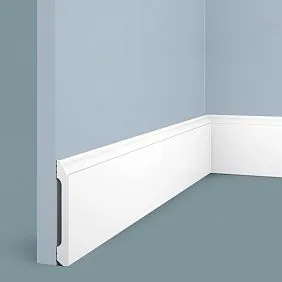
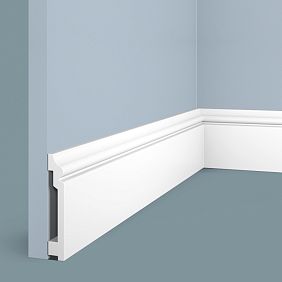
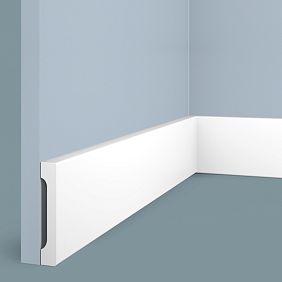
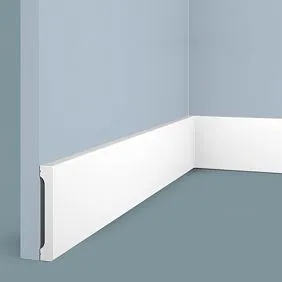
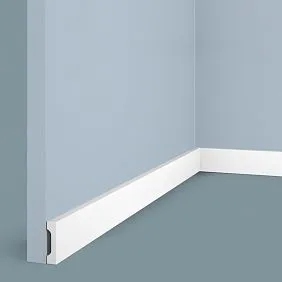
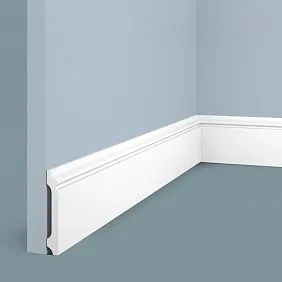

Oak skirting boards
Oak is the benchmark among wood species for floor skirting. Its hardness on the Janka scale is one of the highest among domestic and European species. The structure is dense, with an expressive vascular pattern and characteristic 'rays' on the radial cut. The shade varies from light golden to rich brown depending on the tinting.
Oak skirting holds its shape much more stably under humidity fluctuations than softer species. It is resistant to mechanical impacts, does not chip with careful installation, and maintains its geometry throughout its service life.
Buying oak skirting in Moscow is the right choice for prestigious interiors, for rooms with oak parquet or engineered oak flooring, and for those who choose skirting 'for life' without compromises.
Get Consultation
Beech skirting boards
Beech is a light-colored wood with a fine, uniform texture and a pleasant creamy-pinkish hue. In hardness, it is comparable to oak, but visually much softer. It is this softness of tone that makes beech skirting ideal for light interiors: Scandinavian, minimalist, neoclassical in light shades.
Buying beech skirting in Moscow is the right choice when the flooring is light (ash, maple, light oak, whitewashed oak), and the overall interior is built on natural, airy tones. Beech alongside such a base creates a unity that oak in a dark tint would disrupt.
Important: beech is slightly more sensitive to humidity fluctuations than oak. Under normal operating conditions, this is insignificant, but in rooms with an unstable microclimate, oak is preferable.
Modern wooden profiles
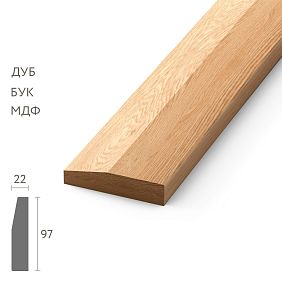
A separate category —modern wooden skirting boardswith a straight rectangular profile without decorative transitions. This is natural wood in a concise modern cross-section: a clean straight line at the floor, minimalism without loss of materiality.
Such a skirting board is chosen for interiors where the design is built on space, light, and texture—not on decorative details. Next to slatted panels, with smooth painted walls, with parquet in a light matte tint—the modern wooden skirting board looks organic and convincing.
To buy a modern wooden skirting board means to choose solid wood without stylistic overload. This is not a compromise between wood and minimalism, but their natural synthesis.
Classical wooden profiles
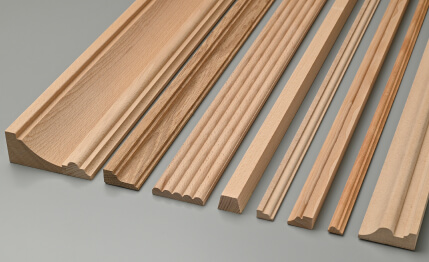
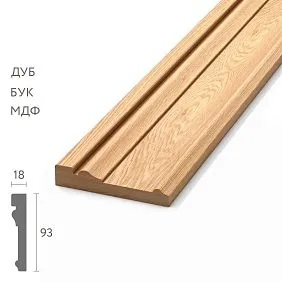
A classic shaped profile—a skirting board with a bead, a step, a relief transition from wall to floor. This is a traditional wooden skirting board that has set the standard for decades in classical, neoclassical, and traditional interiors.
Next to shaped architraves, with wall moldings, with stucco cornices under the ceiling—the classic wooden skirting board completes the architectural system of the room. Without it, this system is incomplete.
Baseboards made of solid oak and beech—classical and modern—are presented in a full range: all heights, both profiles, both wood species.
How to choose a wooden skirting board by wood species
The question 'oak or beech?' is one of the first to arise when choosing a solid wood skirting board. The answer is not as simple as it seems. It's not just a matter of price or availability—it's a question of visual and technical compatibility with a specific interior.
When is oak best
Choose oak when:
-
The flooring is in a warm tone—oak parquet, engineered board with an amber or brownish tint, dark laminate under walnut or wenge.
-
The interior is built on warm natural tones: ochre, terracotta, warm beige, ivory.
-
Doors are wooden or with oak veneer—a skirting board made from the same species continues the theme organically.
-
The room is formal: living room, study, dining room—where the material's weightiness is important.
-
Operating conditions are active: an entrance hall with heavy traffic, a study with regular furniture movement.
Oak will withstand all of this without losing its shape and appearance.
When is beech best
Beech wins where a lightness of tone is needed:
-
Light flooring—ash, maple, whitewashed oak, light laminate.
-
Scandinavian, Japanese, light modern interior.
-
Walls are white, cream, light gray.
-
A uniform texture without a pronounced pattern is needed — beech provides a more neutral surface that holds paint well.
Beech baseboard for painting in white is the perfect solution for modern apartments where a white horizontal line at the floor with the texture of natural wood is needed.
What to choose for an apartment
For a city apartment, both options work — it's important to start from the specific floor covering and doors. If the apartment is entirely decorated in a warm palette with pronounced wooden decor — oak. If the interior is light, neutral, minimalist — beech.
Universal advice: take a sample of the baseboard and place it against your floor covering and door trim in daylight. Visual match in natural light is the only reliable criterion.
What to choose for a house
In a country house, oak is more commonly used — both practically and aesthetically. Houses have more area, higher ceilings, and more active use. Solid oak baseboard withstands loads for decades and looks organic in the context of wood, stone, and natural materials, which are traditional for country interiors.
Buying a wooden baseboard for a house made of oak means making a choice once and not returning to it during the next renovation.
How to choose a wooden skirting board by height and profile
Skirting board height is a decision that is immediately visible and cannot be corrected without complete replacement. A mistake here costs time and money. Let's honestly break down each option.
60–70 mm for compact spaces
A narrow wooden skirting board 60–70 mm is for rooms with ceilings up to 2.6–2.7 meters, for small rooms and corridors, for bathrooms and toilets where it is important not to 'overload' the space.
Buying a narrow wooden floor skirting board is a conscious choice in favor of restraint. It covers the gap at the skirting board, protects the base of the wall, but does not occupy visual space. In a small bedroom of 12–14 sq. m, a narrow skirting board preserves the feeling of ceiling height.
Technical limitation: 60 mm covers the standard expansion gap (8–10 mm) of floating floor coverings with a margin. For non-standard gaps up to 15 mm, a wider profile is needed.
80 mm as a universal option
80 mm is the gold standard of the Moscow market. This is a height that works equally well in most apartment rooms with ceilings of 2.6–2.9 meters. Noticeable enough to be an architectural accent, yet not creating heaviness at the lower part of the wall.
A wide wooden skirting board 80 mm is the best-selling format. It is chosen for living rooms, bedrooms, studies, open-plan layouts. A straight 80 mm profile in an oak-toned finish next to parquet is one of the most foolproof interior solutions.
100–120 mm for prestigious interiors
A tall wooden skirting board 100–120 mm — for rooms with ceilings from 2.9–3.0 meters and above. In Stalin-era buildings, pre-revolutionary apartments, houses with historical ceilings of 3.2–3.5 meters — a tall skirting board is not a luxury, but a norm of proportions.
Buying a tall solid oak wooden skirting board means creating a substantial architectural line at the floor that holds the scale of the room. Paired with cornices, moldings, and shaped architraves — this is a classic architectural system that transforms a room from simply 'large' to truly representative.
Rule of proportions: the height of the skirting board should be about 1/30–1/35 of the room's height. With a 3-meter ceiling — the optimum is 85–100 mm. With a 3.3-meter ceiling — 100–110 mm.
Straight profile
A rectangular profile without relief — the language of modernity. A clean cross-section, without transitions or beads, in solid oak or beech. This is a skirting board that knows how to be inconspicuous where space is more important, while simultaneously creating a clear horizontal line at the floor.
Buy a straight wooden skirting board — for Scandinavian, minimalist, contemporary, and modern interiors, where decorative details are deliberately minimized.
Shaped profile
A shaped profile — a classic wooden skirting board with relief. A bead along the top edge, possibly an additional step, a pronounced transition from the wall plane to the floor plane. This is an element of the room's architectural decor, not just a technical addition.
Buy a shaped wooden floor skirting board — for classic, neoclassical, and traditional interiors, where architectural details are the semantic center, not decoration. A shaped skirting board loses half its power without coordinated architraves and moldings: consider it as part of a system, not as a separate element.
Full range — heights, profiles, wood species — in the catalogwooden and MDF skirting boards.
How to choose a wooden skirting board to match the floor covering
The floor covering sets the main visual tone of the room. The skirting board should either continue this theme or create a deliberate contrast — but in no case should it accidentally conflict with it.
Under parquet
Oak parquet is a straightforward instruction: a wooden skirting board made from the same species. The visual logic is impeccable: two natural elements, processed in a similar way, create a material rhyme. A skirting board slightly darker than the floor or matching in tone—both solutions work.
Buying a wooden skirting board for oak parquet in the same tint as the flooring is the 'matching the floor tone' option. A skirting board one tone darker is an 'architectural accent.' Both are appropriate. The main thing: avoid a situation where the skirting board is significantly lighter than the parquet—this destroys the feeling of a continued wood texture.
For engineered board
Engineered board is a multi-layer product with a natural veneer on the face surface. Visually, it is close to parquet, although technically more stable. The principle for selecting a skirting board is the same: matching the veneer tone or slightly darker.
Buying a solid wood skirting board for engineered board is correct. Veneer and solid wood of the same species look organic. If the engineered board is ash, consider beech skirting board as a lighter, close-toned alternative.
An important nuance: engineered board is often sold in 'non-standard' shades—smoked oak, grey oak, stained. In this case, a skirting board for painting in a neutral or coordinated color is sometimes a more precise solution than trying to find a skirting board in a specific exotic tone.
Under laminate
Laminate is a floating floor covering with a mandatory 8–10 mm expansion gap at the walls. The skirting board is attached only to the wall, not touching the laminate. This technical point is more important than any aesthetic choice: a blocked gap leads to floor swelling within a few months.
Buying a solid wood skirting board for laminate is for when the laminate has a wood texture and you want to elevate the perceived quality of the floor. Next to expensive parquet-look laminate, a wooden skirting board makes the result significantly more convincing than a plastic one.
For laminate with non-standard decors (grey, white, concrete)—a wooden skirting board for painting in white or a neutral color: this is a more practical solution than searching for a skirting board 'to match grey laminate'.
For wooden flooring
Solid wood board and wooden skirting board—this combination existed in Russian and European interiors long before the advent of laminates and quartz vinyl. A natural wood floor made of boards plus a skirting board from the same or similar wood—this is an interior without compromises.
For a wooden board floor, choose a skirting board from the same or a similar species: pine with pine, oak with oak. Or a contrasting accent: a light floor with a dark oak skirting board. This is a designer technique that works when there is a concept.
Wooden skirting boards for floors— the range of profiles, application scenarios, and combinations with the interior are analyzed separately and in detail.
How to choose a wooden skirting board to match the interior style
The interior style sets not only the aesthetics but also the functional expectations: what the degree of decorativeness should be, how expressive the details can be, whether the skirting board should attract attention or blend into the background.
For classic style
A classic interior is an architectural system with all its attributes: stucco, cornices, moldings, shaped architraves, patterned parquet. In this system, the skirting board must correspond: a shaped profile, expressive relief, height of at least 80–100 mm.
A wooden skirting board for classic style is solid oak with a shaped profile, tinted to warm walnut or golden oak, in harmony with the other wooden elements of the interior. It should be part of the system: there is no point in choosing it separately from moldings and cornices.
For neoclassical style
Neoclassicism is classicism reinterpreted in a modern context. Less stucco, cleaner surfaces, but architectural details are present and important. Here, a skirting board of 80–100 mm with a moderate profile—straight or with a slight bevel—made of oak in a restrained tint.
In neoclassicism, the wooden skirting board works in tandem withwooden moldings and cornices— but the system is less saturated than in full classicism. More space, fewer details, but each detail is precise.
For a modern interior
Modern interior—contemporary, loft, eclecticism with a minimalist base—welcomes wooden skirting boards as an element of texture in a neutral space. Straight profile, height 70–80 mm, natural tint or white paint.
To buy a modern wooden skirting board made of solid wood means to bring a living texture to where everything else is smooth and neutral. It is a detail that catches the eye and adds warmth to the space.
For minimalism
Minimalism is the most demanding style when it comes to details: there is not a single superfluous element, so each one must be perfect. A wooden skirting board in minimalism is a straight profile with the cleanest possible section, a neutral or coordinated tint, and a height strictly proportional to the room.
In minimalism, a wooden skirting board is chosen not to 'match the floor' or 'match the doors', but to 'match the space as a whole'. If the interior is white — the skirting board is white or light. If the interior is based on the texture of natural wood — the skirting board is of the same wood, but without relief.
How to choose a wooden skirting board for a room
The room dictates the conditions: the load on the skirting board, visual requirements, type of flooring, desired look.
For the living room
The living room is the main space. Here, the skirting board is visible to everyone and always. It is here that a solid wood skirting board reveals itself fully: its texture is examined up close, its quality is felt through tactile contact, its proportions work for the overall look.
For the living room: oak, 80–100 mm, profile depending on the style. Next to oak parquet — a skirting board of the same species in a coordinated tint. Next to laminate flooring in light ash — a beech skirting board or oak in a light tint.
Buying a wooden skirting board for the living room is a purchase with a view to the years ahead. The living room changes the least often: furniture is updated, wallpaper is repasted, but the skirting board remains. Choose with a horizon of 10–15 years.
For the bedroom
In the bedroom, the skirting board works in silence. It should not attract attention — only softly complete the space. A wooden skirting board made of beech or oak in a neutral tint, 60–80 mm, straight profile — perfect.
In a bedroom with oak parquet, a skirting board made of the same wood creates a sense of material unity, which has a relaxing effect: everything is coordinated, nothing conflicts.
For the hallway
The hallway is the most heavily used area in an apartment. Regular impacts, intensive cleaning, high traffic. For the hallway, you need the densest solid wood — oak. Beech skirting also works here, but with very active use, oak is more reliable.
Buying a wooden skirting board for the hallway made of oak with a high-quality lacquer coating is a solution for 15–20 years without the need for repair. Height 70–80 mm. A straight profile is easier to clean.
For apartments
When furnishing an entire apartment, the principle of unity works to its full potential.Buy wooden skirting board for apartment— means determining one profile, one height, and one wood species for all dry rooms: living room, bedroom, study, children's room, corridor. For the kitchen and bathrooms — a moisture-resistant version of the same profile.
For a country house
In a country house, a solid wood skirting board is in its natural environment. Wood, stone, brick — natural materials that set the tone for a country interior. A solid oak skirting board in a house is not a pretension, but an organic continuation of the material theme.
It's worth buying a wooden skirting board for a house with a height reserve: in country houses, ceilings are often 2.9–3.0 meters and higher. Here, 100 mm looks proportional, 80 mm — modest, 60 mm — lost.
What to combine wooden skirting board with in the interior
A wooden skirting board, taken in isolation, is an element without context. Its strength is fully revealed only within a system of architectural decor.
With wooden moldings
Moldings are horizontal and vertical wall profiles that form frames, belts, and niches. They work in tandem with the baseboard: the baseboard covers the lower contour, moldings cover the middle. Together, they create a vertical architectural narrative for the room.
Wooden moldings and cornicesSTAVROS are designed in proportional harmony with baseboards. By choosing from one collection, you get a guaranteed coordinated system without needing to match proportions yourself.
With wooden cornices
A wooden cornice under the ceiling completes the system from above. The baseboard at the floor—from below. Between them—the wall or molding. This is a full architectural shell of the room made of natural wood. In classic interiors—essential. In modern ones—optional, but always expressive.
With slatted panels
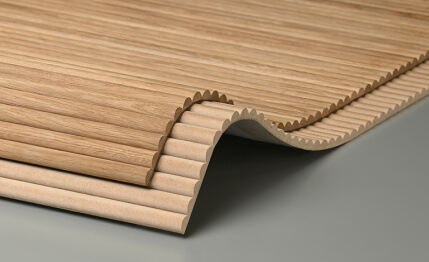
Rafter panelsOn walls—this is a vertical texture created by a row of wooden slats with equal spacing. The lower reference point for the slat panel is the baseboard: the slats start from it and go upward. The baseboard and slat panel from one system create a vertical wooden accent from the floor to any chosen height.
Alongside parquet below, slat panels on the wall, and a wooden cornice under the ceiling—a solid wood baseboard becomes part of an interior with a cohesive, authorial touch.
With doors and architraves
A wooden baseboard paired with wooden architraves is a system that works in every doorway: the vertical slats of the architraves and the horizontal line of the baseboard meet in the corner and create a corner accent.
For maximum unity: baseboard, architraves, and woodenbaseboards and stripsshould be of the same wood species and profile.
Comparison table: oak vs. beech for baseboard
| Characteristic | Oak | Beech |
|---|---|---|
| Hardness | Very High | High |
| Stability at humidity | High | Medium |
| Color | Warm golden-brown | Creamy-pink light |
| Texture pattern | Pronounced, vascular | Thin, uniform |
| Suitable for | Warm tones, oak, walnut | Light tones, ash, maple |
| For painting | Good | Excellent |
| Application | Any spaces | Dry light rooms |
Where to buy wooden floor skirting in Moscow
A practical question that solves everything. Let's break down the criteria that really matter when choosing a supplier in Moscow.
In stock. Repair won't wait. A reliable supplier keeps the full range of wooden skirting boards at a Moscow warehouse: oak, beech, all heights, both profiles. Pickup today or delivery tomorrow is the standard, not an exception.
Choice by wood species. You should be able to hold samples of oak and beech next to your flooring and door frames. A monitor doesn't convey color or texture. A showroom with physical samples is essential for accurate selection.
Choice by height. The 60/70/80/100/120 mm range should be fully available. Only by comparing samples of different heights in the space can you make an accurate decision.
Delivery in Moscow. Planks 2400–2800 mm long are inconvenient to transport yourself. Professional delivery with careful packaging is standard. Check availability and timelines in advance.
Go to catalog. For preliminary review of the assortment:Baseboards made of solid oak and beech— all items with specifications are available online. Get a complete overview of the product line before visiting the showroom.
Common mistakes when choosing
Profile too low
They choose 60 mm 'for modesty' — and end up with a skirting board that visually disappears in a living room with 2.8-meter ceilings. Or one that barely covers the actual gap of the flooring.
Solution: measure the actual gap between the flooring and the wall before purchase. Assess the proportion relative to the ceiling — 1/30–1/35 of the room's height. Only then choose the height.
Mistake in wood species
They take an oak baseboard for a light ash parquet floor—and get a tonal conflict: warm brown next to cool cream. Or a beech baseboard for a dark floor—and lose the sense of unity.
Solution: see samples in person, in daylight, next to the actual flooring. No 'by photo'—color always lies.
Incorrect color relative to the floor and doors
Tonal mismatch between the baseboard and door frames or casings is a common and frustrating mistake. The baseboard and casings meet at every doorway. If they're from different tonal worlds—it's glaring.
Solution: bring a casing sample when choosing a baseboard. Or order a test strip before the main purchase.
Lack of connection with the rest of the wooden decor
They buy a wooden baseboard, but take moldings and cornices from a different system, different profile, different wood species. As a result, each element is good on its own—but they don't work together.
Solution: plan the entire system before the first purchase. Baseboard, moldings, cornices, casings—from one range, one wood species, one style.
Conclusion
A wooden floor baseboard is a choice in favor of a natural material that honestly serves its purpose: it covers the gap, protects the wall base, and creates an architectural line at the floor.
Choose the wood species to match the flooring and tone—oak for warm and rich interiors, beech for light and neutral ones. Determine the height based on the room's proportions—80 mm for most Moscow apartments, 100–120 mm for high ceilings. Choose the profile according to style—straight for modern, shaped for classic.
SeeBaseboards made of solid oak and beech— full range of heights and profiles.modern wooden skirting boards— for laconic interiors without decorative overload. The entire assortment is in the catalogof wooden and MDF skirting boards.
About the company STAVROS
STAVROS is a Russian manufacturer of architectural decor made from natural wood. Specialization: solid oak and beech floor skirting boards, moldings, cornices, architraves, slatted panels, and decorative elements. A separate line is the moisture-resistant HI WOOD profile for areas with high humidity.
All STAVROS products are created as an architectural system: skirting board, molding, cornice, and slatted panel are developed in coordinated proportions and profiles. Production is a full cycle, from sawing solid wood to finishing coating. Warehouse in Moscow, delivery throughout Russia.
STAVROS works with private clients, interior designers, architects, and construction organizations.
Frequently asked questions
Which wooden skirting board is better — oak or beech?
Depends on the tone of the floor covering and the overall color palette of the interior. Oak is for warm tones and dark coverings, beech is for light and neutral ones. Both options are equally high-quality in terms of hardness and durability.
Can a wooden skirting board be used in the kitchen?
In the kitchen area near the sink and stove — not recommended: systematic contact with moisture leads to swelling and deformation. In the kitchen-dining area without direct contact with water — acceptable with a high-quality varnish coating.
How to properly attach a wooden baseboard to a floating floor covering?
Only to the wall — with dowels or liquid nails. The lower edge of the baseboard should not touch the covering, let alone press against it. A 1–2 mm gap between the baseboard and the covering is a mandatory technical requirement.
What height of wooden baseboard to choose for an apartment with 2.7-meter ceilings?
80 mm is optimal for standard Moscow apartments with ceilings of 2.6–2.9 meters. For ceilings of 2.5–2.6 meters and small rooms — 70 mm. For ceilings of 2.9 meters and above — 100 mm.
Is it necessary to paint a wooden baseboard after installation?
Not necessarily — if the baseboard comes with a varnish or oil finish. A baseboard intended for painting is primed and painted after installation in the chosen color. After filling the joints with acrylic sealant, the baseboard can be painted along with the walls.
How to calculate the amount of wooden skirting board for a room?
Room perimeter minus the width of all door openings. Add 10–15% for trimming in corners. Divide by the length of a standard plank (2400 mm). Round up to the nearest whole number.
Can a wooden oak baseboard be combined with white walls?
This is one of the most advantageous options for modern interiors: a warm oak baseboard against a white wall creates a striking natural accent. Works in Scandinavian, contemporary, and light classic interiors.