








































Article Contents:
- What is a Wooden Window Casing and Why is it Needed
- Why wooden window casing is a good choice
- Types of Wooden Window Casings
- Smooth Wooden Casings
- Decorative Wooden Casings
- Carved Wooden Casings
- Casings for Painting and Tinting
- How to Choose a Wooden Window Casing
- By House Style
- By Shape and Profile
- By width
- By finish
- Which wooden window casing to choose for different objects
- For a wooden house
- For a dacha
- For a modern cottage
- What is better for a window: wood, MDF or other materials
- What to combine wooden window casing with
- Technical parameters: what you need to know before ordering
- Installation of wooden window casings: basic principles
- Comparison table: wooden window casing by house type
- What affects the price of wooden window casing
- Where to buy wooden window casing
- Conclusion
- FAQ: Answers to Popular Questions
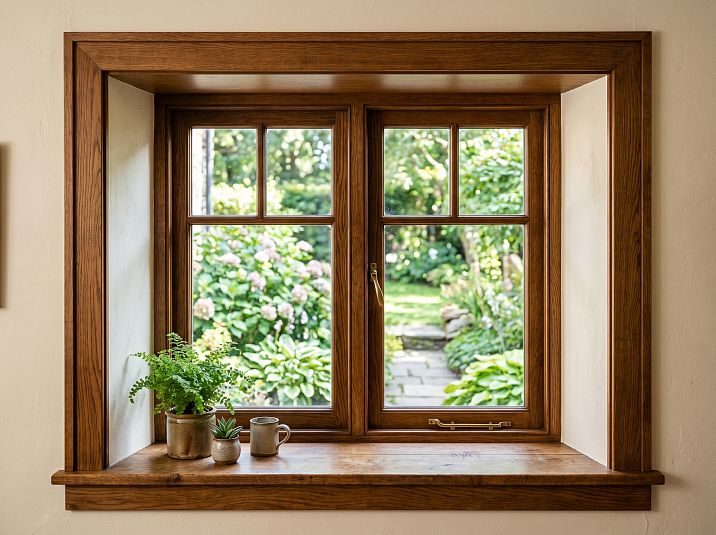
A window is not just a hole in the wall. It is the intonation of the facade. Its character, its voice. And as long as only a frame is inserted into this opening, the voice is mute. A wooden window casing is what gives the facade speech. The framing that turns a technical opening into an architectural element worthy of a glance.
Why wood specifically? Not plastic, not MDF, not aluminum — wood. The answer is surprisingly simple: because it is the only material that carries time within it. Annual rings, the texture of the cut, the living heterogeneity of the grain — all this creates a sense of authenticity that no substitute reproduces.wooden window trim— is the choice of those who understand the difference between an imitation and an original.
But choosing it as an isolated element is a mistake. The casing works within a system. It responds to the facade, echoes the cornice, rhymes with the style of the house. Without this context, even the most beautiful casing is just a strip. With it — an architectural statement.


What is a wooden window casing and why is it needed
Let's start with the basics — because 'casing' is understood differently in common usage, and this creates confusion when choosing.
Covers the joint and finishes the opening. In a construction sense, a wooden window casing is a profiled strip that is mounted around the perimeter of a window opening from the outside or inside, covering the mounting seam between the frame and the wall. This seam is inevitable: no installation is possible without a gap. The casing covers it.
Makes the window visually complete. Without framing, a window opening looks unfinished — like a sentence without a period. The eye stops at the seam, at the not-quite-even joint, at the transition of materials. A wooden casing removes this discomfort: the opening acquires a clear frame, a defined contour, a confident silhouette.
Enhances the architecture of the facade. A house with properly chosen wooden casings looks smarter, richer, and more thoughtful. Not because the casing is expensive — but because it places accents, establishes a hierarchy of surfaces, gives the facade rhythm.
Helps assemble the window into a single composition. A window opening is not just a frame. It includes the reveals, the windowsill, the wall surface around it. A wooden casing unifies all of this into a single visual object. Especially — when it is complemented bywooden cornicesand elements of house carving.




Why a Wooden Window Casing is a Smart Choice
There are arguments that seem self-evident but are worth stating outright—if only because wood's competitors in the market are actively promoting their positions.
Natural material. Wood is not an artificial environment. It is a natural object with its own history. A solid pine or oak wooden window casing not only serves a decorative function—it carries ecological neutrality: it does not emit volatile compounds, does not change the air composition around it, and does not react to ultraviolet light the way plastic does.
Living texture. The texture of natural wood is something the hand feels even without touching. The eye 'reads' the depth of the grain, the warmth of the tone, the relief of the surface. This is impossible to reproduce in MDF or PVC—no matter how many thin films are applied to it.
Premium appearance. The word 'premium' here is not about price, but about perception. A house with wooden casings gives an impression of quality construction even in cases where the budget was moderate. This is one of those elements that changes the overall perception more significantly than its cost in the estimate.
Suitable for any type of property. A wooden window casing for a house, dacha, cottage, sauna, gazebo—it is appropriate anywhere where wood is a primary or accompanying material. And even where it is not: a solid wood casing on a brick facade with wooden frames is an absolutely organic solution.
Wide range of finishing options. Paint, stain, coat with oil, wax, antiseptic—a wooden window casing for painting, for oil, or for staining accepts any finishing option and yields a different, but always expressive, result. This is not a limitation—it is freedom.
Our factory also produces:


What types of wooden window casings are there
Classification is not for theory's sake—it's for making concrete choices. Four main categories, each with its own logic of application.
Get Consultation
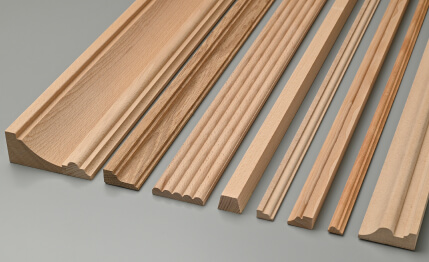
Smooth wooden architraves
Rectangular cross-section, minimal relief, flat front surface. This is the most calm and universal type—a wooden casing that does not aspire to be the main character of the facade but performs its job exemplarily.
For which properties:
-
Modern homes with minimalist architecture
-
Facades with already rich decor, where the casing should complement, not compete
-
Scandinavian style — where purity of form is more important than ornament
-
Neutral solutions for those who haven't yet decided on the character of the design
The advantage of smooth wooden casing is its scalability. It looks equally appropriate on a small cottage window and on a panoramic opening of a modern house. The right width and well-applied finish — and even a simple plank becomes an accent.
Decorative wooden architraves
Profile with multiple transitions, expressive relief, accent geometric elements. This isn't just a 'beveled plank' — it's a thoughtful form with architectural logic.
Decorative wooden window casing fits where the facade should have character. Classic, neoclassical, historical architecture, rich wooden houses with developed facade programs. Here the profile works as ornamentation: creates shadows, establishes surface hierarchy, adds depth to a flat facade.
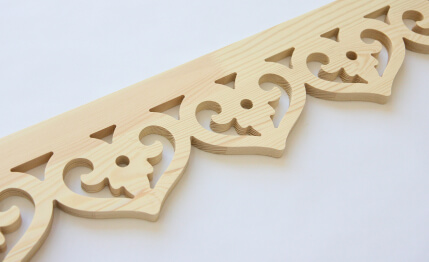
Carved wooden window trims
This is the highest category of window framing — both in visual impact and execution complexity.carved wooden casings— is ornamentation carved from solid wood: floral patterns, geometric motifs, folk symbols, kokoshnik-style finials.
For which properties:
-
Wooden house in Russian style — here carved casing isn't just appropriate, it's essential
-
A traditional dacha with character — carving restores its authentic 'village' elegance
-
An accent facade with a well-thought-out decorative program
-
Houses whereHouse Carving is applied systematically: cornices, bargeboards, brackets, window trims — a unified ornamental language
The article oncarving for window trims details the nuances of selecting carvings for window framing — it analyzes types of ornaments and their compatibility with house styles.
Trims for painting and tinting
This is not a separate type by construction, but by readiness for finishing. An unpainted wooden window trim — a sanded solid wood surface that accepts any color. The main advantage: complete freedom in color selection.
When this is important:
-
If an exact match with the window frame color is needed (especially relevant for white wooden frames)
-
If the facade is to be repainted, the casing is painted along with it.
-
If the project uses a non-standard color not available in the factory range.
Toning to resemble oak, ash, walnut — natural wood texture with emphasized grain pattern. This is visually richer than solid-color paint but requires more careful application.
How to choose a wooden window trim
Theory is good. But the choice always happens under specific conditions: a specific house, specific windows, a specific budget and style. Let's break it down by each parameter.
By house style
Wooden house (log house, log). Only a wooden casing is organic here — and it should be textured or carved. The log is large, massive; the casing must match the scale. A narrow, smooth casing on a massive log house looks unserious. An expressive profile or ornament is needed — something that holds this scale.
Dacha (country house). At a dacha, there are fewer architectural obligations and more freedom. A wooden window casing for a dacha can be decorative, warm in color, with a decorative profile or even simple carving. Expressiveness that would be excessive on a strict cottage is appropriate here.
Cottage. Depending on the architecture: a classic cottage — a wide, shaped casing, possibly with applied corner elements. A modern cottage with laconic geometry — smooth or minimally decorated. The main thing is not to contrast with the building's style.
Modern house. A laconic rectangular profile, solid-color coating, width proportional to the window. Here, wood works precisely as a material — through its tactile honesty, not ornament.
Classical facade. A shaped, multi-step profile, a wide casing from 85 mm, white enamel or toning to resemble light oak. In combination withcornices and casingsFrom the same series — a full-fledged classic system.
By shape and profile
Narrow casing (40–60 mm). For small windows, neutral facades, cases where restraint is needed. The thin profile does not aim to dominate.
Wide casing (90–130 mm). For tall facades, wide openings, classic design. A wide wooden window casing creates architectural weight and a sense of massive, high-quality framing.
Smooth profile. Minimal relief — for modern and neutral solutions.
Figural profile. Several steps, pronounced transitions — for classic and neoclassical styles.
Accent casing. Carved or with applied decorative elements — for cases where the window should become the main decorative accent of the facade.
By width
The width of the casing is selected proportionally to the width of the window opening. The main rule: 8–12% of the window width.
-
Window 600–800 mm → casing 50–70 mm
-
Window 900–1200 mm → casing 75–100 mm
-
Window 1300–1600 mm → casing 100–130 mm
For small windows — moderate width, otherwise the casing will 'eat up' the opening. For tall facades — focus not only on width but also on vertical rhythm: a long side casing requires a repeating ornamental motif or a shaped profile that carries the length.
By finish
Natural untreated wood — maximum eco-friendliness, maximum freedom for subsequent finishing. Requires on-site final treatment — antiseptic, oil, or paint.
Tinting — preserves the living texture of wood, adds color without losing texture. Optimal for wooden houses where the natural expressiveness of the material is important.
Painting white — the most popular solution for classic and modern projects. A wooden window casing for painting white creates contrast with the wall and emphasizes the opening with maximum expressiveness.
Pigmented oil — for a naturalistic result with protective properties. Oil deeply penetrates the fibers, enhances texture, and protects from moisture without a film effect.
Which wooden casing to choose for different projects
Three main types of projects — three different selection strategies.
For a wooden house
A wooden house and a wooden casing — this is material unity. There is no need to choose wood 'in spite of' something. It goes without saying.
What's important:
-
The wood species of the casing does not have to match the wall species, but should be close in density and tone
-
Textured and carved solutions work better than smooth ones — they match the scale of log masonry
-
A carved wooden window casing for a wooden house in Russian style is not just decor, it's a system: it should echo the cornices, eaves, and soffits
Learn more about how trims for windows are selected for a specific style and facade type in the corresponding article.
For a dacha
At the dacha, there's less strictness and more character. Here you can:
-
Choose a warm tint color — ochre, terracotta, dark walnut
-
Use a decorative profile — moderate, without overload
-
Add simple carving in the pediment above the window — it adds elegance to the dacha house without turning it into a 'museum of Russian architecture'
-
Play with contrast: dark walls + white wooden window casings — a winning combination
For a modern cottage
A modern cottage is architecture without unnecessary statements. The conciseness of form is more important than the richness of decor. Here, the wooden window casing is chosen according to the following logic:
-
Smooth or with one or two profile transitions
-
Tinting to light oak or ash — material naturalness as the main argument
-
Moderate width: 65–85 mm for standard openings
-
Precise installation, perfect joints — in a minimalist context any inaccuracy is visible
What is better for a window: wood, MDF or other materials
Honest breakdown — without marketing and without disparaging competitors.
| Parameter | Solid wood | MDF | PVC / plastic |
|---|---|---|---|
| Appearance | Live texture, natural pattern | Smooth surface, no texture | Monotonous, without depth |
| Durability | 30–50 years | 7–12 years | 10–20 years |
| Repairability | High — sanding, repainting | Zero | Zero |
| Painting | Any number of times | 1–2 times | Impossible (or special paint) |
| Ecological | High | Medium (glue, resins) | Low (plasticizers) |
| Moisture resistance | Medium (requires processing) | Low | High |
| Application | Any long-term project | Budget renovation | Ready-made plastic systems |
When wood wins unconditionally. A wooden house, a country cottage, an object with historical or stylistic context, any project with a planning horizon of more than 10 years. Wood is the only material that gains character with age, rather than losing it.
When naturalness is precisely what matters. A children's room, bedroom, any space with high environmental requirements — only solid wood. MDF contains formaldehyde resins, plastic contains plasticizers. Uncoated wood is an inert natural material.
Visual effect and facade expressiveness. No substitute reproduces what natural wood does to the perception of a facade. The depth of the grain, warmth of tone, slight surface irregularity — all this creates a sense of authenticity and quality that is intuitively perceived, without analysis.
What to combine a wooden window casing with
A wooden window surround does not exist in isolation. Its surroundings are what determine the final impression.
Cornices.Cornices and window surrounds— horizontal and vertical elements of a unified system. The wooden cornice above the window supports the surround, establishing the horizontal rhythm of the facade. Their ornaments must be coordinated: similar profile shaping, one scale, one series.
Molding.Wooden moldingsin the interior — horizontal and vertical profile elements that create paneled wall decor. Externally, moldings are used for horizontal belts between floors, rustication of corners, and decorative frames. The window surround must belong to the same stylistic family: a similar profile, the same finish.
House carving as a system. If the window surround is carved, the entire facade must speak the same ornamental language.House Carving— this is not a chaotic set of decorative elements, but a unified program: bargeboards, soffits, brackets, and window surrounds are arranged according to a single design. Only then does the facade read as a cohesive architectural text.
Decorative elements. Corner overlays at the junction of the vertical and horizontal slats of the window surround, rosettes, ornamental inserts — small details that radically elevate the class of the framing. You can view options in the section carved casings.
Facade compositions. A wooden window surround is part of a broader architectural story. When window surrounds, cornices, and carved elements are subordinated to a single idea — the facade ceases to be a wall surface and becomes a statement about who lives in this house.
Technical parameters: what you need to know before ordering
Practical information that answers questions when placing an order.
Standard length. Most wooden window surrounds are produced in lengths of 2000–2200 mm. This is sufficient for most window openings when cut on-site. Non-standard length — the option to order to size.
Standard width. 60, 70, 80, 90, 100, 110 mm — a range covering most applications. Wide wooden architrave (110–130 mm) — a separate option for tall facades and classic designs.
Thickness. 12–18 mm — the working range for facade applications. 18 mm — the optimum for exterior installation: sufficient rigidity with low weight.
Wood species. Pine — the base material, lightweight and easy to work with. Larch — for exterior use in humid climates: its resin content provides natural rot resistance. Oak — for interiors and for those seeking maximum density and durability.
Surface. Unfinished (for on-site finishing) — the standard for most wooden architraves. This is not a limitation, but the correct approach: you determine the color yourself, independent of factory palettes.
Installation of wooden window architraves: basic principles
Professional installation is not magic, but a sequence. Several principles that determine the result.
Pre-installation treatment. This is the most important rule, most often violated. The back side of the architrave and all end cuts — apply antiseptic before fixing to the wall. After installation, access to these areas is blocked. The end cut is the most moisture-absorbing part of the strip. Without treatment — decay starts precisely here.
Fastening. To a wooden wall — finish nails or screws. To a masonry or plastered wall — dowels + construction adhesive. Fasteners — only in neutral zones, not in the ornament area. Heads are countersunk and filled.
Angle cuts. The vertical and horizontal architraves join at a 45° angle. Cutting precision is critically important. A poor angle is visible even through several layers of paint. The cut is made on a miter saw with a 45° stop — this is the only way.
Wall gap. A minimal technical gap (1–2 mm) between the back of the architrave and the wall — for ventilation. Tight contact without ventilation accelerates moisture buildup and, consequently, decay.
Final painting. After installation and puttying — a final coat of paint or oil. Special attention — the lower ends of the side planks that receive rainwater. These are the most vulnerable points — an additional layer here is mandatory.
Comparison table: wooden architraves by house type
| Type of house | Recommended Type | Width | Finish | Features |
|---|---|---|---|---|
| Log cabin | Carved / Textured | 100–130 mm | Toning / Painting | Ornament in Russian style |
| Glued laminated timber | Decorative / Smooth | 80–100 mm | Oil / Toning | Unified series with cornices |
| Dacha | Decorative / Carved | 70–100 mm | Painting in color | Bright finishing possible |
| Cottage Classic | Figural wide | 90–120 mm | White enamel | With corner overlays |
| Modern house | Smooth / laconic | 65–85 mm | Tinting / Oil | Minimal profile |
| Russian style | Carved with kokoshnik | 110–130 mm | White / ocher | House carving system |
What affects the price of a wooden window casing
A question that arises for everyone who comes to the catalog with a budget.
Material. This is the main cost component. Pine is the base price. Larch adds 40–60%. Oak adds 100–150% to the pine base. With the same profile, the difference in wood species means a difference in cost.
Profile. Simple rectangular — minimal milling time, affordable price. Multi-step shaped — more expensive. Carved ornament — significantly more expensive: this involves CNC milling plus manual finishing of details.
Simple or carved model. A beautiful wooden casing with an ornament costs more than a smooth analog of the same width — and is worth the money. The difference in production time per element can be three to fourfold.
Length and width. Standard length 2000–2200 mm — base price. Custom non-standard length — surcharge. Wide casing — more material and milling time.
Finish. Without coating — base price. Factory tinting, priming, enamel — surcharge to the cost. It is often more cost-effective to buy without coating and paint it yourself — the result is the same, the price is lower.
Ready-made solution or adaptation to the project. Stock items — prompt shipment and fixed price. Manufacturing to a non-standard size or specific drawing — higher in cost, but ensures a perfect fit for the project.
Approximate prices for STAVROS (series of carved casings NL):
-
NL-5: from 2,550 rub. (2000×110×18 mm)
-
NL-1: from 3,130 rub. (2000×110×18 mm)
-
NL-8: from 2,990 rub.
-
NL-14, NL-16: check the catalog for details
Where to buy wooden window casing
The most direct answer is with catalog navigation.
Smooth and decorative wooden casings. The general listing of wooden casings is in the sectionBuy wooden window trims: all models, sizes, prices, filtering by profile and application.
Carved wooden casings. The NL series in the sectionhouse carving— carved models for windows and doors, several types of ornament, standard sizes with the possibility of adaptation to the project.
How to choose a solution for the project. Determine the style of the house → choose the type of profile (smooth / decorative / carved) → select the width according to the proportion of the opening → choose the finish → if necessary, coordinate with related elements (cornices, moldings).
Why it is beneficial to look not at one element, but at a set. Wooden casing in a system with cornices, overlays and connecting elements is an architectural solution. STAVROS produces this entire assortment from one material, in uniform series. By ordering a set from one manufacturer, you guarantee a match in all parameters: material, color, profile, scale of ornament.
Conclusion
Wooden window casing is not a minor detail in the list of finishing works. It is an element that determines how your house is perceived. From the outside — by passers-by, neighbors, guests. From the inside — by the residents themselves.
The right choice is built on three pillars: house style, window proportions, and the logic of the finish. Buying a separate casing 'by eye' means risking the result. Selecting it as part of a system—cornices, moldings, house carving, a unified series—means creating a facade that speaks for itself.
Direct links for selection:
STAVROS Company — a Russian manufacturer of wooden decor and millwork products for facades and interiors. Full production cycle: own chamber drying, CNC milling, geometry control at every stage. Only natural solid wood — pine, oak, beech, larch. Full range: casings, cornices, moldings, baseboards, carved elements of house carving, decorative overlays. They work with individuals and organizations. Delivery across all of Russia. Possibility of manufacturing to non-standard sizes and individual projects.
FAQ: Answers to popular questions
Which wooden window casing to choose for a dacha?
Decorative profile 70–90 mm wide, painted in a warm color or tinted. Can have simple carving at the top — this adds elegance to the cottage facade without excess.
How to choose a wooden window casing based on window width?
Calculate 8–12% of the opening width: window 1000 mm → casing 80–100 mm. For small windows — use the lower end of the range; for wide windows — the upper end.
Wooden window casing — outside or inside?
Depends on the window type and purpose. Outside — for facade finishing and covering the external seam. Inside — for finishing the interior slope. Most often installed on both sides.
Which wooden casing is best for white paint?
Unfinished casing made of pine or MDF. Sanded surface accepts primer and paint well. Paint with the same paint as the window frame — you'll get a perfect match.
How much does a wooden window casing cost?
From 2,550 rubles per piece for carved models of the NL series (STAVROS). Smooth and decorative — depending on profile and width. Prices are indicated without delivery.
How long does a wooden casing last outdoors?
With proper antiseptic treatment and regular renewal of the finish coating (every 3–5 years) — 20–35 years. Larch lasts longer than pine due to natural resins.
Can a wooden window casing be repainted?
Yes, and this is one of the main advantages of wood over MDF. Sanding → primer → paint. The number of repaints is practically unlimited with proper surface preparation.
Where to buy wooden window casings with delivery across Russia?
In the STAVROS catalog — wooden window casings in stock, delivery across Russia. Carved NL models, decorative moldings, cornices — all from one source.